
Recency Bias
Why the last thing we saw, heard or measured tends to outweigh everything that came before it.
Recency Bias
A few more minutes with the scope in place
In the early 1990s, Donald Redelmeier, a physician in Toronto, and the psychologist Daniel Kahneman asked patients undergoing colonoscopy, an uncomfortable examination of the bowel, to rate their pain every sixty seconds. Afterwards, they asked each patient how unpleasant the whole procedure had been. Some procedures lasted four minutes and some more than an hour, but the length barely mattered to how people remembered them. What mattered was the worst moment and, strikingly, the last few minutes. A procedure that ended badly was remembered badly, however short it had been.
So they tried something that sounds almost perverse. In a randomised trial published in 2003, with 682 patients, half had a short extra interval added at the end of the procedure, during which the instrument was left in place without being moved. It was still uncomfortable, but less painful than what came before. Those patients went through more total discomfort than the others. Yet they remembered the procedure as less unpleasant. Redelmeier's interest was practical: people who remember screening as awful may be slower to come back for the next one.
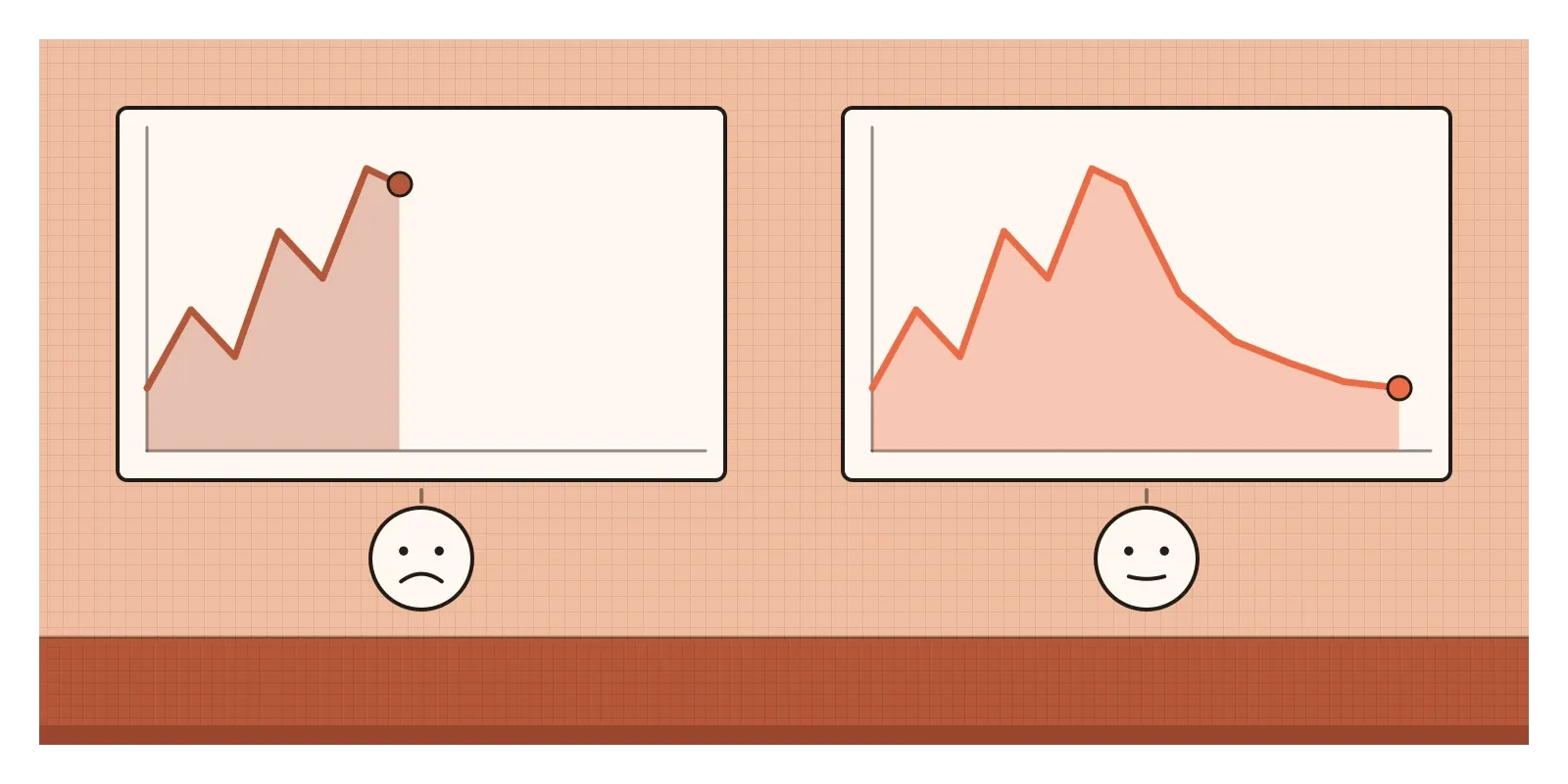
The patients weren't confused. Their memories had simply given the ending far more weight than the middle. The last part of the experience edited the story of the whole.
That's recency bias: giving the most recent information more weight than it deserves, in what we remember and in how we judge. It shows up when a manager writes an annual review from the last month, when a team rewrites a roadmap after one bad week, and when an investor assumes that last year's winners will keep winning. The colonoscopy finding belongs to a close relative, sometimes called the peak-end rule, but the lesson I take from it is about endings. Whatever came last tends to speak loudest.
The last words on the list
Psychologists first measured this in memory. In 1962, Bennet Murdock read people lists of unrelated words and asked them to recall as many as they could, in any order. When he plotted the results by position, he got a U-shaped curve. People remembered the first few words well, which is called the primacy effect, and the last few words even better, which is called the recency effect. The middle sagged. A few years later, Murray Glanzer and Anita Cunitz showed that if people had to count aloud for about thirty seconds before recalling, the advantage of the last words largely disappeared, while the first words stayed. The last items seemed to be sitting in a short-lived store at the front of the mind.
Judgement shows a similar pattern. In 1992, Robin Hogarth and Hillel Einhorn reviewed many studies of how people update their beliefs as evidence arrives. When people evaluate each piece of evidence as it comes in, step by step, later evidence tends to move them more than earlier evidence, especially in long or complicated series. The order of the same facts can change the conclusion.
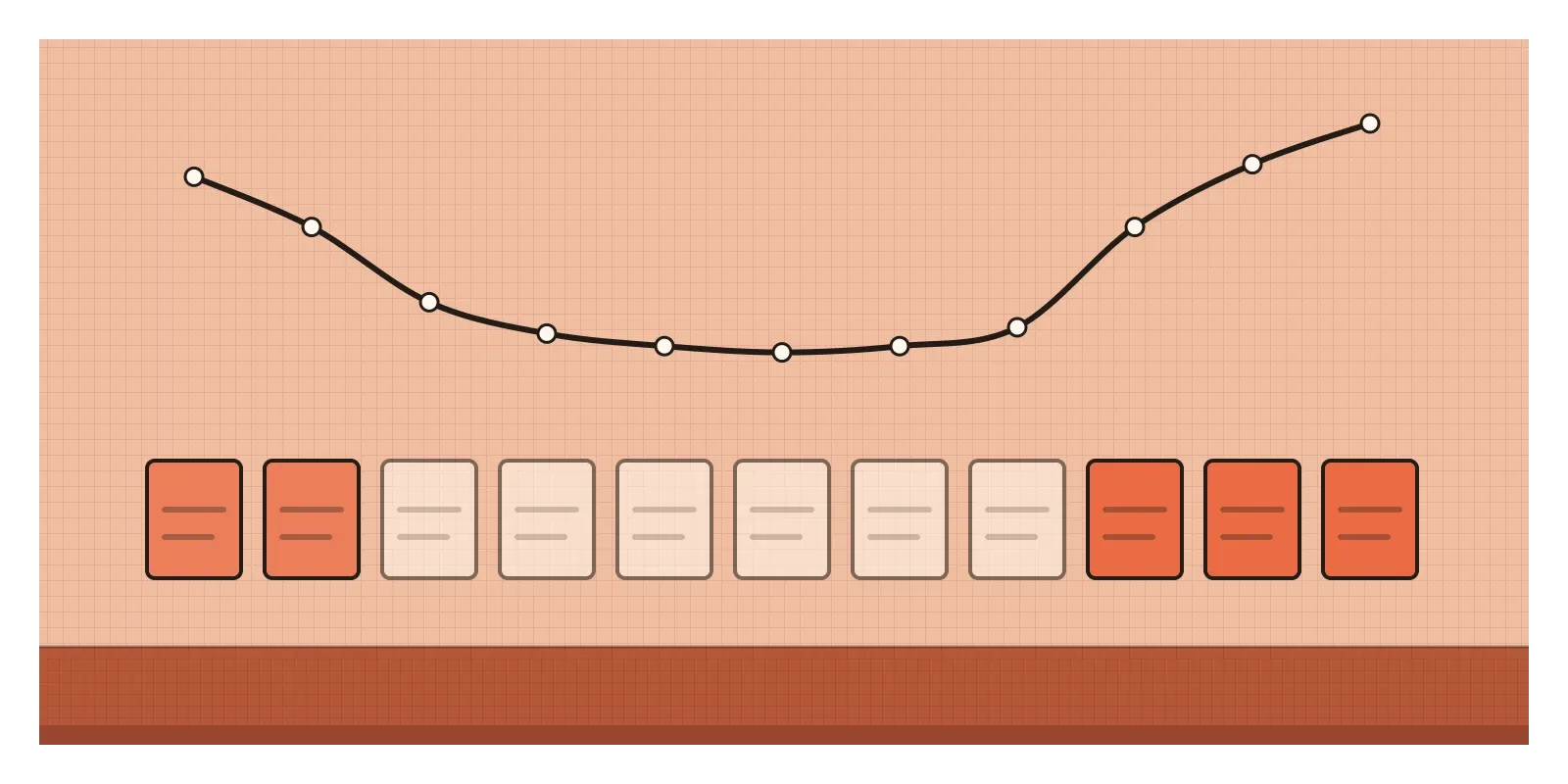
Professional judges aren't immune. In 2005, Wändi Bruine de Bruin analysed scores from the Eurovision Song Contest and from world and European figure skating championships. Performers who appeared later in the running order tended to receive higher scores, and the pattern held whether judges scored everyone at the end or scored each performance straight after it. She pointed out that randomising the order can't remove the effect. It only gives everyone the same chance of a lucky slot.
These findings have held up well. The serial position curve is one of the most repeated results in memory research. The peak-end pattern has been found for pain, unpleasant noise and film clips, though how strongly the end dominates varies from study to study, and some researchers argue it matters most when an experience has a clear shape.
Why the latest feels like the truest
There's a good reason our minds lean this way. The world changes. Last week's weather is a better guide to this week than last year's. The friend's address I learned most recently is the one that's right. For most of human history, the latest information was usually the most relevant, and a mind that weighed it heavily was being sensible, not careless.
Memory adds its own push. The last few things we encountered are still close at hand, vivid and detailed, while older ones have been compressed into a vague summary. It's related to the availability heuristic, the subject of the last post, but it isn't quite the same. Availability is about how easily something comes to mind for any reason. Recency is about position in time: even when we can remember everything perfectly well, we tend to treat the newest piece as the one that counts most, and to assume that whatever just happened is what will keep happening.
That second habit, extending the latest trend into the future, is where recency bias gets expensive.
Insurance after the flood
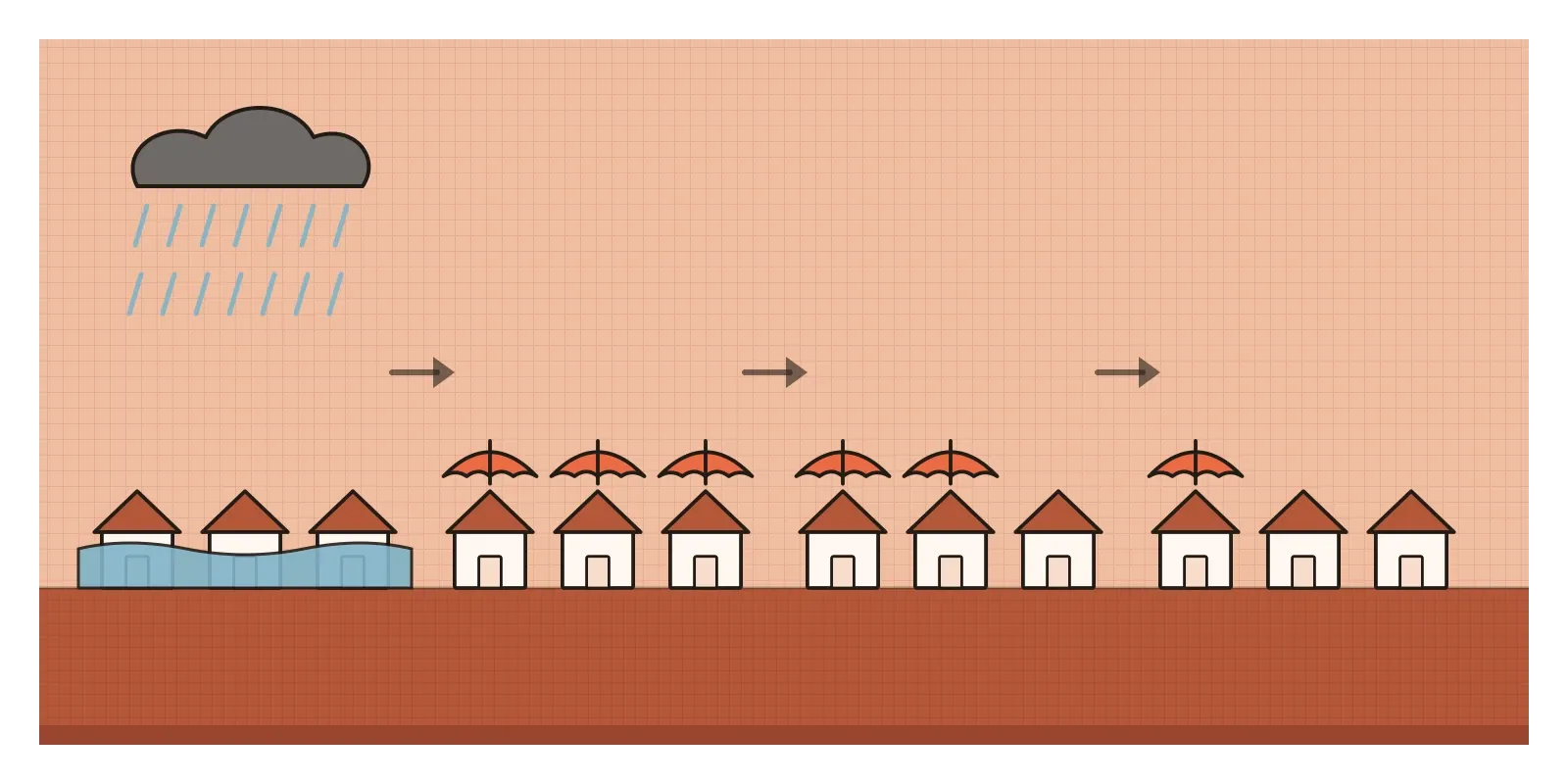
In 2014, the economist Justin Gallagher published a study of flood insurance in the United States. Using decades of data on policies held in communities across the country, he found a clear pattern. In the year after a community was flooded, the number of people holding flood insurance rose sharply. Then, year by year, it drifted back down towards where it had been, even though the risk of the next flood hadn't changed at all. Communities nearby that hadn't flooded, but that watched the coverage on the same local television stations, also bought more insurance, though by less. The model that fitted the data best was one in which people gave recent floods a lot of weight and gradually forgot older ones.
Investing has the same shape. In 1998, Erik Sirri and Peter Tufano showed that money pours disproportionately into the American mutual funds that performed best in the previous year, even though one good year says little about the next. India saw a version of this in 2023, when small-cap shares had a strong run and small-cap mutual funds received unusually large inflows. In February 2024, the market regulator SEBI warned of "froth" in the small- and mid-cap segments. The industry body AMFI asked fund houses to adopt policies to protect investors and, from March, to publish regular stress tests showing how many days each fund would need to sell a quarter or half of its holdings. Several fund houses restricted large fresh investments into their small-cap funds. Nobody can say in advance whether a recent run will continue. The worry was that many new investors were treating the last year as a forecast.
Picture a concept review on a Friday afternoon
Picture a team choosing a direction for a new onboarding flow. Five designers have each prepared a concept, and the review runs from three until five on a Friday. The first concept is presented while everyone is fresh and sceptical, and it collects a long list of questions. By the fourth, people are tired and the discussion is shorter. The fifth concept is shown at a quarter to five. It's clear, it's confident, and it's the one everyone can still picture when the product lead asks, "So, which one?" It wins.
A month later, the same thing happens in a different form. The team synthesises twelve user interviews, and the last two, held the day before, dominate the summary, because they're the ones people can quote. And in the quarterly review, the conversation keeps returning to an outage that happened nine days ago, while a slow, steady rise in support tickets over the whole quarter barely gets a mention.
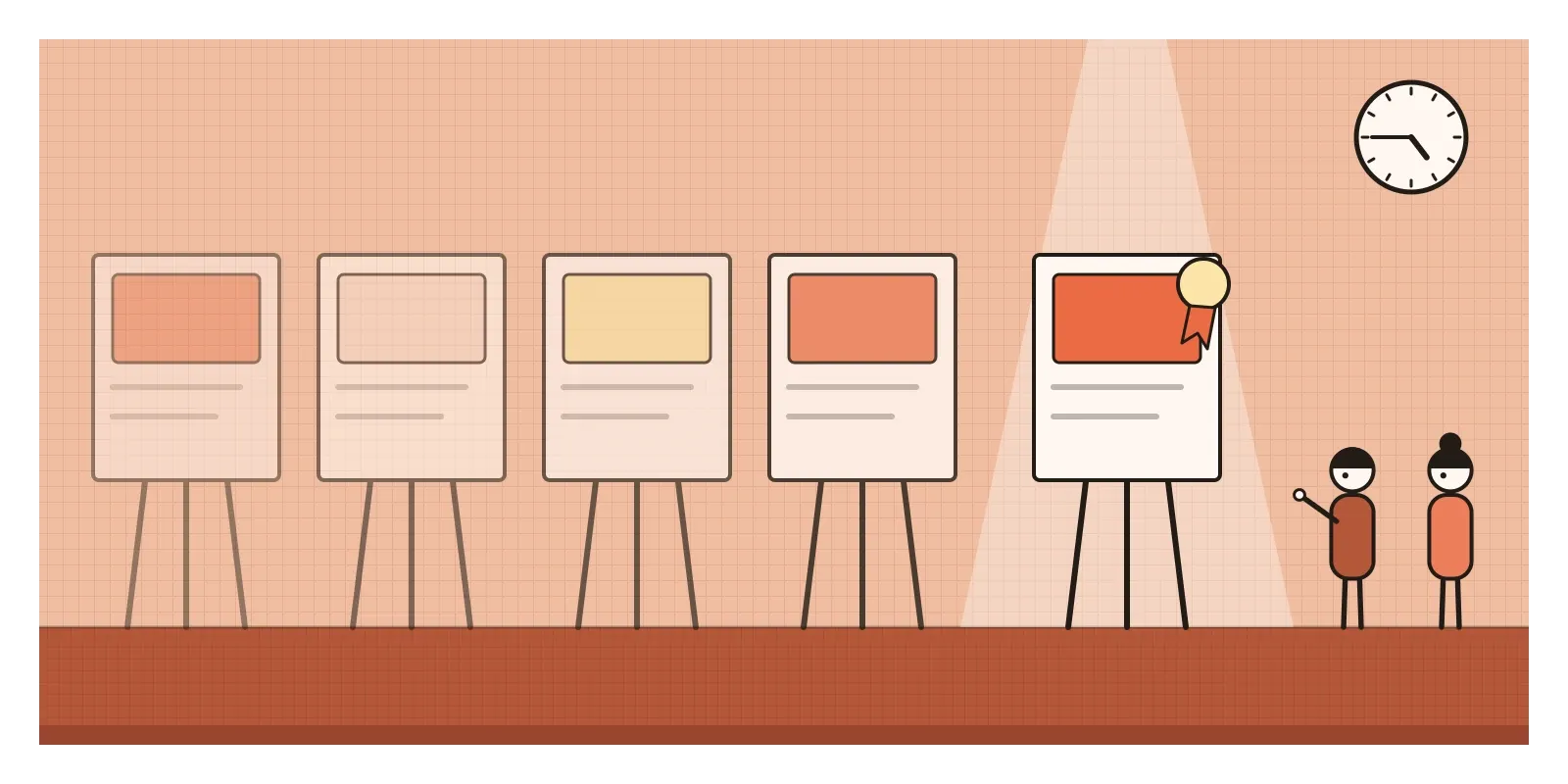
Nobody here is being lazy. Each judgement reflects what's freshest. But freshness has nothing to do with quality, and the team has let the calendar choose its design.
The better version changes the process rather than relying on willpower. Each reviewer scores every concept privately, against the same few criteria, straight after seeing it, before any discussion. The order of presentation rotates from one review to the next, and the first concept gets a second look at the end. In synthesis, every interview gets the same space on the wall before anyone starts clustering. And the quarterly review starts with the full quarter's charts, not with whatever happened last week, so that a single loud incident is seen against the line it sits on.
When the latest really is the best guide
Sometimes weighting the recent is exactly right. After a product has been redesigned, last year's usage data describes a different product. Forecasters often use methods, such as exponential smoothing, that deliberately give recent data more weight, because the world they're forecasting drifts. A designer's tenth iteration usually deserves more attention than the first, because it carries everything learned in between.
The colonoscopy research also suggests something useful for designers. If endings shape memories, then designing the end of an experience well, a clear confirmation, a calm final step, a goodbye that doesn't nag, is a legitimate way to care for people. It becomes a problem only when the ending is used to cover up a bad middle.
So the question isn't whether recent information matters. It's whether it's recent because the world has changed, or merely recent because it's the last thing I happened to see. If something structural has shifted, the new data should win. If it's just the latest point on a noisy line, it shouldn't.
How I try to catch it
The first habit is to write things down as they happen. Memory compresses the past and enlarges the present, so I keep a short running log during long projects and research rounds, and I read it before any summary or review. The month of March gets the same weight as last Tuesday because both are on the page.
The second is to zoom out. Whenever I'm shown a number, I ask to see it on the longest sensible timeline. A drop that looks alarming on a weekly chart is often ordinary on a yearly one.
The third is a question I ask before reacting to something recent: would this still matter if it had happened six months ago? If the answer is yes, it deserves attention. If it only feels urgent because it's fresh, I give it a few days and look again.
I think of those patients in Toronto, remembering an examination by its last few minutes. My own memories of projects work the same way, and a good log is my version of rating the pain every sixty seconds. In the next post I'll turn to a different pull on our decisions, the feeling that harm caused by doing something is worse than harm caused by doing nothing: omission bias.
Further reading: Donald Redelmeier, Joel Katz and Daniel Kahneman, "Memories of colonoscopy: a randomized trial" (2003) · Bennet Murdock, "The serial position effect of free recall" (1962) · Robin Hogarth and Hillel Einhorn, "Order effects in belief updating: The belief-adjustment model" (1992) · Wändi Bruine de Bruin, "Save the last dance for me: unwanted serial position effects in jury evaluations" (2005) · Justin Gallagher, "Learning about an Infrequent Event: Evidence from Flood Insurance Take-Up in the United States" (2014)
The question to askWould this still matter if it had happened six months ago?