The Vienna Secession
How a group of Viennese artists walked out of the official art world and built a white house with a golden dome.
The Vienna Secession
A golden cabbage beside the Karlsplatz
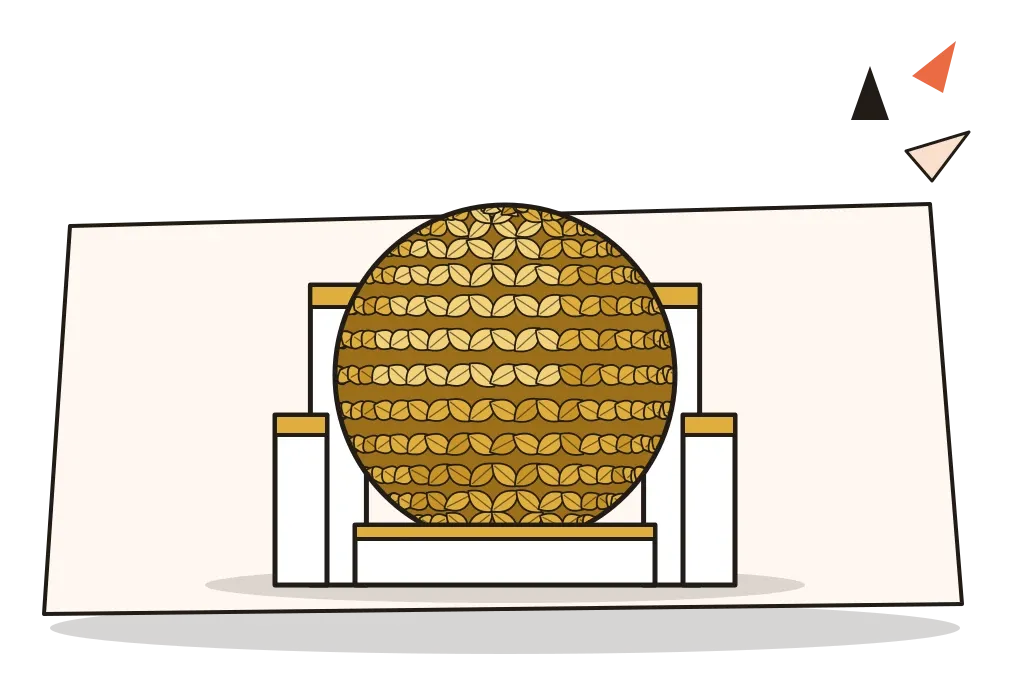
In November 1898, people walking along the edge of the Karlsplatz in Vienna, a wide and rather untidy square just outside the old city, found a building that looked like nothing else in town. It was a low, almost windowless block of white render with stubby towers at its corners. Perched on top, held between four short pylons, was a great openwork ball of gilded metal laurel leaves, thousands of them, glittering in the grey autumn light. Over the entrance ran a motto in gold letters, written by the critic Ludwig Hevesi: "To every age its art, to art its freedom."
The building had gone up in about six months, designed by Joseph Maria Olbrich, an architect of barely thirty, and paid for partly by the steel magnate Karl Wittgenstein. The Viennese promptly nicknamed the dome the golden cabbage, and some of their other names were less polite. Its owners didn't mind. They had just walked out of the city's art establishment, and this was their new home.
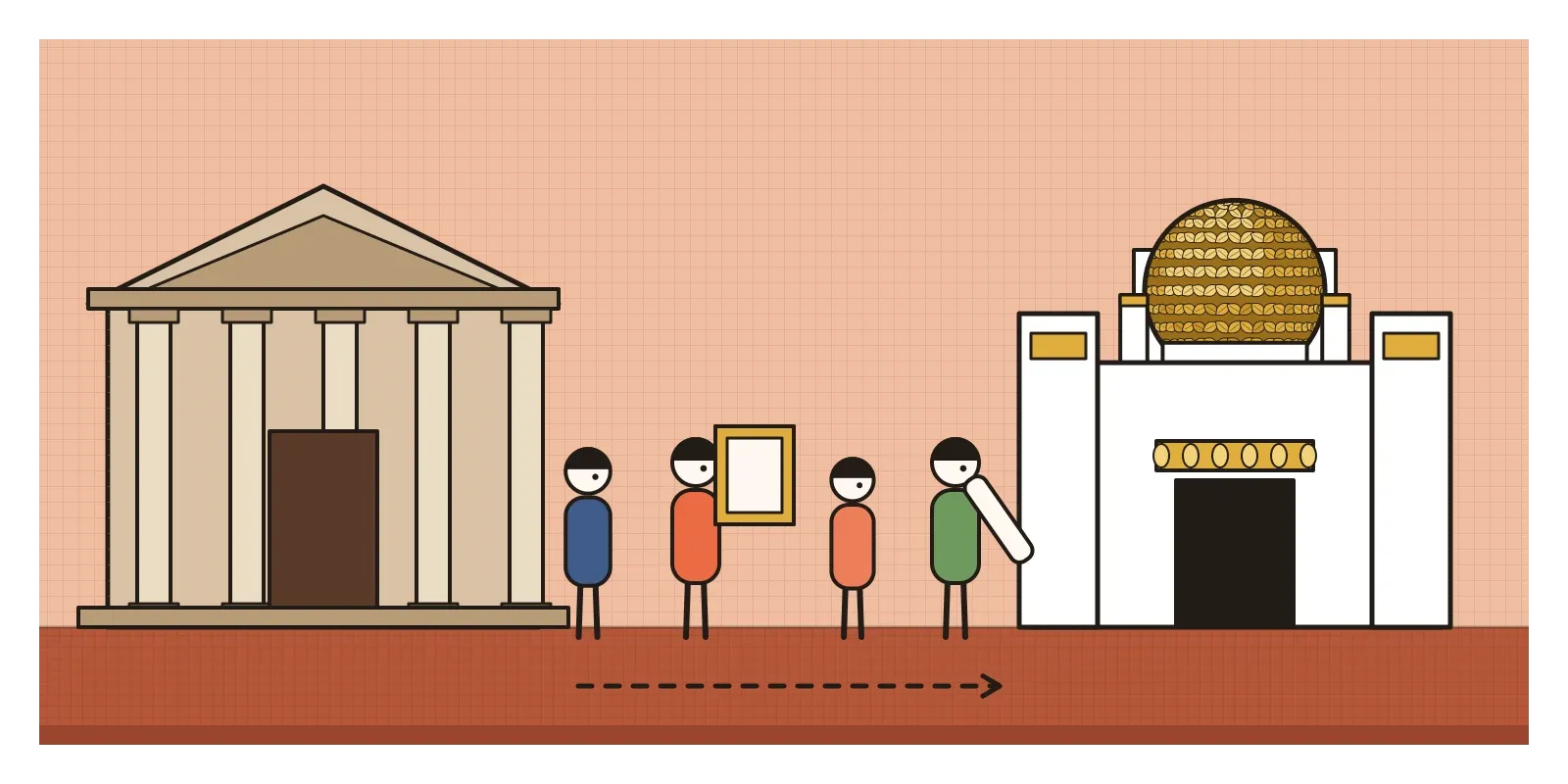
They called themselves the Vienna Secession. It began in 1897 as an exhibiting society, a group of painters, architects and designers determined to show modern art in a city that mostly preferred its art old. It quickly became a style too, flatter, more geometric and more golden than the Art Nouveau of Paris and Brussels, running from Gustav Klimt's paintings to posters, furniture and buildings. The name came from Roman history, when the common people of Rome would walk out of the city to force their rulers to listen.
Walking out of the Künstlerhaus
Vienna in the 1890s was the capital of a huge, ageing empire of many languages, ruled by the Habsburg emperor Franz Joseph. Its showpiece was the Ringstrasse, the boulevard built from the 1860s where the old city walls had stood, and almost every public building along it wore a costume from the past: a parliament in Greek style, a city hall in Gothic, a university in Renaissance. As I wrote in the post on Art Nouveau, this is called historicism, and many younger artists found it suffocating.
The art world was run by the Künstlerhaus, the artists' association whose big annual shows favoured history paintings and pictures that sold easily, and rarely showed foreign modern art. Klimt had grown up inside this world. In his twenties, with his brother Ernst and Franz Matsch, he painted polished, historically correct panels for the stairways of the new Burgtheater and the Kunsthistorisches Museum. He was very good at it, and increasingly bored.
In the spring of 1897, Klimt and around twenty others founded a new association and soon resigned from the Künstlerhaus. Klimt became president. Alongside him were the painter Carl Moll, the designer Koloman Moser and two young architects trained by Otto Wagner, Olbrich and Josef Hoffmann. As honorary president they chose Rudolf von Alt, a much-loved watercolourist of eighty-five, to show this wasn't only a revolt of the young. These were also the years of Freud's The Interpretation of Dreams and of an openly antisemitic mayor, Karl Lueger. The historian Carl Schorske argued that liberal families shut out of political power poured their energy into art and the inner life instead, which says a lot about who paid for the Secession.
A burned ceiling, a knight and a magazine shaped like a square
The first exhibition opened in March 1898, before the building was finished, with work from across Europe, including the Belgian Symbolist Fernand Khnopff, and the emperor came to look. Klimt's poster showed Theseus killing the Minotaur. The censors objected to the naked hero, and later printings added a tree trunk in exactly the right place. The group also launched a magazine, Ver Sacrum, "sacred spring", which ran from 1898 to 1903 on almost square pages, with lettering, illustration and ornament designed together so that each spread worked as one composition.
Klimt's biggest battle came from an older commission: three huge ceiling paintings for the University of Vienna, representing Philosophy, Medicine and Jurisprudence. When Philosophy was shown at the Secession in 1900, it turned out to be a slow column of tangled, naked bodies drifting through starry darkness, with no triumph of reason anywhere. Eighty-seven professors signed a petition against it, and that same year it won a gold medal in Paris. Klimt eventually returned his fee and bought the paintings back. All three were destroyed in May 1945, when retreating German troops set fire to the castle where they were stored.
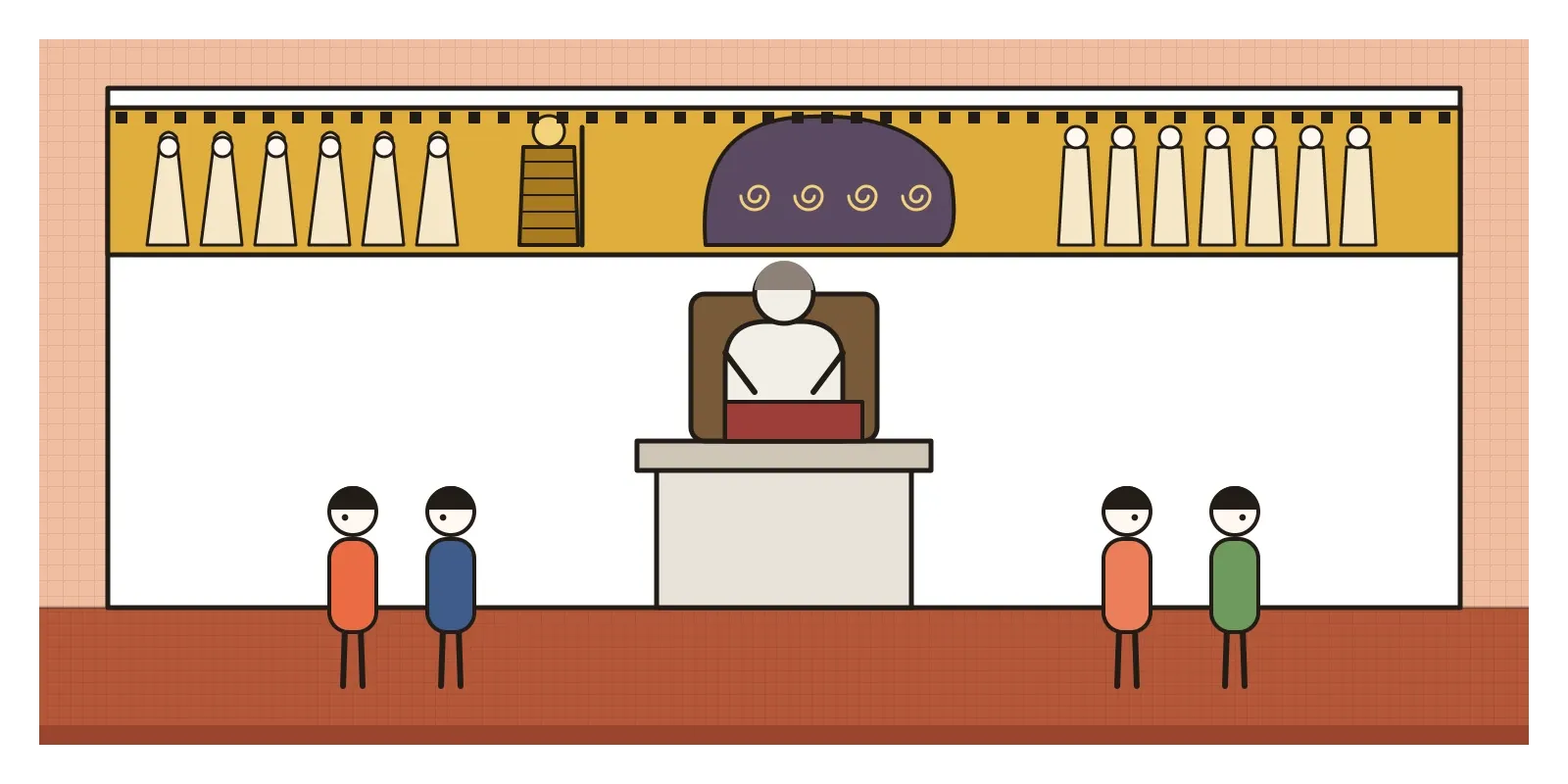
The Secession's most ambitious show came in 1902. The whole building was arranged around one sculpture, Max Klinger's enthroned Beethoven in coloured marbles, bronze and ivory, and at the opening Gustav Mahler conducted his own wind arrangement of part of the Ninth Symphony. Klimt painted a frieze about thirty-four metres long high on the walls of a side room. A knight in golden armour sets out to rescue suffering humanity, passes a gigantic ape-like monster and its attendant Gorgons, and arrives at a choir of women and an embracing couple, a reading of the "Ode to Joy" in paint, gold and inlaid fragments of glass and mother-of-pearl. It was meant to be destroyed after the show. A collector saved it.
Otto Wagner, who had trained Olbrich and Hoffmann, joined in 1899. His railway pavilions on the Karlsplatz have thin marble panels in green iron frames with gilded sunflowers, and on his Postal Savings Bank of 1904 to 1906 he fixed the marble facade with visible aluminium-capped bolts, turning a structural necessity into decoration.
And Klimt found his gold. In 1903 he travelled twice to Ravenna and saw the mosaics I described in the post on Byzantine art. Over the next five years he made the paintings people know best, including the Portrait of Adele Bloch-Bauer I of 1907 and The Kiss, in which realistic faces and hands float in fields of flat gold covered with eyes, spirals and rectangles.
Squares, gold and plenty of empty wall
If Art Nouveau is the whiplash, the Vienna Secession is the whiplash pulled straight. Look for the square first: square pages, square canvases for Klimt's landscapes, square panels on facades, chequerboard borders, rows of small circles and rectangles marching in strict lines. Curves still appear, but they are contained, tamed by a grid.
Then look at how space is flattened. Klimt's later portraits mix two kinds of picture in one frame. The face, hands and shoulders are modelled softly and convincingly, while everything else, the dress, the chair, the wall behind, collapses into a single flat surface of pattern and gold leaf. It's as if a photograph had been laid onto a mosaic. His landscapes, with high horizons or none, fill the canvas edge to edge with leaves like a carpet.
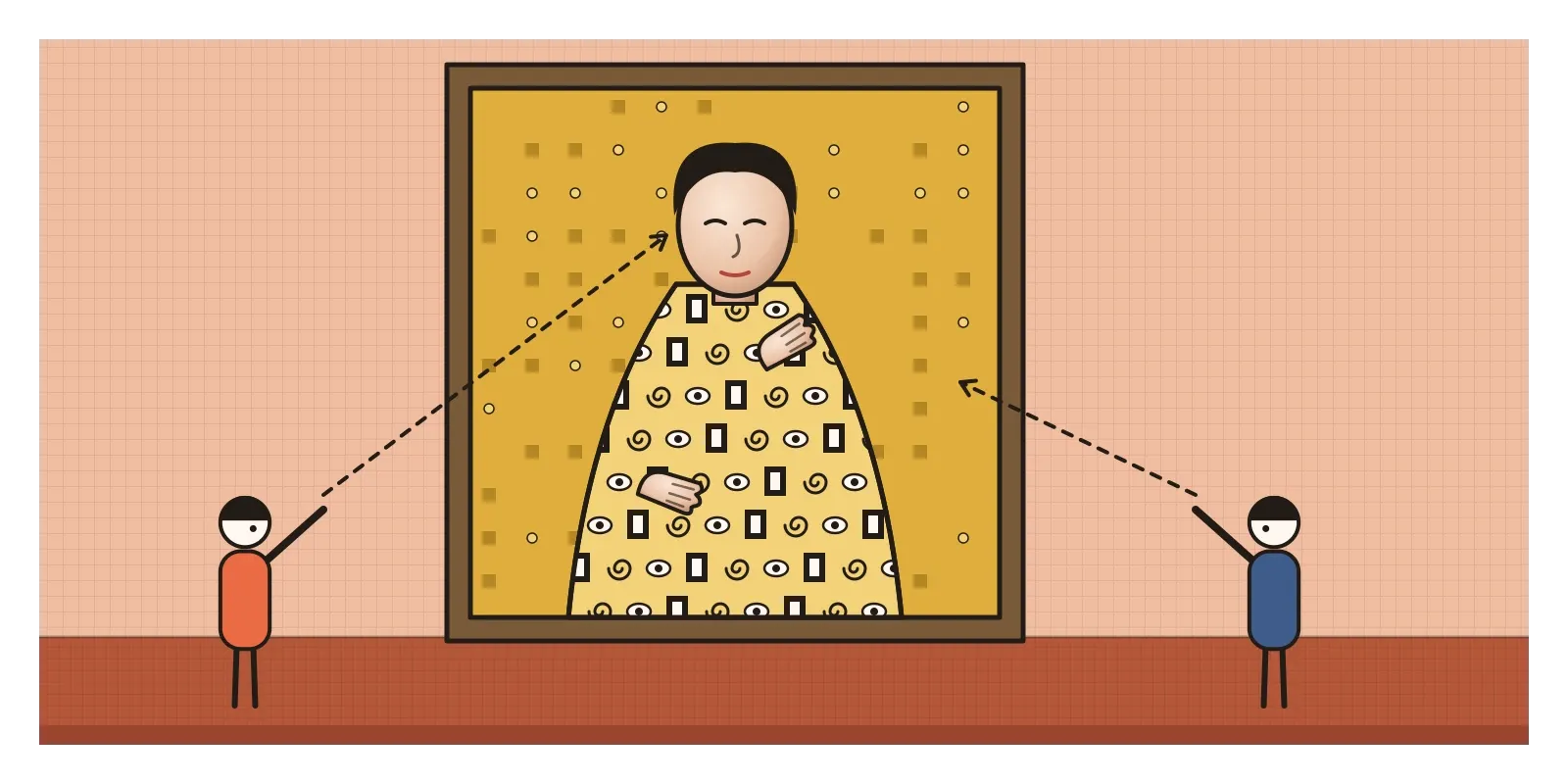
The palette is often restrained, white, black, silver and gold, with flashes of a single strong colour. Lettering is hand-drawn, tall and blocky, squeezed to fill a rectangle as part of the image. On buildings, walls are smooth and white, with ornament gathered into a few places, a band of leaves, a gilded panel, a doorway.
The Secession also changed how art was shown. Its main hall was lit from above through a glass roof, with partitions that could be moved for each exhibition. Instead of crowding paintings frame to frame up to the ceiling like the old salons, it hung fewer works, at eye level, on plain light walls with space around each.
An idea that travelled to Calcutta
I can't point to a Klimt in an Indian museum. India's most direct link to Vienna around 1900 is an idea, and it travelled in the head of an art historian.
The Secession's motto had a scholarly twin in the same city. Alois Riegl, who began as a curator of textiles at Vienna's museum of applied arts, argued in Problems of Style (1893) and later books that every period's art follows its own will to form, its Kunstwollen, and should be judged by its own aims, not as a decline from Greek perfection. As I mentioned in the post on Roman art, this helped rescue whole periods from contempt. It was the conviction the Secession painted over its door.
Stella Kramrisch grew up in Vienna in the years of the Secession and studied art history at the University of Vienna, where she wrote a doctorate on early Indian sculpture. After Rabindranath Tagore heard her lecture in England, he invited her to teach at Santiniketan, and she arrived in the early 1920s. She taught Indian art at the University of Calcutta from 1924 to 1950, and her books, Indian Sculpture and The Hindu Temple, which I drew on in earlier posts, read Indian art closely on its own terms at a time when many European writers still measured it against Greece. She also helped bring Bauhaus artists to a Calcutta exhibition in 1922, a story for the post on the Bauhaus.
There's a looser parallel too. Within a few years of the Secession's walk-out, painters in Calcutta were rejecting the academic style of their own art school, the subject of the post on the Bengal School. Walking out and building your own house turns out to be one of modern art's most repeated moves.
White walls, square frames and gold on everything
The Secession's most lasting gift may be the room itself. A plain, light-walled gallery with a few works at eye level seems so natural now that we forget someone had to invent it. In 1976 the critic Brian O'Doherty called it the white cube, in essays for Artforum, and asked what that neutral-looking space does to the art inside it. The Secession was one of its ancestors, and every portfolio site with generous margins and a few large images is a descendant.
The second gift is designing for a fixed format. Ver Sacrum's square page made its designers compose type, image and ornament within strict edges, the discipline of the square social media post. When Instagram launched in 2010, every photo had to be square, and other shapes arrived only in 2015.
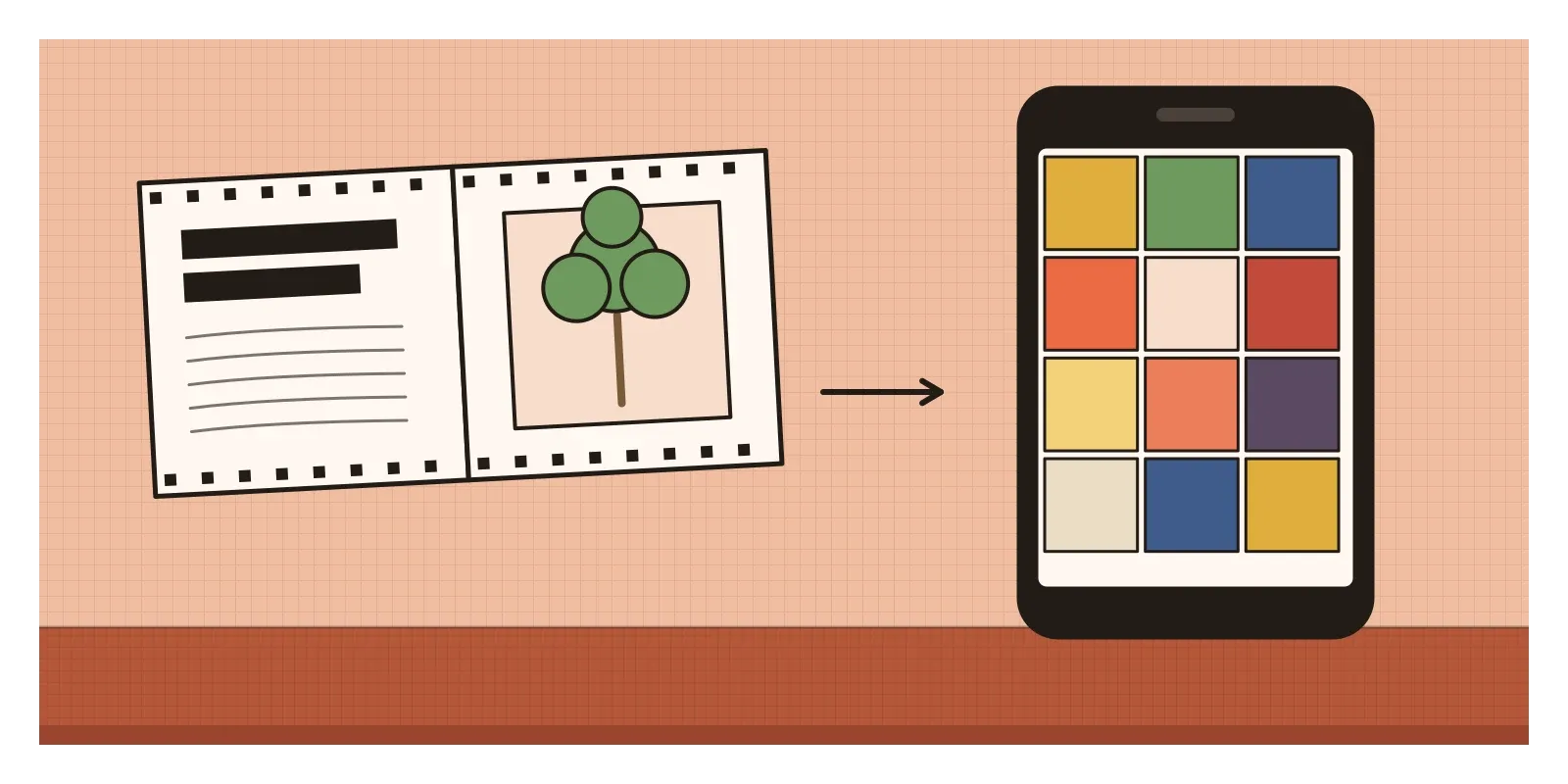
The third is something close to a visual identity: building, posters, catalogues, magazine and rooms designed to speak for one institution with one point of view. And then there's the gold. Klimt died in 1918, so his paintings are out of copyright, and his gold has spread onto mugs, scarves and phone cases and into every AI image tool's list of styles. The lesson under the merchandise is his mix of a believable face with a flat decorative field: one realistic element can anchor an otherwise abstract composition, which is exactly how product photography on a flat graphic background works.
Gold for the few
The Secession promised art for a new age and mostly made it for a small circle of very rich families, industrialists and bankers, many of them Jewish, who bought the paintings and commissioned the portraits. After Germany annexed Austria in 1938, the Nazis seized many of those collections. Klimt's portrait of Adele Bloch-Bauer hung in the Belvedere in Vienna for decades, until her niece Maria Altmann won it back in 2006 after a long legal fight. The Beethoven Frieze, once owned by the Lederer family, was sold to the Austrian state in 1973 under export restrictions, and in 2015 an Austrian advisory board rejected the heirs' claim to it.
Women were largely outside it. The founders were all men, and women weren't admitted to study at Vienna's Academy of Fine Arts until 1920. Women artists set up their own association in 1910. Klimt's paintings are full of women, but the women around him who made things are less remembered. Emilie Flöge, his lifelong companion, ran one of Vienna's most adventurous fashion salons with her sisters, and is still too often introduced only as the woman in his paintings.
As a group, the Secession split in 1905, when Klimt and his circle left after a quarrel over how commercial the association should be. At their own exhibition, the Kunstschau of 1908, a young Oskar Kokoschka showed raw, unsettling work that pointed somewhere else entirely. By the end of 1918, Klimt, Wagner, Moser and Egon Schiele were all dead, and the empire had collapsed. The replies had already arrived. The Wiener Werkstätte took the Secession's squares into everyday objects, and the Expressionists answered its gold with scratched, nervous bodies.
To see it for yourself, the Secession building still shows contemporary art by the Karlsplatz, with the Beethoven Frieze in a room downstairs, and the Belvedere holds The Kiss. In India, Kramrisch's books are the best route back to Vienna's way of looking. For an exercise, take a square sheet and design a poster where lettering, one image and a border of simple geometric ornament share one grid, then draw a portrait in which only the face is shaded and everything else becomes flat pattern. And picture that ball of gilded leaves over the Karlsplatz in 1898, mocked as a cabbage, and still shining. In the next post, on the Wiener Werkstätte, I'll follow Hoffmann and Moser out of the gallery and into the workshop, where the squares came down off the walls and onto spoons, chairs and silver boxes.
Further reading: Carl E. Schorske, Fin-de-Siècle Vienna: Politics and Culture (1980) · Peter Vergo, Art in Vienna 1898-1918 (1975) · Frank Whitford, Klimt (1990) · Alois Riegl, Problems of Style (1893) · Brian O'Doherty, Inside the White Cube (1986)
A reply toVienna's official art world, and a Ringstrasse dressed in borrowed historical styles.