The Ulm School of Design
How a small German design school, founded as a memorial, tried to turn design into a science.
The Ulm School of Design
A school on a hill, built as a memorial
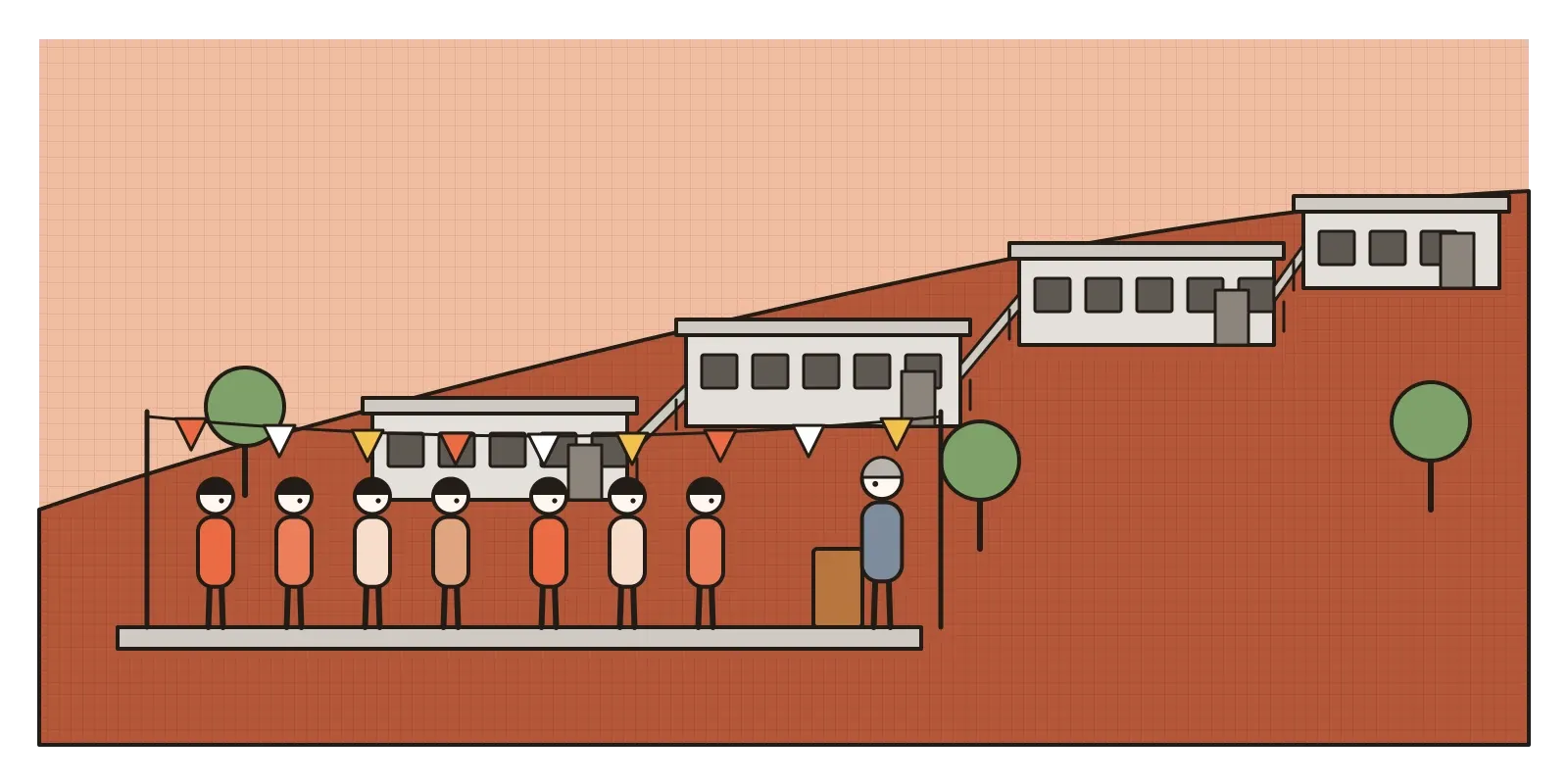
On 2 October 1955, Walter Gropius, the founder of the Bauhaus, then in his seventies, came to a windy hillside called the Kuhberg on the edge of Ulm, in southern Germany, to open a new school building. It wasn't grand. It was a group of low, flat-roofed concrete blocks stepping down the slope, joined by covered walkways, with studios, workshops, a canteen and small rooms where students would live. Its architect was Max Bill, a Swiss painter, sculptor and designer who had studied at the Bauhaus in Dessau in the late 1920s. Money had been so tight that donated steel and concrete from local industry went into the walls, and students made much of the furniture inside as part of their studio work. Gropius had helped the founders find funding, and his visit felt like a torch being handed on.
The school was called the Hochschule für Gestaltung, roughly the College of Design, but almost everyone just calls it Ulm. It was also a memorial. In February 1943, two students in Munich, Hans and Sophie Scholl, were executed by the Nazis for distributing the leaflets of a small resistance group called the White Rose. After the war their elder sister, Inge Scholl, and her future husband, the graphic designer Otl Aicher, both from Ulm, wanted to build something that would help a democratic Germany grow: a place that would educate people to think for themselves. A foundation in the Scholls' name, a large grant secured from John McCloy, the American High Commissioner in Germany, and money from the German government and local industry paid for it.
For fifteen years, from its first classes in 1953 until it closed in 1968, Ulm tried to turn design from an art into something closer to a science: a method built on research, analysis, systems and teamwork, aimed at mass production and the everyday needs of an industrial democracy. It was tiny, quarrelsome and short-lived, and it shaped design education around the world, including in India.
The Bauhaus's argumentative child
Ulm replied to two things at once. The first was the Nazi era, when graphics, film and architecture had been turned into tools of propaganda and spectacle. Aicher and Scholl wanted design that informed citizens rather than seduced them. The second was the Bauhaus, closed by the Nazis in 1933, which Ulm saw as its parent and spent its whole life arguing with. Teaching began on 3 August 1953, in rooms borrowed from Ulm's adult education centre, and in those early years former Bauhaus teachers, including Josef Albers, Johannes Itten and Walter Peterhans, came to teach as guests. Bill, the first rector, imagined a new Bauhaus, where artists would also design.
That didn't last. A group of younger teachers, led by the Argentinian painter and theorist Tomás Maldonado, argued that the Bauhaus had never really escaped from art, and that a designer for the age of automated factories needed mathematics, ergonomics, sociology, semiotics and information theory far more than painting. Maldonado described the designer as a coordinator, someone who brings together the knowledge of engineers, manufacturers, marketers and users, rather than an artist who adds beauty at the end. Bill resigned as rector in 1956 and left the school the following year. What remained became known as the Ulm model: a shared foundation year, then departments of product design, visual communication, industrialised building and, for a while, information, with an independent film department from 1962 led by Alexander Kluge and Edgar Reitz, two of the young directors who launched the New German Cinema. Students worked in small development groups on real commissions from industry, which was unusual for a school at the time.
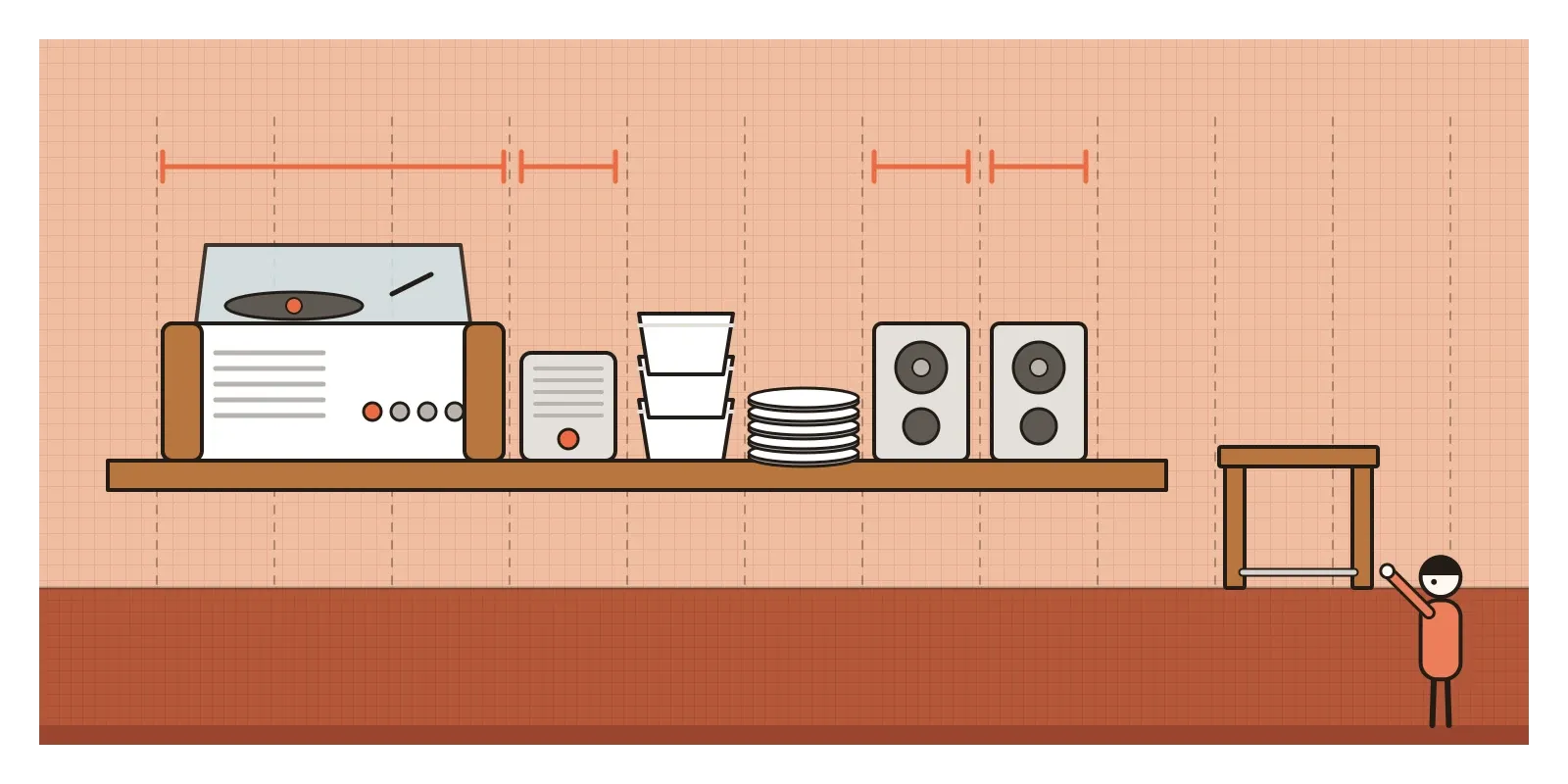
The most famous of those commissions came from Braun, the electrical company near Frankfurt, whose young owners decided in the mid 1950s to remake their entire range. Hans Gugelot, a Dutch architect who led Ulm's product design teaching, worked with Aicher, students and Braun's own young designer, Dieter Rams. Their radio and record player of 1956, a pale metal box with wooden ends and a clear plastic lid, was nicknamed Snow White's coffin. Gugelot's real gift was for systems. With Reinhold Häcker he redesigned the Carousel slide projector for Kodak's German company in 1963, sloping the edge of the round tray so slides were easier to lift out and adding a clear cover to keep off dust.
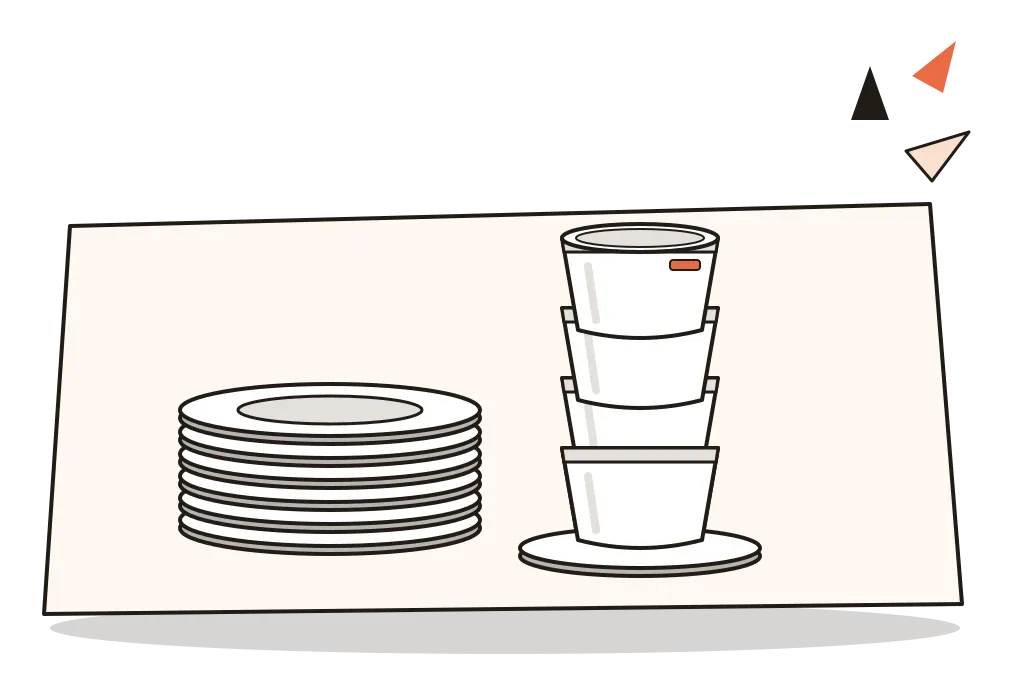
Students did remarkable work too. For his diploma in 1959, Hans "Nick" Roericht designed TC 100, a set of hotel tableware in which cups, bowls, saucers and plates stacked into neat, sturdy columns that saved shelf space and survived dishwashers. Thomas, a company in the Rosenthal group, put it into production in the early 1960s, and the Museum of Modern Art in New York added it to its collection. In graphics, Aicher's development group redesigned the airline Lufthansa in the early 1960s. He kept its old crane symbol but simplified it inside a circle, set the name in Helvetica, fixed a strict palette of blue and yellow, and wrote everything down in a manual so that tickets, timetables and tail fins could all be designed by rule.
Grey boxes, clear lids and a grid underneath
Ulm objects are easy to recognise once you've seen a few. They're mostly white, light grey or black, sometimes with one small accent of colour on a switch or a dial. Forms are rectangular with gently rounded corners, and nothing is there to decorate. Controls are grouped in tidy rows, in the order you use them. Clear plastic lids show the mechanism instead of hiding it. Most importantly, things come in families: sizes based on a common module, parts that combine, cups that stack, units that line up on a shelf.
The school's own stool is a good example. Bill and Gugelot designed it around 1954 from three wooden boards and a round rod, and students used it as a seat, a side table, a shelf, a lectern and a tray for carrying books, depending on which way up it was turned. Ulm's graphics follow the same thinking: sans-serif type, flush-left text, strict grids, photographs and diagrams used as information, and corporate identities written down as rules in a manual rather than left to taste. What Ulm wanted you to notice wasn't a style at all, but a method. In practice, of course, the method produced a very recognisable style.
A teak chair for Ahmedabad
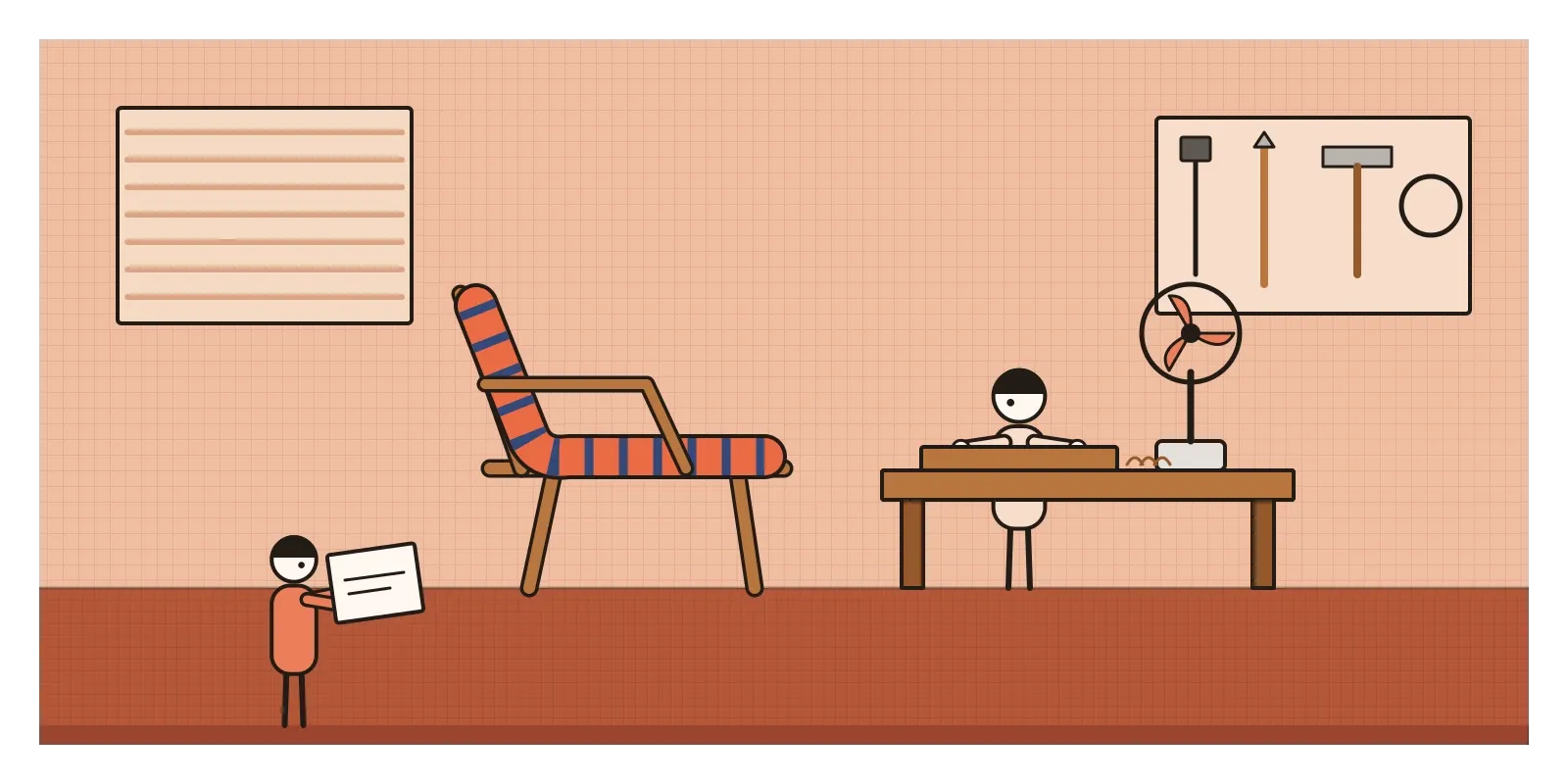
Ulm's closest partner outside Europe was the National Institute of Design in Ahmedabad, founded in 1961, which I'll write about in the next two posts. Otl Aicher travelled through India in 1960 and wrote about a new state, only thirteen years old, trying to modernise on its own terms. In the summer of 1965, Hans Gugelot came to Ahmedabad to teach a workshop. With the designer Gajanan Upadhyaya and NID's students, he made a low lounge chair of teak with a seat of woven Indian textile, now known as the India Lounge Chair, or the 24/42 chair. It was an attempt to join Ulm's system thinking with Ahmedabad's low-cost, local making, and that summer he and the students also worked on a cheap household fan. Gugelot died that September, aged only 45, and the original chair has since been lost; for an exhibition at the Bauhaus Dessau in 2017 it had to be rebuilt from drawings and measurements.
Traffic went the other way too. Sudhakar Nadkarni, a young Indian, studied product design at Ulm from 1962. His diploma project was a white, modular milk kiosk for the streets of Bombay, based on surveys of the people who ran and used the city's kiosks, and it got as far as a prototype. At Ulm he met Kumar Vyas, who spent six months there, and both later taught product design at NID, before Nadkarni went on to lead the new Industrial Design Centre at IIT Bombay. Indian design education still carries Ulm's stamp in its foundation year, its faith in method and its habit of research before form, although, as I'll explain in the post on Indian design education, it soon began to argue with Ulm just as Ulm had argued with the Bauhaus.
Manuals, methods and systems
If you work in product design today, you're probably working in Ulm's shadow. The Lufthansa manual is an ancestor of every brand guideline and every digital design system, the documents that tell hundreds of designers and engineers which colours, type sizes, spacing and components to use so that a product stays consistent. Ulm's product families, where every part shares a module, live on in component libraries and in the design tokens that define a system's colours and sizes in code. Its picture of the designer as a coordinator between engineers, researchers and business is close to the way product teams are organised now, and its insistence on studying how people actually use things before drawing anything is a direct ancestor of user research.
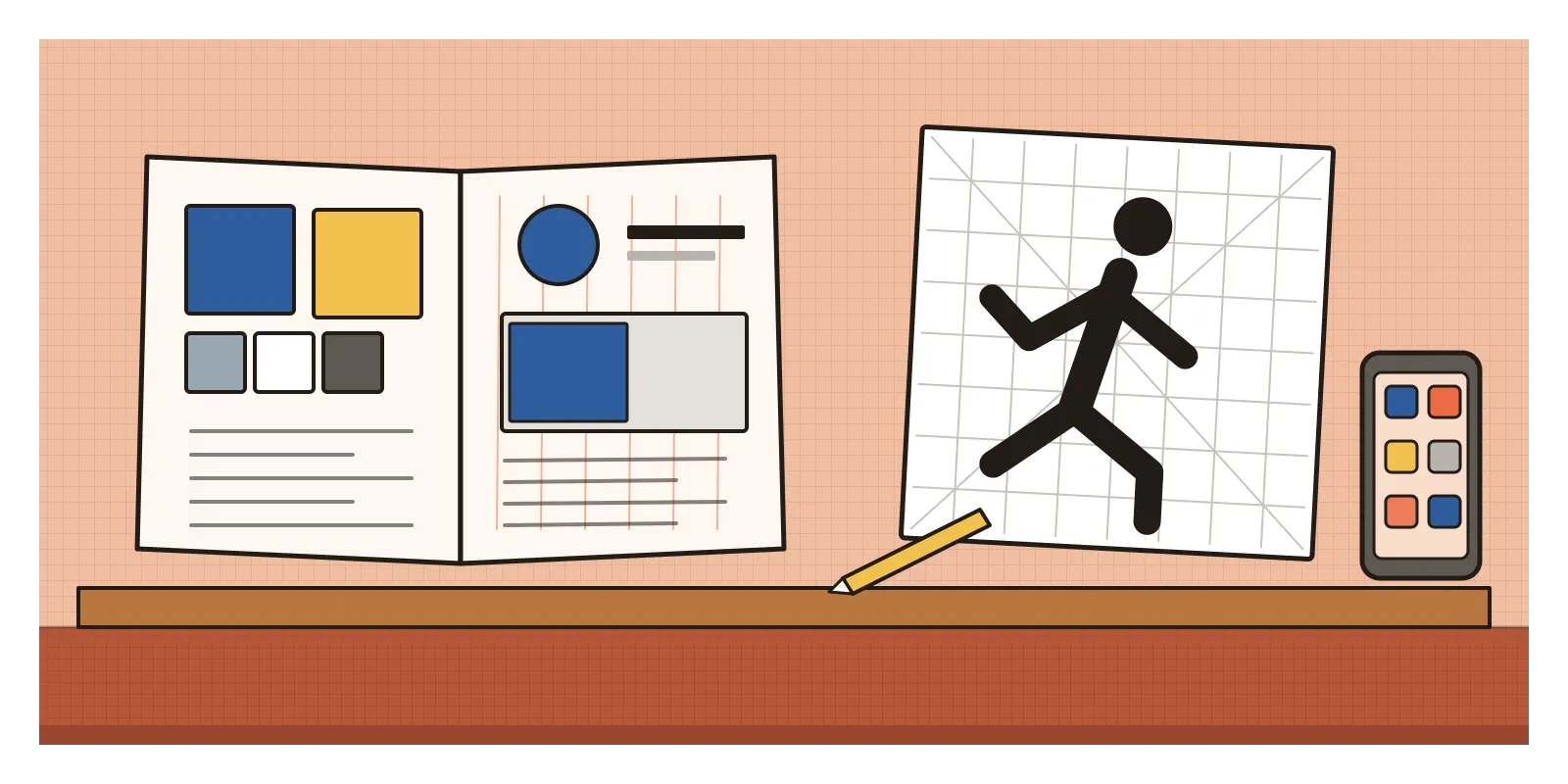
Ulm people carried these ideas a long way. Aicher designed the pictograms for the 1972 Munich Olympics, simple figures built on a strict grid of horizontal, vertical and diagonal lines, and their logic is still visible in airport signs, icon sets and the little figures on your phone. Gui Bonsiepe, a student and later teacher at Ulm, moved to Chile, where his team designed the operations room for Cybersyn, the Allende government's experimental network for managing the economy, in 1972: a ring of swivel chairs facing screens of live data, which now looks uncannily like a modern dashboard. When I review an AI tool's interface and ask whether its parts behave as one consistent system, I'm asking an Ulm question.
Too cold, too clever, too political
Ulm had plenty of critics, many of them inside the school. Bill felt that it had thrown away art, and that a design education without intuition and form would produce engineers' assistants. Others noticed that the "science" was often more aspiration than practice: elaborate charts and theories that didn't always help anyone make a better kettle. The Ulm look, meanwhile, became the polite grey uniform of West German industry, which raised an awkward question for a school founded to help build a better society. Was it reforming consumer capitalism, or just giving it better-looking products? Its teachers and students were mostly men, and its claim to universal, rational answers rarely asked whose reason, or whose everyday life, it was designing for.
Its politics finally finished it. Ulm depended on public money, and from the early 1960s the state parliament of Baden-Württemberg argued repeatedly over whether this expensive, left-leaning school was worth funding. Inside, teachers fought over its direction, and students caught up in the protests of 1968 found it authoritarian. In 1968 the parliament finally withdrew its funding, and by the end of the year the school was closed. Its people scattered: Maldonado to Italy, Bonsiepe to Latin America, and Aicher, eventually, to a studio of his own at Rotis in the Allgäu. The reply came quickly, from Italian designers who found rational grey objects joyless and began making furniture as protest, a story I'll come to in the post on radical design.
Walk up the Kuhberg
Bill's buildings still stand on the hill above Ulm, and the HfG archive, part of the Museum Ulm, shows the school's history and objects inside them. If you can't travel, look closely at any well-designed product family you own, a set of storage boxes or kitchen containers, and work out the module that ties the sizes together. For an exercise, take one object you use every day and redesign it as a family of three that stack, nest or combine. Then write a one-page rule sheet for it, the way Aicher did for an airline, and see how much of your taste you can turn into rules.
On that hillside in 1955, Gropius was opening a school built to honour two students who died for thinking freely. Ulm's answer was to teach designers to think rigorously, to research before drawing, and to design systems rather than ornaments. It didn't always live up to that, but almost every design team that works from a system owes it something. In the next post, on Brutalism, the same post-war hunger for honesty shows up in concrete, at the scale of whole buildings and cities.
Further reading: Herbert Lindinger (ed.), Ulm Design: The Morality of Objects (1991) · René Spitz, hfg ulm: The View Behind the Foreground (2002) · Otl Aicher, The World as Design (1994) · Tomás Maldonado, Design, Nature, and Revolution (1972)
A reply toThe Bauhaus's lingering faith in the artist, and a Nazi era that had turned design into propaganda.