
Ukiyo-e
How cheap woodblock prints of actors, courtesans and travellers became Japan's great popular art.
Ukiyo-e
A wave, a mountain and a new blue
Around 1830, in Edo, the city we now call Tokyo, a man of about seventy sat down to design a picture of a wave. He had changed his artist's name dozens of times, and was signing himself "Iitsu, formerly Hokusai". The picture he drew shows a huge claw of water curling over three long, narrow boats, their rowers crouched flat. Far behind them, small enough to sit inside the trough of the wave, is Mount Fuji, capped with snow. It was one print in a series called Thirty-six Views of Mount Fuji, issued by the Edo publisher Nishimuraya Yohachi over the next few years.
What felt new to buyers wasn't only the drama. It was the colour. A synthetic pigment first made in Berlin in the early 1700s, Prussian blue, had recently started arriving in Japan at a price printers could afford, much of it apparently made in China and shipped in through Nagasaki. People called it bero-ai, "Berlin indigo". The older blues, from indigo and the dayflower plant, printed unevenly or faded. Prussian blue was deep and stable, and it thinned into pale washes of sky and sea. Hokusai's Fuji series leans on it heavily.
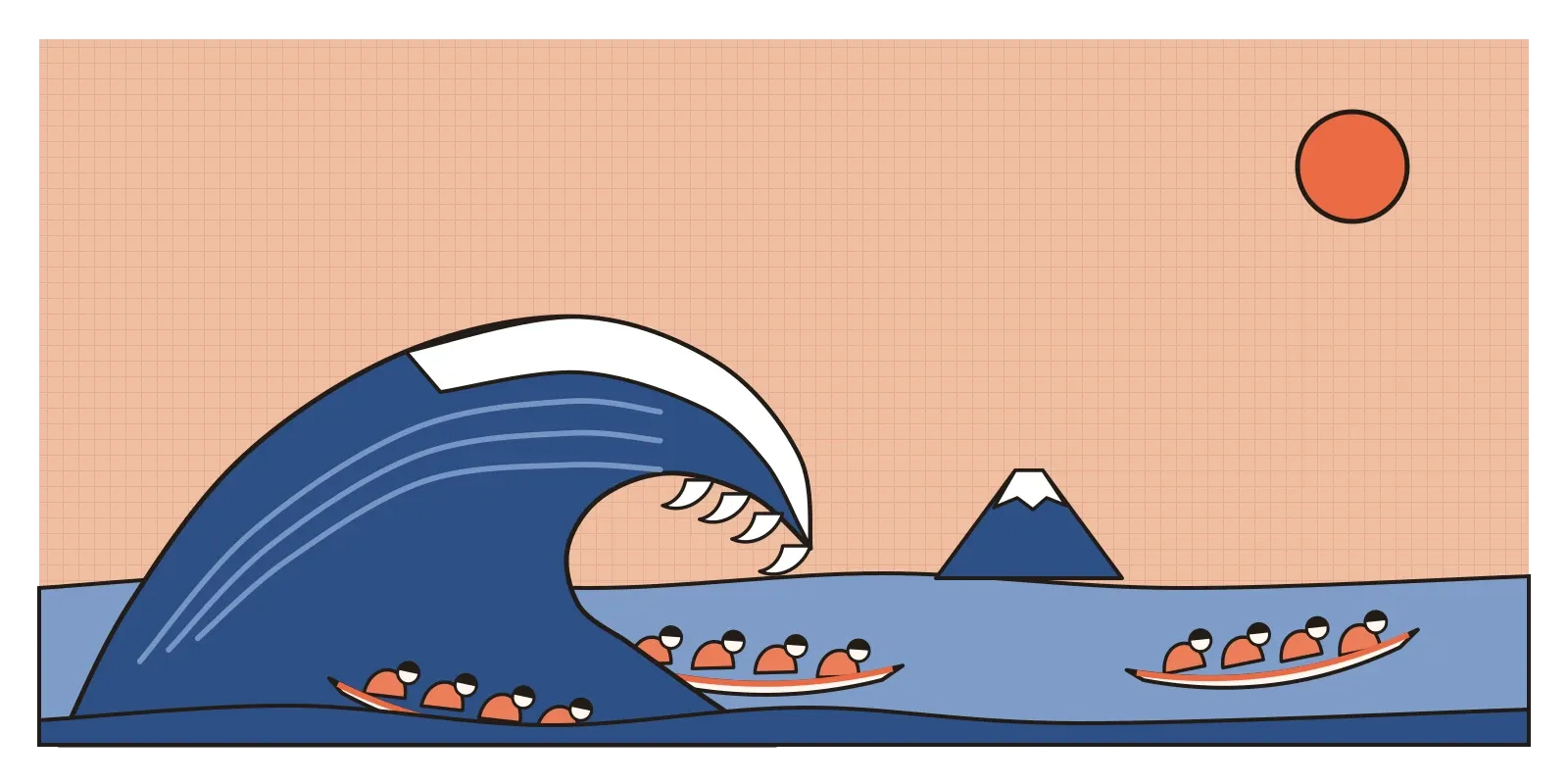
The print is often called The Great Wave, though its title is closer to "Under the Wave off Kanagawa". It's one of the most reproduced images in the world, and it's easy to forget that it began as a mass-produced sheet of paper a little larger than a magazine page, printed in thousands of copies from carved wooden blocks and sold cheaply in shops. That's what ukiyo-e was. The word means "pictures of the floating world", and it names a popular art of woodblock prints, and to a lesser extent paintings and illustrated books, made in Japan from the late seventeenth century to the late nineteenth.
Pictures of the floating world
In 1603 the Tokugawa family took control of Japan and ruled it from Edo for more than two and a half centuries, a long stretch of peace now called the Edo period. Edo grew into one of the largest cities in the world, by the eighteenth century probably home to more than a million people. Society was officially ranked, with samurai at the top and merchants near the bottom, but many townspeople grew rich, and with no political power they spent on pleasure: the kabuki theatre, the teahouses, and the licensed pleasure quarter of the Yoshiwara, rebuilt on the edge of the city after a great fire in 1657.
An older Buddhist word, ukiyo, meant the world of sorrow, where everything passes. In the seventeenth century the same sound was written with a character meaning "floating", and the idea flipped. Around 1661 the writer Asai Ryōi described the floating world as living only for the moment, enjoying the moon, the snow, cherry blossoms and wine, and drifting along like a gourd carried by a river.
Ukiyo-e was the picture side of that culture, and it was a reply to the painting that came before it. The shogunate's official painters, the Kanō school, worked in ink and gold for castles and temples, on Chinese models: sages, tigers, landscapes. The Tosa school painted classical subjects for the imperial court. Neither painted the actors and fashionable women Edo actually talked about, and neither was affordable to townspeople. Printing solved both problems. Hishikawa Moronobu, who died in 1694, is usually credited with turning book illustrations into single-sheet prints, at first in black ink alone, sometimes coloured by hand. Printers gradually added two or three colour blocks. Then in 1765, wealthy amateurs in Edo began commissioning lavish picture calendars for the new year, with the year's long and short months hidden in the design. The artist Suzuki Harunobu and his carvers used the occasion to print in many colours from many blocks. Within a year or two these "brocade pictures", nishiki-e, were the standard.
Four pairs of hands on every print
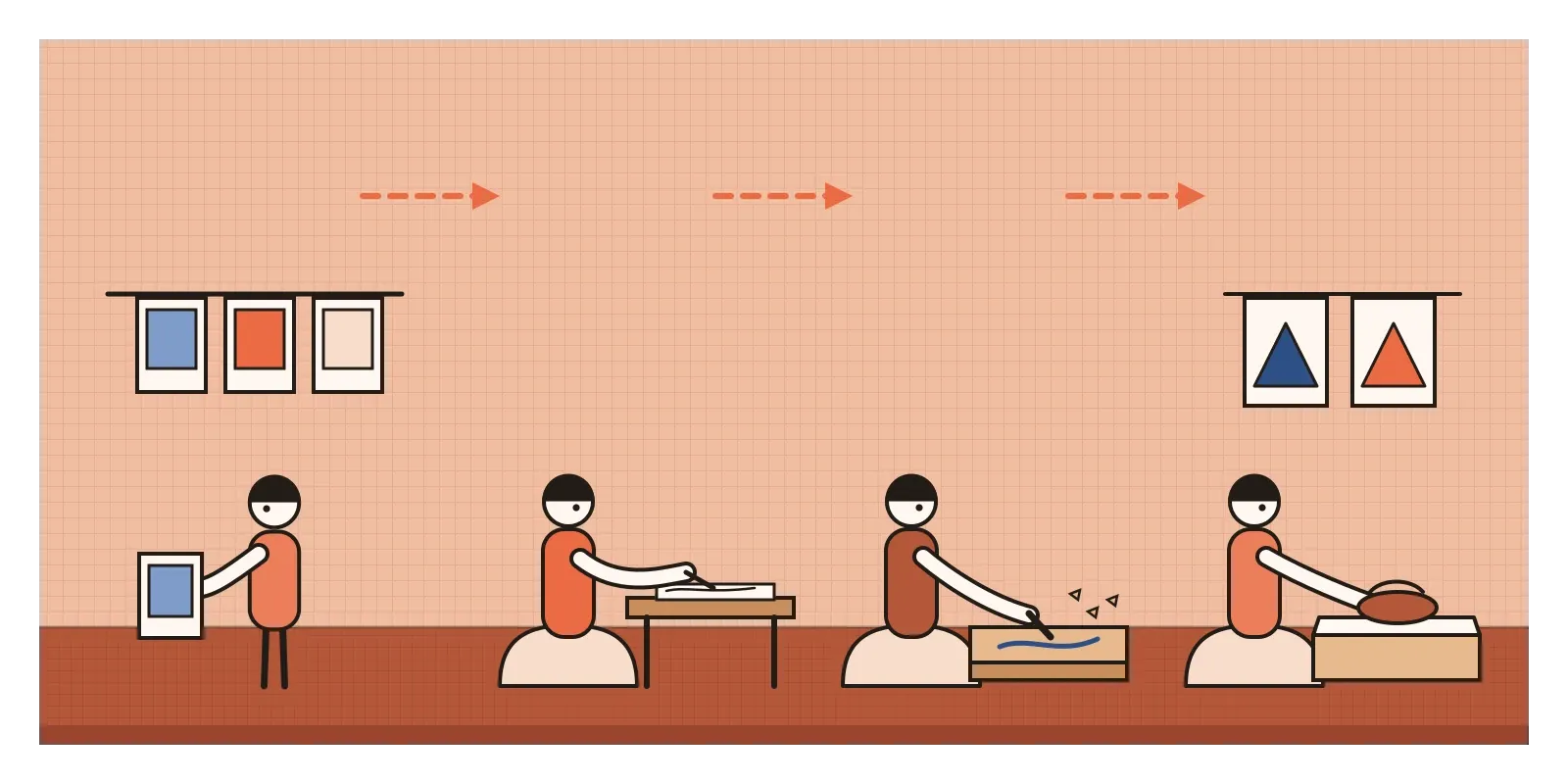
A ukiyo-e print was never the work of one person. A publisher chose the subject, paid for everything and sold the result from a shop. A designer, the artist whose name we remember, drew the image in ink on thin paper. A carver pasted that drawing face down onto a block of mountain cherry and cut through it, leaving the lines standing in relief, then carved a separate block for each colour. A printer brushed water-based colour onto each block in turn, laid damp mulberry paper over it and rubbed the back with a flat pad called a baren. A small notch and an L-shaped corner cut into every block, the kentō, let the printer lay each sheet in exactly the same place for every colour.
Publishers mattered as much as artists. The most famous, Tsutaya Jūzaburō, launched two of the great careers of the 1790s. With Kitagawa Utamaro he published ōkubi-e, "large head" pictures that cropped women to the head and shoulders, like close-ups, so buyers could study a hairstyle or the tilt of a neck. With the artist known as Tōshūsai Sharaku he published around a hundred and forty prints of kabuki actors in about ten months in 1794 and 1795, many against dark, glittering grounds of powdered mica. Sharaku's actors are startling, all big noses, clenched hands and crossed eyes. Then he vanished. Who he was is still debated; the usual answer is a Noh actor called Saitō Jūrobei, but no one is certain.
In the nineteenth century, landscape took over. Hokusai's Fuji views were followed by Utagawa Hiroshige's Fifty-three Stations of the Tōkaidō, published around 1833 to 1834, views along the highway from Edo to Kyoto full of travellers caught in rain, snow and evening light. A popular story says Hiroshige made the journey with an official procession, but historians doubt it. At the end of his life he produced One Hundred Famous Views of Edo, tall prints that often put something huge in the foreground, a branch or a bird's wing, with the city small behind it. His contemporary Utagawa Kuniyoshi specialised in warriors and monsters.
Flat colour, bold lines and a sky wiped onto wood
You can recognise an ukiyo-e print from across a room, and nearly everything you notice comes from how it was made. The key block, printed first in black, gives every shape a firm outline of fairly even weight. Colours sit inside those outlines as flat areas, because each colour was a separate block inked in one go. There are almost no cast shadows. Pattern does the work that modelling does in European painting: a kimono reads as a flat field of checks, stripes or flowers, and the folds are shown by where the pattern breaks rather than by shading.
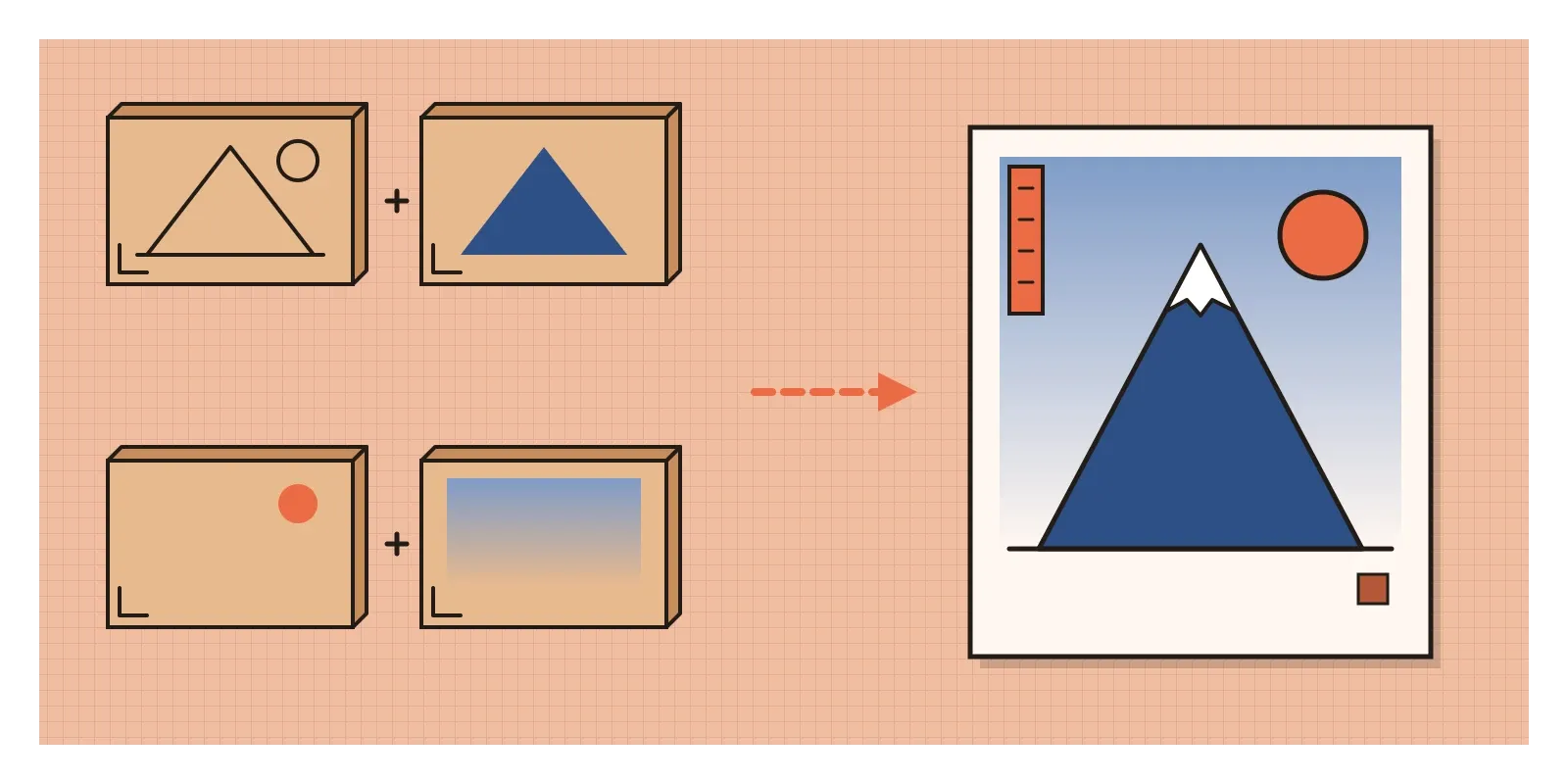
Gradients exist, but they're made by hand. In a technique called bokashi, the printer wiped or moistened part of the block so the colour faded across it, which is how a sky deepens from pale at the horizon to dark blue at the top. Luxury prints add embossing or mica. Compositions are often surprising. Viewpoints are high, objects are cut off by the edge of the sheet, a diagonal road or river carries the eye across the picture, and big empty areas are left alone. Ukiyo-e also borrowed. From the 1740s, artists such as Okumura Masanobu tried the deep, single-point perspective of European prints brought in by Dutch traders, and later landscape artists mixed it with Japanese flatness.
Text is part of the design. A title sits in a coloured cartouche, the signature runs down one side, and small seals record the publisher and the censor's approval, each placed as carefully as a figure.
Printed cloth from India, printed paper in Edo
India's clearest connection with this world runs through cloth. During the Edo period, Japan limited its foreign trade to the Dutch, on a small island in Nagasaki harbour, and to Chinese merchants. Among the goods they brought were painted and printed cottons from India, which the Japanese called sarasa. Indian chintz was prized in Edo. Pieces became pouches for tea utensils and linings for garments, and fragments were collected and treasured. Japanese dyers soon began imitating these cloths with stencils and blocks of their own, a type known as wa-sarasa, Japanese sarasa. So while Edo's printers rubbed colour onto paper, some patterns their customers admired came from Indian workshops printing cloth from carved blocks, much as the printers of Bagru and Sanganer still do, as I wrote in the post on pattern.
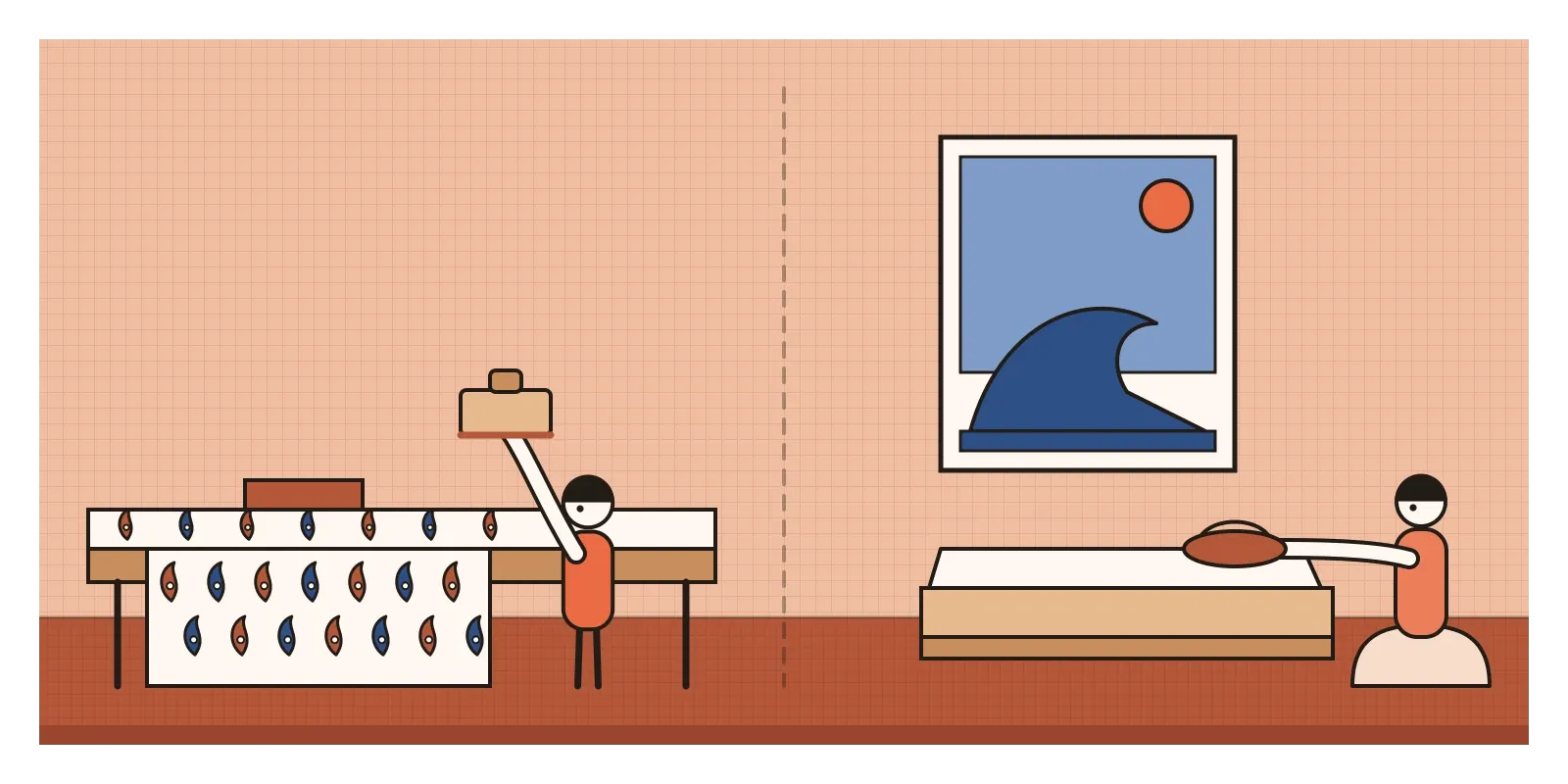
The two traditions used the same basic idea, a carved block and careful registration, for different ends. Indian block printing aimed at repeat and pattern across a length of cloth. Ukiyo-e used many blocks to build one image. The nearest Indian parallel to the print shops of Edo came a little later and is looser. From the early nineteenth century, presses in the Battala area of north Calcutta turned out cheap books, almanacs and pictures with wood and metal engravings, sold to ordinary city buyers rather than to courts. Like ukiyo-e, it was popular, commercial and looked down on by the educated. Calcutta's bazaar painters belong to the same story, and I'll come to them in the post on Kalighat painting.
Layers, registration and a wave on your keyboard
Anyone who has prepared a file for print has used ukiyo-e's logic. One block per colour is exactly how spot colour printing works, and the kentō marks are the ancestors of the registration marks in the corners of a printer's proof. Risograph printing, popular again with illustrators, works almost the same way, one drum per colour, and the layers panel in a design tool repeats the idea of an image built from flat pieces stacked in order.
The visual vocabulary has spread just as far. Strong outlines, flat fills, no shadows and a small, confident palette describe a good deal of today's editorial illustration and app spot art, and much of the flat design that I'll come to near the end of this series. Manga carries the line and the dramatic crop, and Hokusai's sketchbooks, published from 1814 as Hokusai Manga, helped popularise the word. The emoji that began in Japan in the late 1990s are tiny flat pictures in the same spirit, and Apple's water wave emoji has often been said to echo Hokusai. The most useful lesson may be the workshop itself: a publisher who understood the market, a designer, and craftspeople whose skill decided whether the drawing survived the cutting. That's a product team.
What the prints leave out, and where to find them
Ukiyo-e is easy to romanticise, and it deserves some hard questions. Its favourite subject, the beautiful courtesan, was usually a woman sold into a contract as a girl to pay a family's debt, unable to leave the Yoshiwara until it was paid. The prints worked partly as advertising for the quarter, and their glamour was not the life most of those women lived. Credit was uneven too: we know the designers, but carvers and printers were rarely named.
The government watched closely. In 1804 Utamaro was manacled for fifty days for prints showing the sixteenth-century warlord Toyotomi Hideyoshi, a forbidden subject, and he died two years later. During the reforms of the early 1840s, prints of actors and courtesans were banned outright. Kuniyoshi responded with prints of cats and goblins that buyers read as jokes about the authorities. Educated opinion long treated ukiyo-e as vulgar, and after Japan opened to the West in the 1850s, photography and new printing methods took its market. By around 1900 the old trade had largely faded. Two Japanese movements replied: the "new prints" of the 1910s, which revived the workshop system for landscapes and beauties, and the "creative prints", in which one artist did the drawing, carving and printing alone. What happened when ukiyo-e reached Europe is a story for the post on Japonisme.
Few Indian museums have ukiyo-e on show, though the Japanese gallery at the Salar Jung Museum in Hyderabad gives a feel for Japanese decorative art of the period. For the prints, browse the large collections the British Museum and the Art Institute of Chicago have put online at high resolution, where you can zoom in far enough to see the wood grain and the bokashi. Then pick one print and redraw it with a black outline and three flat colours, one of them blue, and no shading. You'll see how much the colour planning is doing. Look at The Great Wave again afterwards. The foam breaking into claws, the gradient of the sky, the tiny mountain: every decision had to survive a carver's knife and a printer's hand before a customer in Edo could buy it for not much more than a meal. In the next post, on Neoclassicism, we go back to Europe in the 1750s, where artists were looking hard at the ancient past.
Further reading: Richard Lane, Images from the Floating World: The Japanese Print (1978) · Timothy Clark, Hokusai: Beyond the Great Wave (2017) · Christine Guth, Hokusai's Great Wave: Biography of a Global Icon (2015) · Julie Nelson Davis, Partners in Print: Artistic Collaboration and the Ukiyo-e Market (2015)
A reply toThe Kanō school's ink and gold, painted for samurai and temples rather than the people of Edo.