The Great Exhibition of 1851
A glass hall in Hyde Park showed off a century of industry, and convinced its critics that design had gone wrong.
The Great Exhibition of 1851
A doodle on pink blotting paper
On 11 June 1850, a railway company held a board meeting in Derby, and one of the people around the table wasn't really listening. Joseph Paxton, head gardener to the Duke of Devonshire at Chatsworth and a director of the Midland Railway, pulled a sheet of pink blotting paper towards him and began to draw in pen. A long, low building, its sides made of glass. A tall arched roof crossing the middle. A rough section showing how it might stand up. The sketch, which his wife kept, is now in the Victoria and Albert Museum, and it's one of the most famous doodles in the history of architecture. Within about a week, Paxton's office at Chatsworth had turned it into proper drawings.
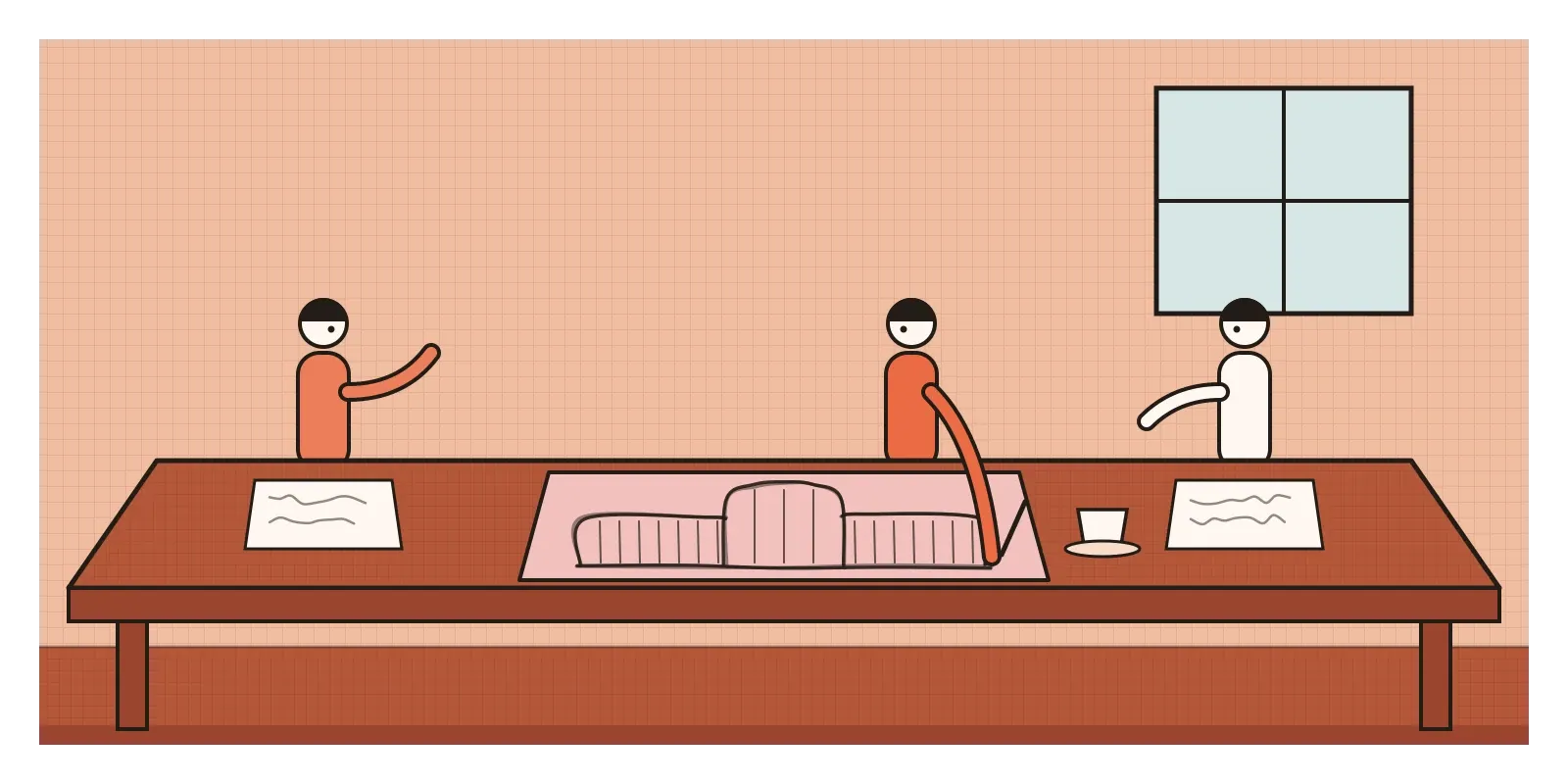
He was solving someone else's problem. London had promised to host a huge international exhibition in Hyde Park the following spring, and the committee in charge of the building was in trouble. It had rejected around two hundred and fifty competition entries and produced its own design, a heavy brick hall with an enormous dome that would have been slow to build and hard to remove. Paxton offered something completely different, a building made almost entirely of standard iron and glass parts that could be manufactured in factories, bolted together on site and taken apart again. To win public support, he had his design published in the Illustrated London News. The committee gave way.
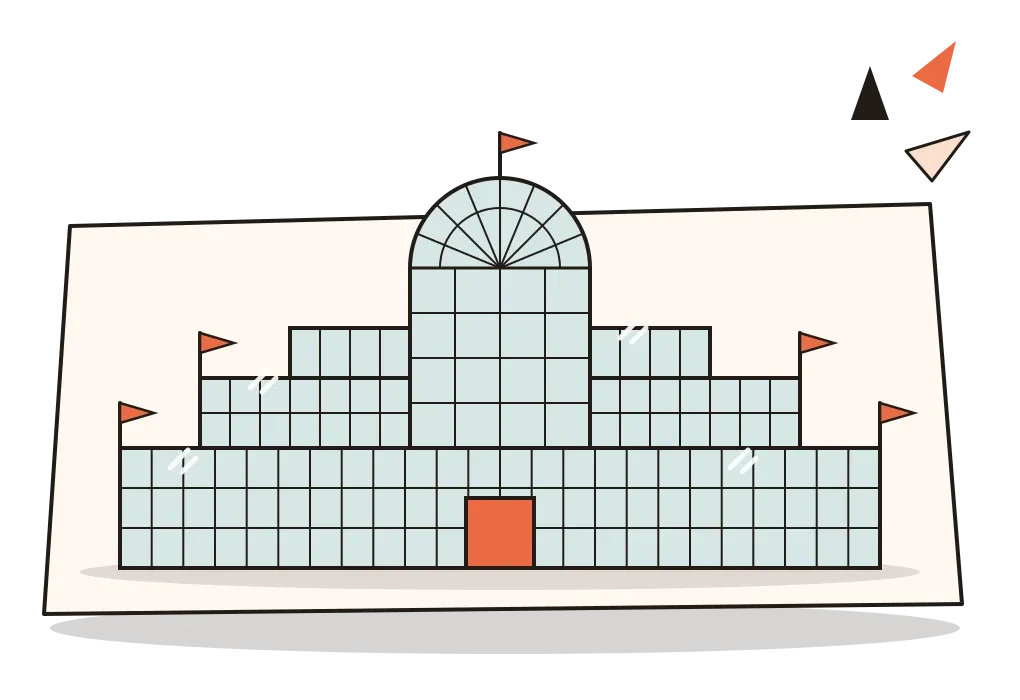
The building became the Crystal Palace, and the event it housed, the Great Exhibition of the Works of Industry of All Nations, ran from 1 May to 15 October 1851. It wasn't a movement in the usual sense. It was a single enormous show, with around a hundred thousand objects from all over the world, and over six million visits. But it matters to this series because it was a turning point in the conversation. It put a century of industrial making on display in one place, and many of the people who walked through it decided that something about design had gone badly wrong.
A giant lily and a greenhouse for the world
The exhibition was the project of a small group of reformers, led by the civil servant Henry Cole and Queen Victoria's husband, Prince Albert, working through the Society of Arts. France had been holding national exhibitions of its own industries in Paris since 1798, and Cole had visited the one in 1849. The British version would be bigger and international, open to every nation. It was a reply to the flood of factory goods I described in the last post, a chance to show it off and to judge it. Britain's leaders were proud of their machines but anxious about the look of what they made, and here British goods would be compared, side by side, with the best of everyone else.
Paxton's idea came from plants. At Chatsworth, in November 1849, he had become the first gardener in Britain to make the giant Amazonian water lily, then called Victoria regia, flower. Its leaves can grow wider than a person is tall, and underneath, a network of deep, radiating ribs makes them strong enough to float a surprising weight. To show this off, Paxton stood his young daughter Annie on a leaf, a scene the Illustrated London News printed. He built the lily a new glasshouse with a roof of light ridges and furrows supported on slender ribs, and he later said the leaf's structure had given him ideas. The Crystal Palace was, in many ways, that lily house scaled up.
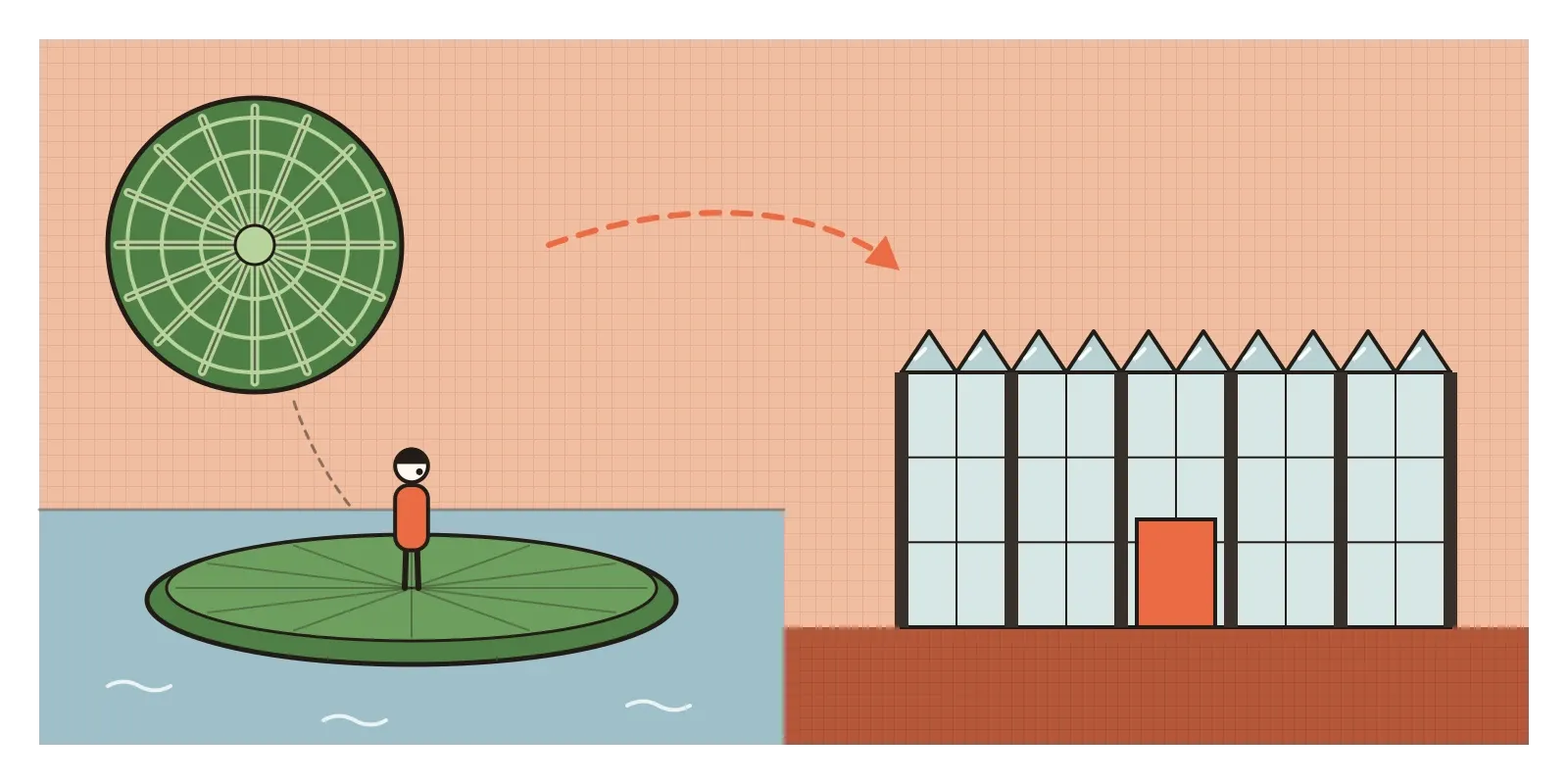
Scaled up is an understatement. The finished building was about 560 metres long, roughly five times the length of a football pitch, with close to three hundred thousand panes of glass made by Chance Brothers near Birmingham. Everything followed a strict grid, so the same cast-iron columns, girders and frames could be made in thousands and repeated. The arched transept was made tall enough to enclose a row of old elm trees rather than cut them down. The building went up in a matter of months, and the interior ironwork was painted in stripes of red, yellow and blue chosen by Owen Jones, the designer whose ideas about flat ornament I wrote about in the post on Indian aesthetic concepts.
Locks, reapers and a knife with too many blades
Inside, Britain and its colonies filled the western half and other nations the eastern half. Some of the most talked-about exhibits weren't British at all. In a London shop window, the firm of Joseph Bramah had displayed a padlock since around 1790, with a promise of two hundred guineas to anyone who could pick it. During the exhibition, an American locksmith named Alfred Charles Hobbs took up the challenge. Working in a room above the shop, he opened it after about fifty-one hours spread over sixteen days, and after an argument, the firm paid.
Other American exhibits made a quieter but deeper impression. Cyrus McCormick's mechanical reaper, which looked crude beside polished British machinery, outperformed its rivals in field trials. Samuel Colt's revolvers were made with parts so consistent that pieces from one gun could fit another. Within a few years, British engineers who went to study American factories were describing an "American system of manufactures", the approach that would eventually lead to the assembly line.
Some exhibits made the opposite argument. The architect A. W. N. Pugin, who believed Gothic was the only honest way to build, arranged a Medieval Court full of church furniture, stained glass, metalwork and tiles made by craftsmen working in medieval styles. And there were the showpieces of virtuosity, objects made to prove that nothing was too elaborate for modern industry. The Sheffield cutlers Joseph Rodgers and Sons, for example, showed a sportsman's knife with around seventy-five blades and tools folded into one handle.
A plain building full of fancy things
The strangest thing about 1851, looked at with a designer's eye, is the contrast between the container and its contents. The building was the future: a repeated grid of standard parts, light, transparent, without carved ornament, built and dismantled like a kit. Many twentieth-century architects later saw it as an ancestor of modern architecture. The things inside it mostly looked backwards. Sideboards were carved with whole historical scenes. Vases were Gothic, Renaissance, Rococo and Chinese at once. Papier-mâché was made to look like lacquer, cast iron to look like carved wood and electroplate to look like silver. Patterns of flowers were shaded to look three-dimensional on carpets and wallpapers, the problem the reformers complained about in the story I told in the post on Indian aesthetic concepts.
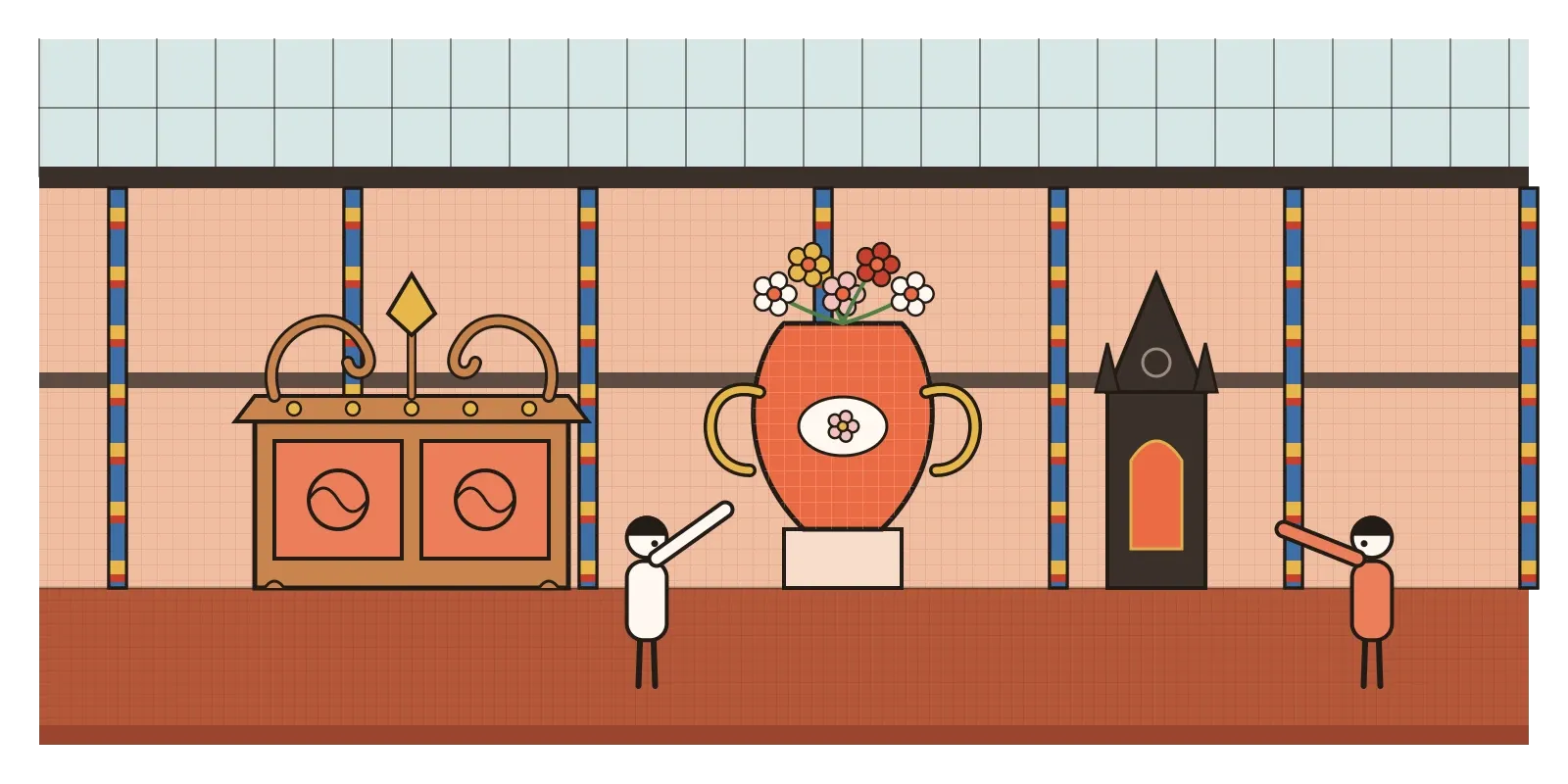
Most visitors seem to have loved the abundance. But for the reformers it was a lesson in what happens when machines make ornament cheap and nobody asks whether it belongs. The German architect Gottfried Semper, then a political refugee in London who helped arrange several national sections, wrote a short book in 1852, Science, Industry and Art, arguing that industry had pulled ornament loose from the materials and techniques that once gave it meaning. If you want a single test for spotting the 1851 look, it's that: the decoration could be lifted off and put on something else, and nothing would change.
A diamond in a birdcage
For many visitors, the star exhibit came from India. The Koh-i-Noor diamond was shown in the main avenue, inside a protective iron cage, lit by gas jets. It had passed through Mughal, Persian, Afghan and Sikh hands before Britain annexed the Punjab in 1849. Under the Treaty of Lahore that followed, the young Maharaja Duleep Singh, then about ten years old, was made to surrender it to Queen Victoria, and it was presented to her in 1850. People queued to see it and many went away disappointed. Its old cut, designed to preserve weight rather than to sparkle, looked dull under the hall's light. In 1852, Prince Albert had it recut by cutters from the Amsterdam firm of Coster, working in the workshop of the jewellers Garrard in London. It came out brighter, and the stone's weight fell from about 186 carats to about 105.6.
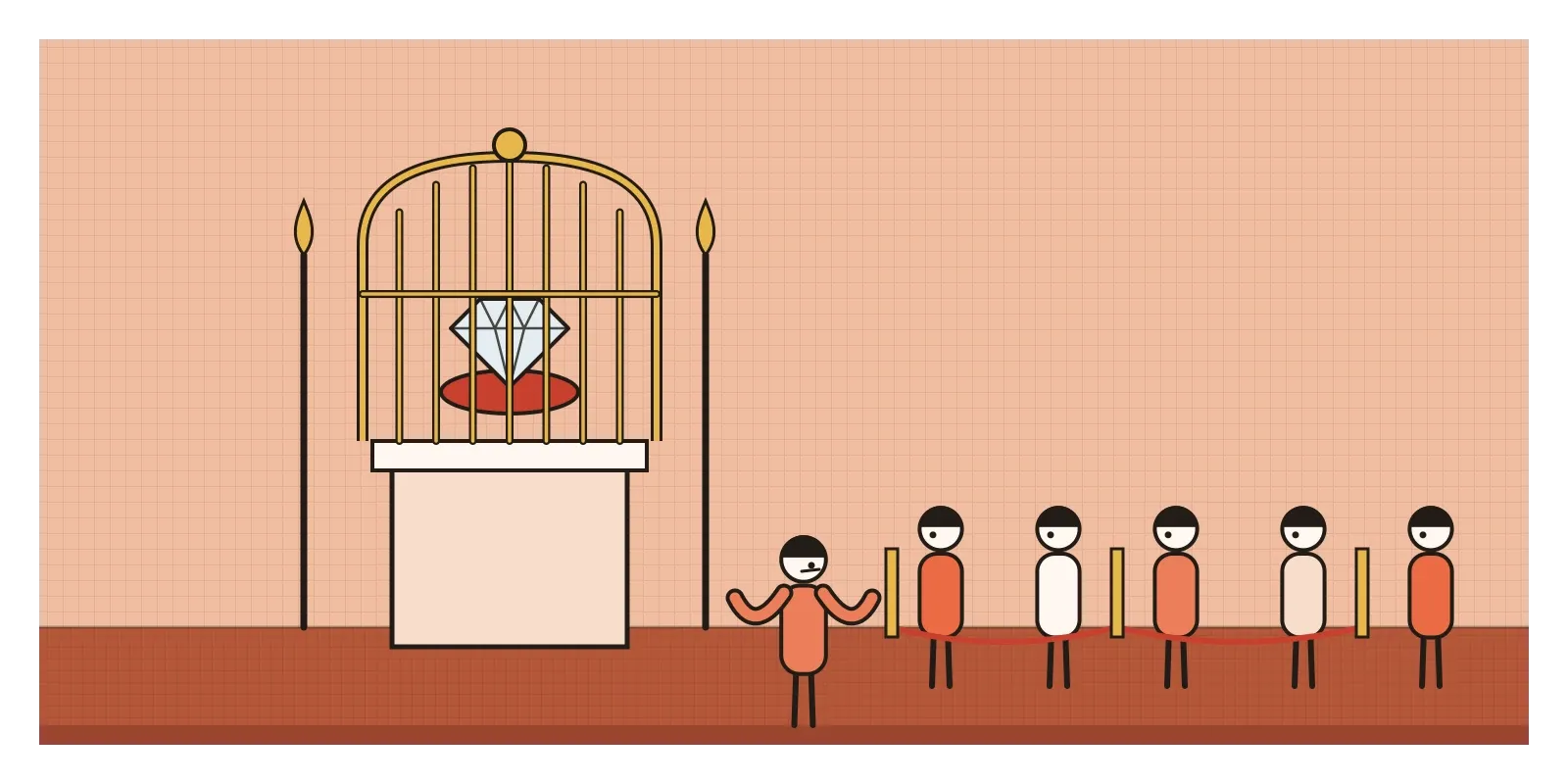
The diamond now sits in a crown in the Tower of London, claimed by India, Pakistan and Afghanistan. Nearby in 1851 stood another gift, a throne and footstool carved in ivory by craftsmen in Travancore and presented to the Queen by its Maharaja, which is still in the Royal Collection. The Indian section, arranged by the East India Company, was one of the largest in the building, full of textiles, carpets, arms and jewellery. As I wrote in the post on Indian aesthetic concepts, design reformers walked through it admiring its flat, well-ordered patterns.
What I notice now is the framing. Britain displayed its own machines, and displayed India mostly as treasure, raw material and handicraft, as if one part of the empire made the future and the other supplied beautiful things from the past. The diamond in its cage, taken from a child and then cut down to suit Victorian taste, is an uncomfortable emblem of that whole arrangement.
From Hyde Park to the product launch
The exhibition made a profit of around £186,000, and the commissioners used it to buy land in South Kensington for a cluster of museums and colleges, including what became the Victoria and Albert Museum, the Science Museum and Imperial College. The idea that a country should collect good design, teach it and measure its industries against the world's best came straight out of 1851. So did the format. Paris answered with its own Exposition Universelle in 1855, then world's fairs followed for the next century and a half, and Expos are still held today. Trade fairs like the Salone del Mobile in Milan or the Consumer Electronics Show in Las Vegas, and the stage-managed product launch with a single object under a spotlight, are all descendants of that walk down the main avenue to see the diamond.
The building has descendants too, in railway sheds, airport terminals and glass-walled shops built from repeated standard parts. In digital design, I think the lasting lesson is about container and contents. It's quite possible to build a clean, modern system, a tidy grid and a component library, and then fill it with content that fights it, every element dressed in a different style because it was easy to add. The reformers of 1851 would recognise the problem at once.
Greenhouses, horrors and a fire
Critics weren't all charmed by the building either. John Ruskin dismissed the Crystal Palace as little more than an enormous greenhouse, proof only that a country could make a great deal of glass. The reformers' own response was more pointed. In 1852, Henry Cole opened a Museum of Ornamental Art at Marlborough House in London, and included a room called "Examples of False Principles in Decoration", full of things like carpets of shaded flowers and wallpapers with realistic landscapes. Visitors nicknamed it the Chamber of Horrors, a satire in Charles Dickens's magazine Household Words mocked it, manufacturers complained, and it didn't last long.
The exhibition's limits went deeper than taste. It was a celebration of empire as much as industry, with colonised peoples present mainly through their goods. Working people were admitted cheaply on "shilling days" but mostly as spectators, and very few women appeared among the exhibitors. When it closed, the Crystal Palace was taken down and rebuilt, larger, at Sydenham in south London, where it stood until it burned down in 1936. Its most important reply came from a group of young designers who decided that the answer to machine-made clutter was to go back to the workshop, which a later post on the Arts and Crafts movement takes up.
To see the legacy in India, visit the Dr. Bhau Daji Lad Museum in Mumbai. It was founded in 1855 and opened in its present building in 1872 as the Victoria and Albert Museum, Bombay, a museum of decorative and industrial arts on the South Kensington model, so it's a direct descendant of the Great Exhibition's idea. Its restored interior of painted cast iron is a small taste of what 1851 felt like. Then, next time you're in a mall, an airport or a trade fair, separate the container from the contents. What is the building doing, what are the things inside it doing, and do they agree?
Paxton's doodle took a few minutes on a sheet of blotting paper during someone else's meeting. The arguments it set off, about machines, ornament, honesty and empire, took the next century. In the next post, on Realism, I'll cross to Paris in 1855, where a painter whose two biggest canvases had been turned down by that city's answer to 1851 built his own exhibition next door.
Further reading: Jeffrey A. Auerbach, The Great Exhibition of 1851: A Nation on Display (1999) · Kate Colquhoun, A Thing in Disguise: The Visionary Life of Joseph Paxton (2003) · Gottfried Semper, Science, Industry and Art (1852) · William Dalrymple and Anita Anand, Koh-i-Noor: The History of the World's Most Infamous Diamond (2017)
A reply toA century of factory goods that nobody had yet stood side by side and judged.