Realism
Painters who put stone breakers, village funerals and crowded train carriages on canvases meant for kings.
Realism
A shed full of paintings beside the world's fair
In 1855, Paris answered London's Great Exhibition with an Exposition Universelle of its own, including an enormous show of painting from across Europe. Gustave Courbet, a thirty-six-year-old painter from a farming family in the Jura, sent in a batch of works. The jury accepted eleven and turned down the two he cared about most, both huge: A Burial at Ornans, which had already caused a scandal a few years earlier, and a new canvas nearly six metres wide called The Painter's Studio. Courbet's response was to build his own exhibition. With help from his patron, Alfred Bruyas, he put up a temporary pavilion on the avenue Montaigne, within sight of the official fine art building, hung around forty of his works inside and gave it a blunt sign: Realism.
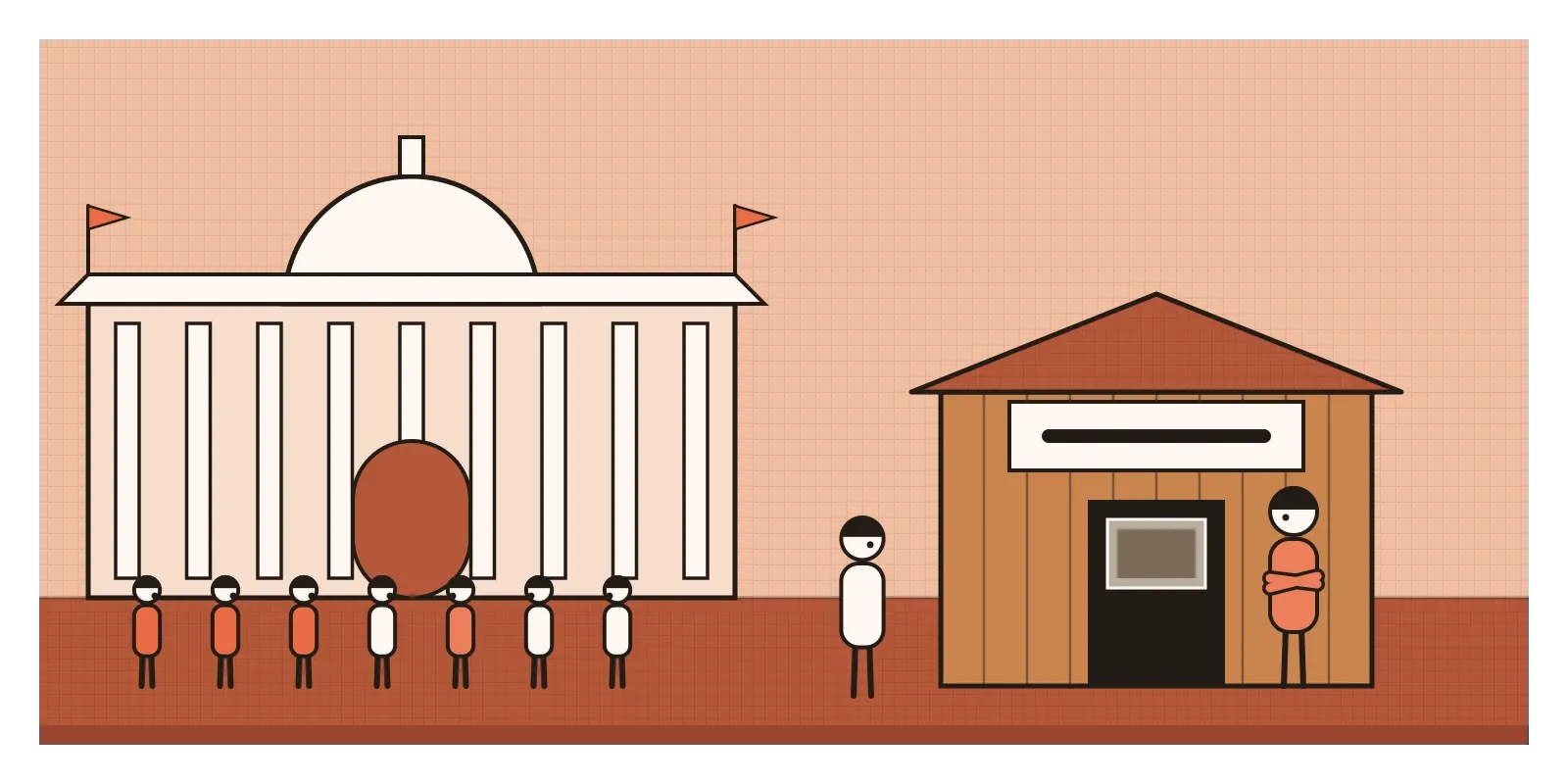
Not many people paid to go in. One who did was Eugène Delacroix, the great Romantic, who wrote in his journal that he'd spent an hour there and found a masterpiece in the picture the jury had refused. Courbet's catalogue, listing thirty-eight paintings and four drawings, opened with a short statement. The label "realist", he said, had been imposed on him, but his aim was to show the customs, ideas and appearance of his own time as he saw them, to make living art.
That's the clearest definition of the movement we have. Realism, which flourished roughly from the late 1840s to the 1880s and was strongest in France, set out to show ordinary contemporary life honestly, without idealising it, and without the myths, heroes and grand emotions that painting had been built around. Novelists such as Honoré de Balzac and Gustave Flaubert were doing something similar in fiction. A gallery wall, the Realists argued, could hold a road mender or a funeral in a muddy village as seriously as a Greek god.
Peasants at the size of kings
To see why that was provocative, you have to know how French art was ranked. The Academy, which trained artists and controlled the official exhibitions, arranged subjects in a hierarchy. History painting, meaning scenes from the Bible, classical myth and great events, sat at the top and was painted on vast canvases. Portraits came next, then scenes of everyday life, landscapes and still lifes, painted smaller as befitted their lower rank. Romanticism, the subject of an earlier post, had broken some of these rules, but it still reached for drama: shipwrecks, battles, exotic lands and stormy emotion.
Realism replied to both. It took the most humble subjects and painted them at the scale of history. Politics helped. In 1848 a revolution in Paris overthrew the king and briefly created a republic, and questions about workers and the rural poor were suddenly urgent. Photography, announced in 1839, was showing people what an unidealised face or street actually looked like. And railways were bringing provincial life closer to Paris, where the critics lived.
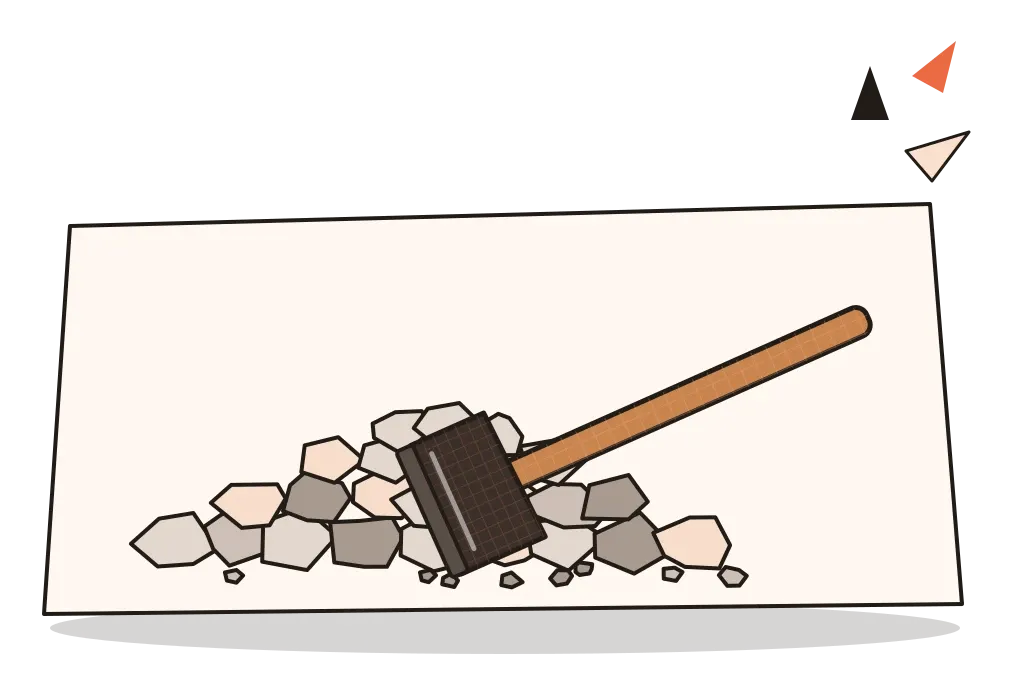
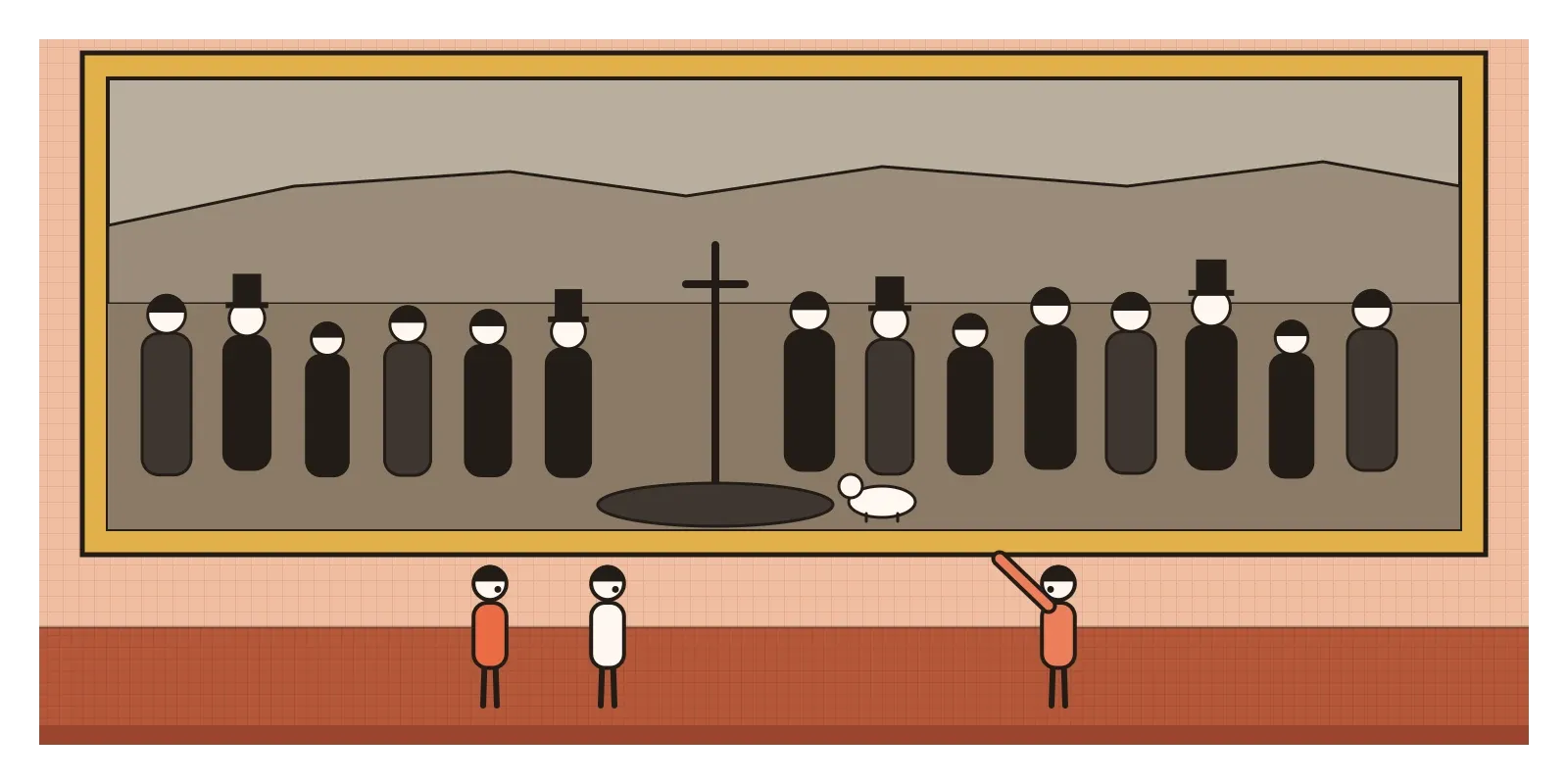
Courbet's A Burial at Ornans, painted in 1849 and 1850, is the clearest example. It's more than six metres wide and shows a funeral in his home town, with dozens of life-size villagers in black standing around an open grave: the priest, the mayor, men in tall hats, women weeping into handkerchiefs, a dog. The villagers posed for him themselves. There's no saint, no hero and no clear centre. When it was shown at the Paris Salon of 1850 to 1851, critics called it ugly and vulgar. The point was that nobody important was in it, yet it was the size of a picture about an emperor. Another painting from 1849, The Stone Breakers, showed two labourers, one old and one a boy, breaking rocks by a road, their faces turned away from us. It was destroyed in Dresden during the Second World War and survives only in photographs.
Gleaners, travellers and a woman in trousers
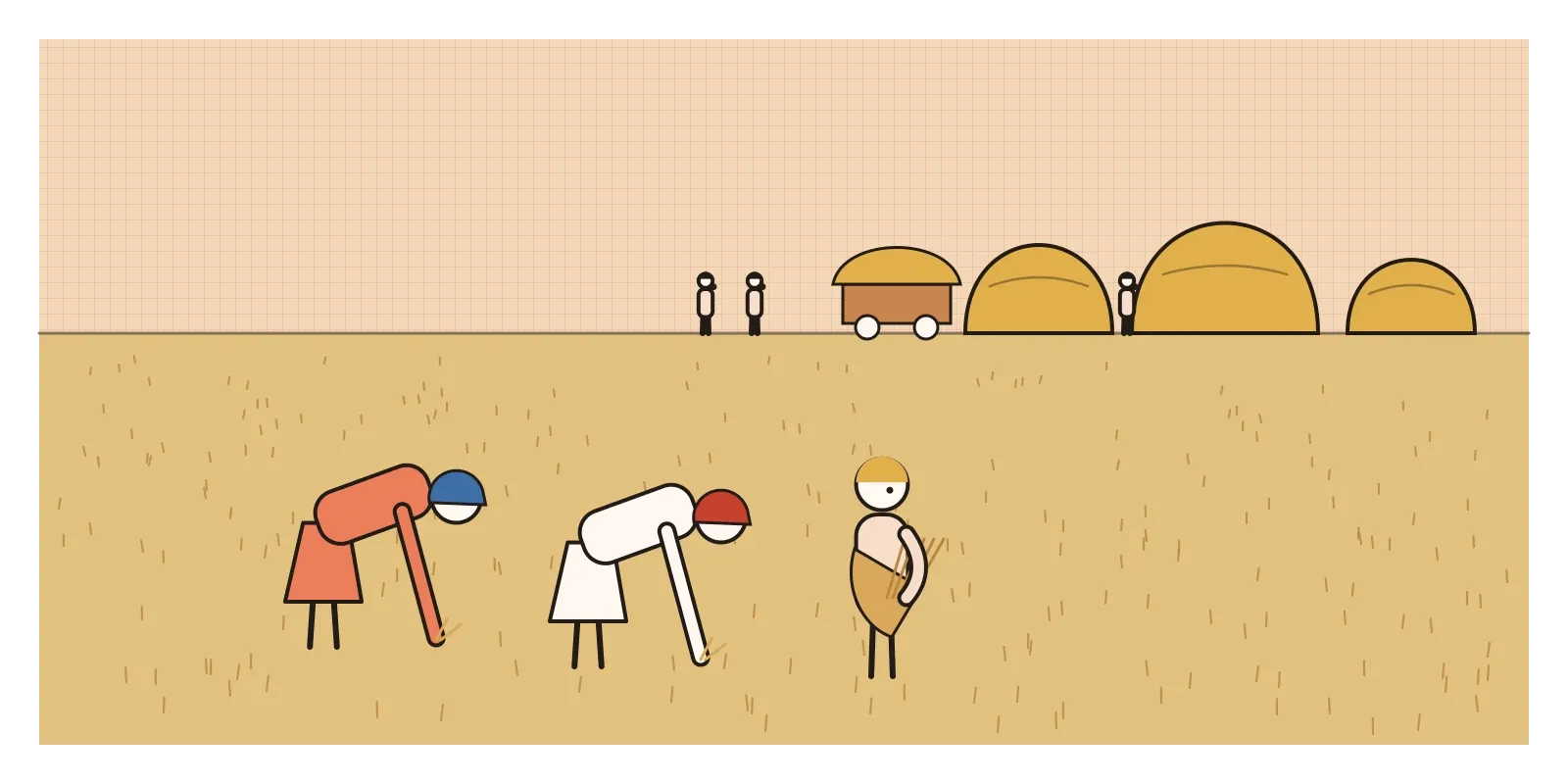
Courbet was loud about Realism, but he wasn't alone. Jean-François Millet, who lived in the village of Barbizon near the forest of Fontainebleau, spent his career painting farm workers. In The Gleaners of 1857, three women stoop in a stubble field, picking up the few ears of wheat left behind after the harvest, which the poorest villagers were allowed to collect. In the distance, under a golden haze, are huge haystacks and a busy harvest. Millet never spells out the contrast between the bent backs in front and the abundance behind, but some critics read the painting as a political threat.
Honoré Daumier earned his living as a caricaturist for Paris newspapers, and in 1832 he spent six months in prison for a cartoon showing King Louis-Philippe as a giant gobbling the people's taxes. His paintings are quieter. In The Third-Class Carriage, from the early 1860s, passengers sit pressed together on hard wooden benches in a dim railway carriage: a grandmother with a basket, a young mother nursing a baby, a boy asleep. Nobody is doing anything remarkable. They're just tired, and the painting lets you sit with them.
Rosa Bonheur, the most successful woman painter of her day, brought the same attention to animals and the people who worked with them. To study horses for The Horse Fair, a huge canvas finished in 1855, she sketched for months at the horse market in Paris. She held a police permit allowing her to wear trousers, which she said she needed for working in markets and slaughterhouses. Realism also spread well beyond France. In Russia, painters who had broken with the Imperial Academy formed the Wanderers in 1870, taking travelling exhibitions of scenes from ordinary Russian life around the country. Ilya Repin, whose painting I mentioned in the post on how the eye sees, was one of them.
Mud, black and a palette knife
Realist paintings are easy to spot once you know what to look for. The subjects are ordinary people in their own clothes, doing work, travelling, waiting or mourning, often shown life-size or close to it. Their bodies aren't smoothed or perfected. Hands are rough, clothes are worn and faces are often turned away or hidden, so that a person stands for a whole kind of life rather than becoming a heroic individual.
The compositions are often flat and spread out. Instead of the neat pyramids of figures that academic painting favoured, with the important person at the top, Realists lined people up across the canvas like a frieze, or let the picture feel unarranged, as if you'd just come upon the scene. The colours are earthy: browns, ochres, dull greens, greys and a great deal of black, often over a dark ground. Courbet sometimes laid paint on with a palette knife, giving rocks and earth a heavy, physical surface. Light is usually plain daylight or gloom rather than dramatic spotlighting. And there's rarely a moral. A Realist painting presents a situation and leaves you to decide what you think about it.
Hunger drawn in ink
In India, the word "realism" usually brings to mind something else: the academic technique of shading, perspective and lifelike skin taught in the colonial art schools, which a later post on Raja Ravi Varma and Indian academic realism takes up. That's realism as a way of painting. Courbet's Realism was more about what you choose to look at, and its closest Indian parallel came almost a century later, in Bengal.
In 1943, during the Second World War, a famine killed millions of people in Bengal. Its causes, from wartime policy and soaring rice prices to the failure of the colonial government to respond, are still argued over, and the economist Amartya Sen's work on it helped change how famines are understood. That November, the young artist Chittaprosad Bhattacharya walked through the Midnapore district, drawing what he saw and writing reports for the Communist Party's paper, People's War. A selection of his drawings was published as a booklet, Hungry Bengal. The authorities seized and destroyed almost all of the five thousand copies, and the copy that survived, said to be one he sent to his mother, is now held by DAG in Delhi. In Calcutta, Zainul Abedin, a young teacher at the government art school, drew destitute families on the city's pavements in brush and ink on cheap paper. His famine sketches made his name, and he later became the founding figure of art education in what is now Bangladesh.
Neither was following Courbet, and the parallel is one of purpose rather than style. They used quick, spare lines, not big oil canvases. But like the French Realists, they insisted that ordinary people's suffering was a subject worthy of art, and refused to let it be prettified. Literature had made the same move a little earlier. Premchand's Hindi and Urdu fiction about peasants and debt, including his novel Godaan of 1936, is often called realist, and the same year he presided over the first meeting of the Progressive Writers' Association in Lucknow.
Ordinary people on the screen
Designers inherit Realism mostly through the images we choose. For years, stock photography was full of idealised people: impossibly happy families, businessmen shaking hands, women laughing alone at salads. In 2014, Getty Images and Lean In launched a collection of photographs showing women at work in more realistic, varied ways, a small but telling attempt to change the default. Many design systems now include illustration guidelines asking for a range of bodies, ages, homes and jobs. Realism's question, who is allowed to appear in the picture and how, is one designers answer every time they pick an image for a product.
Realism also lives on in research. Rosa Bonheur at the horse market is a good model for a design researcher: go where the work happens, watch for a long time and draw what's actually there. Personas built from real interviews, with real frustrations and messy routines, are more useful than invented ideal users. AI image tools make this harder rather than easier. Left to their defaults, they tend to produce glossy, idealised people and spotless rooms, a kind of new academy. Asking for ordinary, specific, slightly untidy reality is now a deliberate design choice.
Honest, but whose honesty?
Realism had real limits. Most of its painters were middle-class men in Paris, depicting poor people for buyers who would never break stones. Its honesty was always staged: Courbet's villagers posed one by one in his studio, and Millet's peasants were composed with great care. Within a few decades, some of those peasants had become sentimental icons, reproduced on calendars to make city people feel nostalgic. And while French Realists painted French farmworkers, France was expanding its empire in North Africa, a reality most of them didn't paint, and other French painters presented the region as exotic fantasy.
Courbet's own story ended badly. He took part in the Paris Commune, the workers' government of 1871, during which the Vendôme Column, a monument to Napoleon, was pulled down. He was blamed, imprisoned for six months and later ordered to pay for its rebuilding, and in 1873 he fled to Switzerland, where he died in 1877. By then, younger painters had taken Realism's love of modern life and dropped its mud and moral weight, choosing to paint light and leisure instead. That reply, Impressionism, comes a few posts later.
To see Realism for yourself, the Musée d'Orsay in Paris holds A Burial at Ornans, The Painter's Studio and The Gleaners, and its online collection lets you zoom in close. In India, DAG has exhibited Chittaprosad's work in Delhi and Mumbai and publishes much of it online. Then try a small exercise. Spend twenty minutes drawing someone near you at work, a vegetable seller, a cobbler, a security guard, with their permission, and resist the urge to make the scene nicer than it is.
Courbet's shed beside the world's fair is long gone, and in 1855 hardly anyone went in. But the question on its sign, what counts as worth looking at, has never gone away. In the next post, on the Pre-Raphaelite Brotherhood, I'll cross back to London, where a group of young painters also wanted truth, but went looking for it in every leaf of a riverbank and in the Middle Ages.
Further reading: Linda Nochlin, Realism (1971) · T. J. Clark, Image of the People: Gustave Courbet and the 1848 Revolution (1973) · Petra ten-Doesschate Chu (ed.), Letters of Gustave Courbet (1992) · Amartya Sen, Poverty and Famines (1981)
A reply toThe Academy's gods and heroes, and Romanticism's storms and shipwrecks.