
The Eames India Report
How a short 1958 report by two American designers, with no designs in it, shaped Indian design education.
The Eames India Report
A design report that opens with the Gita
In April 1958, a short typed report arrived at the Government of India's Ministry of Commerce and Industry. It had been written by Charles and Ray Eames, the American designers whose plywood and fibreglass chairs I described in the post on Mid-Century Modern, after three months of travelling through the country. Officials who opened it expecting a plan for factories, or at least a few drawings of products, found something odder. Before a single word about design, the Eameses had placed two passages from the Bhagavad Gita, on doing your work well without being attached to its fruits. The rest of the report reads less like a consultant's brief than an essay on how a newly independent country should think about the things it makes.
It doesn't propose a single product. There are no sketches of chairs, lamps or pots in it. What it proposes is a way of working, and an institution to teach it: "an institute of design, research and service". Three years later, in 1961, the government set up what became the National Institute of Design in Ahmedabad, and the report, usually just called the India Report, became the founding text of design education in India. Many Indian designers still quote it, and some have read it more times than any textbook.
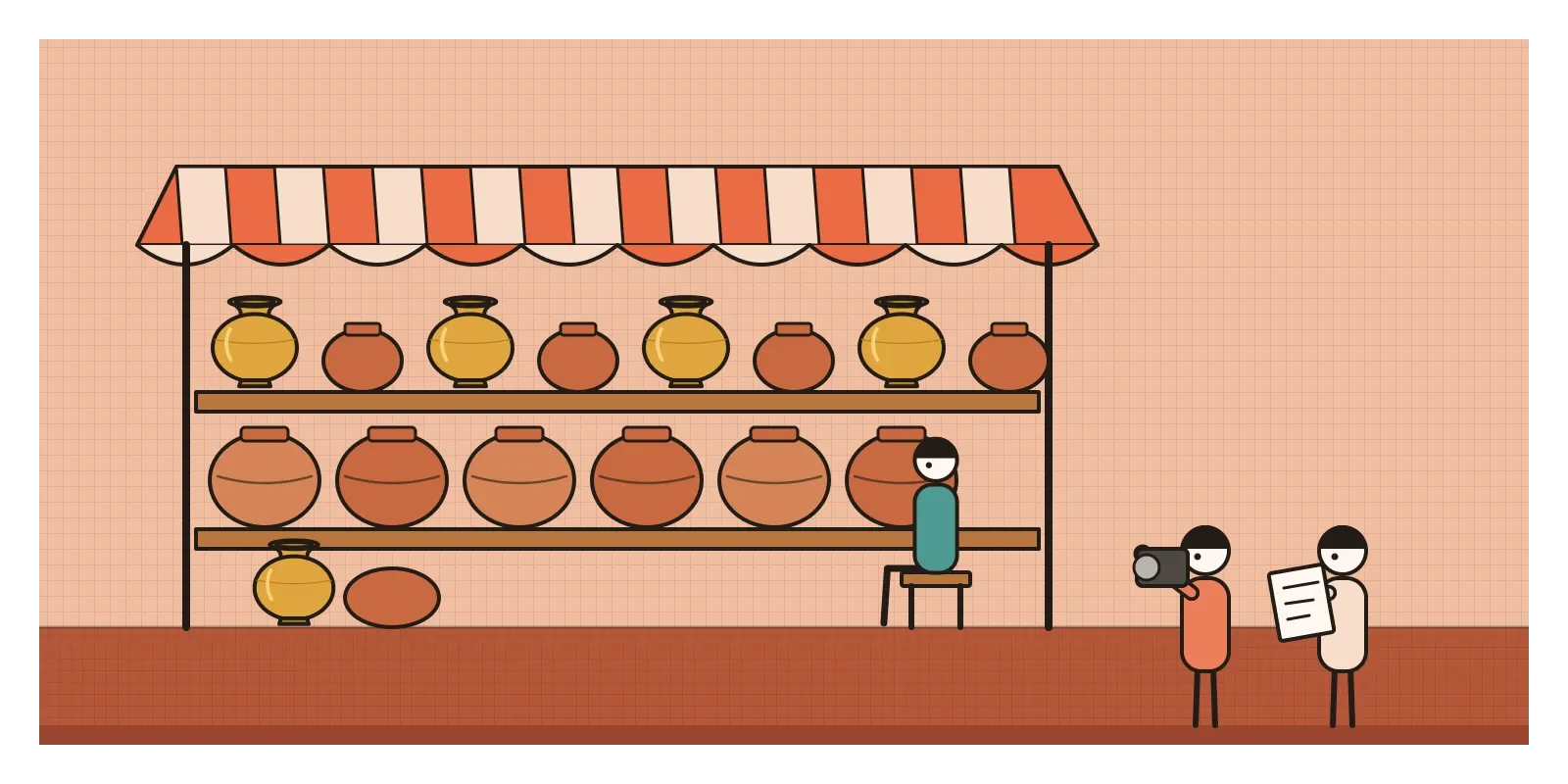
This post is about the report itself, the ideas in it and the world that produced it. The next post follows what India built from it.
Why Nehru's India asked two Americans
In the mid 1950s, Jawaharlal Nehru's government faced a practical worry. India was planning dams, steel plants and new industries, but most Indians still bought things made by small workshops and craftspeople, and the quality of those everyday goods seemed to be slipping as cheap imitations of foreign products spread. The government wanted advice on training in design that could help small industries. Pupul Jayakar, the writer and champion of Indian handlooms, had met Charles Eames when the Museum of Modern Art in New York showed Indian textiles in 1955, a story I told in the post on Mid-Century Modern, and she recommended the Eameses. The Ford Foundation, which was spending heavily on development projects in India, paid for their trip.
The Eameses arrived as famous designers, but they mostly listened. They met officials, industrialists, craftspeople, architects, scientists, teachers and writers, and they walked through villages, markets and workshops with cameras and notebooks. What they wrote replied to two things. One was the colonial art school, set up by the British in Bombay, Calcutta, Madras and Lahore to train draughtsmen and to make crafts suit European taste, where design meant decoration added to an object. The other was the fear, common at the time, that modernising India could only copy the West.
The report's argument starts from change. India, it says, is going through a change in kind, not just in degree, and the force driving it isn't simply Western influence but communication: once people can see and hear how others live, they can no longer make choices by inherited habit and must make them consciously. The Eameses thought India had three advantages in facing this: a philosophy that understood destruction as part of creation, the chance to learn from other countries' mistakes, and a set of needs, food, shelter, distribution and population, that were urgent and clear. Above all, it asked for a relentless search for quality rather than a national style. As I wrote in the post on design, art and craft, the report's most famous passage praises the lota, the brass water pot shaped by generations of makers and users. The Eameses used it to show that good form comes from understanding every factor at once, how a thing is filled, carried, poured, cleaned, stored, paid for and loved, and they hoped the new institute would learn to produce the lotas of their own time.
A burning house, a light and a post office
The second half of the report designs a school rather than an object, and that's where you can see its ideas most clearly. The institute would do research, training and service, each feeding the others. It would be linked to the ministry but independent enough to escape what the report called bureaucratic disintegration. It would start small, with about a dozen students and roughly as many permanent teachers, and it would keep that one-to-one ratio as it grew. Students would mostly be young architects, taken on, the Eameses wrote with a smile, not because of their design training but in spite of it, and taught for about two years. Teachers would come from engineering, economics, dance, sociology, film and much else, and the report warned against specialists who suddenly put on an "art hat" when they met a design problem. The director should be a mature administrator, not a designer.
It then suggested four kinds of project. The first was a continuing study of the standard of living in India, asking what people really value. To start it, the Eameses borrowed an exercise from their friend Buckminster Fuller: imagine your house is on fire, and decide what you'd take with you. The second was to study a rural family's home and surroundings, and the example they chose was light. Don't begin, they said, by designing a "lighting fixture"; begin by asking how electric power could become good light for reading, working and resting in a village home. The third was to design standard but adaptable public buildings, using the post office as the case, down to its signs, forms, stamps and uniforms. The fourth was design for occasions, festivals, state visits and parades, and here the report gently criticised the floats in the Republic Day parade for lacking any unifying idea, compared with the conviction of a temple procession.

Even the buildings were imagined with care. The Eameses suggested housing the institute at Fatehpur Sikri, Akbar's abandoned Mughal city near Agra, or else in plain, unmonumental buildings that worked with the climate, and they wanted students and some teachers to live together on campus so that ideas could grow around the clock. In the end the Sarabhai family argued for Ahmedabad, a city of textile mills and patrons, and won.
Ford money and a dome full of design
Seen from outside India, the India Report belongs to a particular moment in the Cold War. America and the Soviet Union were both courting newly independent, non-aligned countries, and design and culture were part of the courtship. The Ford Foundation's work in India was private, but it ran alongside American foreign policy. In January 1959, with a Ford grant, the Museum of Modern Art opened Design Today in America and Europe in New Delhi, a show of mass-produced furniture, tools, lamps and household goods selected as a guide for India's small industries. George Nelson's office designed the display, and it was housed in a geodesic dome designed by Buckminster Fuller and supplied by the United States Information Agency. More than a hundred thousand people saw it in three weeks, and after touring India the objects were handed over to the new design institute as a teaching collection.

Later that year, the Eameses filled another Fuller dome, at the American National Exhibition in Moscow, with Glimpses of the U.S.A., a film projected on seven huge screens at once. Design was diplomacy, and the Eameses were among its best-known faces. Compared with the schools I've written about recently, the India Report's institute sits in an interesting place. Like the Bauhaus, it wanted learning by doing and a mix of art and industry. Like Ulm, founded a few years earlier with American money of its own, it wanted research, method and design for the needs of a new democracy. But unlike either, it began by asking what an old, mostly rural civilisation already knew, and it put craft, villages and festivals on the same list as factories.
What people really value
Much of what the report asked for now sounds like ordinary good practice, which is a sign of how far its ideas travelled. Its first project, the study of what people value, is a direct ancestor of design research: watching how people live before deciding what to make for them. The lighting example is the cleanest statement I know of a lesson every designer has to relearn, that you shouldn't let the name of an existing product decide the shape of the answer. Ask for a light, not a lamp, and you might end up with a window, a solar torch or a reading room. When I worked on an agentic AI system at Rocketium, the most useful early conversations were the ones where we stopped asking what feature to build and asked what the people using it were really trying to get done.

The post office project anticipated service design, the work of designing a whole public service, its counters, forms, signs, waiting and paperwork, as one experience, and every government team that redesigns a passport office or an online form is working in that tradition. The report's picture of the designer as someone who helps others solve their own problems, rather than handing them finished objects, runs through participatory design and the community projects of Indian design schools. And its insistence on quality rather than style is a useful corrective in an age of AI image tools that can produce endless surface style in seconds. A tool can give you a hundred chairs that look Indian. It can't tell you what a family really needs to sit on.
Romance, distance and what was left out
The report has had sharp critics. The historian Pat Kirkham, an admirer of the Eameses, argued that they didn't really grasp the scale of the problems facing most Indians, such as food, shelter and manufacturers who cared only about profit. Officials who wanted a road map to modern industry found it too abstract to act on, and early teachers at the institute had to invent almost everything the report left vague. The art historian Saloni Mathur has pointed out that it has taken on something like the status of scripture in Indian design, quoted with reverence rather than read critically, and that its admiration for the timeless lota sits close to an old Western habit of seeing India as a land of ancient wisdom rather than a modern country with its own ideas.
Those ideas were already there. Rabindranath Tagore's school at Santiniketan, where Nandalal Bose taught art through craft, nature and festivals, had been doing something close to what the Eameses recommended for decades, and the report barely acknowledges Indian thinking about art education. Its voices are mostly those of officials and experts; the craftspeople it admired appear as makers of objects rather than as people with views. And the money behind it came with Cold War hopes about which way India would lean. The reply came from India itself. Within a few years teachers in Ahmedabad and Bombay were arguing about whether to follow the report, Ulm, Basel or their own traditions, and that argument is the next post.
Read it in an afternoon
The India Report is short, and the National Institute of Design has republished it, so you can read the whole thing in an afternoon. Do it with a pencil, and mark which ideas feel dated and which you'd still argue for. If you're in Ahmedabad, ask whether NID's campus by the Sabarmati is open for its graduation show, when the students' work is on display. Then try the Fuller exercise the Eameses borrowed. Walk round your home and decide which five things you'd carry out of a fire. Write down why. It's the quickest way I know to find out what people, including you, really value.
In April 1958, a government expecting product plans received an essay that began with the Gita. It asked India to work without anxiety about results and with relentless attention to quality, and to train designers who asked better questions. In the next post, on Indian design education, I'll follow what happened when that advice met real students, teachers, weavers and leather workers.
Further reading: Charles and Ray Eames, The India Report (1958) · Saloni Mathur, "Charles and Ray Eames in India" (2011) · Pat Kirkham, Charles and Ray Eames: Designers of the Twentieth Century (1995) · Saloni Mathur, India by Design: Colonial History and Cultural Display (2007)
A reply toThe colonial art school's idea of design as decoration, and the fear that a modern India could only copy the West.