
Indian Design Education
How NID, IDC and a village experiment in Rajasthan turned a foreign report into an Indian way of teaching design.
Indian Design Education
A university with no campus
In 1975, a group of management teachers and designers from Ahmedabad began turning up in the villages of Jawaja, a dry, poor block of about two hundred villages in Ajmer district, Rajasthan. The idea came from Ravi Matthai, who had recently stepped down as the first full-time director of the Indian Institute of Management Ahmedabad. He wanted to find out whether what a business school knew could be of any use to some of the poorest and most excluded people in the country, and he called the experiment a Rural University. It had no campus, no degrees and no fixed faculty. Its classrooms were courtyards, looms, tanning pits and market stalls.
IIM Ahmedabad brought in the National Institute of Design. Ashoke Chatterjee, who became NID's executive director that year, joined the work, and designers including the Finnish textile designer Helena Perheentupa and Nilam Iyer spent long periods with the weavers of the area, who made dhurries, and with leather workers of the Regar community, who had made saddles, harnesses and footwear for generations. The early visits went badly. Villagers saw the project as one more scheme from above. The designers had to unlearn the habit of arriving with answers, sit down and learn how the weavers dyed and wove, what debts they carried and what risks they could afford to take, before suggesting rugs and bags that city buyers might want. Out of that slow work came the Jawaja Weavers Association and the Jawaja Leather Association, run by the artisans themselves.

Jawaja is a good place to start a story about Indian design education because it shows where that education ended up after fifteen years: not just in studios, but in villages, asking who design was for. Indian design education is my name here for the schools, teachers and ideas that grew from the Eames India Report, above all the National Institute of Design in Ahmedabad, founded in 1961, and the Industrial Design Centre at IIT Bombay, founded in 1969. Together they tried to build a modern design profession that belonged to India.
From a mill studio to a riverside campus
As I wrote in the last post, the India Report gave a direction but very few instructions. Turning it into a school fell largely to the Sarabhai family of Ahmedabad, mill owners and patrons of science and the arts, and above all to Gira Sarabhai and her brother Gautam. The government set the institute up in September 1961, at first under the name National Institute of Industrial Design, and it began in borrowed space in the family's Calico Mills before moving into Le Corbusier's new museum building in the city, the Sanskar Kendra. In the mid 1960s Gira and Gautam Sarabhai designed its own campus on the bank of the Sabarmati: long, low buildings of exposed concrete and brick with open studios and shaded courtyards.
Gira Sarabhai chose the first teachers. Dashrath Patel, a painter, potter and photographer, became the founding secretary and shaped the institute for twenty years. H. Kumar Vyas had studied industrial design in London and spent six months at Ulm, which I wrote about in the post on the Ulm School of Design. Because India had almost no trained designers to hire, NID decided to make its own. In 1964 it advertised for graduates in art, engineering and architecture, trained them, and sent many abroad to study in Switzerland, Germany, Italy, France and Britain. By 1969, when the first regular students arrived, about two dozen of those trainees had become NID's teachers. Visitors came for weeks at a time to set projects: the Swiss graphic designer Armin Hofmann, the type designer Adrian Frutiger, the designers Bob Gill and Ivan Chermayeff, and the architect Louis Kahn, who was then building IIM Ahmedabad down the road. The American furniture maker George Nakashima worked with the young architect Gajanan Upadhyaya on furniture for the institute.
Bombay took a different route. At IIT Bombay, the Industrial Design Centre started in 1969 as a postgraduate school inside an engineering institute, with V. N. Adarkar as its first adviser. Its longtime head was Sudhakar Nadkarni, who had studied product design at Ulm from 1962, and IDC took students who were already engineers or architects. Between them, NID's broad, craft-minded, studio-based school and IDC's more technical, research-minded one set the two poles that Indian design education has moved between ever since.
Folded paper, field notebooks and a client brief
You can recognise an Indian design education by a few habits. The first is the foundation programme, a year or so of exercises in line, form, colour, material, space and structure before any specialisation, adapted from the Bauhaus and Ulm courses I described in earlier posts. Students fold, cut, model and draw for months. At NID it took nearly a decade for the programme to find its own identity, through courses like Mohan Bhandari's environment awareness project, in which students studied a small corner of Ahmedabad, a street, a market or a bus stop, in exhaustive drawings. Rooms were called studios rather than classrooms, teachers worked at the same tables as students, and work was judged in open reviews where anyone could walk past and listen. Learning by doing, the Bauhaus idea Gira Sarabhai admired, became a daily routine: you made something, pinned it up, heard what was wrong with it and made it again.

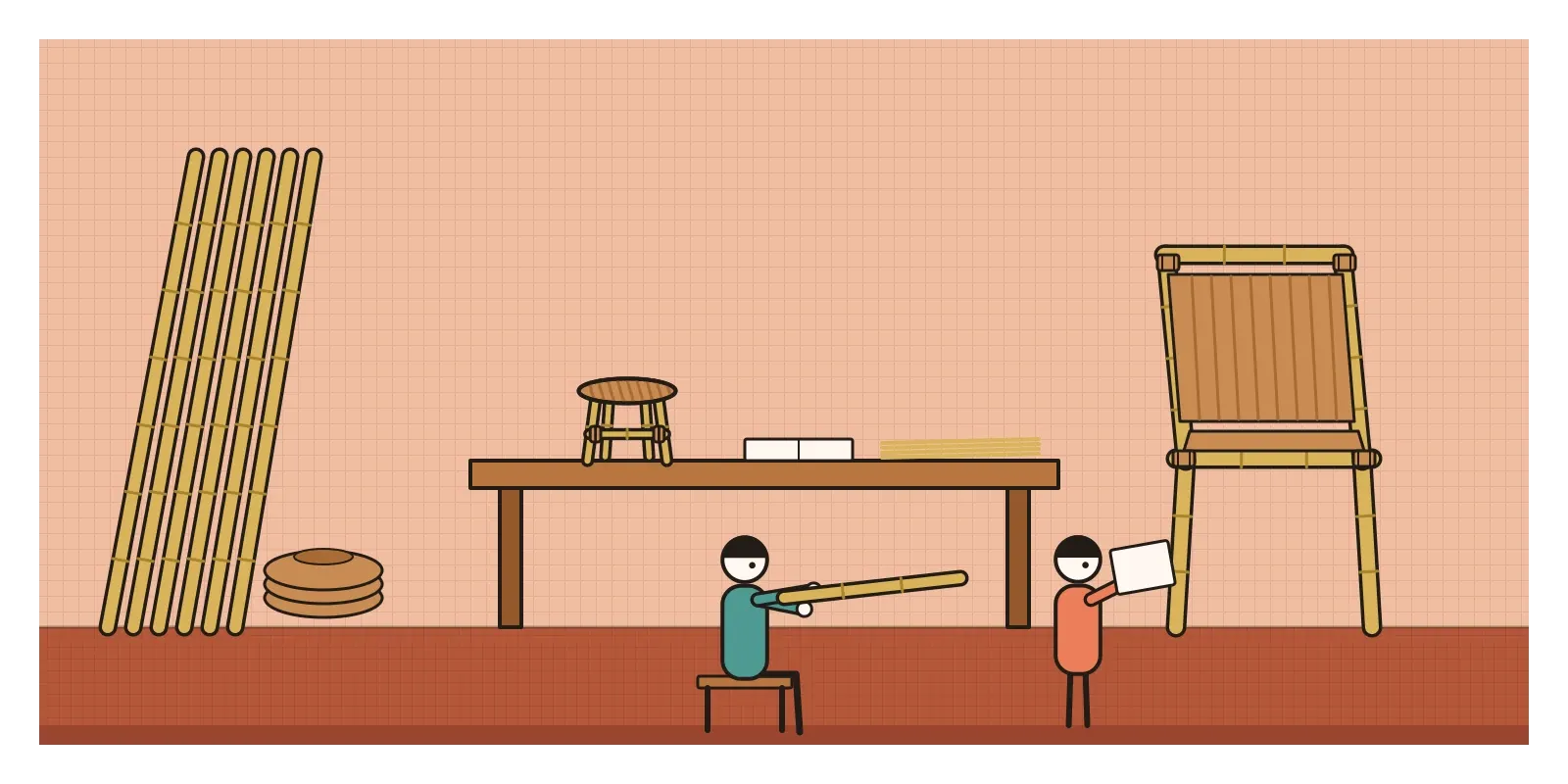
The second is craft documentation. Students go and live with a community of makers, potters, bell-metal casters, weavers or basket makers, and record every tool, material and step in drawings, photographs and interviews. The most famous body of this work is M. P. Ranjan's research on bamboo and cane crafts in north-east India, published with Nilam Iyer and Ghanshyam Pandya in 1986, which treated village basketry as serious engineering. The third is the real brief. Early on, NID students worked on projects for real clients, and the story goes that the Doordarshan logo, the spinning eye of Indian television, came out of a student studio in the 1970s and was picked by Indira Gandhi herself. The fourth is a concern with need: low cost, local materials, and products for people who can't afford imported goods. It's no accident that the rupee symbol, chosen in a national competition in 2010, was designed by D. Udaya Kumar, then a doctoral student at IDC.
Ahmedabad on the world map
Seen from outside, Indian design education was part of a wider conversation about design in what were then called developing countries. Its teachers borrowed freely: Ulm's method and Hans Gugelot's 1965 workshop, Basel's typography through Hofmann and the Indian designers who studied with him, the Eameses' faith in research, and Scandinavian and British craft training. But it also gave something back. In January 1979, the International Council of Societies of Industrial Design and the United Nations Industrial Development Organization held a meeting at NID that produced the Ahmedabad Declaration on Industrial Design for Development. It urged poorer countries to build design capacity of their own, rooted in their own needs and materials, rather than importing Western products and styles.

The same argument was being made elsewhere. Victor Papanek's Design for the Real World, published in English in 1971, attacked designers for serving consumer whims and pleaded for design for the poor, the disabled and the developing world. Gui Bonsiepe, one of Ulm's own graduates, went to Chile and later Brazil and Argentina, and wrote about design from what he called the periphery. India's distinctive contribution was its insistence on craft. Where Ulm saw handwork as something industry would replace, NID treated India's millions of artisans as a living industry and a store of design knowledge, which made it closer in spirit to Tagore's Santiniketan than to Ulm, even when its tools came from Germany.
Fifty years later, a whole profession
For decades, NID and IDC were almost the whole of Indian design education, with a few hundred graduates a year. Then the field widened. The National Institute of Fashion Technology was founded in Delhi in 1986, and it now has campuses across the country. NID itself grew new branches, a postgraduate campus in Gandhinagar and a research campus in Bengaluru, and IDC began awarding doctorates. The government approved a National Design Policy in 2007, and in 2014 Parliament passed an act that made NID an institution of national importance. New NIDs have since opened in Andhra Pradesh, Madhya Pradesh, Assam and Haryana, and hundreds of private design schools teach everything from fashion to interaction design. Many of the designers now building India's apps, payment systems and public digital services came out of these schools.
I see the old habits in my own work. The foundation year taught a generation of Indian designers to think with their hands, and the craft documentation tradition is the direct ancestor of the field research that product teams do before they design anything. S. Balaram, who taught at NID for many years, argued in Thinking Design that Indian design should start from Gandhian ideas of self-reliance and appropriate technology, and M. P. Ranjan, with Aditi Ranjan, edited Handmade in India, an encyclopaedia of the country's crafts. Their questions, who is this for and what can be made here, are good ones to put to any AI product that claims to work for a billion people.
Who gets to be called a designer
Indian design education has real limits, and its own graduates are often its sharpest critics. For most of its history it was tiny, urban, English-speaking and hard to get into, and it drew most of its students from the middle class. That raised an awkward question about craft. The craftspeople whose knowledge filled the documentation reports rarely got the title of designer, the fees or the credit, and a student could build a career on a community's skills while the community stayed poor. Hereditary artisans, many of them from castes that had long been excluded, almost never became design students themselves. Critics have also argued that the schools gradually turned from villages to corporate branding, export products and, later, tech companies, because that was where the jobs were.
Jawaja itself shows both sides. The associations it created still exist, and the leather craft of the area received a geographical indication tag in 2023, but the artisans have also faced shrinking demand, delayed payments and debt, and the hope that a few years of expert help could transform an economy proved too simple. The reply to this whole project is still being written, by the independent studios and craft-led brands that I'll come back to in the post on contemporary Indian design.
Visit a diploma show
The best way to see Indian design education is to visit a graduation show, at NID in Ahmedabad, Gandhinagar or Bengaluru, at IDC in Mumbai or at a NIFT campus near you, where students display their final projects and are usually happy to talk about them. Look for a craft documentation project and read it from start to finish. For a small exercise, document one maker near you, a tailor, a cobbler or a vegetable seller who builds a perfect display every morning. Draw their tools, ask how they learned, and write down one thing you'd never have known without asking.
That's what the designers at Jawaja had to learn in 1975. The expert had to become a student, and the university had no walls. In the next post, on Pop Art, I'll go back to London and New York in the 1950s, where artists were looking at a very different kind of everyday object: soup tins, comics and adverts.
Further reading: S. Balaram, Thinking Design (2011) · M. P. Ranjan and Aditi Ranjan (eds), Handmade in India (2007) · M. P. Ranjan, Nilam Iyer and Ghanshyam Pandya, Bamboo and Cane Crafts of Northeast India (1986) · Victor Papanek, Design for the Real World (1971)
A reply toThe colonial art school's split between art and craft, and a foreign report that said what a design school should be.