
Symbolism
How poets and painters at the end of the nineteenth century turned away from the visible world towards dream, myth and mood.
Symbolism
A tortoise covered in jewels
In 1884, the French novelist Joris-Karl Huysmans published a strange book called À rebours, usually translated as Against Nature. It has almost no plot. Its hero, the Duc Jean des Esseintes, the sickly last member of an old family, is so disgusted by modern Paris that he shuts himself away in a house outside the city and tries to live entirely through refined, artificial sensations. He builds a cabinet of liqueurs that he "plays" like a musical instrument, matching each drink to a sound. He arranges rare flowers chosen because they look like metal or diseased flesh. And, in the scene everyone remembers, he buys a live tortoise to set off the colours of an oriental carpet, decides its shell is too dull, has it glazed with gold and then encrusted with precious stones. A few days later the tortoise dies, unable to bear the weight of so much beauty.
Des Esseintes also owns paintings. He hangs two works by Gustave Moreau showing Salome, the dancer of the Bible who asked for the head of John the Baptist, and Huysmans spends pages describing their jewelled palaces and glittering, half-naked dancer. He collects the charcoal drawings of Odilon Redon, full of floating eyes and faces with eerie smiles. The novel became a cult book. Oscar Wilde's The Picture of Dorian Gray describes a poisonous yellow book that corrupts its hero, and most readers have taken it to be Huysmans's.
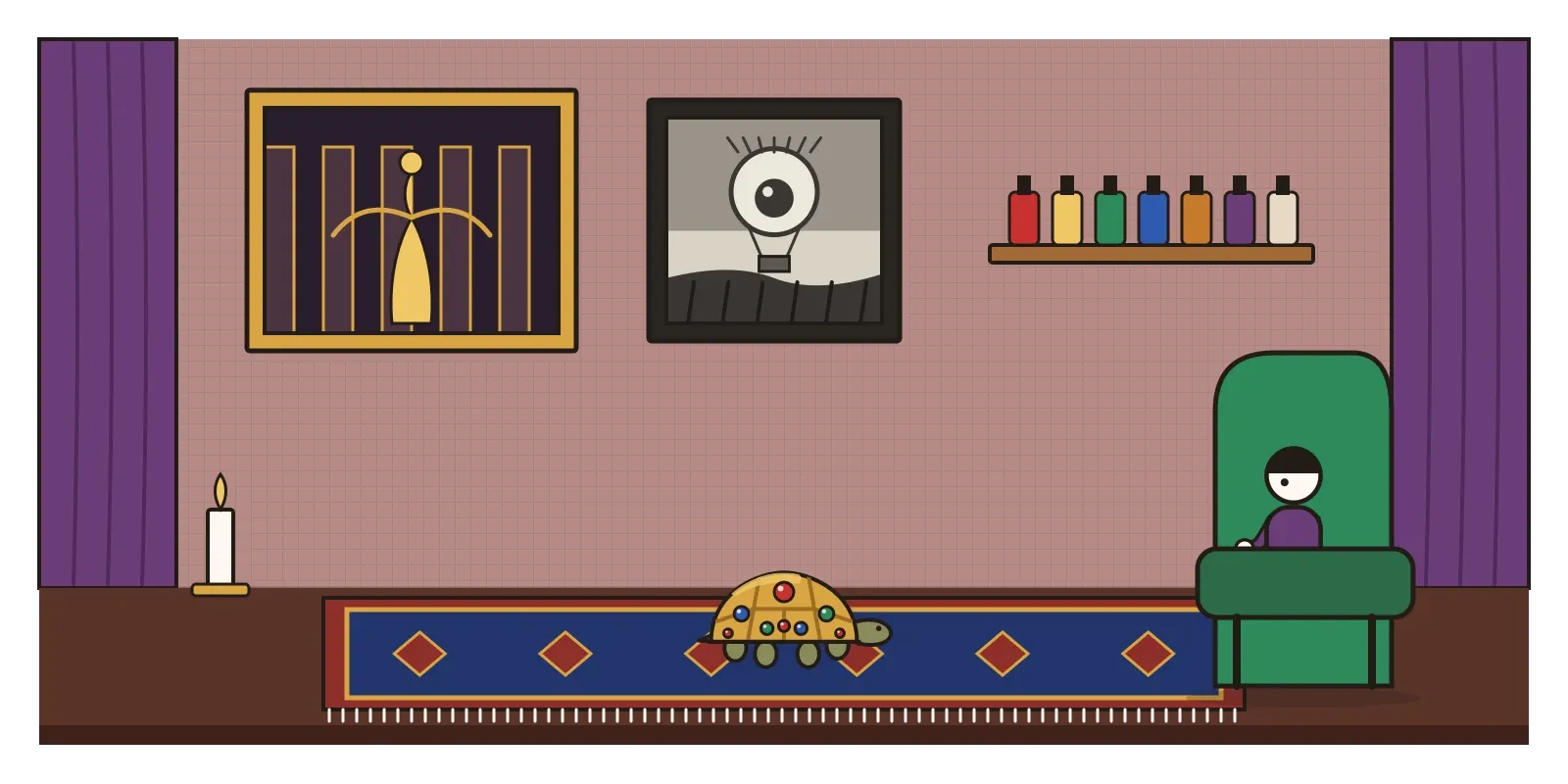
Des Esseintes is a caricature, but he captures the mood of Symbolism very well. Symbolism was a movement in poetry, painting and music, centred in France and Belgium from about the early 1880s to around 1900, with offshoots across Europe, that turned away from describing the visible world and tried instead to suggest invisible things: dreams, myths, moods, the spiritual and the unconscious. Its painters had very different styles, and historians still argue about who counts. What they shared was a conviction that the surface of things wasn't enough.
Against nature, against the obvious
Symbolism was a reply to two things at once. One was Realism and Naturalism, the art and novels of ordinary life that I wrote about earlier in this section, which the novelist Émile Zola had turned into an almost scientific method of documenting society. The other was Impressionism, which to the Symbolists seemed to stop at the retina, painting light beautifully but caring nothing for meaning. Behind both, the Symbolists saw a confident, materialist, industrial age that trusted science, progress and money, and they wanted no part of it.
Their roots were in poetry. In 1857 Charles Baudelaire published Les Fleurs du mal, including a sonnet called "Correspondances", which imagines nature as a temple full of half-understood symbols, where scents, colours and sounds answer one another. A generation later, the poet Arthur Rimbaud wrote "Voyelles", a sonnet giving each vowel a colour: A black, E white, I red, U green, O blue. Stéphane Mallarmé, whose Tuesday evening gatherings in his Paris flat drew poets and painters for years, put the central idea best in an 1891 interview. To name an object, he said, destroys most of the pleasure of a poem. To suggest it, that is the dream. On 18 September 1886, the poet Jean Moréas gave the movement its name in a manifesto in Le Figaro, arguing that poetry should clothe ideas in sensuous form without ever stating them plainly.
Painting followed. Gustave Moreau, older than the rest, had shown The Apparition at the Salon of 1876: Salome stops mid-dance as the bleeding head of John the Baptist appears before her, floating in a burst of light, in a palace so covered in fine gold line that it looks engraved. Odilon Redon worked almost entirely in black for years, in charcoal drawings and lithographs he called his noirs. In an 1882 album dedicated to Edgar Allan Poe, an enormous eye rises like a hot-air balloon over a dark marsh. Later, in the 1890s, Redon turned to colour, and his pastels of flowers, shells and mythical boats glow like stained glass. Pierre Puvis de Chavannes painted pale, still, flat murals of figures in timeless groves, much admired by younger painters including Gauguin and Seurat. In Switzerland, Arnold Böcklin painted Isle of the Dead (1880), a rowing boat carrying a white-shrouded figure towards a rocky island of dark cypresses, so popular that he made five versions. In Brussels, Fernand Khnopff painted women with remote, unreadable faces, and in Norway, Edvard Munch drew on Symbolist ideas for The Scream (1893).
Closed eyes, floating heads and silent water
You can learn to recognise Symbolist work by its mood before its style. Things are still and silent. People have closed eyes, or stare past you, lost in thought. Heads float without bodies, eyes drift without faces. Light is often twilight or moonlight, and water is usually calm and dark. Subjects come from myth, the Bible, legend and dreams: Salome, Orpheus, the Sphinx, Medusa, angels, sleeping figures and isolated islands.
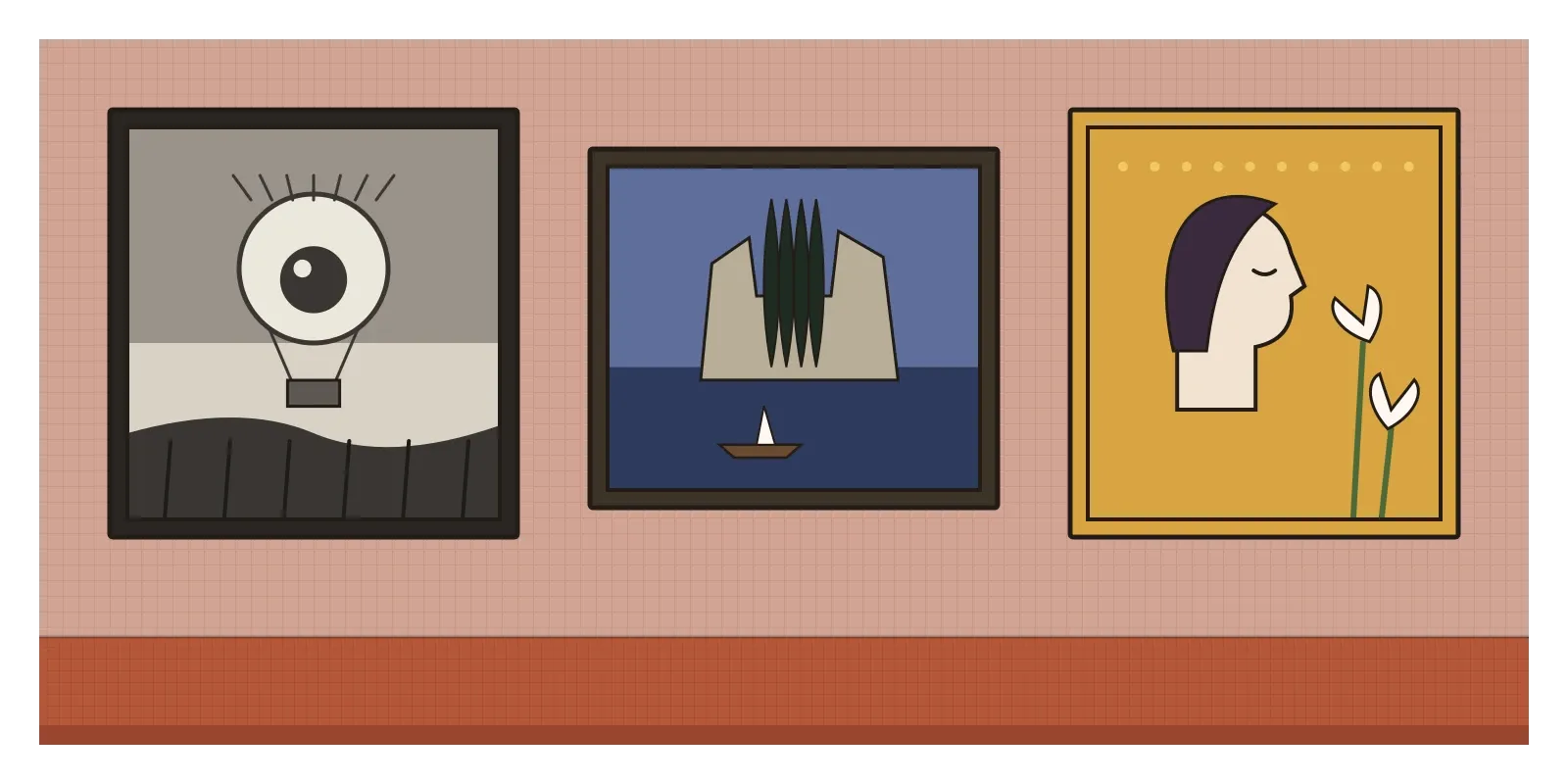
Certain objects keep returning, each loaded with meaning: lilies for purity and death, swans, peacocks, serpents, roses, keys, mirrors, masks. But the meanings are rarely fixed. A Symbolist picture isn't a puzzle with one answer, like an allegory where a woman with scales means justice. It's closer to a piece of music that sets off a mood and leaves you to finish it. Composers felt the same pull: Claude Debussy, a regular among Mallarmé's circle, set Mallarmé's poem about a faun's afternoon dream to music in 1894, in a piece that drifts rather than marches.
Stylistically, Symbolism ranges from Moreau's dense, jewelled surfaces to Puvis's pale flatness and Redon's velvety blacks. Read with a designer's eye, the common tools are reduction and atmosphere: limited, muted palettes, often with one glowing accent of gold or red, soft or flattened space, strong decorative line and a lot of emptiness. The flowing outlines and stylised plants of the later Symbolists lead straight into Art Nouveau.
From Adyar to Dublin and back
The clearest Indian thread in Symbolism runs through a spiritual movement. In 1875, the Russian mystic Helena Blavatsky and the American Henry Steel Olcott founded the Theosophical Society in New York, mixing ideas taken from Hinduism and Buddhism, such as karma and reincarnation, with Western occultism. In 1882 they moved its headquarters to Adyar, on the edge of Madras, now Chennai. Theosophy fascinated many artists who felt Symbolism's longing for a hidden spiritual world. Piet Mondrian joined the Theosophical Society in 1909, and Wassily Kandinsky drew on Theosophical ideas in Concerning the Spiritual in Art (1911). In Sweden, Hilma af Klint, working in a spiritualist circle, painted large abstract canvases from 1906 that are now seen as among the earliest abstract paintings in the West.
Another thread runs through a poet. W. B. Yeats grew up in the Symbolist world. The critic Arthur Symons dedicated his book The Symbolist Movement in Literature (1899) to him, and as a young man in Dublin Yeats was deeply affected by the Bengali Theosophist Mohini Chatterjee, who visited the city in the mid 1880s. In 1912 Yeats wrote the introduction to the English Gitanjali by Rabindranath Tagore, and the next year Tagore won the Nobel Prize for Literature. Yeats's warm, mystical introduction helped make Tagore famous in Europe, but it also helped fix an image of him as an Eastern sage, which Tagore, a modern thinker, educator and reformer, found increasingly frustrating.
There's also a looser parallel within Indian literature. From around 1918 to the late 1930s, Hindi poetry went through a movement called Chhayavad, from chhaya, shadow, led by Jaishankar Prasad, Suryakant Tripathi "Nirala", Sumitranandan Pant and Mahadevi Varma. It turned inward, towards mood, nature, longing and the mystical, and away from the didactic verse before it. Critics often compare it with English Romanticism, and sometimes with Symbolism. The resemblance is real, but it grew from its own sources, and I wouldn't call it a branch of the French movement.
Selling a feeling, not a fact
Symbolism's influence on design is mostly about mood. Mallarmé's idea, that suggesting is stronger than naming, is the basic grammar of a lot of advertising. Perfume advertising is almost pure Symbolism: a dreamlike figure, a glowing bottle, water, gold, twilight and no information at all. Fantasy book covers, album art and the moody world-building of many video games draw on the same vocabulary of lone figures, dark water and mysterious islands. And when people describe the default look of many AI image generators as "ethereal" or "dreamy", with glowing light, mist and a single solitary figure, they're describing a visual language Symbolist painters spent twenty years building.

Baudelaire's correspondences, scents and colours and sounds answering one another, have a modern descendant too. Multisensory design, matching a brand's colours, its sound, its typography and even the haptic tap of a phone so they all feel like one thing, is the same idea put to work. When a payment app pairs a particular colour, a particular chime and a particular vibration, it's building a small correspondence of its own.
Dreams with a dark side
Symbolism's dreams were not innocent. Its most persistent figure is the femme fatale, Salome, the Sphinx, Medusa, the beautiful woman who destroys men, and the historian Bram Dijkstra showed in Idols of Perversity (1986) how deeply this imagery was tangled up with fear of women at the moment many were demanding education, work and the vote. Women appear constantly in Symbolist painting but rarely as painters. Its love of distant palaces and exotic splendour, Moreau's Salome above all, borrowed freely from an imagined East, a habit the critic Edward Said would later call Orientalism. Theosophy, for all its interest in Indian thought, packaged that thought for Western seekers and mixed it with theories of spiritual races that look ugly today.
Then there's escapism. Like des Esseintes behind his shutters, Symbolism often answered an ugly modern world by refusing to look at it. Its jewelled tortoise is a perfect image of the risk: beauty piled onto a living thing until it can no longer move.
The movement faded around 1900, but its ideas didn't. Moreau taught at the École des Beaux-Arts in the 1890s, and among his students were Henri Matisse and Georges Rouault. Munch carried its anxiety into Expressionism. Kandinsky and Mondrian carried its spiritual longing into abstraction. The Surrealists, a generation later, rediscovered Moreau and Redon as ancestors. And its sinuous lines and stylised lilies, pulled out of the dream and onto posters, railings and vases, became Art Nouveau.
Visit a painter's house of dreams
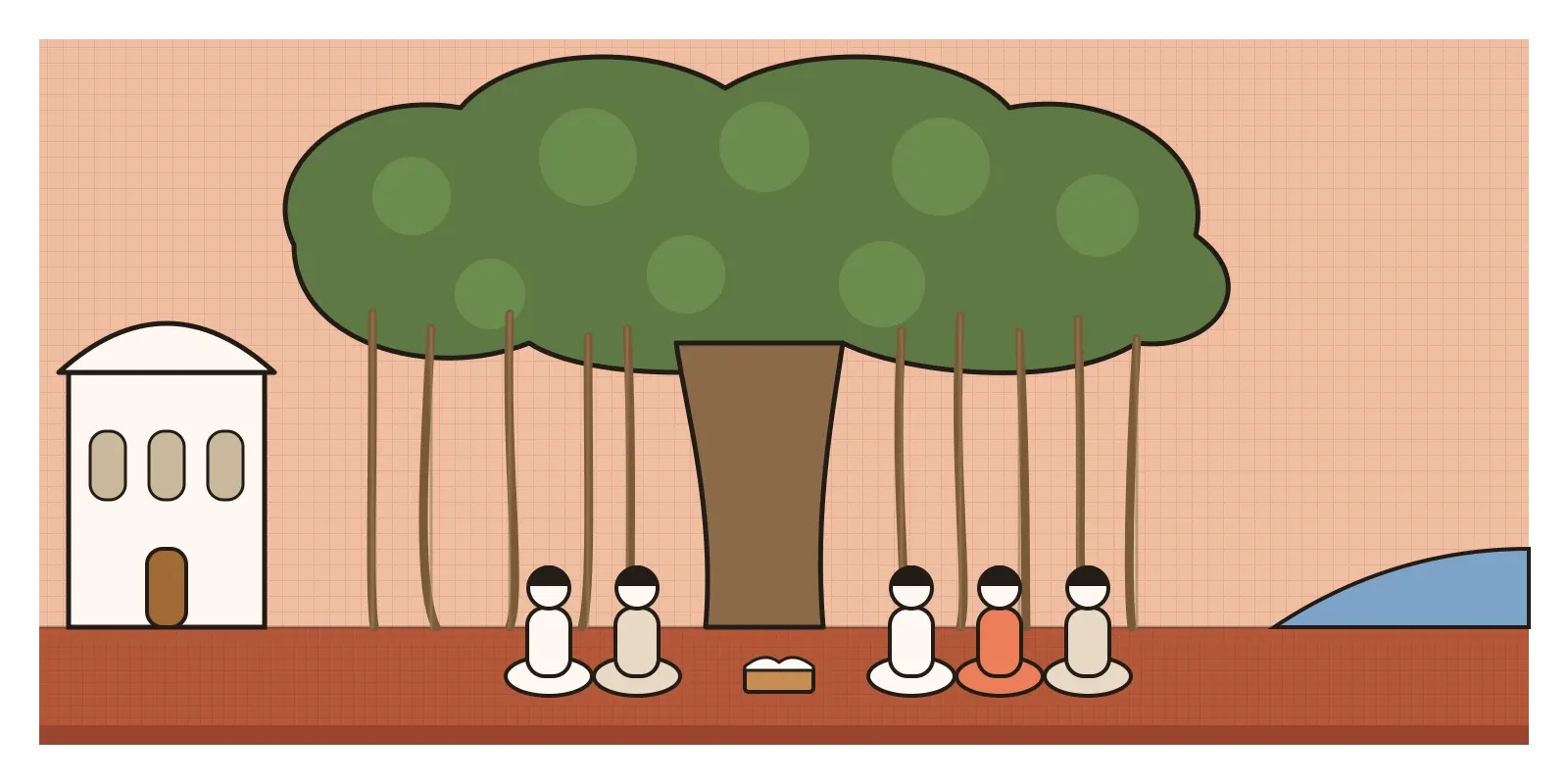
If you're ever in Paris, go to the Musée Gustave Moreau, the tall house in the ninth arrondissement where Moreau lived and worked, which he left to the state along with thousands of his paintings and drawings. Its spiral staircase and walls crowded with half-finished visions are the closest thing to walking into a Symbolist painting. In Chennai, the Theosophical Society's campus at Adyar, with its enormous old banyan tree, is a quieter way to touch the same history. For reading, Huysmans's Against Nature is short, odd and very funny in places.
For an exercise, pick a feeling, not an object: waiting, say, or loss, or calm. Make a small image or a single screen that suggests it without showing anything literal. No words, no obvious symbols like hearts or clocks. Use a limited palette, one accent, lots of empty space and one strange detail. Show it to someone and ask what they feel, not what they see.
Des Esseintes covered his tortoise in jewels because he thought plain nature wasn't beautiful enough, and killed it doing so. Symbolism had the same weakness and the same strength: it believed art should reach beneath the surface of things, and sometimes it buried the living thing under ornament. In the next post, on Art Nouveau, that ornament comes out of the dream and into the street, curling around metro entrances, posters and staircases.
Further reading: J.-K. Huysmans, Against Nature (1884) · Arthur Symons, The Symbolist Movement in Literature (1899) · Michael Gibson, Symbolism (1995) · Bram Dijkstra, Idols of Perversity: Fantasies of Feminine Evil in Fin-de-Siècle Culture (1986) · Rabindranath Tagore, Gitanjali, with an introduction by W. B. Yeats (1912)
A reply toRealism and Impressionism, which painted the surface of the world and stopped there.