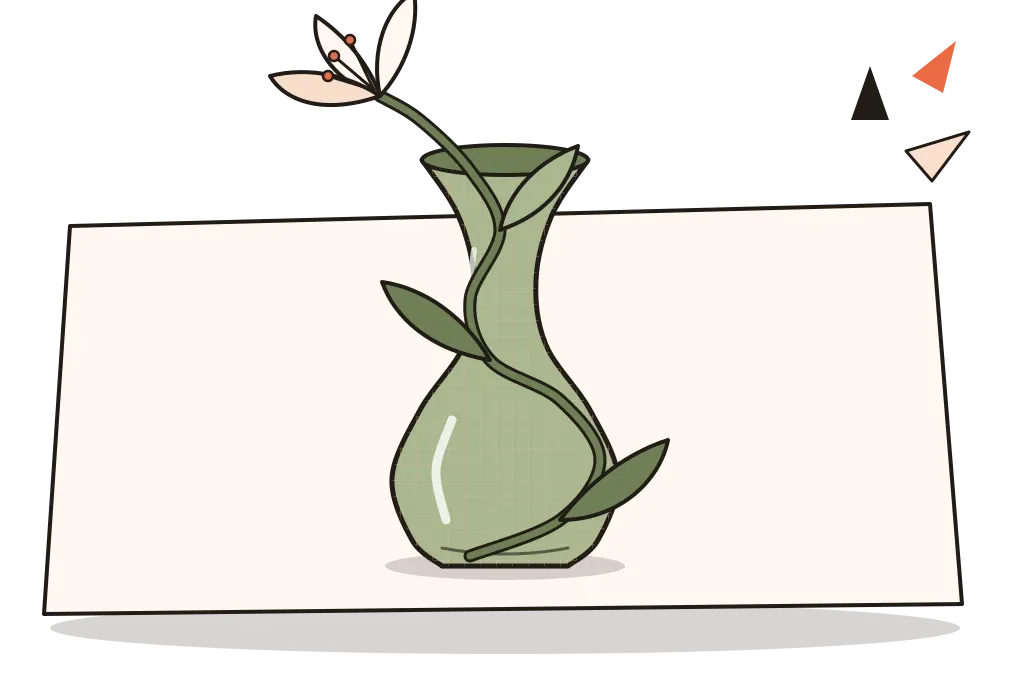
Art Nouveau
How a generation of designers swapped borrowed historical styles for the curling lines of plants, iron and glass.
Art Nouveau
A poster nobody could keep on the wall
Over Christmas 1894, most of the artists who worked for the Lemercier printing firm in Paris were away on holiday. Sarah Bernhardt, the most famous actress in Europe, wanted a new poster in a hurry for her play Gismonda, which had opened that autumn at the Théâtre de la Renaissance. The job went to a young Czech illustrator, Alphonse Mucha, who happened to be in the shop. What he produced looked like no other poster in Paris. It was life-size, about two metres tall and very narrow, with Bernhardt standing in an embroidered robe, a palm frond in her hand and a tall arch of mosaic-like pattern rising behind her head like a halo. The colours were soft and muted, golds, pale greens and dusty pinks, where most street posters shouted.
It went up on the hoardings of Paris around New Year's Day 1895, and according to the story, it didn't stay there long. Collectors bribed bill-stickers for copies or cut them off the walls at night with razors. Bernhardt was so pleased that she signed Mucha to a six-year contract. Much of this tale comes from Mucha's own later accounts and from his son's biography, so the details may have grown in the telling, but the poster is real, and so is the overnight fame it brought him.
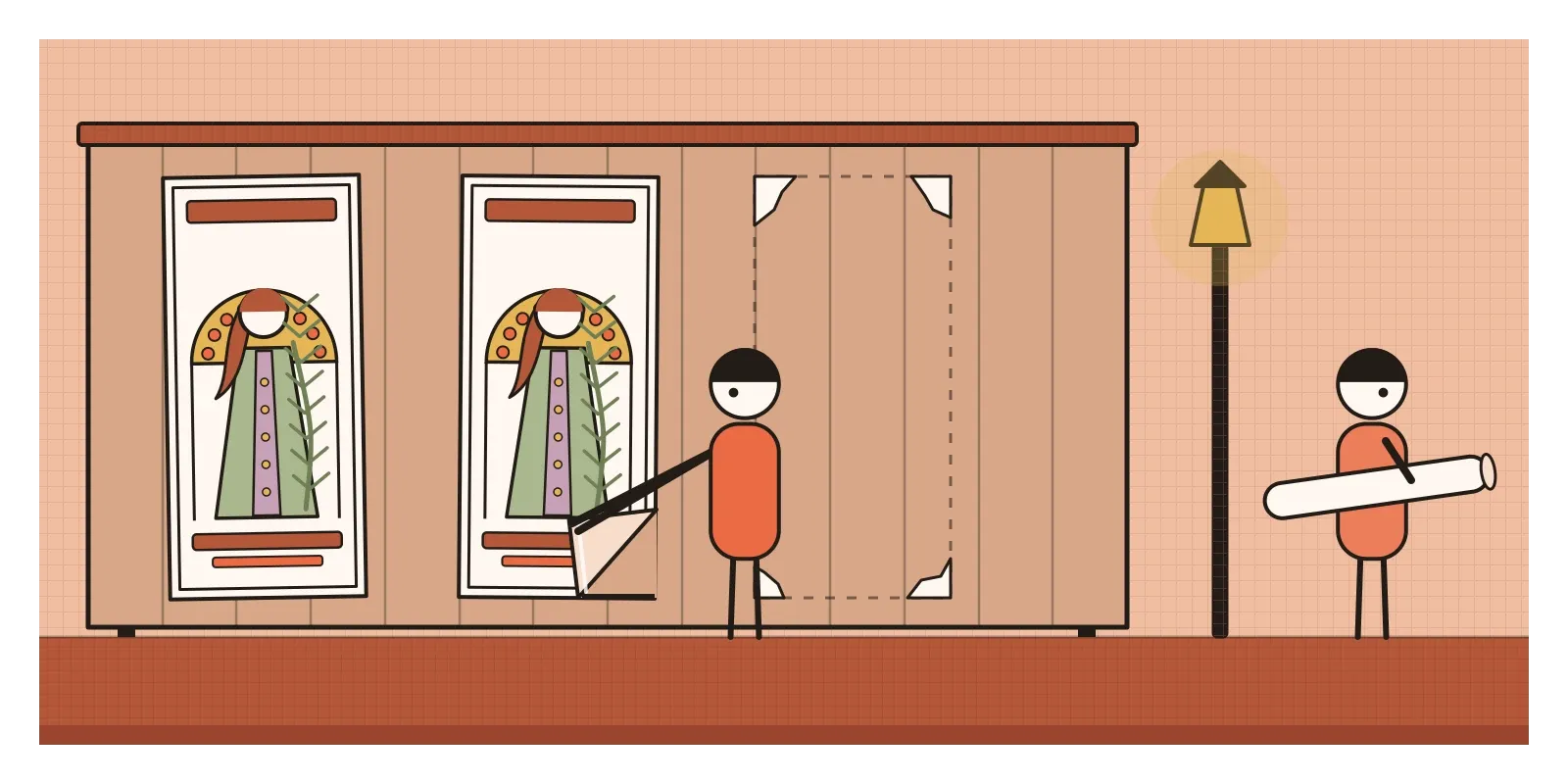
Mucha's poster became one of the emblems of Art Nouveau, French for "new art", the international style that swept through European and American design from around 1890 until about 1910. It is the style of curling stems, flowing hair, dragonflies and lilies, of iron bent into tendrils and glass shaped like flowers. Its makers wanted to stop copying the past and invent a modern ornament drawn from nature, and they wanted it everywhere, on buildings, posters, jewellery, chairs, lamps and the entrances to the underground.
Tired of borrowed clothes
To see why Art Nouveau felt so new, you have to picture what a European city looked like around 1880. For most of the nineteenth century, architects and furniture makers had worked by revival. A parliament was built in Gothic, a bank in Renaissance, a theatre in Baroque, a drawing room furnished in Rococo, often all on the same street. Historians call this historicism. Factories made it worse, stamping out Gothic tracery and Rococo scrolls by the thousand in cast iron and plaster. The new materials of the age, iron and plate glass, were usually hidden behind stone facades dressed up as something older.
Art Nouveau grew out of two earlier replies to this. One was the Arts and Crafts movement in Britain, which has its own post earlier in this series, with William Morris insisting that ordinary objects deserved honest design and good making. The other was the craze for Japanese prints and objects, which I'll write about in the next post, on Japonisme. Japanese design showed Europeans that a single branch, a wave or an insect, drawn with confident line and flat colour, could carry a whole composition.
The name came from a shop. In December 1895, Siegfried Bing, a German-born dealer who had made his name selling Japanese art in Paris, reopened his gallery on the rue de Provence as La Maison de l'Art Nouveau, the House of New Art. The style had different names in different places, and historians still argue about where its edges lie. In Germany it was Jugendstil, after the Munich magazine Jugend, meaning youth, launched in 1896. In Italy it was often called Stile Liberty, after the London shop I'll come to below. In Catalonia it was Modernisme, the style of Antoni Gaudí's Barcelona.
A staircase, a shop window and an underground railway
Many historians date the first fully Art Nouveau building to Brussels in 1893, when the architect Victor Horta began a town house for Émile Tassel, a professor at the city's university. From the street, the Hôtel Tassel looks fairly calm. Inside, it's something else. A slender iron column stands in the middle of the staircase, and at its top the metal splits into curling tendrils, as if the column were a plant stem bursting into growth. The same lines run up the walls in paint, along the banisters in iron and across the floor in mosaic. Horta exposed the iron instead of hiding it and then made it grow.
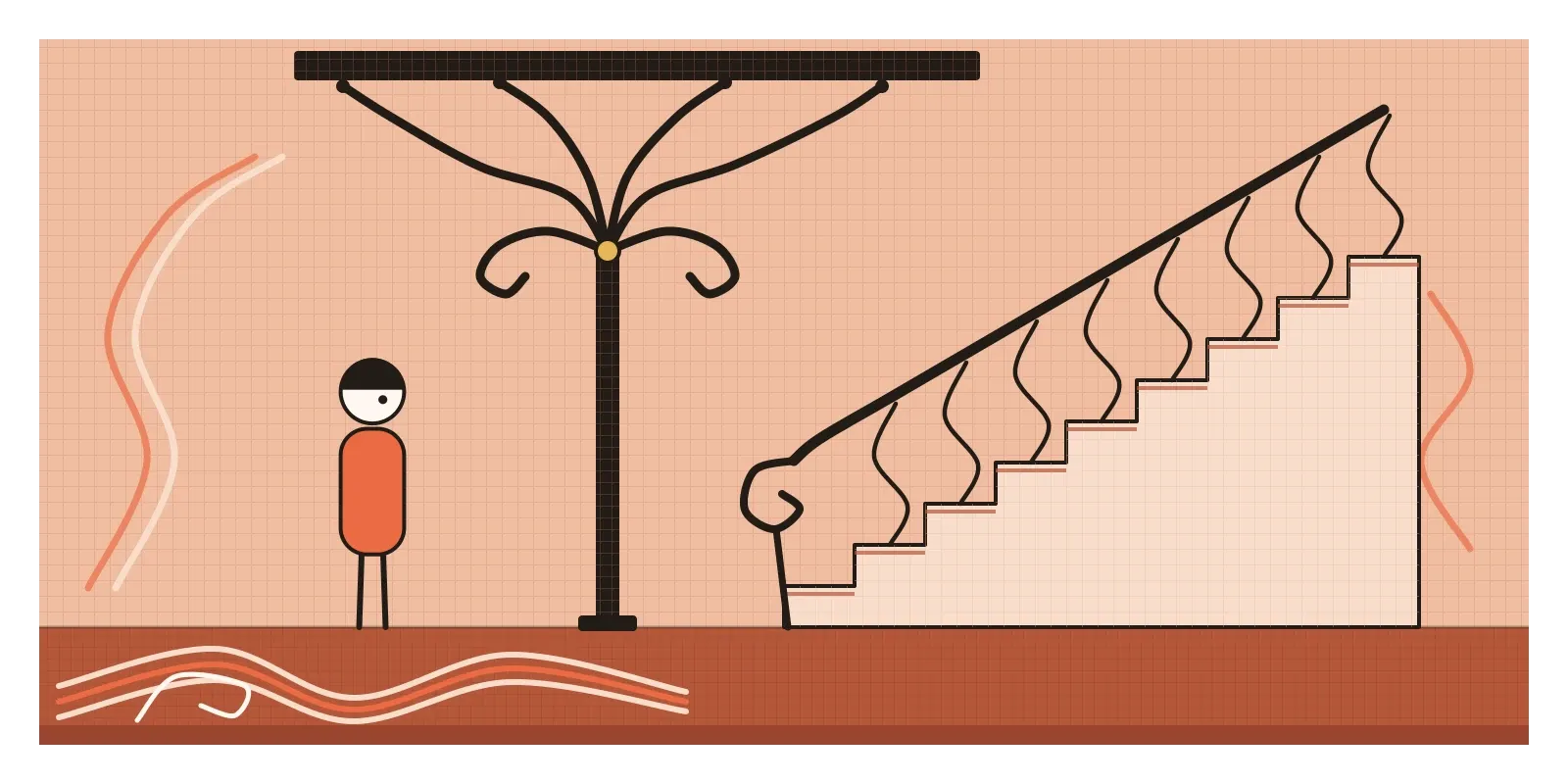
In Paris, the architect Hector Guimard won the job of designing entrances for the new Métro, whose first line opened in July 1900 in time for the Exposition Universelle, the great world's fair of that year. He designed them as a kit of cast-iron parts, painted green, that could be bolted together in different sizes. The railings curl like stems, and two tall stalks rise at each entrance, bending over to hold orange-red lamps like flower buds. Some critics mocked them, and a few were removed, but dozens are still in use.
In the town of Nancy in eastern France, Émile Gallé made glass vases layered in coloured glass and carved back with dragonflies, orchids and sea creatures. In New York, Louis Comfort Tiffany's studio made lamps with shades of coloured glass shaped like wisteria and dragonflies. In Munich, the sculptor Hermann Obrist embroidered a wall hanging, around 1895, now usually called Cyclamen, in which a single flower stem loops across the cloth in a violent, springing curve. A critic likened the line to the crack of a whip, and "whiplash" became the name for the movement's signature curve.
Reading the whiplash
The easiest way to recognise Art Nouveau is to follow its lines. They are long, continuous curves that start slowly, speed up and then snap back on themselves, like a stem bending towards the light or a ribbon caught in the wind. Straight lines and right angles are rare. An Art Nouveau chair seems to grow its decoration out of its own frame, the leg flowing into the seat and the seat into the back. Ornament isn't applied. It's structural, or at least it pretends to be.
The subject matter is nature, but a particular kind: lilies, irises, seaweed, dragonflies, peacocks and women whose long hair turns into pattern. The colours are often muted, olive and sage greens, mauves, amber and gold, with a sudden jewel of iridescent glass or enamel. The movement loved anything that could be bent, poured or layered: iron, glass, enamel, silver and ivory. On posters, figures are drawn with clear outlines and flat areas of colour, framed by decorative borders, haloes and panels of pattern, and the lettering is hand-drawn and swelling, designed as part of the picture rather than set in type.
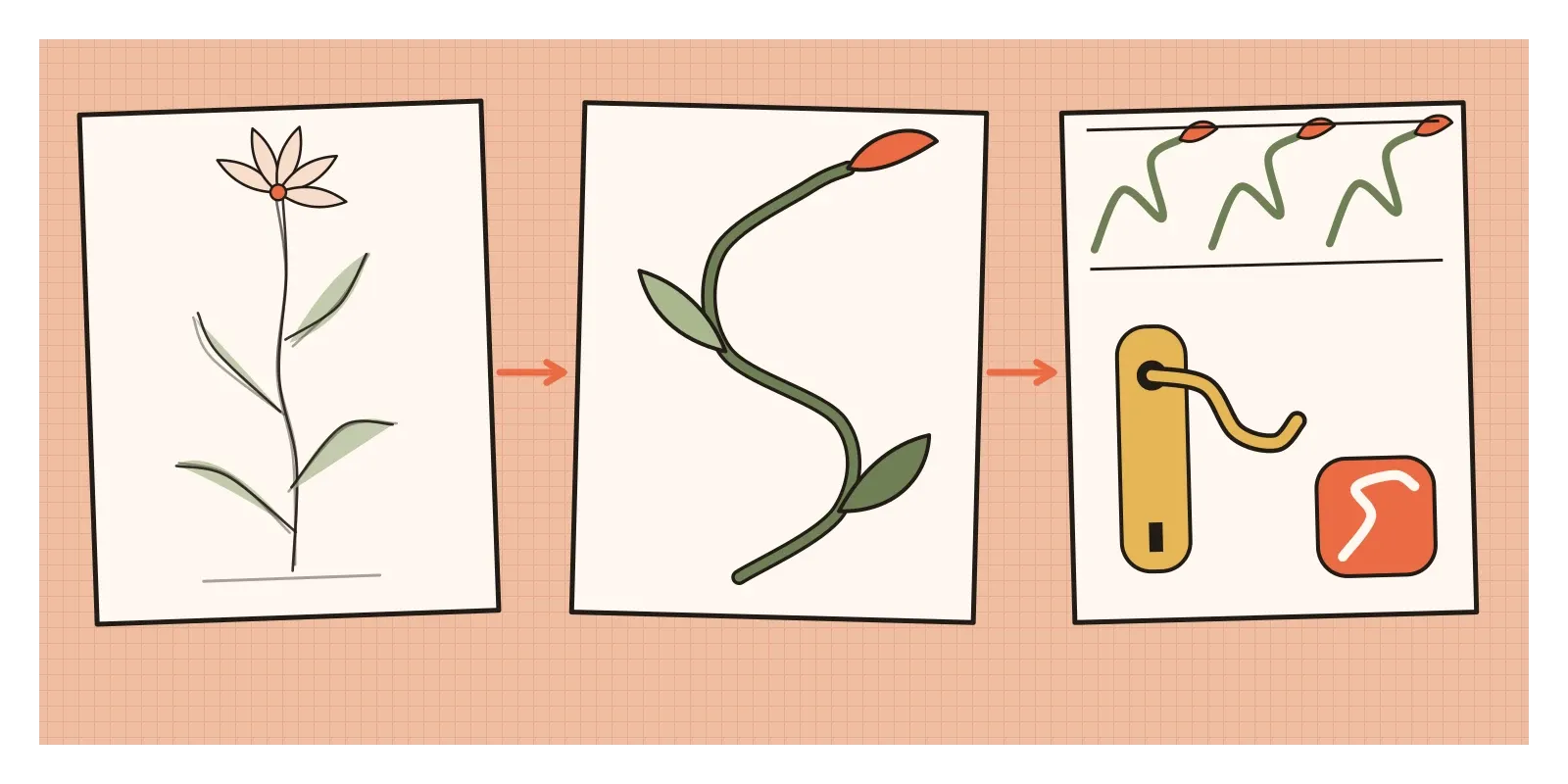
The habit underneath all of this is stylisation, the step from observing a plant to designing with it. Designers drew real flowers carefully, then simplified them, stretched them and repeated them until a poppy became a border, a curl of seaweed became a door handle and a stem became the leg of a table. That step, from the organic shapes I described in the post on shape to the repeats in the post on pattern, is one of the most useful exercises any designer can practise.
Silk from India, dyed in Leek
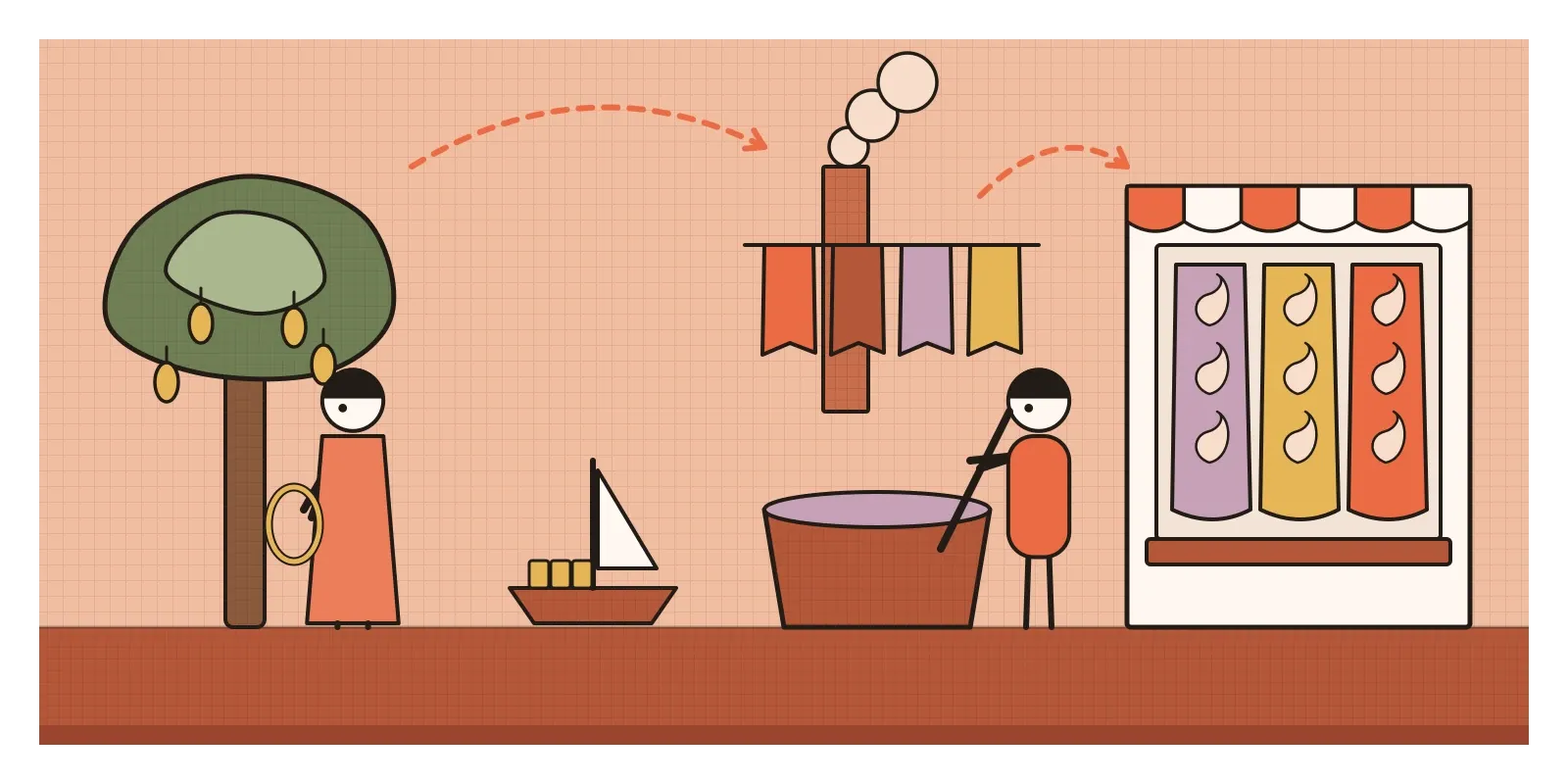
Art Nouveau's link to India runs through cloth. In 1875, Arthur Lasenby Liberty opened a shop on Regent Street in London selling fabrics, ornaments and objects from Japan, China, India and the Middle East. Liberty's soft, coloured silks became so closely linked with the new style that Italians named it after the shop. Many of those silks began in India. Thomas Wardle, a silk dyer from Leek in Staffordshire, who had worked with William Morris on natural dyes, spent years finding ways to dye and print tussar, the golden wild silk spun by moths in the forests of central and eastern India. Liberty sold his printed silks, many of them carrying patterns borrowed from Indian block prints.
It was a loop with an uncomfortable shape. Indian raw silk and Indian patterns travelled to England, were dyed and printed there, and were sold in London as fashionable artistic luxury, at a time when Indian handloom weavers were struggling against cheap machine-made cloth from British mills. The Art Nouveau taste for the "Eastern" was partly a taste for things taken from the East on Britain's terms.
As a style of building, Art Nouveau left far less mark on India, as far as I know, than the Gothic revival before it or the Art Deco that filled Bombay a generation later. You'll find touches of it in the cast-iron railings and stained glass of older houses, but not a movement of its own. The deeper parallel is a loose one. Indian makers had used climbing, curling plant forms for centuries, in creeper borders carved around temple doorways, in Mughal floral inlay and in the vines on painted textiles. Europe's designers arrived at a similar love of the growing line by a very different route, as a rebellion against their own revivals.
Designing the door handle too
The idea I take most from Art Nouveau is total design. Horta didn't just design the shell of his houses. He designed the door handles, light fittings, radiator grilles, mosaic floors, furniture and stained glass, so that every part spoke the same language. The German term for this is Gesamtkunstwerk, a total work of art. It's a direct ancestor of the design systems we build today, where one set of shapes, colours, curves and type has to work across a button, an email, an app icon and a printed box.
Guimard's Métro entrances teach a second lesson, which is that a flowing, organic look can be built from standard, repeatable parts. His kit of cast-iron pieces could be assembled into entrances of many sizes, much as a component library lets a team build many screens from a fixed set of pieces. The curves feel handmade, but the system underneath is industrial.
Mucha's posters, meanwhile, never really went away. His style returned in the psychedelic concert posters of 1960s San Francisco, and many manga and anime artists have named him as an influence. Because Mucha died in 1939, his work is out of copyright almost everywhere, and "in the style of Mucha" is one of the most common style prompts in AI image tools. Here, at least, the borrowing is legally clear.
Too lovely to last
Art Nouveau's critics have plenty to work with. Like Arts and Crafts before it, it promised a new art for modern life and mostly delivered expensive objects for wealthy clients. Horta's town houses were built for a professor, wealthy industrialists and, in one case, Edmond van Eetvelde, a senior administrator of the Congo Free State, the private colony of King Leopold II. That points to the darker side of the Belgian story. At the colonial exhibition held at Tervuren near Brussels in 1897, rooms by leading Belgian Art Nouveau designers displayed ivory from the Congo, where forced labour and terrible violence fed the trade, and sculptors were encouraged to carve it into luxury objects. The beauty of some of that work is hard to separate from where its materials came from.
Women were everywhere in the imagery and much less visible in the credits. The dreamy women on posters were decoration, and the women who made things were often forgotten. Margaret Macdonald worked as an equal partner with Charles Rennie Mackintosh in Glasgow but was long treated as his assistant, and it was only in 2007 that researchers showed that Clara Driscoll, who led a team of women at Tiffany's studio, designed several of its most famous lamps.
The style also burned out quickly. Within a decade, factories were doing to Art Nouveau exactly what they had done to Gothic, stamping its curves onto cheap ashtrays, cake tins and wallpaper, and by around 1910 it already looked dated. The architect Adolf Loos, whom I wrote about in the post on form follows function, attacked ornament itself as a waste of labour. The replies that followed, from the Vienna Secession's squares and grids to Art Deco and modernism, owed something to the experiment while rejecting its curves. Horta's own Maison du Peuple in Brussels, a headquarters for the Belgian Workers' Party completed in 1899, was demolished in 1965 despite protests from architects around the world.
To see Art Nouveau for yourself this week, start close to home and look up. Walk through an older neighbourhood and notice the iron railings, gates and window grilles. Then pick a plant on your street, draw it carefully from life three times, then simplify its stem into a single springing curve and use that curve to design a border, a door handle and an app icon. The Musée d'Orsay's online collection has Gallé's glass and Guimard's drawings. And picture those Gismonda posters disappearing from the hoardings of Paris in January 1895. People were stealing ornament off the street because, for once, it felt new. In the next post, on Japonisme, I'll go back a few decades to the Japanese prints and objects that taught Mucha's generation to see that way.
Further reading: Paul Greenhalgh (ed.), Art Nouveau 1890-1914 (2000) · Debora L. Silverman, Art Nouveau in Fin-de-Siècle France: Politics, Psychology, and Style (1989) · Gabriel P. Weisberg, Art Nouveau Bing: Paris Style 1900 (1986) · Stephan Tschudi Madsen, Sources of Art Nouveau (1956)
A reply toThe revival styles of the nineteenth century, endlessly copying Gothic, Renaissance and Rococo.