Surrealism
How a group of poets and painters in 1920s Paris tried to put dreams, chance and desire to work.
Surrealism
A lecture in a diving suit
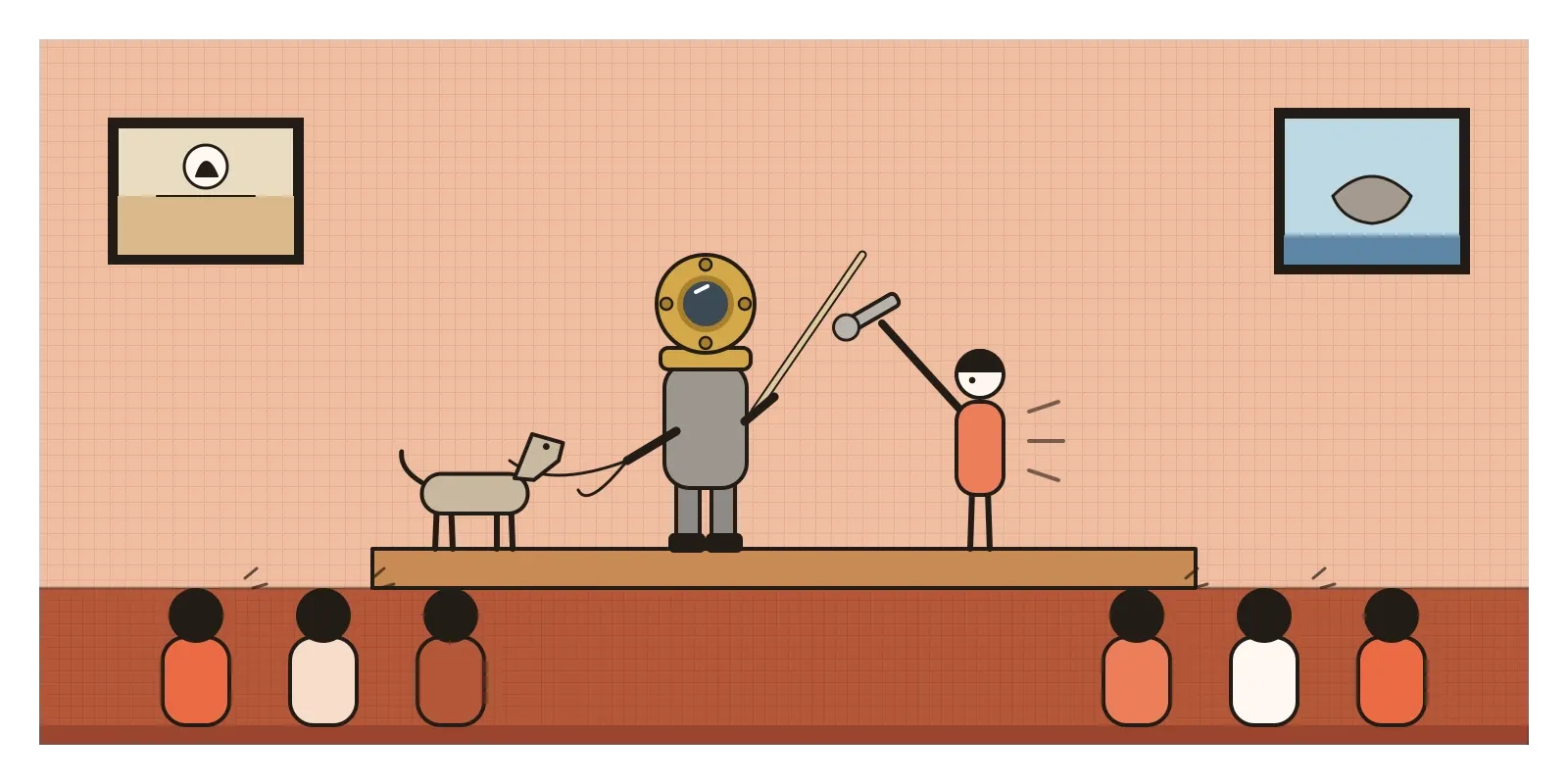
On 1 July 1936, a small crowd at the New Burlington Galleries in London waited for a lecture by a young Spanish painter named Salvador Dalí. The gallery was hosting the International Surrealist Exhibition, which had opened a few weeks earlier with a woman walking through Trafalgar Square, her head entirely hidden by a mask of roses. Dalí arrived dressed in a full deep-sea diving suit, with a heavy metal helmet bolted on, carrying a billiard cue and, by several accounts, leading a pair of large dogs. He wanted, he said, to show that he was plunging into the depths of the unconscious mind.
The plan had one flaw. The helmet had no air supply, and once it was bolted on, Dalí began to suffocate. His gestures grew frantic, and the audience, assuming this was part of the act, laughed and applauded. Eventually someone realised he was in real trouble, and the young poet David Gascoyne is usually credited with finding a spanner and getting the helmet off. Dalí recovered and, the story goes, carried on with his talk. The details vary between memoirs, but the outline is well documented, and it sums up the movement nicely: serious ideas about the mind, presented as theatre, with a real risk underneath the joke.
Surrealism was the movement that tried to bring the unconscious into art and everyday life. It began in Paris in 1924 as a group of writers and grew into an international network of painters, photographers, sculptors and designers that lasted, in one form or another, until the 1960s. Its members wanted to free the imagination from reason, good taste and morality, and they believed that dreams, chance, desire and strange coincidences could reveal truths that logic hid. The word came from the poet Guillaume Apollinaire, who used "surréaliste" in 1917, but the movement made it its own.
Dreams after the trenches
Surrealism grew out of the First World War and out of Dada, which has its own post earlier in this series. The Dadaists, in Zurich, Berlin and Paris, had answered the slaughter with mockery, nonsense poems and anti-art, on the grounds that a civilisation that could produce the trenches had no right to be taken seriously. By the early 1920s, some of the Paris Dadaists felt that mockery had run its course. They wanted to build something, not just tear things down.
The leader of this group was André Breton, a poet who had trained in medicine and had worked during the war in neurological wards with soldiers traumatised by the fighting. There he became fascinated by the ideas of Sigmund Freud, especially the notion that dreams and slips of the tongue carry messages from a hidden part of the mind. In 1919 Breton and his friend Philippe Soupault wrote a book called The Magnetic Fields by writing as fast as they could, without stopping to think or correct, to see what would come out. They called the method automatic writing.
In October 1924, Breton published the Manifesto of Surrealism. In it he defined Surrealism as pure psychic automatism, a way of expressing the actual functioning of thought without any control by reason. The group opened a Bureau of Surrealist Research in Paris where the public could come and report their dreams. It was half laboratory, half joke.
Rubbings, games and a pipe that isn't
Writers came first, but painters soon showed how automatism might work with images. In 1925 the German artist Max Ernst, staying at a seaside inn in Brittany, laid sheets of paper on the worn floorboards and rubbed them with pencil. The grain came up as strange textures that suggested forests, eyes and creatures, which he then developed into drawings. He called it frottage, French for rubbing. The French painter André Masson let his pen wander in automatic drawings and threw sand onto glued canvas to see what shapes appeared.
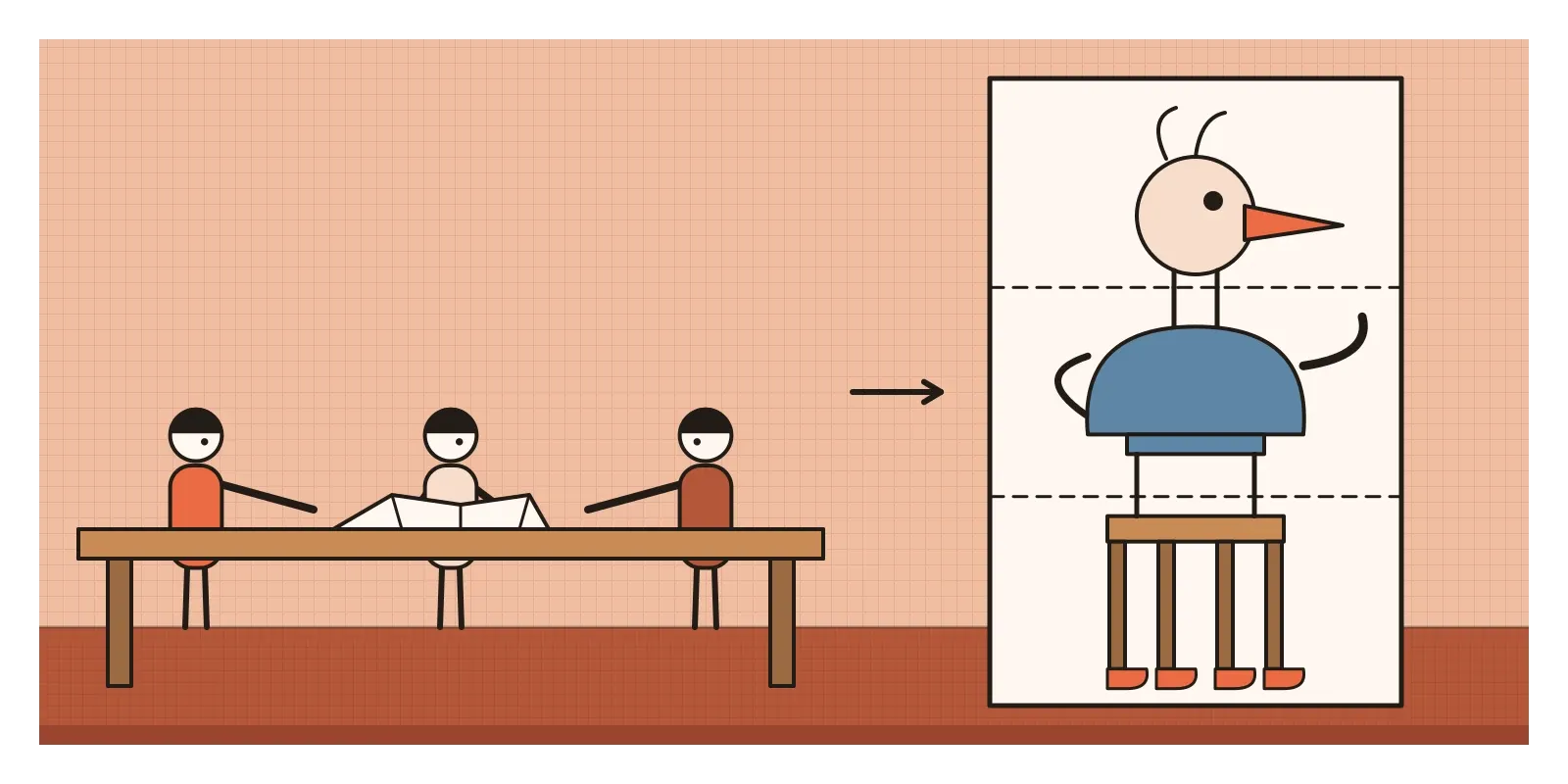
The group also played games. The most famous was the exquisite corpse. One person writes or draws something on a sheet of paper, folds it over to hide most of it, and passes it on to the next person, who adds the next part without seeing the first. When the sheet is unfolded, you get a creature or a sentence that no single mind would have made. The name comes from one of the first sentences the game produced, about an exquisite corpse drinking new wine.
A second strand of Surrealist painting did the opposite of automatism. Instead of loose, accidental marks, it painted impossible scenes with almost photographic precision, so that the dream felt real. The Belgian painter René Magritte painted a single tobacco pipe, as plainly as an advertisement, with a neat line of handwriting underneath saying that this is not a pipe. He was right, of course: it's a painting of one. Dalí's The Persistence of Memory (1931), a small canvas now at the Museum of Modern Art in New York, shows soft pocket watches drooping over a branch and a ledge in a bare, sunlit landscape, as limp as cheese left in the sun.
Some of the most inventive Surrealists were women, though the men who led the group often treated them as muses rather than colleagues. The English painter Leonora Carrington, who later settled in Mexico, filled her pictures with hybrid animals and private myths. Dorothea Tanning painted doors opening onto impossible rooms. The photographer Lee Miller and the French artist Claude Cahun used the camera to make strange, unsettling portraits. Meret Oppenheim's fur-covered teacup, which I wrote about in the post on texture, belongs to this circle too.
The sewing machine and the umbrella
Breton and his friends loved a line from the nineteenth-century poet Lautréamont, who described something as beautiful as "the chance meeting on a dissecting table of a sewing machine and an umbrella". That's the recipe for most Surrealist images. Take familiar things and put them together where they don't belong, at the wrong scale, made of the wrong material or behaving in the wrong way, and render them so clearly that the mind can't dismiss them. A clock goes soft. A rock floats in the sky. A cup grows fur. A train comes out of a fireplace.
In paintings, look for deep, empty, stage-like spaces with long shadows and low horizons, as if the scene were happening in a dream on the edge of a desert or a beach. Look for crisp, careful painting of things that can't exist. In the automatic strand, look instead for textures and lines that seem to have grown on their own, rubbings, drips, scraped paint and wandering contours. In photography, look for collage, double exposures, extreme close-ups and solarised prints, where light and dark partly reverse.
Creatures from crossings-out
India's most interesting link to Surrealism isn't a Surrealist at all. In the 1920s, Rabindranath Tagore, already in his sixties and long famous as a poet, began doing something odd with his manuscripts. When he crossed out words, he didn't simply strike them through. He joined the deleted words up with loops and lines, and the shapes began to turn into things: birds with long beaks, monsters, strange faces and creatures he couldn't name. The doodles grew into drawings and then into paintings in ink and colour, made quickly, often without any plan, and he went on to make well over two thousand of them in the last years of his life.
In May 1930, with the help of his friend the Argentine writer Victoria Ocampo, Tagore's paintings were shown at the Galerie Pigalle in Paris, the city where Surrealism was at its height. They were well received, and it's easy to see why Paris was ready for them. They had the qualities the Surrealists prized: images that seemed to arise from the hand before the mind, dark and dreamlike, unlike anything taught in an academy.
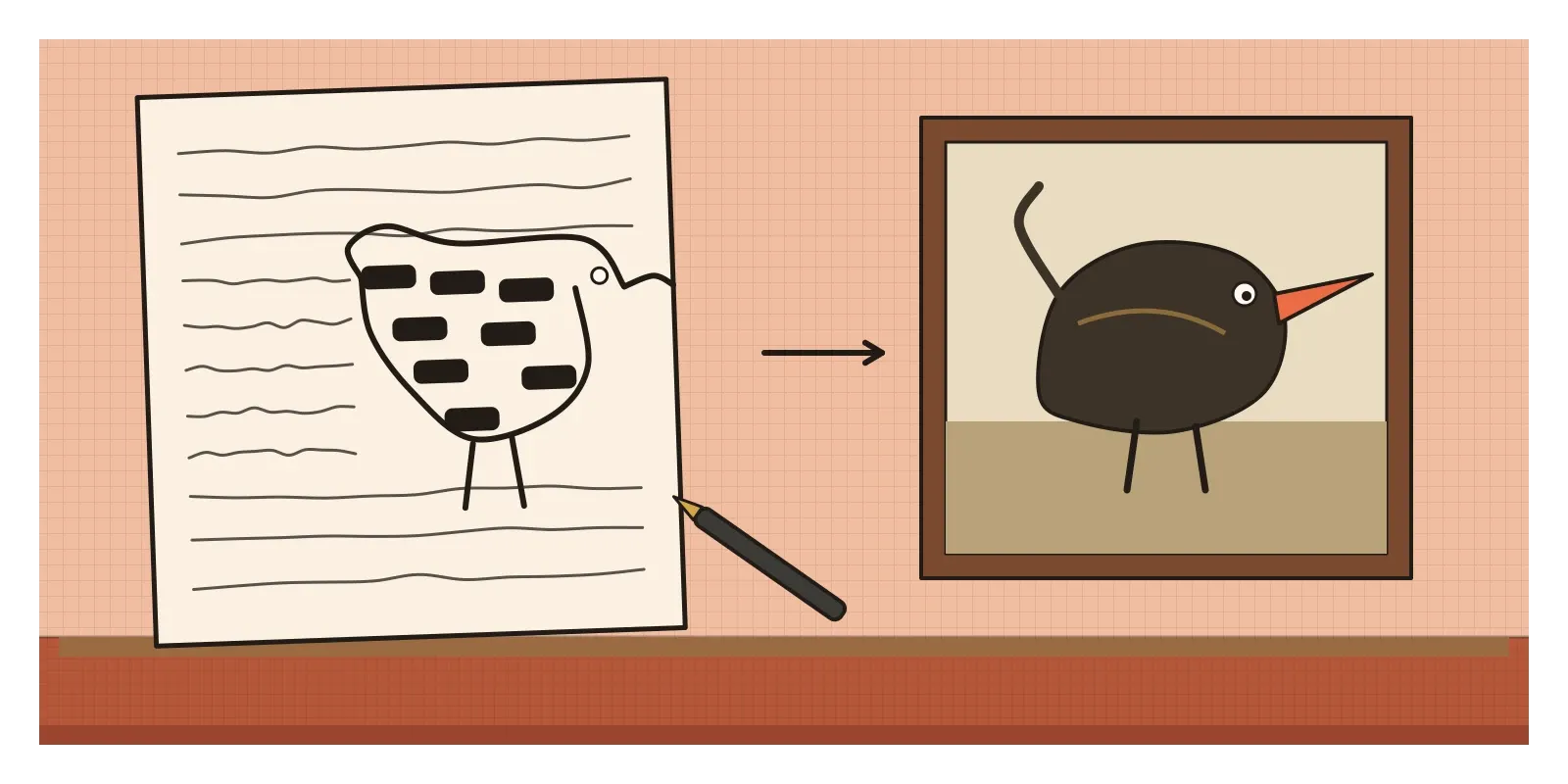
But the parallel is a loose one, and I don't want to force it. Tagore wasn't part of the movement and didn't take up its theories of the unconscious, and his paintings came out of his own long practice as a writer, a sense of rhythm and a fascination with form, not out of reading Freud. What the comparison shows is that the urge to let the hand lead, and see what appears, wasn't only a Parisian invention. It also turned up at a desk in Santiniketan among the crossings-out of a poet in his sixties.
Lobsters, shop windows and prompts
Surrealism moved into design faster than almost any movement before it. In 1937 the fashion designer Elsa Schiaparelli made an evening dress of white silk printed with a huge lobster, designed with Dalí. She also made a hat shaped like an upside-down shoe. The wealthy English collector Edward James commissioned Dalí to make a telephone with a lobster for a receiver and a sofa shaped like a pair of lips, and later spent decades building a jungle garden of concrete stairways that lead nowhere at Las Pozas in Mexico. Shop windows and advertising adopted the impossible object almost at once and never let it go: think of any perfume advert with a bottle floating over a desert.
For designers, the most useful Surrealist ideas are probably the methods rather than the look. The exquisite corpse is a team ideation exercise in disguise. When a group of people each draw part of an idea without seeing the others, they get combinations no one person would reach. Automatic writing survives in the warm-up exercises of writers and designers who fill pages quickly, without judging, to get past the first obvious ideas. And Lautréamont's sewing machine is still the core of most creative briefs: put two unrelated things together and see what new meaning sparks between them.
Today, AI image tools have made Surrealism almost effortless. Ask for a whale floating in a living room, or a teacup full of clouds, and you'll have it in seconds, rendered with exactly the crisp precision Magritte worked so hard for. That's both a gift and a problem. The Surrealists' strange images worked because they were rare, laboured over and charged with private meaning. When impossible pictures are free and infinite, the surprise wears off, and the designer's job shifts from making the strange image to choosing the one that actually means something.
Dreams with a party line
For a movement devoted to freedom, Surrealism was remarkably controlled. Breton ran the group like a small church, expelling members who disagreed with him, and the group's long, quarrelsome affair with the French Communist Party ended in bitterness in the mid-1930s. Dalí was effectively thrown out at the end of the decade for his political views and his love of money, and Breton rearranged the letters of his name into a mocking nickname about greed. The movement's attitude to women was often worse than its rhetoric. Breton's writings idealised woman as a mysterious, childlike muse, and many of the women around the group had to leave it, or outlive it, to be taken seriously as artists.
Its relationship with the colonised world was mixed. The Surrealists collected masks and carvings from Oceania, Africa and the Americas, treating them as windows onto a primitive unconscious, which says more about European fantasies than about the people who made them. Yet they also signed an angry tract in 1931 urging people not to visit the great Colonial Exhibition in Paris, at a time when few European artists said anything against empire.
The Second World War scattered the group. Breton, Ernst, Masson and others reached New York, where their ideas about automatism fed directly into the young painters who became the Abstract Expressionists. Others went to Mexico. After the war, Surrealism felt more like a style than a revolution, and it was increasingly absorbed into advertising and fashion, the very commercial world it had once despised.
To see Surrealism for yourself this week, try the exquisite corpse with friends or colleagues: fold a sheet of paper into three, draw a head, a body and legs in turn, and unfold it. Or make a frottage by rubbing a pencil over paper laid on a rough wooden table, and look for creatures in the grain. Most of Tagore's paintings are held at Rabindra Bhavana in Santiniketan, and the National Gallery of Modern Art in New Delhi has more. And think back to Dalí in the gallery in 1936, gesturing inside his helmet while the audience laughed. It was a performance about the depths of the mind that nearly became a real disaster, which is a fair description of the whole movement. In the next post, on Art Deco, I'll turn to a style of the same years that preferred glamour to dreams.
Further reading: André Breton, Manifestoes of Surrealism (1924, translated 1969) · Dawn Ades, Dada and Surrealism Reviewed (1978) · Whitney Chadwick, Women Artists and the Surrealist Movement (1985) · Mary Ann Caws (ed.), Surrealism (2004) · Rabindranath Tagore, Rabindra Chitravali: Paintings of Rabindranath Tagore (ed. R. Siva Kumar, 2011)
A reply toDada's destruction, and the rule of reason that had led Europe into the First World War.