Art Deco
The geometric, glamorous style of the 1920s and 1930s, from Paris and Manhattan to Mumbai's seafront.
Art Deco
A spire out of nowhere
On 23 October 1929, anyone in midtown Manhattan who glanced up at the unfinished Chrysler Building saw something odd. For weeks the tower had seemed to stop at its crown, a stack of steel arches narrowing towards the sky. Now a slim needle of steel was rising out of the middle of that crown, pushed up from inside the building, where it had been put together in secret in the shaft at the top of the tower. In about an hour and a half it was hoisted and fixed in place. The building now stood about 319 metres tall, higher than the Eiffel Tower, and for a few months it was the tallest structure in the world.
The secrecy was about a race. The building's architect, William Van Alen, was competing with his former partner, H. Craig Severance, whose bank tower at 40 Wall Street was going up downtown at the same time. Severance had raised his tower to beat Chrysler's announced height, and had no way to answer once the spire appeared. The next day was Black Thursday, the first day of the Wall Street Crash. By 1931 the Empire State Building had overtaken them both, and the boom the spire celebrated was over.
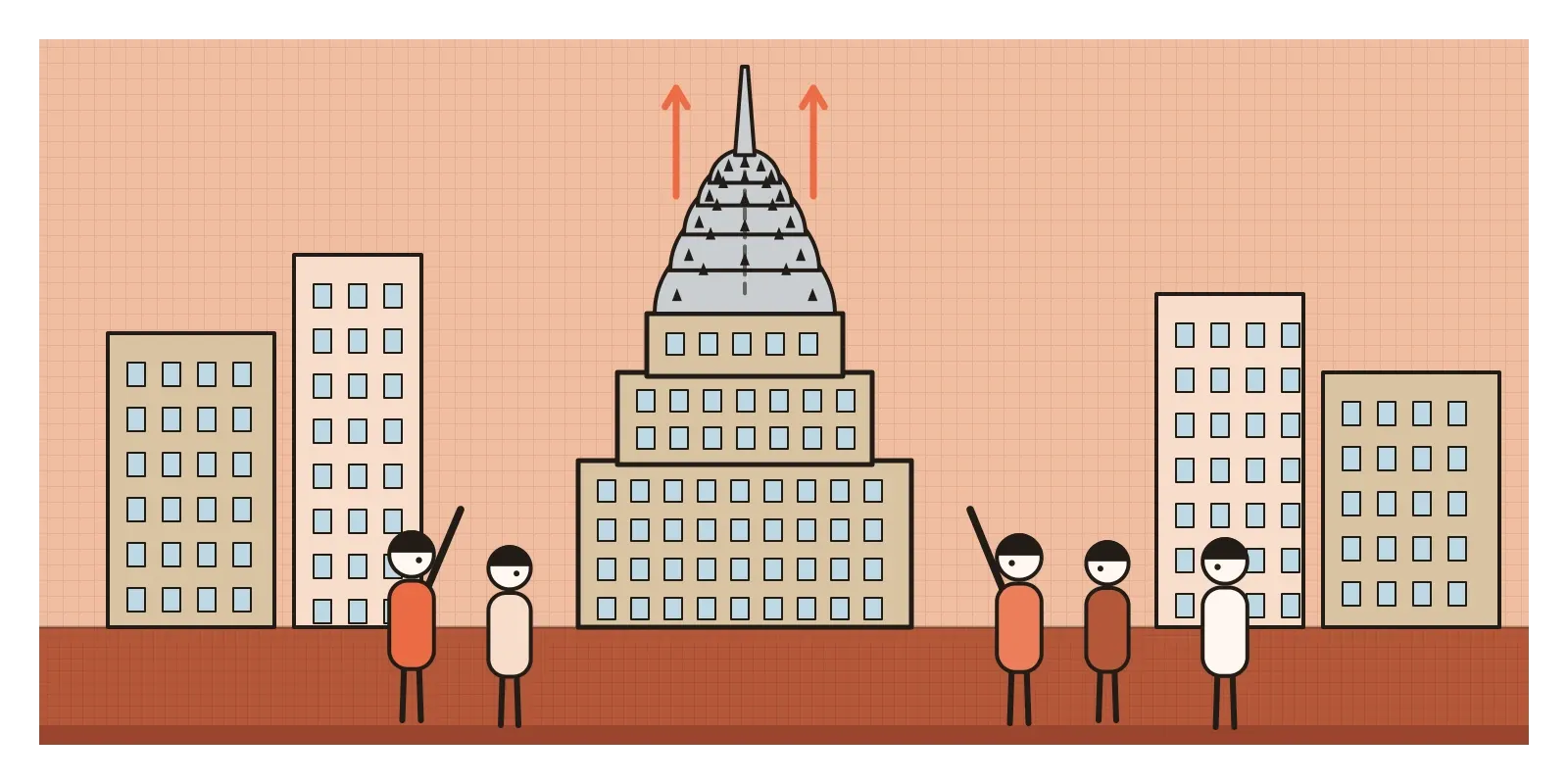
The Chrysler crown, with its sunburst arches of stainless steel and triangular windows, is one of the best-loved pieces of Art Deco ever built. Art Deco was the decorative style of the 1920s and 1930s: geometric, glamorous, fond of both expensive materials and brand new ones, and at home on everything from skyscrapers and cinemas to cigarette cases, radios and lettering. It was the first global style of the machine age, though never really a movement, with no manifesto and no leader.
A fair where copies were banned
The style takes its later name from a fair. From April to October 1925, Paris hosted the Exposition internationale des Arts décoratifs et industriels modernes, a huge show of decorative and industrial art laid out along the Seine around the Grand Palais and the Pont Alexandre III. Its rules said that everything on show had to be new: copies and pastiches of historical styles were not allowed. France had planned it before the First World War, partly to win back leadership in the decorative arts from Germany, which wasn't invited in 1925. The United States stayed away too, reportedly because Herbert Hoover, then Secretary of Commerce, decided America had no modern decorative art worth sending.
At the time nobody called the style Art Deco. People said "moderne", or simply the style of 1925. The name only caught on in the 1960s, after a 1966 exhibition in Paris looking back at the decade, Les Années 25, and the British historian Bevis Hillier's 1968 book Art Deco of the 20s and 30s. Because the label was stuck on afterwards, historians still argue about its edges; it covers work from roughly 1910 to the Second World War, from one-off luxury furniture to mass-produced plastic radios.
What was it replying to? Most directly, to Art Nouveau, which has its own post earlier in this series. After the war, its whiplash curves and tendrils looked fussy and old-fashioned. Art Deco kept the love of luxury and fine craft but straightened the line. It borrowed the fractured planes of Cubism, the hot colours of Diaghilev's Ballets Russes and the squares and grids of the Wiener Werkstätte. In November 1922, Howard Carter's discovery of Tutankhamun's tomb in Egypt set off a craze for pharaonic motifs, and the stepped pyramids of Mexico and Central America supplied the ziggurat. In New York, a zoning law of 1916 made tall buildings step back as they rose, so that light could still reach the street, which turned skyscrapers into stepped, mountain-like silhouettes.
Ebony, lacquer and a fountain of glass
The star of 1925 was Émile-Jacques Ruhlmann, a Parisian furniture maker. With the architect Pierre Patout he built a pavilion called the Hôtel du Collectionneur, the imagined town house of a wealthy collector. Its rooms were filled with Ruhlmann's cabinets and desks in dark Macassar ebony, raised on slender tapering legs and inlaid with tiny dots and lines of ivory. The shapes were simple, almost classical. The materials were outrageously expensive. That combination of plain form and rare surface is the luxury end of Art Deco in a sentence.
Outside, René Lalique, who had made his name with Art Nouveau jewellery, built a tall fountain of moulded glass figures, lit from within at night. Lalique's glass panels went on to line the dining rooms of ocean liners. On the Pont Alexandre III, the painter Sonia Delaunay sold scarves and coats covered in blocks and arcs of colour, bringing abstract painting into fashion, a story that belongs more fully to the post on Orphism.
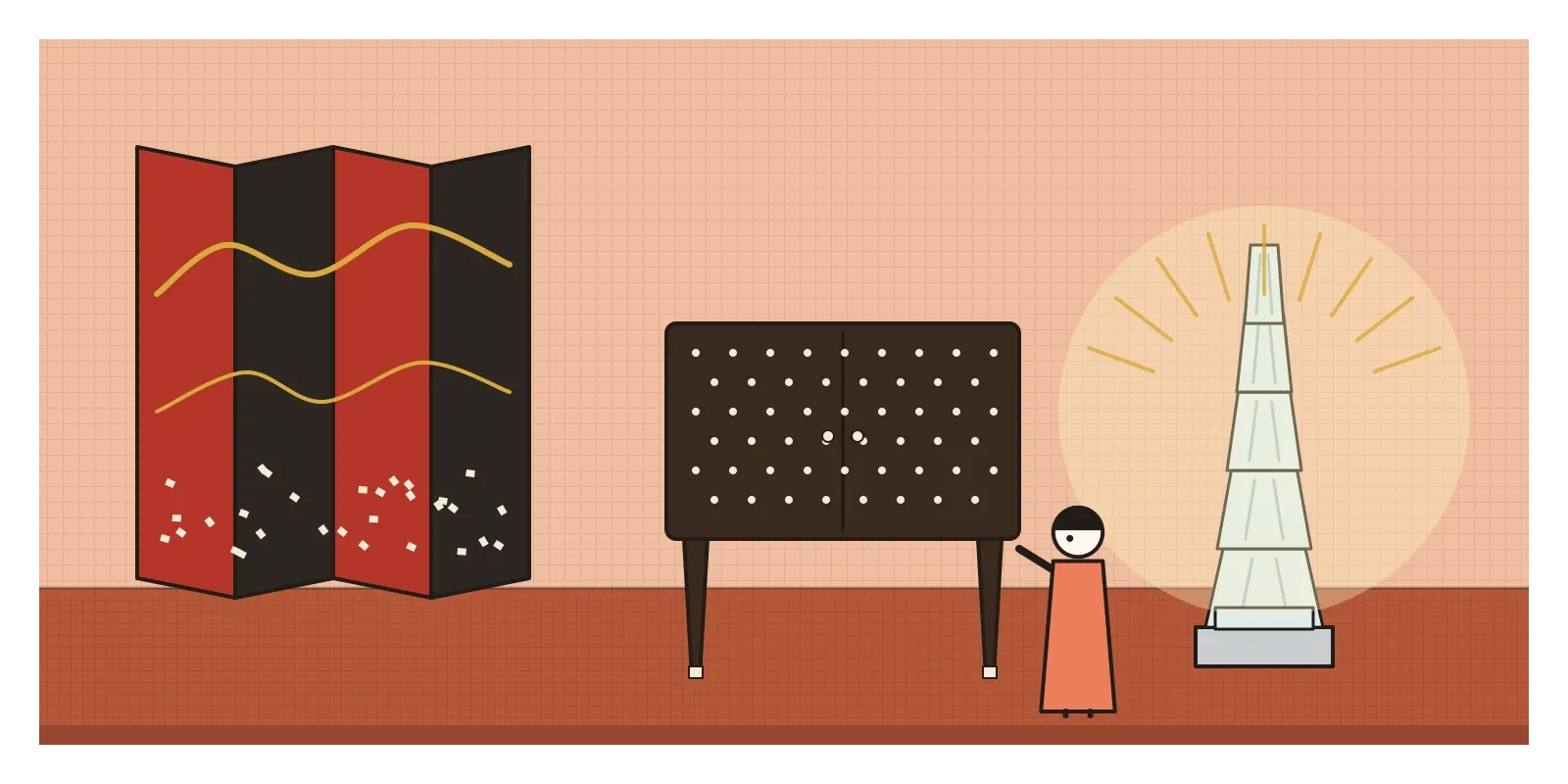
Lacquer was the other great luxury surface. The Irish designer Eileen Gray, working in Paris, learned the slow Japanese technique from the craftsman Seizo Sugawara, building screens and tables out of dozens of thin layers of resin. The metalworker Jean Dunand, who also learned from Sugawara, made lacquered panels in black, red and gold, sometimes set with crushed eggshell. In graphic design, the poster artist Cassandre turned ships, trains and bottles into bold geometric images.
In America the style went up rather than inward. The Chrysler, the Empire State and the Rockefeller Center made Deco the language of the skyscraper. Then it travelled. Miami Beach built rows of pastel hotels along Ocean Drive. Napier, in New Zealand, was rebuilt in the style after an earthquake flattened its centre in February 1931. On the Bund in Shanghai, Sassoon House, now the Peace Hotel, rose in 1929 under a green pyramid roof. And in Bombay, a whole new district went up facing the sea.
Sunbursts, chevrons and stepped skylines
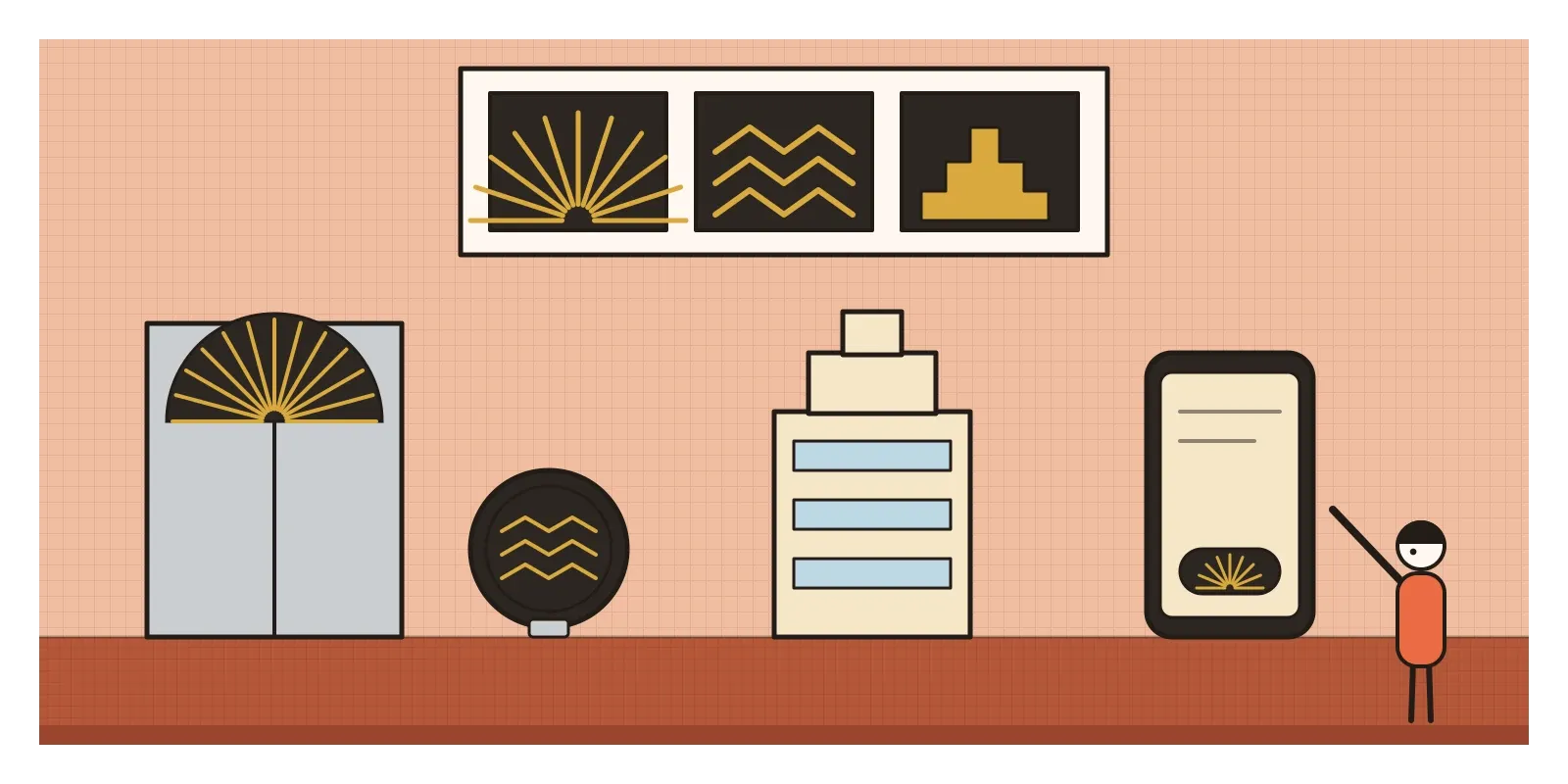
Once you know its vocabulary, Art Deco is one of the easiest styles to spot. Start with the motifs. The sunburst, rays fanning out from a half circle, turns up on garden gates, radio grilles, lift doors and the backs of chairs. The chevron and the zigzag run along friezes and floors. The stepped outline of the ziggurat shapes buildings, clock cases and perfume bottles. There are frozen fountains, leaping gazelles and lines of speed. Unlike Art Nouveau, which drew its ornament from plants, Art Deco draws its ornament with a ruler and a compass.
Next, look at the materials, which are a deliberate mix of old luxury and new technology: ebony, ivory, lacquer, shagreen (the polished skin of sharks and rays) and gold leaf beside chrome, aluminium, Bakelite, coloured glass, terrazzo and neon. Favourite colours are high contrast, black and gold or black and silver, or, in sunnier cities, cream walls with pastel trims.
Buildings are usually symmetrical and vertical, with the ornament concentrated where the eye lands: the entrance, the corner and the crown. Lettering is part of the architecture, set in metal or relief, often tall and condensed, with strong contrast between thick and thin strokes. The effect is ornament that looks engineered.
Bombay turns its face to the sea
In 2018 UNESCO added the Victorian Gothic and Art Deco Ensembles of Mumbai to its World Heritage list, and the best place to see why is the Oval Maidan, a long open ground in the south of the city where people play cricket most afternoons. On its east side stand the Gothic Revival buildings of the 1870s, the High Court and the University with the Rajabai Clock Tower, which I wrote about in the post on Gothic. On its west side, facing them across the grass, runs a row of cream and pastel apartment blocks from the 1930s, with rounded corners, horizontal bands, sunburst grilles on their gates and their names spelled out in decorative lettering. Two ideas of a modern city, half a century apart, face each other across a cricket field.
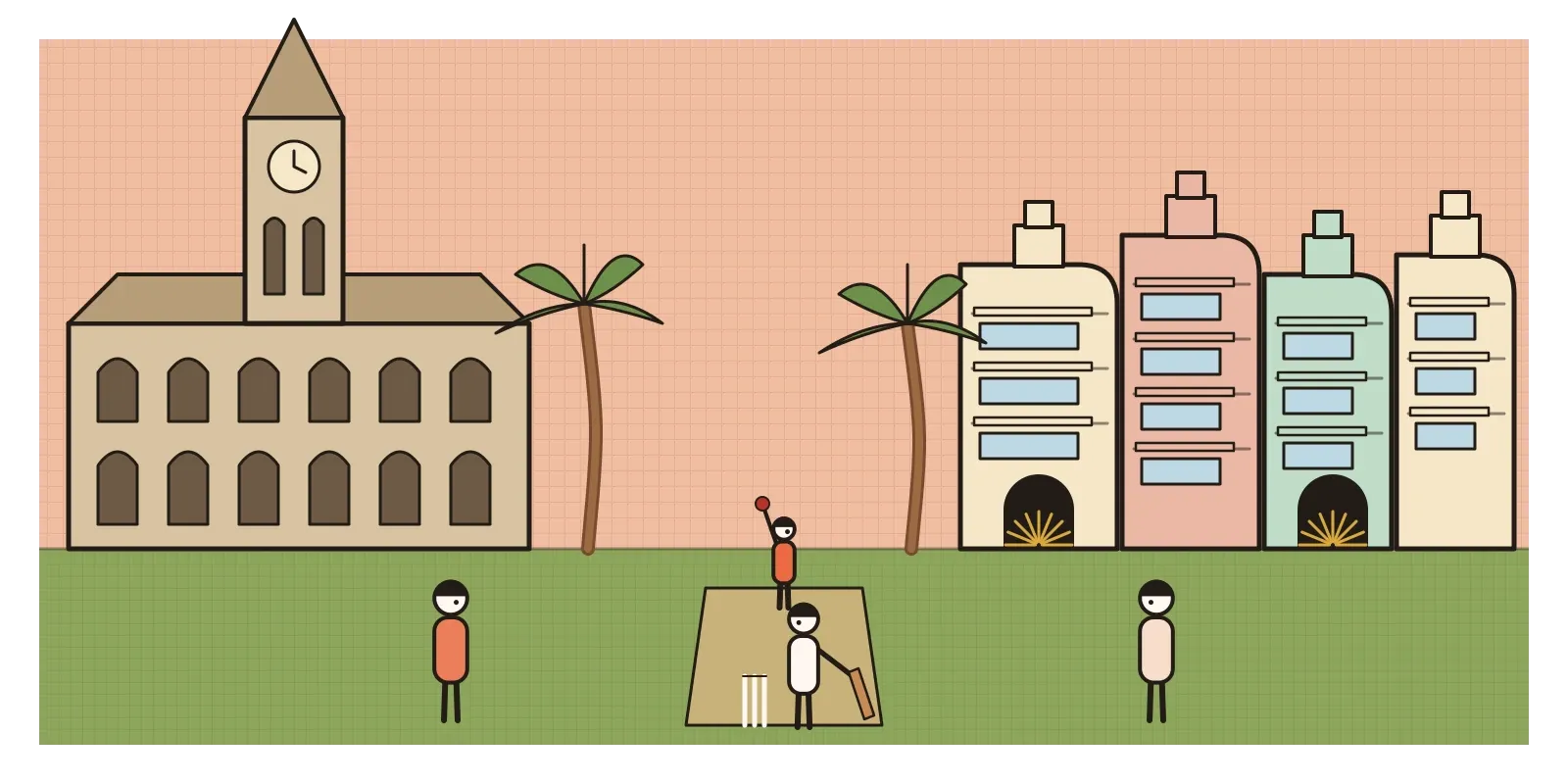
The Deco side stands on new land. The Backbay Reclamation scheme filled in part of the sea west of the old city in the 1920s and 1930s, and the plots were built up quickly in the following years, largely by Indian developers, for Indian families, with Indian architects, engineers and builders. The style continued along the curve of Marine Drive, whose first row of buildings faces the Arabian Sea, and across the city in its cinemas: the Regal at Colaba, which opened in 1933, and the Eros opposite Churchgate station, which opened in 1938, with a facade of cream render and red sandstone and a stepped tower on its corner. On the New India Assurance building of the 1930s, on Mahatma Gandhi Road, carved figures of Indian farmers and workers stand in the place where a Paris building might have put nymphs. Mumbai is often said to have more Art Deco buildings than any city except Miami, though the counts vary.
Why did it take hold so strongly? Writers on the city, including Sharada Dwivedi and Rahul Mehrotra, have read Bombay Deco as the style of a confident Indian business and professional class in the decades before independence. It was modern and cosmopolitan, without the imperial weight of the Gothic buildings across the maidan. Local builders adapted it freely, adding Indian motifs and deep sunshades for the monsoon, a mix sometimes called Indo-Deco.
It reached the princely states too. In Jodhpur, the Umaid Bhawan Palace, built from 1929 to 1943 to designs by the British architect Henry Vaughan Lanchester, has Art Deco interiors, some painted by the Polish refugee artist Stefan Norblin. In Indore, the young Maharaja Yeshwant Rao Holkar II commissioned the German architect Eckart Muthesius, son of the Werkbund's founder, to build the palace of Manik Bagh, finished in the early 1930s and furnished with pieces by Ruhlmann and Eileen Gray.
Gold on black, still selling
Art Deco never really left luxury branding. Look at the packaging of perfume, whisky and chocolates, or at many Indian wedding invitations, and you'll find gold lines on black, fans of rays, stepped frames and tall, high-contrast capitals. Film designers reach for it whenever they want money and modernity at once, as in Baz Luhrmann's The Great Gatsby (2013), and an AI image tool will give you a gold sunburst within seconds.
The more useful lessons are structural. First, Deco shows how a small kit of motifs, a sunburst, a chevron, a step, can be applied at every scale, from a lift door to a lipstick case, and still feel like one family. That's what a good brand system or design system does. Second, it concentrates ornament where attention already goes. The Chrysler Building is plain brick for most of its height and spends its budget on the entrance and the crown, a decent rule for an interface too. Third, pairing an old material with a new one, ebony with chrome, sandstone with neon, is still one of the easiest ways to make something feel familiar and fresh at once.
Ivory, sharkskin and the crash
Modernists despised it even in 1925. Le Corbusier, whose bare Pavillon de l'Esprit Nouveau stood at the same fair (I wrote about it in the post on modernism in design), argued in a book published that year that modern decorative art should have no decoration at all. To him, it was old luxury in a new costume, made one piece at a time for the rich.
There was a darker side to the luxury. Ivory, tropical hardwoods and exotic skins came to Paris through empire, and the 1925 fair itself had colonial pavilions. Its designers borrowed freely from Egyptian, African, Mexican and Asian art as surface pattern, with little interest in what the originals meant. And the style was tied to the speculative boom of the 1920s. The Empire State Building stood so empty in the Depression that New Yorkers called it the Empty State Building. Van Alen had to sue Chrysler for his fee and never designed another major building.
The reply came in two forms. In the 1930s, the luxury Deco of Paris gave way to a cheaper, smoother look made for factories and the Depression, all rounded corners and speed lines, the subject of the next post. Meanwhile the stricter modernists' International Style, which has its own post, stripped ornament away altogether. After the Second World War, Deco was dismissed as kitsch and many of its buildings were demolished, until preservationists in Miami Beach in the 1970s, and residents around the Oval Maidan much later, fought for what remained.
To see Art Deco for yourself this week, if you're in Mumbai, go to the Oval Maidan in the late afternoon, stand on the Gothic side and look west at the row of 1930s blocks, then walk round to the Eros at Churchgate and along Marine Drive. Anywhere else, count sunbursts on gates, window grilles and old shopfronts on a walk; most Indian cities have more than you'd expect. And think back to that steel needle sliding up out of the Chrysler crown on an October afternoon in 1929, the day before the crash. It was the perfect Deco gesture, pure glamour engineered in secret, arriving just as the world that paid for it fell apart. In the next post, on Streamline Moderne, I'll follow the style as it lost its ornament and learned to look fast.
Further reading: Bevis Hillier, Art Deco of the 20s and 30s (1968) · Charlotte Benton, Tim Benton and Ghislaine Wood (eds.), Art Deco 1910-1939 (2003) · Sharada Dwivedi and Rahul Mehrotra, Bombay Deco (2008) · Neal Bascomb, Higher: A Historic Race to the Sky and the Making of a City (2003)
A reply toArt Nouveau's whiplash curves, straightened by Cubism and the machine.