Suprematism
How Kazimir Malevich emptied painting of objects and left flat shapes floating in white space.
Suprematism
The night the sun was locked away
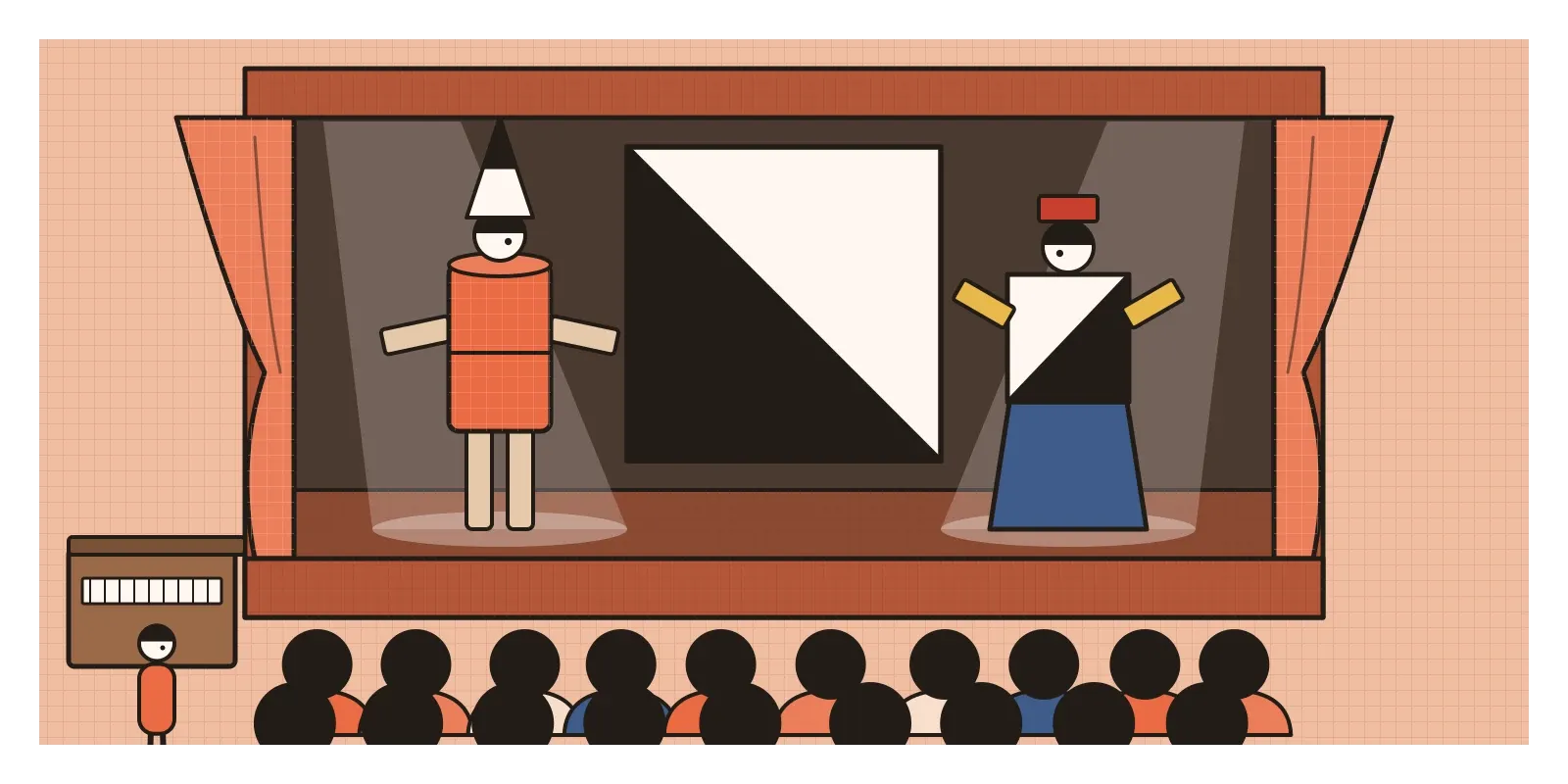
In December 1913, a small group of Russian poets, painters and a composer put on an opera at the Luna Park theatre in St Petersburg. It was called Victory over the Sun. The libretto, by the poet Aleksei Kruchenykh, was written partly in zaum, an invented "beyond-sense" language of sounds that weren't quite words, and the music, by Mikhail Matyushin, was played on an out-of-tune piano. The story followed a band of Futurist strongmen who tear the sun out of the sky and lock it away, so that the old world of nature and habit can end and a new, man-made one begin. The audience laughed, whistled and shouted.
The sets and costumes were by a painter called Kazimir Malevich, born in Kyiv in 1879 to a Polish family. He built the costumes out of cardboard and wire, so the singers moved stiffly, like walking geometry, and used spotlights to cut their bodies into pieces on the dark stage. One backdrop was a square divided corner to corner into a black half and a white half. Two years later, when Matyushin planned a new edition of the opera, Malevich wrote begging him to keep that drawing, saying it would have great significance for painting. He was right, at least about his own.
In 1915 Malevich launched a new kind of art he called Suprematism, from the Latin supremus, highest. Painting, he argued, should show the supremacy of pure feeling, and could only do so once it stopped picturing things. Suprematist works are flat shapes of colour, squares, rectangles, crosses, circles and thin bars, floating on a white ground with no horizon, no objects and no story. As I wrote in the post on abstraction, the most famous of them, Black Square, hung across the top corner of a room in Petrograd at the end of 1915, where an icon would hang in a Russian home. This post is about everything around that square.
Suprematism was a reply to Cubism and Futurism, which have their own posts earlier in this section. Russian artists knew both well. In Moscow, the merchant Sergei Shchukin let visitors into his house to see his Picassos and Matisses, and Malevich had spent 1912 and 1913 in a mixed style people called Cubo-Futurism, all faceted metal figures and blurred movement. But both movements still broke real things apart, a guitar, a face, a racing car. Malevich wanted to finish the job, and the title of his 1915 pamphlet, From Cubism and Futurism to Suprematism, is the argument. Other sources fed in too: the flat gold of icons, peasant embroidery and painted shop signs, and the mystical talk of a fourth dimension then fashionable in Russia. All this while Russia was losing a world war and heading for revolution.
A peasant woman in two dimensions
Beside Black Square at that exhibition hung what looks, at first, like a red square on white. Its full title is Painterly Realism of a Peasant Woman in Two Dimensions, and it's now in the State Russian Museum in St Petersburg. It isn't quite a square. Two sides lean slightly, so the shape seems to tilt and breathe. The title is half joke, half manifesto: a peasant woman with everything but her energy taken away.
In 1916 a group called Supremus gathered around him, and some of its strongest members were women. Olga Rozanova pushed Suprematism towards colour as light. In Green Stripe (1917), a single soft green band runs down a white canvas, its edges glowing as if lit from behind. She died of diphtheria in November 1918, aged thirty-two. Lyubov Popova and Nadezhda Udaltsova also made Suprematist work before moving on to the Constructivism of the next post. Malevich went the other way, away from colour. Around 1918 he painted Suprematist Composition: White on White, also at MoMA, a tilted white square on a slightly warmer white, the shape almost dissolving into the space around it. It was about as far as painting could go without disappearing.
Squares on scarves, plates and city walls
The first time Suprematist designs were shown in public, they weren't paintings at all. In November 1915, about six weeks before the Petrograd exhibition, a show of embroideries made from artists' designs opened at the Lemercier Gallery in Moscow. It was organised with Natalia Davydova, who ran an embroidery workshop on her estate at Verbovka in Ukraine, where village women stitched for sale, and the painter Alexandra Exter. They asked avant-garde artists for patterns and had the embroiderers make them up as cushions, scarves and bags. Malevich's designs arrived too late to be stitched and were shown on paper, but they were Suprematism's first public appearance. Verbovka went on stitching Suprematist pieces for a couple of years, so some of the earliest non-objective art in Europe was made by rural women with needles.
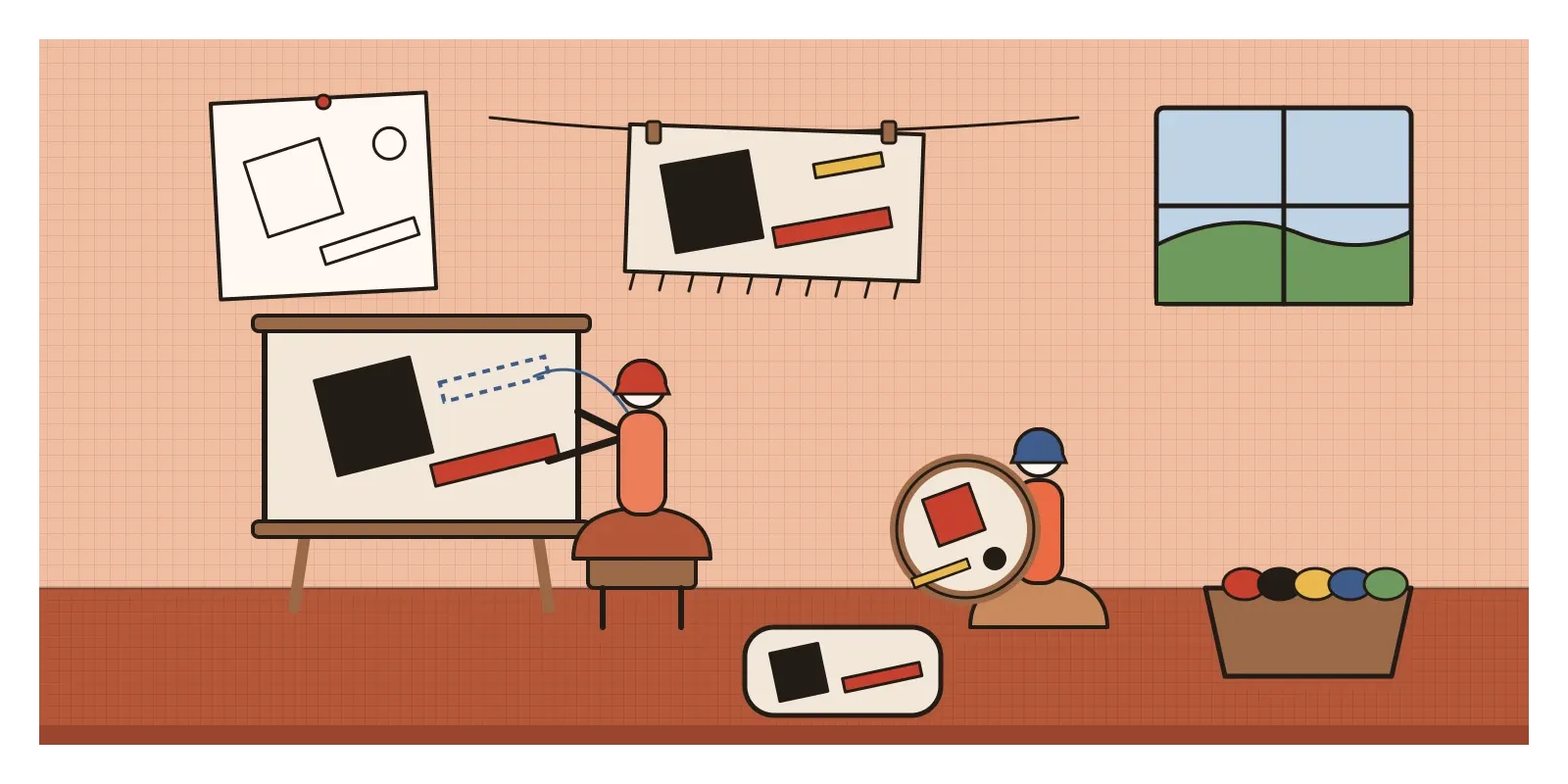
After the revolution of 1917, Suprematism briefly became the style of a city. In 1919 Malevich went to teach at the art school in Vitebsk, now in Belarus, founded by Marc Chagall. Within months most of the students had gone over to Malevich, and Chagall left. Their group, Unovis, roughly "champions of the new art", wore black squares on their sleeves and painted Suprematist shapes on banners, signs and the brick walls of the town for revolutionary festivals. The film-maker Sergei Eisenstein later remembered streets covered with coloured circles and squares. One of the teachers was El Lissitzky, whose story belongs to the next post.
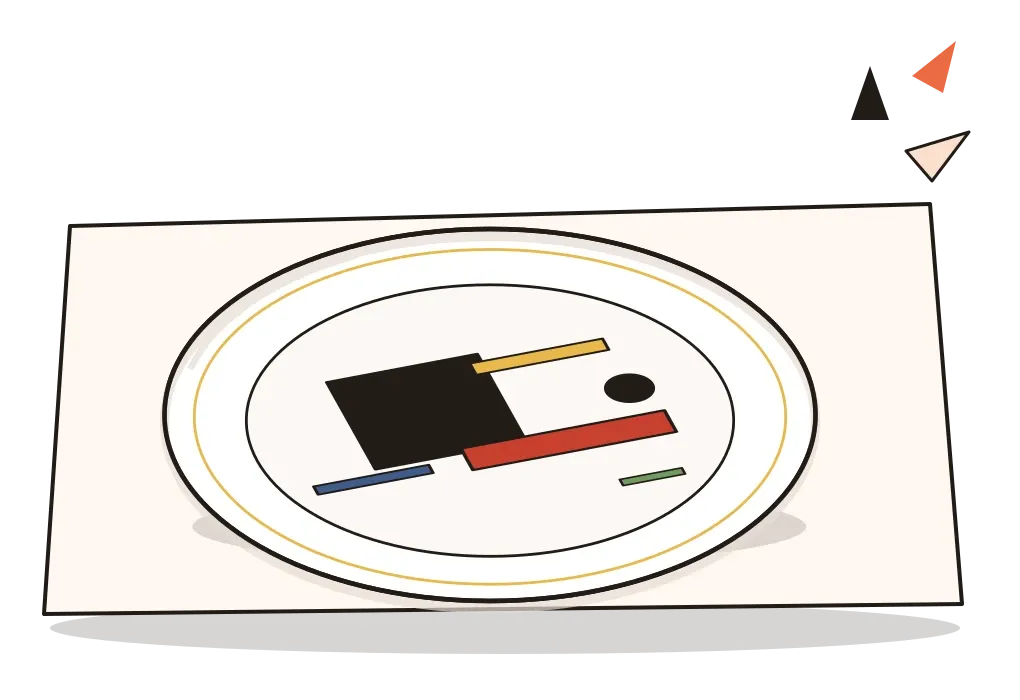
The shapes reached the dinner table too. At the State Porcelain Factory in Petrograd, the old imperial works, Malevich's students Nikolai Suetin and Ilya Chashnik painted Suprematist compositions onto plates and cups in the early 1920s, and Malevich designed a teapot that looks assembled from blocks and half-spheres. He also built what he called architektons, plaster models of stacked white blocks, like towers with no doors, no windows and no function.
Shapes adrift in white space
The first thing to look for is the white. In most paintings the background sits behind the subject. In Suprematism the white is an endless space with no ground, no sky and no up or down, and many of these pictures still work upside down. The shapes don't rest on anything. They float, drift and tilt, and the slight angle of a rectangle is enough to make it feel as if it's moving.
The shapes are few: the square, the rectangle, the circle, the cross, the long thin bar, sometimes a trapezium or a slice of an arc. Colour is flat and unshaded, mostly black and red at first, with yellow, blue, green and pink later. Depth comes only from size and overlap, so a big black shape feels close and a small yellow sliver far away. Compositions are almost never symmetrical. Clusters gather off-centre and leave large areas of white empty, which gives the pictures tension, as if the shapes might drift off the edge.
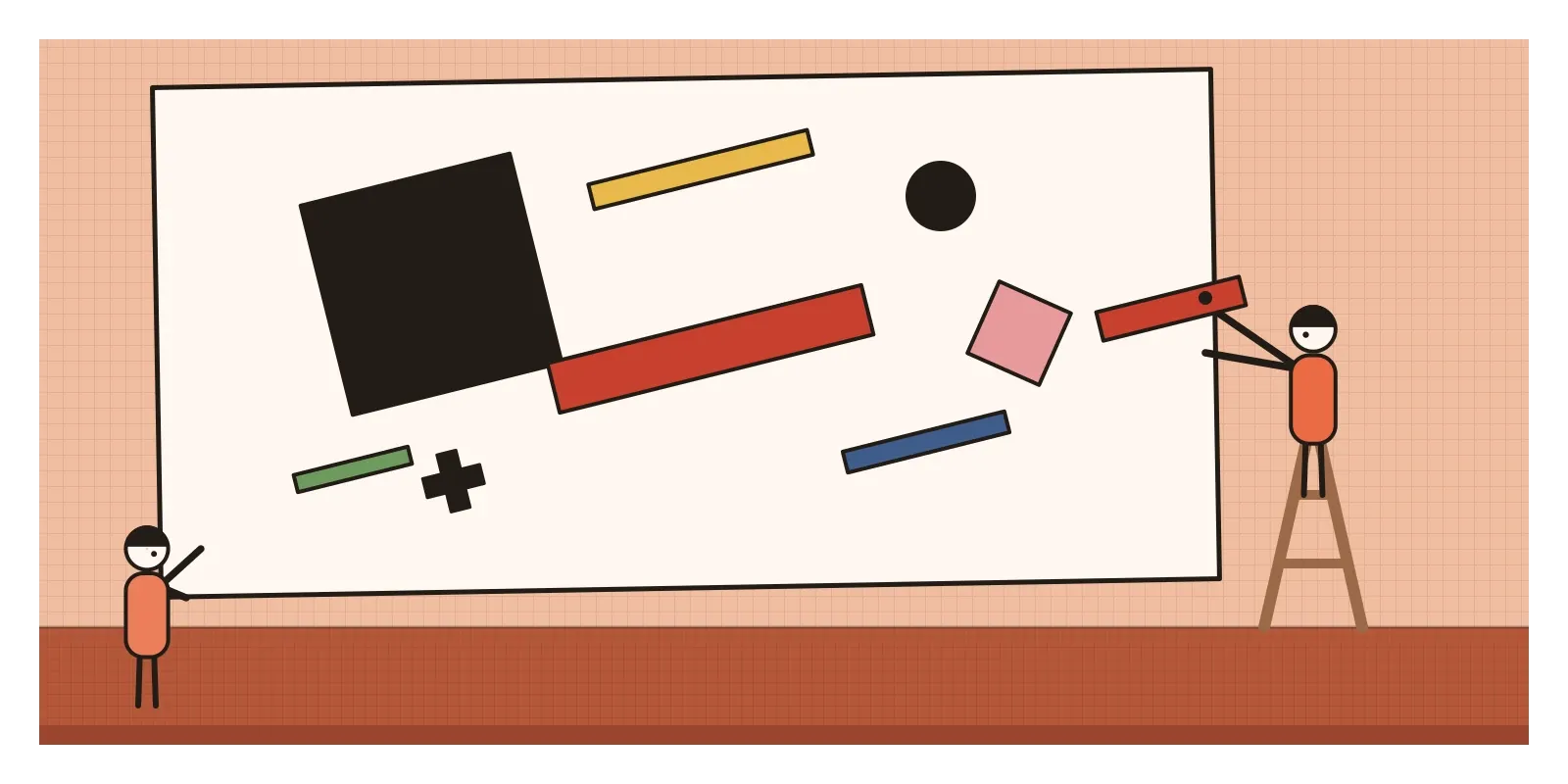
Look closely and these aren't machine-made: the edges are freehand and the paint shows brushmarks. Neither the red square nor the black one is truly square. That slightness matters. Suprematism looks like geometry, but it was meant as feeling, and its makers would have hated to see it mistaken for a diagram.
Two Russian painters of 1913
Suprematism has no Indian branch, but one Russian painter's path crosses Malevich's and ends in the Himalayas. In May 1913, seven months before Victory over the Sun, Paris saw the riotous first night of Igor Stravinsky's ballet The Rite of Spring. Its sets and costumes were by Nicholas Roerich, who had helped Stravinsky shape its story of ancient pagan Russia. So in the same year two Russian painters designed two famous stage productions. Roerich looked back, to a mythical past of sun-worship and earth rituals. Malevich looked forward, to the day the sun was abolished.
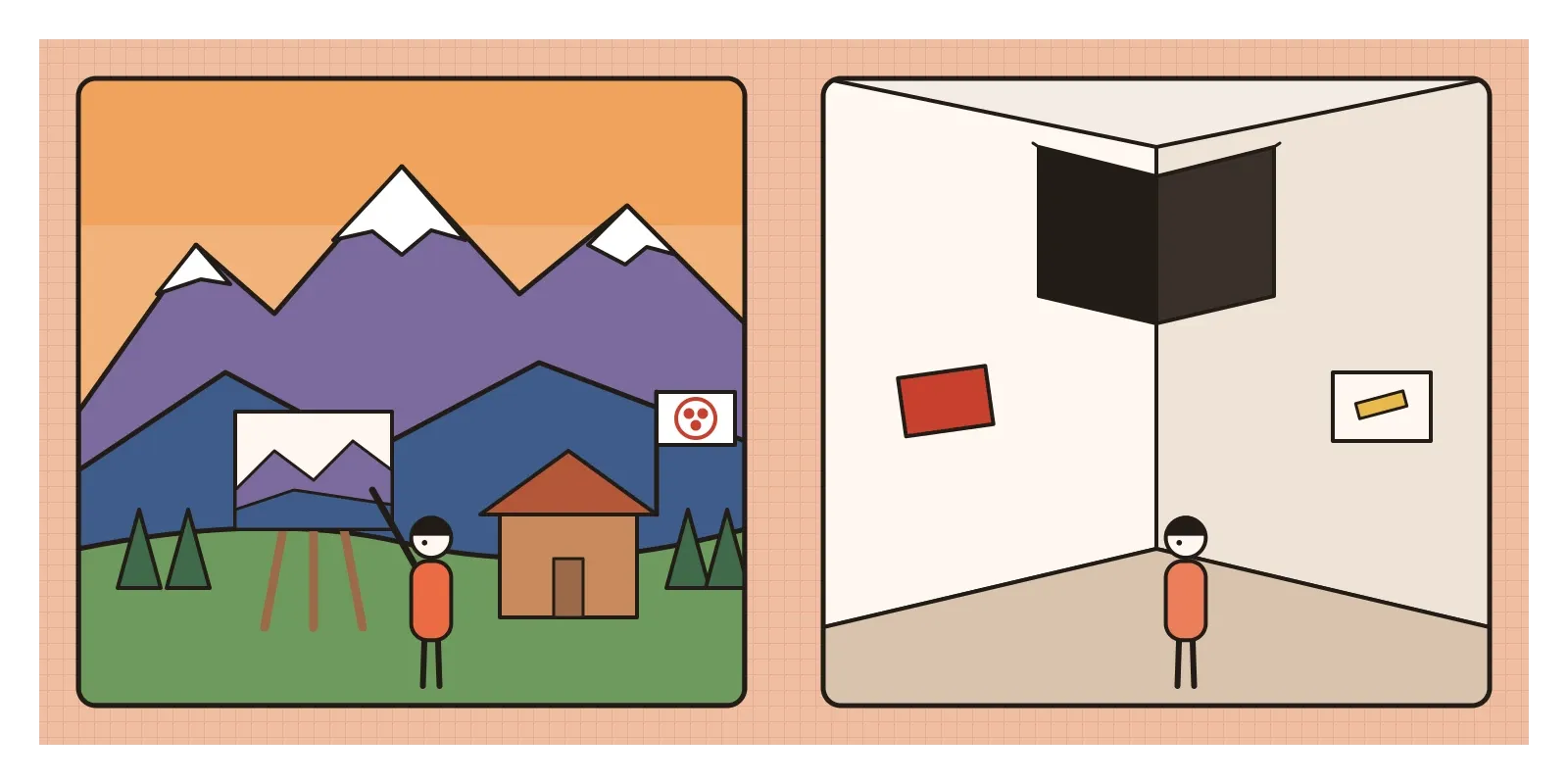
Their lives kept diverging. Roerich left Russia, travelled through Central Asia and Tibet, and in the late 1920s settled with his family at Naggar in the Kullu valley, in today's Himachal Pradesh, where he painted hundreds of mountain views in flat bands of brilliant colour until his death in 1947. In April 1935, a treaty Roerich had campaigned for, to protect museums and monuments in wartime, was signed in Washington. Its emblem, his Banner of Peace, is three circles inside a ring on a white field. A month later, Malevich died in Leningrad. Both men, in the end, set a few flat shapes on white and asked them to carry spiritual meaning. Roerich said his came from ancient symbols. Malevich said his came from nothing at all. Decades later, Indian painters would reach squares, circles and triangles from yet another direction, through Tantric diagrams, which I'll come to in the post on Neo-Tantra.
The infinite white canvas
Open almost any design tool today and you're looking at a Suprematist space. Figma, Miro and their cousins give you an endless white plane with no horizon, where rectangles float at any size, overlap and turn to any angle. Nobody chose that because of Malevich, but the idea that a flat field can be a space rather than a surface, and that a few rectangles placed off-centre can feel dynamic, is something the Suprematists worked out first.
Architecture took it literally. In 1976 and 1977, as a student at the Architectural Association in London, Zaha Hadid made her graduation project a hotel on a bridge over the Thames called Malevich's Tektonik, turning one of the architektons into a building, and her later buildings, with their long, tilted, sliding forms, kept that debt visible. In graphic design, Lissitzky carried the shapes into books and posters, and through him into modern layout. Every abstract brand mark built from a square, a dot or a slanted bar owes something to Malevich's argument that a shape with no subject can still carry energy.
A square on the coffin
Suprematism promised a fresh start, but it had blind spots. Malevich wrapped his work in grand, cloudy theory about cosmic feeling and the zero of form, and even sympathetic readers find much of it impenetrable. He backdated works to make his discoveries look earlier. And in 2015, researchers at the Tretyakov Gallery in Moscow reported a handwritten note on the edge of the original Black Square that seems to refer to an 1897 joke picture by the French humorist Alphonse Allais, an all-black canvas with a racist title about a fight in a cellar at night. The reading is still debated, but it's an uncomfortable thought that the icon of pure feeling may have begun partly as a borrowed, ugly joke.
Politics finished the movement off. Other artists argued that a painted square was no use to workers, and when Malevich showed White on White in Moscow in 1919, Aleksandr Rodchenko answered in the same exhibition with paintings of black on black. By the late 1920s the Soviet state was attacking abstraction as "formalism". Malevich was briefly arrested in 1930, and in his last years he painted peasants with blank faces and a Renaissance-style self-portrait signed with a tiny black square. When he died in 1935, Suetin made him a coffin painted with Suprematist shapes, and a black square rode on the truck that carried it through Leningrad. His ashes were buried under an oak near Nemchinovka, outside Moscow, beneath a white cube with a black square on it, lost in the war. The reply was already under way: Constructivism, which wanted real materials and useful things instead of floating feelings.
The richest collections are in the State Russian Museum, the Tretyakov and the Stedelijk Museum in Amsterdam. In India, you can see Roerich's Himalayas at his estate at Naggar, near Manali, and at the Karnataka Chitrakala Parishath in Bengaluru. For an exercise, cut six shapes from coloured paper, a square, a circle, a cross and three bars of different lengths, and drop them on a white sheet. Move them until they seem to float rather than sit, then take one away at a time until nothing more can go.
Malevich's first square was a backdrop in an opera about locking up the sun. The opera was mostly forgotten. The square escaped into painting, embroidery, porcelain, city walls and finally a coffin, and it's still drifting through the white space of the screens we design on. In the next post, on Constructivism, Malevich's students and rivals take the shapes off the canvas and try to build a new world with them.
Further reading: Kazimir Malevich, From Cubism and Futurism to Suprematism (1915) · Aleksandra Shatskikh, Black Square: Malevich and the Origin of Suprematism (2012) · Achim Borchardt-Hume (ed.), Malevich: Revolutionary of Russian Art (2014) · Camilla Gray, The Great Experiment: Russian Art 1863-1922 (1962) · Charlotte Douglas, Kazimir Malevich (1994)
A reply toCubism and Futurism, which broke objects into pieces but never let go of the objects.