Constructivism
How Russian artists after 1917 traded the easel for the factory, the poster and the stage.
Constructivism
A tower that leaned towards the future
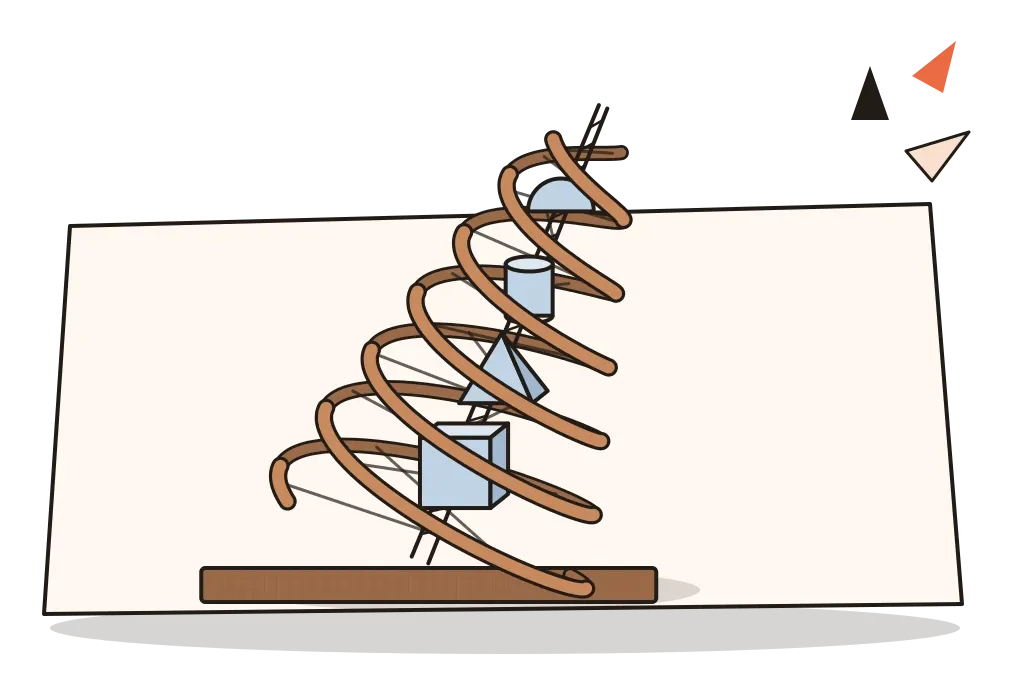
In December 1920, delegates arriving in Moscow for the Eighth Congress of Soviets could step aside from the speeches and look at a strange wooden object standing in the House of Trade Unions. It was a model, several times taller than a person, of two open spirals winding around a tilted spine, like a skeleton of a corkscrew leaning forward. Inside the spirals hung three glass shapes stacked one above another: a cube, a pyramid and a cylinder. It had been built over the previous months by the painter Vladimir Tatlin and a few assistants in a studio in Petrograd, shown there in November for the third anniversary of the revolution, then taken apart and carried to Moscow.
The real thing was meant to be about 400 metres tall, a third higher than the Eiffel Tower, made of iron and glass, and to straddle the river Neva as the headquarters of the Third International, the organisation meant to spread revolution around the world. Each glass volume was to house a different body and rotate at its own speed: the cube once a year, the pyramid once a month, the cylinder once a day. It was never built. Russia was short of bread, let alone iron. The model itself was lost. Yet the critic Viktor Shklovsky's quip that it was made of iron, glass and revolution caught why it mattered. It was a sculpture that wanted to be a building, a machine and a government all at once.
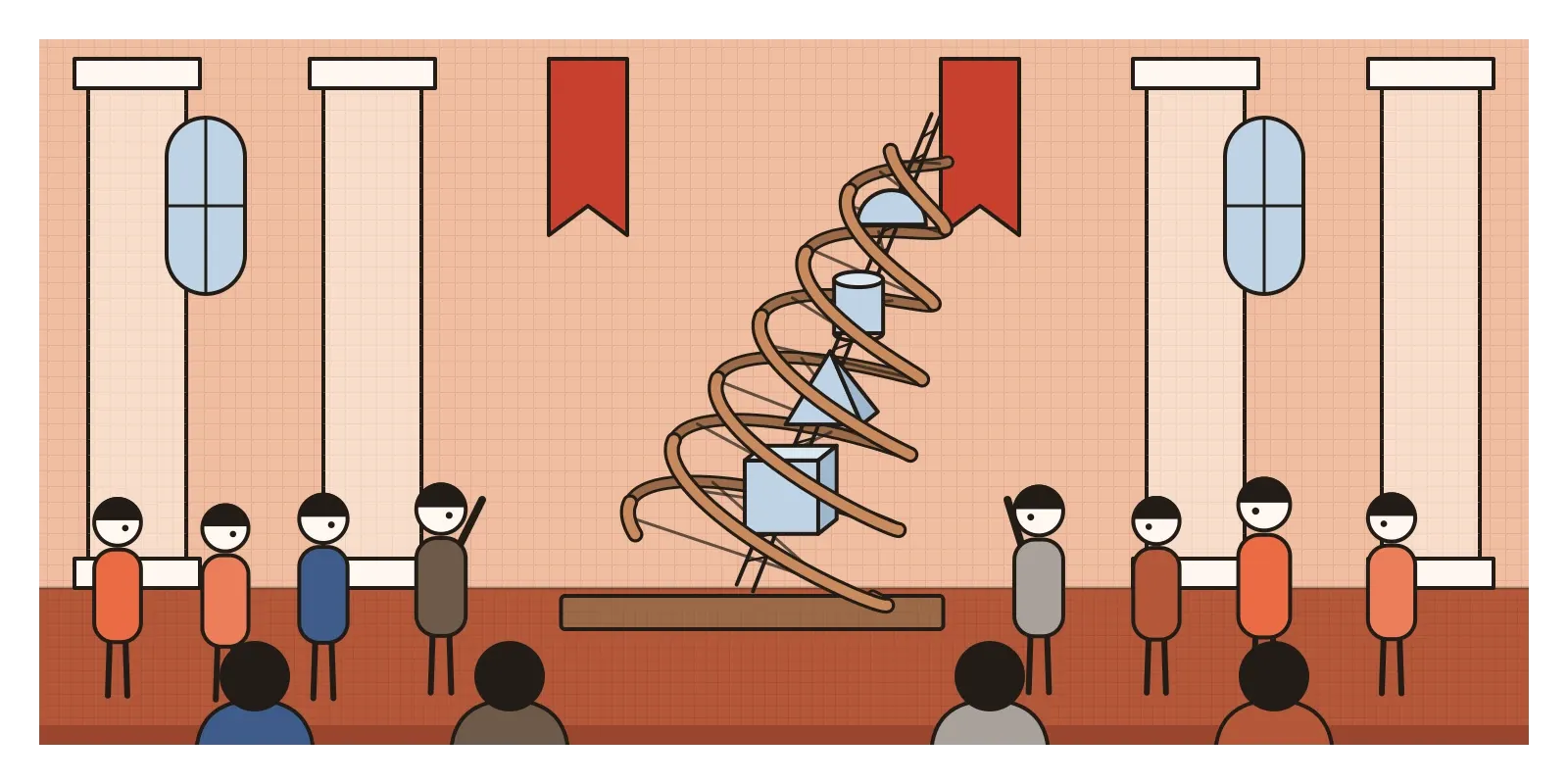
Constructivism was the movement that grew from objects like this. Its members believed that art should stop being a private picture on a wall and become useful work in a new society, so they turned to materials, engineering, typography, textiles, theatre and propaganda. It flourished in Russia from around 1915 to the end of the 1920s, though historians argue about where to draw its edges, especially between early experiments with materials and the stricter group that took the name in 1921.
From floating squares to real materials
In the post on Suprematism, I described Malevich's flat shapes floating in white space. Constructivism began as a rival to that idea, and the rivalry was personal. In 1914 Tatlin had been to Paris and visited Picasso's studio, where he saw the Spanish painter's constructions of cardboard, wood and string. Back in Russia he made what he called counter-reliefs, bits of tin, wood, glass and wire slung across the corner of a room on cables. At the same Petrograd exhibition in December 1915 where Malevich hung his black square, Tatlin hung his corner reliefs, and the two men famously didn't get on. Malevich wanted painting to reach pure feeling. Tatlin wanted to work with real materials in real space.
The revolution of 1917 gave that difference a political edge. The new Soviet state needed posters, books, uniforms, festivals and buildings, and the old patrons of art had gone. Young artists asked what a painter was for in a workers' state. Their answer was that the artist should become a kind of engineer. In March 1921, at the Institute of Artistic Culture in Moscow, Aleksandr Rodchenko, Varvara Stepanova, Aleksei Gan and a few others formed the First Working Group of Constructivists. Gan's book Constructivism, published in 1922, set out their ideas under three strange headings, tectonics, texture and construction: roughly, the purpose of a thing, the nature of its material, and the way it is put together.
Three monochromes and a stage of ramps
The clearest farewell to painting came in September 1921, at a small Moscow exhibition called 5x5=25, where five artists each showed five works. Rodchenko's contribution included three canvases, one pure red, one pure yellow and one pure blue, each painted flat from edge to edge. He later said he had taken painting to its logical end. After that he largely stopped painting and turned to photography, posters, furniture and books.
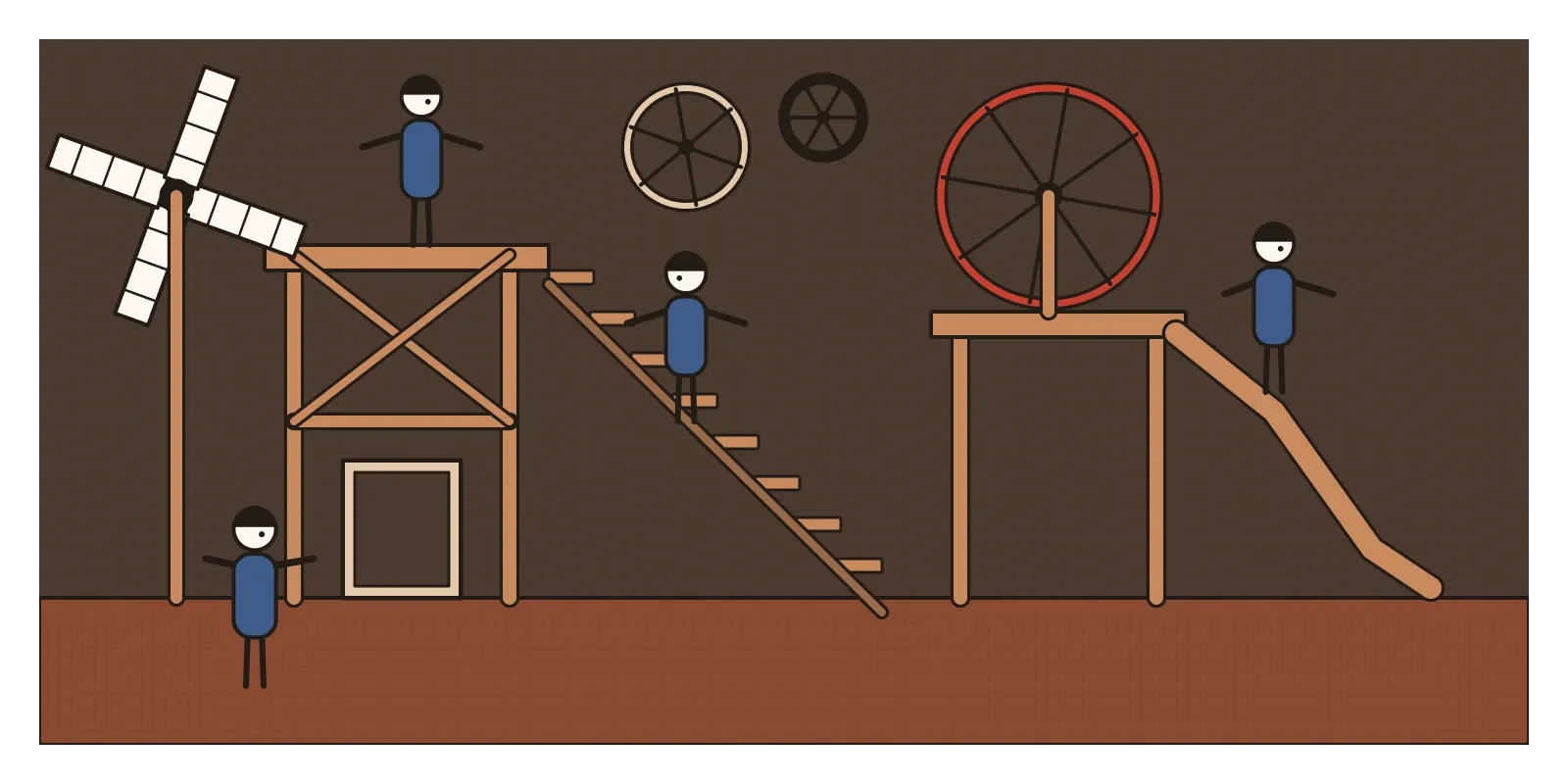
Lyubov Popova took Constructivism onto the stage. In April 1922, the director Vsevolod Meyerhold put on a farce called The Magnanimous Cuckold in Moscow, and Popova designed the set as a bare wooden apparatus instead of a painted scene: platforms, staircases, a slide, doors and a set of wheels and windmill sails that spun faster as the action grew more frantic. The actors wore plain blue working overalls and moved like acrobats. It was a machine for acting, not a picture of a place.
El Lissitzky, who had worked with Malevich in Vitebsk, carried the shapes onto the street. His poster Beat the Whites with the Red Wedge, made around 1919 or 1920 during the civil war, shows a sharp red triangle driving into a white circle, a whole battle reduced to geometry. In 1923, in Berlin, he designed For the Voice, a book of poems by Vladimir Mayakovsky meant to be read aloud, with a cut-away index of tabs down the edge so a reader could flip straight to each poem, and pages built from bold type, bars and circles.
Rodchenko and Mayakovsky also went into business. From 1923 they worked as a two-man advertising team for state companies, Rodchenko designing and Mayakovsky writing short, punchy rhymes. Their posters and wrappers for biscuits, sweets, rubber galoshes and the GUM department store used huge sans-serif letters, diagonal layouts, flat red and black and, increasingly, photographs. In 1925 Rodchenko designed a workers' club reading room for the Soviet pavilion at the big exhibition of decorative arts in Paris: wooden tables, reading stands and a chess table, all in red, grey, black and white, plain enough to be made in any factory. Meanwhile the Vkhutemas, the state art and technical school founded in Moscow in 1920, taught these ideas to hundreds of students, and is often called the Russian Bauhaus.
Circles you could wear to work
The most everyday Constructivist objects were fabrics. In 1923 and 1924, Popova and Stepanova designed prints for the First State Textile Printing Factory in Moscow, turning out patterns of circles, stripes, crosses and interlocking triangles in two or three strong colours. Several went into mass production as dress cotton, and for a short time Soviet women could wear a little piece of the avant-garde. Popova died of scarlet fever in May 1924, aged thirty-five, just as the work was taking off. Stepanova went on to design sports clothes in blocks and stripes of colour, so that players could be told apart at a glance.
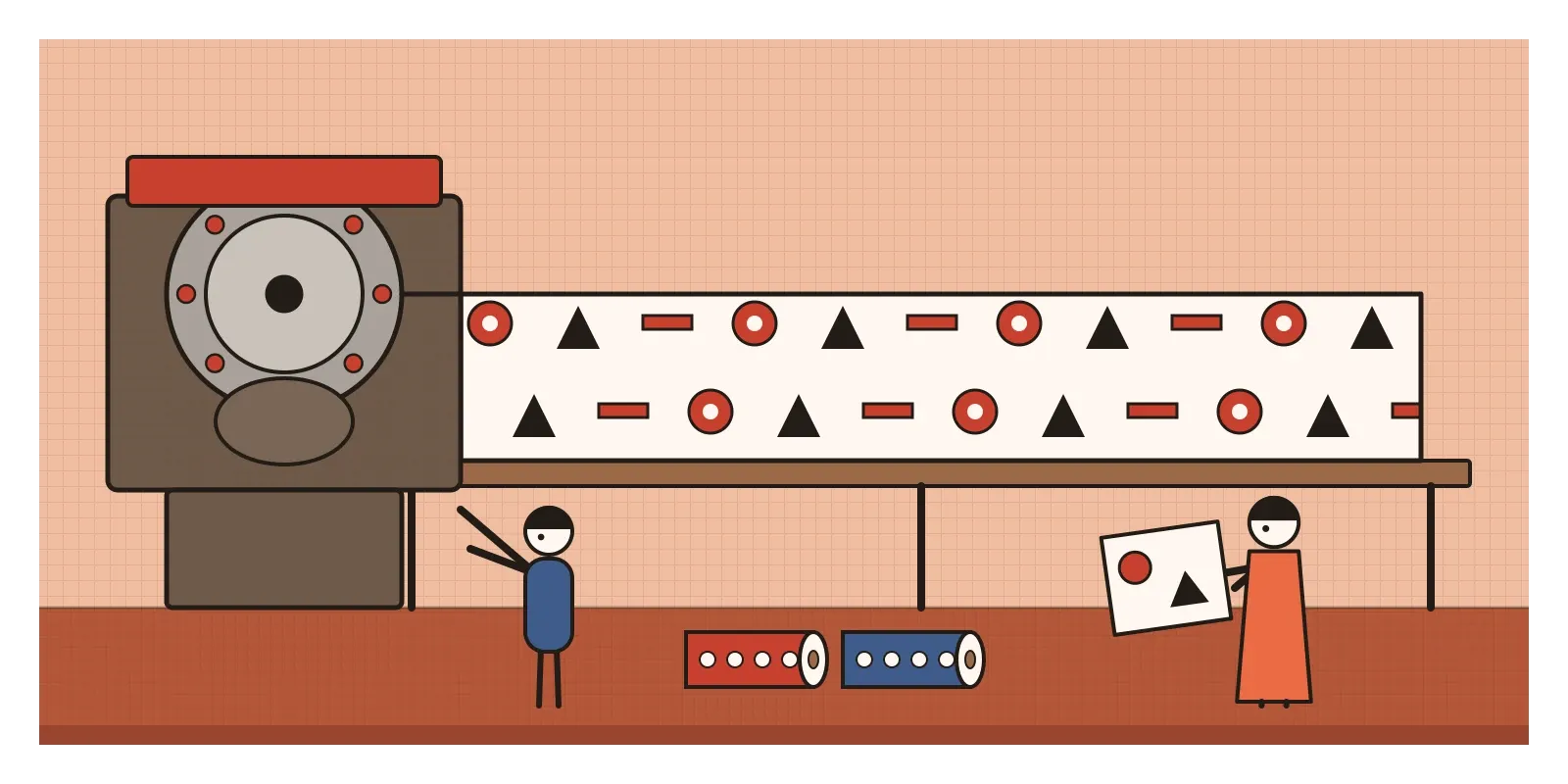
Those fabrics show the whole visual vocabulary in miniature. Constructivism is made of a few elements, the circle, the bar, the triangle, the grid, combined so that you can see how they are put together. Nothing is hidden, and in three dimensions the joints, bolts and struts are on show, as in Tatlin's tower. Colour is limited and loud: red, black and white above all, sometimes with grey or a single extra colour. Diagonals are everywhere, because a tilted line feels like movement and progress, while a level one feels settled.
In graphic design, look for heavy sans-serif letters, often set at an angle or in steps, words placed as blocks in a composition rather than in neat lines, bars and rules that direct the eye, and photographs cut out and combined in photomontage. Faces are shot from far below or far above, buildings from odd angles, because Rodchenko believed that new viewpoints made people see the world afresh.
A poet in Moscow, and walls in Kerala
In September 1930, Rabindranath Tagore spent about two weeks in Moscow. He was sixty-nine, and he went expecting to disapprove. What he saw, especially the drive to teach millions of peasants and workers to read, moved him deeply, and he wrote about it in a series of letters, later collected in Bengali as Russiar Chithi and in English as Letters from Russia. But he also worried aloud, in an interview with the newspaper Izvestia, about the use of force and the suppression of dissent. That part of the interview is said not to have appeared in the Soviet press until 1988.
There's a gap in this story, though, and it's an instructive one. By the time Tagore arrived, the Constructivists were already being pushed aside, and by the 1950s, when Soviet print reached India in bulk, it came in a quite different style. Magazines like Soviet Land, printed in many Indian languages, and cheap, beautifully illustrated Soviet children's books, remembered fondly by generations of readers in Kerala, Bengal and elsewhere, mostly used the warm, realist pictures that Stalin's state preferred.
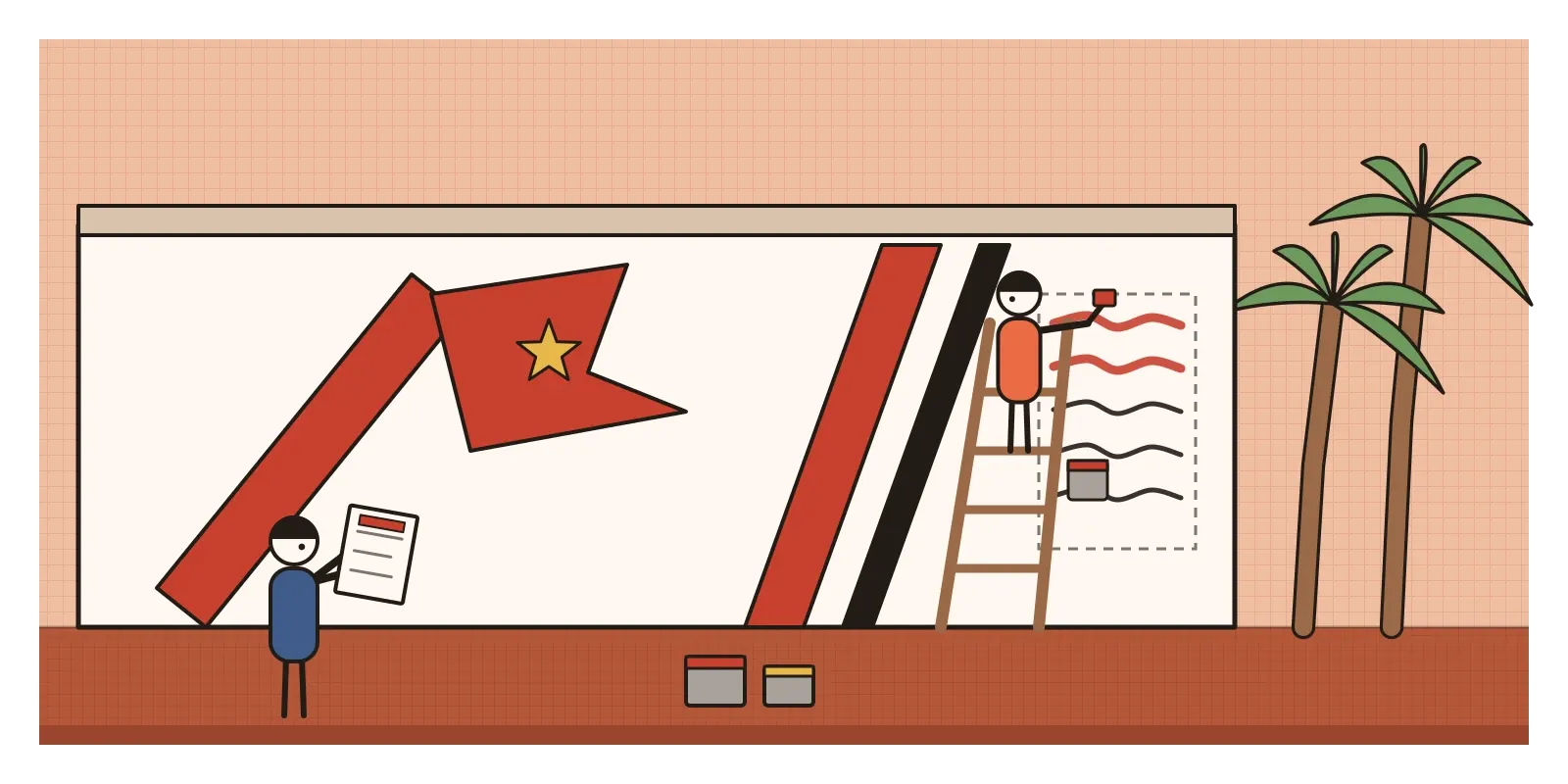
The nearest Indian cousin of the Constructivist poster may be on the street rather than in a gallery. Drive through Kerala or parts of Kolkata at election time and you'll see walls painted by hand with red flags, stars, bold slogans and diagonal bands of colour, made quickly by local painters for a political purpose. The link is loose, and I don't want to overstate it, since these walls owe as much to cinema hoardings and local sign-painting as to anything from Moscow. But the idea behind them, that art can be a public, practical tool for persuading people rather than a private object, is one the Constructivists would have recognised.
The designer as engineer
Constructivism's biggest legacy is a job description. Before it, most artists made objects for collectors. The Constructivists insisted that designing a fabric, a book, a kiosk or a chair was just as serious as painting, and that a designer should understand materials, production and the people who would use the thing. That idea passed through Lissitzky's travels to the Bauhaus and the New Typography, which have their own posts, and it's still the basis of product design. When a designer today sits with engineers to work out what a factory or a codebase can actually make, they're living the Constructivist bargain.
The look survives too. Diagonal layouts, heavy condensed sans-serif type, red and black on white and cut-out photography still signal energy and protest, and record sleeves, festival posters and campaign graphics borrow them constantly. In 1988 an exhibition at the Museum of Modern Art in New York called Deconstructivist Architecture explicitly linked a new generation of tilted, fractured buildings to the Russian Constructivists.
When the state stopped needing artists
Constructivism promised art for everyone, but it depended entirely on a state that soon had no use for it. Many of its grandest projects, Tatlin's tower first among them, existed only as models and drawings, utopias for a country that couldn't feed itself. Ordinary people often preferred familiar pictures to bars and wedges, and by the late 1920s officials attacked the avant-garde as "formalist", too difficult for the masses. In 1932 the Communist Party dissolved the independent art groups, and soon Socialist Realism, heroic workers painted in a conventional realist style, became the only acceptable art. Mayakovsky had shot himself in 1930. The designer Gustav Klutsis, who had drawn folding propaganda kiosks and loudspeaker stands for the streets, was arrested and shot in 1938.
The hardest question is complicity. The Constructivists wanted art to serve the revolution, and it did, including its darkest parts. In 1933 Rodchenko photographed the building of the White Sea Canal for the propaganda magazine USSR in Construction, a canal dug largely by prisoners of the labour camps, thousands of whom died. Art that serves power directly has no defence when power turns murderous. And although women such as Popova, Stepanova and Exter were central to the movement, their textiles and costumes were long ranked below the men's architecture and posters.
Inside Russia nothing replied to Constructivism. It was simply silenced. Outside, the Bauhaus and the New Typography picked up its ideas and softened them.
The largest collections are in the State Tretyakov Gallery in Moscow and the State Russian Museum in St Petersburg, and the Costakis collection in Thessaloniki holds a remarkable group of Russian avant-garde works. Reconstructions of Tatlin's tower model have been made for museums, including one at the Moderna Museet in Stockholm. In India, the closest you'll come is a painted political wall, or a well-thumbed Soviet children's book in a second-hand stall. For an exercise, design a poster with only red, black and white, one photograph cut from a newspaper and a single strong diagonal. Make the diagonal do the work of telling the eye where to go.
Tatlin's spiral never rose over the Neva. It stood for a few weeks in a hall full of delegates and then disappeared. But the belief it carried, that making things is a way of building a society, ran into textiles, books, posters and schools, and from there into the design profession itself. In the next post, on Dada, I'll turn to artists who answered the same war years not by building but by laughing at everything.
Further reading: Christina Lodder, Russian Constructivism (1983) · Aleksei Gan, Constructivism (1922, English translation 2013) · Maria Gough, The Artist as Producer: Russian Constructivism in Revolution (2005) · Norbert Lynton, Tatlin's Tower: Monument to Revolution (2009) · Rabindranath Tagore, Letters from Russia (translated by Sasadhar Sinha, 1960)
A reply toSuprematism's floating shapes, and the idea of art as a private object for a gallery wall.