Romanticism
How artists traded calm columns for storms, ruins, shipwrecks and the overwhelming feeling of the sublime.
Romanticism
Fifteen survivors and a very large canvas
In July 1816, a French navy frigate called the Méduse ran aground on a sandbank off the coast of West Africa, in what is now Mauritania. Its captain had been given the command for political reasons, not for his seamanship. There weren't enough lifeboats, so about a hundred and fifty people were crowded onto a hastily built raft that was meant to be towed to shore. The towlines were let go. For thirteen days the raft drifted. There was fighting, killing, and eventually cannibalism. When another ship finally found it, fifteen people were still alive, and several of them died soon after. Two survivors published an account the next year, and it became a political scandal for the newly restored French monarchy.
A young painter named Théodore Géricault, in his mid-twenties, decided to paint it. He rented a large studio, and the story goes that he shaved his head so he wouldn't be tempted to go out. He interviewed survivors and had two of them pose, had a carpenter who had survived the wreck build him a scale model of the raft, and studied the dying and the dead in a nearby hospital, bringing body parts back to the studio. The finished painting is enormous, around five metres high and seven wide. It shows the raft at the moment the survivors see a tiny ship on the horizon. Bodies sprawl at the bottom, a father holds his dead son, and at the top of a pyramid of straining figures a Black man, posed by a model called Joseph, waves a cloth at the distant sail.
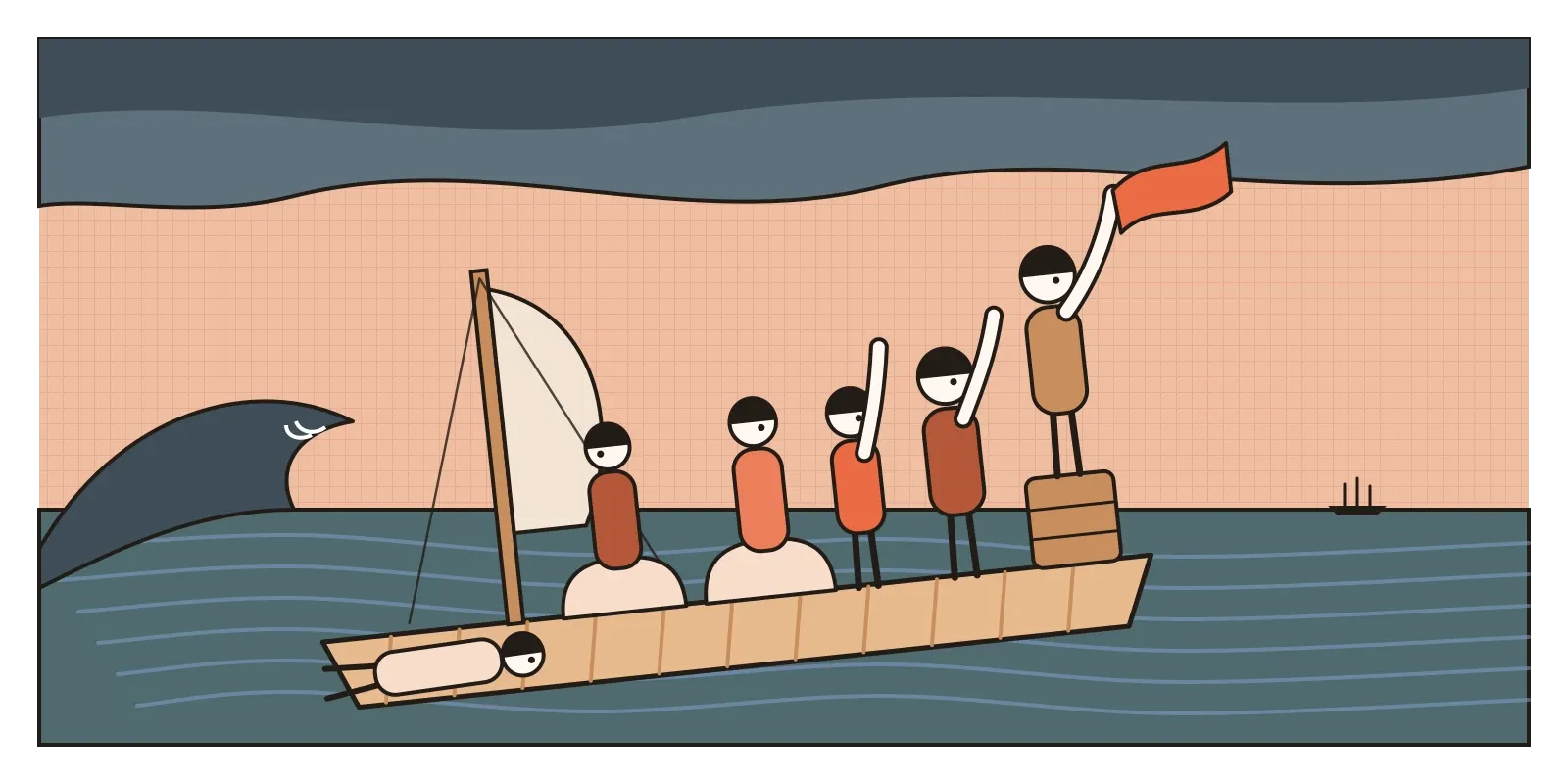
Géricault showed it at the Paris Salon of 1819 under the cautious title Scene of a Shipwreck, but everyone knew what it was. The Raft of the Medusa is now in the Louvre, and it captures almost everything about Romanticism. Romanticism was a movement in art, literature and music, roughly from the 1790s to the 1850s, that put feeling, imagination, nature and the individual above reason, rules and calm. It was less a single style than a mood, and it was a direct reply to Neoclassicism.
When reason wasn't enough
Neoclassicism, the subject of the last post, promised that clear rules and classical models would produce good art and good citizens. By the early nineteenth century, that promise looked thin. The French Revolution, which had borrowed David's Roman virtue, ended in terror and then in Napoleon's wars, which killed millions across Europe. In Britain, factories and smoky industrial towns were transforming the landscape. Many artists and writers concluded that reason alone couldn't explain or redeem the world. They looked instead to emotion, to wild nature, to the medieval past, to folk songs and national legends, and to their own inner lives.
Philosophy gave them a word. In 1757 the Irish writer Edmund Burke published an essay that separated the beautiful, things that are small, smooth and pleasing, from the sublime, things that are vast, dark, powerful or dangerous, which fill us with a kind of delighted terror. A storm at sea, a mountain range or an abyss is sublime as long as you're watching from somewhere safe. Poets followed. William Wordsworth and Samuel Taylor Coleridge's Lyrical Ballads of 1798 found poetry in ordinary speech and in nature, and in Germany writers began using "romantic" for a kind of art that reached for the infinite.
Architecture turned too. Instead of Greek temples, some patrons wanted Gothic towers and pointed windows, which felt mysterious, national and Christian. Horace Walpole began turning his house at Strawberry Hill, near London, into a little Gothic castle as early as 1749, and after the old Palace of Westminster burned in 1834, it was rebuilt in an elaborate Gothic style by Charles Barry and A. W. N. Pugin.
Monks, fog, storms and firing squads
In Germany, Caspar David Friedrich painted landscapes that feel like prayers. In The Monk by the Sea, finished around 1810, a tiny figure stands on a strip of pale sand under an enormous, empty sky that fills most of the canvas, with a band of dark sea between. When it was shown in Berlin, viewers found the emptiness unsettling. A review in a newspaper edited by the writer Heinrich von Kleist said, roughly, that looking at it felt as if your eyelids had been cut off. In Wanderer above the Sea of Fog, from around 1818, a man in a dark coat stands on a rock with his back to us, looking out over peaks rising from mist. Friedrich often used figures seen from behind, so that we look at the view through them, and art historians call this device the Rückenfigur, the back figure.

In England, J. M. W. Turner turned light and weather into the subject itself. In The Slave Ship, shown in 1840, a blazing sunset and a coming storm almost swallow the scene. Only slowly do you notice the shackled bodies and the fish in the water, a reference to slave ships throwing sick captives overboard, probably inspired by the massacre on the British ship Zong in 1781. Turner liked a good story about himself, and he claimed he'd had himself tied to a ship's mast during a storm to paint Snow Storm, shown in 1842. Historians doubt it happened. His friend and rival John Constable painted the quieter English countryside, and his The Hay Wain won a gold medal at the Paris Salon in 1824, impressing younger French painters.
In Spain, Francisco Goya painted The Third of May 1808 in 1814, showing Spanish civilians being shot by a firing squad of Napoleon's soldiers. The soldiers are a faceless row of rifles. The victim at the centre, in a white shirt lit by a lantern, flings his arms wide. It's a painting of war with no glory in it at all. And in France, Eugène Delacroix, who had posed for one of the figures on Géricault's raft, became the movement's leading painter. His Liberty Leading the People, painted after the revolution of July 1830, shows a bare-breasted woman carrying the French flag over a barricade of bodies, followed by workers, students and a boy with pistols.
Colour against line
Paris in the 1820s had a famous rivalry that makes Romanticism easy to see. On one side was Jean-Auguste-Dominique Ingres, David's former pupil, who believed drawing was the foundation of art: crisp contours, smooth surfaces, invisible brushstrokes. On the other was Delacroix, who believed colour and movement came first: loose, visible brushwork, colours placed side by side to vibrate, forms that blur at the edges. Critics and students took sides. Line stood for reason and the Academy. Colour stood for feeling.
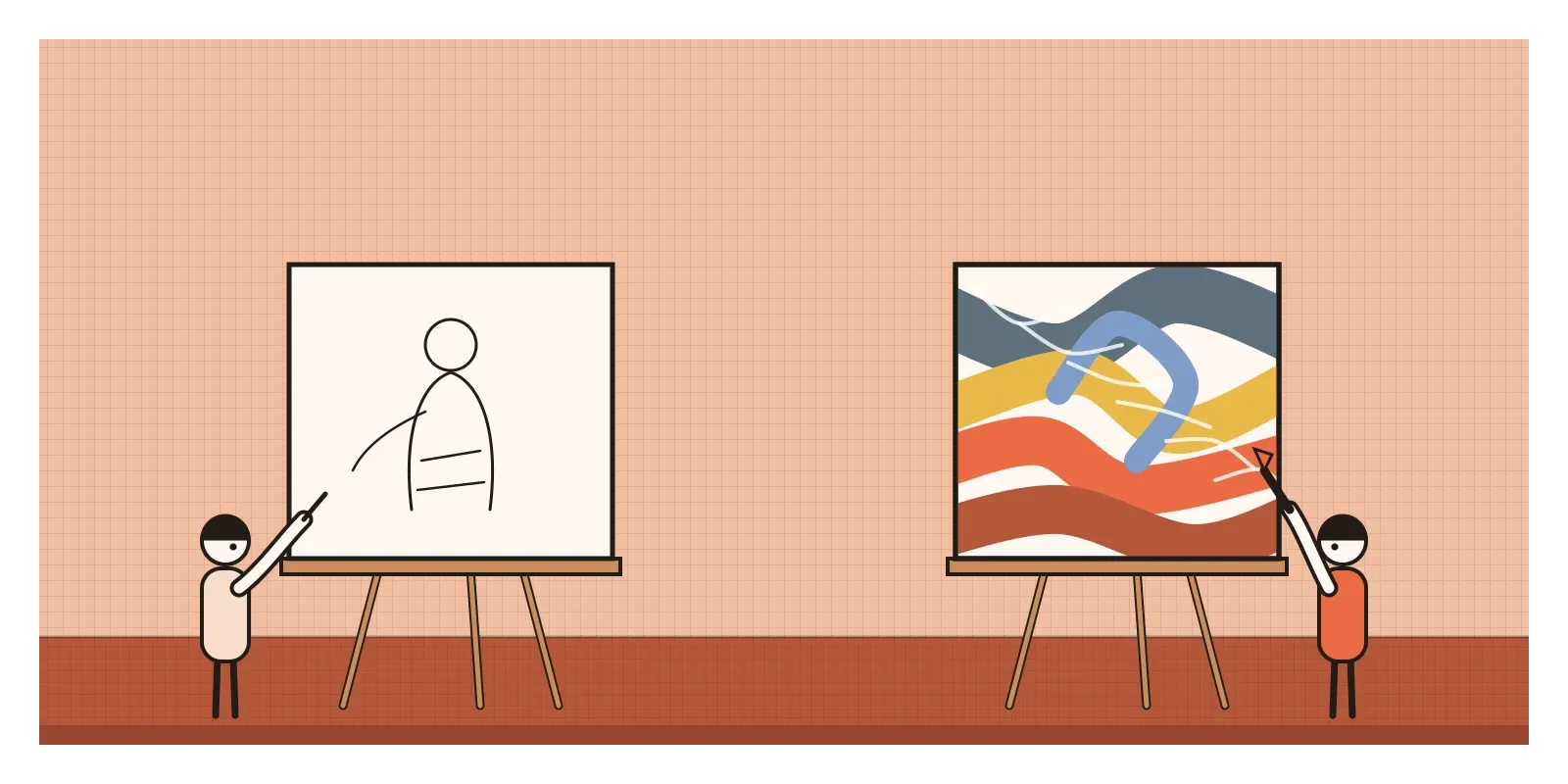
So the first thing to look for is the surface. Romantic paintings show the brush. Turner scraped, smeared and scrubbed his paint, and some of his late canvases are close to abstraction. Compositions favour diagonals, swirling vortices and crowded pyramids rather than Neoclassicism's calm frieze. Light is dramatic: sunsets, moonlight, lightning, lanterns in the dark. Scale is used for feeling, with tiny people against huge skies, seas or mountains. Favourite subjects are storms, shipwrecks, ruins, graveyards, Gothic abbeys, wild animals, war, and faraway places imagined as exotic. Where Neoclassicism said "follow the model", Romanticism said "trust your own response".
India in aquatint, and a poet in Calcutta
Romantic eyes shaped how Britain pictured India. The painter William Hodges travelled in India in the early 1780s and published a set of prints of its monuments. Then, from 1786 to 1794, Thomas Daniell and his young nephew William journeyed from Calcutta up the Ganges to the Himalayan foothills and down to the far south, sketching temples, forts, tombs and rivers, sometimes with a camera obscura. Back in London, they turned the drawings into Oriental Scenery, a huge series of 144 coloured aquatints published between 1795 and 1808. Their India is grand, picturesque and strangely empty, a land of crumbling ruins and dramatic rocks under vast skies, with only a few small figures.
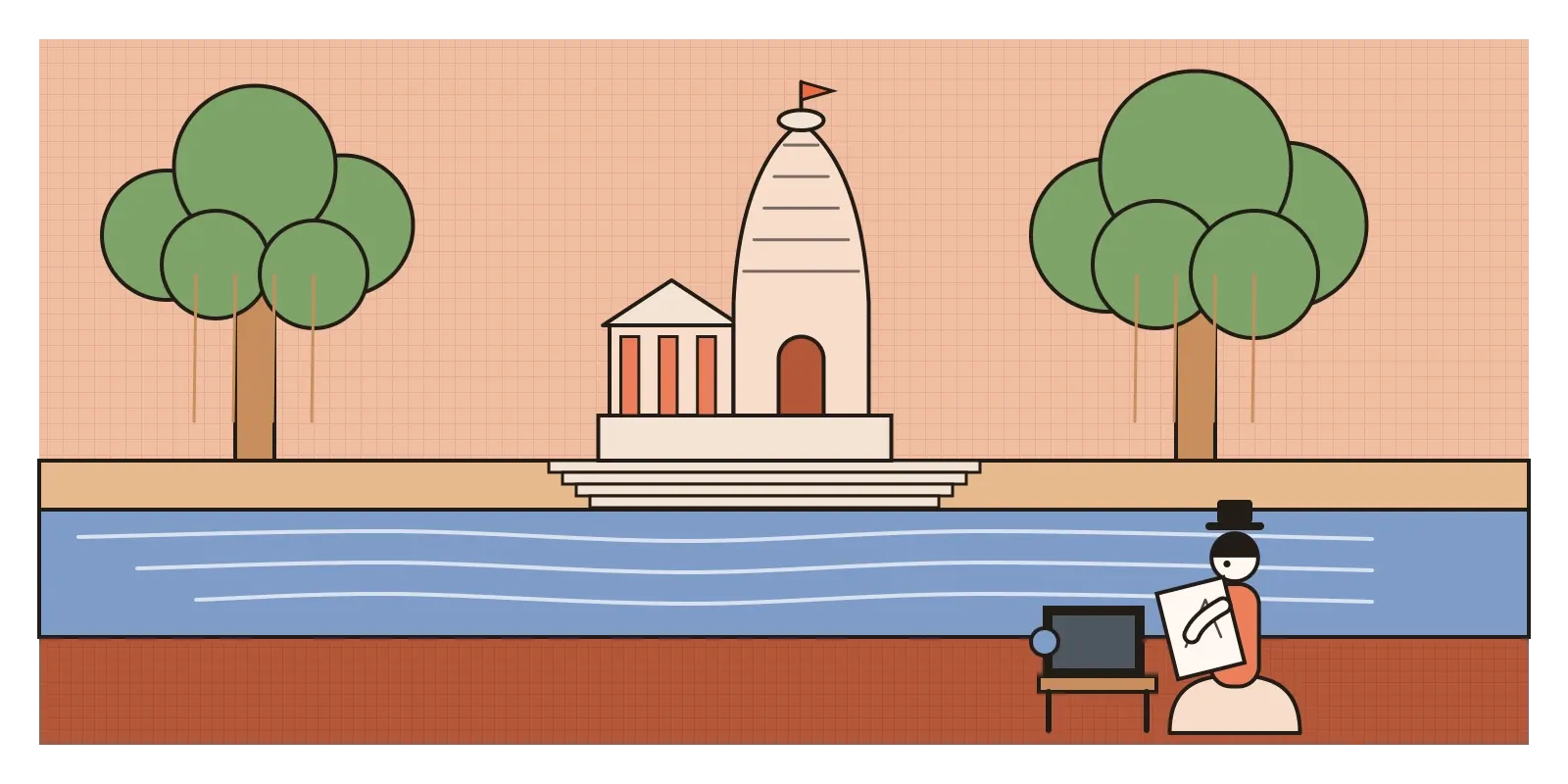
Those images travelled back into British design. At Sezincote House in Gloucestershire, built around 1805 for a man who had made his fortune with the East India Company, Thomas Daniell advised on a house with an onion dome and Mughal-style arches. The Prince Regent then had John Nash remodel the Royal Pavilion at Brighton, from 1815, with domes and minarets in the same spirit. The flattering half of this is admiration. The darker half is that a ruined, timeless India suited an empire that wanted to see itself as the country's new caretaker.
Romanticism also had an Indian voice. Henry Louis Vivian Derozio, born in Calcutta in 1809 to a family of mixed Portuguese and Indian descent, was a poet steeped in Byron and the English Romantics. At seventeen he began teaching at Hindu College, where he encouraged his students to question everything, and he wrote passionate patriotic poems about India as his native land, among the first in English by an Indian-born poet. The college dismissed him in 1831, and he died of cholera that December, aged twenty-two. His students, known as Young Bengal, carried his spirit of rebellion into the Bengal Renaissance.
The tiny figure and the vast view
Romanticism is everywhere in design once you look. Travel ads, outdoor brands and social media are full of Friedrich's back figure: one person on a ridge or a cliff edge, seen from behind, looking out at mountains, sea or fog. It works for the same reason it did in 1818. We step into the figure's shoes. Website hero images often use the same composition, a huge landscape with a small human for scale. For years, Apple named versions of macOS after Californian landscapes, Yosemite, El Capitan, Big Sur, with sublime photographs of those places as default wallpapers.
Game designers use the sublime deliberately: the long walk towards a gigantic structure, the reveal of a vast valley after a narrow tunnel. Film lighting borrows Romantic contrasts of storm, silhouette and sunset. And the Romantic idea of design as emotional rather than purely rational is behind much of modern brand storytelling. The useful lesson for product designers is about scale and feeling. Making something small against something large can create awe, but it can also make people feel powerless, so use it on purpose.
The trouble with following your feelings
Romanticism had blind spots. Its fascination with faraway places often became what the critic Edward Said, in 1978, called Orientalism: Delacroix's harems and North African scenes, like the Daniells' empty India, showed Europe's fantasies more than the lives of the people painted. Its cult of the lonely genius was overwhelmingly male. Women were central to Romantic literature, and Mary Shelley's Frankenstein, published in 1818, is a sharp critique of a man who follows his ambition without responsibility, but in painting they were mostly cast as muses and symbols, like Delacroix's Liberty. Romantic love of national legends and folk culture also fed nationalism, which later took ugly forms.
By the 1840s, some painters had had enough of grand emotion. They wanted to show ordinary people as they actually lived, without heroics, shipwrecks or exotic dreams, and that reply became Realism, which comes a few posts later. In the next post, on Company painting, I'm turning back to India, to the Indian painters who were working for East India Company officials in these same years, often alongside the Daniells' picturesque views.
To see Romantic India for yourself, visit the Victoria Memorial in Kolkata, which has a large collection of the Daniells' paintings and aquatints, and compare their empty ruins with photographs of the same places full of people today. Then try an exercise. Take one photo of a view with no person in it, and another with a single small figure seen from behind. Notice how differently they feel. Géricault's survivors, waving at a speck on the horizon, are still the purest example: a picture about hope and horror at once, made by someone who believed a painting could make you feel something you couldn't forget.
Further reading: Hugh Honour, Romanticism (1979) · Edmund Burke, A Philosophical Enquiry into the Origin of Our Ideas of the Sublime and Beautiful (1757) · Joseph Leo Koerner, Caspar David Friedrich and the Subject of Landscape (1990) · Mildred Archer, Early Views of India: The Picturesque Journeys of Thomas and William Daniell, 1786-1794 (1980)
A reply toNeoclassicism's calm, its rules and its faith in reason.