
Company Painting
How Indian painters trained in Mughal courts reinvented their craft for East India Company patrons.
Company Painting
A painter on the Governor-General's boat
In the summer of 1814, a fleet of boats set off from Calcutta up the Ganges. It carried the new Governor-General of the East India Company's territories, Lord Moira, soon to become the Marquess of Hastings, with his family, officials, servants and soldiers, on a tour of the Company's lands upriver that would last well over a year. Somewhere in that flotilla was a painter called Sita Ram, probably from Bengal. His job was to record what the party saw. Over the journey he painted more than two hundred watercolours: riverbanks and ghats, ruined mosques and forts, busy cities and the Mughal monuments along the way.
His pictures are startling to anyone who expects Indian painting to look like a Mughal miniature. They're landscape views in European watercolour, with deep perspective, glowing sunsets, dramatic clouds and small figures for scale. Sita Ram had clearly studied the picturesque aquatints of Thomas and William Daniell, which I wrote about in the post on Romanticism. But his colours are richer and stranger than theirs, his skies more theatrical, and his India busier. His albums are now in the British Library. For a long time the painter was little more than a name.

Sita Ram is one of many painters who made what is now called Company painting, the work Indian artists produced, roughly between the 1760s and the 1860s, for officials, soldiers, scientists and their families connected with the British East India Company. It isn't a single style so much as a meeting of two. Painters trained in Mughal and regional court traditions adapted their skills to European materials, conventions and subjects, because that's what their new patrons wanted to buy. The name comes from the patrons, which already tells you something about who was in charge.
New patrons for an old skill
Company painting was a reply to two things at once. The first was the decline of the Mughal court. Through the eighteenth century, the emperors in Delhi lost power and money, and in 1739 the Persian ruler Nadir Shah sacked the city. Painters who had once worked in imperial workshops, as I described in the post on Mughal painting, moved to wealthy regional courts like Murshidabad and Lucknow, and when those courts weakened in turn, they needed new customers. Some families moved to Patna, a busy trading town on the Ganges, and set up there.
The second was the arrival of a powerful new class of foreign patrons. After the Battle of Plassey in 1757 and the Company's takeover of revenue collection in Bengal in 1765, thousands of British men, and later women, lived in India as administrators, merchants, doctors and soldiers. Many were curious about the country and wanted pictures to understand it and to send home: its plants and animals, its monuments, its festivals, and above all its people, sorted into occupations, castes and costumes. Photography didn't exist yet. Indian painters were the camera.
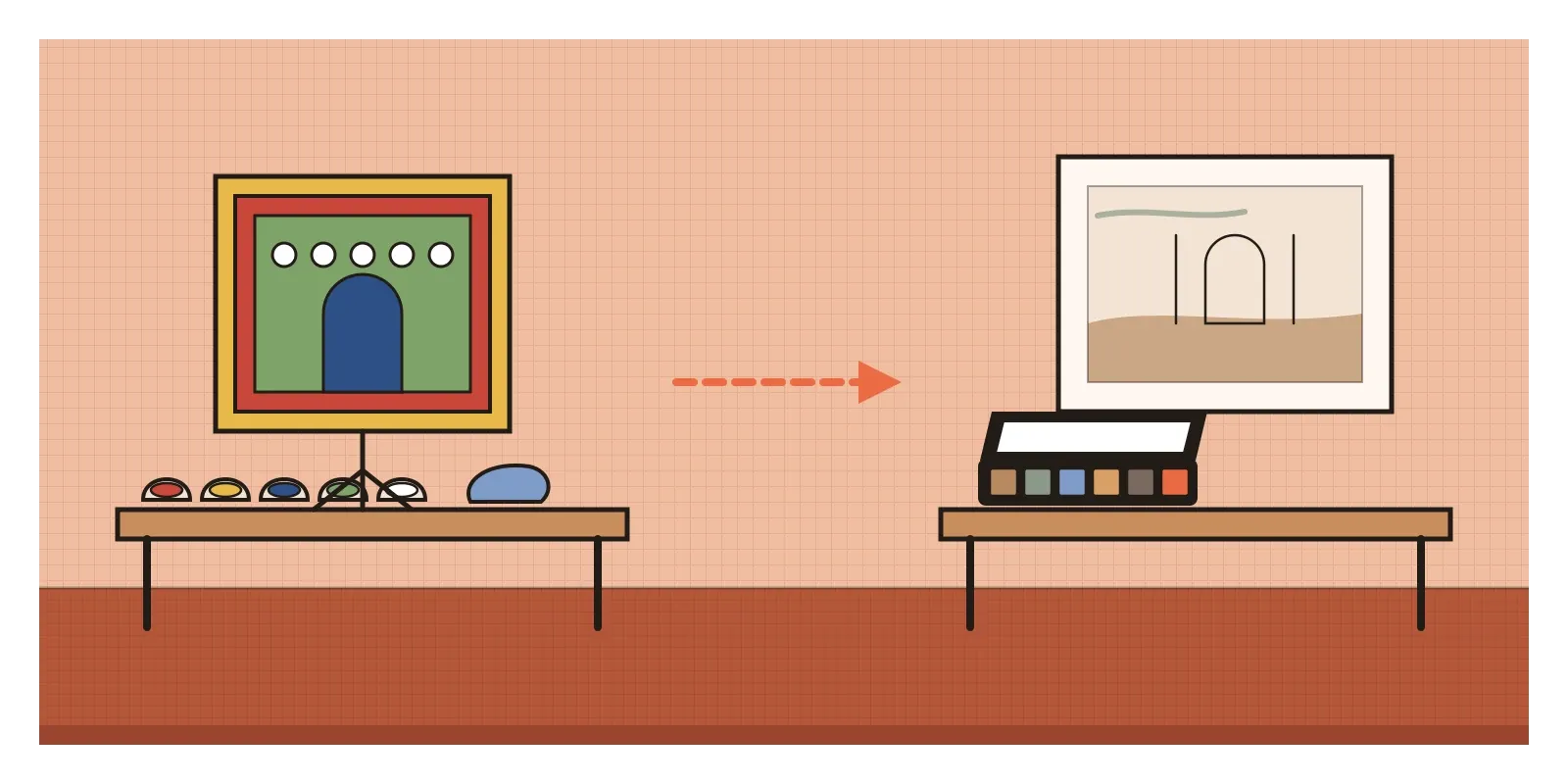
So the painters changed their tools. Mughal painting used opaque colours made from ground minerals and plants, bound with gum and applied in layers on burnished paper, and burnished again to a soft shine. The new patrons preferred the look of English watercolour, which is thin, transparent and quick, on smooth European paper, often in muted sepias, greys and greens. Painters learned to model forms with soft washes, to set buildings in linear perspective and to leave large areas of the paper bare.
Troopers, traders and a panorama of Delhi
I wrote about the most famous natural history commission, the Impey Album of birds painted in Calcutta, in the post on observational drawing, so here I'll look at the people and places. Some of the most moving Company paintings are in the Fraser Album, commissioned around 1815 to 1819 by two Scottish brothers, William and James Baillie Fraser. William was a Company official in Delhi, closely tied to the irregular cavalry raised by James Skinner, and he asked Delhi painters, especially Ghulam Ali Khan and his circle, to paint the people around him. They painted Skinner's troopers, villagers, dancers and members of Fraser's own household, each a real individual with a particular face, posture and set of clothes, often against a plain background. They feel closer to portraits than to types, and you remember them as people.
In Patna, painters like Sewak Ram made sets showing local trades and festivals: a potter at his wheel, a man selling sweets, a wedding procession, the Muharram processions. Patna and other towns also became known for small paintings on thin sheets of mica, a translucent mineral, which were sold in sets to visitors as souvenirs, much like postcards. In the south, around Thanjavur and Tiruchirappalli, painters produced albums showing pairs of figures, a man and a woman, labelled by caste or occupation, which British buyers collected in Madras.
In Delhi itself, the painter Mazhar Ali Khan worked for Sir Thomas Metcalfe, the Company's agent at the Mughal court. In the 1840s he painted many of the buildings in and around Delhi for an album that Metcalfe sent to his daughter in England, and he made a huge panoramic view of the city from the gateway of the Red Fort. It is, unintentionally, a record of a Delhi that was about to disappear. After the uprising of 1857, much of the old city around the fort was demolished.
One figure, a strip of ground and a lot of white paper
Company paintings are surprisingly easy to spot. The classic format is a single figure, or a pair, standing on a thin strip of ground with a soft shadow at their feet, against blank paper. There's no background, no setting, no story, just a person with the tools or goods that identify their work: a water carrier with his leather bag, a barber with his kit, a woman spinning. Often a label is written underneath in English, sometimes also in Persian or a local script, added for the buyer.

The palette is softer than Mughal painting, with sepias, ochres, dusty greens and greys, though touches of bright red, gold or white often survive from the older tradition. Faces and bodies are modelled gently with washes and fine hatching rather than outlined and filled. Clothes and objects are drawn with almost scientific precision, because accuracy was the point. Architectural paintings show buildings in careful elevation or in single-point perspective, every arch and inlay recorded, sometimes with tiny figures to show scale. Natural history paintings put a specimen alone in the middle of the page, life-size where possible, with leaves, flowers and fruit arranged so that each part can be studied. In all of them you can feel the double training: a Mughal eye for fine detail and pattern, applied to a European idea of what counts as an objective record.
The same deal in Canton, and then the camera
Company painting wasn't uniquely Indian. In Canton, now Guangzhou, the one Chinese port where Western merchants were allowed to trade for much of this period, Chinese painters made what are now called export paintings for European and American buyers: harbour views, scenes of tea production and porcelain making, sets of trades and costumes, and portraits in oil. Many were painted on thin sheets of pith, a light, soft material often wrongly called rice paper, and bought as souvenirs. The arrangement was the same as in India. Skilled local artists, trained in one tradition, adapted to the tastes and expectations of foreign traders, and much of their work ended up in collections far away with the painters' names lost.
Both traditions were overtaken by the same invention. From the 1840s and especially the 1850s, photography reached India, and the camera did the recording job more cheaply and with more apparent authority. Between 1868 and 1875, the government published The People of India, eight volumes of photographs of Indians arranged by caste, tribe and region, each with a descriptive caption. It's the Company occupation set again, now as photographs and official knowledge. At the same time, the government art schools founded in Madras, Calcutta and Bombay in the 1850s began training Indian students in European academic drawing, which led eventually to Raja Ravi Varma's oil paintings, a story for a later post.
Packshots, personas and the people in the margins
Look at an online shop and you'll see Company painting's visual grammar everywhere. A product photographed alone on a white background, perfectly lit, with a small shadow underneath so it doesn't float, is the same convention as a Patna trader standing on his strip of ground. It works for the same reason: nothing distracts from the object, and every item in the set can be compared with the others. Emoji sets of professions, a farmer, a cook, a mechanic, each with one identifying tool, are Company occupation sets for a phone keyboard.

The more uncomfortable trace is in research. A user persona, a single invented figure on a plain background labelled with a job, a few habits and a tool or two, is a close cousin of the Company type. It can be useful, but it can also turn real, varied people into a neat category, which I wrote about in the post on stereotyping bias. The Fraser Album is a good reminder of the alternative. Its painters were asked to paint specific people, and the result is far more alive and far more truthful than any set of types.
The other lesson is about the brief. Company painters were brilliant at adapting their craft to a patron's conventions without losing their own eye, which is a skill every designer working with clients needs. But it was also a relationship of unequal power, where the client decided what mattered and usually took the credit.
Who got named, and who got classified
For most of the twentieth century, Company painting was looked down on from two directions. British critics saw it as a clumsy imitation of European art, and later Indian nationalist critics saw it as a colonial corruption of Indian traditions. Both views missed how inventive the best painters were. Recent scholarship, and exhibitions like Forgotten Masters at the Wallace Collection in London in 2019, curated by the historian William Dalrymple, have tried to restore the artists' names.
The harder criticism is about what the paintings were for. Sets of castes and occupations helped the Company describe, count and govern Indians as fixed types, an approach that, many historians argue, later fed into colonial censuses and helped harden caste categories that had been more fluid. The painters were often poorly paid and frequently unnamed, while their patrons' names were written in gold on album covers. By the 1860s, photography and the art schools had taken over most of their work, though their influence continued in bazaar painting, which I'll come to in the post on Kalighat.
To see Company painting in India, look for Company-era watercolours at the Victoria Memorial in Kolkata, though what's on display changes, or browse the large online collections of the British Library and the Victoria and Albert Museum, where you can zoom in on every thread of a turban. Then try a small exercise. Draw one person you see every day, the person who sells you vegetables or fixes your phone, once as a "type", with just their tool, and once as themselves, with whatever makes them particular. Sita Ram on his boat was asked to record a country for strangers, and he did it so well that his own name nearly vanished from his pictures. In the next post, on the Industrial Revolution and design, I'll look at how machines changed who made things, and how.
Further reading: William Dalrymple (ed.), Forgotten Masters: Indian Painting for the East India Company (2019) · Mildred Archer, Company Paintings: Indian Paintings of the British Period (1992) · Mildred Archer and Toby Falk, India Revealed: The Art and Adventures of James and William Fraser, 1801-35 (1989) · Partha Mitter, Art and Nationalism in Colonial India, 1850-1922 (1994)
A reply toThe fading Mughal court, and new foreign patrons who wanted India recorded on paper.