Rajput and Pahari Painting
How painters in the courts of Rajasthan and the Himalayan foothills turned devotion and poetry into colour.
Rajput and Pahari Painting
A painter's handwriting in a priest's ledger
In 1763, a painter called Nainsukh made the journey from the small hill state of Jasrota, near Jammu, down to Haridwar on the Ganga. He was carrying the ashes of his patron, Raja Balwant Singh, for whom he had worked for close to twenty years. At Haridwar, as Hindu families have done for centuries, the party went to the family priests, the pandas, who keep enormous handwritten registers of the pilgrims who come to them, generation after generation. Nainsukh wrote a long entry in the register in his own hand, and added a drawing.
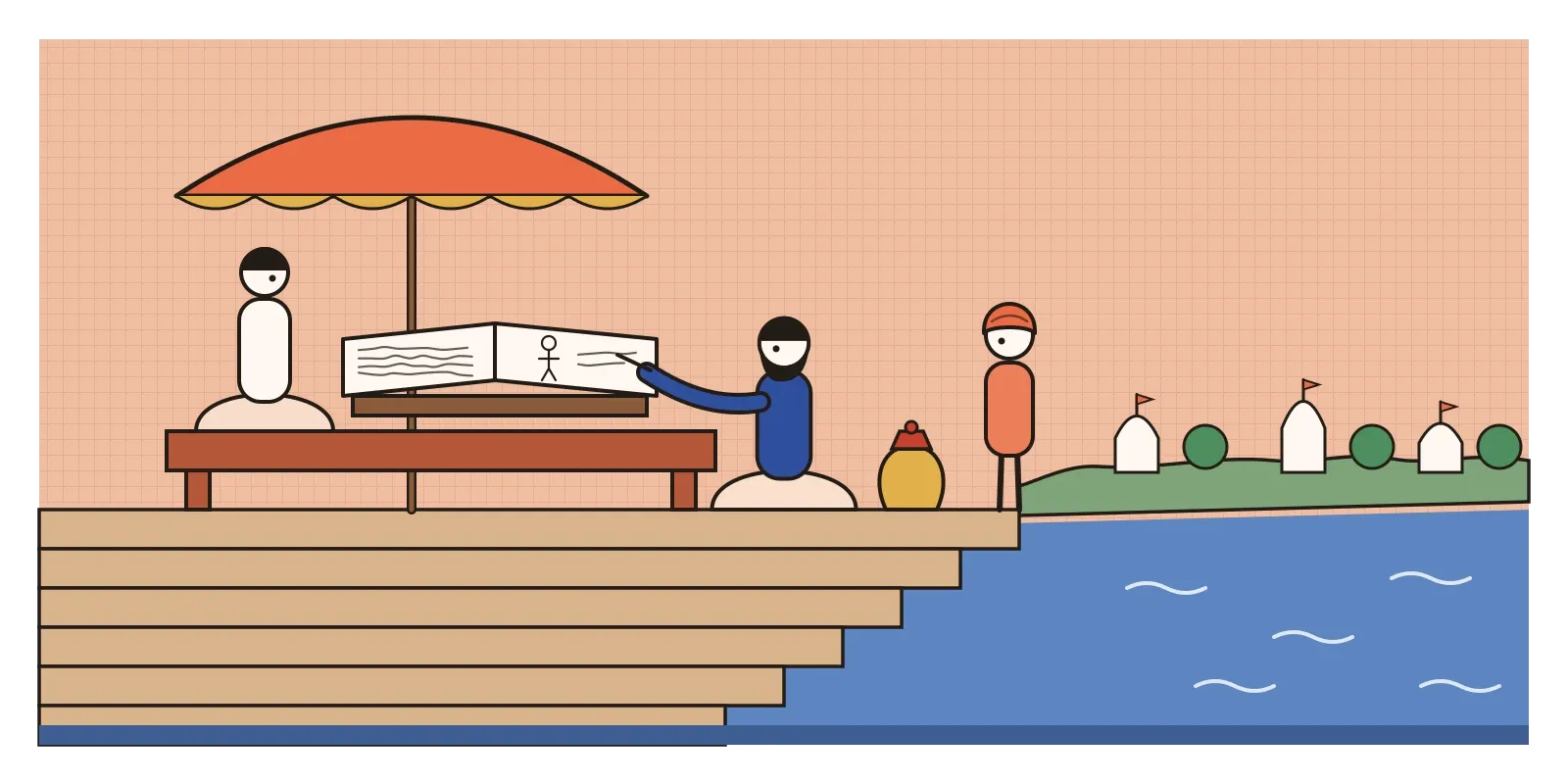
Two centuries later, the art historian B. N. Goswamy went looking for the painters of the Punjab hills in those same registers. Paintings from the hill courts were rarely signed, and scholars had long sorted them by kingdom, as Kangra style or Basohli style. Goswamy found pages written by the painters themselves, recording their names, fathers, brothers and villages, and with them he began to rebuild whole families of artists. Among the most moving finds was Nainsukh's entry. Later registers also record that, when Nainsukh himself died in 1778, his nephew carried his ashes to the same river.
Rajput and Pahari painting is the name usually given to the painting made from roughly the sixteenth to the nineteenth century in the Hindu courts of Rajasthan and central India, the Rajput kingdoms, and in the small hill states of the Himalayan foothills, the Pahari kingdoms, from pahar, meaning hill. It's a family of many regional styles rather than one, but most share flat, glowing colour, a love of poetry and, very often, devotion to Krishna.
Kingdoms between the emperor and the gods
The Rajput rulers of Mewar, Bundi, Kota, Marwar, Bikaner, Amber and Kishangarh, and the hill rajas of Basohli, Guler, Kangra, Chamba and Mandi, lived in the shadow of the Mughal empire. Most of them eventually made terms with it, sent sons to its court and led its armies, and they saw Mughal painting at close quarters. Some even hired painters trained in Mughal workshops. But their own painting began from somewhere else. Before the Mughals arrived, painters in western and central India were already making bold, flat pictures for Jain manuscripts and for Hindu love poetry, with figures in profile, large eyes and strong red and yellow grounds. One group, usually called the Chaurapanchashika style after a set of illustrated love poems, is a striking ancestor.
The other force was the bhakti movement, the wave of personal, emotional devotion that swept India from the medieval period, much of it centred on Krishna. Poems like Jayadeva's twelfth-century Gita Govinda, about the love of Radha and Krishna, and later Hindi works such as Keshavdas's Rasikapriya of 1591 gave painters a vast store of subjects, lovers waiting in groves, quarrels and reconciliations, and the many types of heroine classified by poets. In the post on mood boards I wrote about Ragamala paintings, which belong to this same world. If Mughal painting was largely about recording what happened at court, Rajput and Pahari painting was more often about feeling, a reply that kept what was useful in Mughal technique and set aside its documentary purpose.
Beetle wings, red borders and a raja by the fire
One of the great Rajput masterpieces is the Ramayana made for Rana Jagat Singh of Mewar at Udaipur between 1649 and 1653. Two of its volumes are attributed to the workshop master Sahibdin, a Muslim painter who spent his life illustrating Hindu epics. His pages are crowded with episodes, the same characters appearing several times across one wide horizontal sheet, set against flat fields of red, yellow and green. Folios are now split between the British Library, the CSMVS in Mumbai and other collections.
In the hills, the most startling early style is Basohli's. A set of paintings of the Rasamanjari, a Sanskrit poem about lovers, made around 1694 to 1695 by a painter named Devidasa, has hot mustard and red grounds, figures with enormous lotus-shaped eyes and architecture as flat as a stage set. Its painters added something unusual: to show emeralds in jewellery, they glued on tiny iridescent fragments of beetle wings, which still shimmer green when the page is turned.
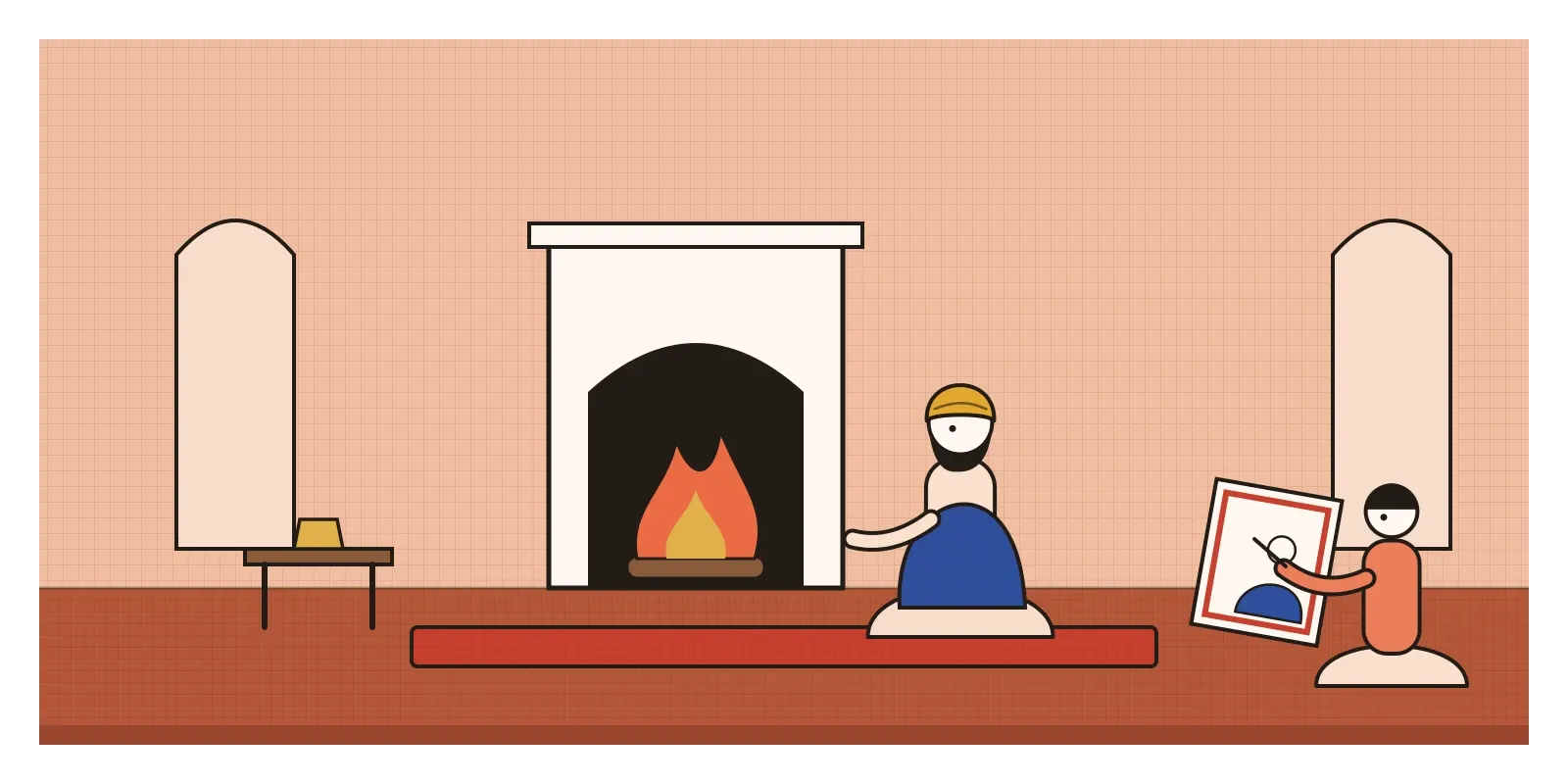
A generation later, Nainsukh, born around 1710 into a family of painters in Guler, went to Jasrota and found an unusual patron in Balwant Singh. Nainsukh painted him doing almost everything: inspecting a horse, listening to musicians, sitting by a fire in his private rooms, having his beard trimmed and writing a letter. These are not grand state portraits. They are close, observant and often gently funny pictures of a man's ordinary days. The CSMVS in Mumbai holds a group of them, including the letter-writing scene, dated 1758.
The family went on to shape the classic Kangra style. Around 1775 to 1780, painters of the next generation, probably Nainsukh's and his brother Manaku's sons and nephews, made a famous Gita Govinda series, possibly for Raja Sansar Chand of Kangra. Here the hot flat grounds give way to soft green hills, flowering trees, rivers and moonlit groves, and Radha and Krishna move through a landscape that seems to share their feelings. In Rajasthan, meanwhile, the painter Nihal Chand at Kishangarh around the middle of the eighteenth century gave his women impossibly long, curved eyes and slender necks. One of his Radhas, often linked to the court singer known as Bani Thani, appeared on an Indian postage stamp in 1973.
Hot grounds and cool hills
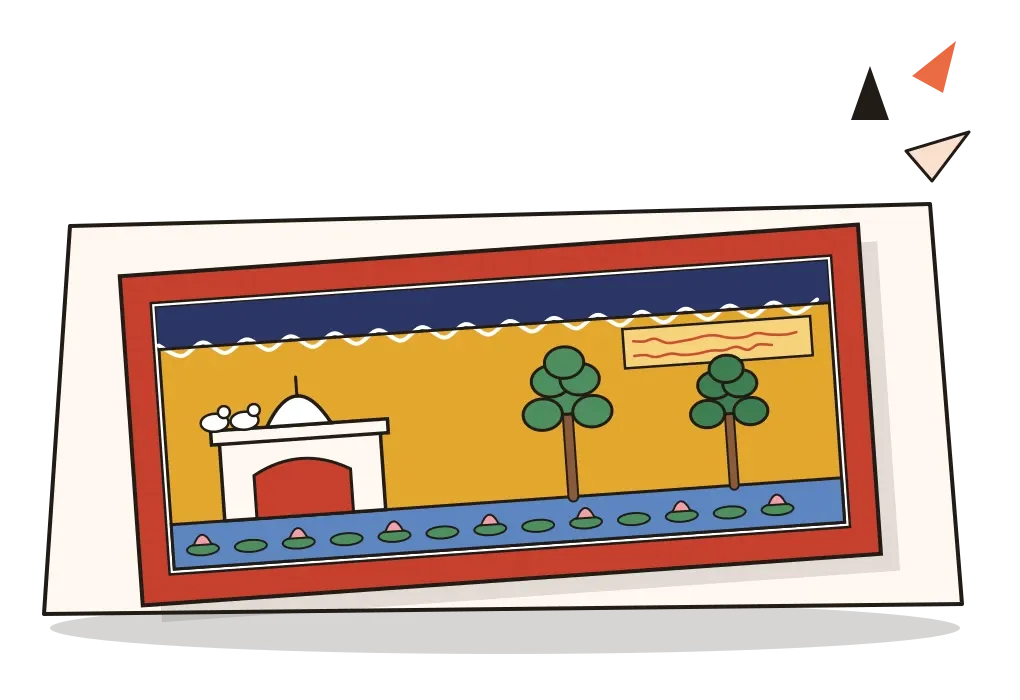
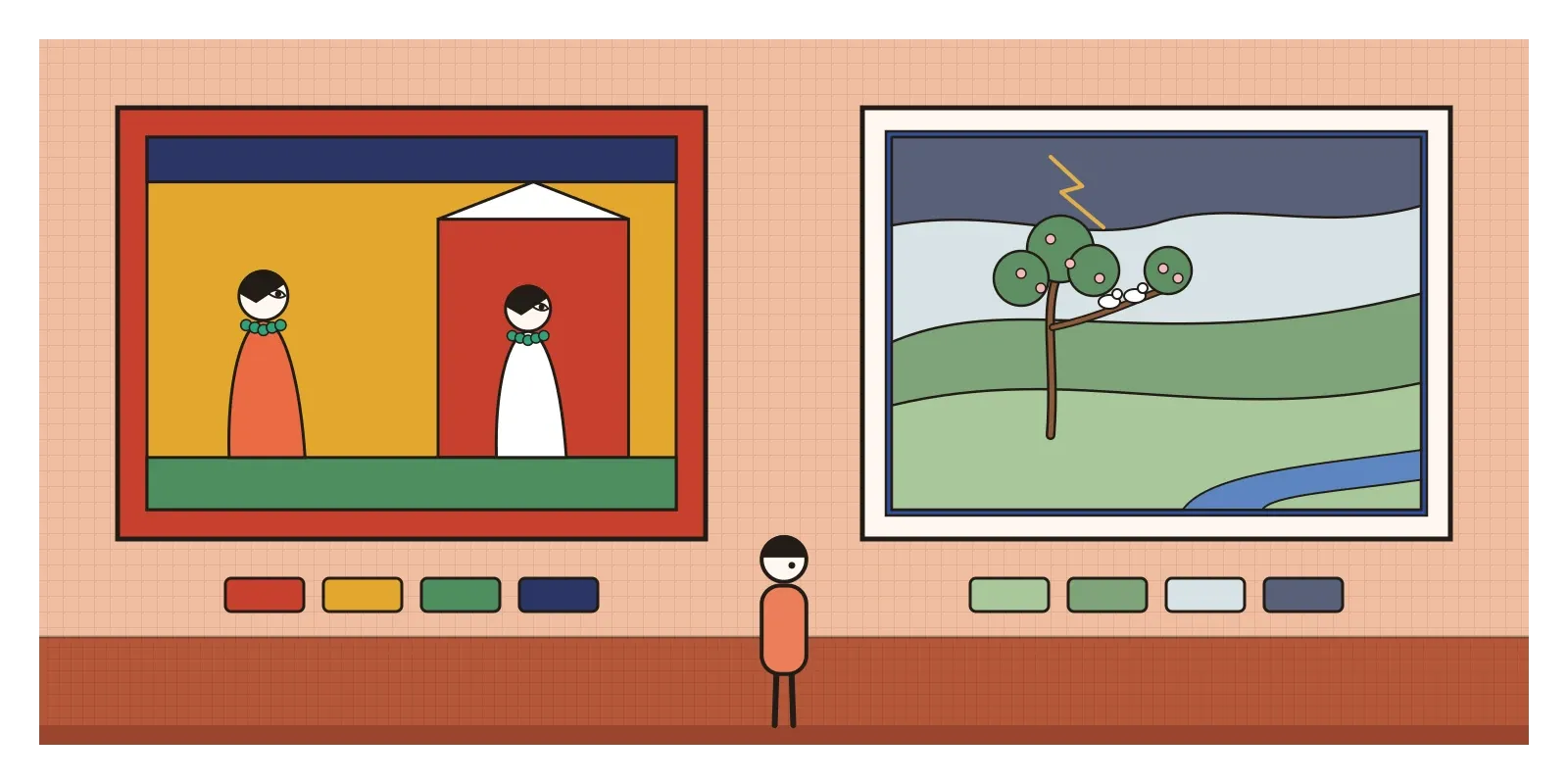
The easiest way to start recognising these paintings is by their colour. Rajasthani painting, especially from Mewar and Malwa, often uses whole fields of pure colour as backgrounds: a red ground behind one scene, a yellow one behind the next, a strip of dark blue sky with a curling white line of clouds at the top. The colours aren't there to describe the world. They set a mood and separate one part of the story from another, the way a stage is lit. Many pages are framed by a thick red border, and many are horizontal, echoing the long palm-leaf and paper manuscripts, called pothis, that came before them.
Figures are usually in profile, which makes their gestures and glances easy to read, and eyes are large and expressive. Space is flat and stacked. A palace is a cut-away box with people in each room, a lake is a flat shape filled with fish and lotuses, and trees are rows of round or oval clumps of leaves, each one outlined. Text often sits in a panel at the top, because these pictures were made to be read alongside the poem.
Pahari painting moves from fire to air. Basohli is the fierce early phase, all saturated colour and bold outline, with those beetle-wing jewels. Guler and Kangra are cooler and more lyrical, with delicate line, subtle greens and greys, gentle modelling learned partly from Mughal painting, and landscapes with real depth. Lightning drawn as a thin gold line through dark monsoon clouds is a favourite Pahari touch, as is a pair of birds on a branch that echoes the lovers below.
Mughal neighbours and a scholar from Ceylon
Because this is an Indian movement, the outward view is mostly about two neighbours. The first is the Mughal court, which this style constantly talked to. Rajput rulers saw Mughal paintings, borrowed its portrait conventions, and sometimes employed its painters. When Mughal patronage shrank in the eighteenth century, painters trained in its refinement moved to the courts of the plains and hills, and the delicate modelling of later Pahari work owes a great deal to them. Yet the Rajput and Pahari painters never accepted the Mughal goal of recording things as they looked. They used Mughal skill in the service of poetry and devotion, which is a little like a designer who learns every tool of photo-realistic 3D and then chooses to draw flat illustrations.
The second outward story is about how the wider world came to see it. In 1916, Ananda Coomaraswamy, the Ceylon-born scholar whose ideas on ornament I discussed in the post on Indian aesthetic concepts, published Rajput Painting, the book that gave the style its English name and its first serious champion. He presented it as the true Hindu tradition, spiritual and rooted in the land, in contrast to what he saw as the worldly, foreign art of the Mughal court. The book did a great deal to make the world take this painting seriously. As I'll come to below, its neat division of Indian painting into two camps has not aged so well.
A style that lives in families
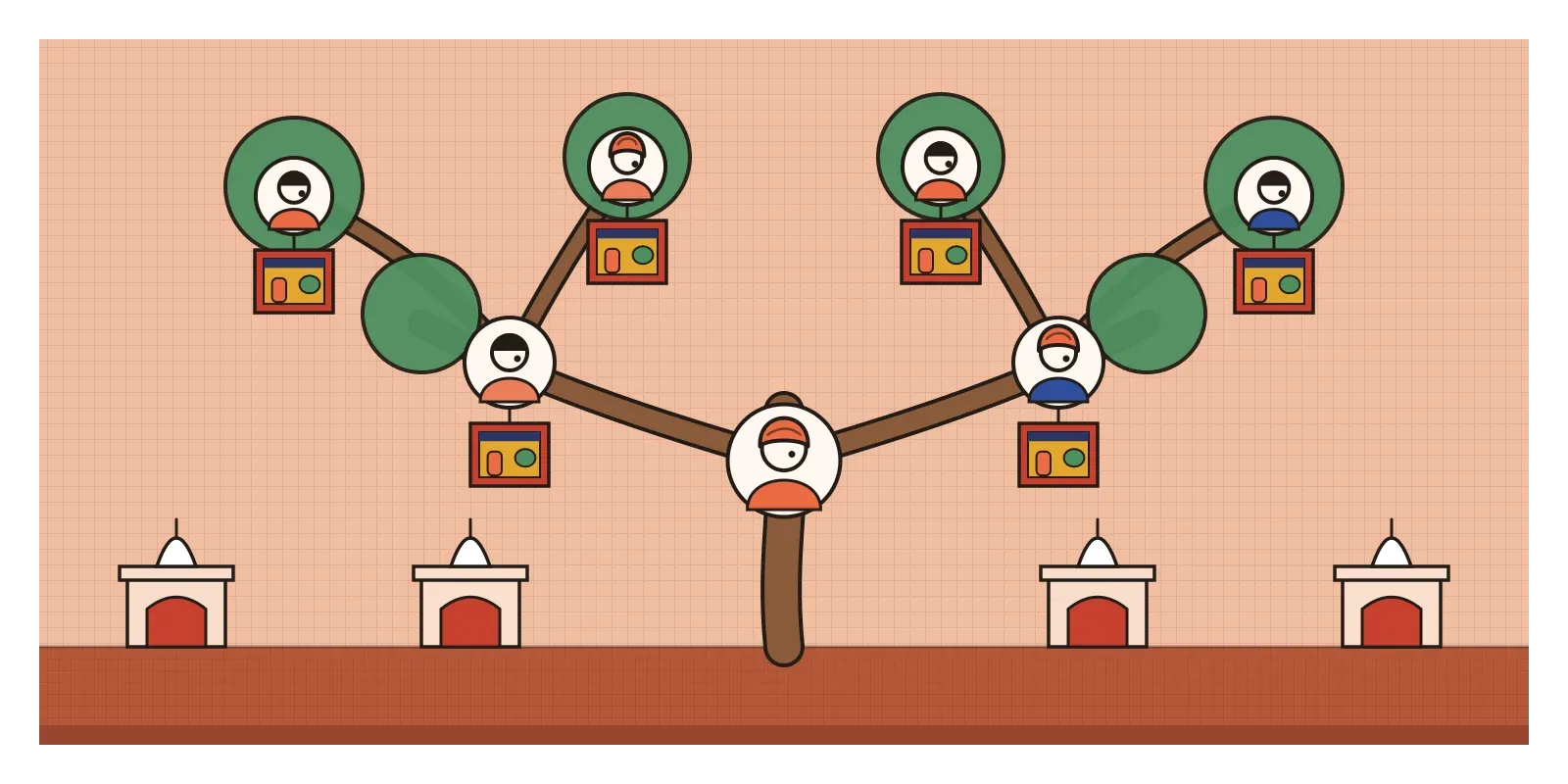
The idea I keep coming back to is Goswamy's. He argued that in the hills, style travelled with families rather than with kingdoms. A father taught his sons, the sons worked for whichever raja would employ them, and the same family manner turned up in several states at once. Calling a picture Kangra style says less than knowing which family painted it. I think that's true of design teams too. A style often belongs less to a brand or a city than to a lineage of people who trained each other, which is why a design system really lives in the people who teach it, not in its documentation.
The colour is the other inheritance. These painters show how a few flat, saturated fields can carry a whole emotional story, which is close to rasa theory, the subject of an earlier post, put into paint. Modern Indian illustration, textile prints, wedding invitations, book covers and festival campaigns borrow this vocabulary constantly: a bold red frame, a flat mustard ground, figures in profile, ornament in the borders. Done well, it's more than nostalgia. It's a reminder that flat colour can be warmer and more expressive than any amount of realistic rendering.
And then there's Nainsukh's way of looking. He watched his patron through ordinary days and painted what mattered to him, not just how he wanted to be seen on the throne. That's the attitude user researchers try to bring to contextual inquiry, sitting beside people as they actually work, noticing the small rituals no survey would capture.
Patrons, poets and a tidy story
For all their warmth, these paintings were made for kings, and their world is a feudal one. The painters were mostly hereditary craftsmen, the skill passing from father to son, and most remained anonymous to the people who later collected their work. The women in them, the waiting heroines and lovesick milkmaids, are mostly ideals imagined by male poets and painters for male patrons. And Coomaraswamy's division of Indian painting into a Hindu, spiritual Rajput side and a Muslim, worldly Mughal side was always too tidy. Sahibdin, the master of the Mewar Ramayana, was Muslim. Painters moved between Mughal and Rajput workshops, and the two traditions borrowed from each other throughout. Many sets were later broken up and sold page by page, and a single Gita Govinda can now be scattered across a dozen museums.
The hill courts declined in the nineteenth century as Sikh and then British power absorbed the small states, and painters found fewer patrons. Photography arrived, Company painting spread, and Indian elites turned to European-style oil portraits. The most famous reply was Raja Ravi Varma's realism, which I wrote about in the post on light, shade and rendering. Then, in the early twentieth century, the Bengal School answered Ravi Varma by looking back to exactly these flat, poetic pictures.
To see them, visit the CSMVS in Mumbai for Nainsukh's Balwant Singh pictures, the National Museum in New Delhi, the Bhuri Singh Museum in Chamba, the Kangra Art Museum in Dharamshala or the City Palace Museum in Udaipur. Amit Dutta's 2010 film Nainsukh restages his paintings in the hills where they were made. For a small exercise, draw someone you know in an ordinary moment, making tea or reading their phone, the way Nainsukh painted Balwant Singh, then fill the background with a single flat colour that matches the mood. Try it again with a different colour and watch the feeling change.
Nainsukh's entry in the priest's register is a reminder that these painters were people with families, journeys and griefs, not just regional labels. In the next post, on the Baroque, I'll return to Europe, where painters of the same century were using light and movement to stir feeling of a very different kind.
Further reading: B. N. Goswamy, Nainsukh of Guler: A Great Indian Painter from a Small Hill-State (1997) · B. N. Goswamy and Eberhard Fischer, Pahari Masters: Court Painters of Northern India (1992) · Ananda K. Coomaraswamy, Rajput Painting (1916) · W. G. Archer, Indian Paintings from the Punjab Hills (1973) · Milo Cleveland Beach, Mughal and Rajput Painting (1992)
A reply toThe Mughal court's documentary realism, borrowed for its skill and turned towards poetry and devotion.