Radical Design
How young Italian designers in the late 1960s used chairs, grids and impossible cities to argue with design itself.
Radical Design
A chair that came out of a bag
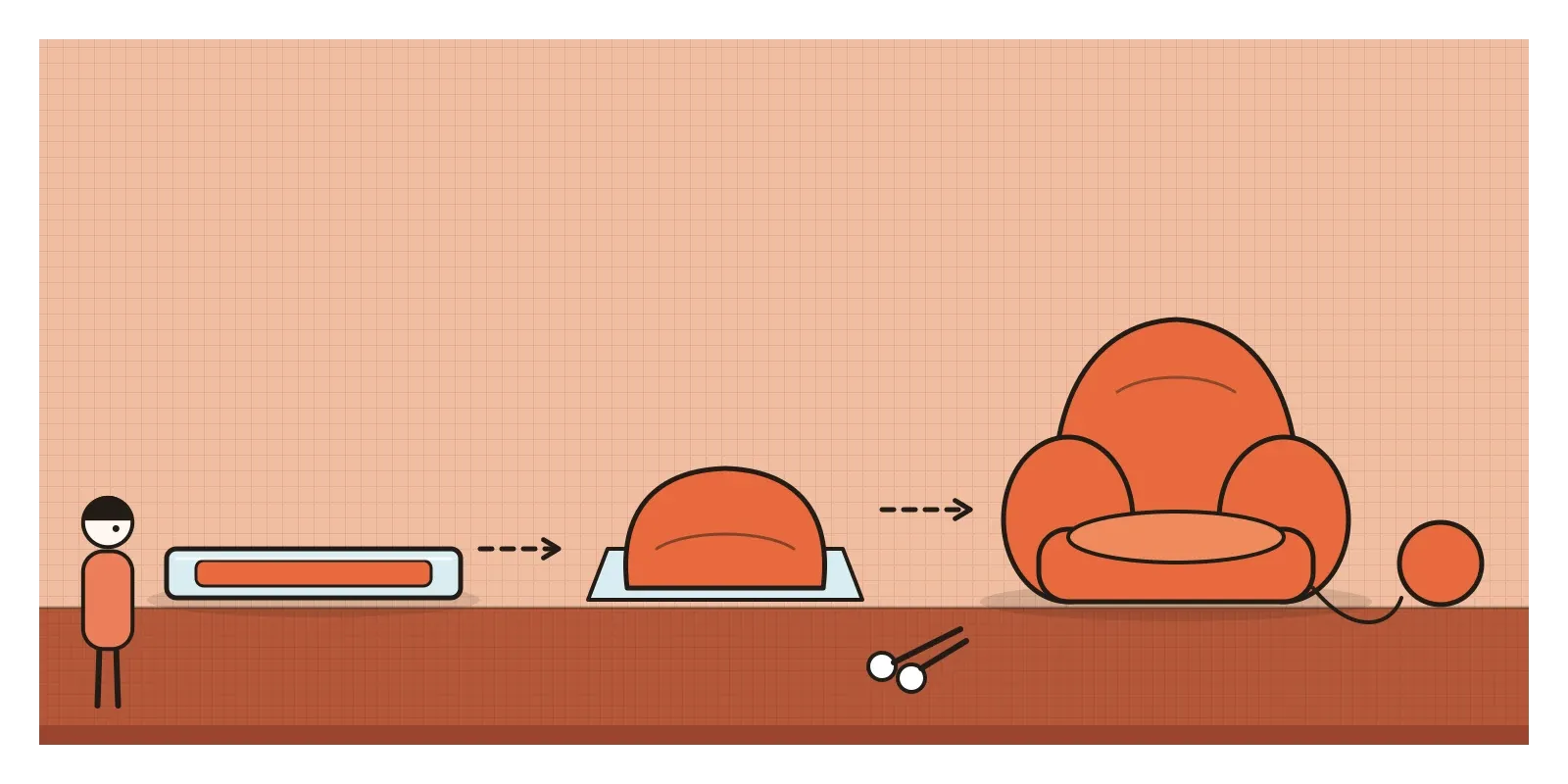
In 1969 the Italian furniture company C&B Italia launched a set of armchairs by a young designer called Gaetano Pesce that arrived in a most unusual way. Each chair was made of soft polyurethane foam with no frame inside. In the factory it was squashed flat in a vacuum chamber and sealed in a plastic envelope, a fraction of its real size, so that it could be shipped like a parcel. At home, you cut open the plastic, air rushed back into the foam, and the chair slowly swelled into shape in front of you, like a loaf rising. The series was called Up.
The largest of them, the Up 5, was a deep, rounded armchair with soft curves like a woman's body, and it came with a round footstool tied to it by a cord. Pesce said the pair was a ball and chain. He meant it as a statement about women, who in his view had always been prisoners, and the footstool was the shackle. A comfortable armchair for a living room was also, if you looked, a small political cartoon.
That double life, half product, half argument, is the heart of Radical Design. The name covers a loose group of young Italian architects and designers, active from around 1966 to the mid-1970s, who used furniture, drawings, photomontages, films and exhibitions to criticise the consumer society, modernist architecture and the design profession they had just joined. Many of their projects were never meant to be built. Some were jokes. A few, oddly, are still in production.
A flood, a pop show and a manifesto
In the 1950s and early 1960s, Italy went through what Italians call the economic miracle. Factories in the north boomed, families bought their first cars, fridges and televisions, and Italian design became famous for elegant, inventive products: Olivetti typewriters, Kartell plastics, Cassina furniture. Critics praised it as bel design, beautiful design. But for a generation of architecture students the success felt hollow. Modernism, as I wrote in the posts on the Bauhaus and the Ulm School of Design, had promised that rational design would make life better for everyone. In Italy it seemed to be producing ever more beautiful things for people who already had plenty.
Many of those students were in Florence. In November 1966 the river Arno flooded the city, filling streets, workshops and libraries with mud, and young volunteers, students among them, helped dig it out. A month later, in December 1966, two new groups showed together in a small gallery in Pistoia, near Florence. One was Archizoom, founded by Andrea Branzi, Gilberto Corretti, Paolo Deganello and Massimo Morozzi. The other was Superstudio, founded by Adolfo Natalini and Cristiano Toraldo di Francia. They called their show Superarchitettura, and its manifesto announced, roughly, an architecture of superproduction and superconsumption, of the supermarket and the superman. It was hard to tell whether they were celebrating the consumer boom or mocking it, and that was the point.
The mood hardened with the student protests of 1968. In late May that year, protesters occupied the Milan Triennale, Italy's great design exhibition, soon after it opened. Similar groups appeared elsewhere, Haus-Rucker-Co and Hans Hollein in Vienna, Ant Farm in California, and Archigram in London, which I mentioned in the post on Metabolism. In the early 1970s the critic Germano Celant, who also named the art movement Arte Povera, called the Italian work "radical architecture", and the label stuck.
An endless city and a grid around the world
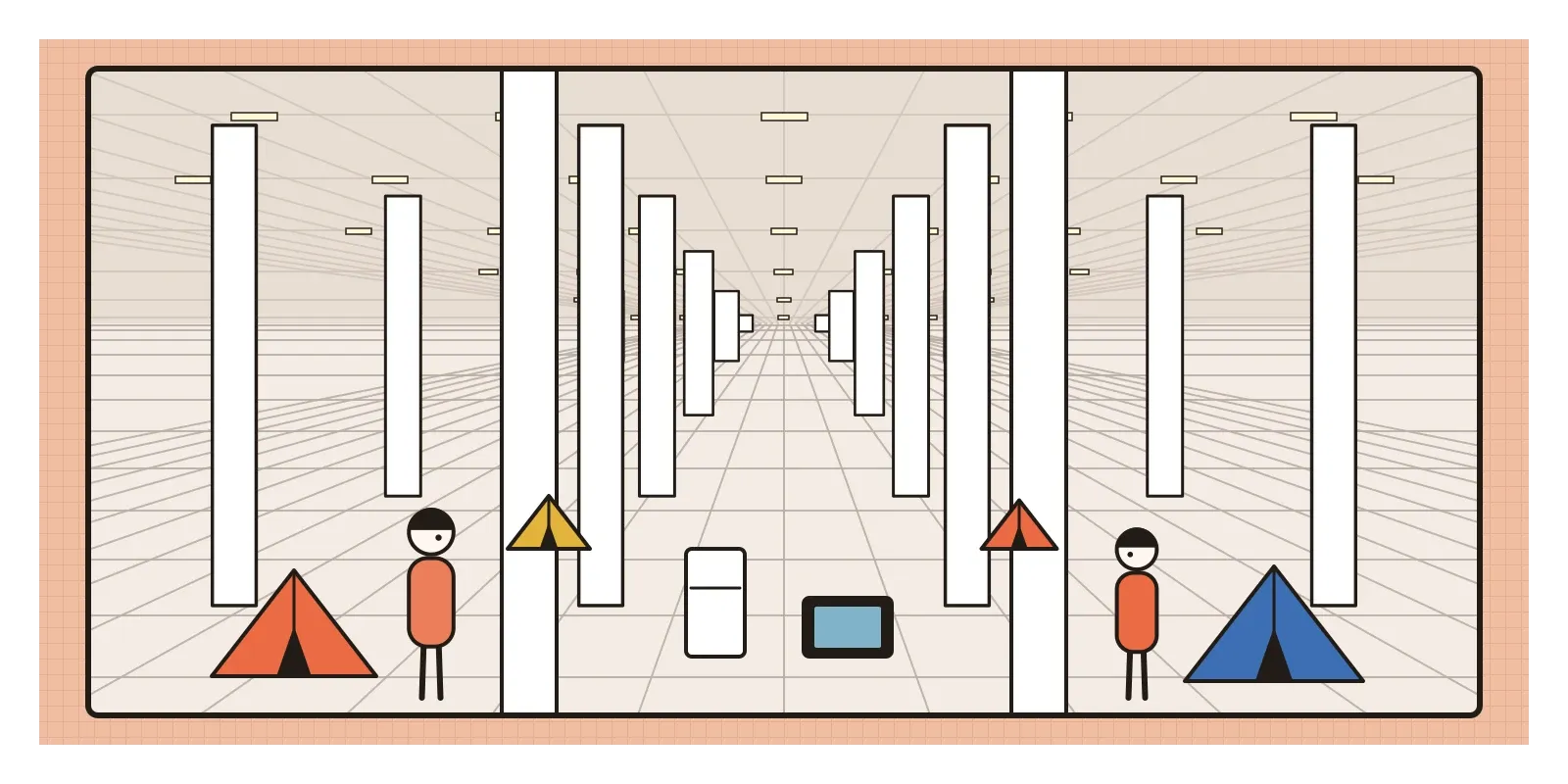
Archizoom began with furniture that misbehaved. Their Superonda sofa of 1966 was simply a block of foam cut along a wavy line into two pieces with no frame, which could be stacked into a sofa or laid flat as a lounger. Their Dream Beds of 1967 were deliberately kitsch, loaded with borrowed ornament and fake luxury. In 1969 they made a chair named after Mies van der Rohe, a triangle of chrome with a stretched rubber sheet that sagged alarmingly when you sat down. Then they turned to cities. No-Stop City, developed from 1969 to the early 1970s, imagined the city as one endless interior, like a supermarket or a factory floor, a grid of columns lit artificially, with no centre, no streets and no views, where residents camped among the services wherever they liked. Some of its plans were drawn by typing rows of characters on a typewriter. It was a utopia and a warning at once.
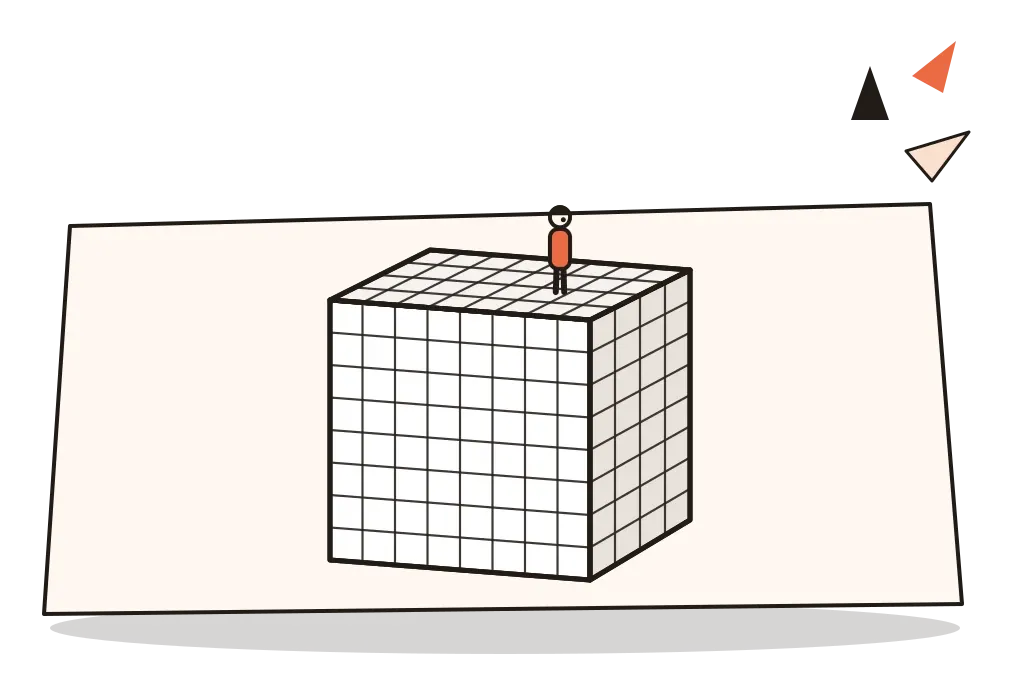
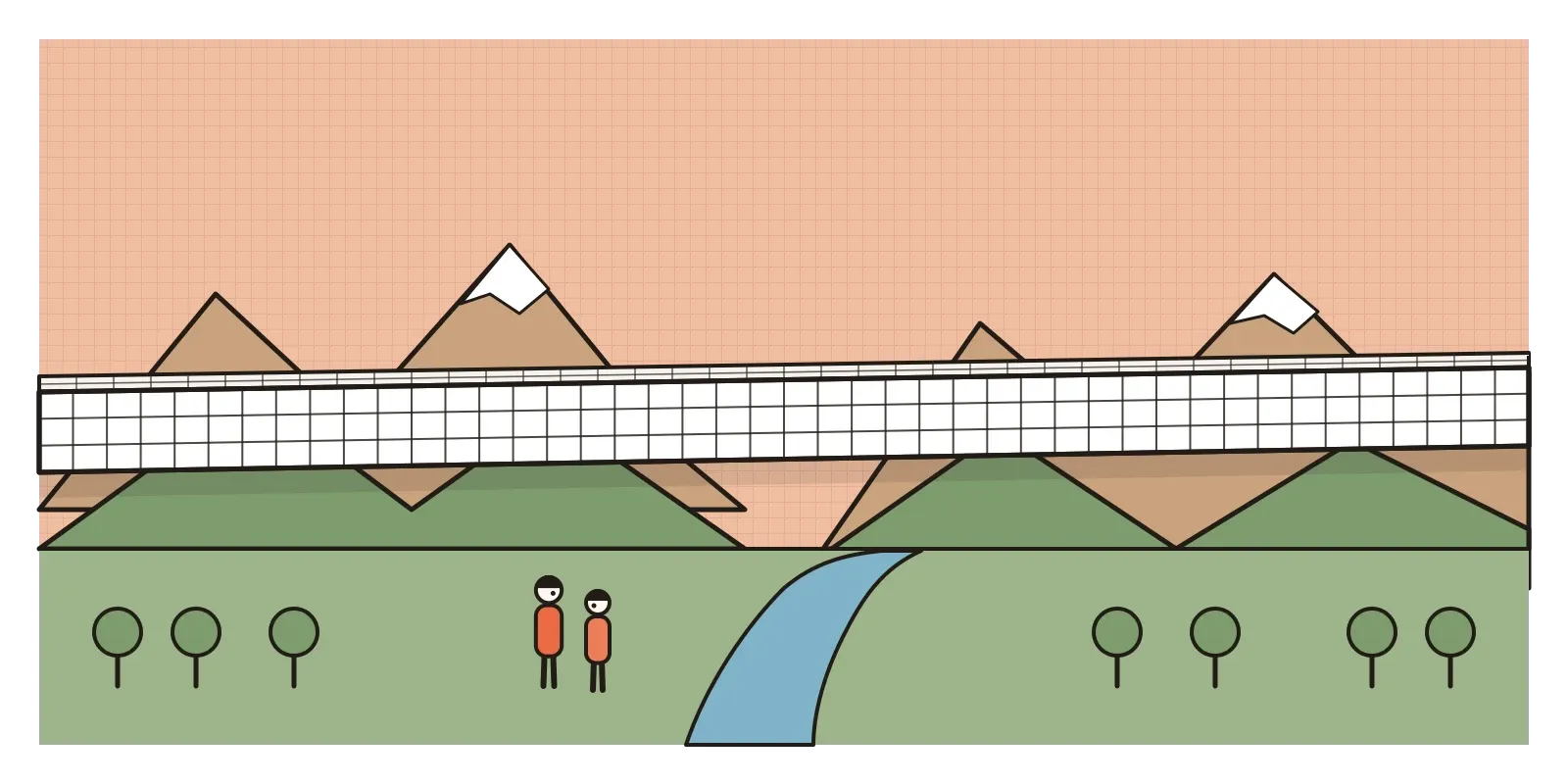
Superstudio worked mainly in images and stories. In 1969 they proposed the Continuous Monument, a single, featureless white structure ruled with a square grid that would run across the whole planet, through deserts, over mountains, across cities, shown in photomontages that look serene and terrifying at once. The same year they drew Histograms of Architecture, catalogues of neutral gridded blocks that could be scaled into anything from a table to a city. The furniture company Zanotta turned them into the Quaderna tables in 1970, covered in a printed black-on-white grid laminate, and they're still made. In 1971 Superstudio published Twelve Cautionary Tales for Christmas, twelve ideal cities that turn into nightmares, and they then made films about what they called fundamental acts: life, education, ceremony, love and death.
Others pushed scale and humour. Studio65 in Turin made Bocca, a sofa shaped like a pair of red lips, a nod to Dalí's lip sofa that I mentioned in the post on Surrealism. Gruppo Strum made Pratone, a patch of giant green foam grass blades to lie on. In 1972 the Museum of Modern Art in New York put much of this on show in Italy: The New Domestic Landscape, organised by Emilio Ambasz, alongside sleek Italian products, as if to show both the miracle and its critics. Early in 1973, many of the radicals, Pesce and Ettore Sottsass among them, met at the offices of the magazine Casabella in Milan and founded Global Tools, a kind of counter-school that planned workshops in manual skills, the body and communication.
How to spot design that is arguing
Radical Design is easy to recognise once you know it's being ironic. The most common motif is the grid: a neutral square grid in black lines on white, printed on laminate, drawn over landscapes or stretched to infinity. It stands for the modernist dream of a rational, universal system, taken so literally that it becomes eerie. Scale is played with constantly, so lips become sofas and grass becomes a chair. Foam replaces frames, so furniture loses its skeleton and becomes something you sink into or rearrange. Colours are often pop-bright, borrowed from advertising and nightclubs, though Superstudio's grids are almost colourless.
Just as important is the medium. Much Radical Design exists as drawings, collages, storyboards, magazine pages, films and exhibition installations, rather than as products. A photomontage of a white grid crossing a valley isn't a building proposal. It's an argument in the form of an image, like a political cartoon by architects. Even the products are often uncomfortable, funny or slightly wrong, so that sitting in them makes you notice what you expect a chair to do. As a designer, I find that the most useful idea here is that a design can ask a question rather than answer one.
Sottsass, a long illness and plates for Shiva
The Radical designer with the deepest Indian connection was Ettore Sottsass, a generation older than the Florentine students and already a well-known consultant to Olivetti. In the autumn of 1961 he travelled to India for the first time, with his wife, the writer and translator Fernanda Pivano. Soon afterwards he fell seriously ill with nephritis, a kidney disease, and was treated at Stanford's hospital in Palo Alto, California, at a point when his doctors feared he would not survive. He did, and the two experiences, India and nearly dying, changed his work.
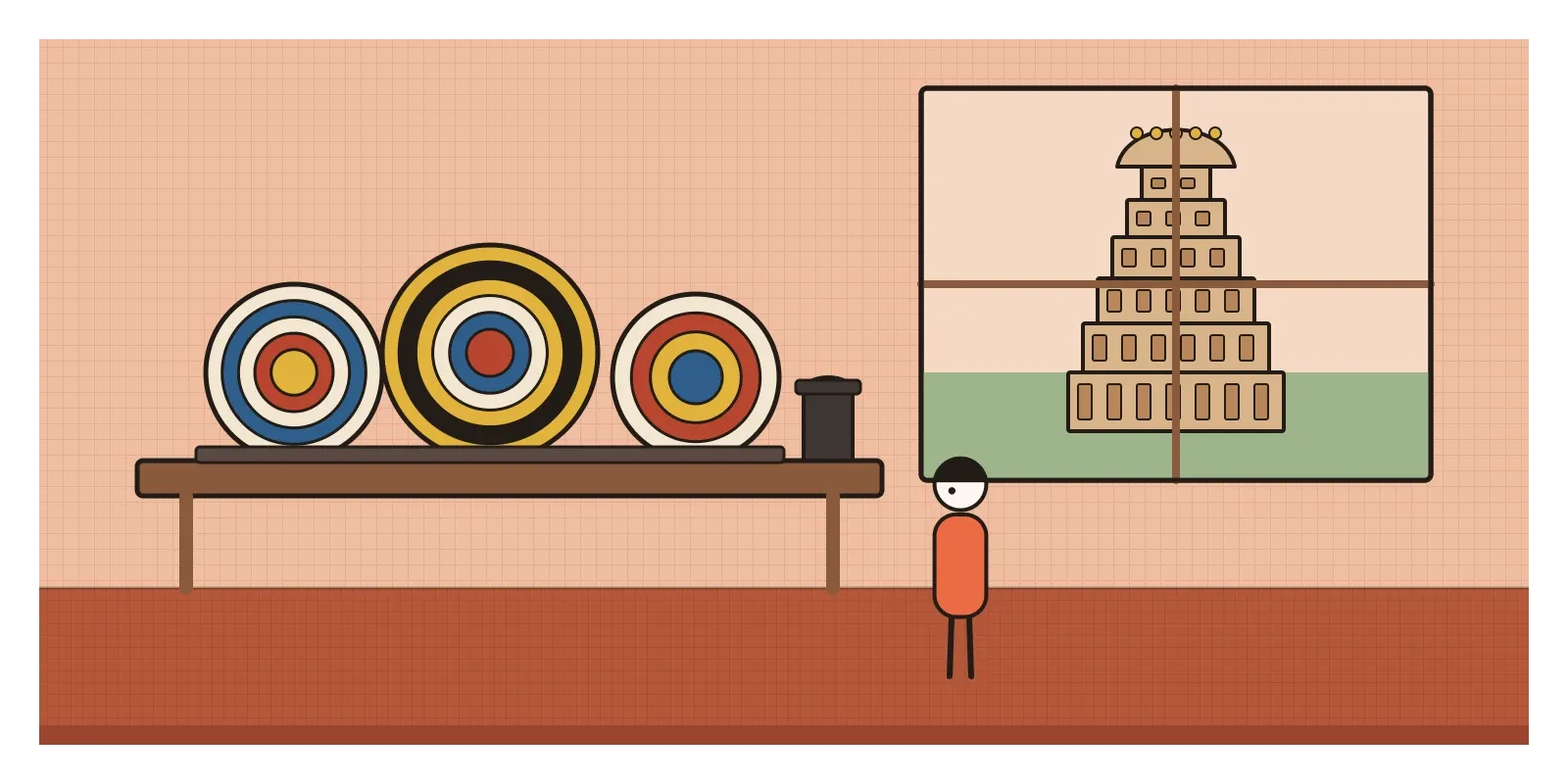
During his convalescence he made a series of dark, mysterious ceramics, the Ceramiche delle tenebre (ceramics of darkness), in 1963. In 1964, recovered, he made a set of plates called Offerta a Shiva, offerings to Shiva, glazed with concentric rings and bands, often described as his thanks for recovering. Later series of ceramics, called Tantra and Yantra, drew on Hindu diagrams. He went back to India many times, and writers on his work often trace to those journeys his habit of treating objects as part of ritual and daily life rather than as efficient tools. That idea, that a thing could carry meaning and feeling before function, runs through his Radical work and his later furniture, which I'll come back to in the post on the Memphis Group.
There was no Radical Design movement in India, and the reason is a useful contrast. In the 1970s Indian designers were facing the opposite problem. The question at the National Institute of Design in Ahmedabad, as I wrote in the post on Indian design education, was how to make enough good, affordable things for people who had too little, often by working with craftspeople. The Florentines were rebelling against too much stuff. Indian designers were trying to make sure there was enough.
Paper cities that changed real ones
Radical Design built very little, but it travelled far. In 1972, Rem Koolhaas and his collaborators made Exodus, or the Voluntary Prisoners of Architecture, a set of drawings of a vast walled strip cutting through London, openly in debt to Superstudio, and Koolhaas went on to become one of the most influential architects of his time. The Quaderna tables, the Bocca sofa and the Pratone are still sold. Pesce's trick of squeezing foam flat for shipping lives on, by a different route, in the mattress that arrives rolled in a box and unfurls in your bedroom. The habit of designing to provoke rather than to sell has become a discipline of its own, speculative and critical design, which has its own post later in this section. And the grid-over-landscape montage is everywhere in architecture schools, now often made with AI image tools in minutes.
Its critics have plenty to point at. The groups were almost all men; Lucia Bartolini, a member of Archizoom, is rarely named alongside the founders. Its critique of consumption was quickly consumed, as limited editions and gallery pieces for wealthy collectors. Some on the political left saw its paper utopias as an escape from real politics after 1968, and Global Tools held only a few meetings and workshops before it faded around 1975. By the late 1970s some of the same people, including Branzi, Sottsass and the editor Alessandro Mendini, had turned from critique to colourful, decorated objects, first with Studio Alchimia in Milan and later with Memphis, which belong to the story of Postmodernism. In the next post, on Mingei and Japanese aesthetics, we go back several decades to a very different criticism of industrial goods, one that looked to anonymous potters and weavers.
Design a cautionary tale
Radical Design is easiest to see in museums with design collections. MoMA in New York, the Centre Pompidou in Paris and the design museum at the Triennale in Milan all hold key pieces, though there is very little of it in Indian collections. For reading, Andrea Branzi's The Hot House is a history written from the inside, and Peter Lang and William Menking's Superstudio: Life Without Objects collects Superstudio's images and tales.
For an exercise, borrow Superstudio's idea of the cautionary tale. Take a product you're working on and imagine it succeeding completely, used by everyone, all day, everywhere. Draw it as a short storyboard of four frames. What does the world look like? What has disappeared? Then draw the opposite: a version of the product that criticises its own excess, an app that stops you scrolling, a feature that tells you not to buy. You may not ship either, but you'll understand your design better.
Pesce's armchair still arrives, in some versions, flat and sealed, and it still swells up in front of its owner. The ball is still tied to its foot. You can sit in the argument, and many people do, without ever noticing it's there.
Further reading: Andrea Branzi, The Hot House: Italian New Wave Design (1984) · Peter Lang and William Menking, Superstudio: Life Without Objects (2003) · Emilio Ambasz (ed.), Italy: The New Domestic Landscape (1972) · Cindi Strauss (ed.), Radical: Italian Design 1965 to 1985, The Dennis Freedman Collection (2020)
A reply toThe polished "bel design" of Italy's economic boom, and modernism's faith that good design would make life better for everyone.