Mingei and Japanese Aesthetics
How a Japanese philosopher found beauty in cheap everyday pots, and why wabi-sabi and ma still shape quiet design.
Mingei and Japanese Aesthetics
Five boxes deep, one rice bowl
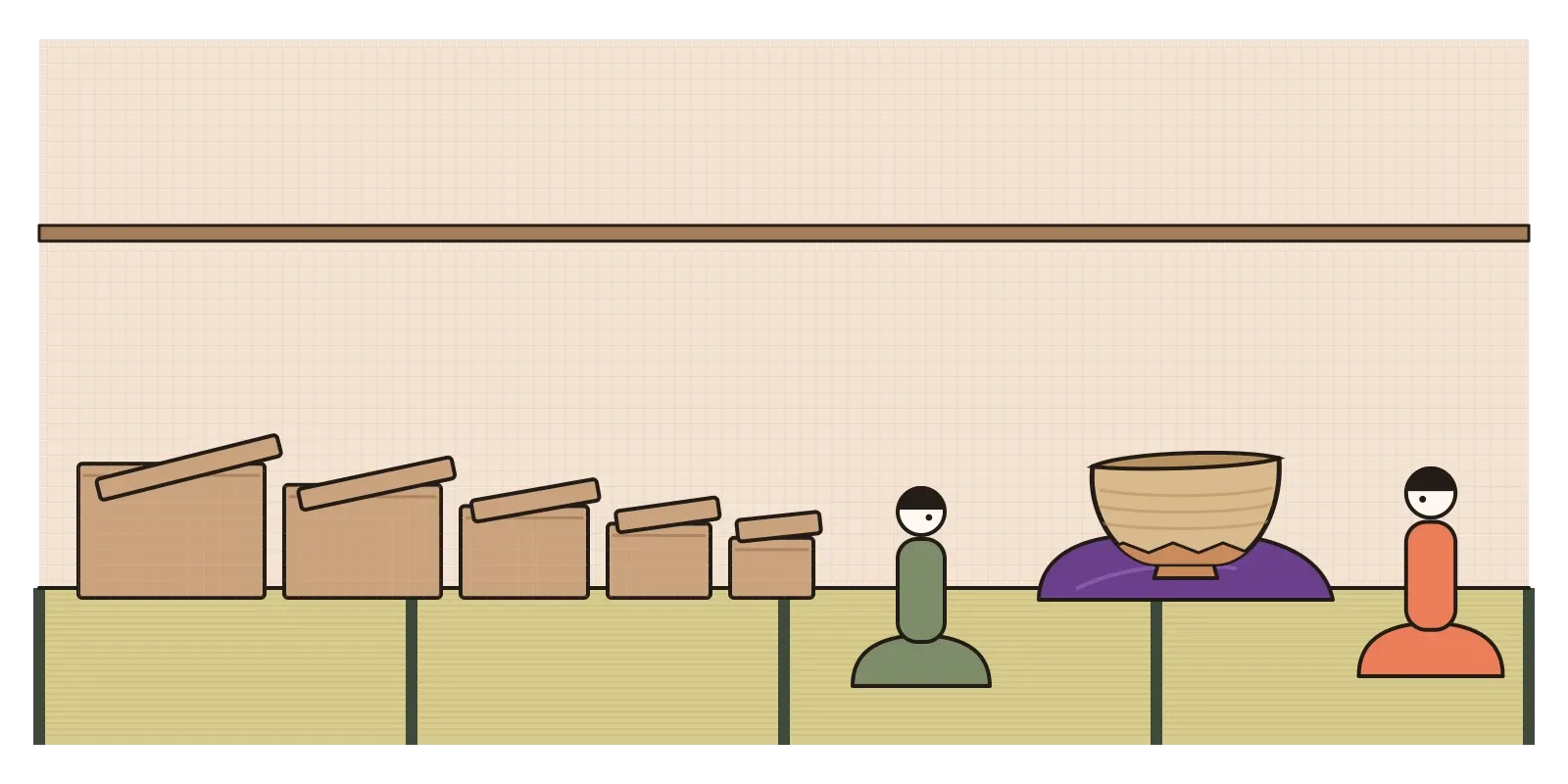
In 1931, the Japanese philosopher Yanagi Sōetsu went to Kōhō-an, a small sub-temple of the Daitoku-ji monastery in Kyoto, with his friend the potter Kawai Kanjirō. He had wanted for years to see a particular tea bowl kept there, known as the Kizaemon Ido. It was one of the most famous objects in Japan, a national treasure that tea masters had passed down and revered for centuries. It was brought out the way such things are, in box after box, five deep, wrapped in purple silk and wool.
When the last wrapping came off, Yanagi felt a kind of shock. It was a good bowl, he later wrote, but how ordinary. It had been made in Korea in the sixteenth century as a plain rice bowl, the kind a poor family would eat from every day, thrown quickly by a potter whose name nobody had recorded, with a rough foot and a glaze that ran where it liked. Its makers would have been astonished to see it in silk. Yanagi's conclusion wasn't that the tea masters were fools. It was that they had seen something real, a beauty that came from plainness, use and the absence of showing off, and that the same beauty was lying unnoticed in every farmhouse kitchen.
That idea is the centre of Mingei, the Japanese folk craft movement Yanagi led from the 1920s, and it connects to older Japanese ideas about beauty that this post also covers: wabi-sabi, the beauty of the plain, imperfect and aged, and ma, the meaningful gap. Together they've given modern design one of its most influential vocabularies, the language of quiet, unbranded, imperfect things.
Factories, export wares and a new word
Mingei was a reply to Japan's rush into the industrial age. After 1868, the Meiji government set out to modernise the country on Western lines, and factories, railways and Western-style schools spread fast. Japanese crafts were pushed in two directions at once. Many traditional workshops lost out to cheap machine-made goods. Others turned to elaborate, showy export wares made for Western buyers, the market I described in the post on Japonisme, crowded with gold, dragons and technical display. Neither, Yanagi felt, had anything to do with the honest things people had used for centuries.
He was well read in Western thought, especially William Morris, and the parallel with the Arts and Crafts movement, which I wrote about earlier in this section, is close. But his path to Mingei ran through Korea, then a Japanese colony. A friend introduced him to Korean ceramics of the Joseon dynasty, and he came to love their plain white porcelain and their unselfconscious decoration. In 1925, on a research trip with Kawai and the potter Hamada Shōji to study the wooden Buddhist carvings of a wandering monk, the three of them coined a new word, mingei, from min, the people, and gei, craft: crafts of the people. They published a prospectus for a folk craft museum in 1926, launched a beautifully made magazine called Kōgei in 1931, and opened the Japan Folk Crafts Museum in Komaba, Tokyo, in 1936, paid for largely by the textile industrialist Ōhara Magosaburō.
Potters, dyers and a philosopher's eye
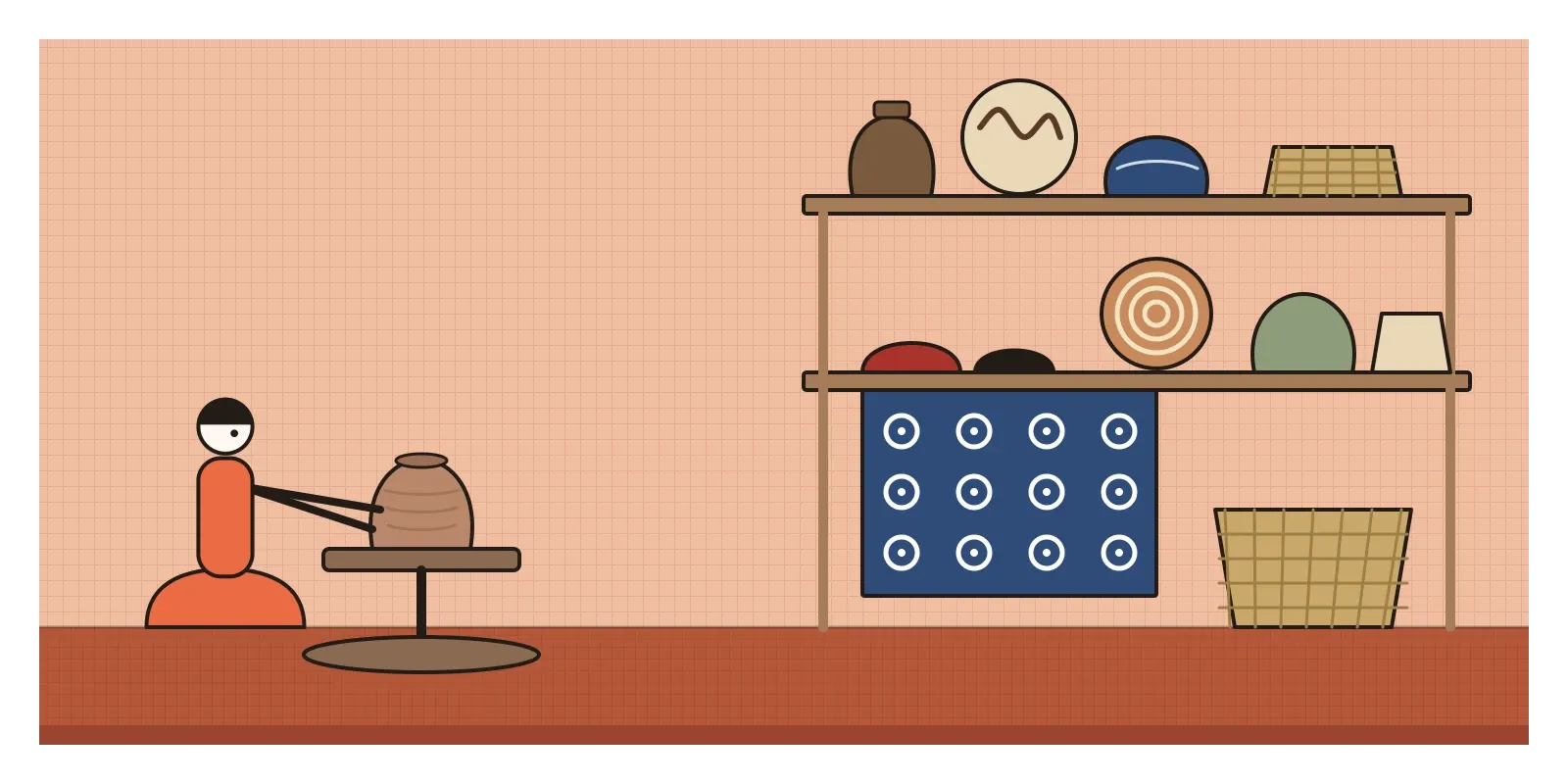
Yanagi was the theorist. His argument, collected later in English in The Unknown Craftsman, was that the most beautiful objects were made by anonymous craftspeople, in quantity, cheaply, for daily use, following tradition rather than ego, so that beauty came through them almost by accident. He called this the way of craft, and, drawing on Pure Land Buddhism, he compared it to salvation by grace rather than by effort.
Hamada Shōji spent the early 1920s in England helping the potter Bernard Leach set up a workshop at St Ives in Cornwall, then settled in Mashiko, a pottery village north of Tokyo, where he worked with local clay and glazes for the rest of his life. He famously did not sign his pots. In 1955 he was named one of Japan's first Living National Treasures. Leach became the movement's voice in English, and his A Potter's Book (1940) shaped studio pottery across Britain, America and beyond. Kawai Kanjirō built himself a house and workshop in Kyoto, now a museum, and refused the honours that Hamada accepted. Serizawa Keisuke turned Okinawan stencil dyeing into bold printed textiles, and Munakata Shikō made large, energetic woodblock prints that won top prizes at international biennales in the 1950s.
The next generation took the ideas into industry. Yanagi's son, Yanagi Sori, trained as a designer and in 1954 made his Butterfly Stool, two identical curved pieces of moulded plywood joined under the seat by a single rod, an industrial object with the calm of a handmade one. He believed machine-made things could have mingei's honesty too, if designers worked from use rather than from fashion.
Wabi, sabi, ma and shadows
Mingei drew on ideas much older than itself, especially those of the tea ceremony. In the sixteenth century the tea master Sen no Rikyū developed a style of tea called wabi, built on rustic simplicity: a tiny room, sometimes only two tatami mats in size, entered through a low doorway, with rough walls, a single flower and plain bowls. The Taian tea room near Kyoto, traditionally attributed to him, survives. The potter Chōjirō made him dark, hand-shaped bowls that became known as raku ware. The contrast with Rikyū's patron, the warlord Toyotomi Hideyoshi, who built a portable tea room covered in gold, could hardly be sharper, and the relationship ended badly: in 1591 Hideyoshi ordered Rikyū to kill himself.
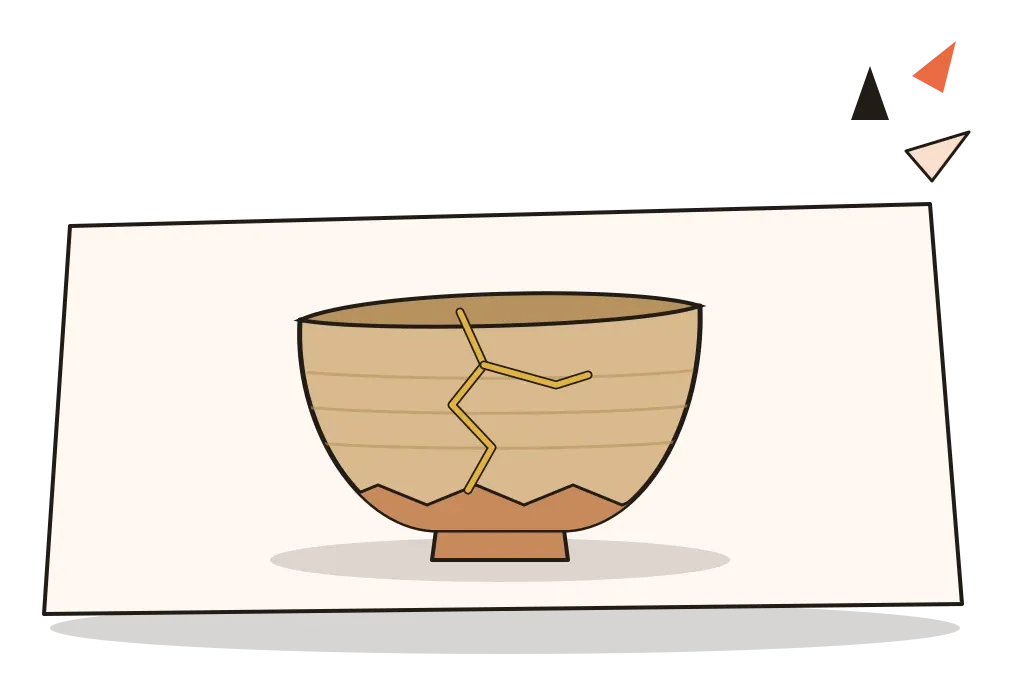
Wabi is often paired with sabi, the beauty of age, patina and wear, and together they have become the phrase wabi-sabi: the beauty of things that are imperfect, impermanent and incomplete. A related practice is kintsugi, mending broken ceramics with lacquer dusted with gold, so the cracks become bright lines. A popular story says it began when the shogun Ashikaga Yoshimasa sent a broken Chinese bowl away for repair and got it back held together with ugly metal staples, but that origin is legend rather than record.
Ma is harder to translate. It means an interval, a gap in space or time that is felt rather than empty: the pause between notes, the space between stepping stones, the bare wall around a single scroll in an alcove. The architect Isozaki Arata explained it to Western audiences in an exhibition in Paris in 1978. And in his essay In Praise of Shadows (1933), the novelist Tanizaki Jun'ichirō defended the dim, layered darkness of old Japanese rooms, where lacquer and gold glow faintly, against the bright electric light of modern life.
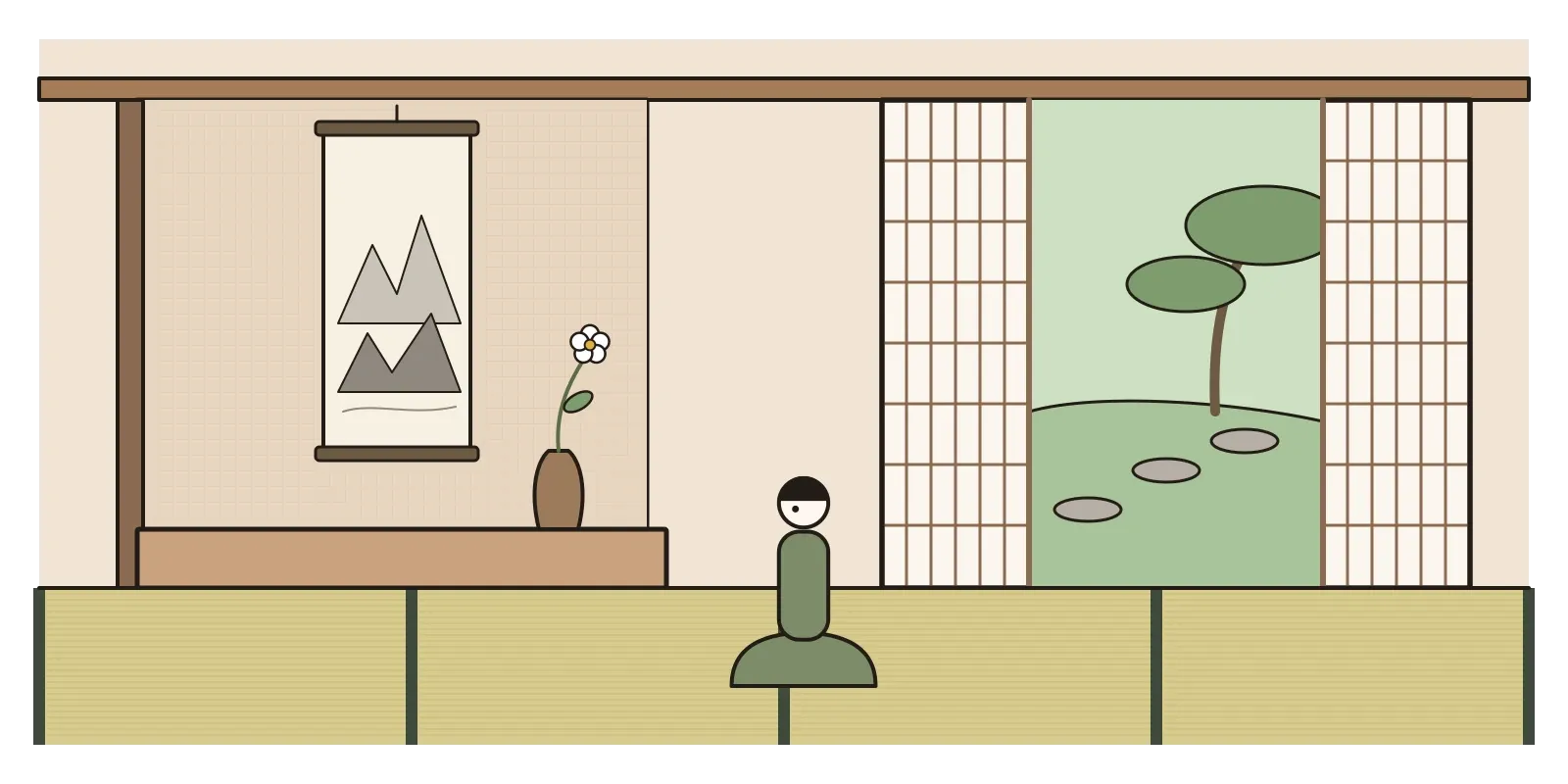
Read with a designer's eye, this vocabulary is easy to recognise. Forms are simple and slightly irregular, showing the hand that made them: throwing rings on a pot, brush marks in a glaze, a rim that isn't quite round. Materials are natural and left visible, clay, wood, bamboo, paper, indigo cotton. Colours are muted and earthy. Compositions are asymmetrical, and empty space is treated as a material in its own right. Nothing shouts. In the post on balance, I mentioned how ikebana avoids perfect symmetry, and the same instinct runs through all of this.
From Tokyo to Delhi, and a darner's needle
The most direct link to India runs through a young man called Gurcharan Singh. In 1919 he went to Tokyo to study ceramics, and accounts of his life say that there he met Leach, Hamada, Kawai and the potter Tomimoto Kenkichi, just as the circle that would become Mingei was forming. Back in India, after many years of work in ceramics, he set up Delhi Blue Art Pottery in 1952, making glazed studio pottery. He's often called the father of Indian studio pottery, and his son Mansimran Singh later set up a pottery at Andretta in Himachal Pradesh. The idea of the potter as an independent maker, neither factory worker nor village caste craftsman, reached India partly through that one journey.
There's a wider parallel. After independence, Kamaladevi Chattopadhyay and Pupul Jayakar led a national revival of Indian crafts, with boards, emporia and a crafts museum in Delhi, and like Yanagi they argued that anonymous makers' everyday work deserved respect as art. The difference was scale and urgency. In India, crafts were the livelihood of millions, so the revival was about income as much as beauty.
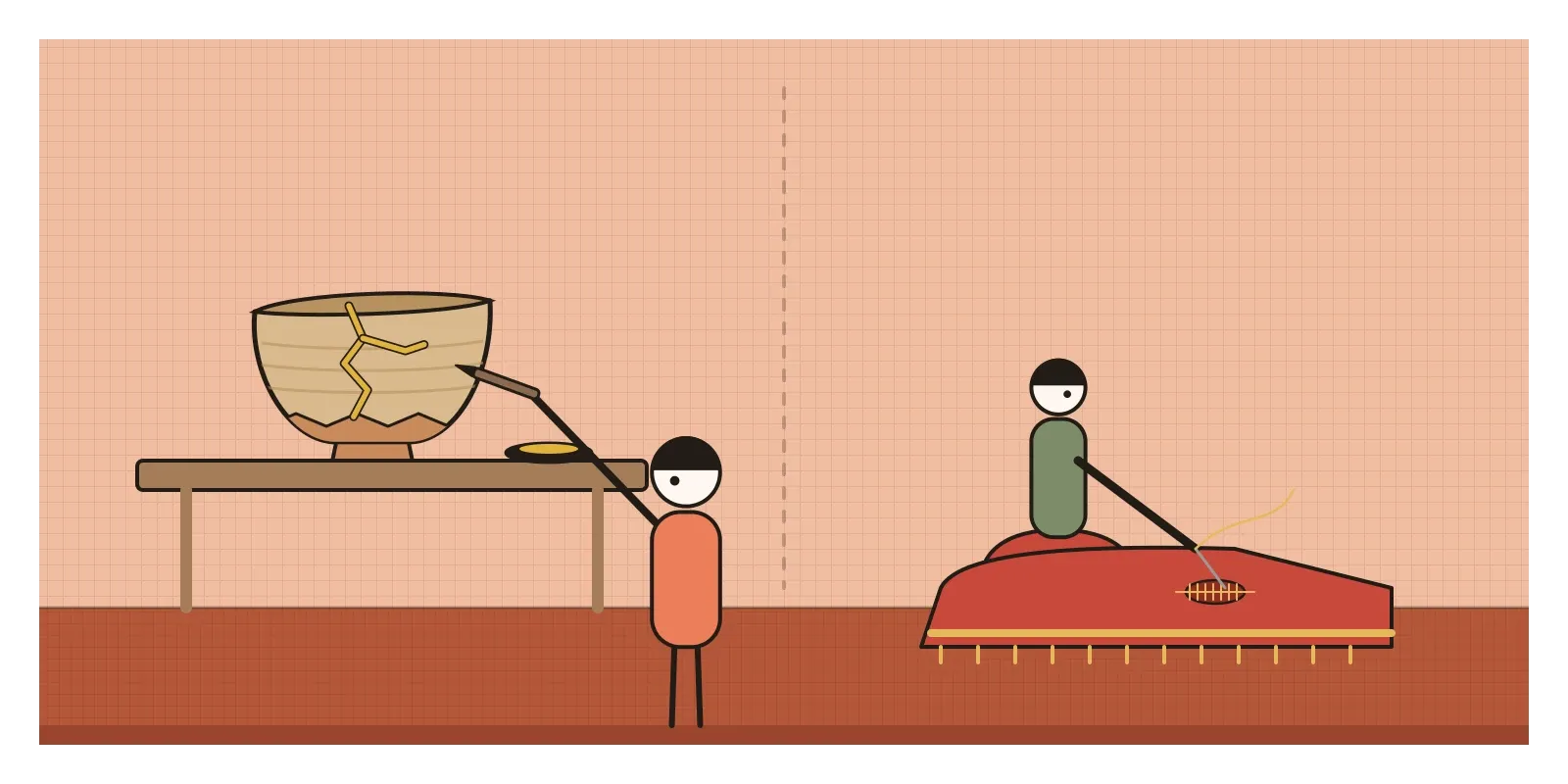
The most interesting contrast, for me, is in repair. Kintsugi makes a crack visible and golden, turning the history of an object into decoration. India has its own masters of mending, the rafoogars, darners in Kashmir and in towns such as Najibabad in Uttar Pradesh, who repair fine shawls so skilfully, matching thread and weave, that the damage disappears. Both traditions refuse to throw a damaged thing away. One celebrates the scar, the other hides it. As a designer, I find that a useful choice to have in mind whenever something in a product breaks and has to be fixed in front of users.
No logo, no noise, and some hard questions
Mingei and wabi-sabi are all over contemporary design. Muji, which I mentioned in the post on Minimalism, built a brand on unbranded, plain goods, and its art director Hara Kenya writes about emptiness as something a design can offer people to fill. In 2006 the designers Fukasawa Naoto and Jasper Morrison put together an exhibition called Super Normal, of ordinary, anonymous objects that work so well you hardly notice them, an idea Yanagi would have recognised. Handmade-looking ceramics are standard in cafés, and kintsugi has become a metaphor for resilience in self-help books. In interfaces, generous white space is a kind of ma, and the best loading states and transitions use a pause rather than filling every millisecond with motion.
The movement also deserves hard questions. The historian Kim Brandt has shown how closely Mingei was tied to Japanese imperialism: Yanagi's collecting in Korea, and later in Okinawa and Japanese-occupied Manchuria, depended on colonial power, even though he publicly defended Korean culture and in 1922 opposed the planned demolition of a palace gate in Seoul. The scholar Yuko Kikuchi has called its idea of a timeless Japanese and Asian craft spirit a kind of Oriental Orientalism, a theory built partly from Western ideas and then presented as native essence. The anonymous craftsman was praised by famous, named men, whose pots now sell for high prices. And wabi-sabi, sold abroad as a lifestyle, often means expensive rough-looking things for people who never have to make do. Rikyū's humble bowls were, after all, prized by warlords.
In the next post, on Googie and Atomic Age design, we cross the Pacific to post-war America, where coffee shops and motels were trying to look like rockets, about as far from a quiet tea room as design can get.
Hold a bowl with both hands
In Tokyo, the Japan Folk Crafts Museum still occupies Yanagi's building in Komaba, and Kawai's house in Kyoto is open to visitors. In India, the Sanskriti Museum of Everyday Art at Anandagram, on the edge of Delhi, is built around the same idea: lamps, locks, nutcrackers and kitchen tools made by unnamed makers, shown as things worth looking at. The crafts museum at Pragati Maidan in Delhi is another good place to start. For reading, Yanagi's The Unknown Craftsman and Tanizaki's In Praise of Shadows are both short, and Kim Brandt's Kingdom of Beauty gives the necessary other side.
For an exercise, pick one ordinary object you use every day whose maker you don't know, a steel tumbler, a cane basket, a wooden spoon. Draw it slowly, then write down every mark that use has left on it. Then open a screen you've designed and remove one thing, leaving the space empty on purpose, and see whether the screen feels calmer or simply unfinished.
The Kizaemon bowl is still in its boxes at Kōhō-an, wrapped in silk. Yanagi's point was that it had been beautiful before anyone wrapped it, when it was just a bowl of rice on a poor family's floor.
Further reading: Sōetsu Yanagi, The Unknown Craftsman: A Japanese Insight into Beauty (1972) · Jun'ichirō Tanizaki, In Praise of Shadows (1933) · Leonard Koren, Wabi-Sabi for Artists, Designers, Poets and Philosophers (1994) · Kim Brandt, Kingdom of Beauty: Mingei and the Politics of Folk Art in Imperial Japan (2007) · Yuko Kikuchi, Japanese Modernisation and Mingei Theory: Cultural Nationalism and Oriental Orientalism (2004)
A reply toJapan's rush into factory goods and showy export wares after the Meiji Restoration.