
Prehistoric Art
The first images people made on rock, bone and ivory, and what they still teach us about seeing.
Prehistoric Art
A girl looks up in Altamira
In 1879, a Spanish lawyer and amateur archaeologist called Marcelino Sanz de Sautuola was digging in a cave on his land at Altamira, near Santander in northern Spain. He was looking at the floor, searching for flint tools and bones. His young daughter María, usually said to have been eight or nine, had come with him. She wandered into a low side chamber, looked up at the ceiling and called out to her father. The words are remembered in slightly different versions, but the gist is that she had seen oxen. Above them, painted across the rock in red and black, was a herd of bison, some standing, some curled up, their bodies swelling over the natural bumps of the stone.
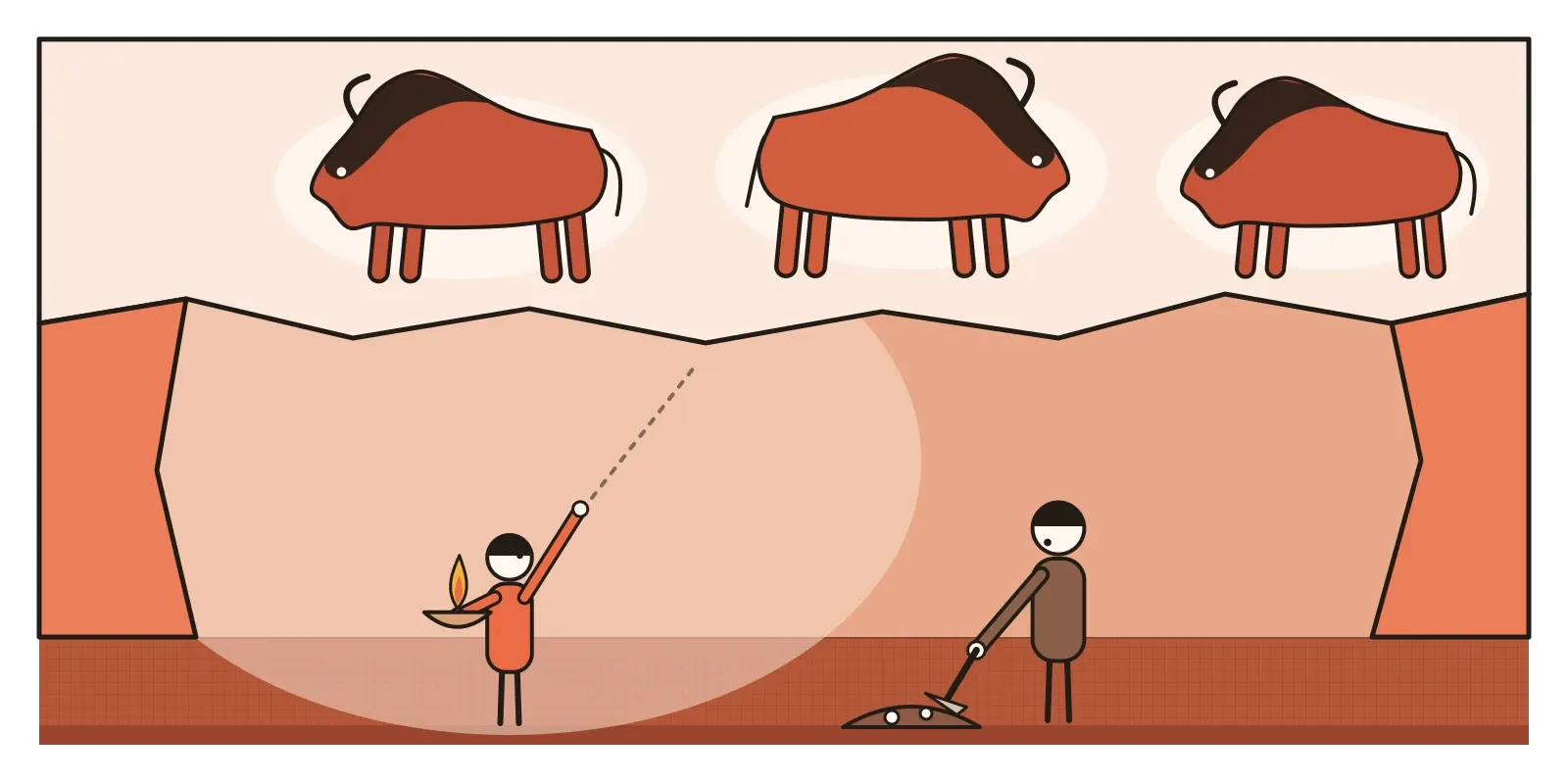
What happened next is the part I find most telling. Sautuola published the paintings in 1880 and argued that they were as old as the stone tools on the floor. Most experts dismissed him, and some suggested the paintings were a recent fake. They were simply too good. People in the Ice Age were supposed to be primitive, and these bison were confident and beautifully observed. Sautuola died in 1888 with his reputation damaged. Only after similar paintings turned up in French caves, some sealed behind deposits that couldn't have been faked, did the French prehistorian Émile Cartailhac change his mind. In 1902 he published an article whose title translates as "Mea culpa of a sceptic".
This is the first post in a new series about art and design movements, and I wanted to start with that ceiling. Prehistoric art isn't really a movement. It's the name we give to everything people made before writing, across tens of thousands of years and every inhabited continent: paintings and engravings on rock, carved figures in ivory and bone, patterns scratched into lumps of pigment. But it's where the long conversation begins, and the experts who refused to believe in Altamira are a good warning for everything that follows. We tend to see what we expect to see.
Replying to the rock itself
The series is built around one idea: every style is a reply to the one before it. Prehistoric art is the awkward exception, because there's no earlier style we know of for it to answer. What its makers did reply to was the world around them, the animals they hunted and feared, and, very often, the rock itself.
The dates are long and keep moving. Crossed lines scratched into a piece of red ochre at Blombos Cave in South Africa are around 75,000 years old. The oldest known figurative paintings, pictures of recognisable things, aren't in Europe at all. On the Indonesian island of Sulawesi, a red painting of a wild pig with three small human-like figures beside it, in a cave called Leang Karampuang, was dated in 2024 to at least 51,200 years ago. In Europe, the great painted caves span roughly 40,000 to 12,000 years ago, during the last Ice Age, when much of the continent was cold grassland grazed by bison, horses, mammoths and reindeer.
Dating rock art is genuinely difficult. Red ochre can't be radiocarbon dated, so researchers often date thin mineral crusts that later formed over a painting, which gives only a minimum age. In 2018, a team using this method argued that some marks in Spanish caves were over 64,000 years old, and so made by Neanderthals. Other specialists have challenged the result, and the question is still open. It's worth holding all these numbers loosely.
Horses in the dark, a lion-man and a pig in Sulawesi
We don't know the name of a single prehistoric artist, so the works have to speak for their makers. In December 1994, three cave explorers, Jean-Marie Chauvet, Éliette Brunel and Christian Hillaire, felt a draught coming from a pile of rocks in the Ardèche gorge in southern France, dug through, and found a cave that hadn't been entered for thousands of years. The oldest paintings in Chauvet Cave are around 36,000 years old, and they upended the idea that art had slowly improved from crude beginnings. On one wall, four horse heads overlap, each slightly offset from the last, with open mouths and shaded muzzles. Elsewhere, a pride of lions stretches across the rock in charcoal outline and smudged shading, all heading the same way.
Lascaux, in the Dordogne, is younger, around 17,000 years old, and its Hall of the Bulls has huge aurochs, an extinct wild cattle, some over five metres long. Found by four teenagers in 1940, it drew so many visitors after the war that their breath and the lighting encouraged mould. It closed in 1963, and today people visit replicas instead.
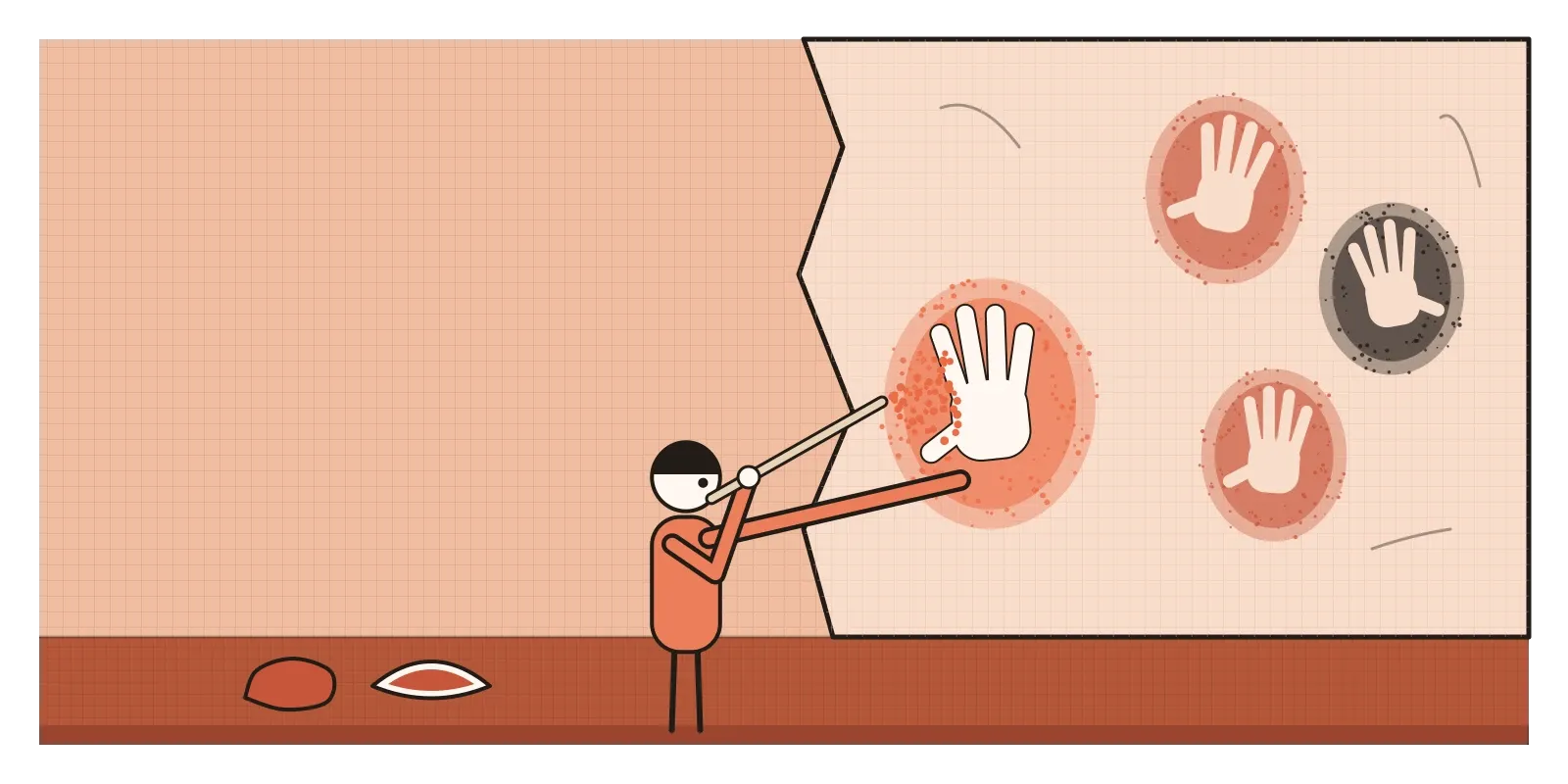
Not all prehistoric art was on walls. The Lion-man of Hohlenstein-Stadel, in southern Germany, is a figure about thirty centimetres tall, carved from mammoth ivory around 40,000 years ago, with a human body and a lion's head. It's one of the oldest known images of something that doesn't exist: an idea, not an observation. And across the world, people pressed their hands to rock and blew pigment around them. At the Cueva de las Manos in Patagonia, hundreds of hand stencils, many around 9,000 years old, crowd one rock wall, most of them left hands, which suggests people held the blowing tube in their right.
Bellies made from bulges
Look at enough cave art with a designer's eye and some patterns start to stand out. The first is the use of the surface. At Altamira, the bison are painted over bulges in the ceiling, so the rock supplies the curve of a belly or a shoulder, and in flickering lamplight the animals seem to breathe. Artists chose where to paint by what the stone already suggested, a crack for a back, a ridge for a horn. It's an idea I keep returning to: the material isn't a blank surface but a collaborator.
The second is the economy of line. Many animals are drawn in profile, the view that tells you the most about an animal's shape, with a single confident contour, sometimes left open at the belly or legs. Horns and antlers are often shown in a twisted perspective, turned towards us while the body stays sideways, so that both are easy to read. Interior shading, where it exists, is done with smudged charcoal or by scraping the rock to lighten it.
The palette is tiny: red and yellow ochres, which are iron oxides dug from the earth, black from charcoal or manganese, and sometimes white clay. Pigments were ground, mixed with water and applied with fingers, pads of fur, chewed sticks or by blowing. Scale varies wildly, from bulls bigger than a car to engravings smaller than a palm. And animals dominate. People are rare and usually sketchy, and there are many abstract signs, dots, grids and lines, whose meanings we can only guess at.
From a train window near Bhopal
India has one of the richest collections of rock art in the world, and its most famous site was found by an observant passenger. The story usually told is that in 1957, the archaeologist Vishnu Shridhar Wakankar was travelling by train through the hills south of Bhopal when he noticed rock formations that reminded him of the painted shelters he'd seen in Spain and France. He went back, climbed up and found them covered in paintings. The site is Bhimbetka, in Madhya Pradesh, a range of sandstone outcrops with hundreds of rock shelters, several hundred of them painted. It became a UNESCO World Heritage Site in 2003.
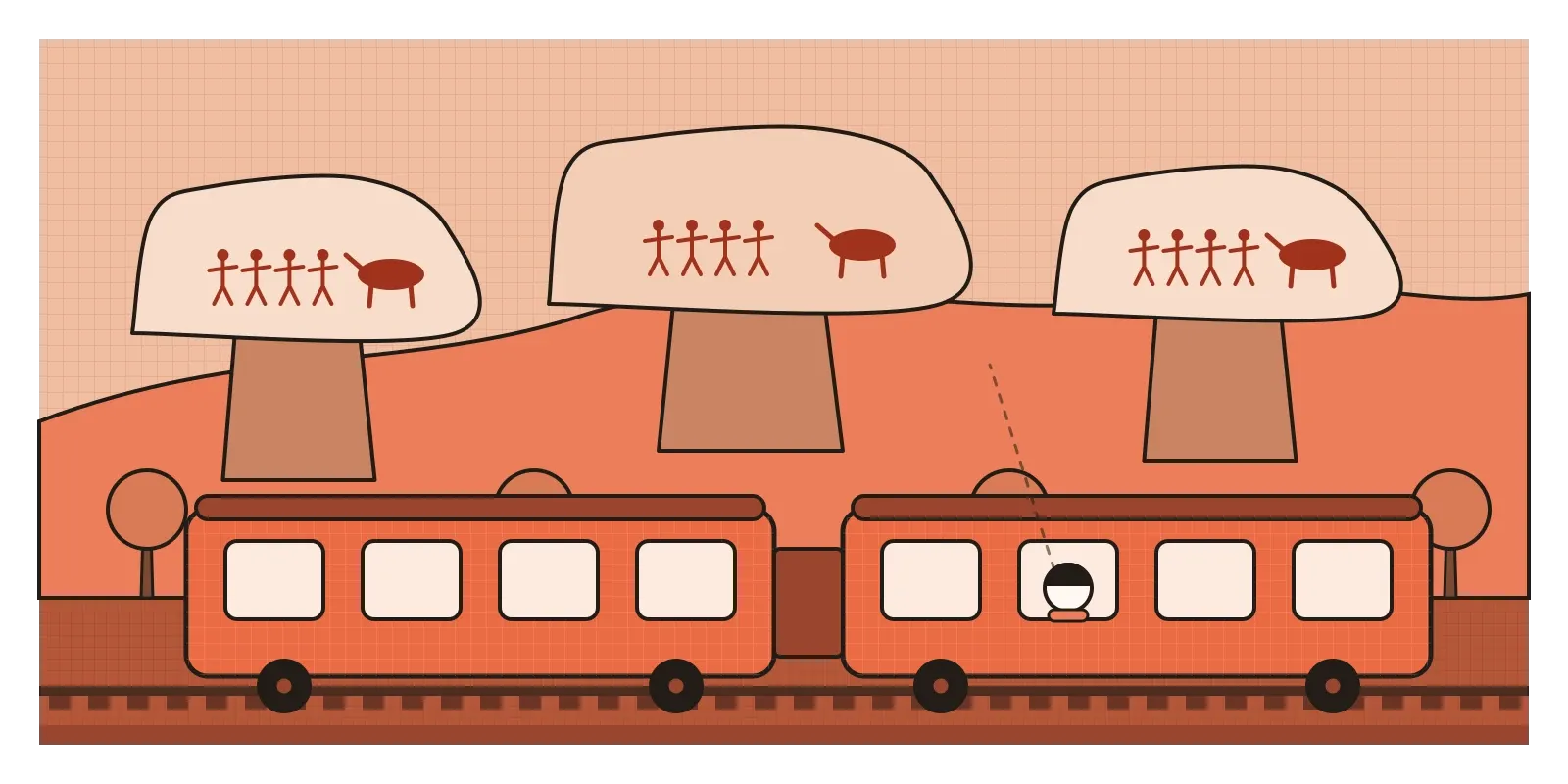
What makes Bhimbetka unusual is its length. People painted these shelters across thousands of years, in layers. The oldest are usually placed in the Mesolithic, the middle stone age, though experts disagree about the earliest dates, and the latest reach into historical times. Most are in red and white. There are hunters with bows, people dancing in lines, honey collectors, riders on horses and elephants, and large boars, bison and deer, some filled with patterns of lines. Compared with the European caves, the figures are smaller and livelier, and they tell stories of a community rather than show single animals.
The contrast I find most interesting is that in India this tradition never fully stopped. Wall painting in Adivasi communities, like the Saura paintings of Odisha, made on the mud walls of homes for ancestors and spirits, still uses a reduced, rhythmic language of figures and animals. I don't want to overstate the link. These are living art forms with their own histories, not leftovers from the stone age, as I said of Warli painting in the post on abstraction. But the sense that a wall is a place to speak to the unseen runs through all of them. In Kerala, the Edakkal caves in Wayanad carry engraved figures and patterns, brought to wider attention in the 1890s by a British police officer, Fred Fawcett.
The oldest interface is a wall
It might seem strange for a product designer to care about cave paintings, but they hold some of the most basic lessons in visual communication. The first is the silhouette. A bison or a horse at Lascaux is recognisable from its outline alone, because the artist chose the view and the features that carry the most information, the hump, the horns, the legs. That's exactly what a good icon does. The test I trust most for an icon is to fill it in solid black and see if it still reads. Cave painters passed that test 30,000 years ago.
The second lesson is about context. Many of these images are deep in caves, in places that are hard to reach, where they were seen by the moving light of a lamp or a torch. Some researchers have even found that painted areas cluster where the acoustics are strongest. Whatever their purpose, the images were made for a specific setting and a specific way of moving through space. What we design is always experienced somewhere too, on a phone in bright sun or a laptop late at night, never in the clean conditions of a design tool.

The third lesson is the hand stencil itself, one of the most widespread images on earth, from Patagonia to Sulawesi to France. It's a record of a person touching a surface and leaving a trace, the gesture we now make thousands of times a day on glass. And the last is the simplest. Long before writing, before cities, before anything we'd call design, people were making marks so that others would see them.
What we can't know, and where to look
The biggest limit of prehistoric art is how little we understand it. For a century, theories have come and gone. Early scholars saw decoration, art for art's sake. The French priest Henri Breuil argued for hunting magic, though the animals painted don't always match the bones of what people ate. Others saw structured pairs of male and female symbols, and the archaeologist David Lewis-Williams argued that some images record visions seen in trance. Each theory says as much about its own decade as about the Ice Age. We also see only what survived in sheltered rock. Art on skin, wood, bark and open rock faces has almost all vanished, so our picture is badly skewed.
There's a quieter bias too. Cave art was long assumed to be the work of men, but studies comparing finger lengths in hand stencils suggest that many were made by women, though the method has its critics. And admiration can be destructive. Lascaux was nearly ruined by visitors, and many Indian rock shelters still suffer from graffiti and quarrying. Prehistoric art didn't end so much as fade into everything that came after, as farming spread and people settled, built and began to record things in new ways.
To see it this week, if you're near Bhopal, Bhimbetka is about forty-five kilometres south of the city, and the Indira Gandhi Rashtriya Manav Sangrahalaya in Bhopal has rock shelters on its own grounds. If you can't travel, the French culture ministry's online tour of Lascaux is excellent. For a small exercise, pick an animal you know well, look at it for a minute, then draw it from memory in a single outline, without lifting your pen. Then try again, keeping only the features a stranger would need to recognise it. It's harder than it looks.
Sautuola's critics couldn't believe that people they imagined as primitive had painted that ceiling. María just looked up and saw the animals. That's probably the best way to begin this series: with fresh eyes, before deciding what we think we're looking at. In the next post, on ancient Egyptian art, I'll look at a civilisation that took the opposite path, building a strict set of rules for images that lasted three thousand years.
Further reading: Gregory Curtis, The Cave Painters: Probing the Mysteries of the World's First Artists (2006) · David Lewis-Williams, The Mind in the Cave (2002) · Jean Clottes, What Is Paleolithic Art? (2016) · Erwin Neumayer, Lines on Stone: The Prehistoric Rock Art of India (1993)
A reply toNothing we know of. These are among the first marks, made in answer to the animals and the rock.