Ancient Egyptian Art
How Egypt built a strict visual system of grids, profiles and scale that lasted three thousand years.
Ancient Egyptian Art
A queen left behind in a sculptor's house
On 6 December 1912, a German team led by the archaeologist Ludwig Borchardt was digging through the ruins of a house at Amarna, on the east bank of the Nile in Middle Egypt. The house had belonged to a sculptor called Thutmose, and it was full of his work. There were faces cast in plaster, unfinished heads in stone, tools and pigments, the leftovers of a busy studio. That afternoon the team lifted out a painted bust of a woman in a tall, flat-topped blue crown, almost undamaged after more than three thousand years. It was Nefertiti, the chief wife of the pharaoh Akhenaten. Borchardt wrote in his diary, in effect, that describing it was pointless. You had to see it.
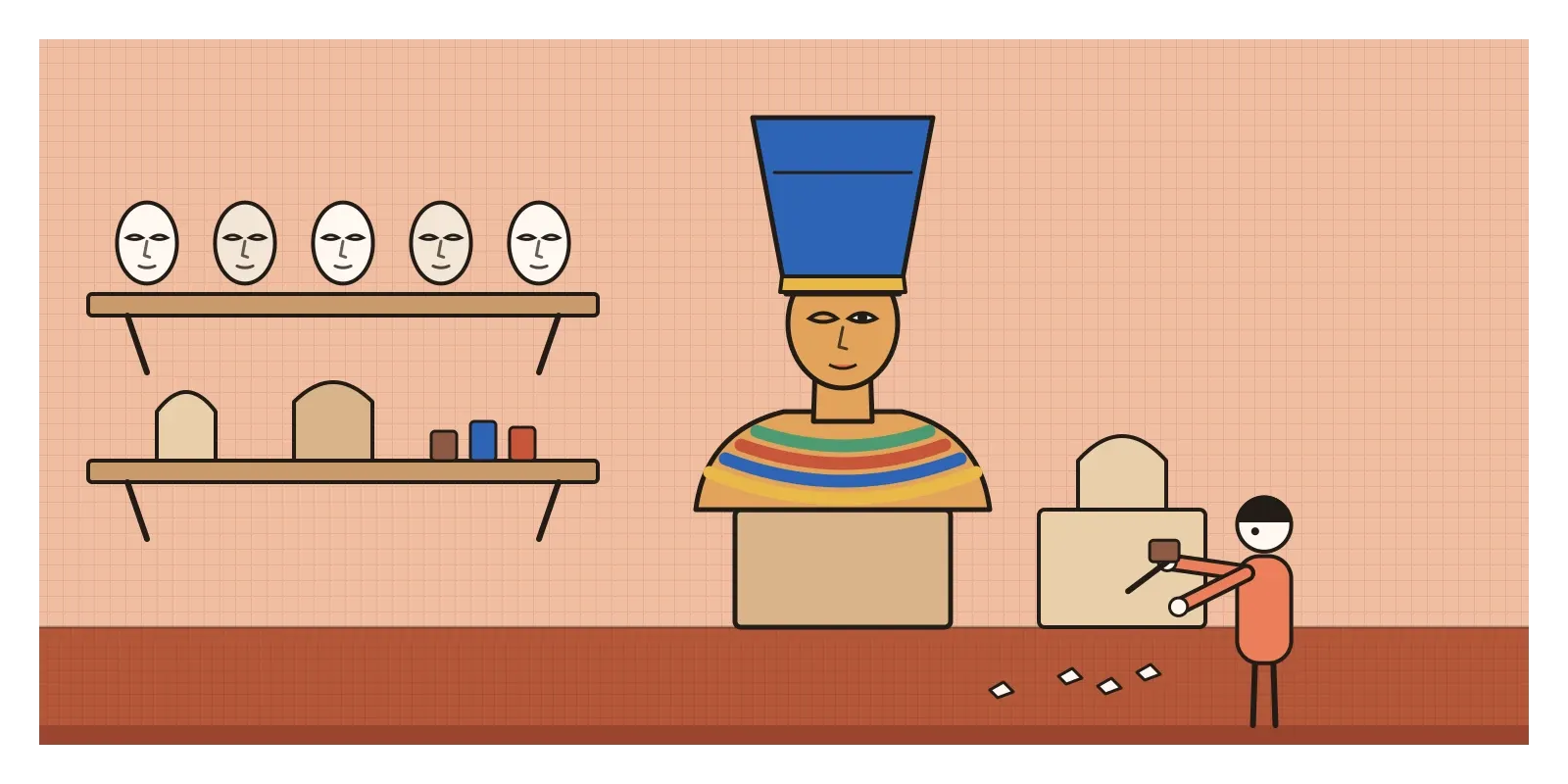
The bust is now one of the most famous images from the ancient world, but what interests me is where it was found. Not in a temple or a tomb, but on a workshop shelf. It seems to have been a model, a reference for other craftspeople to copy. Only one eye was ever inlaid. Borchardt searched the rubble for the second and never found it, and many scholars think it was never made, because a model didn't need it. When Akhenaten died, his city was abandoned, and Thutmose left the bust behind.
Ancient Egyptian art is the name we give to what was made in Egypt from around 3100 BCE, when the country was unified under one king, to around 30 BCE, when it became part of the Roman Empire. For most of those three thousand years, artists followed a remarkably stable set of rules, and studios like Thutmose's, with their models and casts, were part of how the rules were kept.
Three thousand years of keeping the rules
Everything in Egypt depended on the Nile. Its yearly flood made a narrow green strip of farmland in the desert, and the river carried people, grain and stone up and down the country. There was good stone, limestone, sandstone and hard granite from Aswan, and papyrus reeds for writing. The patrons were the pharaoh, seen as a link between the gods and the world, and a powerful class of priests and officials. Most of what survives was made for temples and tombs, because those were built to last.
That explains a lot. Much Egyptian art wasn't meant to be looked at the way we look at art in a museum. A statue in a tomb was a home for the spirit of the dead. A painting of food or servants on a tomb wall was meant to provide them for eternity. The art historian Ernst Gombrich pointed out that one Egyptian word for a sculptor meant something like "one who keeps alive". If an image has to work forever, you want it complete, clear and correct, not a passing impression from one angle.
So what did it reply to? Before unification, communities along the Nile had their own styles of pottery and carving. The first kings who joined Upper and Lower Egypt needed one visual language for royal power, and they built it remarkably quickly. After that, the main conversation was with Egypt's own past. Later artists treated Old Kingdom work, from the age of the pyramids at Giza, as the classic standard and revived it again and again.
A palette, a pair and a hunt in the marshes
One of the earliest works already has most of the rules in place. The Narmer Palette, a slab of dark siltstone about sixty-four centimetres tall, was found at Hierakonpolis in the late 1890s and is now in the Egyptian Museum in Cairo. It's shaped like a palette for grinding eye paint, but far too big to use. On one side, a king raises a mace over a kneeling enemy, and he's much bigger than everyone else. The figures stand on ground lines in horizontal bands, called registers, and a few hieroglyphs name them. On the other side, two long-necked beasts twist their necks together to form the circle where paint would have been ground.
From around 2500 BCE comes a statue of the pharaoh Menkaure and a queen, in a hard, dark stone called greywacke, now in the Museum of Fine Arts in Boston. Both stand with the left foot forward, looking straight ahead, and her arm goes around his waist. The pose is formal, but the touch makes it human.
My favourite works, though, are the paintings from the tomb-chapel of Nebamun, a scribe and grain accountant at Thebes, made around 1350 BCE and now in the British Museum. In one, Nebamun stands in a small boat in the marshes, hunting birds with a throwing stick, while a cat leaps among the reeds. In another, a garden pool is painted as if seen from above, full of fish and ducks shown from the side, with trees laid flat around its edges. In a banquet scene, two young musicians turn their faces towards us, which is very rare in Egyptian art, and you can feel the painter enjoying the break from the rules.
And then there's Amarna itself. Akhenaten, who ruled around 1353 to 1336 BCE, turned Egyptian religion towards a single sun god, the Aten, and his artists turned the style upside down. He was shown with a long face, narrow shoulders, wide hips and a rounded belly, and the royal family kissing and playing with their children under the sun's rays. It was a reply from inside the tradition, and a short one. His successors went back to the old ways and tried to erase his name.
Every part from its best side
The most recognisable feature of Egyptian art is the way people are drawn. The head is in profile, but the eye is drawn as if seen from the front. The shoulders face us squarely, and the legs and feet are in profile again. No real body can stand like this. The German Egyptologist Heinrich Schäfer argued in 1919 that Egyptian artists weren't drawing what they saw from one fixed point but what they knew, showing each part from the angle that described it most completely. A pool is clearest from above, a fish from the side, an eye from the front.
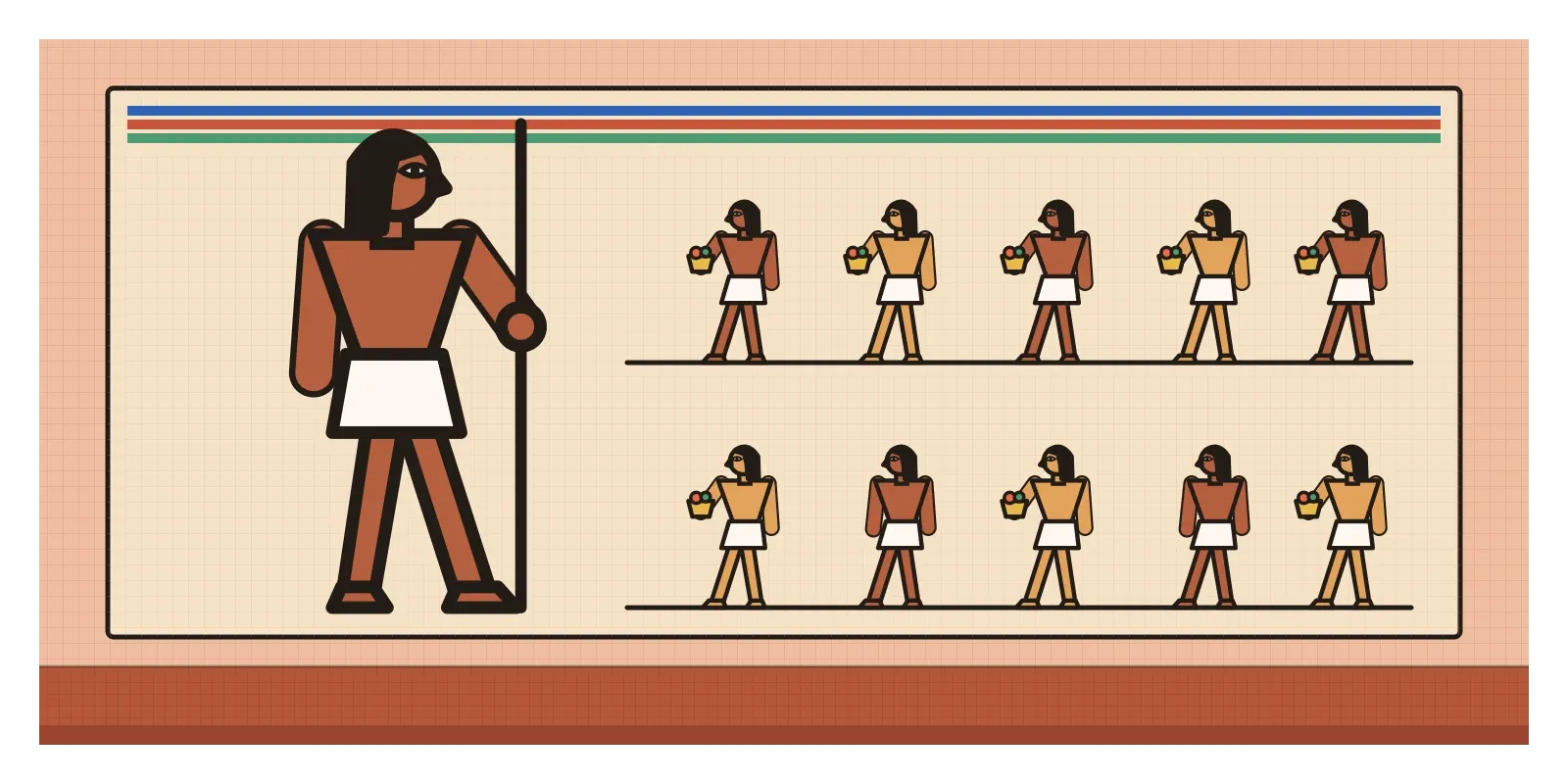
The second feature is scale. Size shows importance, not distance. Kings and gods are biggest, then the owner of the tomb, then his family, then servants and enemies. Art historians call this hierarchical scale, and once you notice it, it's everywhere.
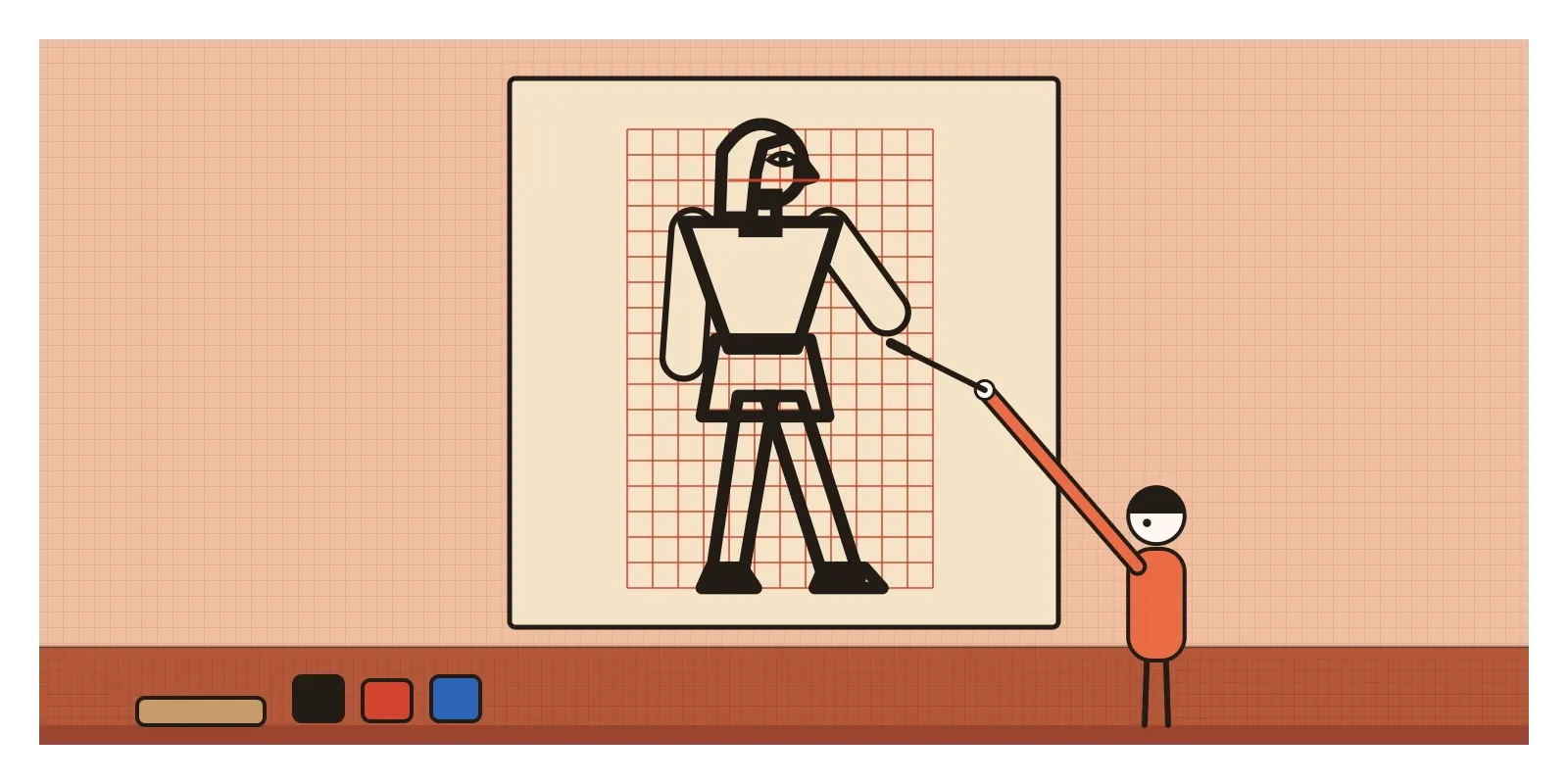
The third is the grid. Unfinished tomb walls show the method. A draughtsman marked out a grid of squares in red, sketched the figures on it, and a senior artist corrected the outlines in black. By the Middle Kingdom, a standing figure usually filled eighteen squares from the soles of the feet to the hairline, with knees, waist and shoulders falling on particular lines. Much later, around the seventh century BCE, artists changed to a finer grid of twenty-one squares up to the eye. The grid meant a figure painted by one team would match one painted centuries later, at any size.
Add a few more habits. Colour was flat and symbolic: men were usually painted reddish brown and women a paler yellow, a convention rather than a description. Outlines were clear and continuous. Hieroglyphs and images were made by the same artists and shared the same walls. And the Egyptians invented the first known synthetic pigment, Egyptian blue, made by heating sand, lime, a copper mineral and a natural salt called natron, which gave them a bright, stable blue that nature didn't easily provide.
Measuring gods in face-lengths
There's no evidence of direct artistic contact between pharaonic Egypt and India, so this is a parallel, not an influence. India developed its own canon of proportion for sacred images, and unlike Egypt's, it's still in daily use.
Indian treatises on image-making, the shilpa shastras, measure the body in units called tala, roughly the length of the face from hairline to chin. A major deity might be made on a system of ten face-lengths, called dasatala, while other figures use nine or fewer, with sub-units for every part of the body. In Swamimalai, near Kumbakonam in Tamil Nadu, families of sthapatis, traditional sculptors, still cast bronze images by the lost-wax method using these measurements, and the rules pass down through apprenticeship as much as through texts.
The two canons describe different ideals. Egyptian figures are upright, broad-shouldered and still. Indian figures bend and sway, with full, smooth bodies that seem filled with breath. But both traditions believe a sacred image must be made correctly to work at all, and both had rituals for bringing an image to life. In Egypt, priests performed the Opening of the Mouth on statues and mummies. In South Indian temple consecration, the eyes of a new image are ritually opened as one of the final acts. I think of that whenever I see Nefertiti's empty eye socket.
Hierarchical scale is shared too. In Indian temple reliefs and the Pichwai paintings of Nathdwara, the central deity is often far larger than the devotees around it. It's one of the oldest tools in visual communication, found on every continent.
Grids, icons and a system that lasted
What strikes me most as a designer is that Egyptian art was a design system, and a hugely successful one. It had a grid, proportions, approved poses, a colour convention, a library of symbols and a way of training new people. It let thousands of anonymous artists across thirty centuries produce work that reads as one language. Every design system I've worked with has the same aim, to let many hands make consistent things without reinventing every decision. Ours tend to last a few years.
The composite view lives on in icon design. A good icon shows each object from its most informative angle: a car in profile, a clock face-on, a folder from slightly above, a person as a round head on a simple body. Exploded diagrams in instruction manuals and technical drawings that show a front, side and top view on the same sheet are doing what the Nebamun painter did with the garden pool, choosing clarity over a single viewpoint.
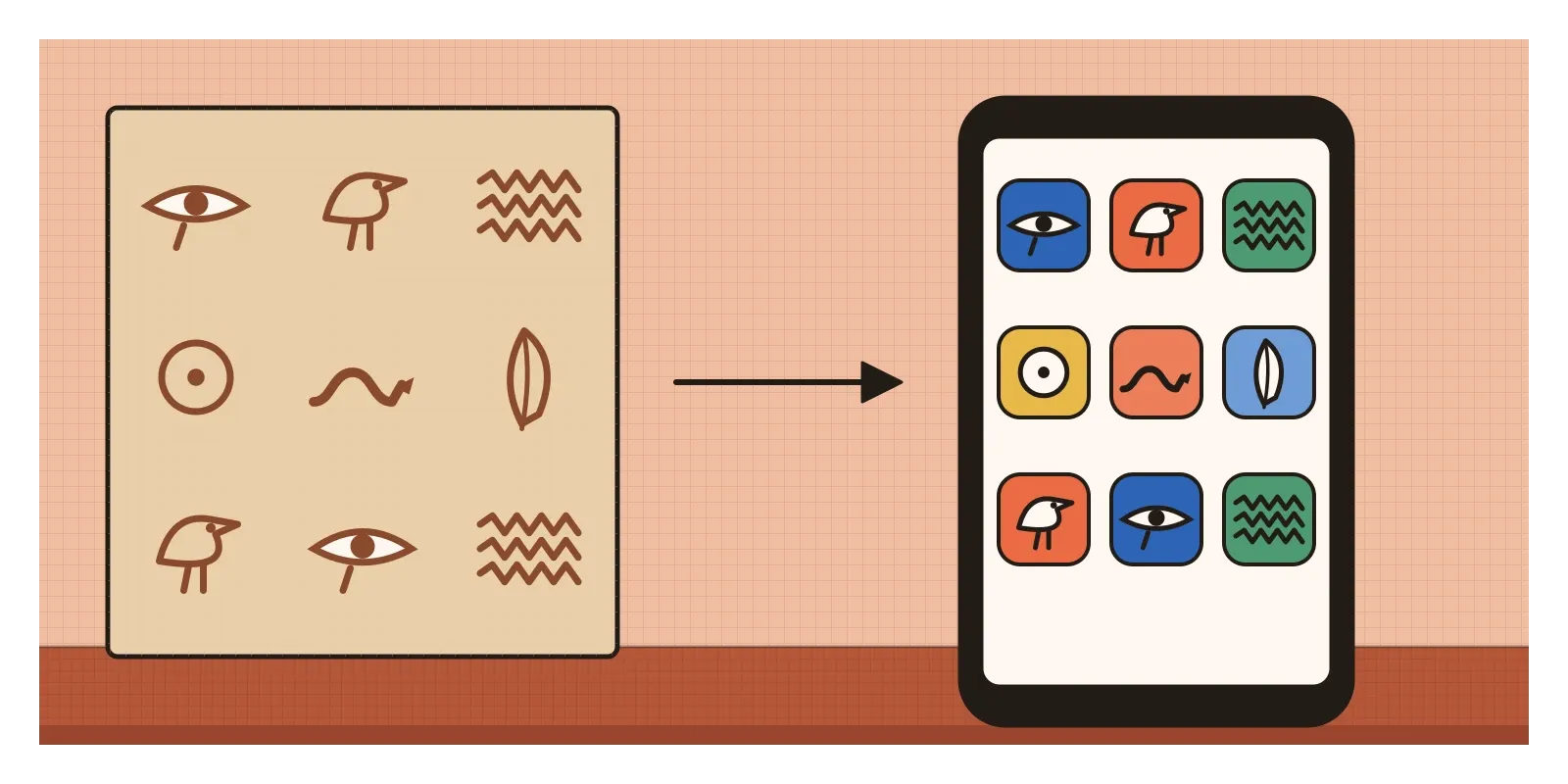
Hieroglyphs are worth a designer's attention too. They mixed pictures of things with signs that stood for sounds, so a drawing of an object could also stand for the sound of its name, a kind of rebus. The signs are small, beautifully drawn pictograms of birds, reeds, hands and eyes, arranged in neat blocks. Anyone who has designed an icon set, or used emoji in place of words, is working in a related way. And hierarchical scale is simply visual hierarchy, which I wrote about in the post on hierarchy. Making the most important thing biggest is still the first move in almost every layout.
Whose hands, whose museum
The strengths of Egyptian art are also its limits. It served kings, gods and a small elite, and showed the world as they wanted it seen, the king always victorious, enemies always tiny. Its makers were mostly anonymous. The old idea that the pyramids were built by armies of slaves comes largely from the Greek historian Herodotus, writing two thousand years later. Excavations of the workers' settlements at Giza suggest skilled craftsmen and rotating labourers who were housed and fed, but the labour was demanded by the state, and it was hard and dangerous. And the stability I admire as a designer also made change slow and unwelcome, as Akhenaten found.
There's a more recent problem too. Much of the best Egyptian art is outside Egypt. The Rosetta Stone, which helped Jean-François Champollion decipher hieroglyphs in 1822, was found by French soldiers in 1799 and taken by the British in 1801. Nefertiti has been in Germany since the finds were divided in 1913, and Egypt has asked for her return many times. The tradition faded slowly under Persian, Greek and Roman rule, and the last known hieroglyphic inscription was carved at Philae in 394 CE. Long before that, Greek sculptors had borrowed the Egyptian striding figure and begun, very gradually, to make it move, which I'll come to in the post on Greek art.
To see it this week in India, the Indian Museum in Kolkata has an Egyptian gallery with a mummy that came to the city in the nineteenth century. For a small exercise, draw a friend the Egyptian way: profile head, front-facing eye, square shoulders, profile legs. Then draw them from life, from one fixed point. Compare which drawing tells you more about them, and which looks more like them. They're rarely the same.
Thutmose's bust was a working model, made to help others get the queen right. The whole of Egyptian art was a little like that: a set of models, grids and rules, so that the images would always be correct. In the next post, on Indus Valley art and design, I'll look at a civilisation that was just as fond of standards, but used them for bricks, weights and drains rather than for kings.
Further reading: Gay Robins, The Art of Ancient Egypt (1997) · Gay Robins, Proportion and Style in Ancient Egyptian Art (1994) · Heinrich Schäfer, Principles of Egyptian Art (1919, English translation 1974) · Joyce Tyldesley, Nefertiti's Face: The Creation of an Icon (2018)
A reply toThe scattered local styles of early Nile communities, pulled into one royal language of power.