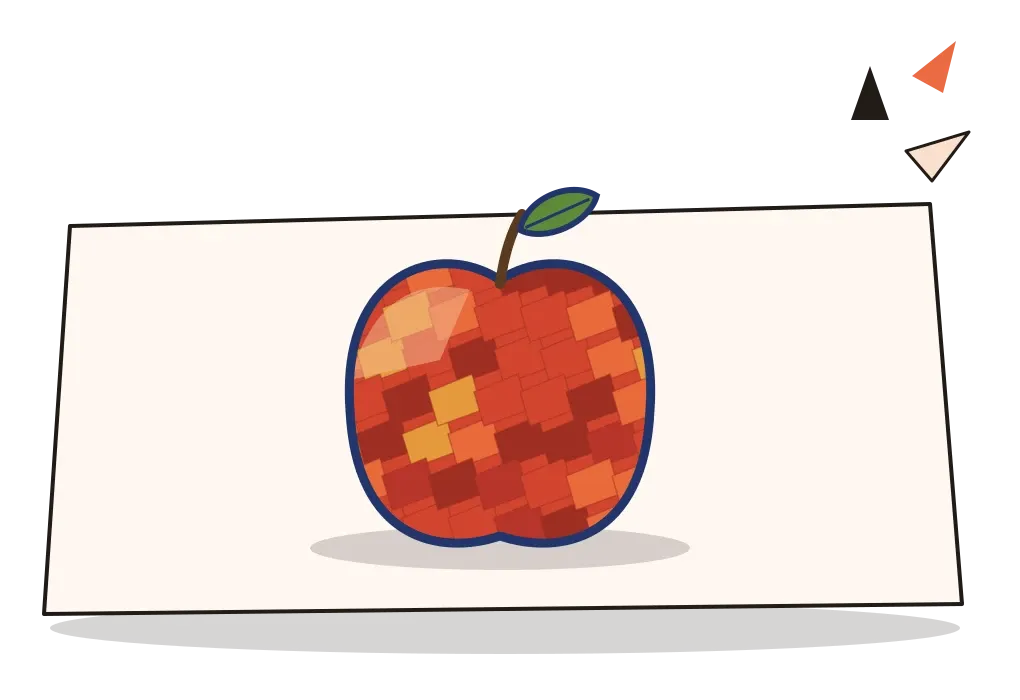
Post-Impressionism
How Cézanne, Van Gogh, Gauguin and Seurat kept Impressionism's colour but went looking for structure and meaning.
Post-Impressionism
The winter London laughed at modern painting
In November 1910, the critic and painter Roger Fry opened an exhibition at the Grafton Galleries in Mayfair, London, called Manet and the Post-Impressionists. Most of the British public had barely caught up with Impressionism. Now they were shown rooms full of paintings by Paul Cézanne, Vincent van Gogh and Paul Gauguin, along with newer work by Henri Matisse and Pablo Picasso: thick swirling paint, flat areas of strong colour, dark outlines, apples that seemed to slide off tilted tables. Visitors laughed out loud. Some reviewers called the paintings childish, some suggested the painters were mad, and some decided the whole thing must be a hoax. Fry, a respected scholar of Italian painting, was accused of having lost his mind.
The name of the show had been invented in a hurry. Fry's friend Desmond MacCarthy, who helped organise it, later told the story of Fry losing patience with the search for a title and saying, more or less, that they should just call them post-impressionists, since they came after the Impressionists anyway. Whether or not it happened quite like that, the name stuck. Fourteen years later the novelist Virginia Woolf, who was part of Fry's circle, wrote that "on or about December 1910 human character changed." She was being playful, but she chose that date for a reason.
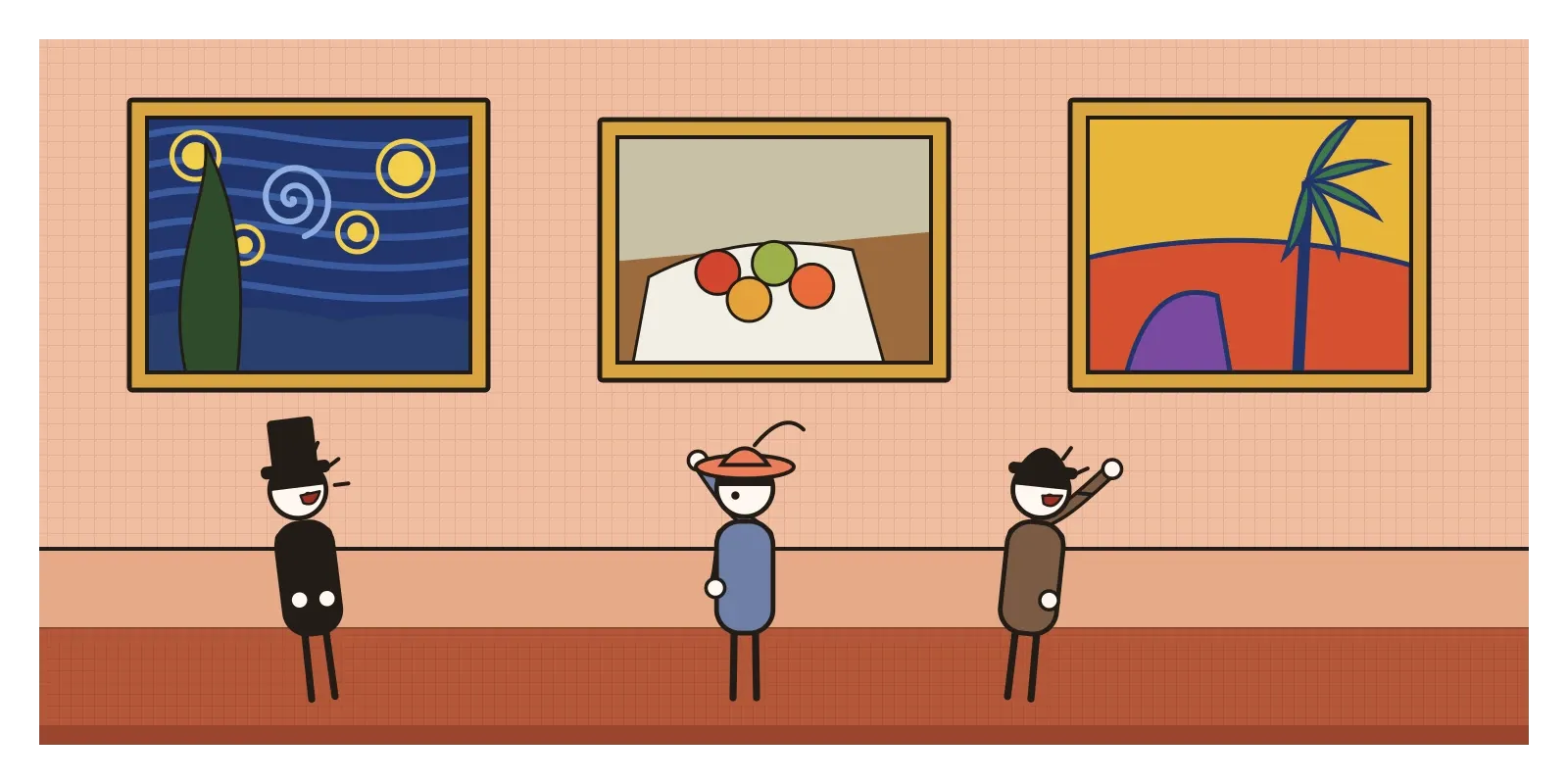
That gives Post-Impressionism an odd status. It isn't a movement its painters belonged to. It's a label an English critic stuck on them after the fact. All four painters now most associated with it were dead by 1910: Van Gogh in 1890, Seurat in 1891, Gauguin in 1903 and Cézanne in 1906. It covers French painting from about the mid 1880s to about 1905, by artists who started from Impressionism's bright colour and broken brushwork and then pushed off in very different directions. Some historians find the term too vague to be useful. I find it useful precisely because it names a reply. All of these painters, in their own ways, decided that painting the passing look of things wasn't enough.
Four painters who wanted more than light
By the mid 1880s, Impressionism had won. Its painters were selling, and its look was spreading. The next generation, and some of the original rebels themselves, began to feel that something had been lost along the way. Impressionist pictures were fresh, but they could also feel flimsy, dissolving solid things into flickers of light and caring more about a sunny afternoon than about what anything meant. The Salon des Indépendants, founded in 1884, now let any artist exhibit without a jury. The four figures usually grouped together never formed a group at all. Some of them fell out spectacularly.
Paul Cézanne, from Aix-en-Provence in the south of France, had shown with the Impressionists in 1874 and 1877 and then withdrew to work almost alone. He painted the mountain of Mont Sainte-Victoire, near his home, dozens of times, and he painted apples, jugs and crumpled tablecloths with a slowness that his models found unbearable. In the post on form I mentioned his advice about the cylinder, the sphere and the cone. His critic friend Gustave Geffroy reported him saying he wanted to astonish Paris with an apple, and in a way he did. His still lifes look at the table from slightly different angles at once, so the fruit seems both solid and slightly unstable.
Vincent van Gogh, a Dutch former art dealer and preacher, came to painting late and worked at an astonishing pace in his last few years. I wrote about his Night Café in the post on colour harmonies. In Arles in 1888 he also painted The Bedroom, his own small room in the Yellow House with its wooden bed, two chairs and pictures on the wall, in flat, strong colours he hoped would feel restful. In June 1889, in the asylum at Saint-Rémy, he painted The Starry Night, the view from his window before dawn, with a village he added from imagination and a sky churning with spirals.
Paul Gauguin, a former stockbroker, worked in Pont-Aven in Brittany in 1888 with the younger painter Émile Bernard, and together they developed a style of flat colour inside dark outlines, which a critic named cloisonnism after cloisonné enamel, where colours are held in little walls of metal. In 1891 Gauguin sailed for Tahiti, then a French colony, looking for what he imagined was a simpler, purer life. There he painted his largest picture, Where Do We Come From? What Are We? Where Are We Going? (1897 to 1898), a long frieze of figures from birth to old age. Georges Seurat, the youngest, took the opposite route to all three. In the post on point I described his A Sunday Afternoon on the Island of La Grande Jatte. Before it, he painted Bathers at Asnières (1884), young workers resting on a riverbank in a calm, almost frozen light, rejected by the Salon and shown instead at the first Salon des Indépendants.
One apple, four answers
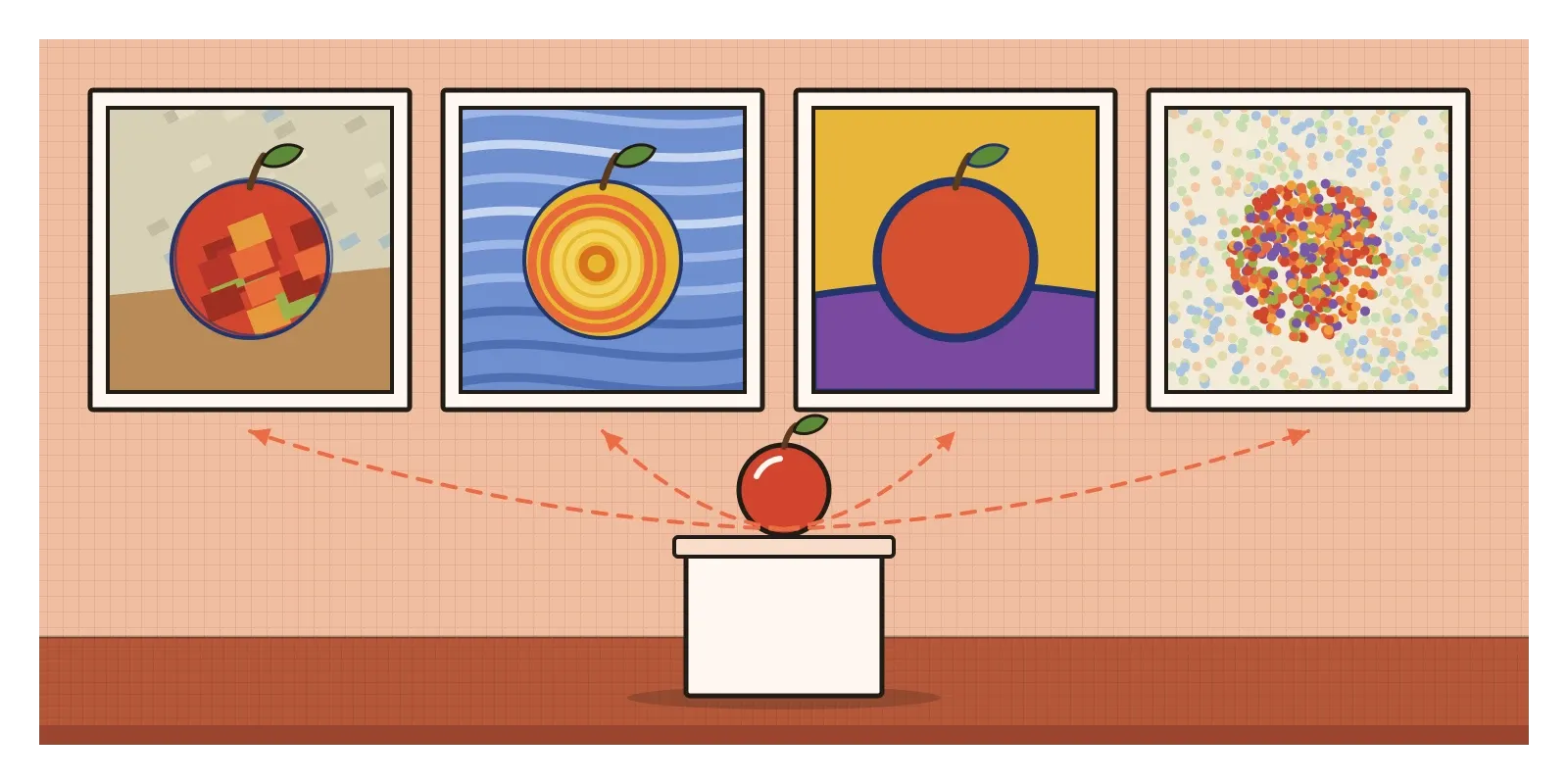
If you put their work side by side, the easiest way to tell them apart is to ask what each one added to Impressionism. Cézanne added structure. His brushstrokes are short, parallel and slanted, laid down in patches like little planes, so a cheek or an apple is built from facets of warmer and cooler colour, the way a sculptor might build a form. Edges are often broken or doubled, as if he'd looked twice.
Van Gogh added emotion. His paint is thick, often squeezed straight from the tube, and his strokes follow the shapes of things, curling around a cypress or rippling across a field, so the whole surface seems to move. His colours are pushed past nature, a yellow sky, a blue face, to say how a place felt. Gauguin added symbol and decoration. He flattened space, outlined shapes in dark blue or black, and filled them with unmixed colour that he chose for meaning or mood rather than accuracy. A red field could be red because the picture needed red. Seurat added system. He placed small dots of pure colour side by side according to the colour science of his day, kept his figures still and simplified, and composed with careful geometry.
What they share, read with a designer's eye, is a shift in what a picture is for. For the Impressionists, a canvas was a window onto a moment. For the Post-Impressionists, it was increasingly a made thing, a flat surface organised with colour, line and pattern, which happened to show a mountain or a bedroom. That shift, from depicting to constructing, is what made the next twenty years of modern art possible.
Amrita Sher-Gil answers Gauguin
The most direct Indian conversation with Post-Impressionism happened a generation later, in Paris. Amrita Sher-Gil was born in Budapest in 1913 to a Sikh aristocrat and scholar, Umrao Singh Sher-Gil, and a Hungarian mother, and spent much of her childhood in Shimla. In 1929, at sixteen, she went to Paris to study painting, first at the Académie de la Grande Chaumière and then at the École des Beaux-Arts. Like many young painters there, she absorbed Cézanne and, above all, Gauguin. Her painting Young Girls is usually credited with winning her election, in 1933, as an associate of the Grand Salon in Paris, a rare honour for someone so young.
In 1934 she painted Self-Portrait as a Tahitian. She shows herself bare-shouldered, hair pulled back, in the pose and warm earth colours of one of Gauguin's Tahitian women, with a shadowy figure behind her. Many critics read it as a reply to Gauguin. He had travelled to the colonies to paint brown women as exotic objects for European eyes. Sher-Gil, who was half Indian and half European, borrowed his style and put herself in the picture as both the painter and the painted, looking back.
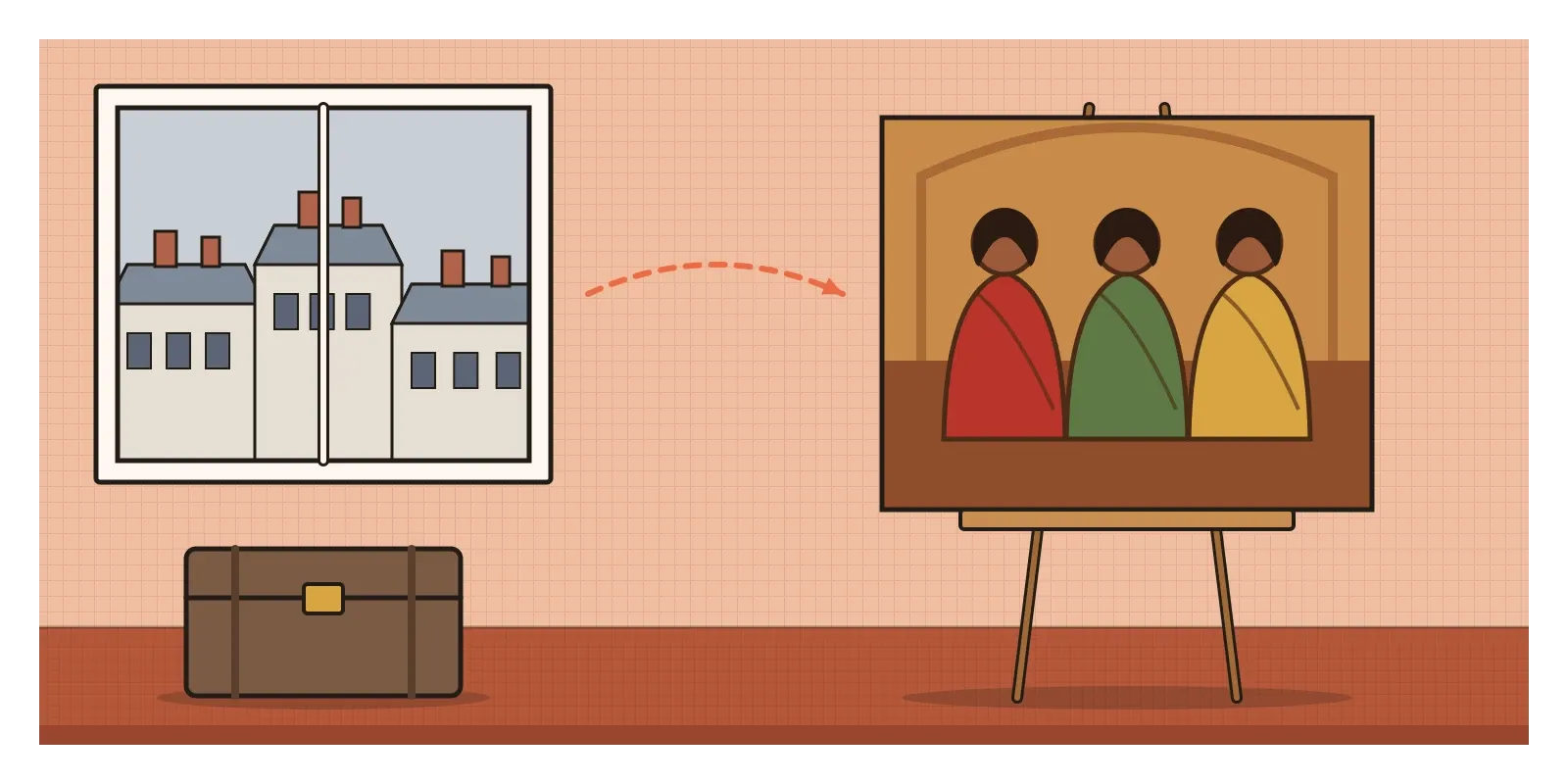
Later that year she returned to India, and her work changed. She travelled to the caves at Ajanta and through South India, and her paintings of the next few years, such as Three Girls (1935), which won a gold medal from the Bombay Art Society, show women in quiet, heavy stillness, painted in flat, earthy reds, ochres and greens. The flattened forms and strong colour owe something to Gauguin and Cézanne, and the gentle line and grouping owe something to the Ajanta murals. She took Post-Impressionism's idea that a painting could be a constructed, decorative surface and used it to paint Indian lives from the inside, without the exoticism Gauguin brought to Tahiti. She died in Lahore in 1941, aged only twenty-eight. The Progressive Artists' Group, which has its own post later in this section, came of age in a world she had helped open up.
Swirls, dots and flat colour on your phone
Each of the four left a trace in design. Seurat's dots run straight into the halftone printing and pixels I described in the post on point. Gauguin's flat colour inside dark outlines passed through posters and comics into the flat, outlined illustration style used across apps, websites and onboarding screens today, including, I'll admit, the pictures on this blog. Cézanne's habit of building form from flat facets has a cousin in low-poly 3D, which builds mountains and animals from a few dozen coloured triangles.
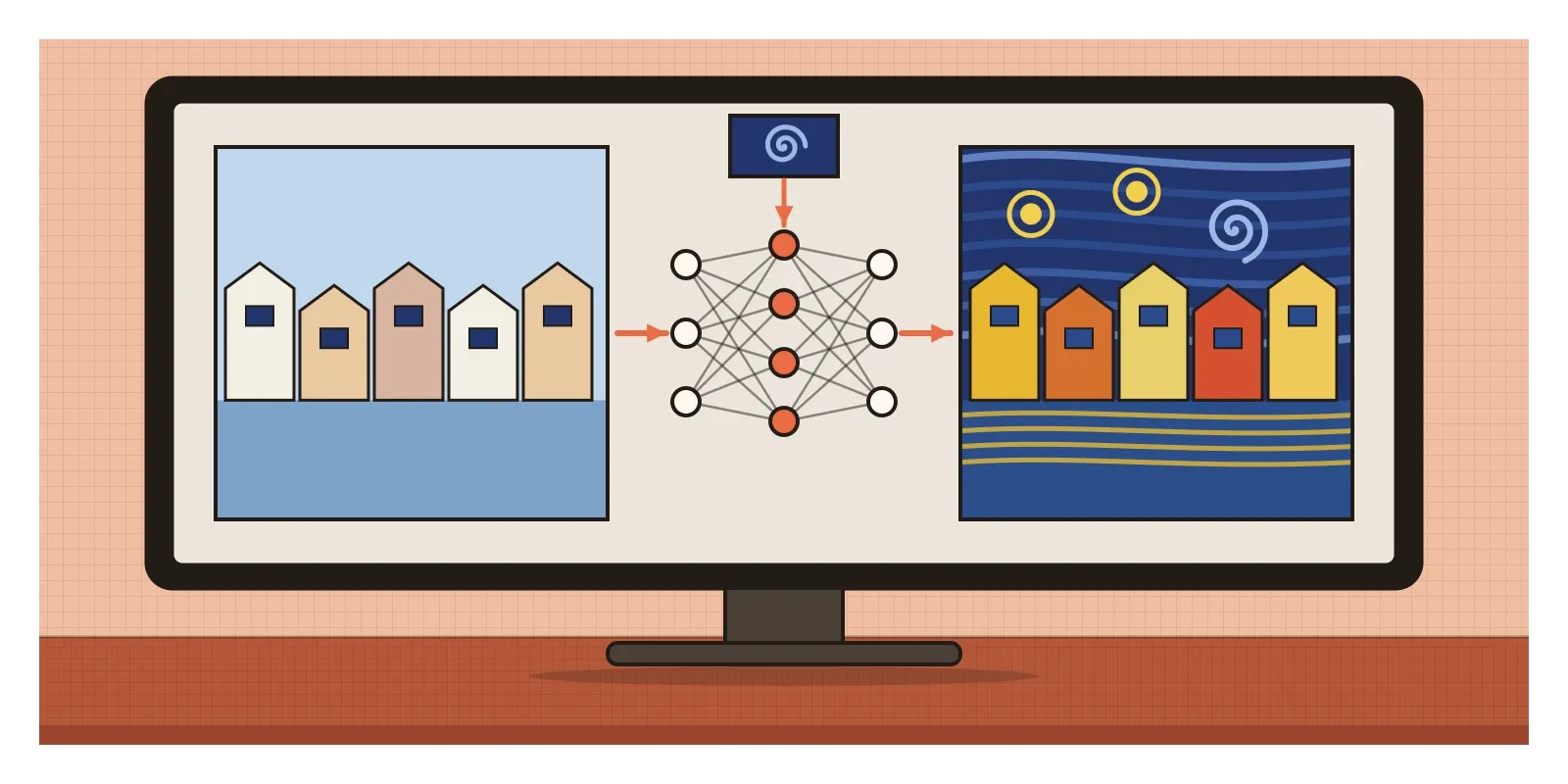
Van Gogh's swirls have had the strangest afterlife. In 2015, three researchers in Germany, Leon Gatys, Alexander Ecker and Matthias Bethge, published a paper called "A Neural Algorithm of Artistic Style", which showed how a neural network could separate the content of a photograph from the style of a painting and recombine them. One of their showcase examples turned a photograph of Tübingen into something that looked painted in the manner of The Starry Night. Within a year, apps were doing it to millions of selfies. For many people, Van Gogh's brushstroke became the first and most obvious proof that a computer could imitate a style, which raises questions about authorship and style that I'll come back to in the post on AI-generated aesthetics.
Paradise for whom?
The hardest problem is Gauguin. The Tahiti he painted was a fantasy. The island had been a French colony for years, its population devastated by disease, and its people largely Christianised by the time he arrived. He painted it as an untouched paradise anyway. He also took girls as young as thirteen as his "wives", and wrote about it himself. In recent years, museums have started putting that history on the wall beside the pictures rather than leaving it out.
There are other limits. The myth of Van Gogh as the tortured genius, mad and unrecognised, has made his real illness into a romantic story and encouraged the idea that suffering makes good art. The label Post-Impressionism itself bundles together four men and leaves out others, including women such as Suzanne Valadon, who painted bold, outlined figures of her own. And Fry's way of reading these pictures, as pure arrangements of form and colour, was influential partly because it let viewers ignore what the paintings were actually about, including colonies and the women in them.
As a moment, it ended by turning into everything that came next. Matisse and the Fauves, around 1905, took Gauguin's and Van Gogh's colour and made it wilder. Picasso and Braque took Cézanne's facets and turned them into Cubism. German painters took Van Gogh's emotional brushwork into Expressionism. And at the same time, other artists were following Gauguin in another direction altogether, away from the visible world and into dreams.
Find an apple, and paint it four ways
In India, the best place to see what Sher-Gil did with these ideas is the National Gallery of Modern Art in New Delhi, which holds the largest collection of her work. For the French painters, the Musée d'Orsay in Paris, the Courtauld Gallery in London, built around Samuel Courtauld's collection of these painters, and the Van Gogh Museum in Amsterdam are the big three. For reading, Van Gogh's letters to his brother Theo, all published online by the Van Gogh Museum, are some of the best writing about colour by any painter.
For an exercise, put an apple on a table and draw it four times in four small boxes. In the first, build it from flat patches like Cézanne. In the second, make every stroke follow its curve, like Van Gogh. In the third, outline it in dark blue and fill it with one flat colour, like Gauguin. In the fourth, use only dots. You'll learn more about what each painter chose in twenty minutes than from any label.
The crowds at the Grafton Galleries in 1910 laughed because they thought these painters couldn't paint. In fact, each had chosen deliberately what painting should do after Impressionism. In the next post, on Symbolism, I'll follow the painters and poets who decided it should stop describing the world altogether and turn to dream, myth and inner meaning.
Further reading: Belinda Thomson, Post-Impressionism (1998) · Roger Fry, Vision and Design (1920) · Leo Jansen, Hans Luijten and Nienke Bakker (eds.), Vincent van Gogh: The Letters (2009) · Yashodhara Dalmia, Amrita Sher-Gil: A Life (2006) · Leon A. Gatys, Alexander S. Ecker and Matthias Bethge, "A Neural Algorithm of Artistic Style" (2015)
A reply toImpressionism's fleeting surfaces, which seemed to have lost solidity, feeling and meaning.