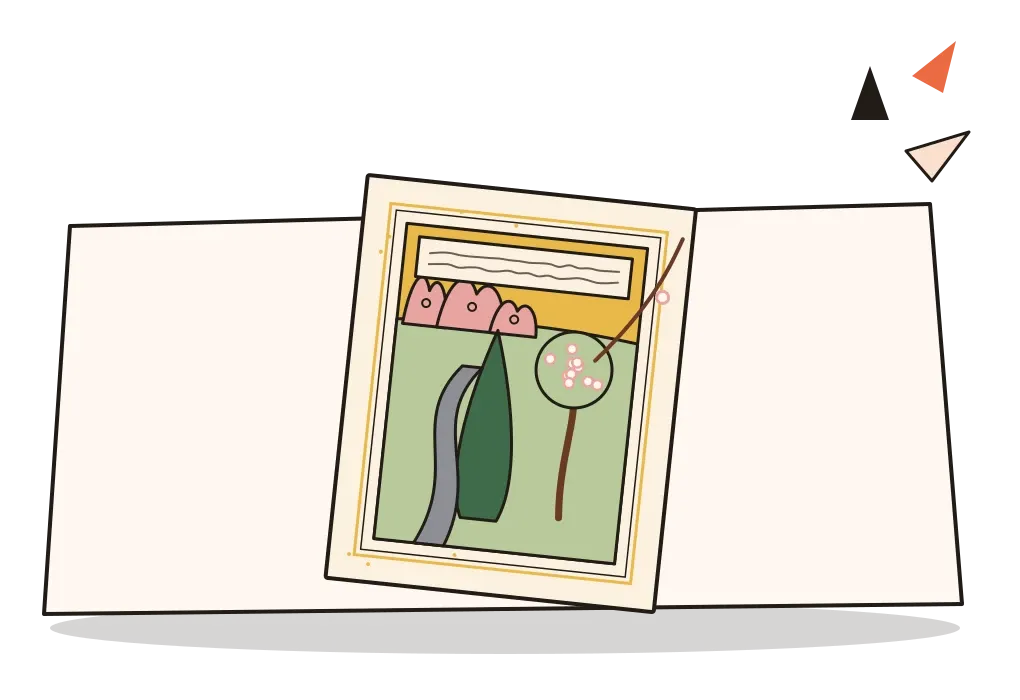
Persian Miniature Painting
How royal workshops in Herat and Tabriz turned books of poetry into small, jewelled worlds of colour.
Persian Miniature Painting
A book swapped for a painting at Vienna airport
On 28 July 1994, at Vienna airport, a British dealer called Oliver Hoare handed a set of wooden crates to officials of the Islamic Republic of Iran. In exchange, Iran gave up Woman III, a 1953 painting by the American artist Willem de Kooning that the Tehran Museum of Contemporary Art had bought before the 1979 revolution and then kept out of sight. The crates held what was left of one of the greatest books ever made: the text, the binding and around 118 paintings from the Shahnameh of Shah Tahmasp.
That book had already had quite a life. It was made in the royal workshop at Tabriz, in north-west Iran, from around the early 1520s, over the better part of two decades, and in its finished state it had 759 leaves and 258 paintings. In 1568 Tahmasp gave it to the Ottoman sultan Selim II as a diplomatic gift. Centuries later it belonged to the Rothschild family, and in 1959 the American collector Arthur Houghton bought it. Houghton then did something scholars still find painful. He took it apart. Seventy-eight paintings went to the Metropolitan Museum of Art in New York in 1970, and many other pages were sold, some at auction, to collectors around the world. The swap at Vienna sent the remainder home.
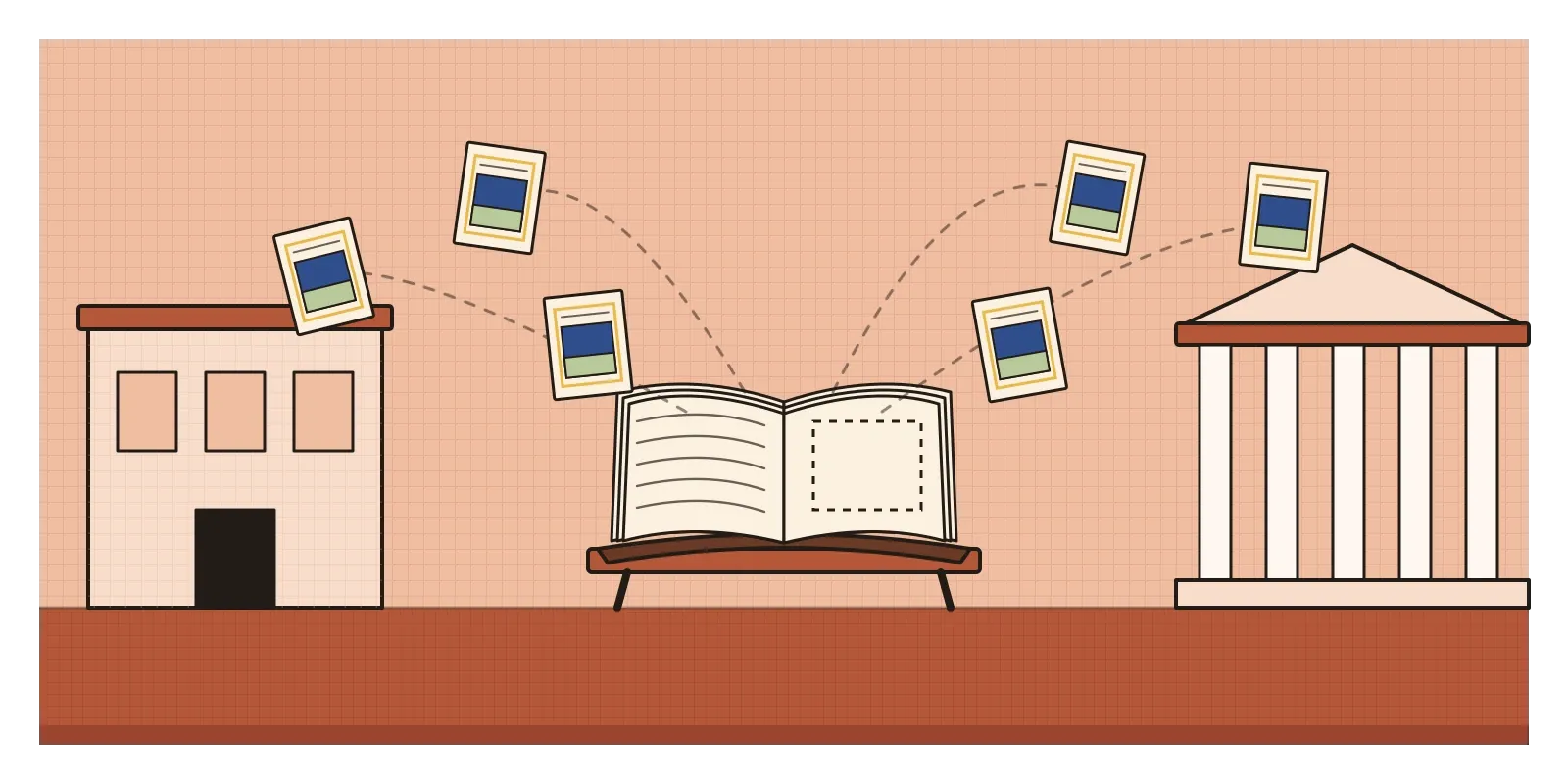
Persian miniature painting is the tradition that book belongs to. It names the small, intensely detailed paintings made for manuscripts and albums in Iran and Central Asia, at its height from roughly the fourteenth to the seventeenth century, usually illustrating poetry and history. The word "miniature" has nothing to do with size in its origins. It comes from the Latin miniare, to colour with minium, the red lead that also outlined the letters in the Insular gospel books of the last post. But these paintings are small, often no bigger than your hand, and they repay the kind of close looking you'd give a piece of jewellery.
Mongols, Chinese scrolls and a book of kings
The text most often illustrated was the Shahnameh, the Book of Kings, an epic of roughly fifty thousand couplets that the poet Ferdowsi finished around 1010. It tells the story of Iran's kings and heroes from the first man to the Arab conquest, and illustrating it was a way for rulers to place themselves in that long line. Close behind came the romances of Nizami, the moral tales of Sa'di and the mystical poetry of Jami.
The painting tradition took its decisive shape after the Mongols conquered Iran in the thirteenth century. Their empire stretched to China, and Chinese scrolls, silks and ceramics travelled west to the court at Tabriz. Painters there absorbed Chinese ways of drawing twisting trees, curling clouds and craggy rocks. Books like the world history commissioned by the vizier Rashid al-Din in the early fourteenth century, and a huge Mongol-era Shahnameh of the 1330s, have a rough, dramatic power. (That second book was also broken up for sale, by a Paris dealer called Georges Demotte in the early twentieth century, which tells you the Houghton story wasn't unique.)
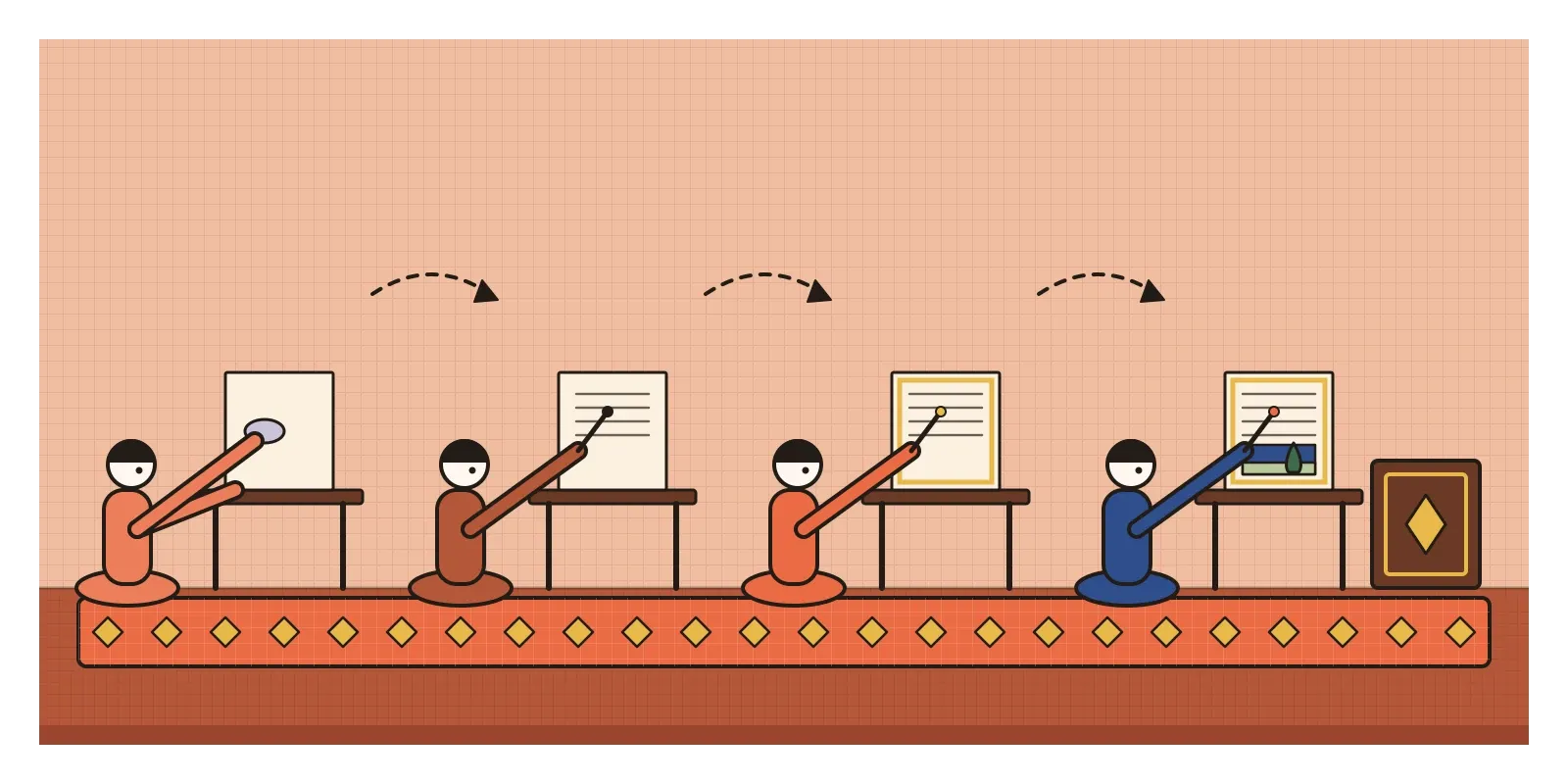
The classical Persian style was the reply to those Mongol-era books. Under the Timurid princes of the fifteenth century, in cities such as Herat and Shiraz, painters took the Chinese-influenced landscape and made it calmer, brighter and more ordered, a jewelled, idealised world rather than a dramatic one. The work happened in a kitabkhana, a royal library that was also a workshop. Papermakers sized and burnished the sheets until they were smooth enough for a fine pen. Calligraphers, who ranked highest of all, copied the text. Illuminators painted gold borders and headings, painters filled the spaces left for pictures, and binders finished the book in tooled leather or lacquer. The blues came from lapis lazuli, the same Badakhshan stone I wrote about in the post on the colour wheel, and gold and silver were used freely. Much of the silver has since tarnished to black, so many skies and rivers that once shimmered now look dark.
The painter of mazes and the boldest page
The most celebrated name is Kamal al-Din Bihzad, who worked in Herat for the Timurid ruler Sultan Husayn Bayqara and lived from around the 1450s to 1535. In a copy of Sa'di's Bustan dated 1488, now in the National Library of Egypt in Cairo, he painted the story of Yusuf, the Biblical Joseph, fleeing from Zulaykha, who has lured him into her palace and locked the doors. Bihzad turned a few lines of verse into an architectural puzzle. The palace zigzags upwards in tiled rooms, stairs and doorways, each surface patterned differently, and the two figures are caught in the middle of it, small, urgent and easy to miss. Bihzad was admired for making his figures feel individual and for noticing ordinary people, builders, servants and shepherds, at the edges of grand scenes. Attributing any single painting to him is tricky, and historians argue about many of them.
When the Safavid dynasty took power in Iran in the early sixteenth century, the Herat style travelled west and merged with the bolder Turkman painting of Tabriz. Shah Tahmasp's Shahnameh was the result. Its most famous page, The Court of Gayumars, is attributed to Sultan Muhammad and dated to the mid-1520s. It shows the first king of the world in the mountains with his court, all dressed in leopard skins, surrounded by rocks that swirl in pinks, greens and blues and hide dozens of faces if you look long enough. The painter and historian Dust Muhammad, writing in 1544, said that even the boldest painters hung their heads in shame before it. His essay, written as a preface to an album, is one of the first histories of painting in the Islamic world.
Later, in Safavid Isfahan, the emphasis shifted. Reza Abbasi, working around 1600, made single-page drawings and paintings of elegant young courtiers for albums rather than illustrated books, with a line so fluid it seems to have been written as much as drawn.
No shadows, and a horizon near the top
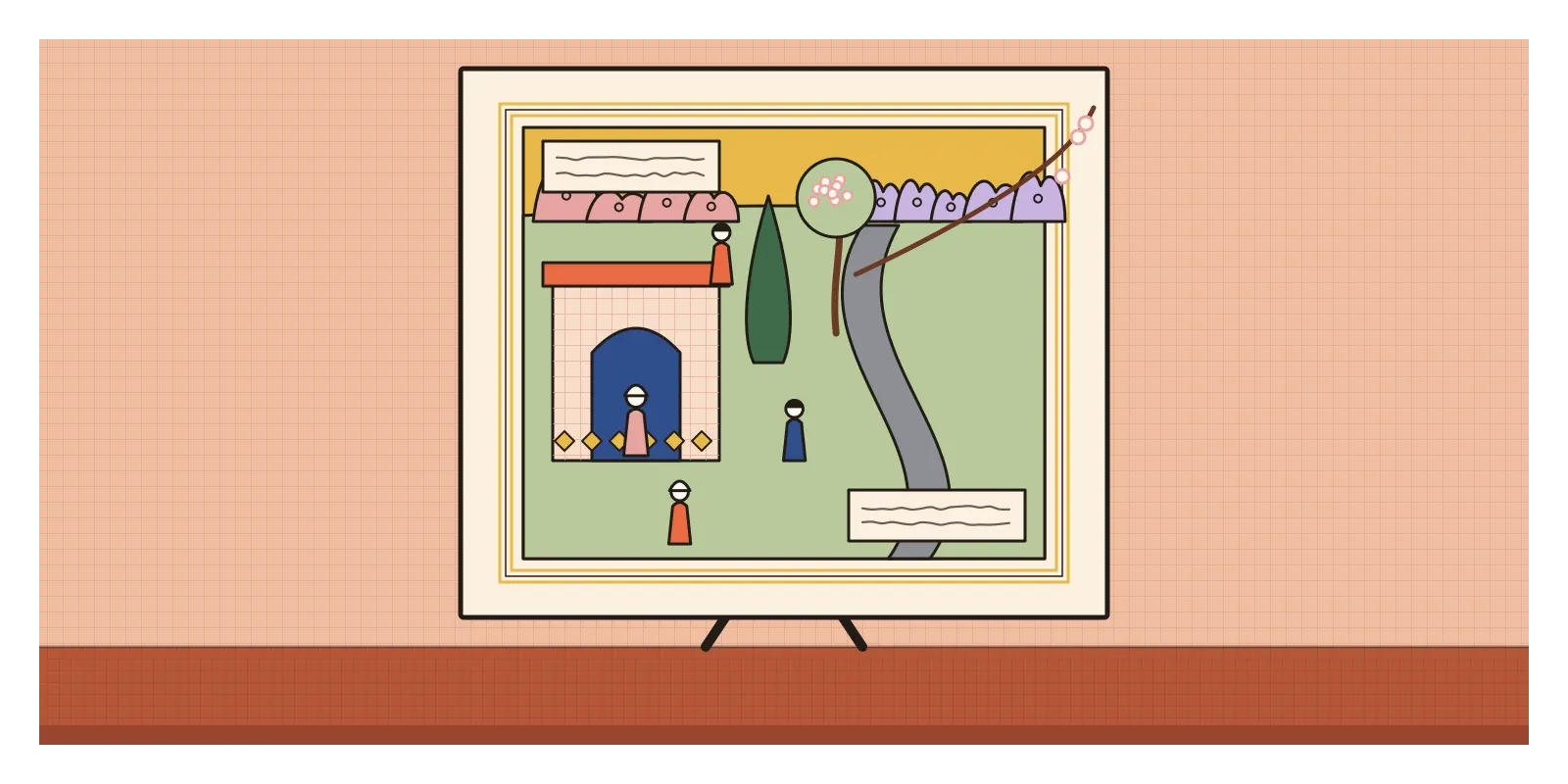
The quickest way to recognise a Persian painting is to look for the horizon. It's usually very high, sometimes almost at the top edge, so the ground tips up towards you like a carpet and everything is visible at once. Things further away are placed higher on the page rather than drawn smaller. There's no single viewpoint and no fixed light source, so nothing casts a shadow. A building is shown from the front, the side and inside at the same time, with every wall and floor covered in tile patterns.
Skies are often gold or deep lapis blue. Rocks look spongy, like coral, and sometimes conceal faces. Cypress trees, tall and dark, stand beside fruit trees in blossom. The figures are slender and idealised, with round faces and patterned robes, and they're small in relation to the setting. Text is part of the design. Panels of elegant calligraphy, usually in the flowing script called nastaliq, sit inside the picture, and the painting often breaks out of its ruled frame into the margin, a branch or a horse's head crossing the line.
Colour is saturated and carefully balanced, with complementary pairs like orange against blue and pink against green used again and again. The line is fine and even, closer to writing than sketching. In the post on visual literacy, I wrote that a viewer trained only in Renaissance perspective might think Indian miniatures got space "wrong". The same misreading happens with Persian pages. Their painters chose to show everything clearly rather than show it from one spot.
A sultan's cookbook from Mandu
The tradition reached India well before the Mughals. In Mandu, the hilltop capital of the Malwa sultanate in central India, a book of recipes was begun for Sultan Ghiyath Shah, who ruled from 1469 to 1500, and completed for his son Nasir Shah. Now known as the Ni'matnama, the Book of Delights, and dated to around 1495 to 1505, it covers food, perfumes, medicines and pleasures, and its fifty or so paintings mostly show the sultan watching the women of his court cook and serve. The first paintings are in the Turkman style of Shiraz, in southern Iran. As the book goes on, the pictures become more and more Indian, with flatter fields of colour, different costumes and faces, and plants and landscape drawn the way painters in central and western India drew them. You can watch two traditions meeting page by page. The book later passed through Bijapur and Tipu Sultan's library at Srirangapatna and is now in the British Library.
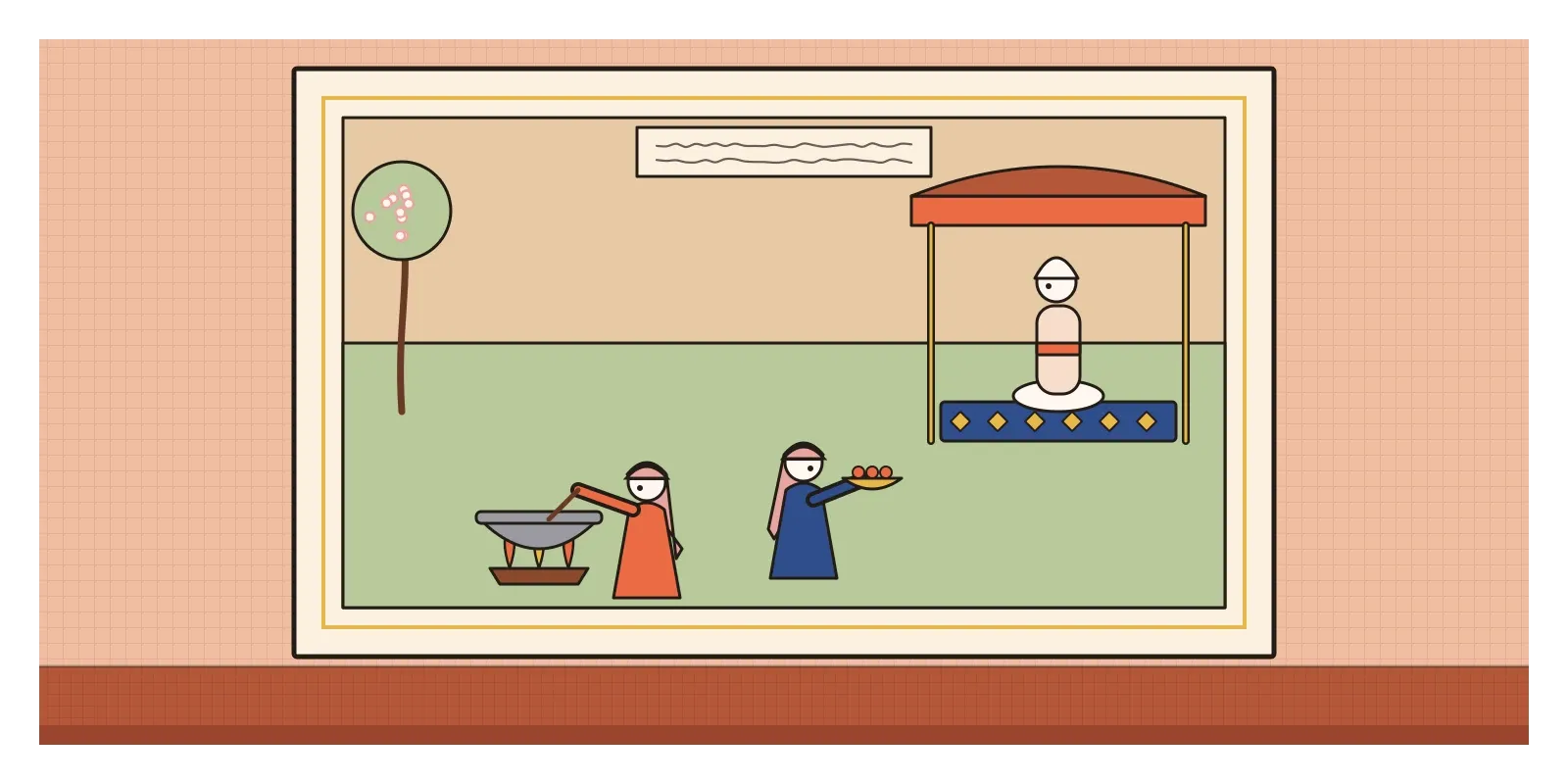
A generation later came the meeting that mattered most. In 1544 the Mughal emperor Humayun, driven out of India, took refuge at Shah Tahmasp's court, just as Tahmasp was losing interest in painting. Two of the Safavid painters, Mir Sayyid Ali and Abd al-Samad, later joined Humayun, and their workshop became the root of Mughal painting. That story, and how Indian painters transformed what they learned, belongs to the post on Mughal miniature painting a little later in this series. The influence ran in both directions. Indian painters brought stronger colour, livelier storytelling and a keen eye for real animals and plants, and Persian artists in India adapted to new patrons and new subjects.
Cutaways, frame-breakers and a Lahore classroom
Bihzad's palace, with every room open to view, is a direct ancestor of the cutaway illustration, the explainer drawing in which a building, a factory or an app's architecture is sliced open so you can see everything inside at once. It gives up realism for clarity, which is exactly the choice the Persian painters made. Isometric illustrations, much loved by tech companies, do something similar. Nothing shrinks with distance, so nothing gets hidden.
The integration of text and image is a lesson for editorial and interface design. In a good Persian page, the calligraphy panels and the picture share one grid, and the picture is allowed to break the frame at exactly one or two points for emphasis. Designers do the same thing when a product photo overlaps the edge of its card or a figure spills over a column on a magazine page. It works because the frame is otherwise strict. And the kitabkhana itself looks a lot like a modern design team, with specialists handing work along a pipeline and a director, like Bihzad, setting the standard.
Miniature painting is also a living practice. The National College of Arts in Lahore has taught it for decades, and the Pakistani-American artist Shahzia Sikander, who trained there, helped create what's often called neo-miniature, using the old techniques to make thoroughly contemporary art.
Princes, fragments and a page you can step into
These were luxury objects made for very few eyes. A single royal manuscript could absorb years of work from dozens of people, most of them unnamed, for the pleasure of a prince and his circle. Women appear mostly as idealised figures to be looked at, as in the Ni'matnama. Some later owners, uneasy with images of living beings, smudged or scratched out the faces. And the European word "miniature" has helped keep the tradition in a smaller box than it deserves, as if it were a minor art beside the large oil painting. The way these books were collected made things worse. Dealers and collectors in the twentieth century treated a book as a bundle of pictures, cut it up and scattered it, and many of the finest pages left Iran and India for Western museums during the colonial era.
The style didn't end so much as change shape. Albums replaced books, artists moved to the Mughal and Ottoman courts, and European prints and oil painting crept in. In the next post, on the Renaissance, we'll be in Florence at the same moment Bihzad was painting in Herat, where artists were answering the same question, how to show the world on a flat surface, in exactly the opposite way.
In India, the Salar Jung Museum in Hyderabad and the Khuda Bakhsh Oriental Library in Patna both hold Persian manuscripts. For an exercise, draw your own room the Persian way: tip the floor up so it fills most of the page, put further things higher rather than smaller, leave out every shadow and give each surface its own pattern. Then think of Tahmasp's book, split into hundreds of pieces across the world. Each page still holds a whole world, which is why each one was worth fighting over.
Further reading: Sheila R. Canby, Persian Painting (1993) · Stuart Cary Welch, A King's Book of Kings: The Shah-nameh of Shah Tahmasp (1972) · Norah M. Titley, The Ni'matnama Manuscript of the Sultans of Mandu (2005) · Sheila S. Blair and Jonathan M. Bloom, The Art and Architecture of Islam 1250-1800 (1994) · Oliver Hoare, The Exchange (2024)
A reply toThe rough, dramatic Mongol-era books of Tabriz, refined into a calm and jewelled world.