Neo-Tantra
How Indian painters of the 1960s and 1970s built a modern abstract art from dots, triangles and Tantric diagrams.
Neo-Tantra
A dot on a classroom wall
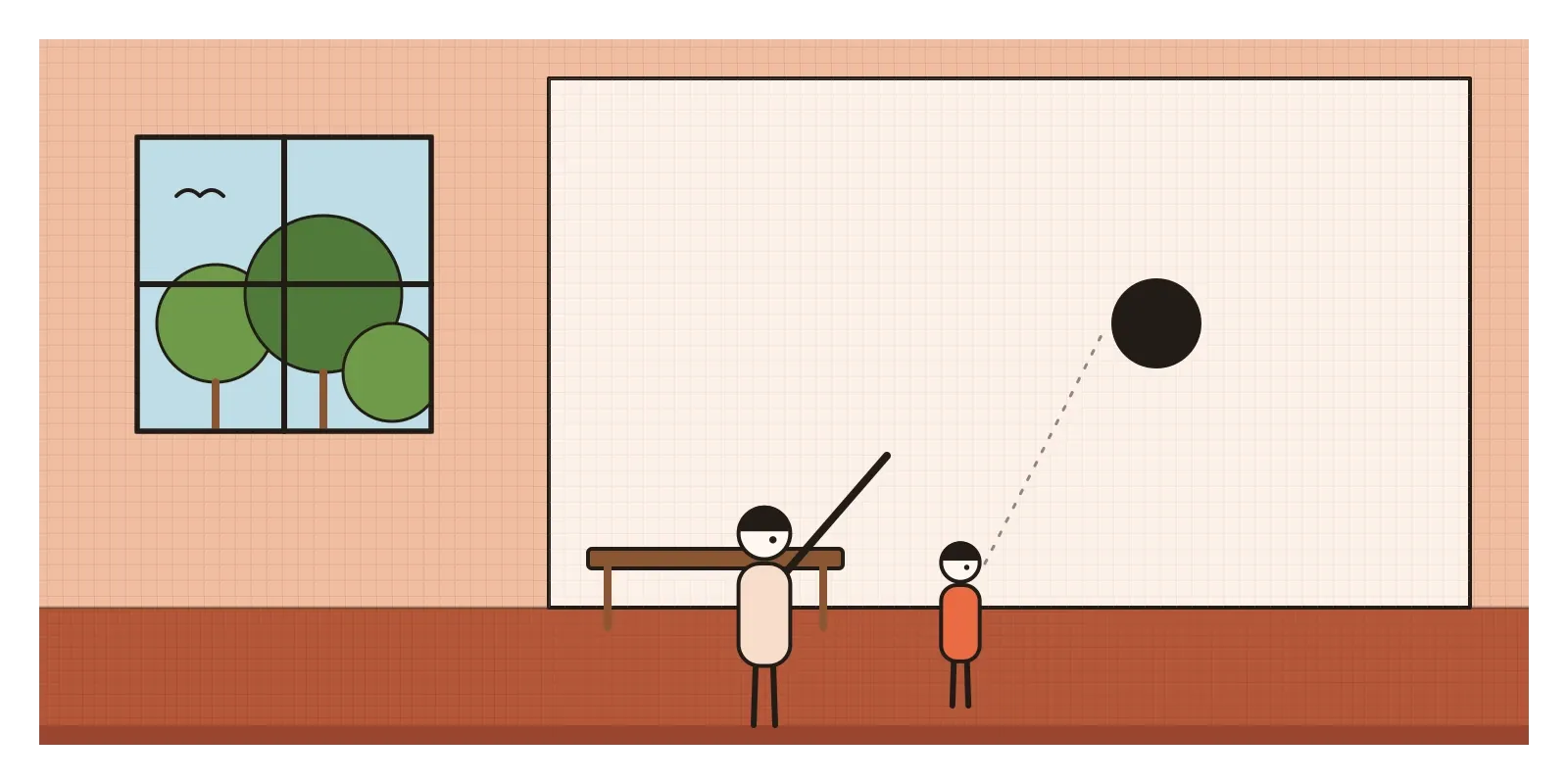
Sayed Haider Raza grew up in the 1920s and 1930s in the forests of Mandla district, in what is now Madhya Pradesh, where his father was a forest officer. By his own account he was a restless, distracted schoolboy, whose mind drifted out of the window to the trees and the river. When he was about eight, his teacher, whom later writers name as Nandlal Jharia, kept him back one evening, drew a dark circle on the whitewashed classroom wall and told him to look at it and nothing else. Raza remembered staring at the dot until his wandering mind settled on that one point.
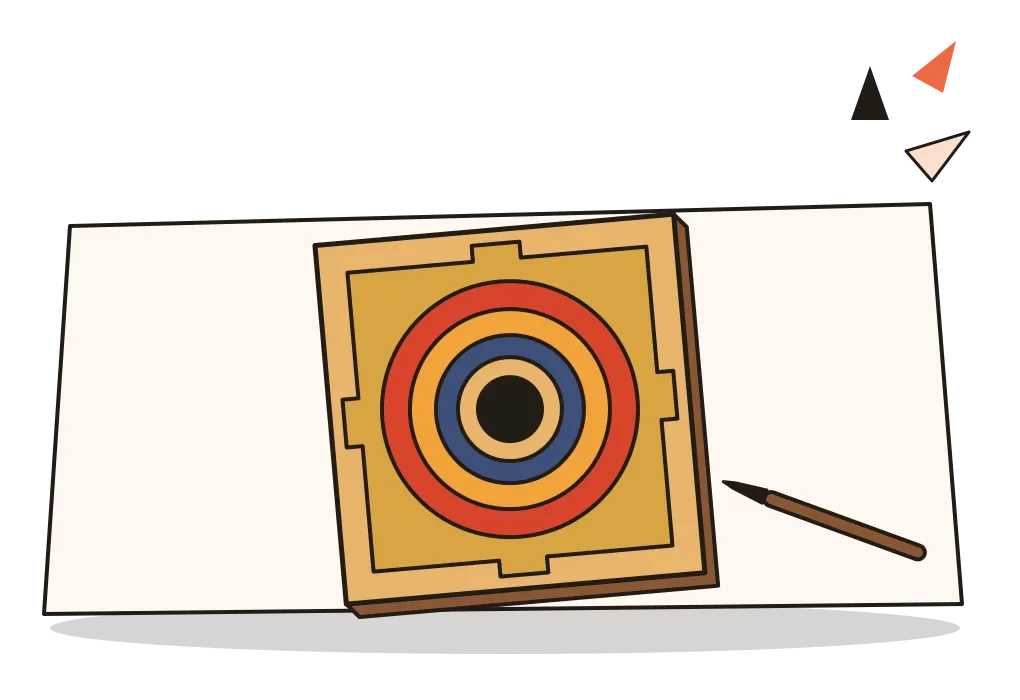
Half a century later, Raza was living in France, a successful painter of glowing, expressionist landscapes. Around 1980 he began painting a black circle at the centre of his canvases, surrounded by bands of colour, triangles and concentric rings, and he called it the bindu, the Sanskrit word for a dot, a point or a seed. He said it was the same dot his teacher had drawn. For the rest of his life it was his central subject: a point from which everything grows and to which everything returns.
Raza came to the bindu late, but he arrived at a place many Indian painters had already reached in the 1960s and 1970s. Their work drew on the visual language of Tantra, a set of Hindu, Buddhist and Jain traditions of ritual and meditation that use diagrams, sounds and symbols as tools for concentrating the mind. The art historian L. P. Sihare gave the tendency a name, Neo-Tantra. It was never an organised movement with members and a manifesto. It was a loose family of artists who found in Tantric geometry a way to be both abstract and Indian.
Abstraction without a passport
By the early 1960s, Indian modern art had a problem with abstraction. The Progressive painters in Bombay, whose story has its own post in this series, had learned modernism from Europe, and abstract painting in particular looked like something made in Paris and New York. An Indian artist who painted pure colour and form could easily be accused of copying. At the same time, the regional modernists of Baroda and Madras, whom I wrote about in the last post, were showing that local traditions could be a source rather than a museum. What was missing was an abstract language with Indian roots.
Tantra offered one. Its ritual diagrams, the yantra, are geometric figures of squares, circles, lotus petals and interlocking triangles built around a central point, used as supports for meditation. Its paintings, made for practitioners in Rajasthan, Nepal and elsewhere, include astonishingly spare images: a single egg-shaped oval, a band of colour, a black circle on a stained page. To a modern eye they looked like abstract art centuries before Kandinsky.
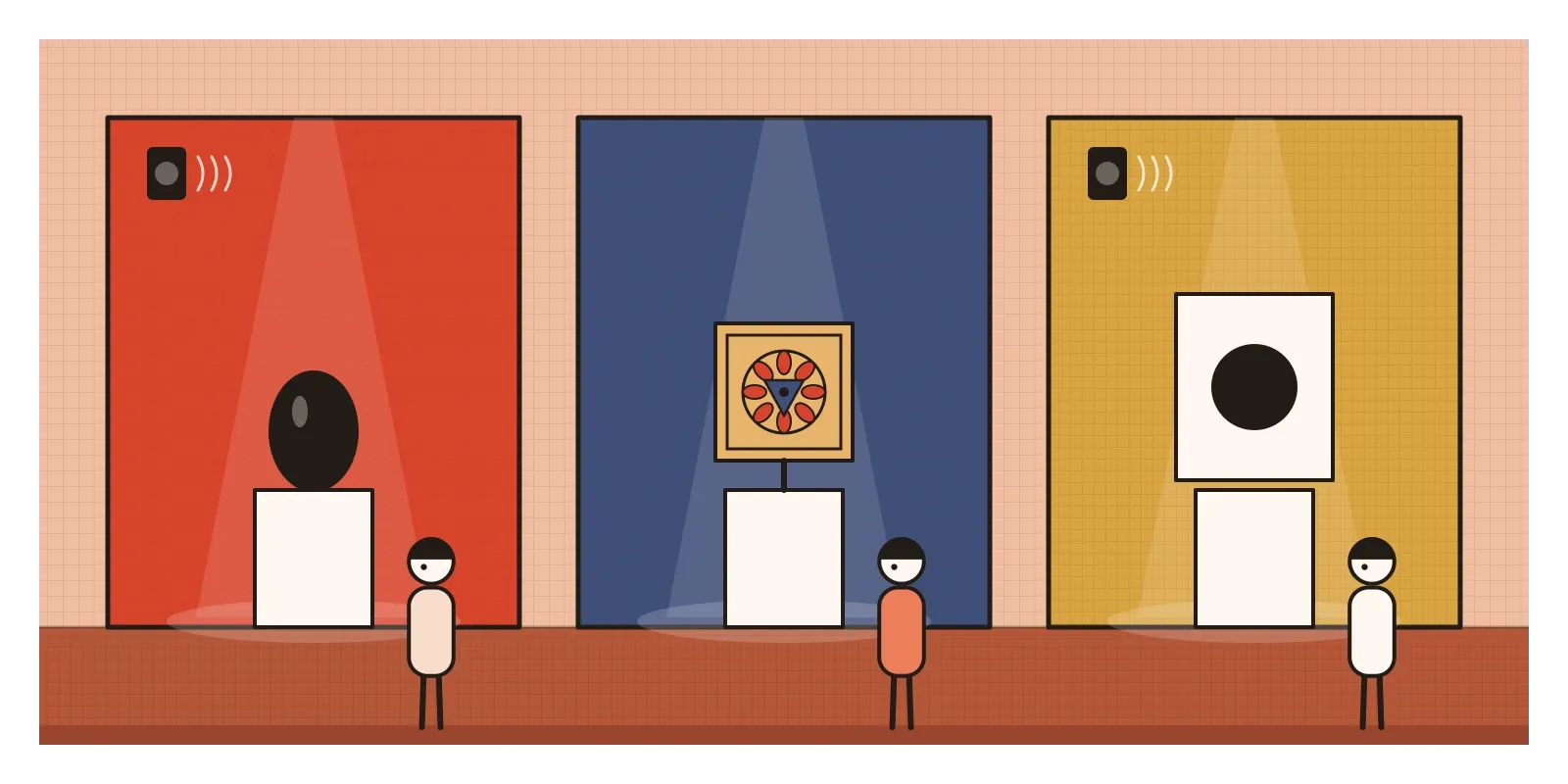
The key text was a book. In 1966 Ajit Mookerjee, a Bengali writer and collector who ran the Crafts Museum in New Delhi, published Tantra Art: Its Philosophy and Physics, a lavish volume of diagrams, paintings and objects, many from his own collection. Five years later, in the autumn of 1971, the Hayward Gallery in London opened an exhibition called simply Tantra, selected by the British scholar Philip Rawson and drawing heavily on Mookerjee's collection. Rawson led visitors through nine enclosed, coloured rooms with sound and slide projections, closer to a temple or a meditation than a white-walled gallery. It's often credited with helping to make Tantra fashionable in the Western counterculture. Indian painters now had a source that felt both their own and, suddenly, internationally modern.
Five painters around a centre
Ghulam Rasool Santosh, born in Srinagar in 1929, had worked as a sign painter and a weaver before studying painting at Baroda in the 1950s. Kashmir has its own philosophical tradition, Kashmir Shaivism, in which Tantra plays a central part, and in 1964, after what he described as a profound experience on a pilgrimage to the Amarnath cave in the Himalayas, his painting changed. His canvases became luminous, symmetrical compositions in which a seated human form, often read as the union of male and female, dissolves into triangles, arcs and flame-like shapes, glowing as if lit from inside.
Biren De, born in 1926 and trained in Calcutta, spent 1959 to 1960 in the United States on a Fulbright grant and came back painting light. His mature canvases are built around a radiating centre, an oval or a lens-shaped form from which waves of colour pulse outwards, carefully symmetrical and almost vibrating. Sohan Qadri, born in Punjab in 1932, practised as a yogi before he became an artist, and from the 1970s lived in Copenhagen. He soaked heavy paper in intense dyes, then pierced and crinkled its surface with fine tools, so that his quiet fields of colour have the texture of skin or ploughed earth.
In Madras, K. C. S. Paniker's Words and Symbols, which I described in the last post, used astrological charts and diagrams that sit close to Tantric imagery, and his younger colleague K. V. Haridasan painted series of yantra-like compositions at Cholamandal. Raza, arriving last, made the bindu famous. His late paintings set the black dot inside rings and triangles in the colours he associated with India, saffron, deep red, ochre, black and blue, and gave them titles like Germination and the names of the five elements.
Triangles, eggs and a single point
Neo-Tantric painting is easy to spot once you know its alphabet. Almost every composition is centred and symmetrical, built outward from a point rather than across a horizon. The point is often a dot or a small circle. Around it sit concentric rings, squares with gateways on each side, lotus-petal borders and triangles. In Tantric thought an upward-pointing triangle is usually associated with the male principle and fire, a downward one with the female principle and water, and the two together form a six-pointed star of union. The oval or egg shape stands for the cosmic egg, the potential from which everything emerges.
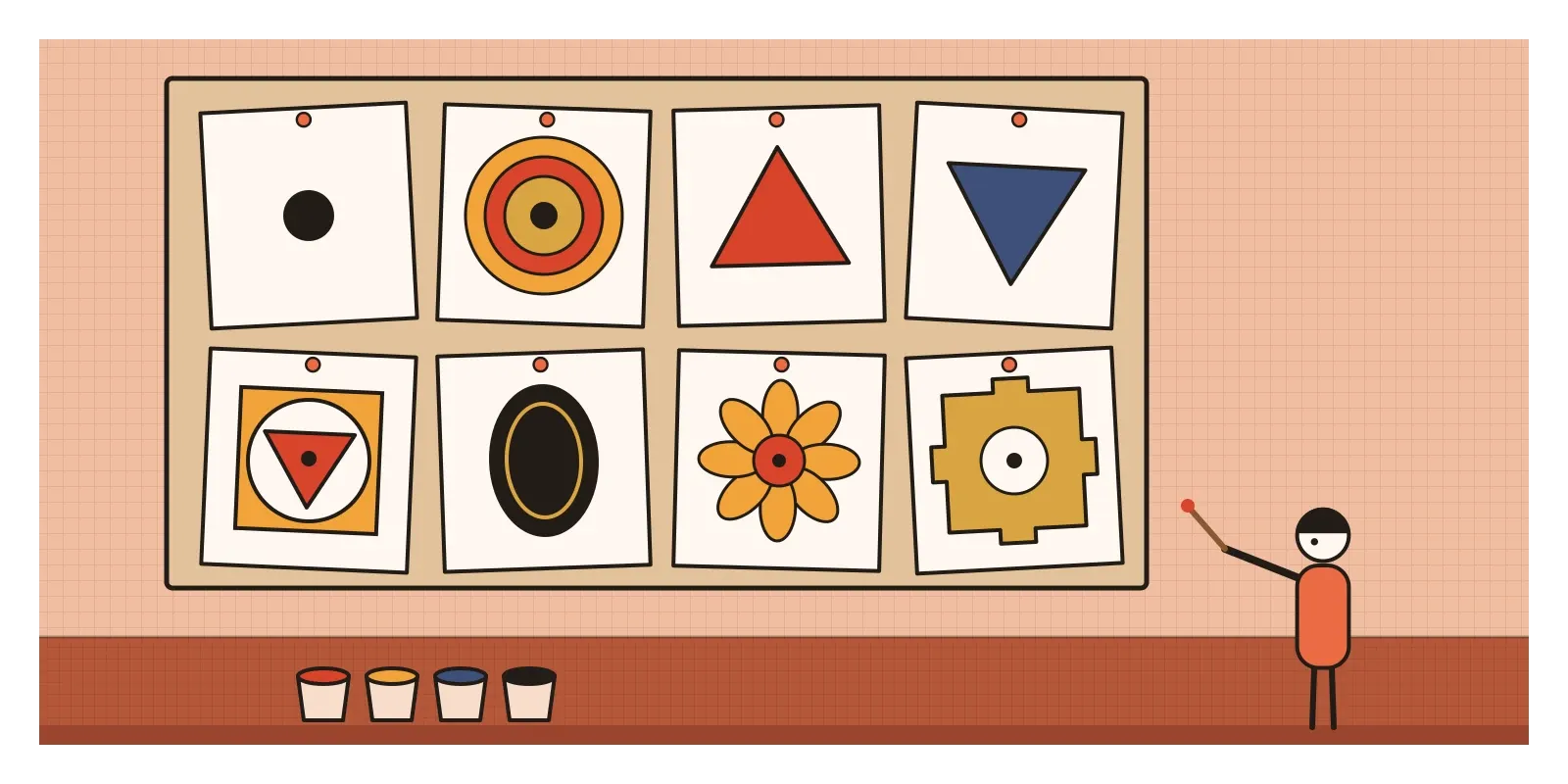
Colour is saturated and symbolic rather than descriptive: vermilion and saffron, indigo, black, ochre, sometimes gold. Edges are hard and geometry is precise, but surfaces are often warm and hand-made, with visible brushwork, soaked paper or textured grounds, so the effect is closer to a painted object than to a printed diagram. There is no perspective and no horizon. The space is a field you look into, not a scene you look across, and like the dot on Raza's classroom wall, the whole picture is designed to hold your attention at one place.
This is what separates Neo-Tantra from the decorative use of the same shapes. In a ritual yantra, the geometry is a tool for focusing the mind, and the best Neo-Tantric paintings try to keep that function. They're meant to be looked at for a long time.
Spiritual abstraction, East and West
Because Neo-Tantra is an Indian tendency, the useful question is how it fitted into the wider world, and the answer is that it joined an old conversation. As I wrote in the post on Symbolism, the first European abstract painters, Kandinsky and Hilma af Klint among them, drew on Theosophy, a spiritual movement headquartered at Adyar in Madras from the 1880s that borrowed heavily from Indian ideas. So when Indian painters turned to Tantric geometry in the 1960s, they were in a sense taking back a source that European abstraction had already drawn on.
The traffic went both ways again in the 1960s and 1970s. Western hippies travelled the overland trail to India, Tantric posters hung in student rooms, and designers took up the imagery too. The Italian designer Ettore Sottsass, whose story belongs to the post on the Memphis Group, made ceramics in the late 1960s inspired by Indian temples and yantras. Some of the most striking images in Mookerjee's books were anonymous Rajasthani paintings made by and for practitioners, many in the twentieth century, which Western collectors began to buy and treat as minimalist art. The French poet Franck André Jamme spent decades collecting them, and his book Tantra Song (2011) presented them to a new audience. Whether those painters would have recognised the word "art" for what they did is an open question.
Breathing circles on a screen
Neo-Tantra's clearest trace in design today is in products about attention and calm. In 2016 Apple added a Breathe app to the Apple Watch, whose animation is a cluster of translucent circles that slowly bloom outwards and fold back in, timed to your breath. Meditation and wellness apps rely on the same centred, radial forms, a pulsing dot or a set of concentric rings, because they do exactly what Raza's teacher wanted: they give a restless mind one point to rest on. Whether or not their designers know it, they're using the oldest function of the yantra.

There's a broader lesson in composition. Most interfaces are built on a grid read from top left to bottom right, a habit inherited from print. Centred, radial compositions behave differently. They stop movement rather than direct it, which makes them good for moments of focus, a timer, a recording button, a loading state or a single call to action, and bad for anything you need to scan. In the posts on balance and on emphasis and focal point I wrote about radial symmetry and about how a single strong focal point organises a whole picture. Neo-Tantric painting takes both to their limit. And designers working on Indian brands often reach for this vocabulary, kolam-like geometry, mandalas, a central dot, to signal something calm and rooted. It's worth knowing what these shapes mean in their own traditions before borrowing them.
Mysticism for sale?
The strongest criticism came from within Indian art. Critics such as Geeta Kapur argued that the search for an essential "Indian-ness" in timeless symbols risked becoming a kind of self-exoticism: Indian artists performing mysticism for Western audiences and buyers who expected India to be spiritual, while the country's real modern life of cities, politics and poverty went unpainted. Neo-Tantric canvases sold well to collectors at home and abroad, and they fitted rather too neatly into the image of a timeless, spiritual India that official cultural festivals liked to export. In 1985 an exhibition at the University of California, Los Angeles, simply titled Neo-Tantra, gave the label something like official status, just as younger Indian artists were turning back towards narrative and politics.
There are also questions about using sacred material. Tantric diagrams belong to living religious practices, and turning them into decorative paintings, posters or logos can drain them of meaning or offend those who use them. The word itself causes confusion, since in the West "neo-Tantra" also names a set of modern sexual and self-help practices, a distant and often garbled relative of the traditions these painters studied. And yet the history is more complicated than either nationalism or exoticism. Raza and Santosh were both born into Muslim families and found in Tantric geometry a shared Indian language rather than a sectarian one. Their dots and triangles were less about religion than about attention.
To see this work for yourself, the National Gallery of Modern Art in New Delhi and the Kiran Nadar Museum of Art in Delhi both hold paintings by several of these artists, and Raza's work appears regularly in exhibitions across India. For an exercise, try Raza's teacher's method. Draw a dark dot on a sheet of paper, pin it at eye level and look at it for two minutes. Then design one screen or poster with a single centred point and nothing else competing with it, and notice how much harder it is to make one point carry everything.
Raza's teacher wanted a distracted boy to sit still. Raza turned that one dot into a lifetime of paintings, and other painters turned an ancient set of diagrams into a modern Indian abstraction. In the next post, on Indian modern architecture, I'll leave the canvas for buildings, and for architects who had to work out how to be both modern and Indian in brick, concrete and shade.
Further reading: Ajit Mookerjee, Tantra Art: Its Philosophy and Physics (1966) · Philip Rawson, Tantra: The Indian Cult of Ecstasy (1973) · Ajit Mookerjee and Madhu Khanna, The Tantric Way: Art, Science, Ritual (1977) · Franck André Jamme, Tantra Song: Tantric Painting from Rajasthan (2011) · Ashok Vajpeyi, A Life in Art: Raza (2007)
A reply toThe belief that abstract painting was a Western import, and the Paris-facing figuration of the Bombay Progressives.