
Neo-Expressionism
How painters in Germany, Italy and New York brought back thick paint, bodies and history after years of cool restraint.
Neo-Expressionism
Two paintings taken by the prosecutor
In the autumn of 1963, a 25-year-old painter who called himself Georg Baselitz opened his first solo exhibition at the gallery of Michael Werner and Benjamin Katz in West Berlin. Within days, officials from the public prosecutor's office arrived and took two of the paintings away. One, Die große Nacht im Eimer, roughly "the big night down the drain", showed a stunted, misshapen young man exposing himself, painted in sour flesh tones and muddy browns. The other was called Der nackte Mann, the naked man. The charge was indecency. The case dragged on, by most accounts until 1965, when the pictures were returned. The first of them now hangs in the Museum Ludwig in Cologne.
What shocked people wasn't only the subject. It was the whole attitude. In 1963 serious painting in West Germany was supposed to be abstract, international and calm, a way of putting the Nazi years and their propaganda art behind the country. Baselitz, who had grown up in East Germany and moved west in the late 1950s, was painting ugly, clumsy, damaged bodies in thick paint, and doing it as a German about Germans.

For more than a decade he looked like an outsider. Then, in January 1981, the Royal Academy in London opened an exhibition called A New Spirit in Painting, curated by Christos Joachimides, Norman Rosenthal and Nicholas Serota, with 38 painters, Baselitz among them, and the message that painting was back. Critics soon had a name for what they were seeing, Neo-Expressionism, the international return in the late 1970s and 1980s of large, gestural, figurative painting, full of bodies, myths, history and the painter's own life, made in Germany, Italy and the United States. Like most labels in this series, it lumps together artists who didn't think of themselves as a group, and several of them disliked it.
After a decade of cool
Neo-Expressionism was a reply first of all to the 1970s. As I wrote in the post on Minimalism, the most admired art of the previous decade had stripped things down to industrial boxes, bricks and lights, and Conceptual artists went further, arguing that the idea was the work and the object almost unnecessary. Art arrived as typed statements, photographs, maps and performances. In many art schools, painting on canvas looked old-fashioned, even finished. A painter who wanted to show a human figure, tell a story or simply lay on paint with a big brush had very little to stand on.
The name pointed back to an earlier generation. The German Expressionists, whom I wrote about in the post on Expressionism, had painted with raw colour and violent line in the 1900s and 1910s, and the Nazis had condemned their work as degenerate. For young German painters in the 1970s, picking up that language meant picking up their country's buried history too. Germany was divided, much of the past was still unspoken, and art that dealt with it directly made people uncomfortable.
Money was part of the story too. The 1980s brought a boom in the art market, fed by new wealth from finance in New York and London. Large, colourful, physical paintings were easier to sell, hang and insure than a conceptual artist's typed instructions, and a new generation of dealers knew it.
Upside-down forests, straw hair and broken plates
In 1969 Baselitz began painting his subjects upside down, starting with a forest hung on its head. His reasoning was that an inverted tree or face stops being a story and becomes a set of painted marks, so the viewer has to look at the painting rather than through it. He has painted that way ever since.
Anselm Kiefer, born in 1945, took on German history more directly. His enormous canvases show ploughed fields, wooden attics and monumental buildings in perspective, built up with sand, straw, ash, shellac and sheets of lead. In 1980 he and Baselitz represented West Germany at the Venice Biennale. From around 1981 Kiefer made a series of paintings responding to Paul Celan's poem "Death Fugue", written by a Jewish survivor of the Holocaust, in which golden-haired Margarete stands for Germany and ash-haired Shulamith for the murdered Jews. In some of these works the golden hair is real straw glued to the canvas. In Berlin, younger painters showing at a gallery on the Moritzplatz, among them Rainer Fetting, Helmut Middendorf and Salomé, painted the city's nightlife in hot colour and were nicknamed the Neue Wilde, the new wild ones.
In Italy the critic Achille Bonito Oliva gave a group of young painters a name in 1979, the Transavanguardia, the "trans-avant-garde". Sandro Chia, Enzo Cucchi, Mimmo Paladino, Nicola De Maria and Francesco Clemente painted dreamlike figures, myths and Mediterranean landscapes, borrowing freely from old art.
In New York the return was louder. Julian Schnabel, after seeing the broken-tile mosaics of Antoni Gaudí's Park Güell in Barcelona, began gluing smashed crockery onto huge wooden panels and painting over it, and his plate paintings, shown at Mary Boone's gallery from 1979, sold before the shows opened. David Salle layered unrelated images on one canvas. Jean-Michel Basquiat, whose SAMO phrases on SoHo walls I mentioned in the post on street art, began painting around 1980 and by 1982 was the youngest artist at Documenta in Kassel. His canvases are crowded with crowned heads, skulls, anatomical drawings, lists and words crossed out so you notice them more, and they deal with Black history, money and fame. He died in 1988, aged 27.
Few women were invited in, but some were doing related work. The Austrian painter Maria Lassnig had spent decades painting what she called body awareness pictures, showing how her body felt from inside rather than how it looked. She was widely recognised only in her old age.
Big, thick and deliberately clumsy
Neo-Expressionist paintings announce themselves by size. Many are taller than a person and wider than a room's wall, made to overwhelm in a gallery. The paint is thick, visibly brushed, smeared or dripped, and the drawing is often deliberately crude. In 1978, the year before the movement had a name, the curator Marcia Tucker held a show at the New Museum in New York called Bad Painting, for artists who ignored good taste on purpose. That spirit runs through the whole movement.
The figure is back, but distorted: heads too big, limbs twisted, bodies upside down or floating. Colour is strong and often harsh. Materials invade the canvas, straw, lead, broken plates, velvet, antlers, maps. Images are borrowed from myth, religion, comics, history and older paintings, and words may be scrawled across the surface. And the subject is often the artist's own history, body and country, treated with heavy emotion rather than irony. Where a Minimalist work tried to say nothing about its maker, a Neo-Expressionist painting can feel like a shout.

A place for people in Bombay and Delhi
In 1981, the same year as the London show, six Indian painters and a critic put on an exhibition called Place for People, shown in Bombay and Delhi. The painters were Bhupen Khakhar, Vivan Sundaram, Gulammohammed Sheikh, Nalini Malani, Jogen Chowdhury and Sudhir Patwardhan, and the critic was Geeta Kapur, who wrote its catalogue essay. It's often described as a turning point in Indian art, the moment when painting about people, cities and stories came back to the centre.
The parallel with Europe is real but the reasons were different. Minimalism had barely taken hold in India. What these painters were moving away from was the abstraction and inward spirituality that many leading Indian modernists had turned to, as I described in the post on the Progressive Artists' Group. They wanted to paint ordinary Indian life and its politics, after the years of the Emergency: Patwardhan's Bombay workers, Chowdhury's sagging, cross-hatched figures, Sheikh's crowded, layered places, Khakhar's tender portraits of small-town men. Their figures were rarely as violent as Baselitz's, and their storytelling owed as much to Indian painting traditions as to Europe. Notably, one of the six was a woman.
At the same time, one of the Transavanguardia painters was working in India. Francesco Clemente spent long periods in the country from 1973, keeping a studio in Madras. Around 1980 to 1981 he made a series of twenty-four gouaches on old handmade paper, Francesco Clemente Pinxit, in collaboration with miniature painters from Jaipur and Orissa, who painted decorative borders and details around his loose, dreamlike figures.
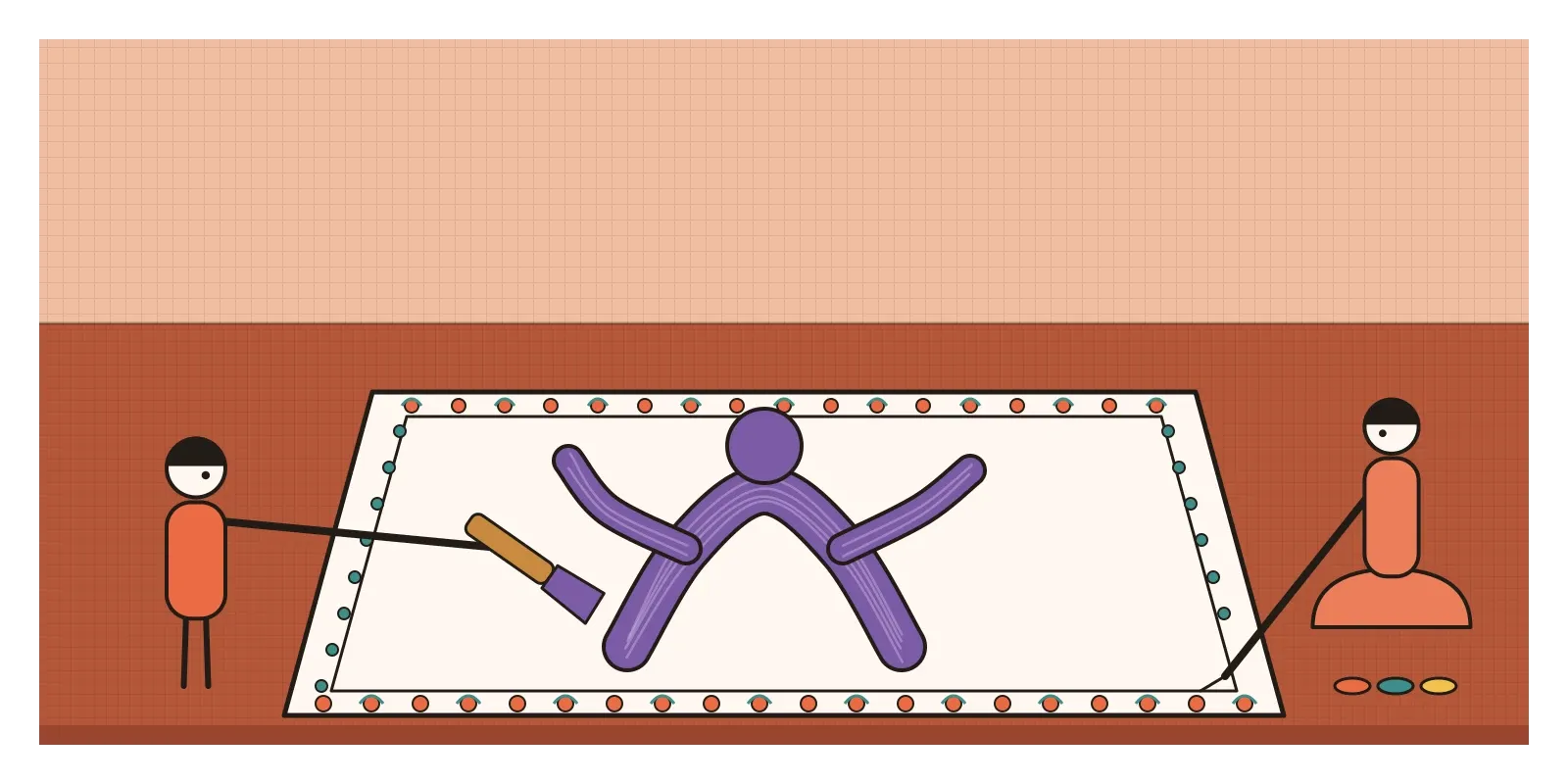
It's a beautiful series, and it raises a question I still find hard. The Indian painters' skill was essential to the work, but the title carries one name, and in most accounts the collaborators remain anonymous. Even Akbar's workshops, as I wrote in the post on Mughal painting, often noted the designer and the colourist in a page's margin. It's worth noticing who gets credited when a European artist works with Indian craftspeople.
The return of the hand
Neo-Expressionism's legacy in design is the return of the visible hand. Brand illustration in the last decade has moved away from smooth vector drawing towards rough brushwork, scratchy outlines and imperfect, hand-drawn type, and packaging for everything from craft beer to skincare uses big, loose, painterly marks to signal authenticity. Album covers, posters and streetwear borrow the crowded, scrawled look of a Basquiat canvas, and his three-pointed crown has become one of the most licensed images in contemporary culture, on T-shirts, sneakers and phone cases.
There's a subtler lesson about materials and scale. Kiefer's straw and lead remind me that what something is made of carries meaning before anyone reads a word. Digital designers fake this with texture overlays, grain and torn-paper edges, and AI image tools will add a "thick impasto" finish on request. But texture added as a filter is decoration. The Neo-Expressionists used it because the subject needed weight.

Who got to shout
Neo-Expressionism had fierce critics from the start. In 1981 the art historian Benjamin Buchloh published an essay in the journal October comparing the return of figurative painting to the "return to order" of the 1920s, when European artists retreated from the avant-garde into classical and national styles in the years before fascism. He saw the new painting as nostalgic and authoritarian, a convenient product for a booming market. Others felt it was hype, with dealers creating reputations and waiting lists before the paint had dried.
The exclusion was blatant. The 1981 London show had 38 artists, and every one of them was a man. In 1984 the Museum of Modern Art in New York opened An International Survey of Recent Painting and Sculpture, with around 170 artists, of whom fewer than fifteen were women. The next year a group of anonymous women artists in gorilla masks, the Guerrilla Girls, began putting up posters around New York counting the women and artists of colour missing from galleries and museums, and they are still at it. Basquiat, nearly the only Black artist the movement's market celebrated, was described in reviews with words like primitive and wild child, and his short life was consumed by the same fame that made him.
By the end of the 1980s the market had cooled, and artists replied in different ways: with the slick, ironic objects of Neo-Geo, with photography and installation, and with the critical art of the 1990s. Painting didn't go away again, though. The Neo-Expressionists had made it impossible to declare it dead.
To see the Indian side of this story, look for works by the Place for People painters at the National Gallery of Modern Art in Delhi or Mumbai, or at the Kiran Nadar Museum of Art in Delhi. Read Geeta Kapur's essays in When Was Modernism. Then try an exercise: paint or draw a quick portrait of someone you know, then turn your sheet and your source upside down and draw them again. Notice how differently you see shapes and marks when the story drops away.
I often think of those two canvases being carried out of a Berlin gallery in 1963, and of how long it took the art world to catch up with them. In the next post, on pixel art and early computer graphics, we go from the biggest, thickest marks in this series to the smallest: a single square of light.
Further reading: Geeta Kapur, When Was Modernism: Essays on Contemporary Cultural Practice in India (2000) · Benjamin H. D. Buchloh, "Figures of Authority, Ciphers of Regression" (1981) · Christos M. Joachimides, Norman Rosenthal and Nicholas Serota (eds), A New Spirit in Painting (1981) · Achille Bonito Oliva, The Italian Trans-avantgarde (1980) · Guerrilla Girls, Confessions of the Guerrilla Girls (1995)
A reply toThe cool, painting-is-dead restraint of Minimalism and Conceptual Art.