Mughal Miniature Painting
How the Mughal emperors built a studio where Persian, Indian and European ways of seeing became one style.
Mughal Miniature Painting
Six portraits on a table by candlelight
In 1616, the English ambassador Sir Thomas Roe was at the court of the Mughal emperor Jahangir in Ajmer, trying, mostly without success, to win trading rights for the East India Company. Among his gifts was a tiny portrait by the English miniaturist Isaac Oliver, and Roe let it be known that no painter in India could match it. Jahangir's chief painter thought otherwise. A wager was made, the painter took the miniature away, and some weeks later Roe was called in at night and shown several identical little portraits laid out side by side, his own among them.
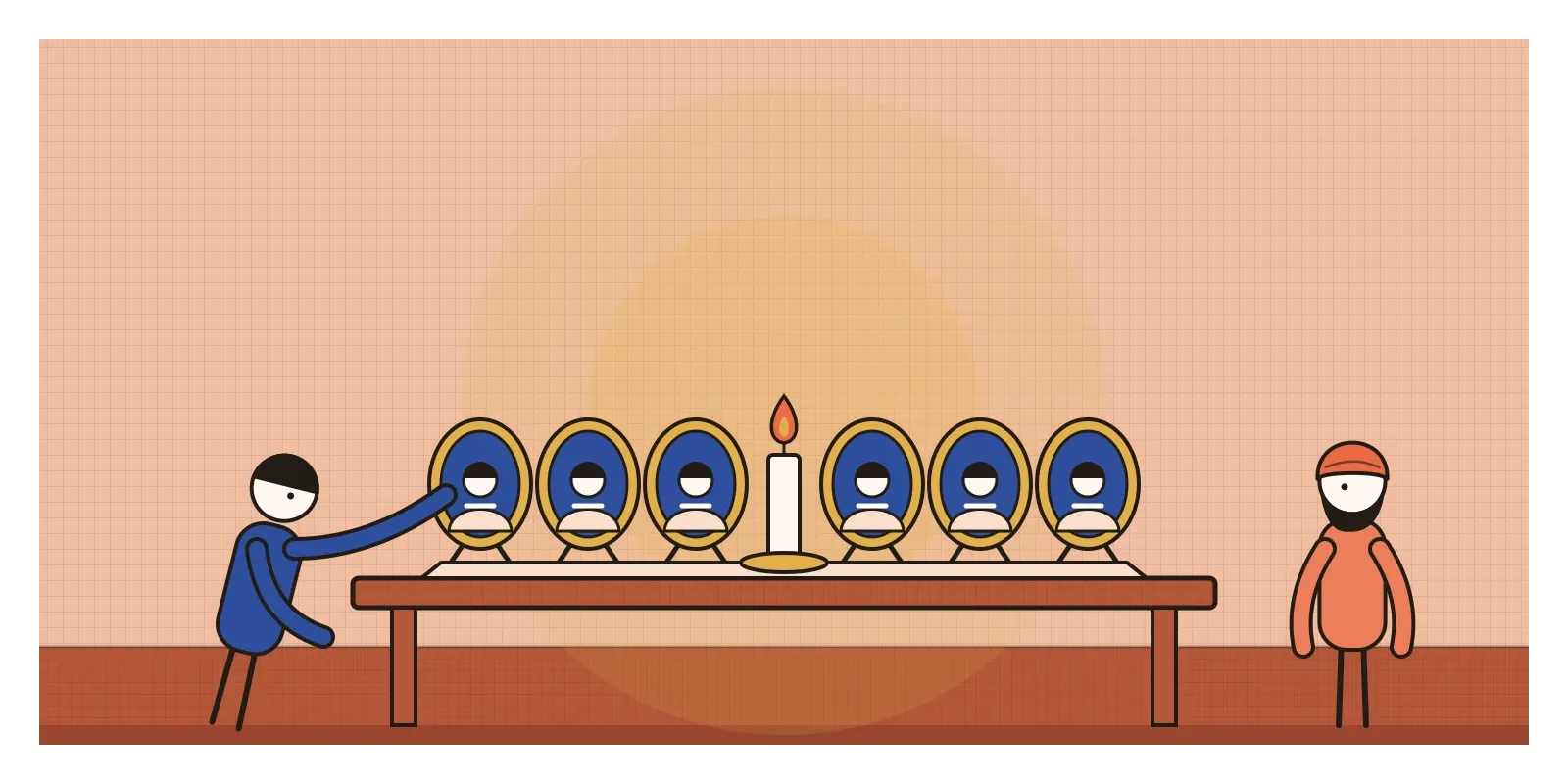
Roe admitted in his journal that, by candlelight, he had real trouble telling which one was his. Accounts of the ending differ. Some say he eventually found his original by small differences, others that he simply lost the bet. What all of them agree on is that Jahangir was delighted, and let the ambassador choose one of the copies to take home.
Mughal miniature painting is the painting made in the workshops of the Mughal emperors and their nobles, from the middle of the sixteenth century until the court's decline in the eighteenth and nineteenth. The pictures were small, in opaque watercolour on paper, made for illustrated books and albums that were held in the hands. Their painters, as Roe found out, could absorb almost anything they saw, Persian, Indian or European, and make it their own.
An exiled emperor and two painters from Iran
The Mughal dynasty began in 1526, when Babur, a prince from Central Asia, defeated the Sultan of Delhi at Panipat. His son Humayun lost the throne in 1540 to the Afghan ruler Sher Shah Suri and spent years in exile, part of it at the court of Shah Tahmasp of Iran, whose royal workshop I wrote about in the post on Persian miniature painting. Two of its painters, Mir Sayyid Ali and Abd al-Samad, joined him in Kabul, and when he won back Delhi in 1555, they came with him. A few months later Humayun fell down the steep stairs of his library and died, and his thirteen-year-old son Akbar became emperor.
Akbar never learned to read well, but he loved books, had them read aloud to him and turned his father's two Persian masters into the heads of a workshop that, according to his chronicler Abu'l Fazl, eventually employed more than a hundred painters. Many were Indian, recruited from places like Gujarat, Gwalior and Kashmir with older painting traditions of their own. Abu'l Fazl tells the story of one of them, Daswanth, the son of a palanquin bearer, who used to draw on the walls until Akbar noticed his talent and put him under Abd al-Samad. Daswanth became one of the reign's greatest painters before his life ended in tragedy in 1584.
The first great project was the Hamzanama, the adventures of Hamza, an uncle of the Prophet Muhammad, retold as a romance of giants, sorcerers and battles. It took about fifteen years, probably from around 1562 to 1577, and by most modern counts produced around 1,400 paintings on cotton cloth, each nearly seventy centimetres tall. Only around two hundred are known to survive. Many historians imagine them held up before listeners while a storyteller recited, though no account says exactly how they were used.
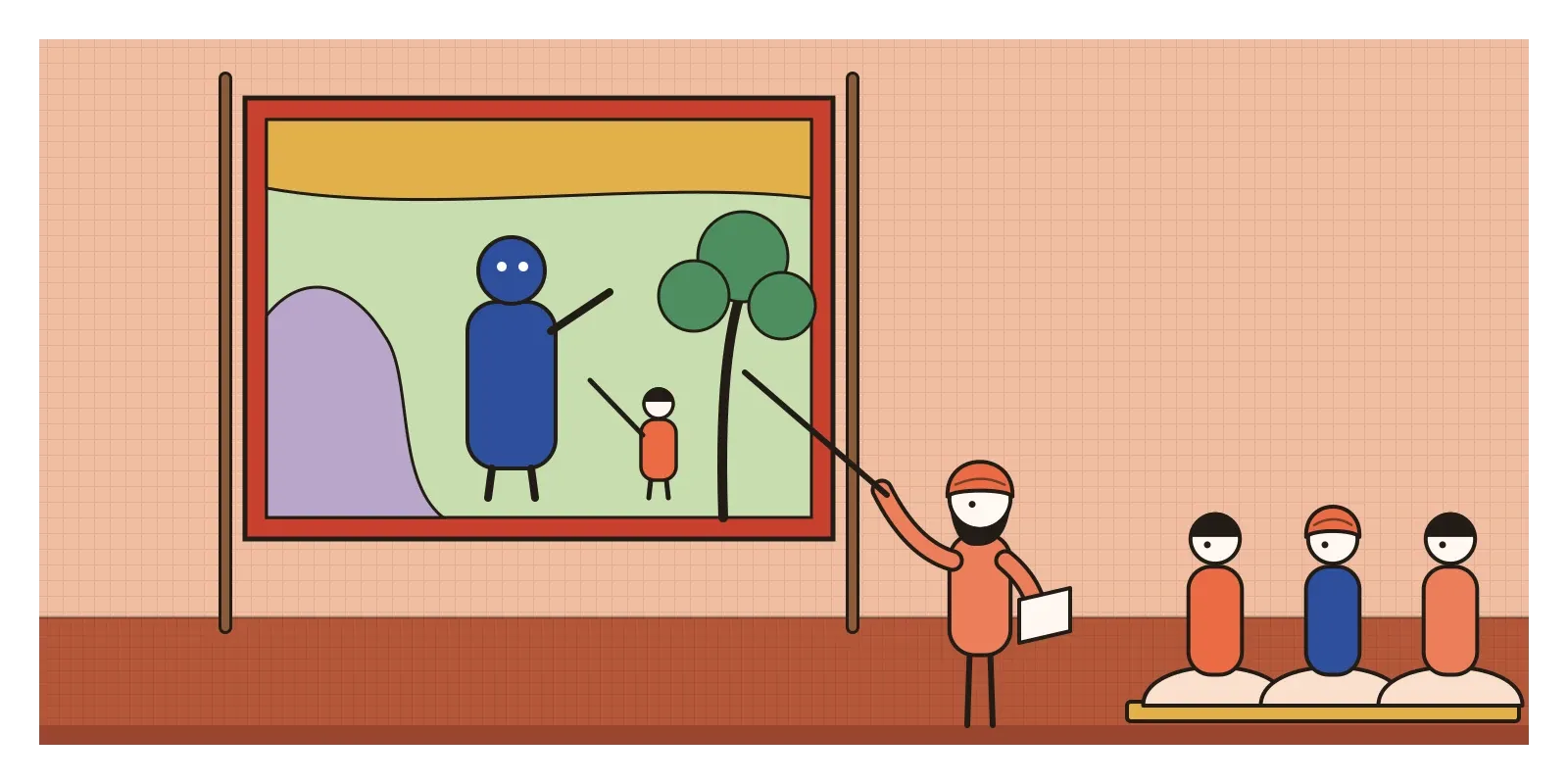
The Hamzanama shows what Mughal painting was replying to. Persian court painting was jewel-like and calm, with small, elegant figures on a high, flat stage. The Indian traditions of the new recruits were bolder and flatter still. The Mughal studio kept the Persian refinement and the Indian vigour, then pushed both towards something new: crowded, violent, physical scenes where trees bend, water churns and people seem to have weight. Later it would push further, towards painting real people and real events.
Composition by Basawan, faces by Nanha
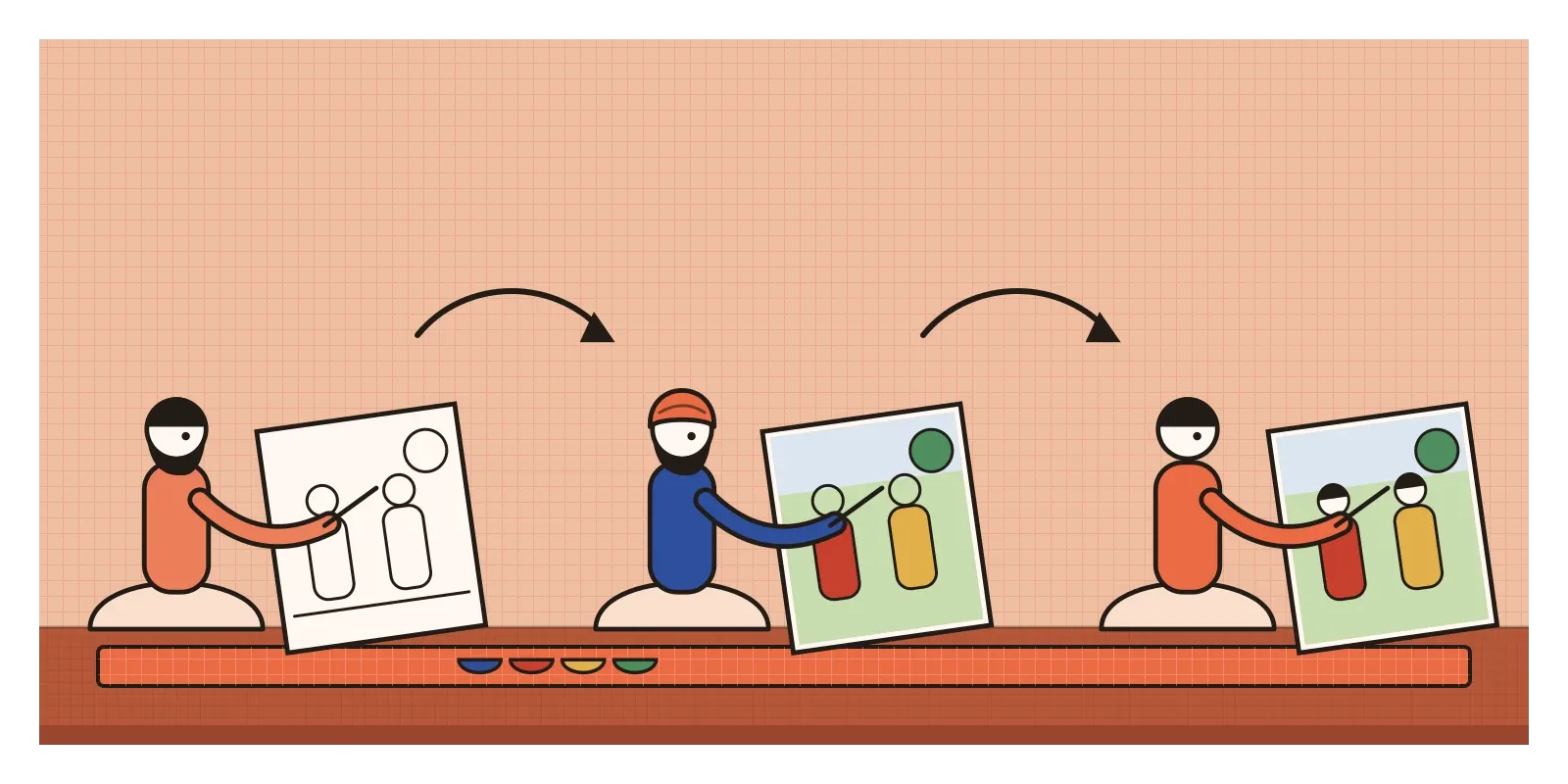
Akbar's grandest later book is the Akbarnama, Abu'l Fazl's history of the reign. The copy now in the Victoria and Albert Museum in London was illustrated around 1590 to 1595 by dozens of painters, and its margins hold something precious: notes in red ink, written by the court librarians, naming who did what. One page reads, in effect, composition by Basawan, colours and details by Ikhlas, faces by Nanha. A Mughal picture was often a relay, with a senior artist planning the scene, another laying in the colour, and a specialist painting the portraits.
Basawan, one of the most admired of Akbar's painters, was a master of crowds and space, with figures that turn into the picture and drapery modelled with soft shading. When Akbar's son Jahangir came to the throne in 1605, the emphasis changed. Jahangir preferred single, exquisite pictures to vast books, and he was obsessed with nature. He boasted in his memoirs that he could look at a painting and name the artist of each face in it.
His favourite painter of animals was Ustad Mansur, whom he titled the Wonder of the Age. In 1621, during the New Year festivities, the emperor was given a zebra, which had reached India from Ethiopia by way of Turkish traders. Jahangir examined it closely, half suspecting someone had painted the stripes on, and had Mansur record it. The painting, now in the V&A, shows the animal standing alone on bare paper in profile, every stripe placed with the care of a natural historian.
Jahangir also used painting to argue. Around 1615 to 1618, a painter called Bichitr made one of the strangest pictures of the period, now in the Freer Gallery in Washington. Jahangir sits on an hourglass throne, haloed by both sun and moon, handing a book to a Sufi sheikh. Below him, waiting their turn, stand an Ottoman sultan and King James I of England, whose face Bichitr copied from an English portrait, quite possibly one that came with Roe's embassy. European cherubs flutter around the hourglass, and in the bottom corner Bichitr has painted himself, holding up a small picture as an offering. Under Shah Jahan, from 1628, it grew more formal and jewelled, as in the symmetrical court scenes of the Padshahnama at Windsor.
Gold margins, profile faces and skies from Flanders
The first thing to notice about a Mughal painting is how close it asks you to come. The figures may be no bigger than your thumb, but you can count the threads in a sash. The pigments were laid in thin layers and burnished smooth, as I described in the post on the colour wheel, with the finest details done in brushes of a few hairs, and gold used generously.
The second thing is a mix of viewpoints. As I wrote in the post on visual literacy, many Indian paintings show a courtyard from above and its walls from the front at once, and make important people larger. Mughal painters did too, but they also borrowed European tricks. In 1580, Jesuit priests arrived at Akbar's court with printed books and Flemish engravings, a story I told in the post on Mannerism, and painters copied them eagerly. You start to see blue, hazy distances with little European-looking towns on the horizon, shading on folds of cloth and faces, and haloes behind the emperor's head.
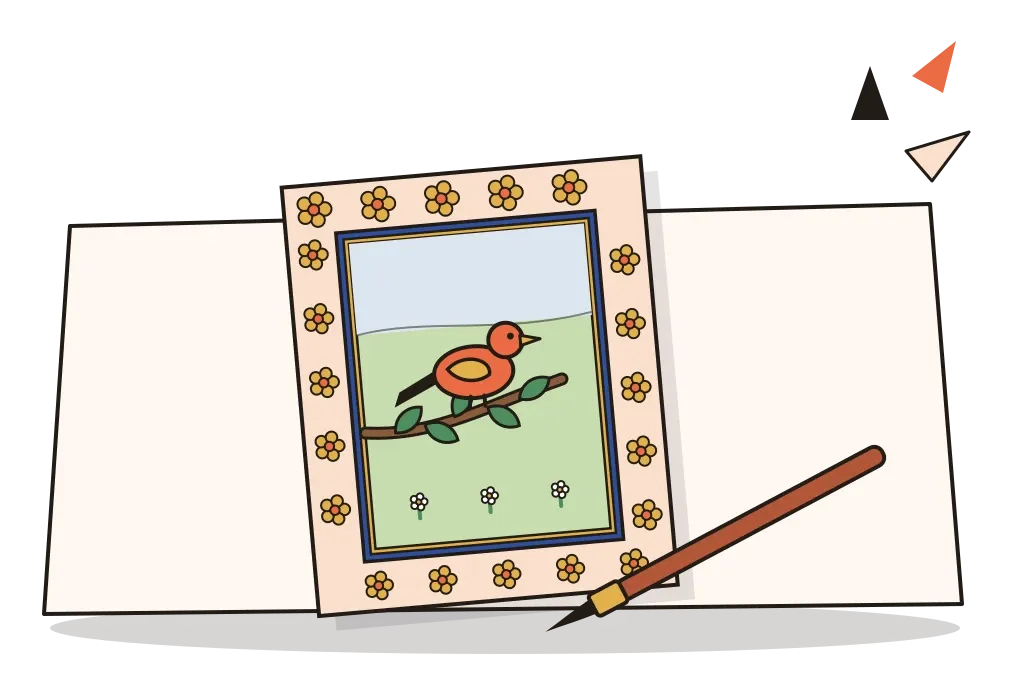
Portraits are the third clue. Jahangir's and Shah Jahan's painters usually showed rulers and courtiers in strict profile, standing on plain grounds, with every jewel and beard hair recorded. Profile was a choice, not a limitation: it made a face as recognisable as a head on a coin. Finally, look at the frame. Single pictures were mounted on album pages, called muraqqa, with thin ruled borders of colour and gold around the painting, then a wide margin painted with gold flowers, birds or small figures. Pages of painting often faced pages of calligraphy, so an album was a careful rhythm of image and word.
Looking outward from Agra and Lahore
For an Indian movement, the interesting question is what it borrowed and what it gave away. It borrowed openly. Persian technique came with Humayun's painters, Indian vigour came with Akbar's recruits, and European realism came first with the Jesuits and then with ambassadors like Roe, who brought English portraits and prints as gifts. But Mughal painters never simply imitated. They used European modelling on Indian faces and filled Persian borders with Indian plants, keeping what was useful and dropping the rest.
Influence also flowed the other way. Mughal paintings travelled to Iran, and, in an episode I'll come to in the post on the Baroque, a celebrated Dutch painter in Amsterdam would be copying Mughal portraits by the 1650s. Within India, a parallel tradition flourished in the Deccan sultanates of Bijapur and Golconda, more dreamlike and more richly coloured, with its own links to Iran and the Ottoman world. The Deccani painters used Persian refinement for reverie, the Mughals for record.
Credits in the margin
What feels most familiar to me is the workshop. A senior artist planning the composition, a team laying in colour, a specialist finishing faces, a librarian noting who did what, and a demanding client who knew enough to judge every face: that's not far from a modern product team with a design lead, illustrators, a motion specialist and a stakeholder review. The red-ink notes in the Akbarnama are among the earliest design credits I know of, and a quiet argument for recording who actually made each part of the work.
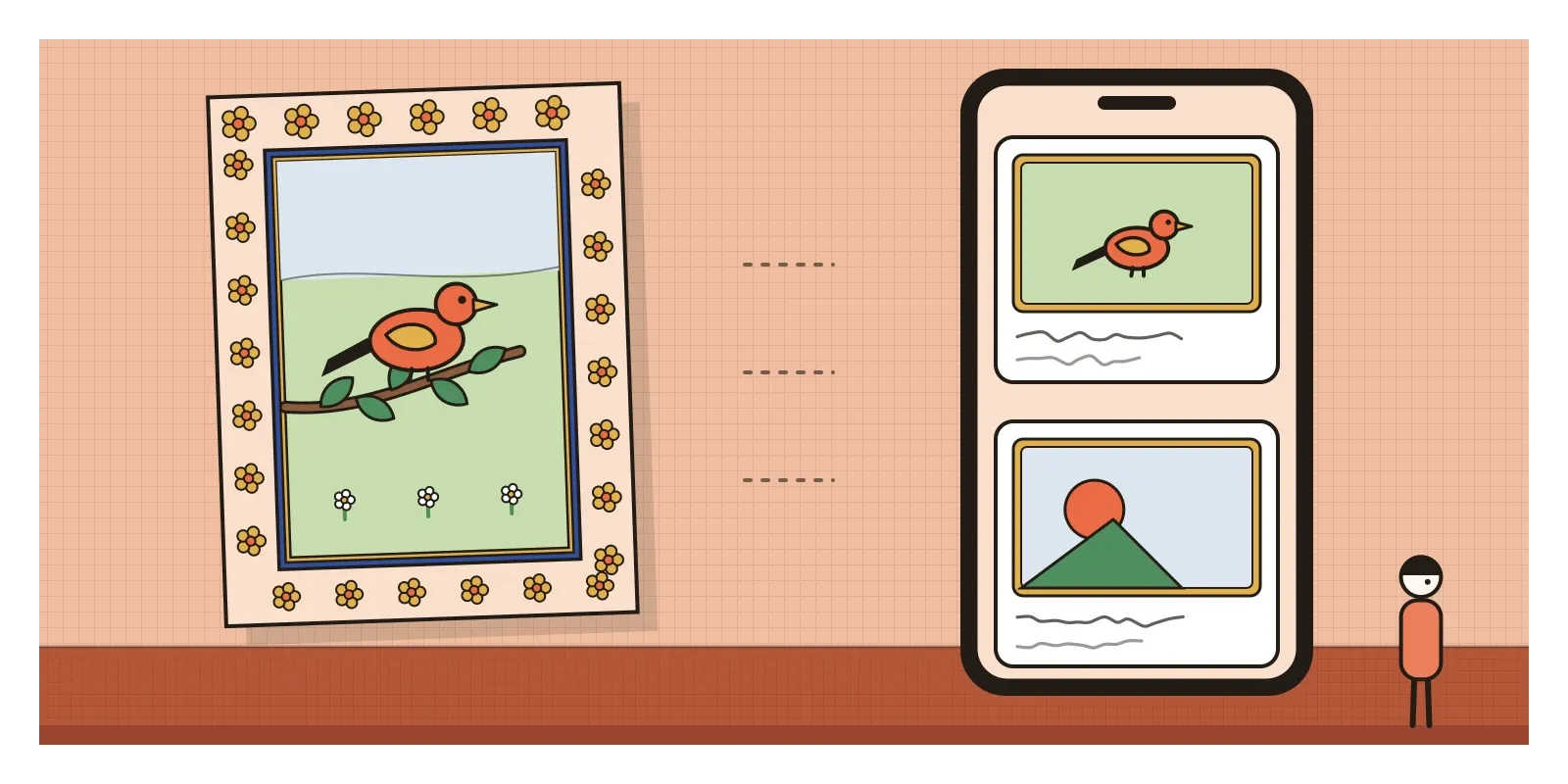
The album page is another inheritance. A picture inside a thin rule, inside a coloured border, inside a wide decorated margin, is a nesting of frames that every interface designer uses daily. A card component on a phone has the same structure: content, a hairline border, padding, then a background that holds many cards together. Albums also alternated picture and calligraphy pages in a deliberate rhythm, as a good long-form article does with images and paragraphs.
Then there's Roe's wager, which feels newly relevant. Image tools today can produce a picture in almost any style in seconds, and designers argue about where learning a style ends and copying begins. In the Mughal workshop, copying was how painters trained, and copies were made openly. But the best painters went on to make pictures nobody had seen before, like Mansur's zebra, and were remembered for it. Copying was the start of the craft, not the whole of it.
An emperor at the centre of every picture
For all its beauty, this was court art in the narrowest sense. It was made for an emperor and a small circle around him, and much of it is flattery. In one picture by Abu'l Hasan, Jahangir embraces the Shah of Iran, his rival, while standing on a lion and towering over him. A few years later, in 1622, the Shah took the fortress city of Kandahar from him. Painters were salaried servants dependent on one man's taste. Women appear mostly through the eyes of men barred from the women's quarters, and only a handful of women painters are known by name, such as Sahifa Banu, whose signed portrait of Shah Tahmasp is in the V&A. Later, many albums were broken up and sold, which is why so much of this art now sits in London, Dublin and Washington.
The court style faded with the court. Aurangzeb, who ruled from 1658 to 1707, cared far less for painting, and painters drifted to the courts of nobles and to the Rajput and hill kingdoms. Much later, Mughal-trained painters made the Company paintings I described in the post on observational drawing. But the most important reply came from the hill and desert kingdoms, where painters took Mughal technique and turned it towards devotion, poetry and bold colour.
To see it for yourself, the National Museum in New Delhi, the Chhatrapati Shivaji Maharaj Vastu Sangrahalaya in Mumbai, the Salar Jung Museum in Hyderabad and the Rampur Raza Library all hold Mughal paintings, and the V&A and the Brooklyn Museum have put many Hamzanama pages online. For a small exercise, try Roe's test on yourself. Pick a small detail from a painting or botanical print, a leaf or a bird, and copy it at exactly the same size with the finest pen or brush you have. Then lay the two side by side under a lamp and ask a friend to pick the original. Where your copy gives itself away is usually where you stopped looking.
Roe never got the trade treaty he wanted from Jahangir, but he went home with a copy of his own miniature that he couldn't easily tell from the original. That's the Mughal studio in miniature: it took whatever came to court and made it its own. In the next post, on Rajput and Pahari painting, I'll follow those painters into the hills and deserts, where the same skills served a very different kind of love.
Further reading: Milo Cleveland Beach, Mughal and Rajput Painting (1992) · John Seyller, The Adventures of Hamza: Painting and Storytelling in Mughal India (2002) · Wheeler M. Thackston (trans.), The Jahangirnama: Memoirs of Jahangir, Emperor of India (1999) · Susan Stronge, Painting for the Mughal Emperor (2002) · B. N. Goswamy, The Spirit of Indian Painting (2014)
A reply toThe jewel-like Persian court painting that Humayun's artists brought home from Safavid Iran.