Modernism in Design
How designers between the wars tried to make everyday things as efficient, honest and repeatable as machines.
Modernism in Design
A kitchen planned with a stopwatch
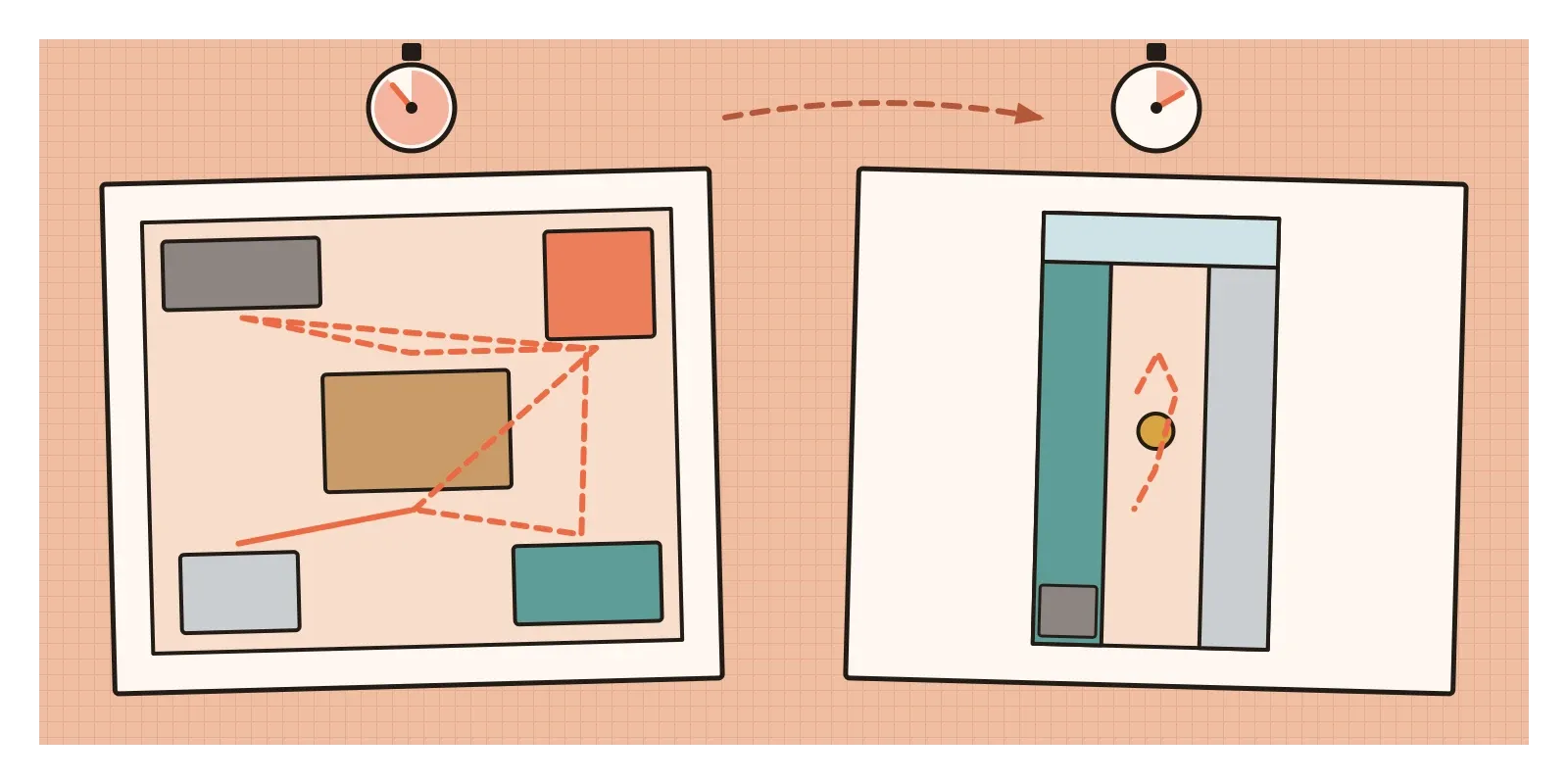
In 1926, a 29-year-old Viennese architect called Margarete Schütte-Lihotzky joined the city building department of Frankfurt am Main. Germany was short of hundreds of thousands of homes after the First World War, and Frankfurt's city architect, Ernst May, had launched a programme to build thousands of affordable flats quickly, with standard plans and factory-made parts. Schütte-Lihotzky's job was the kitchen. She studied how long each task took and how many steps it needed, and she designed a room barely 1.9 metres wide and about 3.4 metres long, laid out like the galley of a railway dining car.
Everything was in reach. A row of aluminium drawers with pouring spouts held flour, sugar, rice and pulses, and the flour drawer was made of oak, because its tannins were believed to keep out mealworms. A fold-down ironing board hung on the wall, a lamp slid along a rail on the ceiling to wherever it was needed, and a swivel stool let the cook sit while working at the counter under the window. The cupboards were painted a blue-green that, it was said, flies disliked. A sliding door opened onto the living room, so a parent could keep an eye on the children. Around ten thousand of these kitchens were fitted into Frankfurt's new flats in the late 1920s. Schütte-Lihotzky, who lived to 102, later said with some amusement that she had hardly ever cooked herself when she designed it.
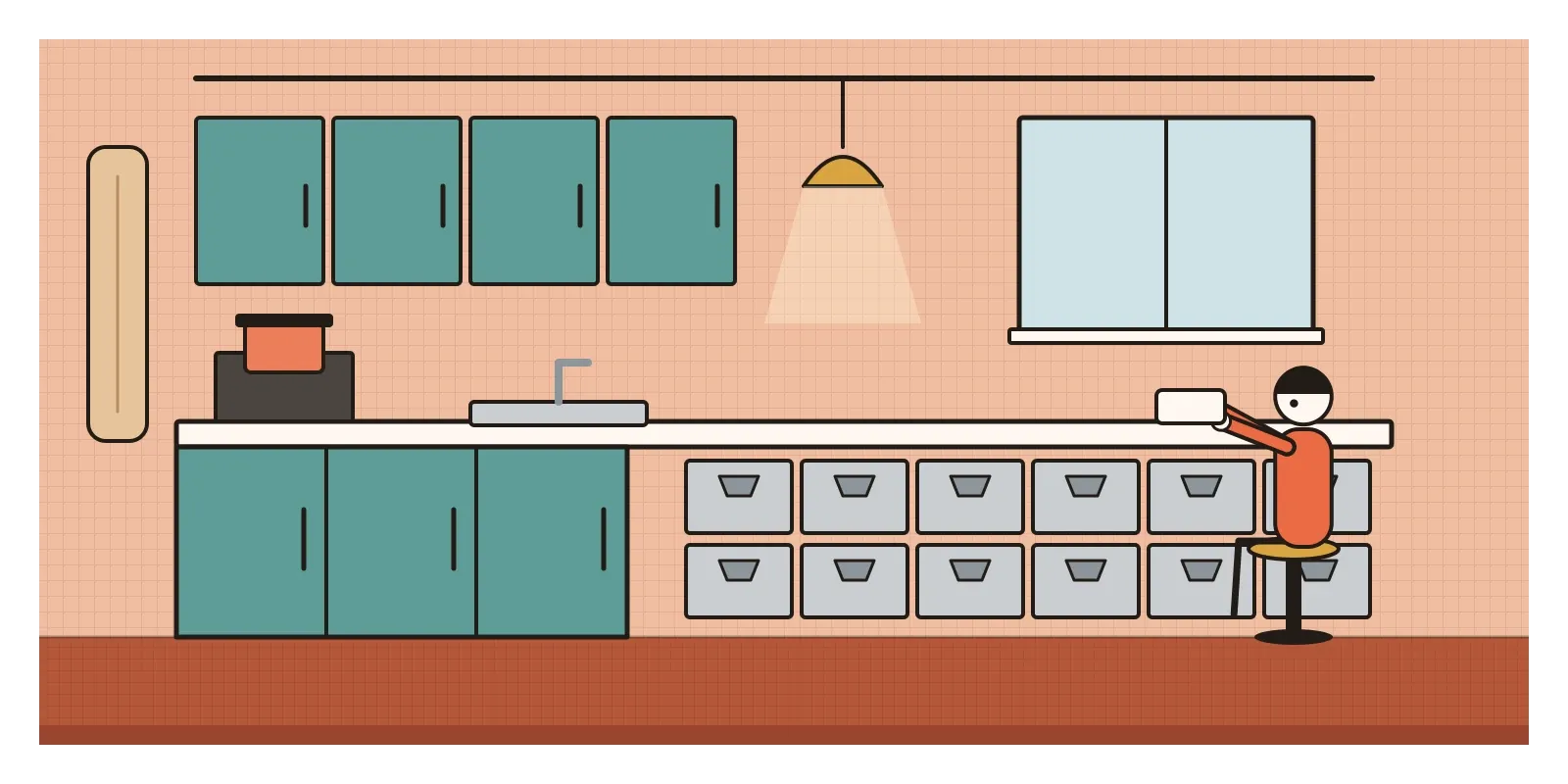
The Frankfurt Kitchen is modernism in design in a single room. Modernism is a broad name for the ideas that took over architecture and design from roughly the 1910s to the 1960s: that objects and buildings should be shaped by their use and their method of manufacture, not by historical styles; that ornament was mostly dishonest or wasteful; that standard, repeatable parts made by machines could give everyone decent things; and that good design could make life healthier and fairer. Several of its strands have their own posts in this series, from the Deutscher Werkbund and the Bauhaus to De Stijl and the International Style. This post is about the shared ideas, and about the people, many of them women, who turned them into objects you could live with.
Clearing out the parlour
Picture a middle-class European living room around 1900: heavy curtains, carved furniture in three revival styles, patterned wallpaper, rugs on rugs, ornaments on every surface and dust on every ornament. Modernism was, first of all, a reply to that room. In the post on form follows function I wrote about Louis Sullivan's skyscrapers and Adolf Loos's attack on ornament, the two ideas that gave modernists their slogans. Schütte-Lihotzky had actually worked with Loos in Vienna, on housing for families who had built their own settlements after the war. Modernism took his irritation and gave it a social mission.
The First World War gave that mission urgency. Cities needed housing fast and cheaply, and governments and city councils, especially in Germany, the Netherlands and Austria, became the biggest clients of modern design. In 1929, the international congress of modern architects met in Frankfurt to discuss "the dwelling for the minimum existence", the smallest home in which a family could live decently. Meanwhile the factory, which the Arts and Crafts movement had treated as the enemy, became the model. Henry Ford's assembly line and Frederick Winslow Taylor's time studies, which broke factory work into measured motions, fascinated European designers. The American writer Christine Frederick had applied Taylor's methods to the home in The New Housekeeping (1913), and its German translation in 1921 was one of Schütte-Lihotzky's sources.
Ocean liners, gas pipes and a table for breakfast in bed
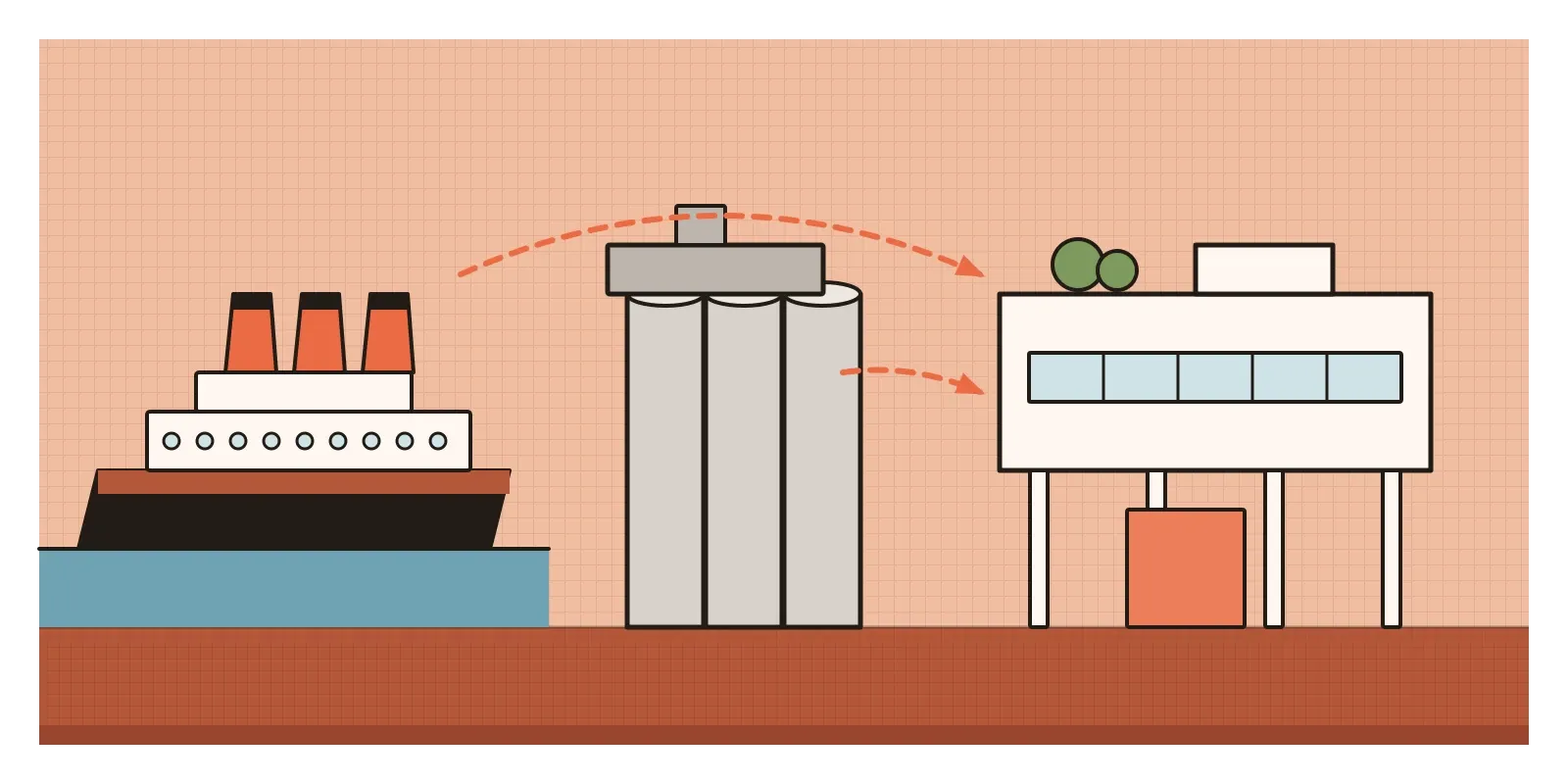
The loudest voice was the Swiss-French architect Le Corbusier. In Vers une architecture (1923), usually translated as Toward an Architecture, he illustrated ocean liners, aeroplanes, racing cars and American grain silos and told architects to learn from engineers, who solved problems without worrying about style. A house, he wrote, should be a machine for living in. At the 1925 Paris exhibition, surrounded by the luxurious pavilions that gave Art Deco its name, he built the Pavillon de l'Esprit Nouveau and furnished it with ordinary, off-the-shelf objects such as bentwood café chairs, laboratory glassware and leather club armchairs. He called these "type-objects", things refined by long use until they no longer needed redesigning.
In 1927 a young designer called Charlotte Perriand showed her portfolio at Le Corbusier's studio. In her own account, he told her, "We don't embroider cushions here." Shortly afterwards he saw the bar she had built from aluminium and chromed steel for that year's Salon d'Automne, and he hired her. With Le Corbusier and his cousin Pierre Jeanneret she designed some of the period's best-known furniture, including a reclining chaise longue of chromed tube set on a separate base, so the sitter could rock it to any angle, shown in 1929. Most historians now credit Perriand with much of the furniture work, which for decades was sold under Le Corbusier's name alone.
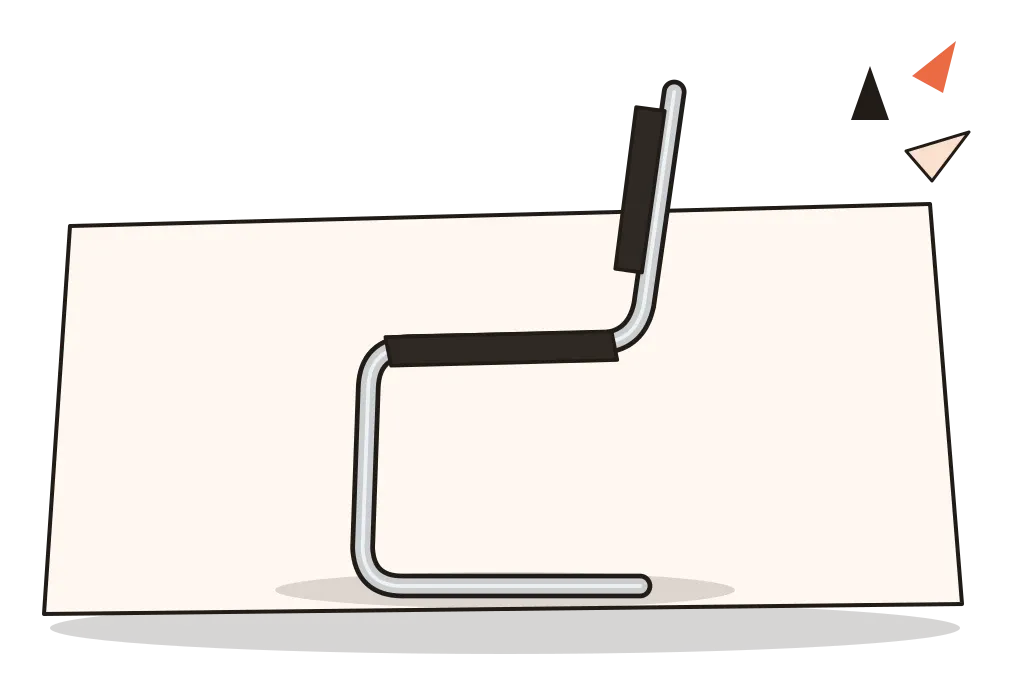
The Irish designer Eileen Gray, who had first made her name with luxurious lacquer work, built a white villa called E-1027 above the sea at Roquebrune-Cap-Martin on the French Riviera between 1926 and 1929, with her partner Jean Badovici. Every fitting was thought through, down to a small round side table of chromed tube whose height adjusts so that it can slide over a bed. The usual story is that she designed it so her sister could eat breakfast in bed without crumbs everywhere. In 1926 the Dutch architect Mart Stam made a prototype chair from lengths of gas pipe and plumbing joints, with no back legs at all. The seat hung from a single bent frame, an idea called the cantilever. Several designers, including Marcel Breuer of the Bauhaus, raced to develop it, and the dispute over who had invented it ended up in a German court, which credited Stam with the artistic copyright.
The look of honesty
Modernist design is easy to spot once you know the rules it set itself. Ornament disappears. Shapes are simple geometry, rectangles, cylinders and circles, and every part is meant to show what it does: the frame of a chair is visibly a frame, the legs are visibly legs. Materials are new or newly exposed: chromed steel tube, plate glass, plywood, concrete, aluminium, linoleum and Bakelite, used for their own qualities rather than disguised as marble or carved oak.
Colour is mostly white, grey and black, with natural wood and leather, and sometimes a single primary colour as an accent. Furniture is light, often lifted off the floor on thin legs, so you can see under it and clean around it, because hygiene was a real concern in the decades after tuberculosis and the influenza pandemic. Storage is built in. Windows run in long horizontal bands. Things are standardised and modular: cupboards come in units, paper comes in fixed sizes like the A series I described in the post on proportion and scale, and type is usually a plain sans serif, which the post on the New Typography covers properly. The whole look is meant to say efficient, clean, honest and new.
Chandigarh's chairs on the scrap heap
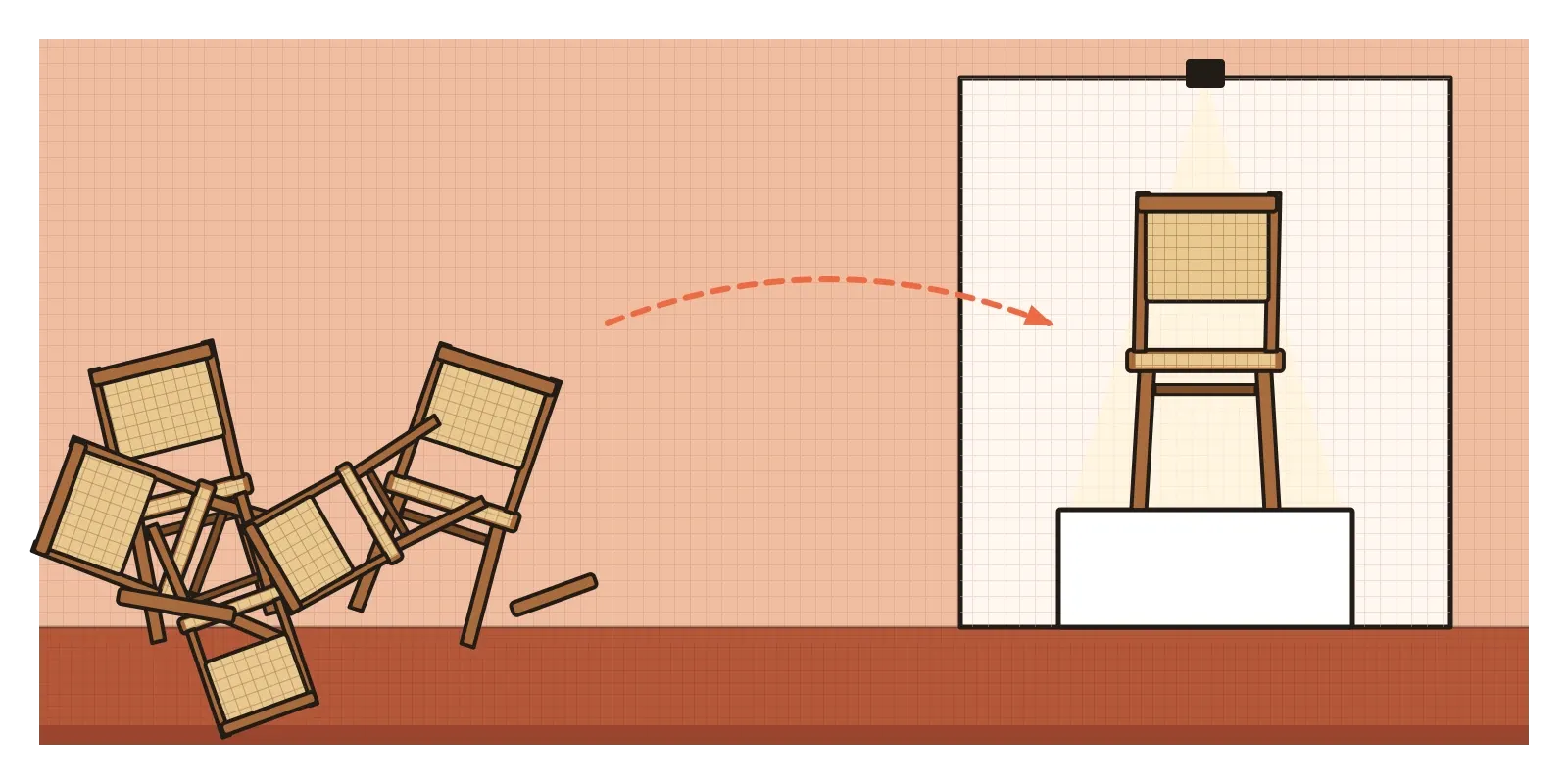
India's richest modernist design story is about furniture. When Le Corbusier took on the new capital of Punjab at Chandigarh in 1951, which I wrote about in the post on proportion systems, his cousin Pierre Jeanneret moved there and stayed for most of the next fifteen years. Jeanneret designed thousands of pieces of furniture for the city's offices, courts, colleges and homes: desks, benches, library chairs, sofas and office chairs, usually in teak or Indian rosewood with seats and backs of woven cane. They were deliberately simple to build, so that local carpenters and cane weavers could make them with ordinary workshop tools, and many have the confident, slightly chunky geometry that came from adapting European modernist ideas to Indian timber, climate and craft.
For decades they were simply government furniture. By the 1990s many were broken, stacked in storerooms and sold off in lots at scrap auctions for very little. Then European dealers noticed them. Restored chairs began to appear in galleries and auction houses in Paris, London and New York, selling for thousands of euros or dollars each, and by the early 2010s Indian officials were trying to trace and stop the export of pieces that had left the city. The story has two sides. It shows how good that marriage of modernist design and Indian craft was. It also shows how easily value is recognised only once something has been carried abroad.
The kitchen in your phone
Modernism's ideas run so deep in design today that they feel like common sense. The fitted kitchen, with continuous counters and cupboards of standard sizes, descends from Frankfurt, and the rule of thumb that sink, stove and fridge should form a short "work triangle" came out of American research on efficient kitchens in the 1940s and 1950s. Flat-pack furniture, modular shelving and standard paper sizes are all modernist in spirit.
In digital products the inheritance is everywhere. A design system, with its fixed set of buttons, spacing, colours and type, is the type-object and the standard part reborn: a small library of refined pieces that can be combined into thousands of screens. When we count the steps in a checkout flow and try to remove one, we're doing what Schütte-Lihotzky did with her kitchen. Even the visual style of most interfaces, flat surfaces, sans serif type, a grid and a restrained palette with one accent colour, is modernist. So is a habit worth questioning. When we design for "the user", we inherit modernism's belief that one carefully studied standard person can stand for everyone.
One standard person, many real ones
That belief was modernism's biggest blind spot. The Frankfurt Kitchen was efficient, but it was designed for one woman working alone. It was too small for two people or for children to help, it shut the cook into a narrow room, and some tenants found it confusing or simply didn't like being told how to cook. Later feminist historians pointed out that it made housework more efficient without questioning who did it. Le Corbusier's own record with women is worse. In 1938 and 1939, while staying at E-1027, he painted murals on its walls, by most accounts without Gray's agreement, and she regarded it as vandalism.
The machine aesthetic also proved easier to imitate than to live up to. After the Second World War, modernism became the official style of corporations and governments around the world, and its standard housing blocks, cheaply built, often became the most disliked buildings in their cities. In colonies and newly independent countries it could look like progress or like another imported rulebook. Many modernists had seen their work as left-wing and humane, which is why the Nazis attacked it as foreign and Bolshevik in the 1930s and drove many of its designers into exile. Schütte-Lihotzky herself joined the Austrian resistance and spent the rest of the war in prison after the Gestapo arrested her in 1941.
The replies came from several directions. In Scandinavia, designers kept modernism's honesty and social purpose but swapped chrome for wood, cold geometry for comfort and the factory for the craft workshop. In the 1960s and 1970s, postmodernists would attack the whole project with jokes and ornament.
To see modernism for yourself, look up a reconstructed Frankfurt Kitchen, since several museums, including MoMA in New York and the MAK in Vienna, own one and show it online. In India, walk through Chandigarh's Capitol Complex or the Pierre Jeanneret Museum in his old house in Sector 5. Then try an experiment at home: time yourself making tea, count your steps and see what one change to where things are kept would save. That's exactly how a narrow room in Frankfurt began, with a young architect, a stopwatch and the conviction that a few saved steps, multiplied by ten thousand flats, could change people's lives. In the next post, on Scandinavian Design, I'll follow the designers who kept that conviction but made it warmer, in birch, teak and wool.
Further reading: Le Corbusier, Toward an Architecture (1923) · Christine Frederick, The New Housekeeping (1913) · Christopher Wilk (ed.), Modernism: Designing a New World, 1914-1939 (2006) · Charlotte Perriand, A Life of Creation (2003) · Penny Sparke, An Introduction to Design and Culture: 1900 to the Present (1986)
A reply toThe cluttered, ornamented Victorian parlour and the revival styles that filled it.