
Googie and Atomic Age Design
How post-war America put rockets, atoms and boomerangs on coffee shops, cars and kitchen tables.
Googie and Atomic Age Design
A coffee shop that looked ready for take-off
In February 1952, the American magazine House and Home published a short, cheeky article by its architecture editor, Douglas Haskell. It was called "Googie Architecture", and it named a style that serious architects had been doing their best to ignore. The name came from a coffee shop on Sunset Boulevard in Los Angeles, at the corner of Crescent Heights, designed by the architect John Lautner and opened in 1949. Googie's, said to be named after the nickname of the owner's wife, had a roof of steel that swept up from the pavement and tilted towards the sky, as if the whole building were about to lift off. Its walls were glass, its sign was tall and angular, and it glowed at night for drivers passing at speed.
The story usually told is that Haskell was being driven through Hollywood by the architectural photographer Julius Shulman when they passed the coffee shop, and Haskell decided there and then that this was the name for the whole thing. It may be tidier than the truth, but the name stuck. Haskell's article was half amused and half appalled. He described buildings that wanted to look as though they defied gravity and that treated architecture as a kind of advertising, built for the eye of a passing motorist rather than for any principle. He was being rude, and he was also right.
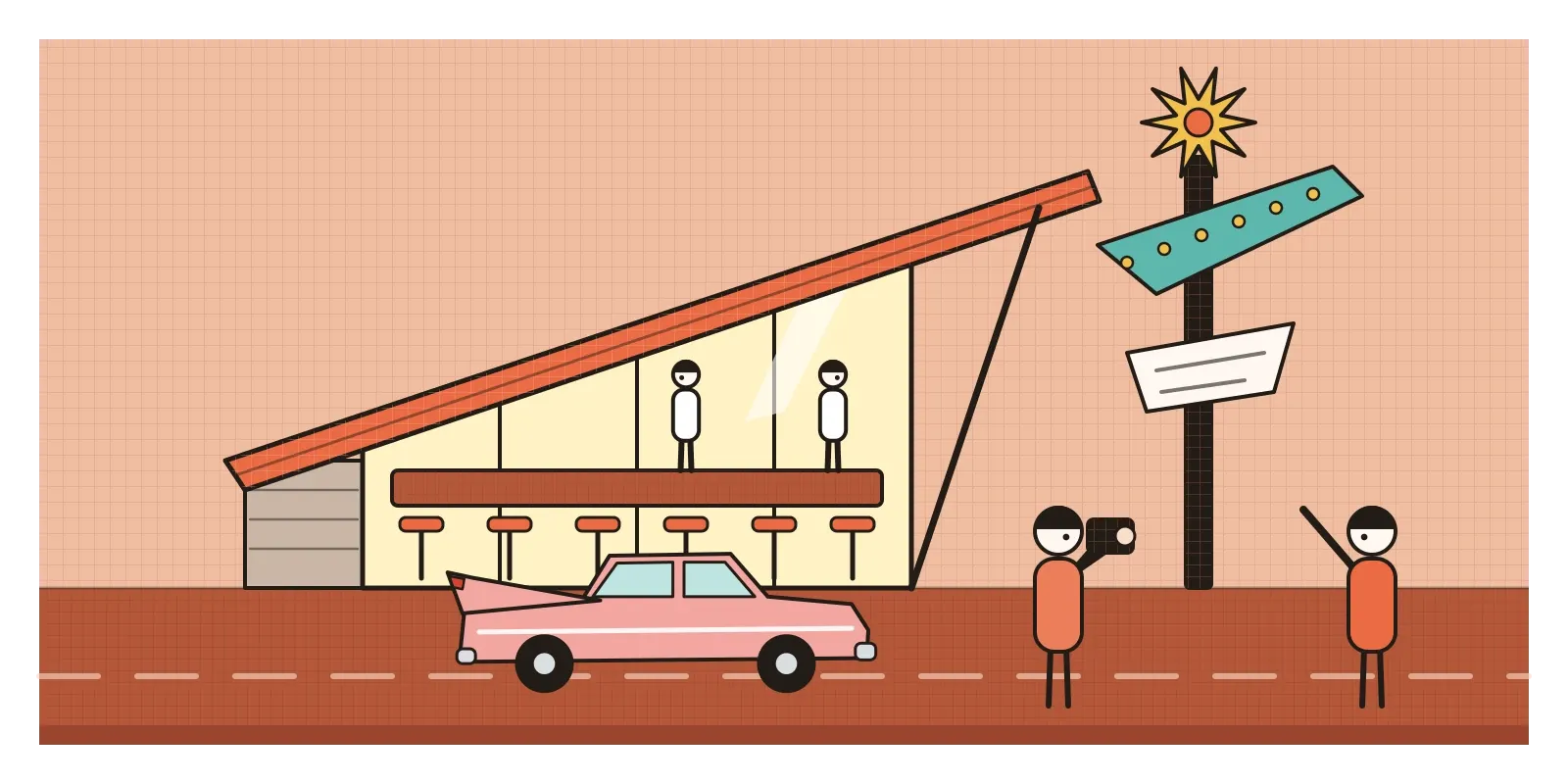
Googie is the name we now use for the roadside architecture of post-war America: coffee shops, motels, bowling alleys and petrol stations with upswept roofs, boomerangs, starbursts and signs that seem designed by a rocket engineer on holiday. Atomic Age design is its cousin indoors, the furniture, fabrics, cars and objects of roughly 1945 to the mid-1960s that borrowed the imagery of atoms, satellites and space travel. Together they were the most cheerful style of the twentieth century, and one of the most looked down on.
Fins, atoms and the post-war boom
The United States came out of the Second World War richer than any country had ever been, with factories that had learned to make aircraft by the thousand and now needed something else to make. Millions of families moved to new suburbs and bought cars, fridges and televisions on credit. Southern California, home to much of the aircraft industry, grew fastest of all, and its cities were built around the car. A restaurant on a wide boulevard had a few seconds to catch a driver's eye, so it had to shout.
The science of the age gave it a vocabulary. The atomic bomb had ended the war in 1945, and within a few years the atom had been rebranded as a source of cheap, clean power. President Eisenhower's "Atoms for Peace" speech at the United Nations in December 1953 made that official. The jet, the rocket and, after the Soviet Union launched Sputnik in October 1957, the satellite were suddenly daily news. The drawing of an atom, a nucleus with electrons whizzing around it on elliptical orbits, became a motif you could print on curtains.
What Googie replied to was the sober modernism of the International Style, which has its own post in this section: the plain white box, the glass curtain wall, the idea that architecture should be honest, rational and quiet. Googie took the same new materials and used them to have fun. It also replied to the grey years of the Depression and wartime rationing. After fifteen years of making do, people wanted things that looked like tomorrow.
Boomerang roofs and a needle in Seattle
Lautner, who had trained with Frank Lloyd Wright, later disliked being linked with the style, and Googie's real masters were a firm called Armet and Davis. Louis Armet and Eldon Davis designed dozens of coffee shops across Los Angeles, and their Norms restaurant on La Cienega Boulevard, opened in 1957, is a perfect example: a roof that folds up into a sharp zigzag, a tall, angular sign, walls of glass and stone, and a long counter inside where you could see the cooks at work. Wayne McAllister designed drive-ins, Bob's Big Boy in Burbank (1949), with a sign as tall as a tower, and casinos in Las Vegas.
Las Vegas was Googie's capital. Its 1959 welcome sign, designed by Betty Willis, a diamond shape with a starburst on top and silver dollars across its face, is probably the best-known example, and it's said she never copyrighted it, which is one reason you see copies everywhere. The Theme Building at Los Angeles airport, opened in 1961, is a restaurant held up on two huge crossed parabolic arches, like a flying saucer that has landed on spindly legs. It came from a team that included the architect Paul R. Williams, one of the first Black architects to build a major practice in America. The next year Seattle built the Space Needle for its world's fair, a thin tower with a revolving restaurant at the top, which began, by most accounts, as a doodle by the hotel executive Edward Carlson.
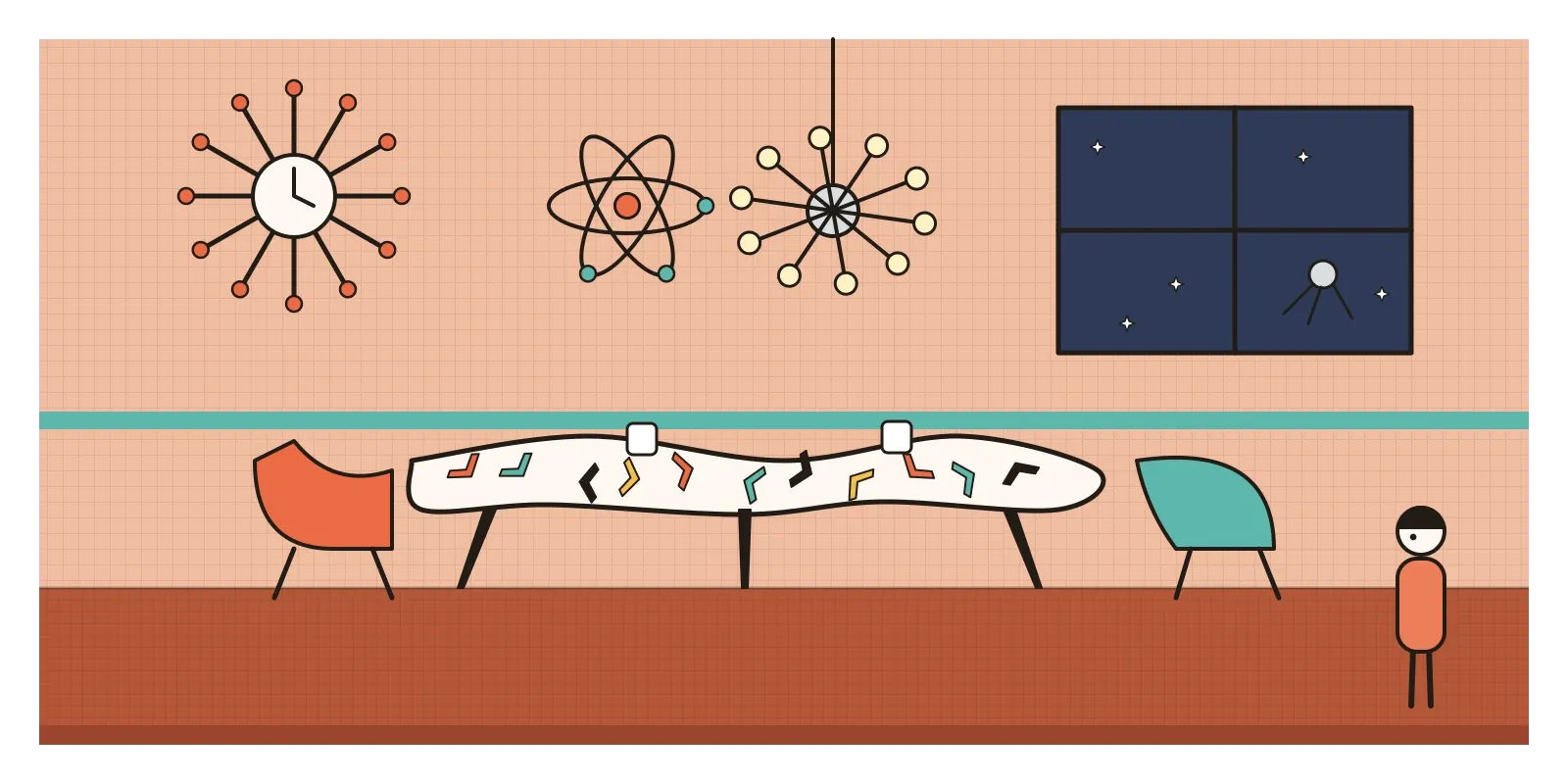
Cars carried the atomic mood to most families. At General Motors, the designer Harley Earl and his team are said to have been inspired by the twin tail booms of the Lockheed P-38 Lightning, a wartime fighter plane, and the 1948 Cadillac had two small fins at the back. Over the next decade the fins grew, and on the 1959 Cadillac they rose into tall points with twin bullet-shaped lights, like a rocket's exhaust. Indoors, the boomerang became the decade's favourite shape. A pattern of scattered boomerangs, usually credited to the designer Brooks Stevens, covered millions of laminate kitchen tables. Clocks were shaped like starbursts, and after 1957 hanging lamps sprouted rods tipped with bulbs, a type still called the Sputnik.
Europe had its own atomic moment. At the Festival of Britain in 1951, the Festival Pattern Group of manufacturers made textiles and tableware from scientists' diagrams of atoms in crystals such as insulin and haemoglobin, an idea encouraged by the crystallographer Helen Megaw. In Brussels, the Atomium, built for Expo 58, is an iron crystal enlarged billions of times, nine steel spheres joined by tubes you can walk through.
Reading a building at forty miles an hour
Googie is the easiest style in this series to recognise, because it was designed to be recognised quickly. Look for roofs that tilt, fold, float or swoop upwards instead of sitting flat, often cantilevered so they seem to rest on nothing. Walls are often plate glass, so the lit interior becomes the advertisement. The sign is as important as the building, sometimes more so: a tall pylon, an arrow, a boomerang or an upturned triangle, with a starburst or a ring of planets on top, outlined in neon and bulbs that chase each other at night. Angles are sharp and dynamic. Very few things are square.
The materials mix the new and the natural. Steel and glass sit next to rough stone walls, planters, wood and terrazzo floors, which gave even a cheap coffee shop some warmth. Colours are bright and optimistic: turquoise, coral, lime, yellow, pink and chrome. In objects and patterns, the motifs repeat across everything: boomerangs, kidney shapes, amoebas, atoms with orbiting electrons, stars, satellites, rocket fins and parabolas.
As a designer, I read Googie as a lesson in distance. A coffee shop was seen first from a moving car, then from the car park, then from the counter, and each distance had a job: a silhouette to be noticed, a lit interior to invite you in, a counter where you could watch the cooking. Good app icons and shop fronts work at three distances in the same way.
A rocket on a bicycle
India had an atomic age and a space age too, but it looked nothing like Las Vegas. Its symbols were real reactors and real rockets, built by a poor, newly independent country on a tight budget. In August 1956, a small research reactor called Apsara went critical at Trombay, near Bombay, the first in Asia, under the physicist Homi Bhabha. Jawaharlal Nehru, opening the Bhakra Nangal project in 1954, had called big dams the temples of modern India, and science was given the same reverence. Bhabha, himself a keen painter, also began buying the work of young Indian artists for the Tata Institute of Fundamental Research, building one of the country's important modern art collections inside a physics institute.
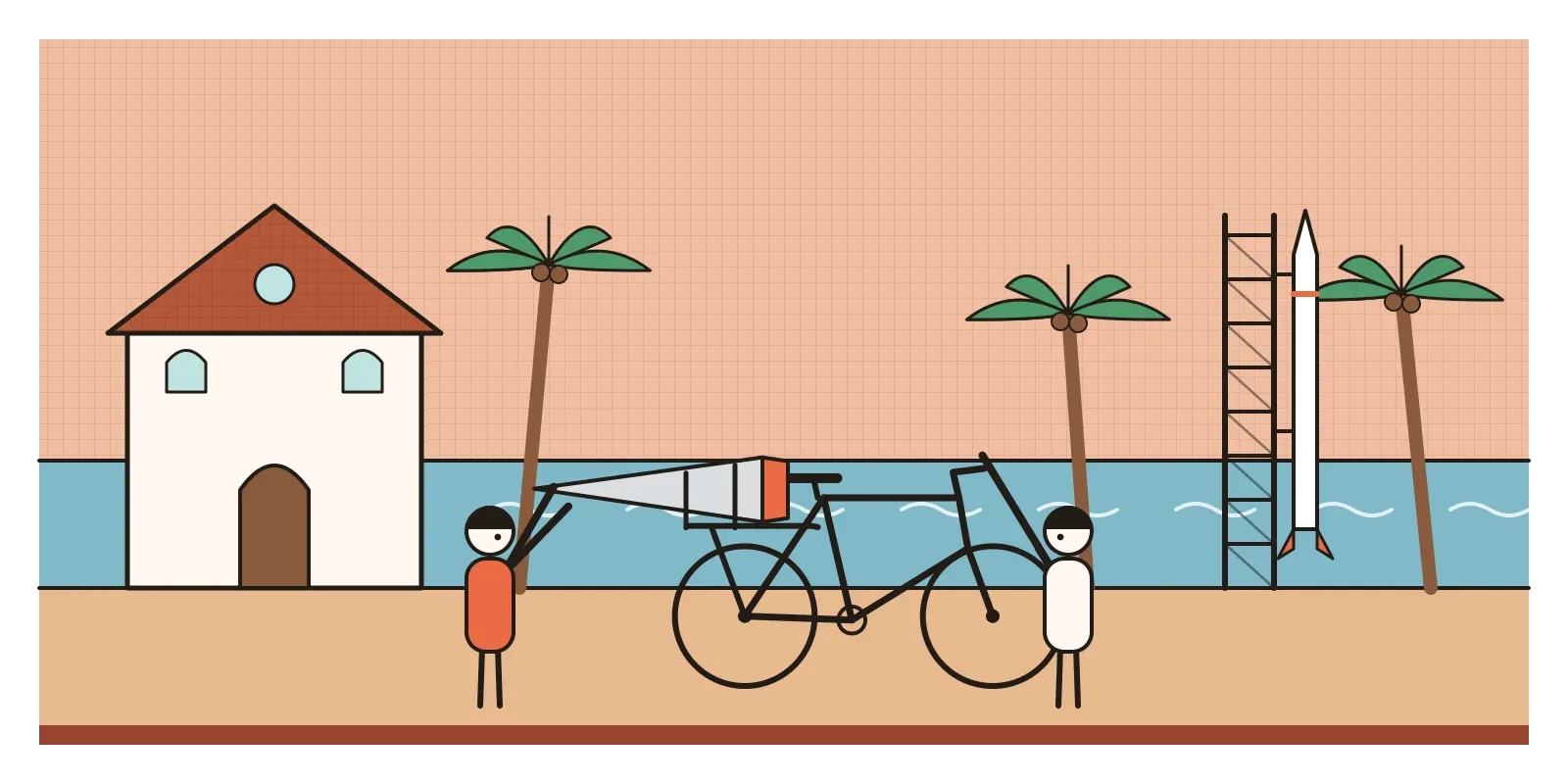
The space story is even more vivid. On 21 November 1963, India launched its first sounding rocket, a small American-made Nike-Apache, from Thumba, a fishing village near Thiruvananthapuram, chosen because it lies close to the magnetic equator. The scientists, led by Vikram Sarabhai, used the village church of St Mary Magdalene as a laboratory and office, and rocket parts were carried around the site on bicycles and, for heavier loads, a bullock cart. A famous photograph shows a nose cone strapped to the carrier of a bicycle. The church is now a space museum.
The contrast is the point. American Googie put rockets on coffee shop signs because rockets were exciting. India put rockets on bicycles because that was what it had. When Calcutta built the Birla Planetarium, opened in 1963, its dome is said to have been modelled on the stupa at Sanchi rather than on a flying saucer. The future, in India, was imagined through its own past. Look for Indian Googie and you'll find only loose echoes, like the starbursts painted on trucks and the chasing bulbs of wedding halls.
Starbursts that never went out
Googie's lasting gift to design is the idea that a building or an object can be a sign. Every fast-food chain with a giant logo on a pole, every shop front lit like a stage, every brand that wants to be recognised from a distance owes it something. The oldest surviving McDonald's, in Downey, California (1953), still has its two tall golden arches on either side of the building, which were part of the architecture before they became the logo. Disneyland's Tomorrowland (1955) turned the style into a theme park, and The Jetsons (1962) into a cartoon sitcom in the sky.
Today, retro-futurism is a style of its own, and starbursts and boomerangs keep returning in packaging, wallpaper, hotel interiors and video games. The lesson in optimism is worth keeping. Most interfaces now feel cautious and grey, and Googie is a reminder that delight is also a design decision.
Architects dismissed it as vulgar, commercial and dishonest, a style that faked structure for effect. Later critics pointed to darker things. The cheerful atom was printed on fabrics in the same years that schoolchildren practised hiding under desks in case of a nuclear attack, and the bikini swimsuit was named in 1946 after an atoll in the Pacific where atomic bombs were being tested on islands whose people had been moved away. The optimism belonged mostly to white, suburban, car-owning America, while new highways were often driven through poorer, Black neighbourhoods. And the style depended on cheap petrol and on waste: fins were restyled every year so that last year's car looked old.
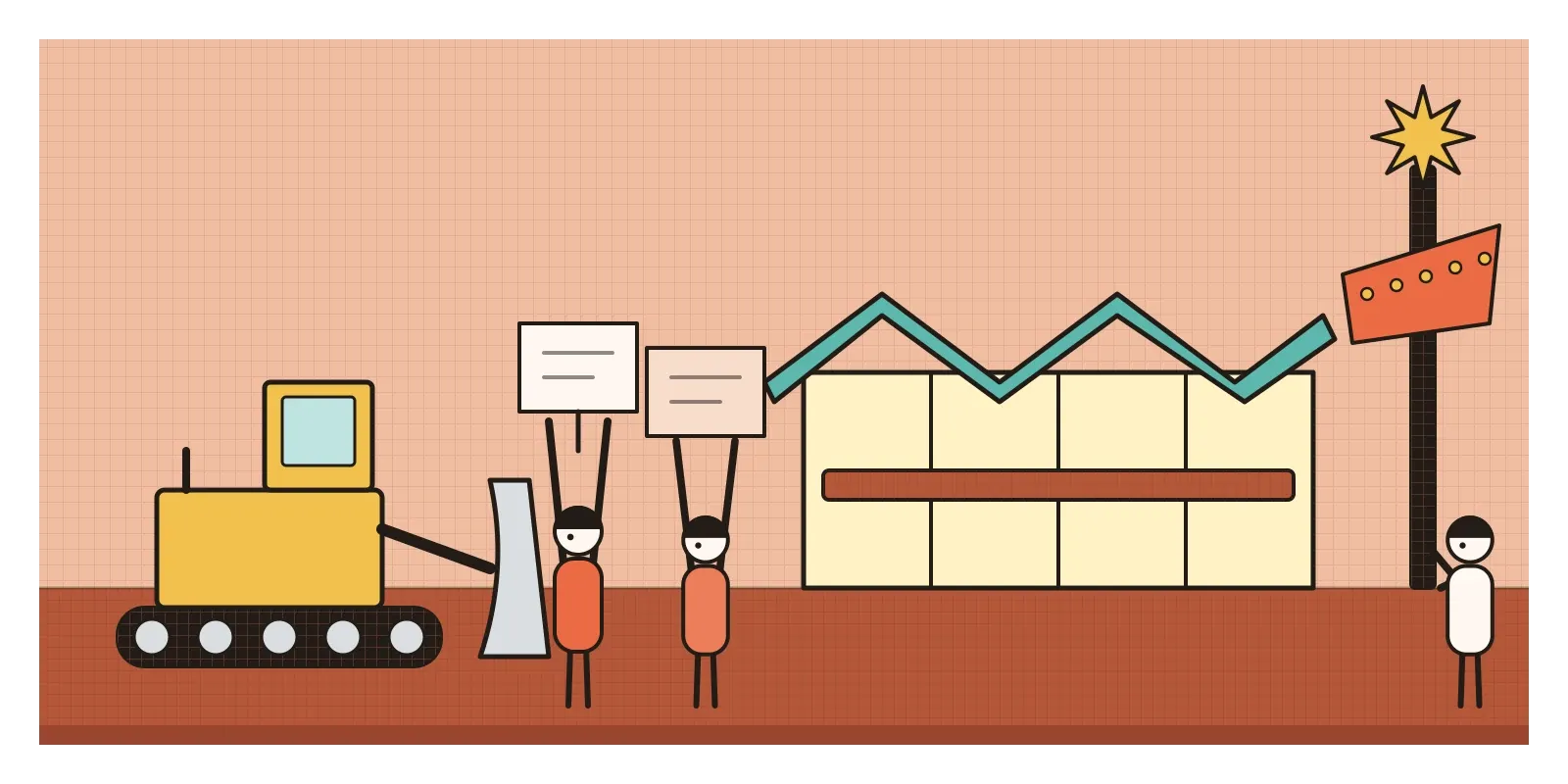
By the mid-1960s the style had run out of road. Real rockets became ordinary, the counterculture wanted something less corporate, and many Googie buildings were torn down. Googie's itself was demolished in 1989. That loss helped start a preservation movement: Alan Hess's 1985 book on coffee shop architecture made the case that this was a real style worth studying, and in 2015 Los Angeles declared Norms on La Cienega a historic monument after it was threatened with demolition. Designers had already replied. Pop, psychedelic posters and, later, Postmodernism took Googie's love of signs and popular taste and made it knowing and ironic, and in 1968 Robert Venturi and Denise Scott Brown took a class of Yale students to study the Las Vegas Strip seriously, which led to their 1972 book Learning from Las Vegas, mentioned in the post on form follows function.
Go and find a starburst
To see the Indian side of this story, visit the Space Museum at Thumba, near Thiruvananthapuram, inside the old church where the rocket scientists worked, or the Birla Planetarium in Kolkata. If you're in Los Angeles, have a slice of pie at Norms on La Cienega and look up at the roof. Alan Hess's Googie Redux is the best illustrated history, and Thomas Hine's Populuxe is a funny, sharp account of how ordinary American objects looked in those years.
For an exercise, walk down a busy road near you and look only at signs. Note which ones you can read at walking pace, which ones from a moving auto or bus, and which you'd notice only from a car at night. Then sketch a sign for a small shop that works at all three distances.
Googie's lifted off its corner of Sunset Boulevard for forty years without ever leaving the ground. The roof never flew, but it made a hamburger feel like the future, which is what a sign is for. In the next post, on Computational and Generative Art, the future arrives for real, as a few engineers and artists in the 1960s began asking a computer to draw.
Further reading: Alan Hess, Googie Redux: Ultramodern Roadside Architecture (2004) · Thomas Hine, Populuxe (1986) · Douglas Haskell, "Googie Architecture", House and Home (1952) · Lesley Jackson, The New Look: Design in the Fifties (1991)
A reply toThe plain white boxes of the International Style and the grey, rationed years of the Depression and the war.