Mid-Century Modern
How post-war American designers took wartime plywood, fibreglass and steel and turned them into cheerful furniture for ordinary homes.
Mid-Century Modern
The steel arrived, and the plan changed
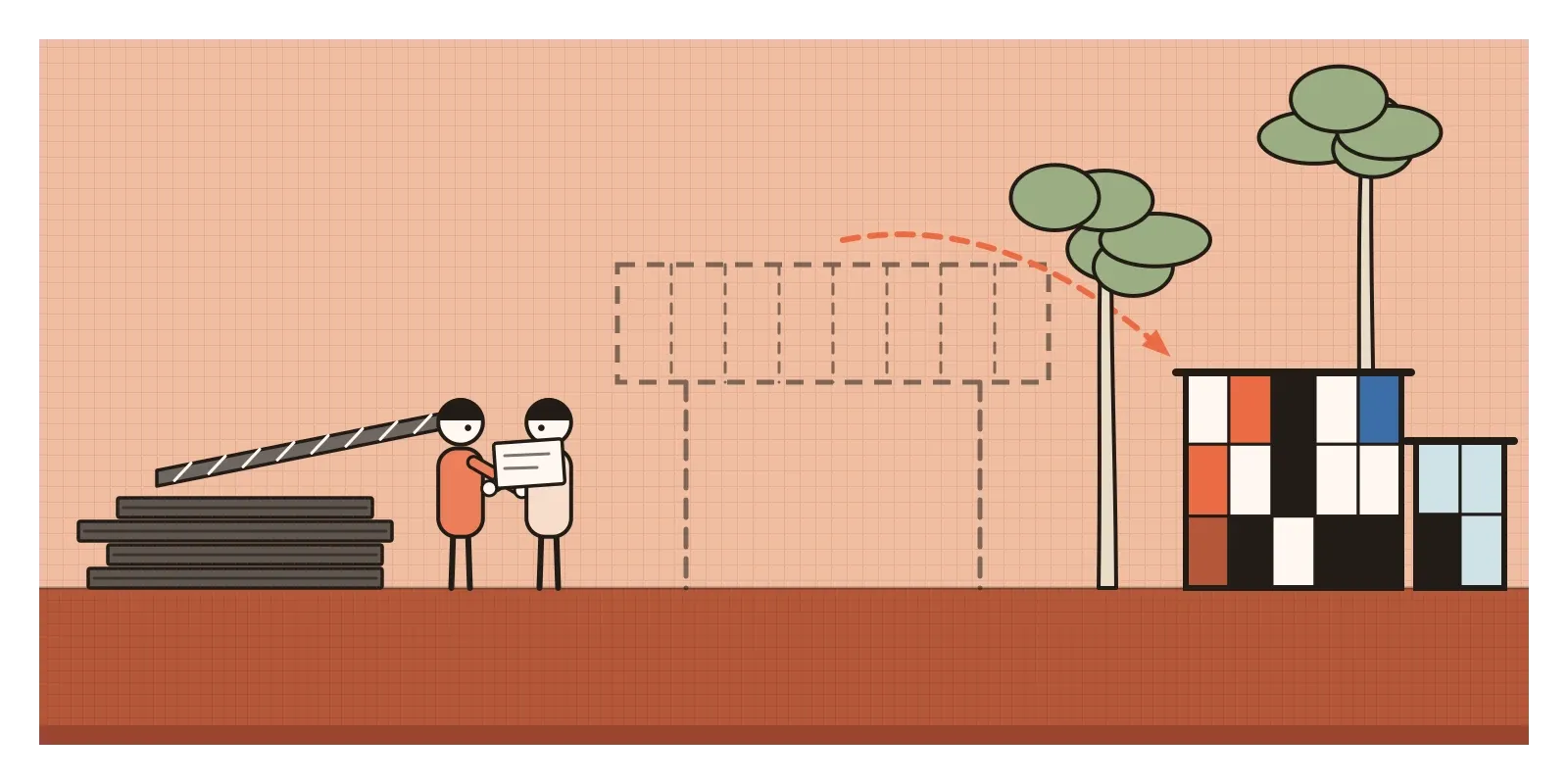
In 1945, Charles and Ray Eames ordered the steel for a house they had not quite finished designing. The site was a meadow on a bluff in Pacific Palisades, on the edge of Los Angeles, with a row of eucalyptus trees and a view of the ocean. The first plan, drawn with their friend Eero Saarinen, was a glass box lifted on steel legs and stretched out across the meadow like a bridge. The parts were all standard: steel beams, lightweight open-web joists and factory window frames, the kind of thing you could order from a manufacturer's catalogue.
Then nothing came. Steel was scarce after the war, and the parts didn't reach the site until 1948. In the meantime the Eameses had spent many afternoons on that meadow, picnicking and getting to know the trees, and they no longer wanted to fill it with a bridge. So they redesigned the house around the parts they had already bought. They tucked it into the slope behind the eucalyptus, as two simple boxes with a courtyard between them, and by most accounts they needed only one extra beam. The same kit of steel now enclosed far more space. They moved in around the end of 1949 and lived there for the rest of their lives.
That story holds most of what we now call mid-century modern, the style of American design, and some European design, from roughly 1945 to 1970. It is the look of moulded plywood and fibreglass chairs, of furniture on thin splayed legs, of glass walls, open-plan living rooms and bright accents against warm wood. Its makers believed that the factories and materials of the war could now make good, modern things for ordinary families. The name itself arrived much later. It was popularised by the writer Cara Greenberg, whose book Mid-Century Modern: Furniture of the 1950s came out in 1984, when the originals were already turning up in junk shops.
Softening the machine for the suburbs
The Eames House was part of an experiment. In January 1945, John Entenza, editor of the Los Angeles magazine Arts & Architecture, announced the Case Study House programme. The magazine would commission architects to design and build model homes for the post-war world, using new materials and industrial methods, and open them to the public. Millions of servicemen were coming home, the government's GI Bill was helping them buy houses, and America faced a severe housing shortage. Suburbs were spreading fast. In 1947 the developers Levitt and Sons began building Levittown on Long Island, putting up identical houses with assembly-line speed.
The war had also left behind a set of new techniques: plywood bent into compound curves, plastics reinforced with glass fibre, aluminium, new glues and new ways of bonding rubber to wood. Designers who had spent the war making splints, radar domes and aircraft parts now wanted to use them at home.
What they replied to was the modernism of 1920s Europe, which has its own posts earlier in this series. The Bauhaus and the International Style had promised furniture for everyone, but in practice tubular steel chairs and white villas often ended up as luxuries for an educated few, and many Americans found them cold. Most American homes, meanwhile, were still filled with heavy reproduction furniture in colonial and period styles. Mid-century designers kept modernism's honesty about materials and its dream of mass production, and added what it had lacked: warmth, curves, colour and a sense of humour. Historians disagree about the exact boundaries. Some start the period in the 1930s, some include Scandinavian design, which I wrote about in the last post, and some stop at 1965. I've used the narrower American story here.
Plywood, fibreglass and a chair on television
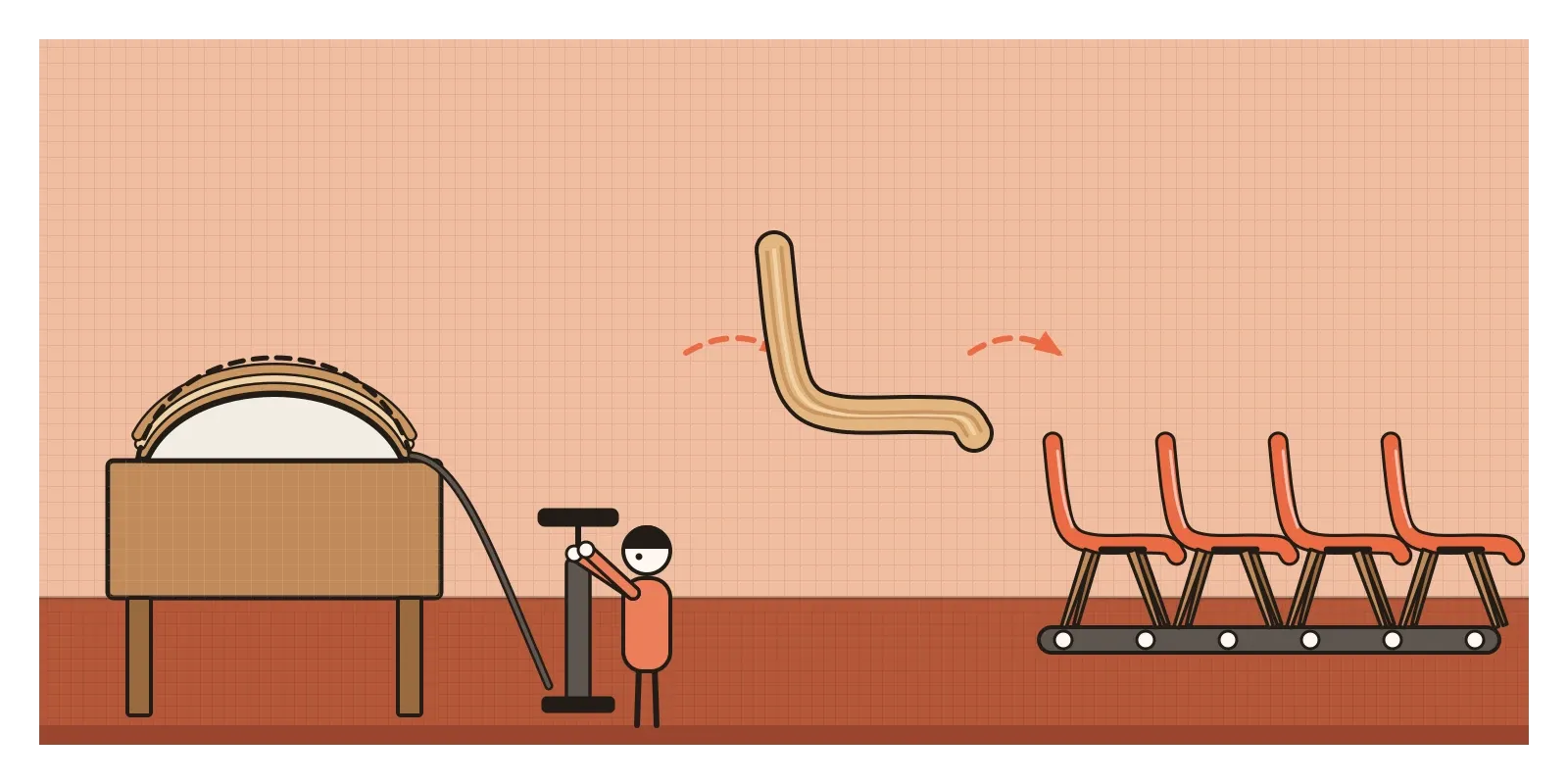
Charles Eames, who had trained as an architect, and Ray Kaiser, a painter, met at the Cranbrook Academy of Art in Michigan, married in 1941 and moved to Los Angeles. In their apartment they built a homemade machine for pressing thin layers of wood veneer into curved shapes, heated with electric wires and squeezed with a bicycle pump. They called it the Kazam! machine. In 1942 their experiments became a moulded plywood leg splint for the US Navy, made in large numbers, and after the war the same technique produced their plywood chairs, sold by the Michigan furniture company Herman Miller.
Their next leap came through a competition. In 1948 the Museum of Modern Art in New York held an International Competition for Low-Cost Furniture Design, and the Eameses entered seat shells moulded in one piece. By 1950, their shell chairs were being made in fibreglass-reinforced plastic, among the first mass-produced plastic chairs, and the same seat could sit on wooden legs, a metal base or rockers. In 1956 they went the other way, with a luxurious lounge chair and ottoman in moulded plywood and leather. It was introduced to the public on NBC's Home television show. Charles said he wanted it to have the comfortable, broken-in look of a well-used baseball glove.
George Nelson was the person who brought many of these designers together. In 1945 he and Henry Wright published Tomorrow's House, a book that proposed the storage wall, a built-in wall of shelves and cupboards that replaced bulky freestanding furniture. Herman Miller's owner, D. J. De Pree, liked the idea so much that he made Nelson the company's design director. Nelson then brought in the Eameses, the sculptor Isamu Noguchi and the textile designer Alexander Girard. His office also produced some of the period's most cheerful objects, like a clock whose hours are marked by little balls on spokes and a sofa made of round, brightly coloured cushions on a steel frame. Both carry Nelson's name, but the designer Irving Harper, who worked in his office, later said he had designed them, a common story in studios of the time.
Eero Saarinen, son of the Finnish architect who ran Cranbrook, designed a family of chairs and tables for the furniture company Knoll in the mid-1950s, each standing on a single slender pedestal. He said he wanted to clean up what he called the "slum of legs" under tables and chairs. His TWA terminal at New York's Idlewild airport, now JFK, opened in 1962 and spread its concrete roof like a bird about to take off. Florence Knoll, who had also studied at Cranbrook, ran Knoll with her husband Hans and led its Planning Unit, which redesigned the offices of large American companies with clean, low furniture, open layouts and carefully chosen fabrics. If you have worked in an open-plan office, you have worked in a descendant of her thinking.
Legs that splay and rooms that flow
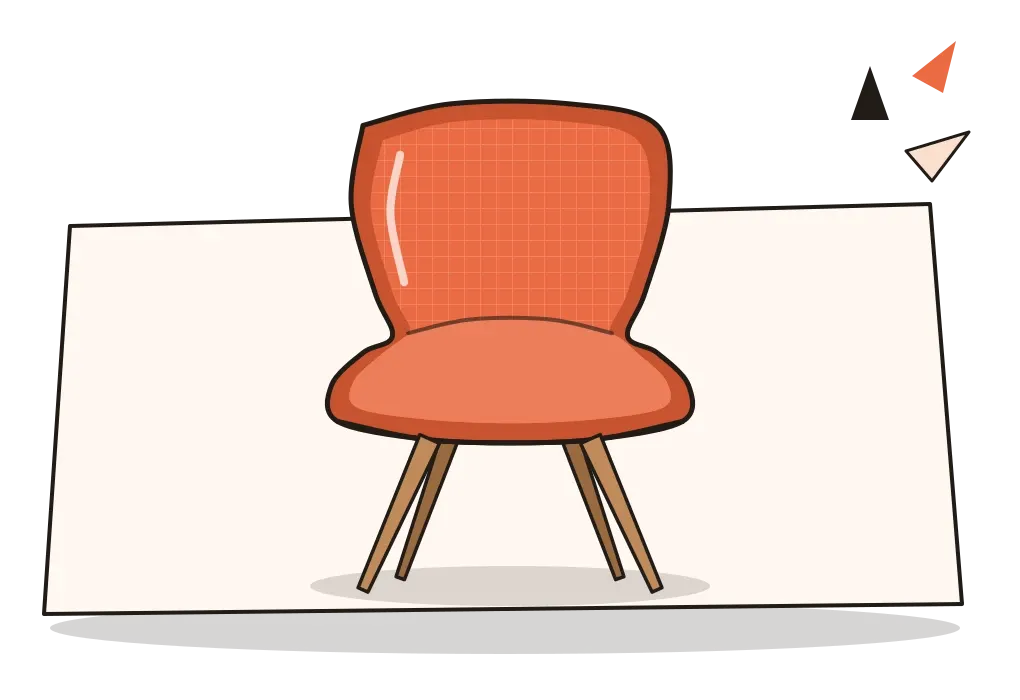
The easiest clue is the legs. Mid-century furniture is lifted off the floor on thin legs, often tapered and splayed slightly outwards, sometimes on a single pedestal or a wire base. That makes even a big sofa or sideboard look light, as if it were hovering, and lets the floor run underneath it, which makes rooms feel bigger. Seats are often shells, moulded in one piece with compound curves that follow the body. Shapes swing between strict rectangles, in cabinets and storage walls, and soft organic outlines, in kidney-shaped tables and boomerang-shaped trays.
The materials are honest about themselves. Plywood shows its layered edge, fibreglass shows its slightly flecked surface, and joints are often visible, like the rubber mounts that join an Eames seat to its frame. Wood is usually warm and dark, teak or walnut. Colour arrives in confident accents against white walls and wood: mustard yellow, olive, orange, turquoise and red. Houses open up, with walls of glass, sliding doors, post-and-beam structures and a single flowing space for living, eating and watching the new television.
Saris over a pool in New York
The most beautiful link between mid-century modern and India came in the spring of 1955, when the Museum of Modern Art opened Textiles and Ornamental Arts of India. The objects were chosen by Edgar Kaufmann Jr., the curator who also ran the museum's Good Design exhibitions, and the catalogue carried essays by Pupul Jayakar, who championed Indian handlooms and crafts, and John Irwin of the Victoria and Albert Museum. Alexander Girard designed the installation as an imaginary Indian bazaar, with gold columns around a long pool of water and dozens of saris hanging above it. The Eameses made a short colour film of the show.

It was at this exhibition that Jayakar met Charles Eames, the start of a conversation that led to the Eameses' journey through India in 1958 and their report on design education, which has its own post shortly. In the post on design, art and craft, I mentioned their admiration for the lota. Mid-century designers were genuinely fascinated by Indian craft. Girard collected folk objects from around the world, and the Eames House was famously crowded with them.
The exchange was uneven, though. In New York, Indian textiles were displayed as inspiration for American taste, while India itself was trying to build industries, design schools and modern cities of its own. India's closest cousin of American mid-century furniture came out of that effort: Pierre Jeanneret's teak and cane chairs for Chandigarh, made by local carpenters, which I wrote about in the post on modernism in design. The two share a lot, light frames lifted on angled legs, local wood, honest joints and the hope that good design could furnish a whole new society. The difference is that Jeanneret relied on Indian carpenters and their workshops rather than moulding presses, so the parallel is real but loose.
The chair in every café
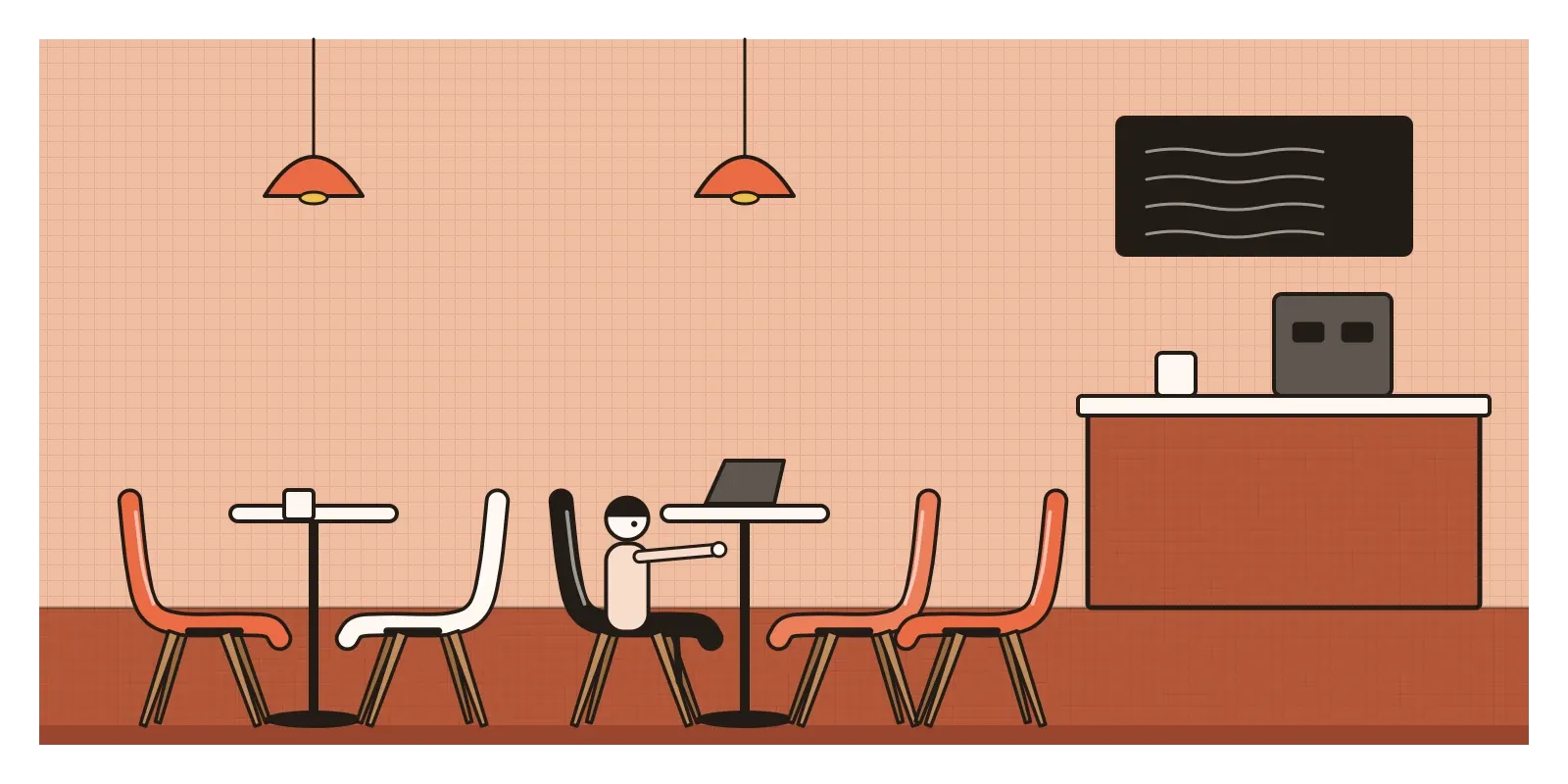
Mid-century modern is probably the most copied furniture style in the world. Go into almost any café or co-working space and you'll see moulded plastic shell chairs on wooden or wire legs, mostly cheap copies. Herman Miller and Knoll, the two companies that made much of the original work, merged in 2021 as MillerKnoll, and both still sell the designs. The television series Mad Men, which began in 2007, helped turn the style into a lifestyle shorthand for good taste, and today "mid-century modern living room" is one of the most common prompts people type into AI image tools.
The deeper traces are in how designers work. The Eames House is a lesson in building something personal from standard, off-the-shelf parts, which is exactly what a component library asks a product team to do. The shell chair, one seat on many bases, is a design system in miniature. The Eameses also worked for IBM, making exhibitions and films about computers and mathematics, and their 1977 film Powers of Ten, which zooms out from a picnic to the edge of the universe and back down into a hand, is a direct ancestor of every map and photo app that lets you pinch from a street to a planet.
A bright future, for some
The optimism of mid-century modern had limits. The suburbs it furnished were often closed to many Americans. Levittown's early contracts barred Black families from buying homes, and federal lending rules steered money away from Black neighbourhoods. The Case Study houses, meant as models for everyone, were mostly built for affluent professionals, and most post-war families bought conventional houses instead.
Credit was uneven too. Newspapers often described Ray Eames as Charles's wife and helper, although she was a full partner in the work, and the names of designers like Irving Harper stayed hidden behind their bosses'. The new materials had costs that nobody counted at first. Herman Miller stopped making fibreglass shells in the late 1980s because of environmental concerns about the process, and switched to a recyclable plastic in 2000, before bringing back fibreglass made by a cleaner process in 2013. Early lounge chairs were veneered in Brazilian rosewood, a tree now so endangered that international trade in it is banned.
By the mid-1960s, younger designers found all this tasteful restraint dull. Pop design answered it with disposable paper chairs and inflatable plastic armchairs, and the radical designers of Italy, who have their own post later in this series, questioned whether more beautiful products were the answer at all.
To see it for yourself, visit the Pierre Jeanneret Museum in Chandigarh, set in the house where Jeanneret lived, for India's own mid-century furniture. If you're ever in Los Angeles, the Eames Foundation runs visits to the Eames House. Watch Powers of Ten online; it's nine minutes long. Then try a small exercise. Look at the legs of every chair and table in your home and count how many are lifted, splayed or tapered, and then design a room using only five standard parts, the way the Eameses did with their steel. In the next post, on Abstract Expressionism, I'll go to New York painters of the same years. It's a fitting move, because before she was a designer, Ray Eames was a painter who studied with Hans Hofmann, the teacher of many of them. She knew that a pile of parts, like a blank canvas, could become something nobody had planned.
Further reading: Pat Kirkham, Charles and Ray Eames: Designers of the Twentieth Century (1995) · Cara Greenberg, Mid-Century Modern: Furniture of the 1950s (1984) · Elizabeth A. T. Smith, Case Study Houses (2002) · Stanley Abercrombie, George Nelson: The Design of Modern Design (1995) · Lesley Jackson, The New Look: Design in the Fifties (1991)
A reply toThe cold tubular steel of pre-war European modernism, and the heavy period furniture of the American home.