Abstract Expressionism
How a group of New York painters put the canvas on the floor and made the act of painting the subject.
Abstract Expressionism
A painter seen from underneath
In the summer of 1950, a young German-born photographer called Hans Namuth drove out to Springs, a village near East Hampton on Long Island, to photograph Jackson Pollock at work. Pollock painted in a converted barn behind his house. When Namuth arrived, by his own account, Pollock told him the painting on the floor was finished. Then he looked at it again, picked up a can of paint and a stick, and started walking around the canvas, flicking and pouring long loops of paint onto it while Namuth photographed him.
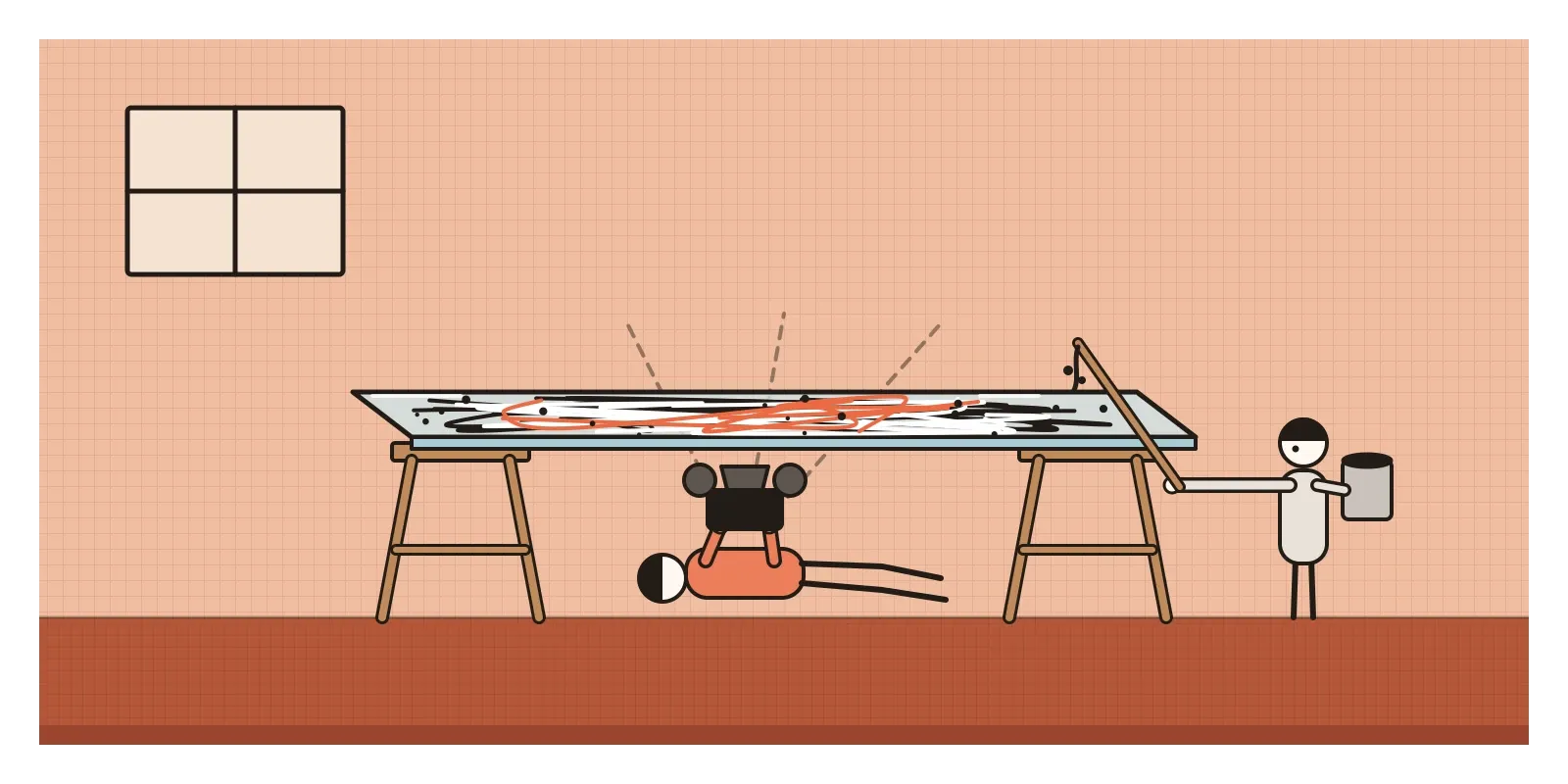
That autumn, Namuth came back with a film camera. Outdoors the light kept changing, so he had an idea that sounds like a magician's trick. Pollock would paint on a large sheet of glass raised on supports, and Namuth would lie underneath and film him from below, so that the paint seemed to land on the lens. The painting made that way, Number 29, 1950, a web of paint, pebbles, wire mesh and string, is now in the National Gallery of Canada. The short film, made with Paul Falkenberg, and Namuth's photographs, published in the magazine ARTnews in 1951, did something no painting could do on its own. They showed millions of people that the way a picture was made could be the point of it.
That's the heart of Abstract Expressionism, the first American art movement to change painting everywhere. From the early 1940s to the late 1950s, a loose group of painters in New York made very large abstract pictures in which gesture, colour and scale carried the feeling, rather than any recognisable subject. Critics called them the New York School. They never agreed on a name or a manifesto, and several hated the label we use now.
Refugees, relief cheques and a city with something to prove
The movement grew out of the Depression and the war. In the 1930s the American government's Federal Art Project, part of the New Deal, paid artists a weekly wage to paint murals and teach. Pollock, Lee Krasner, Willem de Kooning and Mark Rothko all worked for it at some point. It kept them alive and got them used to working big. In 1936 Pollock also joined a workshop run by the Mexican muralist David Alfaro Siqueiros, where students poured and dripped industrial paint.
Then, around 1940, the war brought Europe to New York. The Surrealists Max Ernst, André Masson and André Breton, the abstract painter Piet Mondrian and many others arrived as refugees. The young Americans met them in studios and at Peggy Guggenheim's gallery, Art of This Century, which opened in 1942. The New Yorkers took the Surrealists' automatism, drawing without conscious control, which has its own post earlier in this series, and made it physical. Guggenheim gave Pollock his first solo show in 1943 and a monthly contract.
What they replied to was the art around them. The best-known American painting of the 1930s was Regionalism, folksy scenes of farms and small towns by painters like Thomas Hart Benton, who happened to be Pollock's teacher. Social Realism told stories about workers and injustice. Both seemed small after a war that had produced the Holocaust and the atomic bomb. The other target was Paris. They admired Picasso and Miró but wanted to stop being their pupils. The phrase "abstract expressionism" had been used before, for Kandinsky, and the critic Robert Coates applied it to the New Yorkers in 1946. Historians still argue about where it begins and ends; I've used the usual dates, from the early 1940s to Pollock's death in 1956.
Drips, zips and a painting worked on for two years
The painters split, roughly, into two camps. The first made pictures from visible gestures. Pollock's drip paintings of about 1947 to 1950 are the famous example. In Autumn Rhythm (1950), at the Metropolitan Museum of Art, black, white and brown skeins of enamel paint loop across a canvas more than five metres wide, with no centre and no edge that matters more than any other. In 1947 Pollock wrote that he preferred to work on the floor, where he could walk round the canvas and feel part of it, and compared his method to the sand paintings of Native American healers in the West. He had probably seen Navajo artists demonstrate sand painting at the Museum of Modern Art in 1941.
Lee Krasner, who married Pollock in 1945, made her Little Image paintings in an upstairs bedroom at Springs between about 1946 and 1950: small canvases covered edge to edge with thick, tiny marks arranged like a grid of private hieroglyphs. Willem de Kooning, a Dutch immigrant who had arrived as a stowaway, spent about two years on Woman I (1950 to 1952), painting, scraping off and repainting a ferocious female figure with a toothy grin. As I wrote in the post on Persian miniature painting, its sister Woman III later ended up in a strange exchange with Iran. Franz Kline painted huge black strokes on white, like enlarged fragments of calligraphy, after seeing his small brush drawings blown up by a projector.
The second camp worked with colour. Mark Rothko stacked two or three soft-edged rectangles of colour on a coloured ground, painting in thin washes so that the edges seem to breathe. He wanted viewers to stand close. In 1958 he took on murals for the Four Seasons restaurant in New York's Seagram Building, then withdrew; nine of those dark red paintings went to the Tate in London, arriving on the day in 1970 that he died. Barnett Newman covered enormous canvases with flat colour broken by thin vertical stripes he called zips. Vir Heroicus Sublimis (1950 to 1951), at the Museum of Modern Art, is more than five metres of red cut by five zips. Helen Frankenthaler bridged the two camps. In Mountains and Sea (1952) she poured thinned paint onto raw, unprimed canvas laid on the floor, so the colour soaked in like a stain.
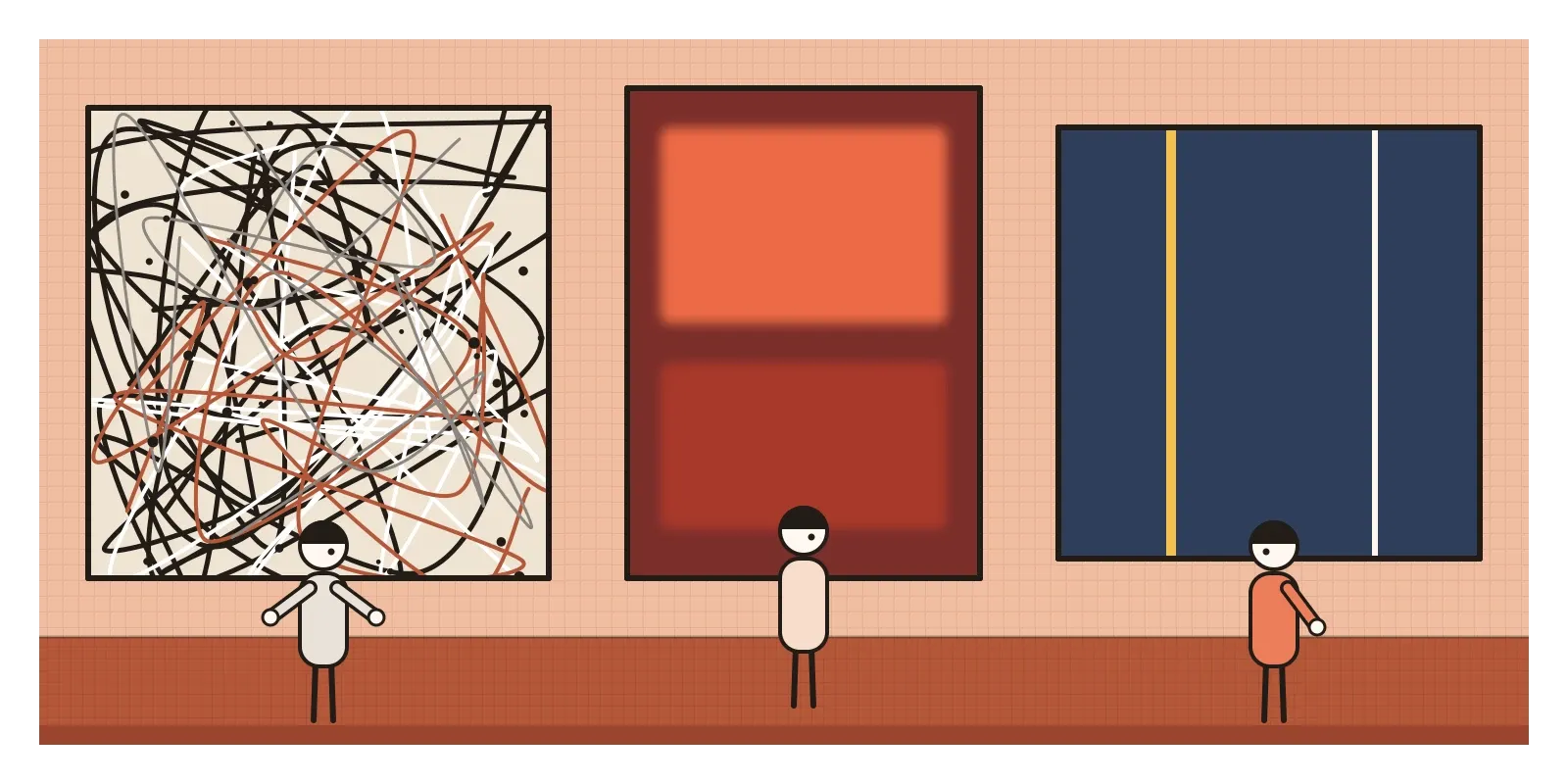
Two critics fought over what it all meant. Clement Greenberg argued that these painters were purifying painting down to what only painting could do, which was to be a flat surface covered in colour. Harold Rosenberg, in a famous 1952 essay in ARTnews, called them "action painters" and said the canvas had become an arena in which to act. Rosenberg's version became the myth: a lone, heroic man wrestling with paint, just as Namuth's photographs showed.
No centre, no frame, no story
Look first at the size. These paintings are often taller than you and wider than your arms. They're meant to fill your field of vision, so that you stand inside the picture rather than looking at it like a window. Then look for a centre. Usually there isn't one. Pollock's drips spread evenly to the edges, a quality critics called "all-over" composition, and Rothko's rectangles float without pointing anywhere in particular.
The materials tell the story of how they were made. You'll find house paint and industrial enamel next to artists' oils, sticks and hardened brushes, trowels, raw canvas and paint thinned until it runs. Drips are left in, and so are scrapes, crusted ridges and the places where a stroke ran out. The record of the hand is the content. Colour ranges from Kline's black and white to Rothko's glowing maroons and oranges. Titles are often just numbers or vague words, because the painters didn't want you looking for a story.
A roller, a palette knife and a room in Nizamuddin
The Indian painter closest to this world was Vasudeo S. Gaitonde, who was born in Nagpur in 1924 and trained at the Sir J. J. School of Art in Bombay. He exhibited with the Progressive Artists' Group, which has its own post next, and by the end of the 1950s he had moved away from painting things. He put down the brush, began working flat on a table, and built his pictures with a roller and a palette knife, laying down thin, translucent layers of colour, scraping them back and rolling on more. In 1964 a Rockefeller fellowship took him to New York for a year, where he could see the Abstract Expressionists' paintings for himself.
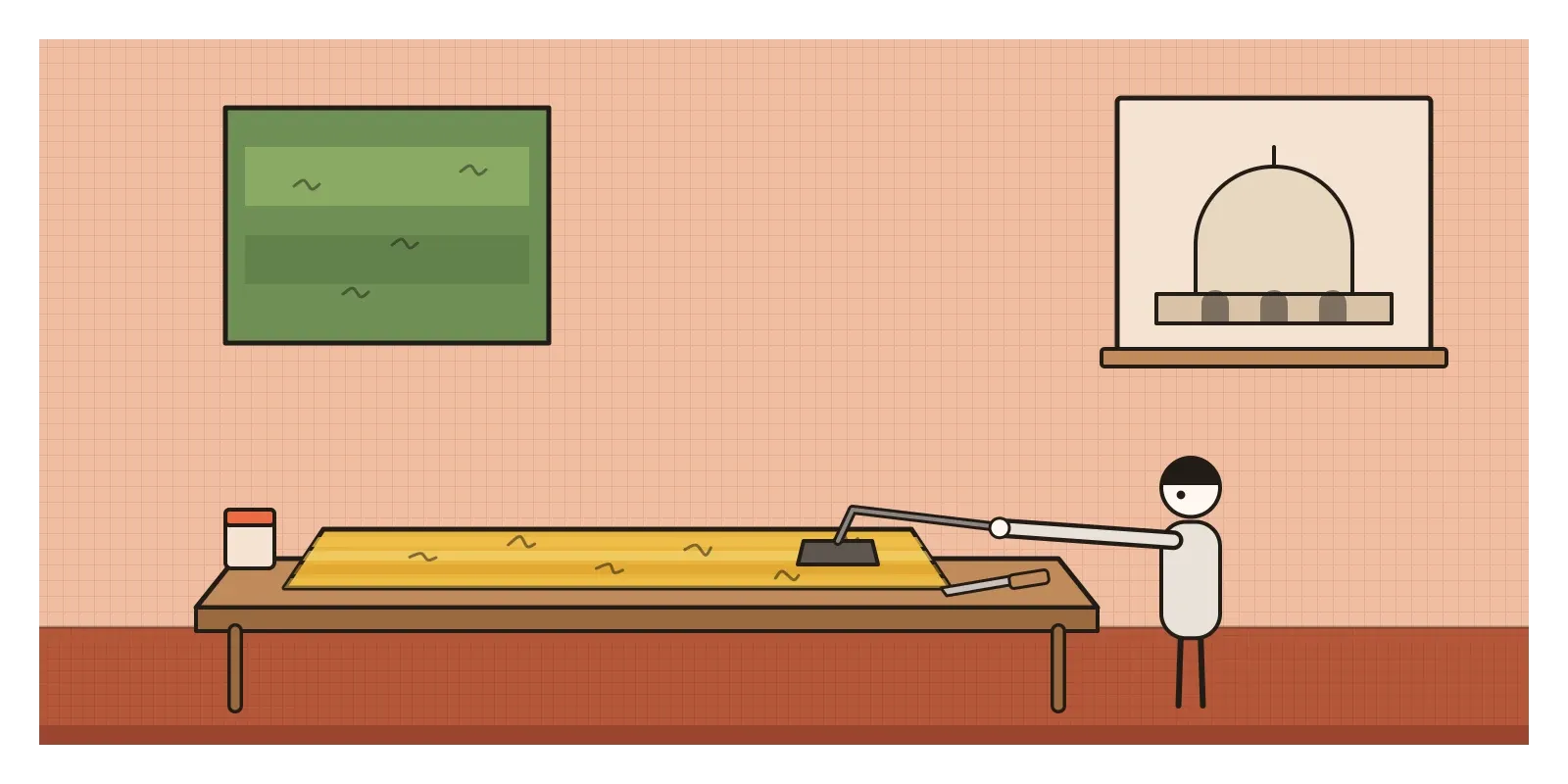
It's tempting to file Gaitonde as India's Rothko, and the comparison is half right. His mature paintings are fields of glowing yellow, green or ochre in which small, half-dissolved marks float like the remains of an ancient script. Like Rothko, he wanted silence in front of his pictures. But he disliked the word abstract and preferred to call his work non-objective, and he drew on Zen Buddhism and East Asian calligraphy rather than heroic gesture. His paintings are mostly modest in size. Where Pollock's drama was in the movement of his body, Gaitonde's was in waiting. By many accounts he could spend weeks looking at a canvas before touching it again.
He moved to Delhi in 1971 and lived for decades in a single rented room in Nizamuddin East, painting very little in some years. In 2014 the Solomon R. Guggenheim Museum in New York, Pollock's city, gave him a full retrospective, curated by Sandhini Poddar, a rare honour for an Indian modern painter. It was a quiet reply across fifty years: New York's painting had a cousin in India that had been doing something different all along.
The process video and the colour field
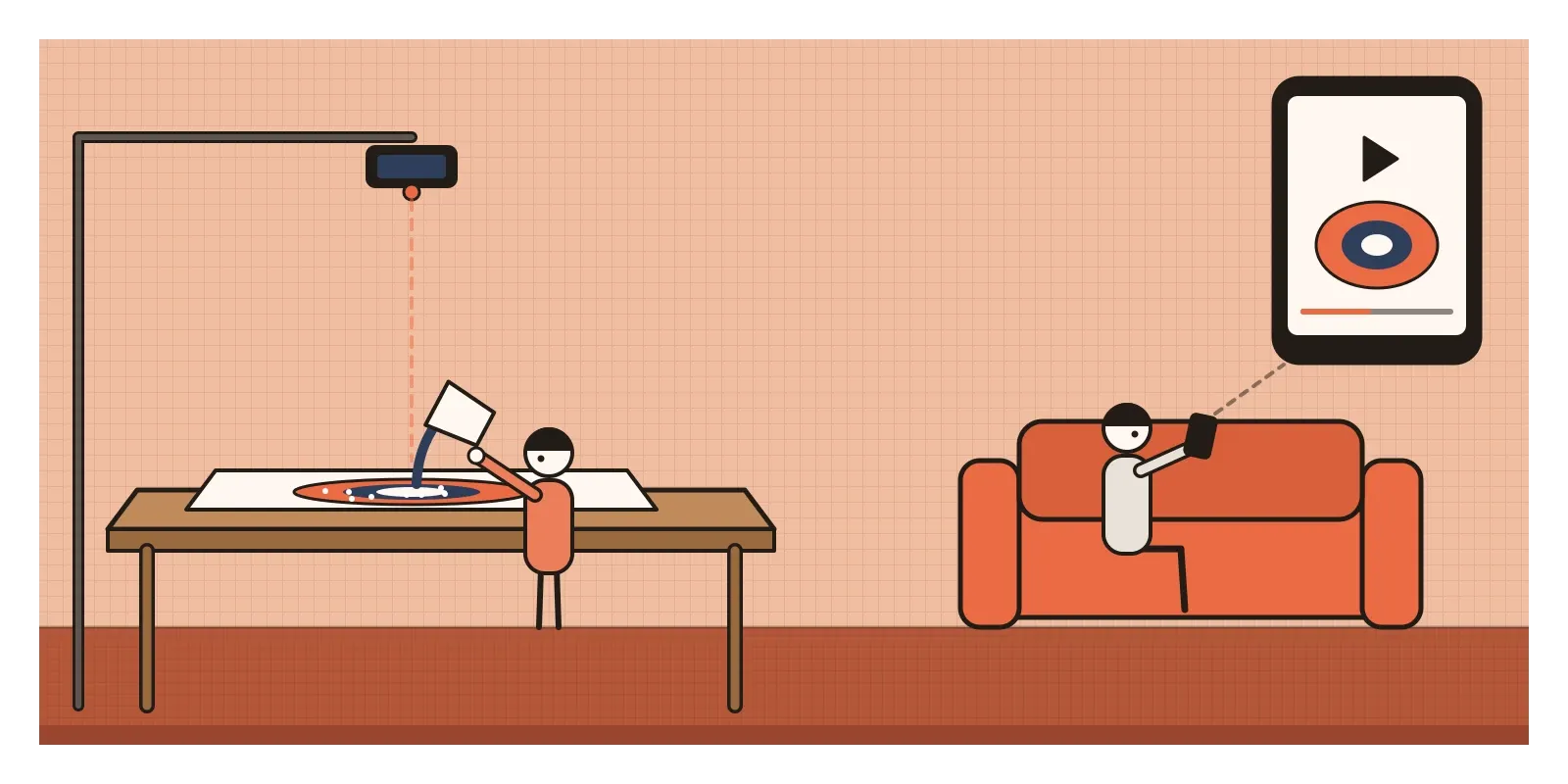
The most direct trace of Abstract Expressionism in today's world isn't a painting. It's Namuth's idea of filming the process. Every overhead time-lapse of someone pouring resin, every speed-painting video and every reel of a hand drawing on a tablet descends from that camera under the glass. They sell the same promise: watch the making, and the result means more.
Designers borrow the colour field constantly. Large, soft-edged blocks of colour with nothing on them are the backbone of countless wallpapers, landing pages and album covers, and gradient meshes in design tools are a way of getting Rothko's breathing edges without the months of glazing.
The all-over composition left a mark too. Pollock showed that a surface can be organised without a focal point, a lesson in every pattern, texture and generative background you've used to make a screen feel alive without distracting from its content. And because these paintings look, to an untrained eye, like something a machine could make, they've become a favourite test for AI image tools. Type "in the style of Pollock" and you get the splatter, but rarely the rhythm, the sense that each loop answers the one before it.
Heroes, the Cold War and who was left out of the photograph
In January 1951, Life magazine published a photograph of fifteen painters who had protested against the Metropolitan Museum of Art's conservative choices for a big exhibition. The press called them "the Irascibles". Fourteen are men in suits. The one woman, Hedda Sterne, stands on a table at the back. That picture sums up the movement's biggest blind spot. Krasner, Elaine de Kooning, Grace Hartigan, Joan Mitchell and Frankenthaler were working at full power in the same years, and many were treated as wives, students or footnotes. Black painters such as Norman Lewis, who took part in the group's discussions and made fine abstract pictures, were left out of the story for decades. And Pollock's admiration for Navajo sand painting, a sacred healing practice, was a borrowing he never had to ask permission for.
Then there's politics. In 1958 and 1959 the Museum of Modern Art sent The New American Painting on a tour of eight European countries. In 1974 the critic Eva Cockcroft argued that Abstract Expressionism had been used as a weapon in the Cold War, a picture of American freedom set against Soviet Socialist Realism. The CIA did quietly fund cultural organisations that promoted American art abroad, though historians still argue about how much this mattered. Meanwhile, at home, some politicians attacked modern art as communist.
The heroic myth also hurt the painters. Pollock had stopped drinking for two years, and by many accounts he started again on the evening the filming ended. He died in a car crash in 1956, at forty-four. Rothko took his own life in 1970. The next generation answered with a laugh. In 1953 Robert Rauschenberg asked de Kooning for a drawing and spent weeks erasing it, and Jasper Johns painted flags and targets, things that already existed. Pop Art and Minimalism, which have their own posts later, replied to the inner struggle with comic strips and steel boxes.
To see it for yourself in India, look for Gaitonde's paintings at the National Gallery of Modern Art in New Delhi or Mumbai, or the Kiran Nadar Museum of Art in Delhi, and stand close for longer than feels normal. Watch Namuth's ten-minute film online. Then try a small exercise. Tape a large sheet of paper to the floor, thin some poster paint until it drips from a stick, and work on it from all four sides for ten minutes without a picture in mind. Afterwards, ask what decided where each loop went: your hand, your feet or the paint. That's what Namuth was really filming from under the glass. In the next post, on the Progressive Artists' Group, I'll go to Bombay in the same years, where six young painters were building a modern Indian art of their own.
Further reading: Irving Sandler, The Triumph of American Painting: A History of Abstract Expressionism (1970) · Serge Guilbaut, How New York Stole the Idea of Modern Art (1983) · Mary Gabriel, Ninth Street Women (2018) · Steven Naifeh and Gregory White Smith, Jackson Pollock: An American Saga (1989) · Sandhini Poddar, V. S. Gaitonde: Painting as Process, Painting as Life (2014)
A reply toThe folksy realism of American Regionalist painting, and Paris's claim to be the only home of modern art.