Mexican Muralism
How painters after the Mexican Revolution took art off the easel and put a nation's story on public walls.
Mexican Muralism
A face on the wall at Rockefeller Center
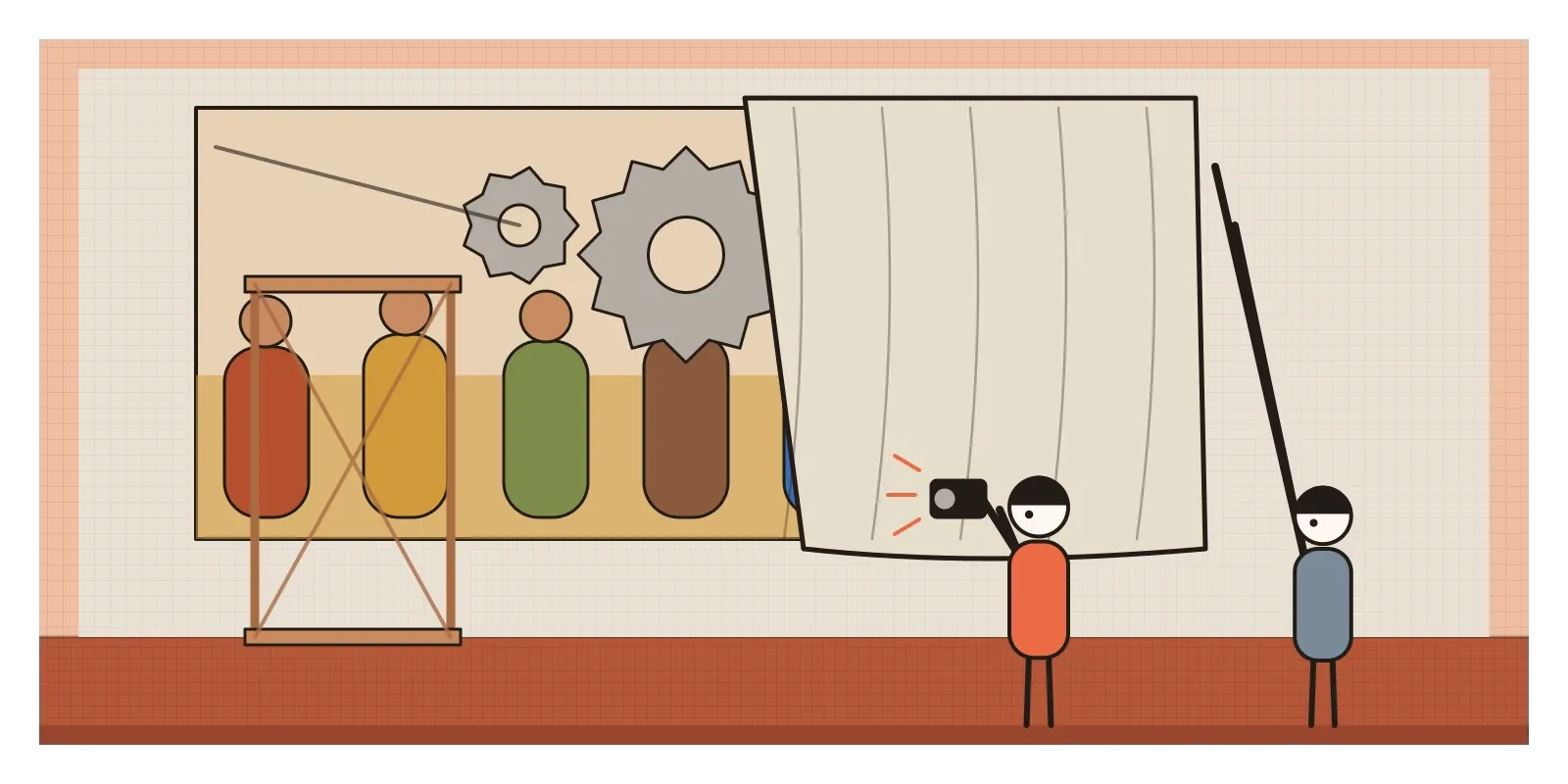
In the spring of 1933, the Mexican painter Diego Rivera was up on a scaffold in the lobby of the RCA Building, the new centrepiece of Rockefeller Center in New York, painting a fresco called Man at the Crossroads. The commission came from the Rockefeller family itself. The theme they'd agreed on was humanity choosing its future between two paths, and Rivera filled the wall with giant machines, microscopes, telescopes, marching workers and crowds. Then, in late April, a newspaper reported that among the workers he had painted a recognisable portrait of Lenin.
On 4 May, the young Nelson Rockefeller wrote to Rivera, politely asking him to replace Lenin's face with that of an unknown man. Rivera refused, though he offered to add Abraham Lincoln on the other side to balance it. On 9 May he was paid his full fee, ordered down from the scaffold and escorted out, and the unfinished wall was covered over. Before it disappeared, his assistant Lucienne Bloch photographed it with a small camera, against orders. In February 1934 the fresco was chipped off the wall and destroyed. Rivera went home and painted a new version, from Bloch's photographs and his own drawings, in the Palacio de Bellas Artes in Mexico City, where you can still see it.
It's a perfect story about Mexican Muralism, the movement that, from the early 1920s, put enormous paintings of history, labour and revolution on the walls of public buildings. Its painters believed art should belong to everyone, not to collectors, and should tell people the story of their own country. That belief was exactly what made a Communist painter on a capitalist's wall so explosive.
A revolution that needed a picture of itself
The Mexican Revolution, which began in 1910 against the long dictatorship of Porfirio Díaz, was a decade of civil war that killed hundreds of thousands of people. When it settled, around 1920, the new government under Álvaro Obregón faced a country where most people couldn't read, many spoke Indigenous languages rather than Spanish, and there was no shared picture of what the nation was.
Under Díaz, official taste had looked to Europe. The Academy of San Carlos in Mexico City taught French and Spanish academic painting, and wealthy families decorated their homes in Parisian style. In 1910, for the centenary of independence, the government even staged an exhibition of Spanish art. The painter Gerardo Murillo, who called himself Dr. Atl, answered with a rival show of Mexican artists, a first small act of cultural independence.
In 1921 the philosopher José Vasconcelos became Mexico's minister of public education, and he did something extraordinary: he gave painters the walls of public buildings, schools, ministries and colleges, and paid them, modestly, to cover them. That same year Rivera came home after more than a decade in Europe. In Paris he had painted Cubist pictures, as I mentioned at the end of the post on Vorticism and Orphism, and then spent months in Italy studying Renaissance frescoes. He came back convinced that the easel painting, made to hang in a private drawing room, was a dead end, and that the wall was the future.
Three giants and the women beside them
Mexican Muralism is usually told as the story of three men, los tres grandes. Rivera was the storyteller. In the courtyards of the Ministry of Public Education in Mexico City, between 1923 and 1928, he painted more than a hundred panels across three storeys: miners, weavers, sugar-cane cutters, village festivals and teachers. His figures are rounded, calm and solid, his colours warm earth reds, ochres and greens, and the crowds are arranged with the clarity of an Italian altarpiece.
José Clemente Orozco was the tragedian. He had lost his left hand as a young man in an accident with gunpowder, and he painted the Revolution not as a triumph but as a catastrophe, with soldiers trudging into the dark and women mourning. His masterpiece covers the walls and the dome of the Hospicio Cabañas, an old orphanage in Guadalajara, painted from 1936 to 1939. Look up into the dome and a burning figure seems to rise into the sky, a man made of fire.
David Alfaro Siqueiros was the agitator and the experimenter. In 1922 he helped found a union of painters and sculptors whose manifesto, published in 1924 in its newspaper El Machete, declared that public, monumental art was for the people and that easel painting was aristocratic. Siqueiros wanted modern materials for a modern art. He painted with industrial lacquers and spray guns, used photographs and projectors to plan compositions, and in 1936 ran an experimental workshop in New York where a young Jackson Pollock learned to pour and drip paint. In 1932 in Los Angeles he painted América Tropical, an Indigenous man crucified beneath an American eagle, on a wall on Olvera Street. It was whitewashed within a few years and only conserved and reopened to visitors in 2012.
The movement wasn't only the three men. Aurora Reyes, a teacher and poet, painted a mural in 1936 showing rural teachers being attacked, which made her one of the first Mexican women muralists. The American sisters Marion and Grace Greenwood painted murals in Morelia and in Mexico City's Abelardo L. Rodríguez market in the 1930s. And Rivera's own American career, from the San Francisco Stock Exchange to the twenty-seven panels of Detroit Industry at the Detroit Institute of Arts in 1932 and 1933, paid for by Edsel Ford, made Mexican murals famous across the United States.
Wet plaster and a day's work
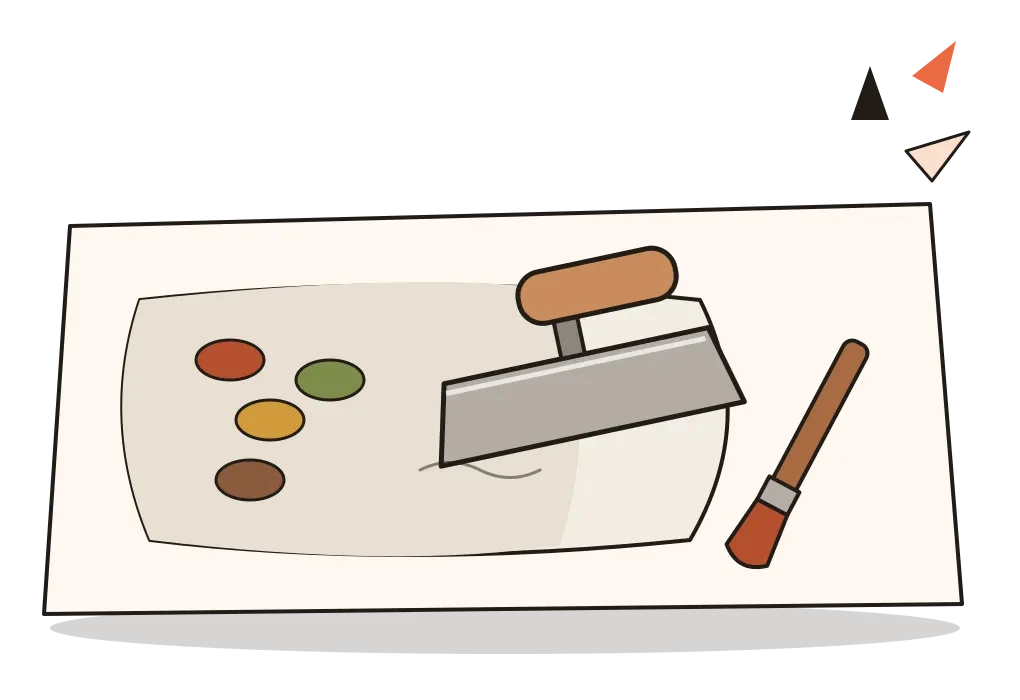
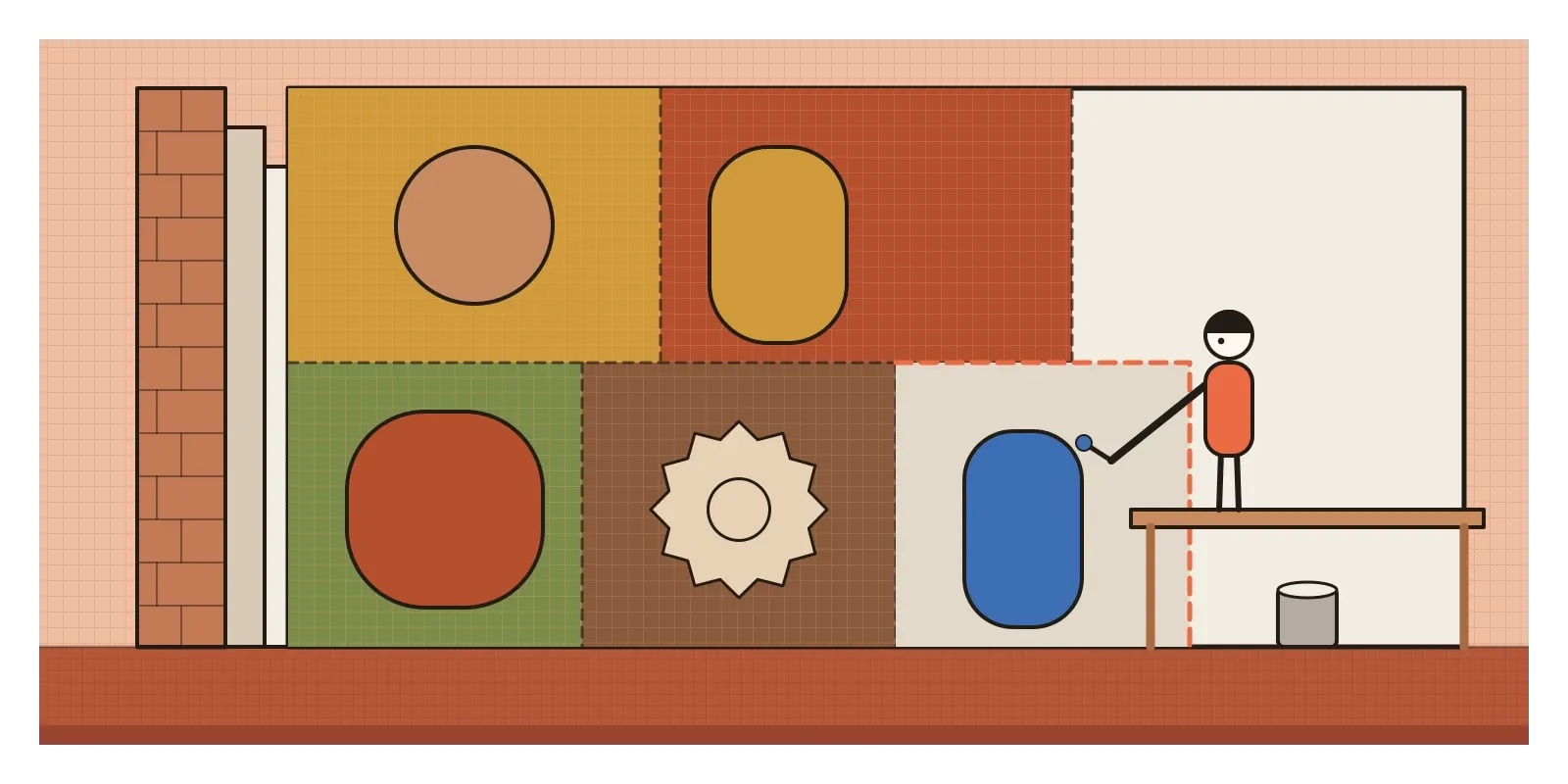
The first thing to recognise is the technique. Most of the great murals are true fresco, the method Rivera studied in Italy. The wall is built up in layers of lime plaster, and each morning a plasterer lays a fresh, smooth patch just big enough for one day's painting. The painter works into it while it's wet, with pigments ground in water, and as the lime dries the colour is locked into the wall itself. Whatever isn't finished by evening has to be cut away. Look closely at a fresco and you can often see the faint seams between one day's patch and the next, a map of the painter's working days.
Then look at the composition. These are walls you walk past, up staircases, along corridors and round courtyards, so the paintings are built to be read on the move and from far away. Figures are large and simplified, with bold outlines and solid volumes. Crowds are packed tightly, often stacked one above another in bands, so a single wall can hold a whole history. Architecture becomes part of the picture: a painting wraps round a doorway, climbs a stairwell or fills a dome. The subjects are labour, land, history and struggle, with Indigenous people, workers and peasants as heroes, and capitalists, priests and conquistadors as villains. The colour is earthy and warm, with the occasional blaze of red.
Siqueiros pushed further, with dramatic foreshortening, figures that seem to burst out of the wall and compositions designed to shift as you walk round them. In design language, he was thinking about the viewer's path through a space, long before anyone called it that.
From Jhelum to Mexico City, and a wall in Santiniketan
Mexican Muralism had a real Indian chapter, and it runs through a young painter from Jhelum. Satish Gujral, who lost most of his hearing after an illness as a child, had lived through Partition and was painting its suffering when, in 1952, he won a scholarship to study at the Palacio de Bellas Artes in Mexico City. There he worked alongside Rivera and Siqueiros. He came home with Mexican scale and anguish in his work, painting the refugees of Partition in heavy, twisted forms, and later worked across murals, sculpture and architecture. His Belgian Embassy in New Delhi, finished in the early 1980s, is one of the most sculptural buildings in the city.
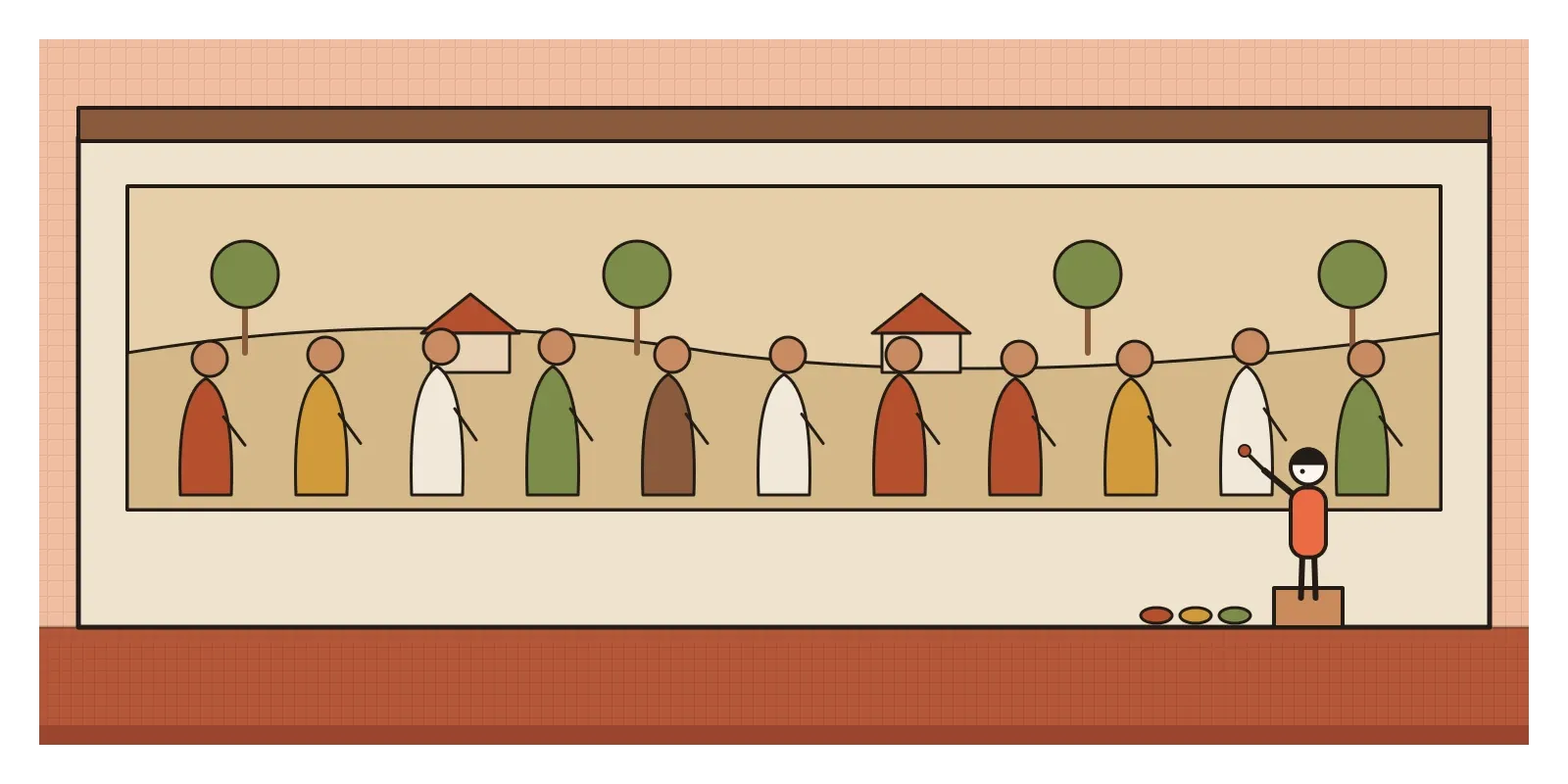
The other connection is a parallel, not an influence. At Santiniketan, Benode Behari Mukherjee painted a huge mural of medieval Indian saints and poets around the hall of the Hindi Bhavan in 1946 and 1947, just as India was becoming independent. It's a long procession of figures walking through towns and countryside, in calm earth colours, and like the Mexicans he painted on wet plaster, using fresco methods Santiniketan's artists had learned partly from traditional wall painters. Where the Mexicans painted revolution, Benode painted the devotional poets who had crossed lines of caste and religion. A decade later he lost his sight, and kept working. His former student Satyajit Ray made a short documentary about him, The Inner Eye, in 1972.
Walls that speak to people who walk past
The most direct legacy is political. In 1933 the American painter George Biddle wrote to President Roosevelt, pointing to Mexico as an example of what governments could do with artists. Within a few years the New Deal was paying artists to paint murals in post offices and schools across the United States. Chicano artists in California and the Southwest took up the mural in the 1960s and 1970s, and the murals of Belfast, Johannesburg and Kerala's hand-painted political walls belong to the same family.
In India today you can see the idea in Delhi's Lodhi Colony, where the St+art India Foundation has turned housing walls into an open-air gallery, and in station and flyover murals in many cities. They're friendlier and far less political than Rivera, but they share his conviction that a city's walls are a medium.
For designers, Mexican Muralism is a lesson in designing for people who aren't looking for you. A mural has to work for someone walking past, who may not read, may not care, and gives it a few seconds. That means big, clear shapes, a strong reading order, and a story that survives at a distance. It's the same brief as a station sign, an onboarding screen or an explainer illustration. Siqueiros's spray guns lead to graffiti and street art, and his idea of a picture that changes as you move through a space sounds a lot like the immersive installations and scroll-driven websites of today.

Revolution on a government budget
The muralists' biggest contradiction was their patron. They painted the people's revolution on the walls of a state that was steadily becoming one long-ruling party, and the government that funded them could also stop them. They painted Indigenous Mexicans as noble heroes, but the painters were mostly urban, educated and of European or mixed descent, and Indigenous people rarely had a say in how they appeared. The movement was overwhelmingly male. And its politics turned dark. Rivera and Siqueiros were fierce Communists who fell out with each other and with almost everyone else, and in May 1940 Siqueiros took part in an armed raid on Leon Trotsky's house in Coyoacán, an attempt to kill him that failed. Trotsky was murdered by a different Soviet agent three months later.
There's also the Rockefeller problem. The muralists took commissions from the industrialists they criticised, and the walls could be painted over by whoever owned the building. Man at the Crossroads and América Tropical were both destroyed or hidden by their owners.
By the 1950s, younger Mexican painters felt trapped. Muralism had become an official style, required in public buildings and repeated by lesser artists. The artist José Luis Cuevas attacked it in an essay called "The Cactus Curtain", and his generation, later called the Ruptura, the break, turned to abstraction, personal imagery and international modernism. Every style is a reply, and this was the reply to a style that had turned into a state.
To see Mexican Muralism for yourself this week, look up the online tours of the Palacio de Bellas Artes, the Ministry of Public Education and the Hospicio Cabañas, all of which publish high-resolution images. If you're in India, go to Santiniketan and stand in front of Benode Behari Mukherjee's mural at Hindi Bhavan, then watch The Inner Eye. Or try a small exercise. Pick a wall you pass every day and sketch a mural for it that would tell your neighbourhood's story to someone walking by in ten seconds, using no words at all.
And think back to Lucienne Bloch, standing in the lobby of the RCA Building in 1933 with her small camera, saving a wall the owners wanted gone. In the next post, on the Harlem Renaissance, a few miles uptown in the same city, Black American artists were building a public image of their own.
Further reading: Desmond Rochfort, Mexican Muralists: Orozco, Rivera, Siqueiros (1993) · Leonard Folgarait, Mural Painting and Social Revolution in Mexico, 1920-1940 (1998) · Bertram D. Wolfe, The Fabulous Life of Diego Rivera (1963) · Diego Rivera with Gladys March, My Art, My Life (1960) · R. Siva Kumar, Santiniketan: The Making of a Contextual Modernism (1997)
A reply toEuropean academic painting made for the private drawing rooms of the Díaz-era elite.