
Mannerism
What a generation of artists did after the Renaissance seemed to have solved everything.
Mannerism
A face in a barber's mirror
Around 1524, a young painter from Parma called Francesco Mazzola, known as Parmigianino, sat down in front of a barber's convex mirror and studied what it did to him. The curved glass bent the room into a bowl, pulled the window into an arc, and made his hand, resting nearest the glass, swell to an enormous size while his face stayed small and calm in the middle. According to Giorgio Vasari, who told the story in his Lives of the Artists, Parmigianino had a woodturner make a wooden ball, had it cut in half, and painted on the curved half exactly what he saw in the mirror. The result, about twenty-four centimetres across, is now in the Kunsthistorisches Museum in Vienna.
Parmigianino was about twenty-one. He took the little painting to Rome that summer with a couple of others and presented it to Pope Clement VII, hoping it would win him big commissions. Vasari says the pope and his court were amazed. The commissions never quite came. In 1527, Vasari adds, imperial troops sacking Rome burst in on Parmigianino while he was painting, and were so impressed that they let him work on, a story that may be as polished as the mirror. Four and a half centuries later, the American poet John Ashbery wrote a long poem about the painting, Self-Portrait in a Convex Mirror, which won the Pulitzer Prize in 1976.
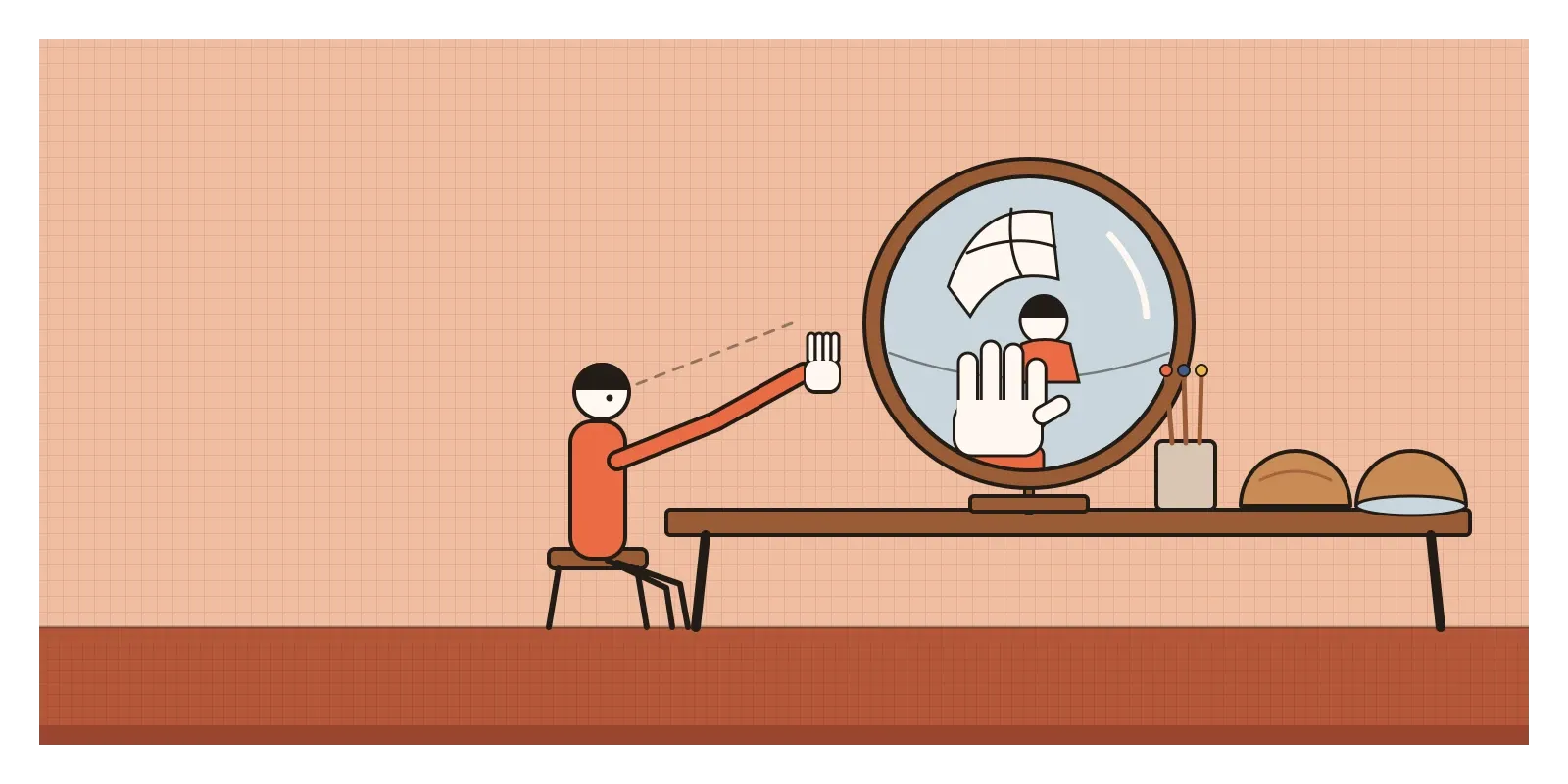
That painting is a perfect introduction to Mannerism, the style that dominated much of Italian art from around 1520 to around 1600 and spread to France, Spain and northern Europe. It's skilful, self-aware and a little strange. It takes the tools the Renaissance had mastered, perspective, anatomy, smooth modelling, and uses them to distort rather than to describe. Historians argue about where it begins and ends, and even about whether it deserves to be called a movement at all.
What do you do after perfection?
By 1520, the problems the Renaissance had set itself looked solved. Leonardo had died in 1519 and Raphael in 1520, and Michelangelo's David and Sistine ceiling seemed impossible to surpass. Vasari, writing a generation later, presented them as the summit of art. For a young artist, that left an awkward question. If you can't be more correct than Raphael, what can you be?
The answer was to be more stylish. The Italian word maniera simply meant style or manner, and in Vasari's day it was praise: a painter with bella maniera had a refined, graceful way of working, learned partly by studying great art rather than nature. The world around them was anything but settled. Luther's protests of 1517 had split the Church. In 1527 the troops of the emperor Charles V sacked Rome, killing thousands and scattering its artists. Florence became a duchy under the Medici, and power moved into courts that prized wit, learning and luxury. Mannerism grew partly out of Michelangelo's own later work, his restless Medici Chapel and his crowded Last Judgment, and it spread when the French king Francis I invited Italian artists such as Rosso Fiorentino to decorate his palace at Fontainebleau from 1530.
Long necks, crowded crosses and a room of falling giants
Jacopo Pontormo's Deposition, painted from about 1525 to 1528 for the Capponi Chapel in the church of Santa Felicita in Florence, is the style at its most haunting. The body of Christ is being lowered, but there's no cross, no ground and almost no space. A tangle of figures in pale pinks, sky blues and acid greens seems to float, held up by two young men balanced on tiptoe, with anxious faces turned out towards us. It's beautiful and deeply unsettling.
Parmigianino's Madonna with the Long Neck, begun around 1534 and left unfinished at his death, is now in the Uffizi. The Virgin is impossibly tall, with a swan's neck and long tapering fingers, and the Christ Child stretched across her lap is far too big. Behind her, a row of columns runs off into the distance, and a tiny prophet stands beside them at a scale that doesn't fit anything else. Agnolo Bronzino, court painter to the Medici, made portraits with skin like polished enamel and an Allegory with Venus and Cupid, now in the National Gallery in London, so packed with puzzling symbols that scholars still argue about what it means.
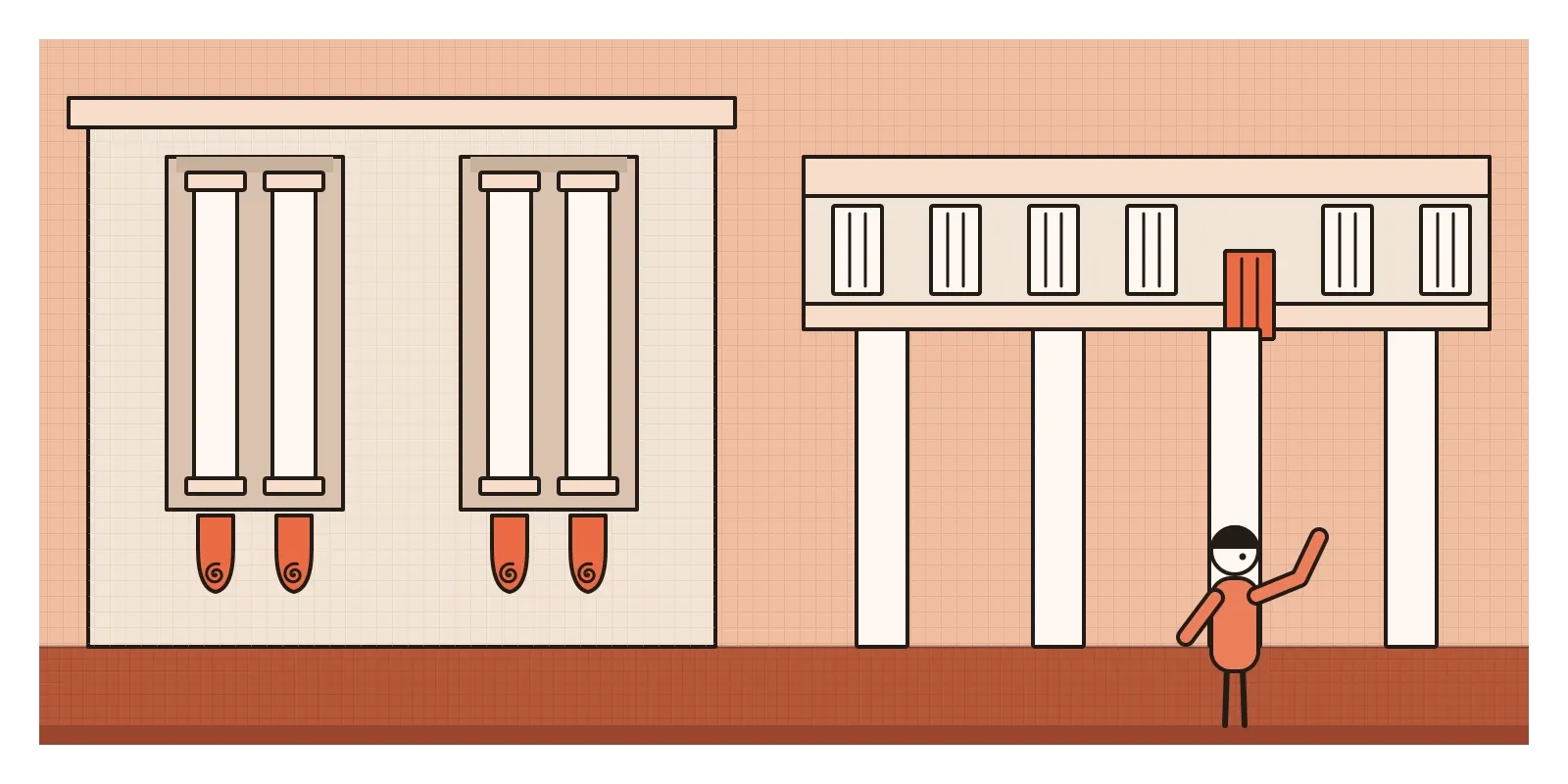
Architects played the same game. At the Palazzo Te in Mantua, built from around 1524 for the Gonzaga family, Giulio Romano let some of the stone blocks in a classical frieze appear to slip out of place, as if the building were about to come apart. Inside, in the Room of the Giants, he painted every wall and the ceiling with giants crushed by collapsing columns, so visitors stand in the middle of the disaster. In Florence, Michelangelo's vestibule for the Laurentian Library sets its columns back into recesses in the wall, where they support nothing, and hangs brackets beneath them that hold nothing up. A flowing staircase, built later to his design, pours down into the room. Benvenuto Cellini's gold salt cellar for Francis I, a sea god and an earth goddess reclining with impossible grace, is a tiny piece of tableware made with the ambition of a monument.
The stylish style
The art historian John Shearman, in his 1967 book Mannerism, called it "the stylish style", and that's a good place to start. Begin with the bodies. Mannerist figures are stretched, with small heads, long limbs, sloping shoulders and elegant hands with spread fingers. In the post on proportion and scale, I described the classical idea of a well-proportioned body. Mannerists knew those rules perfectly and pulled them out of shape on purpose. Figures twist upwards in a spiral pose called the figura serpentinata, the serpentine figure. Giambologna's marble Abduction of a Sabine Woman, finished in 1583 for the Loggia dei Lanzi in Florence, coils so completely that it has no single front, and you have to walk around it.

Space is squeezed and ambiguous. Figures crowd the front of the picture, the background lurches away too fast, and scale jumps without warning. There's often no clear focal point, so your eye keeps moving. Colour is cool and artificial, with shot colours, called cangiante, in which a robe turns from pink in the light to green in the shadow, like silk. Surfaces are smooth and polished, and subjects are full of learned references meant for a few insiders. In architecture, the clue is a classical rule visibly broken: a column with no job, a block that slips, a doorway too big for its wall. The joke only works if you know the rule.
Late in the century the style travelled with Domenikos Theotokopoulos, a painter from Crete known as El Greco, who settled in Toledo in Spain in the 1570s. His flickering, elongated saints are often counted as the last great Mannerist paintings, though he made the style his own.
Engravings at Akbar's court
In 1580, a Jesuit mission from Goa arrived at Fatehpur Sikri, the new capital of the Mughal emperor Akbar, who had invited them to debate religion at his court. Among their gifts was the Royal Polyglot Bible, eight volumes printed in Antwerp by Christophe Plantin between 1568 and 1572, illustrated with engravings. Over the following decades, Jesuits and merchants brought more European prints and paintings, and Akbar asked his painters to study them. Artists such as Basawan and Kesu Das copied and adapted European engravings, borrowing their modelling, their deep landscapes and their crisp cross-hatched shading.
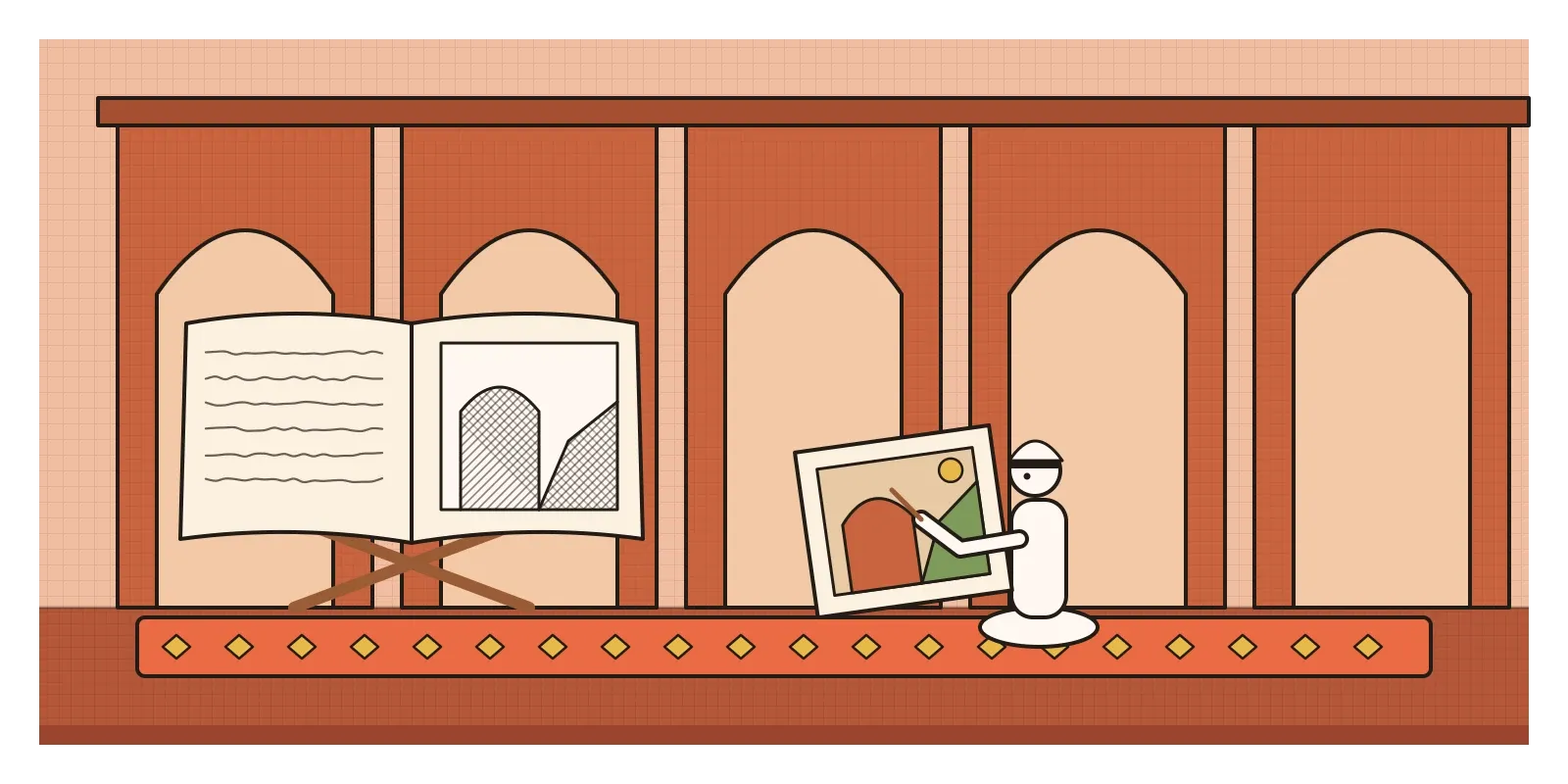
Most of those prints were made in Flanders and Italy in exactly the decades when Mannerism dominated, by engravers who loved twisting poses, crowded compositions and elongated figures. Historians usually describe what reached the Mughal court simply as European influence, so calling it Mannerist is partly my emphasis, but the dates and the forms fit. It's a striking meeting. A style that was all about self-conscious artifice arrived in a workshop that took what it wanted, the shading and the sense of distance, and absorbed it into its own clear, observant way of painting. The Mughal painters were doing what the Mannerists had done to Raphael, studying a powerful manner and bending it to their own purposes. In Goa itself, the Basilica of Bom Jesus, built by the Jesuits between 1594 and 1605, mixes classical orders in a way that historians variously describe as late Renaissance, Mannerist or early Baroque.
Stretched limbs and the showcase problem
Mannerist proportions are everywhere in fashion. Fashion illustrators traditionally draw a figure nine or more heads tall, far longer than a real body, so that clothes hang and flow, and the long, small-headed figure has a direct line back to Parmigianino's Madonna. In the late 2010s, many tech companies filled their websites with illustrations of people with long, bendy limbs and tiny heads, sometimes called Corporate Memphis, after the Memphis Group, which has its own post later in this series. The architect Robert Venturi, whom I wrote about in the post on form follows function, admired Mannerist architecture in his 1966 book Complexity and Contradiction in Architecture, and its broken rules fed into postmodern buildings.
The deeper lesson for designers is about what happens when a field matures. In 2013 the designer Paul Adams, then at Intercom, wrote an essay called "The Dribbblisation of Design", arguing that many designers were making beautiful screens to impress other designers on the showcase site Dribbble rather than to solve real problems. That's a very Mannerist situation: the basic problems feel solved, the audience is your peers, and skill turns inward into style. Some interface trends of the last decade, glossy and clever in a screenshot but hard to use, followed exactly that path. When I notice a design getting more admired by designers than understood by users, I think of that long-necked Madonna.
Too clever by half
Mannerism's critics arrived quickly. The Catholic Church, answering the Reformation at the Council of Trent, issued a decree on images in 1563 that pushed for religious art that was clear, decent and easy for ordinary worshippers to understand. Obscure allegory and nude saints were not what it wanted. In 1672 the critic Giovanni Pietro Bellori dismissed the painters of the previous century as having abandoned nature for a fantastic manner, and for a long time "mannered" was simply an insult. Mannerism only became a respectable label for a period in the early twentieth century, partly because the distortions of Expressionism made them look again. The style was courtly and exclusive, made for a few connoisseurs, and as usual most of its names are men's. Lavinia Fontana in Bologna, one of the first women to run a professional career painting public altarpieces as well as portraits, is an exception worth looking up.
Its reply came in the 1590s, when painters such as the Carracci in Bologna and Caravaggio in Rome turned back to nature, strong light and direct emotion, the beginnings of the Baroque. In the next post, on Mughal miniature painting, we'll stay at Akbar's court and see how his workshop turned Persian, Indian and European ideas into something new.
If you're in Goa, visit Bom Jesus and look for the places where its classical columns and frames don't quite behave. For a small exercise, repeat Parmigianino's experiment. Hold a shiny spoon or look into a convex car mirror, and draw what it does to your face and hand, the swelling near the edge and the room bending into a curve. You'll find that distortion, done deliberately, is a skill, not a mistake. Parmigianino knew the rules well enough to paint his own hand too big, and to make a pope stare at it.
Further reading: John Shearman, Mannerism (1967) · Giorgio Vasari, Lives of the Artists (1550, revised 1568) · Gauvin Alexander Bailey, Art on the Jesuit Missions in Asia and Latin America, 1542-1773 (1999) · John Ashbery, Self-Portrait in a Convex Mirror (1975) · Paul Adams, "The Dribbblisation of Design" (2013)
A reply toThe calm, balanced perfection of the High Renaissance.