Land Art
How artists in the late 1960s left the gallery for deserts, lakes and fields, and made the landscape their material.
Land Art
A coil of black rock in a red lake
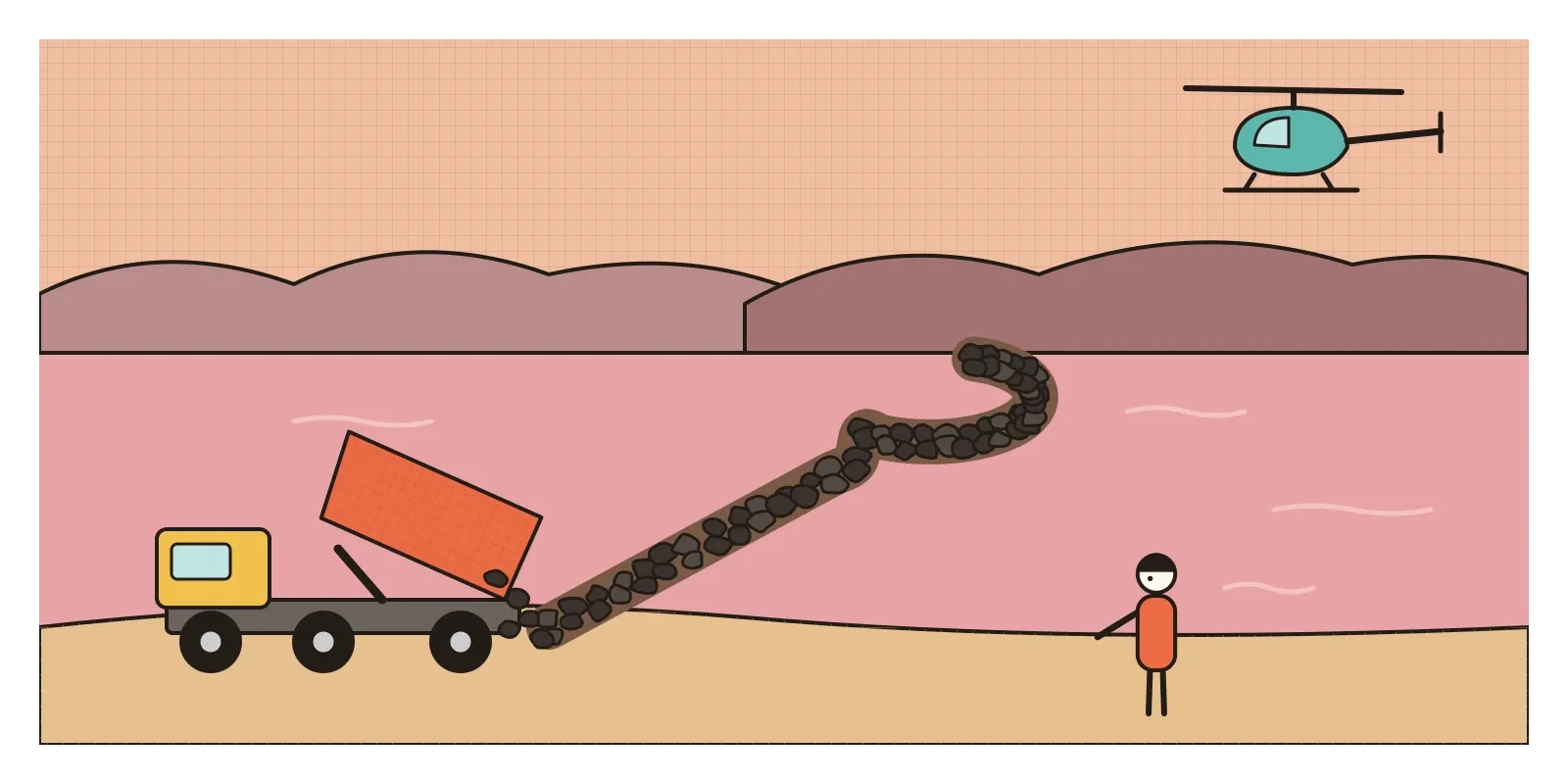
In April 1970, the American artist Robert Smithson hired a local contractor, two dump trucks, a tractor and a front loader and drove them out to Rozel Point, a remote stretch of shore on the north-eastern side of the Great Salt Lake in Utah. The water there is strange. Cut off from the rest of the lake by a railway causeway, it's so salty that algae and bacteria turn it a reddish pink, and the shore is littered with black basalt boulders, old oil-drilling junk and salt crust. Over a few days the crew tipped thousands of tonnes of rock and earth into the shallows, building a path about four and a half metres wide that ran out from the shore and curled anticlockwise into a coil roughly 460 metres long. Smithson called it Spiral Jetty. He also filmed it from a helicopter, circling above it like a hawk.
The lake had the last word. The jetty was built during a drought, and by 1972 the water had risen and swallowed it. For most of the next thirty years it lay underwater, a famous artwork almost nobody had seen except in photographs and Smithson's film. Then, around 2002, a new drought brought it back up, and the black rocks emerged crusted in brilliant white salt crystals. Smithson, who died in 1973, never saw that. But he would probably have liked it, because he was fascinated by entropy, the slow running down of things, and the jetty had become a demonstration of it.
Land Art, also called Earth Art or earthworks, is the name for art made in and of the landscape, mostly between the late 1960s and the 1970s. Instead of making objects for galleries, artists moved earth, rock and water, dug trenches in deserts, planted fields, walked across meadows, or lined up structures with the sun and stars. The works were often huge, often far away, sometimes temporary, and usually known to most people only through photographs, maps and films.
Out of the white cube and into the desert
Land Art grew out of the same New York art world as Minimalism, which has its own post in this section, and many of its artists, including Smithson, Walter De Maria and Robert Morris, began close to it. Minimalism had already made the space around an object part of the work. Land Art took the next step and made the space itself the work, at the scale of a valley.
It replied to several things at once. One was the gallery, the white cube with its clean walls, prices and collectors, which many artists had come to see as a kind of prison. Another was the art object itself. A trench in Nevada couldn't be hung over a sofa or easily sold. A third was the mood of the time: the first photographs of the whole Earth from space, the growing environmental movement, protests against war and a feeling that modern life had lost its connection to land and time. Two exhibitions put a name to it. In October 1968, the dealer Virginia Dwan showed Earthworks at her New York gallery, with photographs, plans and soil, and in 1969 a show called Earth Art at Cornell University invited artists to make works on and around the campus.
Patrons mattered more than the romantic image suggests. Dwan paid for Spiral Jetty and several other projects, and later the Dia Art Foundation, founded in 1974, bought and maintained some of the biggest works. Land Art needed bulldozers, land, permits and pilots, and those were expensive.
Trenches, poles, tunnels and a line in the grass
Michael Heizer made Double Negative in 1969 and 1970 on the edge of a mesa in the Nevada desert: two long, straight trenches cut into opposite sides of a natural gorge, with some 240,000 tons of rock blasted and bulldozed out. The work is the empty space, two cuts facing each other across a gap. In the early 1970s he began City, a vast complex of earth and concrete mounds, ramps and hollows in a remote Nevada valley, which took him about fifty years and opened to a handful of visitors at a time in 2022.
Walter De Maria's The Lightning Field, finished in 1977 in New Mexico, is a grid of four hundred polished stainless steel poles spread over a mile by a kilometre of high desert, their tips set at one level plane. Visitors, a few at a time, stay overnight in a simple cabin so they see the poles change through sunset, night and dawn. Lightning is rare. The light on the steel is the real subject. In the same year he filled a New York loft with a deep layer of soil, the New York Earth Room, still open to visitors.
Nancy Holt's Sun Tunnels, completed in 1976 in the Great Basin Desert of Utah, are four large concrete pipes lying in an open cross. They are aligned so that the sun rises and sets through them on the summer and winter solstices, and their walls are pierced with holes in the patterns of constellations, so that small spots of sunlight travel across the inside during the day. Holt was married to Smithson and finished one of his works after his death.
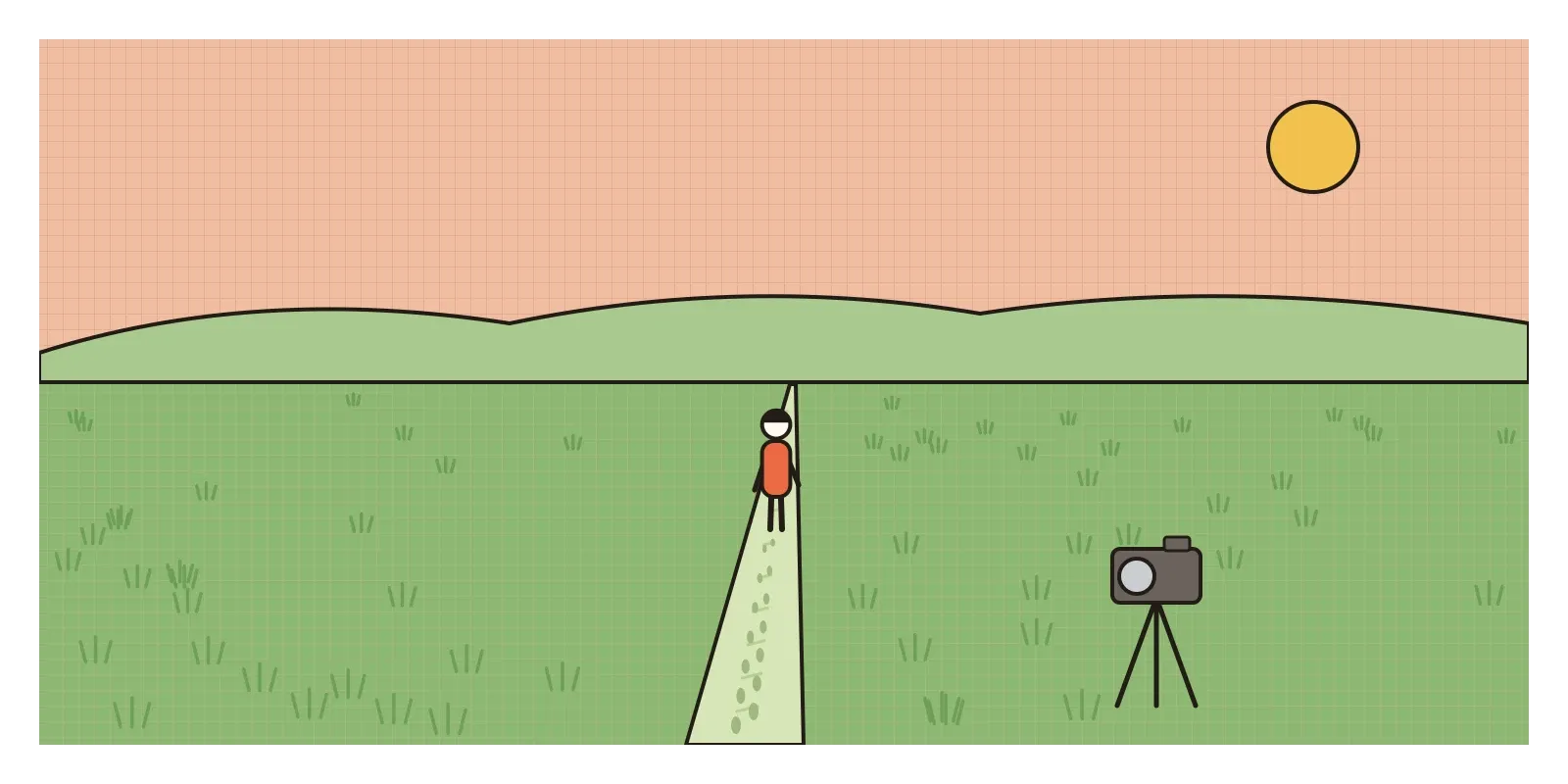
Not all Land Art used machines. In 1967, the British art student Richard Long walked back and forth across a field in Wiltshire until his steps flattened a straight line in the grass, then photographed it. The work was the walk, and the photograph was its trace. Long went on to make walks across mountains, deserts and moors, recording them in maps, words and lines of stones. From 1973, the Cuban-American artist Ana Mendieta made her Siluetas, the outline of her body pressed into mud, sand or grass, filled with flowers or gunpowder or water, then left to disappear. Christo and Jeanne-Claude, who wrapped buildings and stretched fabric across landscapes, are often grouped with them, though they resisted the label.
Scale, time and the long drive
You recognise Land Art less by its forms than by where it is and how you meet it. The forms are usually simple: lines, spirals, circles, grids, trenches, mounds and ramps, often borrowed from prehistoric earthworks and ancient monuments. The materials are what was there, rock, soil, salt, water, grass, light, or industrial materials chosen to contrast with them, like steel poles and concrete pipes. The colour is the landscape's own.
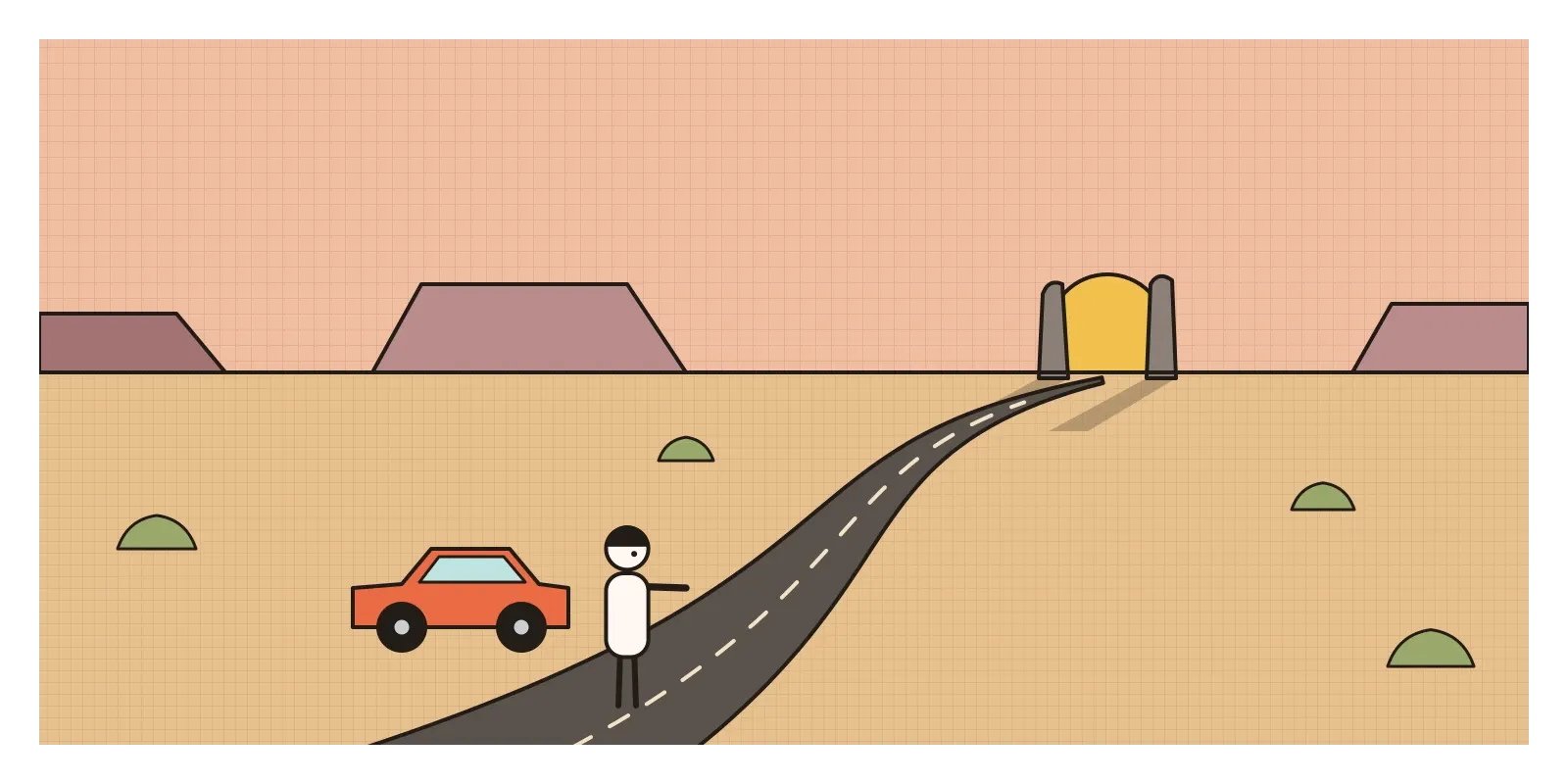
Scale is the first thing you feel. Many works are too large to see all at once from the ground, which is why their best-known images are aerial photographs. Time is the second. The works change with the weather, the seasons and the hour, and some are designed around it, aligned with solstices or meant to erode. And the journey is part of the work. To see The Lightning Field or Sun Tunnels, you have to drive for hours across empty land, and by the time you arrive you are already paying a different kind of attention.
As a designer, that's the part I find most useful. Land Art treats the approach, the waiting and the leaving as part of the experience, not as friction to be removed.
Instruments for the sky in Jaipur
The clearest Indian parallel is older than Land Art by more than two centuries. In the 1720s and 1730s, Sawai Jai Singh II, the ruler who founded Jaipur, built a set of astronomical observatories, the Jantar Mantars, in Delhi, Jaipur, Ujjain, Varanasi and Mathura. The largest, in Jaipur, is a field of enormous masonry instruments: a giant triangular sundial, the Samrat Yantra, whose shadow moves visibly across its curved scales, sunken hemispheres, circular walls and stairs that lead nowhere but the sky. They were scientific tools for measuring time and the positions of stars, not sculpture, but walking among them feels very much like walking through a Land Art site.
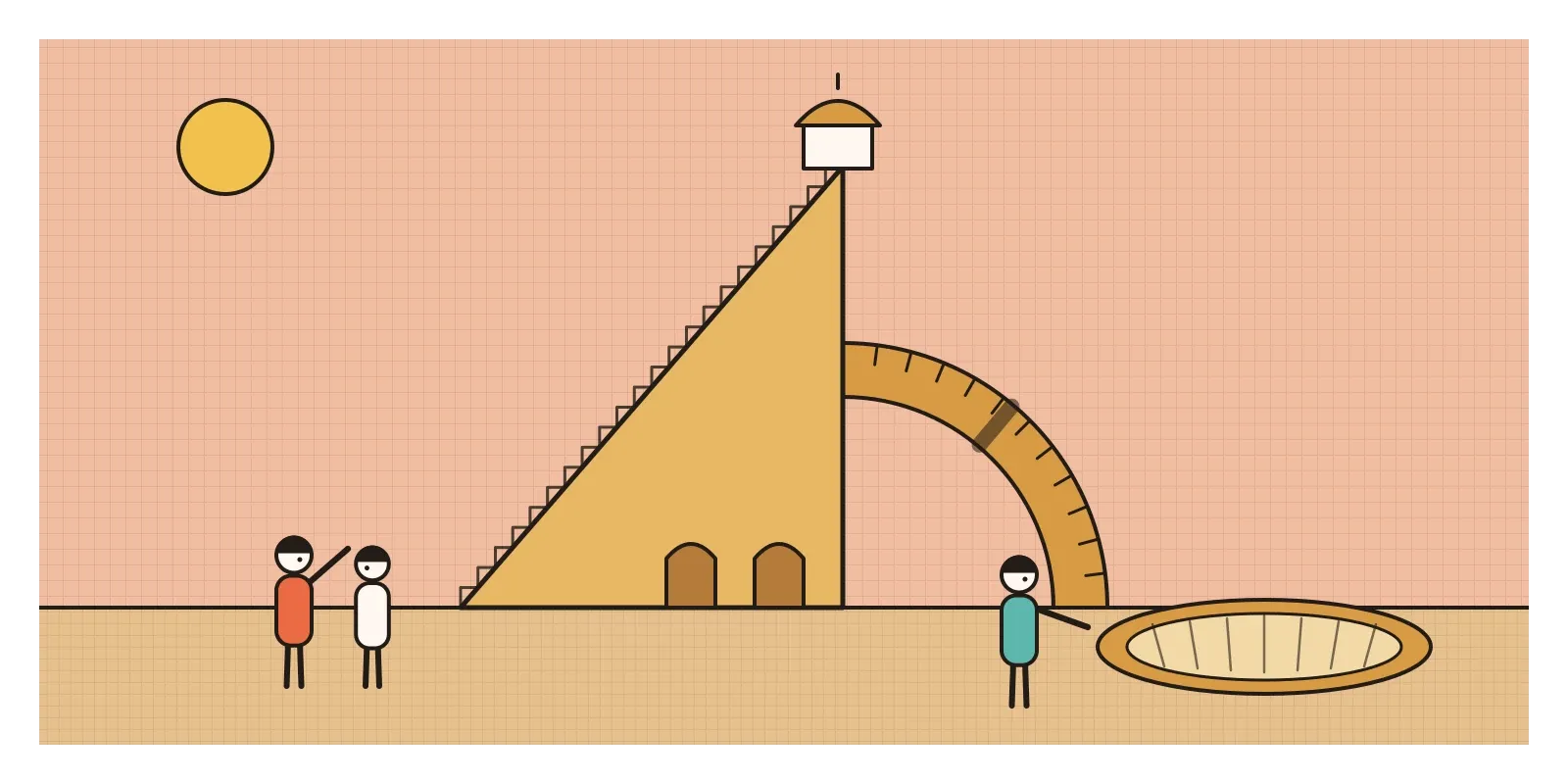
The Japanese American sculptor Isamu Noguchi, whose lamps appear in the post on organic design, visited and photographed the Jantar Mantars on his travels through India in 1949. He had already proposed Sculpture to Be Seen from Mars in 1947, a huge face shaped in the earth, and the observatories stayed with him; their influence has been traced in his later gardens and playgrounds. Nancy Holt's sun-aligned tunnels are close cousins too, although I haven't found evidence that she was thinking of Jaipur. The difference matters. Jai Singh's instruments were built to measure the sky for a king's calendar and court. The Land Artists borrowed the look of such monuments to make you feel your own small place in time.
Indian art also has its own long practice of art that disappears into the land, from the kolam swept away by noon to clay images immersed in rivers after festivals. And when I wrote about Nek Chand in the post on material exploration, I described another way of building a landscape as art, from a city's waste rather than from its deserts.
Memorials, gardens and the cost of a bulldozer
Land Art changed how designers think about landscape. Contemporary landscape architecture, with its earth mounds, long ramps, reflecting water and paths designed for slow walking, owes it a great deal. So do memorials. The most famous example is Maya Lin's Vietnam Veterans Memorial in Washington, opened in 1982, a long black wall cut into a slope of grass, which she has described as cutting open the earth. Buildings and public spaces aligned with the sun on particular days, and temporary installations in parks and festivals, all draw on the same idea that a site, a season and a journey can be the material of a design.
For product and interface designers, the lesson is subtler. Land Art shows that experience can be designed over time and distance, that the route to something shapes how you feel when you get there, and that not everything needs to be visible in one glance. It's also an argument for designing with change. Most of our designs are meant to look the same forever. Land Art accepted weather and decay as collaborators.
Its critics have strong points. Many early works damaged the very landscapes they celebrated, with bulldozers, dynamite and tonnes of displaced rock, which sits oddly beside the environmental movement of the same years. The image of the lone male artist conquering the desert with heavy machinery could look like a frontier fantasy. The "empty" land of the American West was not empty: it was the homeland of Native American nations, and few early artists asked whose land it was. The works also depended on rich dealers and foundations, and they are hard and expensive to visit, so their audience is either small and privileged or reduced to photographs, which brings the art straight back to the galleries and books it tried to escape.
Replies came from inside the movement. Women artists such as Holt, Mendieta and Agnes Denes worked more lightly, with the body, the sun and living things. In 1982 Denes planted two acres of wheat on a rubble landfill in Lower Manhattan, beside the World Trade Center, and harvested it, a field set against some of the most expensive land in the world. Ecological artists went further and made works that cleaned rivers or restored land. In the next post, on Arte Povera, Italian artists in the same years replied with their own humble materials, soil, wood, rags and vegetables, brought back indoors.
Go and stand in a landscape
To see the closest Indian experience, visit the Jantar Mantar in Jaipur (a UNESCO World Heritage Site) or the smaller one in Connaught Place in Delhi, and go in the morning when the shadows are sharp. Stand at the foot of the great sundial, watch its shadow creep and notice how small you feel. Lucy Lippard's Overlay connects Land Art with prehistoric monuments, and Suzaan Boettger's Earthworks is a clear history of the movement.
For an exercise, choose a path you walk often, to a bus stop, around a campus, through an office. Walk it once at half your usual speed and note what changes: which sounds, surfaces, shadows and views appear. Then sketch one small change, a bench, a turn, a gap, that would make someone else slow down there too.
Smithson's jetty disappeared for thirty years and came back white. It's still there, changing with every drought and flood, which is the most honest thing about it. A landscape is never finished, and Land Art was the first art movement to make that its subject.
Further reading: Suzaan Boettger, Earthworks: Art and the Landscape of the Sixties (2002) · Lucy R. Lippard, Overlay: Contemporary Art and the Art of Prehistory (1983) · Robert Smithson, "The Spiral Jetty" (1972), in Robert Smithson: The Collected Writings (1996) · Jeffrey Kastner (ed.), Land and Environmental Art (1998)
A reply toThe white-cube gallery and the idea that art must be an object you can buy and carry.