Arte Povera
How a group of Italian artists in the late 1960s made art from rags, coal, lettuce, twigs and live horses.
Arte Povera
Twelve horses in a garage
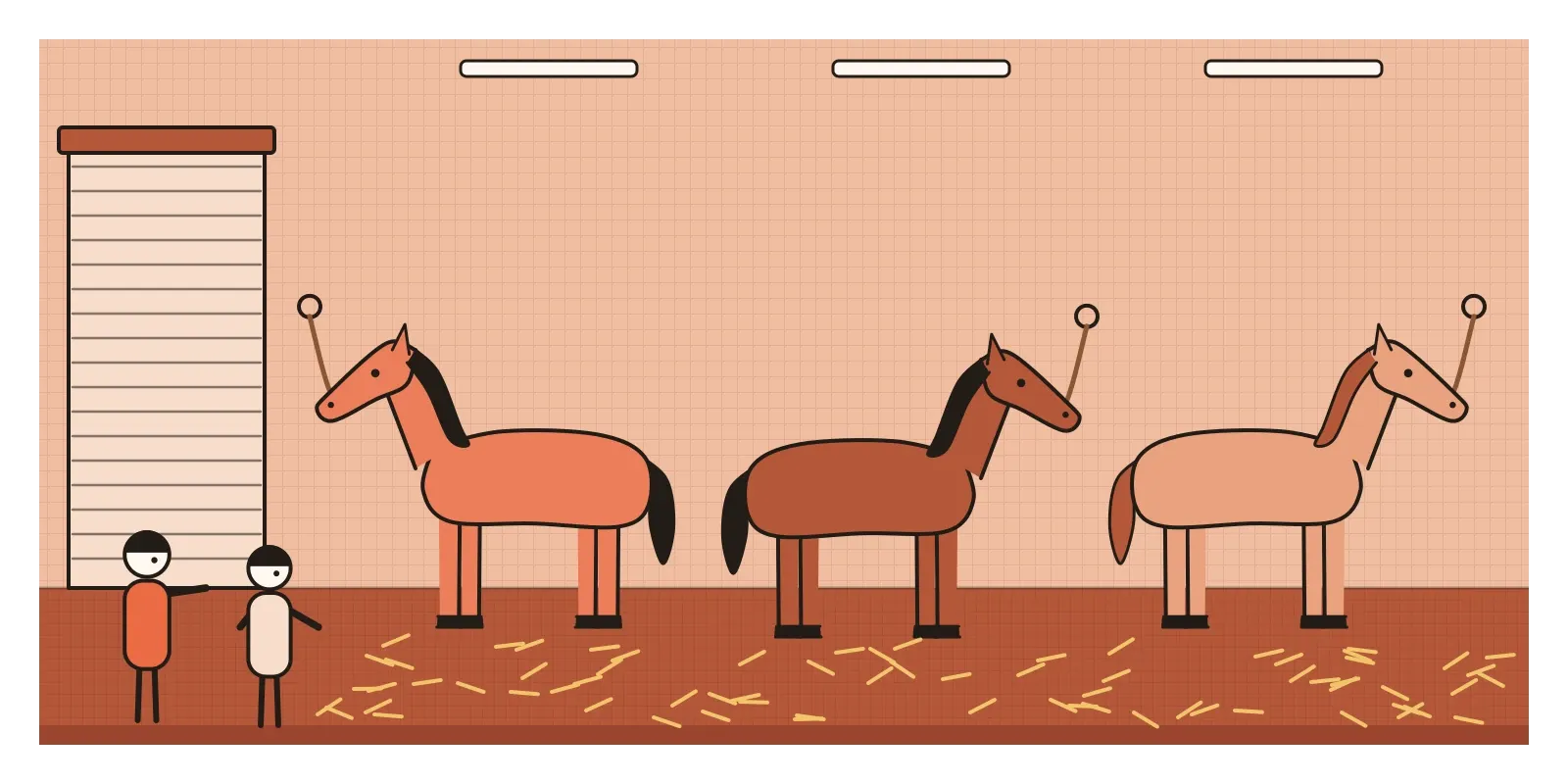
On 14 January 1969, visitors to a new gallery space on via Beccaria in Rome walked into a converted garage and found twelve live horses. The Greek-born artist Jannis Kounellis, who had lived in Rome since the 1950s, had tethered them at intervals around the walls. There were no paintings, no plinths and no labels. There was the smell of animals, the stamp of hooves, the steady arrival of dung and the uneasy question of how close it was safe to stand. The dealer Fabio Sargentini had just moved his gallery, L'Attico, into the garage. The horses stayed for a few days. Some visitors found the whole thing nauseating. Many never forgot it.
Kounellis always insisted that he was a painter, and that's the key to the piece. The room was his canvas and the horses were his paint: living colour, weight, warmth and movement arranged in space, a real thing in place of a picture of one.
Kounellis belonged to a loose circle of Italian artists who, in the late 1960s, gave up the polished materials of art for things that were cheap, ordinary, natural or alive: rags, coal, earth, wax, lettuce, twigs, stones, water, fire and animals. In 1967 a young critic from Genoa, Germano Celant, gave them a name, Arte Povera, which means poor art, and which I mentioned briefly in the post on material exploration. The poverty wasn't about money. It meant stripping art back to its materials and to the plain experience of being in a room with them.
An economic miracle and a poor theatre
Italy in the 1960s was richer than it had ever been. Between the late 1950s and the mid-1960s, what Italians called the economic miracle turned a largely rural country into an industrial one. Fiat's car plants in Turin drew hundreds of thousands of workers up from the south, and televisions, fridges and scooters filled new apartment blocks. Turin, the car city, also became Arte Povera's home. Most of the artists lived or worked there, among them Michelangelo Pistoletto, Mario and Marisa Merz, Giovanni Anselmo, Giuseppe Penone, Gilberto Zorio and Alighiero Boetti. Rome had Kounellis and Pino Pascali.
The art world they were answering was increasingly American. At the Venice Biennale of 1964, Robert Rauschenberg became the first American to win the top prize for painting, and many Europeans read it as a sign that New York had taken over. What came out of New York next was Pop Art, celebrating the bright surfaces of consumer goods, and Minimalism, with its factory-made steel boxes and fluorescent tubes, both of which have their own posts in this series. Each came from a confident industrial society and looked like it: smooth, manufactured, finished. The Italians replied with the opposite. Where Pop took the supermarket and Minimalism took the factory, Arte Povera took the field, the hearth and the market stall.
Celant borrowed his word from the theatre. The Polish director Jerzy Grotowski had been arguing for a "poor theatre", stripped of elaborate sets, costumes and lighting, so that nothing was left but the actor and the audience. Celant's first exhibition under the new name opened at the Galleria La Bertesca in Genoa in September 1967, and a few months later he published a short, combative article in Flash Art, "Arte Povera: Notes for a Guerrilla War". Artists, he argued, should refuse a system that turned everything into a product, and behave like guerrillas, mobile and armed with whatever was to hand.
A year later Italian students occupied their universities, and in the "Hot Autumn" of 1969 workers in Turin and Milan struck in huge numbers. Arte Povera was never a political party, but it breathed the same air.
Rags, lettuce and a tree inside a beam
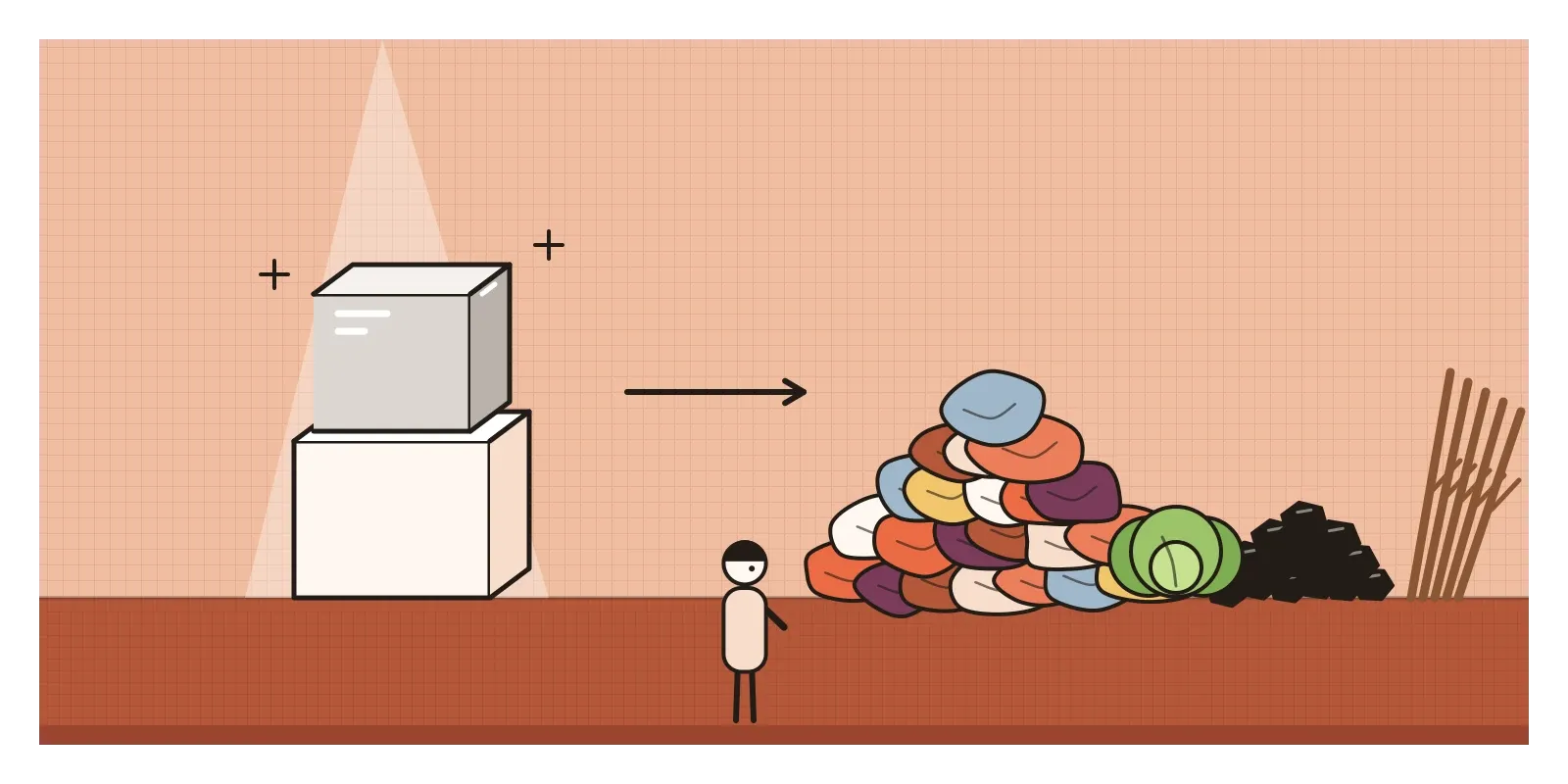
Michelangelo Pistoletto had already found a way to pull the world into the picture. From the early 1960s he made mirror paintings, life-size figures painted on thin paper and later screen-printed, fixed to sheets of polished stainless steel. The figures stand still, but the steel reflects the room, so every visitor becomes part of the painting and no two people ever see the same picture. In 1967 he made Venus of the Rags, a cast of a classical statue of Venus, seen from behind, standing face to face with a heap of old, brightly coloured clothes. The ideal and the discarded are pressed together.
Pino Pascali, in Rome, filled shallow metal basins with water dyed blue, laid them across the floor and called the work 32 Square Metres of Sea, Approximately (1967). He died in a motorcycle accident in 1968, aged thirty-two.
Giovanni Anselmo's Untitled (Structure that Eats) of 1968 is the movement's best-known joke and its most serious idea. A small granite block is bound to a larger one with copper wire, held in place by a fresh lettuce squeezed between them. As the lettuce dries and shrinks, the small block slips, and eventually it falls unless someone replaces the lettuce. Museums that own a version of it have to keep buying lettuce. The work isn't finished on the day it's installed. It's a process that has to be looked after.
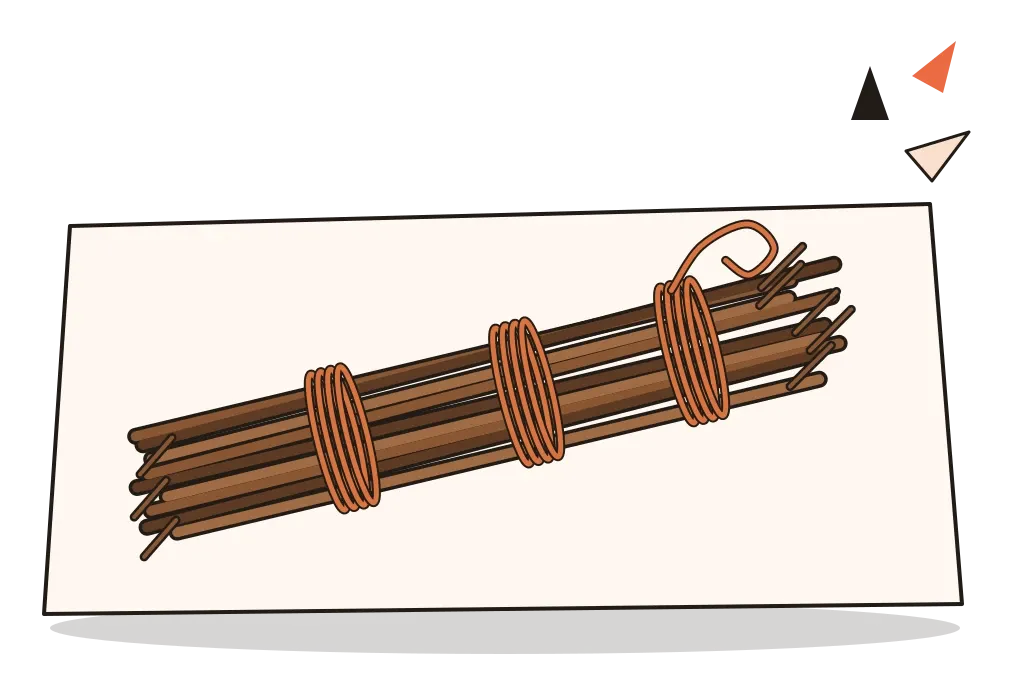
Giuseppe Penone treated trees as collaborators. In 1968 he made a steel cast of his own hand and fixed it around the trunk of a young tree in a gripping position, so that over the years the tree would grow around his grip. Soon afterwards he began taking squared industrial timber beams and carving them back, following a single growth ring, until the shape of the young tree hidden inside reappeared. Mario Merz built igloos, domed frames covered in clay, glass, stone or twigs, the oldest kind of shelter remade from whatever was nearby. Marisa Merz, his wife, was for decades the most overlooked member of the circle. In 1966 she hung curling forms of cut and stapled aluminium sheet from the ceiling of the family kitchen in Turin, and later she knitted small shapes out of fine copper wire, using a domestic skill to make work that sat somewhere between sculpture and housework.
Materials that won't sit still
You can usually recognise Arte Povera before you know who made it. The material comes first, and it's usually one you'd never expect in a museum: a heap of coal, a sack of grain, a block of wax, a bundle of twigs. Often it's paired with something industrial, so the work becomes a small argument between nature and manufacture. Lettuce meets granite and copper. Twigs meet neon. Rags meet a classical statue. Glass sits on coal.
Time is part of the material. Things wilt, rust, grow, burn, melt or fall, and many works only make sense if you imagine them changing after you leave. Kounellis even used real fire from gas jets. Nothing sits on a plinth. Works lie on the floor, lean against walls or hang from the ceiling, at the scale of a body, so you move around them as you would around furniture or animals. The colours come from the stuff itself: earth browns, coal black, the orange of copper, the dull grey of lead, the sudden brightness of a neon tube.
Set it beside Minimalism and the difference is clear. Both put objects straight on the floor, but Minimalism hid the hand and wanted its boxes identical and permanent. Arte Povera wanted every heap to be particular and every work to stay slightly alive.
Burnt wood and knotted hemp
There's no direct line from Turin to India, and as far as I know none of these artists worked with Indian artists at the time. But in the same years some Indian artists were reaching for humble materials too, from a very different starting point. The parallel is loose, but it's worth drawing.
Jeram Patel, born in Gujarat in 1930, trained at the J. J. School of Art in Bombay and studied design in London. From the early 1960s he began attacking wooden boards with a blowtorch, burning and gouging them into dark, blistered reliefs. Fire was his brush. Patel was a member of Group 1890, a short-lived collective that turns up again in the next post, and he later taught at Baroda.
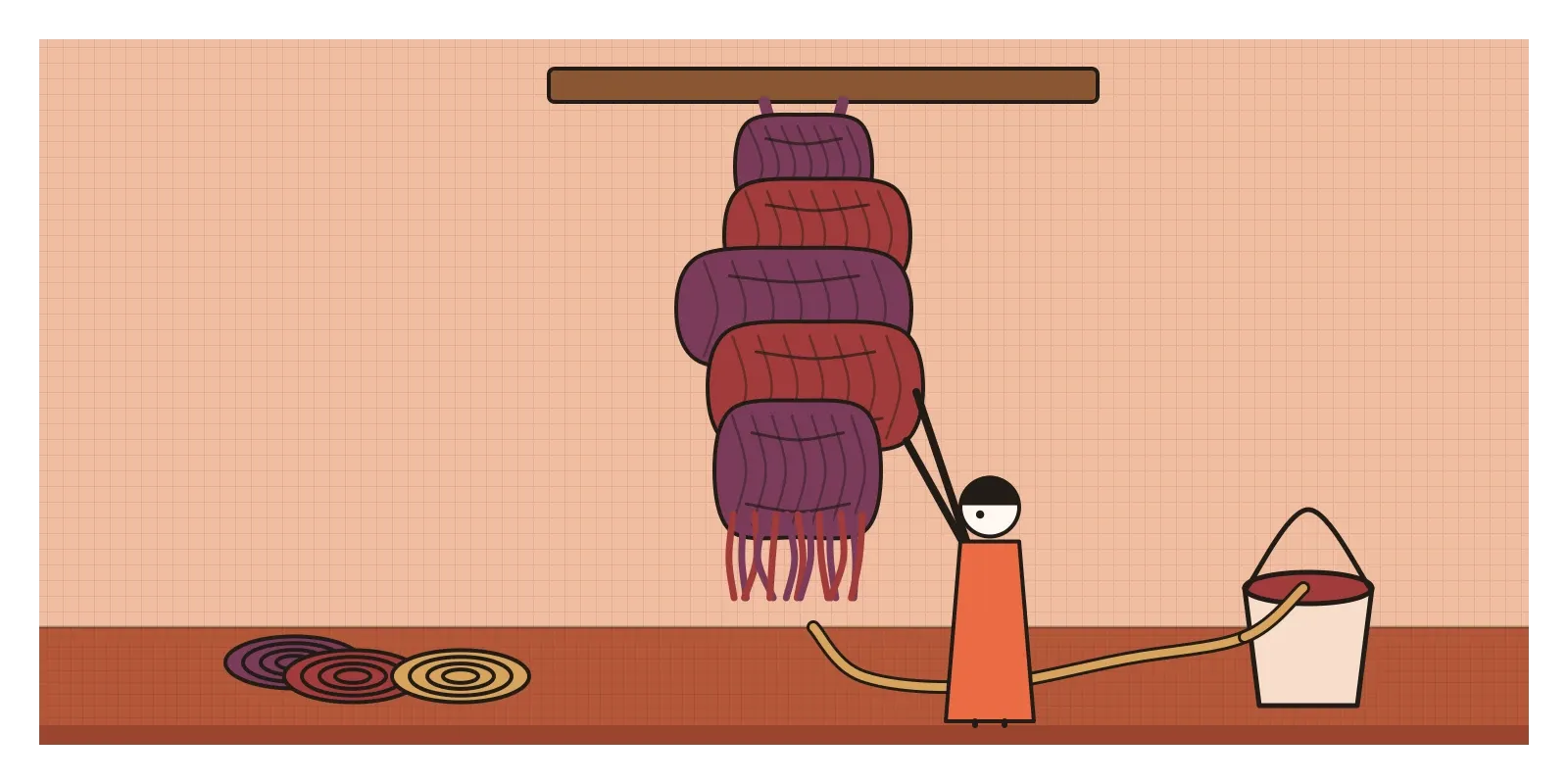
Mrinalini Mukherjee, born in 1949, was the daughter of the painter Benode Behari Mukherjee and the sculptor Leela Mukherjee. She studied at Baroda in the late 1960s, and around the start of the 1970s she began knotting thick ropes of hemp fibre, which she dyed herself in deep reds, purples and ochres, into tall, soft and mysterious forms. Some look like plants, some like seed pods and some like ancient goddesses. Hemp rope was the stuff of cattle tethers, cots and boat rigging, about as far from marble and bronze as a sculptor could go, and knotting is a craft technique many people in India learned at home. In 2019 the Met Breuer in New York gave her a major retrospective called Phenomenal Nature.
The difference matters as much as the likeness. The Italians were reacting against a consumer boom, and their poor materials were a gesture of refusal inside a rich society. In India in the 1960s and 1970s, rope, earth and charred wood weren't a statement about anything. They were simply what most people lived with, already full of labour, ritual and use. The sculptor Sheela Gowda, whose work with cow dung and kumkum I wrote about in the post on material exploration, has built a whole practice on that difference. A humble material doesn't arrive empty. It brings its history into the gallery with it.
Raw plywood and the beauty of the unfinished
Walk into almost any new café or concept store in Bengaluru, Mumbai or Delhi and you'll see Arte Povera's grandchildren: scaffolding boards for shelves, exposed brick, raw plywood, jute sacks, crates for tables. The look says honest, handmade and slightly rough. It's a long way from guerrilla warfare, but the idea that ordinary, unfinished materials can carry feeling owes a lot to these artists.
The deeper trace is in how designers think about materials. The studio Formafantasma, founded by the Italian designers Andrea Trimarchi and Simone Farresin, starts from what a material is, where it comes from and where it goes. Their Botanica project of 2011 imagined objects made from plant resins of the kind used before oil-based plastics.
Then there's time. Anselmo's lettuce is a reminder that a designed thing has a life after launch. Untreated leather, raw brass and a wooden handle that darkens with use are designed with that life in mind. Digital products have a version too: a design system has to be cared for, not just finished. And Pistoletto's mirror paintings, which only work when you're standing in front of them, are an early version of something product designers take for granted: the user completes the work.
Poor art, rich collectors
The obvious contradiction is in the name. Art made from rags and coal was soon bought by major museums and wealthy collectors, and Celant became one of the most powerful curators in the world, directing the Venice Biennale in 1997. Critics have pointed out that the artists were mostly comfortable, middle-class men playing at poverty in a country where real poverty, in the south and in Turin's migrant neighbourhoods, was never far away.
The label was Celant's, not the artists', and several disliked it. By the early 1970s he had largely stopped promoting them as a group, and they went their own ways. Marisa Merz was for a long time the only woman regularly counted in, and even she was often treated as Mario's wife rather than an artist in her own right, until she received the Golden Lion for lifetime achievement at the Venice Biennale in 2013. By the end of the 1970s, a new generation in Italy replied by going back to big, colourful paintings, a return I'll come to in the post on Neo-Expressionism.
To see Arte Povera for yourself, the Castello di Rivoli museum just outside Turin has one of the largest collections, and Tate Modern in London often has a work or two on show. In India, look out for exhibitions of Jeram Patel's burnt reliefs and Mrinalini Mukherjee's knotted fibre, which appear regularly in Delhi and Mumbai. For a small exercise, buy one humble material this week, a lettuce, a ball of jute twine or a bag of rice, and make three arrangements with something manufactured, like a steel bowl or a brick. Photograph them every day for a week and notice which one you start to care about.
Kounellis's horses were only in that garage for a few days, but they made a point that design keeps having to relearn. The most powerful material in a room is sometimes the one that's alive, and the most memorable experience is often the one nobody can quite control. In the next post, on the Baroda School and the Madras Art Movement, I'll look at Indian artists in the same years who turned to craft, folk art and their own regions for a modern art of their own.
Further reading: Germano Celant, Arte Povera (1969) · Robert Lumley, Arte Povera (2004) · Carolyn Christov-Bakargiev (ed.), Arte Povera (1999) · Jerzy Grotowski, Towards a Poor Theatre (1968)
A reply toThe glossy, factory-finished art of American Pop and Minimalism, and Italy's consumer boom.