Islamic Art and Design
How a coin without a face, a reed pen and a compass shaped thirteen centuries of pattern.
Islamic Art and Design
A coin with no face
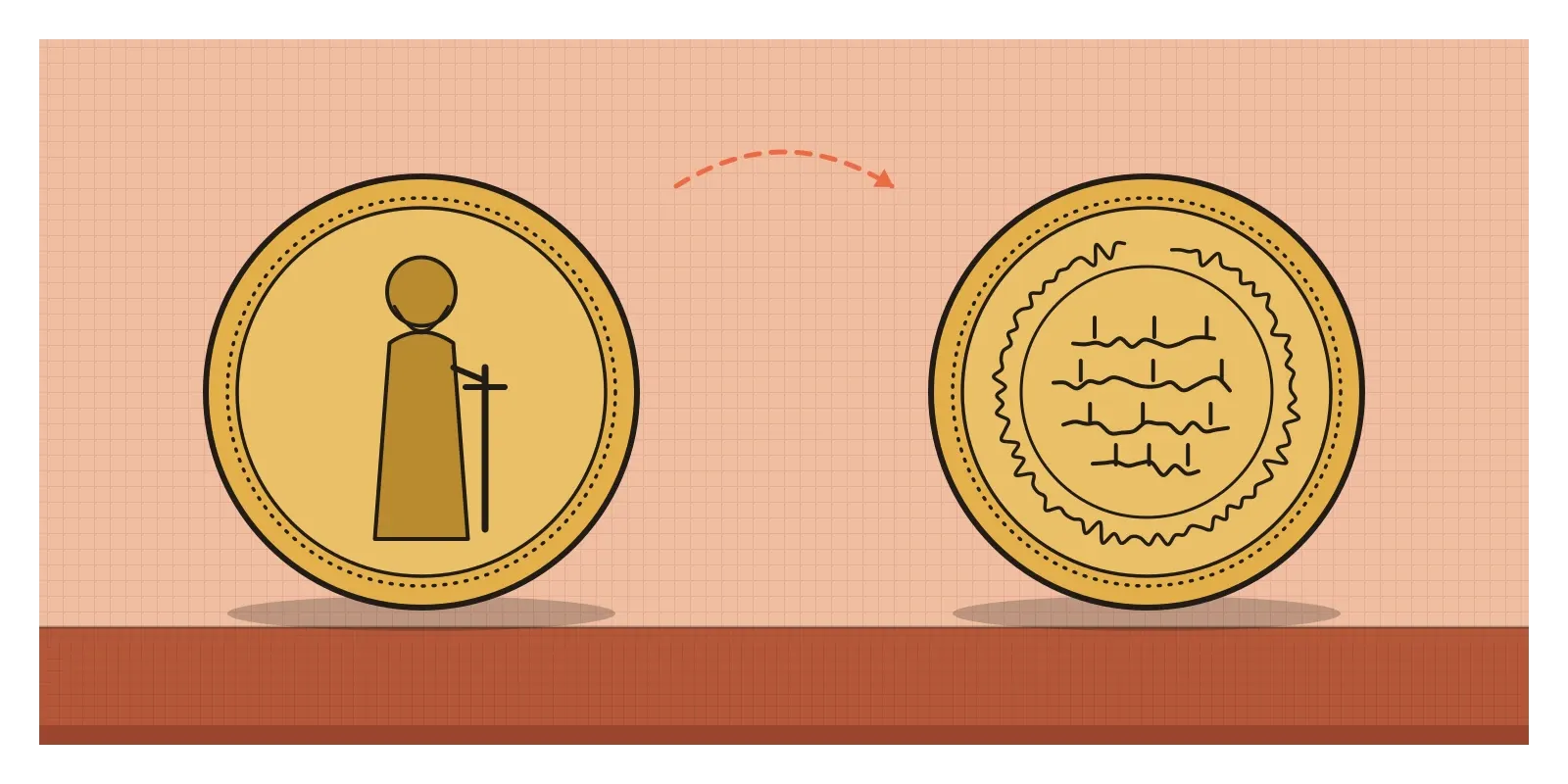
Around 696 or 697 CE, the year 77 in the Islamic calendar, the mints of the caliph Abd al-Malik, who ruled a vast new empire from Damascus, began striking a new kind of gold coin. For decades the Arab conquerors had used coins like the ones they found, Byzantine gold with emperors and crosses and Persian silver with crowned kings. In the early 690s the caliph's mints tried a compromise, a gold coin showing a standing bearded figure gripping a sword, usually taken to be the caliph himself. Then the figure disappeared too. The new dinar carried no picture at all. Both faces were filled with Arabic writing, a declaration that God is one, words from the Qur'an and the date, arranged in lines and rings of angular script.
It's a design decision you can hold in your hand: a ruler represented not by his portrait but by carefully arranged words. That choice runs through what we now call Islamic art: writing treated as image, plant forms and geometry in place of figures in sacred spaces, and an extraordinary trust in pattern. The label covers art and architecture made over more than thirteen centuries, from Spain to Indonesia, wherever Muslims ruled or Islam shaped daily life. It includes mosques and Qur'ans, but also palaces, carpets, ceramics and metalwork, much of it secular. In the post on pattern, tessellation and symmetry I wrote about the Alhambra. This post is about the larger tradition behind those walls.
Byzantium's gold without Byzantium's faces
Islam began in Arabia in the early seventh century. Within about a hundred years of the Prophet Muhammad's death in 632, Arab armies had taken Syria, Egypt, Iraq, Persia, North Africa and most of Spain. The new rulers inherited the arts of two great powers: Byzantium, the subject of the previous post, with its gold mosaics and images of emperors and saints, and Sasanian Persia, with its carved stucco, silver dishes and royal hunts. Early Islamic art grew straight out of both, often with the same craftsmen.
You can see this in the Dome of the Rock in Jerusalem, completed under Abd al-Malik around 691 to 692. It stands on the Temple Mount, which Muslims call the Haram al-Sharif, over a rock revered in both Jewish and Islamic tradition. Its octagonal plan borrows from Late Roman and Christian buildings, and inside, Byzantine-style mosaic glitters with vines, jewelled vases, crowns and trees. What's missing is people. There are no saints and no emperor. Instead, a long band of mosaic writing runs around the arcade, among the earliest dated texts quoting the Qur'an.
Why no figures? The Qur'an doesn't spell out a ban on images, but sayings attributed to the Prophet warn against image-makers, and religious scholars came to discourage figures in religious settings because of the fear of idolatry. Outside the mosque, figures never went away. Qusayr Amra, a small Umayyad bathhouse in the Jordanian desert built in the early eighth century, is painted with hunters, bathers, musicians and animals. So the absence of figures is about sacred space, not a blanket rule, and historians still debate how deliberate it was at first. Either way, the reply is clear: keep the materials and skills of the old empires, and turn them towards writing, ornament and geometry.
A pen measured in dots
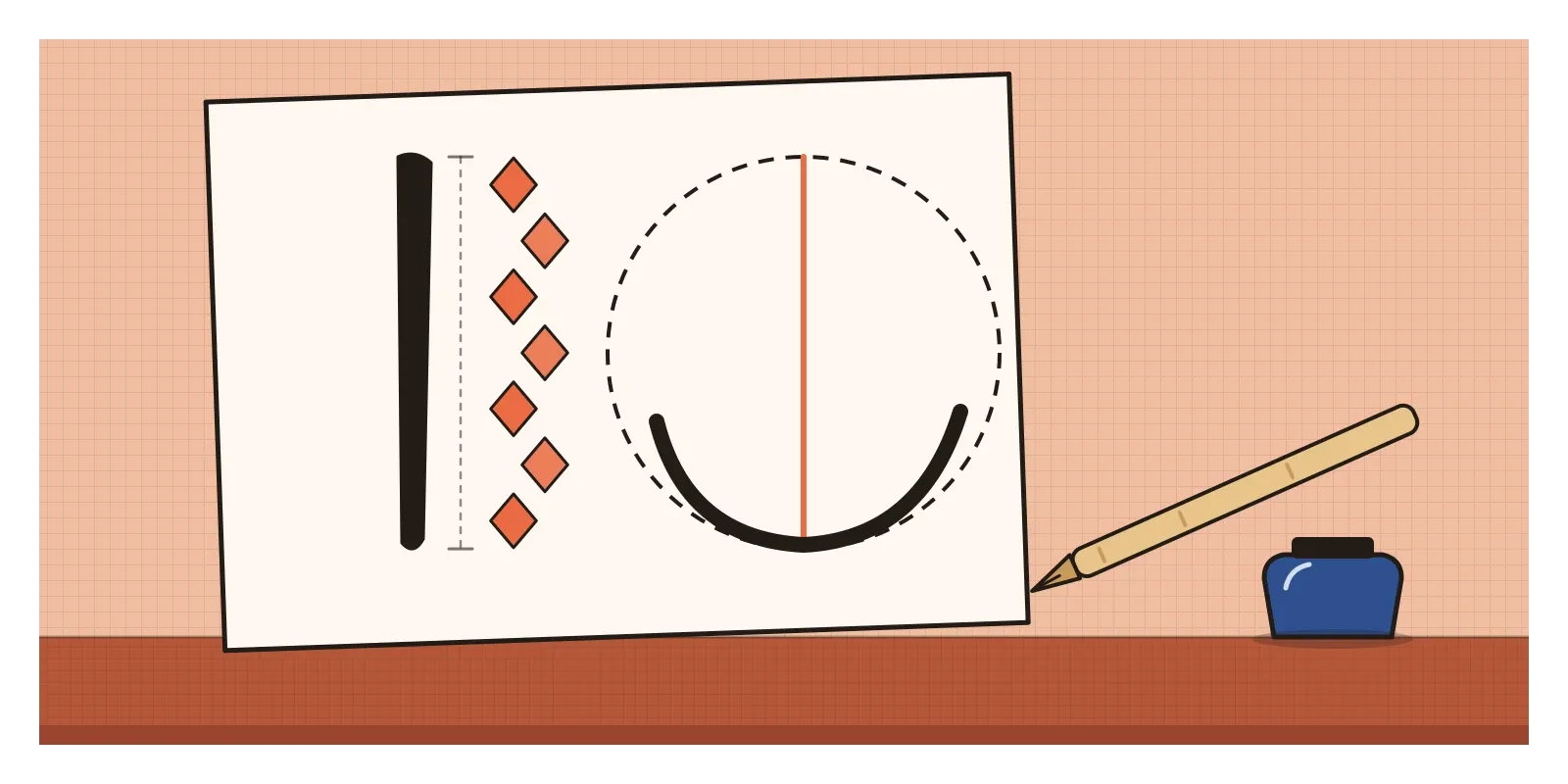
If one art sits at the top of this tradition, it's calligraphy, because it carries the words of the Qur'an. The man usually credited with turning Arabic handwriting into a system is Ibn Muqla, a vizier at the Abbasid court in Baghdad who lived from about 886 to 940. His idea was to measure every letter. The calligrapher cuts a reed pen, called a qalam, and presses its tip on the paper to make a small rhombus, a diamond-shaped dot. The alif, a single upright stroke, is then made a fixed number of dots tall, and a circle with the alif as its diameter sets the size of the curved letters. Every letter follows from that one measure. None of Ibn Muqla's own manuscripts survives, and according to the chroniclers his career ended with rivals having his right hand cut off. But his proportioned script was refined by Ibn al-Bawwab, whose Qur'an copied in Baghdad in 1000 to 1001 is now in the Chester Beatty Library in Dublin.
Architecture travelled just as far. In Córdoba, in southern Spain, Abd al-Rahman I, an Umayyad prince who had escaped the massacre of his family in Syria, began a great mosque around 785. Later rulers extended it into a forest of columns carrying double tiers of horseshoe arches striped red and cream, like a grove of stone palms. When the caliph al-Hakam II added a new prayer niche in the 960s, chroniclers say the Byzantine emperor sent a mosaicist and gold glass cubes to decorate it, a neat reminder of how close the two traditions remained.
Six centuries later, in Istanbul, Mimar Sinan served as chief architect to the Ottoman sultans for about fifty years. His Süleymaniye Mosque, built from 1550 to 1557, and his Selimiye Mosque in Edirne, finished around 1575, are answers to Hagia Sophia, the Byzantine church the Ottomans had turned into a mosque. Sinan wanted one great, calm dome held up by a structure you barely notice. Around the same time, in Safavid Iran, weavers knotted the Ardabil Carpet, dated by its own woven inscription to 1539 to 1540 and now in the Victoria and Albert Museum in London: a golden medallion floats on a deep blue field of flowering tendrils, with a mosque lamp hanging from each end. The inscription names Maqsud of Kashan, though nobody is sure whether he designed it or oversaw the work.
Pattern that runs past the edge
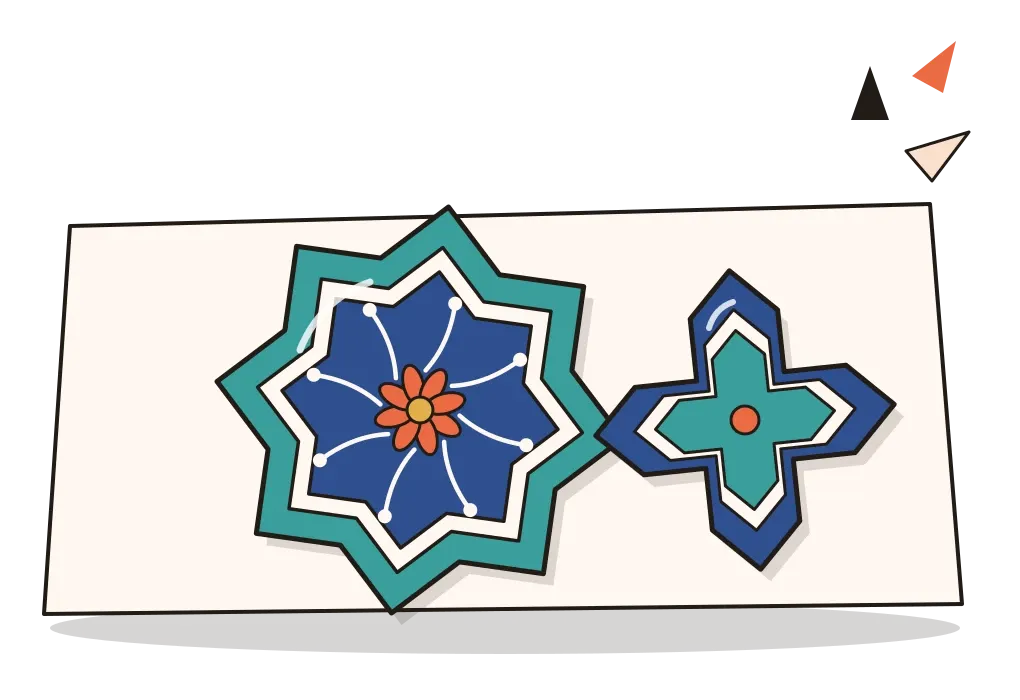
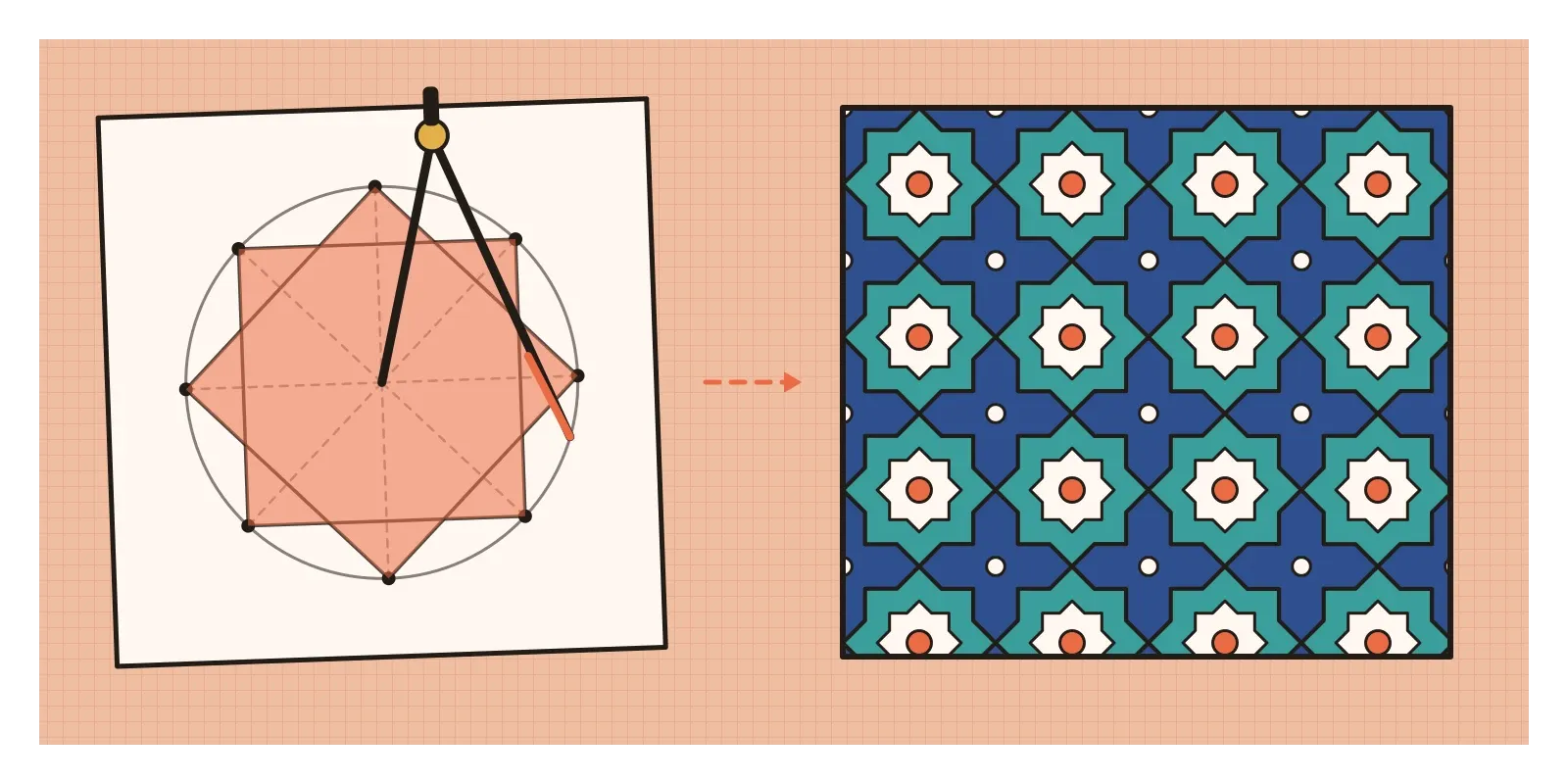
With a designer's eye, three families of ornament keep coming back. The first is geometry: star polygons, interlacing bands and the girih tiles I described in the post on pattern. These were drawn with only a compass and a straightedge. You start with a circle, divide it into equal parts, join the points and a star appears, and repeating that cell on a grid produces a pattern that seems to carry on beyond the wall. The frame crops the pattern. It never finishes it. A rare survival called the Topkapı Scroll, a long roll of architectural pattern drawings probably from the late fifteenth or sixteenth century, shows these constructions with their faint guide lines still visible, like a designer's working file.
The second family is plant ornament: stems that split, curl and split again in an endless rhythm, which Europeans later called the arabesque. The third is writing itself, in many scripts. Kufic is angular and stately, good for stone and coins. Naskh is round and readable, the everyday script of books. Thuluth is tall and sweeping, made for monumental bands. In Iran and Central Asia builders even laid out square Kufic in glazed and plain bricks, words built from blocks like pixels on a screen.
Then there's space and surface. Muqarnas, a honeycomb vault of small niches stacked in tiers, turns the awkward corner between a square room and a round dome into a cascade of facets that catches light. Courtyards and fountains bring water and shade into the plan. Colour leans towards turquoise, cobalt, white and gold, and later the tomato red of Ottoman Iznik tiles. Often a plain outer wall hides a richly covered interior.
A stone tree in Ahmedabad
Islam reached India by two roads: with Arab traders along the western coast, and later with armies from the north-west, which led to the Delhi Sultanate from around 1206. Builders here were often local masons trained in temple work, so Indo-Islamic architecture is a conversation between two traditions: pointed arches and domes on one side, carved brackets, lotus motifs and corbelled stonework on the other. The Gujarat Sultanate, which founded Ahmedabad in 1411, is one of the best places to see it. Its mosques have carved pillars that would look at home in a Jain temple.
The most famous single object in the city is a window. Around 1572 to 1573, Sidi Saiyyed, a nobleman of African descent, one of the Habshi or Siddi people who served at the Gujarat court, built a modest mosque near the old city wall. In the arched openings of its western wall are carved stone lattices, or jalis. The best known shows intertwining trees, their trunks and branches curling into a dense pattern of leaves and fronds, cut from slabs of yellow sandstone so finely that daylight comes through as lace. It isn't geometric at all. It's plant ornament grown into a picture. Ahmedabad has adopted it as an unofficial emblem, and the Indian Institute of Management Ahmedabad based its logo on a stylised version of it.
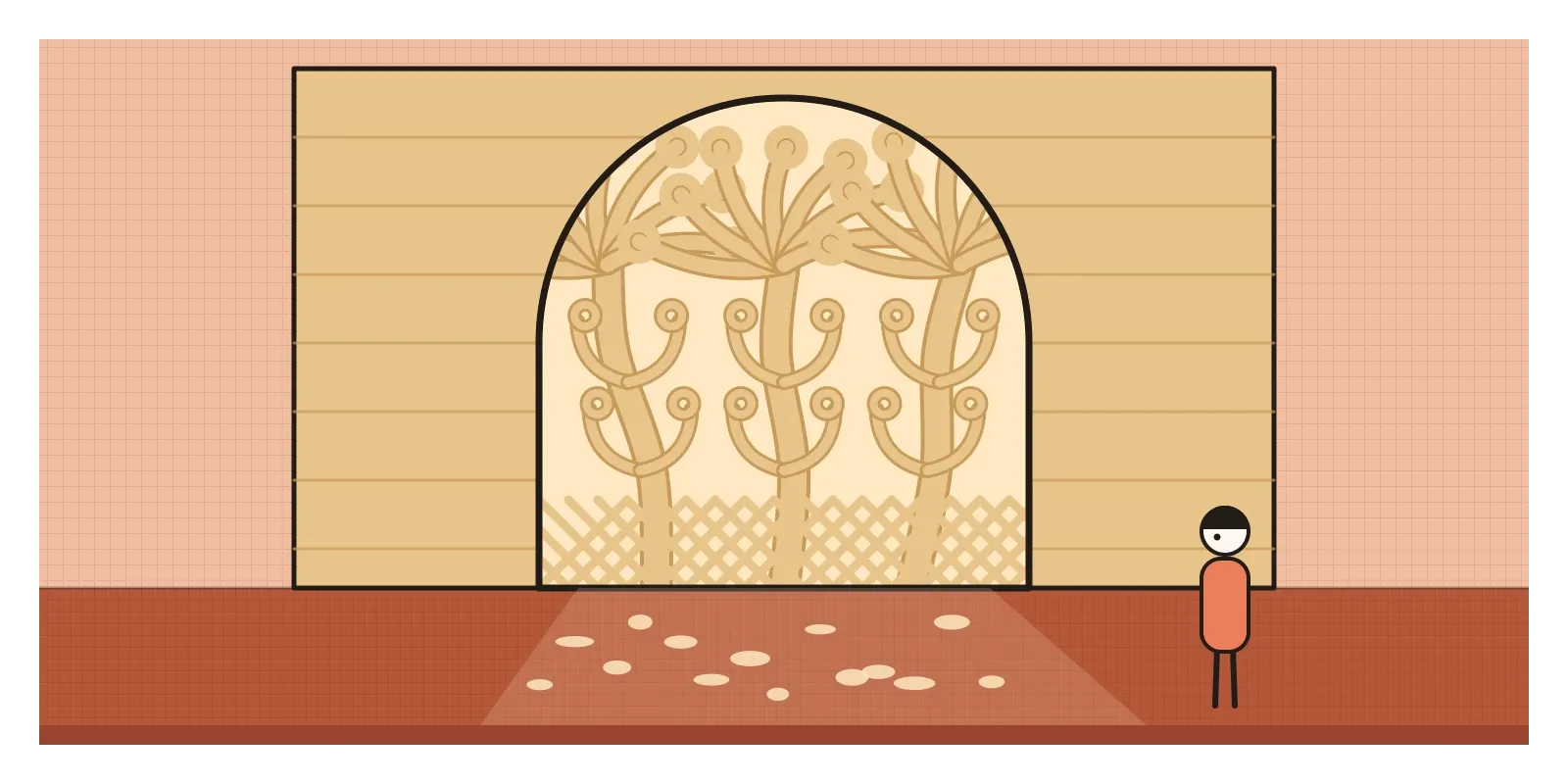
The jali shows what India added: pierced stone that gives privacy, cools the air and breaks harsh sunlight into soft patches. In the Deccan, metalworkers in Bidar developed Bidriware, probably from around the fourteenth or fifteenth century: vessels of a dark zinc alloy inlaid with silver in flowing vines and geometric bands, still made there today. The Mughals, who come in a later post, and the Taj Mahal, which I wrote about in the post on balance, are only the most famous chapter of a much longer story.
Pattern, script and shade on today's screens
Because the old patterns were built step by step from circles and lines, they translate beautifully into code. Computer scientists such as Craig Kaplan have written programs that grow star patterns from tilings of polygons, much as the pattern makers did, and generative tools for packaging and backgrounds lean on the same logic: one cell, strict rules and a repeat that implies infinity.
Architects keep reinventing the screen. Jean Nouvel's Institut du Monde Arabe in Paris, opened in 1987, has a south front made of metal diaphragms that open and close like camera lenses to control the light, a mechanical version of the wooden lattice screens of Cairo. In Kerala, the architect Laurie Baker built cheap, cool houses with brick jalis, simply by leaving gaps in the brickwork.
Writing may be the deepest influence. Arabic is cursive, and most letters change shape depending on whether they come at the start, middle or end of a word. That made printing hard for centuries, and pushed font technology to handle letters that join and change shape in context, which every phone now does quietly. Arabic interfaces also run right to left, so whole layouts are mirrored. It's a good test of whether a design system was built for one script or for the world.
One label for thirteen centuries
The biggest criticism is of the name itself. "Islamic art" was largely shaped by nineteenth-century European collectors and scholars, who grouped thirteen centuries and three continents under a religion, even though much of the work was secular and made for kings and merchants. In 2003 the historians Sheila Blair and Jonathan Bloom called the field an unwieldy mirage. European fashion turned it into fantasy too: Moorish smoking rooms, harem paintings and pattern books like Owen Jones's, which I mentioned in the post on Indian aesthetic concepts, took the look and left out the people. Many objects now in Western museums left their homes in the colonial era.
Some modern writers read the geometry as a fixed cosmic code. Historians such as Gülru Necipoğlu argue that meanings shifted with place and century, and that the patterns were also, simply, superb craft. And the cliché that Islamic art has no figures erases a huge tradition of painting, which comes later in this series. The tradition didn't end. It's still practised, taught and revived. But in Europe around the year 1000, masons were starting their own reply to the Roman ruins around them, sometimes borrowing horseshoe arches and striped stones from Spain. In the next post, on Romanesque, I'll look at the churches that covered Europe.
To see this for yourself, visit the Sidi Saiyyed Mosque in Ahmedabad, checking the visiting customs first, or the Alai Darwaza of 1311 in Delhi's Qutb complex, with its pointed arches, carved script and stone screens. In Hyderabad, the Salar Jung Museum has fine Bidriware and manuscripts. Then try the oldest exercise in the tradition. With a compass, draw a circle and divide it into eight equal parts. Join every second point with a ruler and two overlapping squares give you an eight-pointed star. Repeat it on a grid and watch new shapes appear between the stars. It's the same pleasure the caliph's designers found in a coin with no face: when you take away the picture, the arrangement becomes the message.
Further reading: Jonathan M. Bloom and Sheila S. Blair, Islamic Arts (1997) · Oleg Grabar, The Formation of Islamic Art (1973) · Sheila S. Blair, Islamic Calligraphy (2006) · Gülru Necipoğlu, The Topkapı Scroll: Geometry and Ornament in Islamic Architecture (1995) · Eric Broug, Islamic Geometric Patterns (2008)
A reply toThe figure-filled imperial and church art of Byzantium and Sasanian Persia.