The Industrial Revolution and Design
How steam, iron and the factory split designing from making, and taught objects to repeat themselves.
The Industrial Revolution and Design
A portrait woven from twenty-four thousand cards
Around 1839, in a silk workshop in Lyon, a weaver called Michel-Marie Carquillat finished a portrait of a man who had died five years earlier. From a few steps away it looks like a fine engraving: an elderly man seated at a workbench, surrounded by tools and a small model of a machine, every fold of his coat and every shadow on his face rendered in delicate greys. Up close, it turns out to be woven, in black and white silk. The sitter was Joseph-Marie Jacquard, the inventor of the loom that made it. Every line of the picture was controlled by punched cards, one card for each pass of the shuttle, and the portrait needed about twenty-four thousand of them, laced together into a long chain.
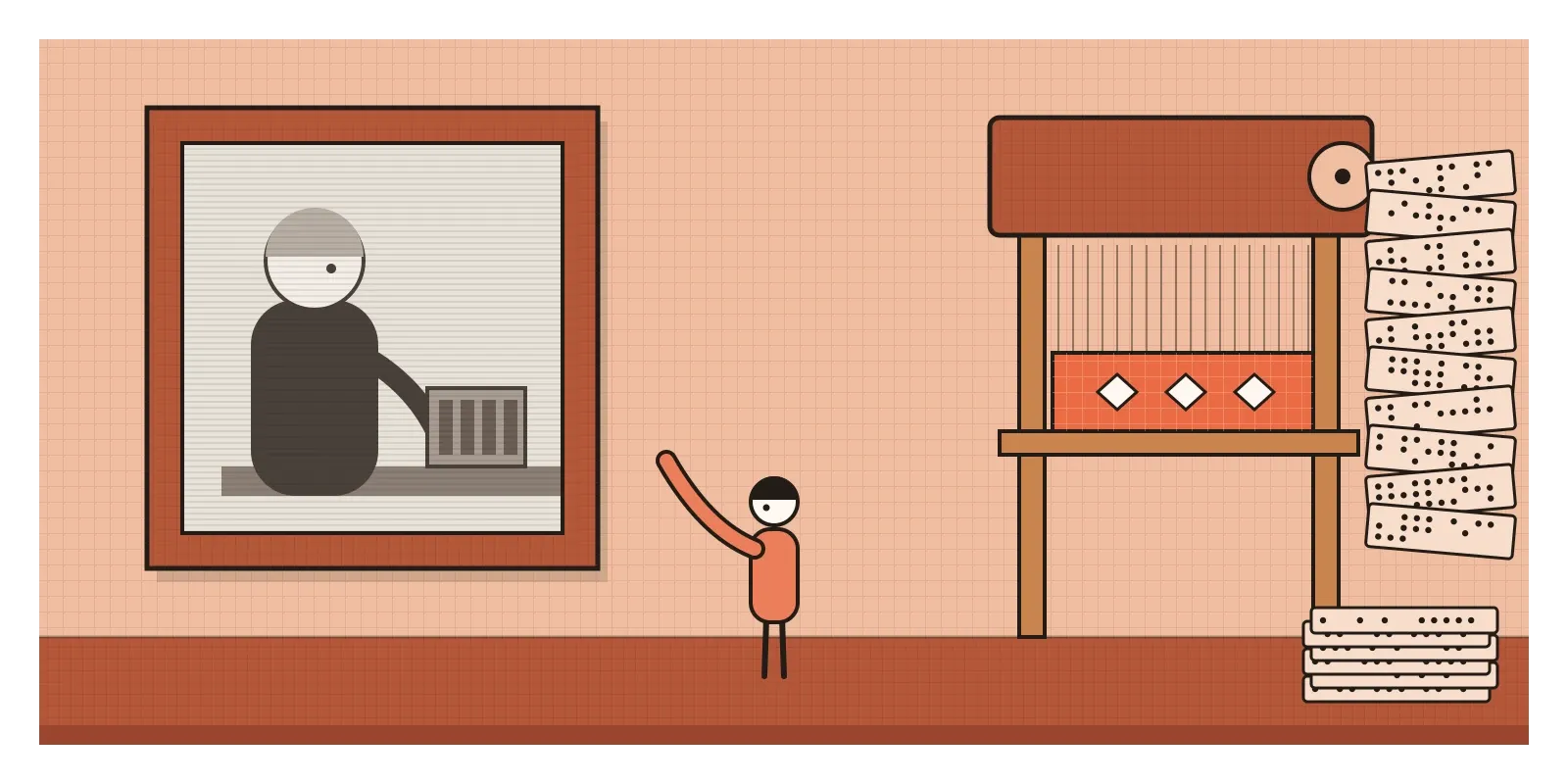
Only a small number of these portraits were made, and one was owned by the English mathematician Charles Babbage, who was then designing a calculating machine he called the Analytical Engine. He is said to have enjoyed asking visitors how they thought it was made, and most guessed it was an engraving. That detail may have been polished in the retelling, but his interest wasn't. Babbage planned to feed his engine its instructions on punched cards, borrowed directly from Jacquard's loom.
The portrait holds the whole story in one object. The picture doesn't really live in the silk. It lives in the cards, and anyone with the same chain and the same kind of loom could weave an identical copy. That's what the Industrial Revolution did to design: it turned making into instructions that machines could repeat as many times as anyone wanted. The term usually describes Britain from roughly 1760 to 1840, as steam, machines and factories took over from hand work, before the change spread elsewhere. Historians argue about the dates and even the word "revolution", because the change came in uneven waves. But for anyone who makes things, it's the moment the ground moved.
The end of the one-at-a-time world
Before the factory, most things were made in small workshops by people who both designed and made them. Cloth was often made under the putting-out system, in which a merchant delivered raw wool or cotton to families who spun and wove at home. Every object carried small variations, and output was limited by the number of skilled hands.
Several things came together in eighteenth-century Britain to change that: cheap coal, a growing market of people with money for cups, buttons and printed cotton, and capital and raw materials flowing in from an expanding empire and from plantations worked by enslaved people. Inventions followed one another. Richard Arkwright opened his water-powered spinning mill at Cromford in Derbyshire in 1771, Samuel Crompton's spinning mule followed in 1779, and James Watt's improved steam engine, built with the Birmingham manufacturer Matthew Boulton from 1775, gave factories power that didn't depend on a river.
The posts on Neoclassicism and Romanticism were about styles replying to each other. This was something different, a change in how things were made that ran underneath both. What it replied to was the workshop itself, with its slowness and its unrepeatable variations. In the post on design, art and craft, I wrote about how the potter Josiah Wedgwood broke the making of a pot into many separate tasks, so that the person who designed it and the people who made it were no longer the same. Across Britain, the same split was happening in iron, textiles, metalwork and print.
An iron bridge that thought it was made of wood
Over the River Severn in Shropshire, in a gorge full of furnaces and smoke, stands one of the strangest and most important objects of the period. The Iron Bridge was designed by the architect Thomas Farnolls Pritchard and built by the ironmaster Abraham Darby III, whose family had pioneered smelting iron with coke in the same valley. Its ribs were cast and raised in 1779, and it opened to traffic on New Year's Day in 1781. It was the first major bridge in the world made of cast iron, a single arch of about thirty metres, using several hundred tonnes of metal.
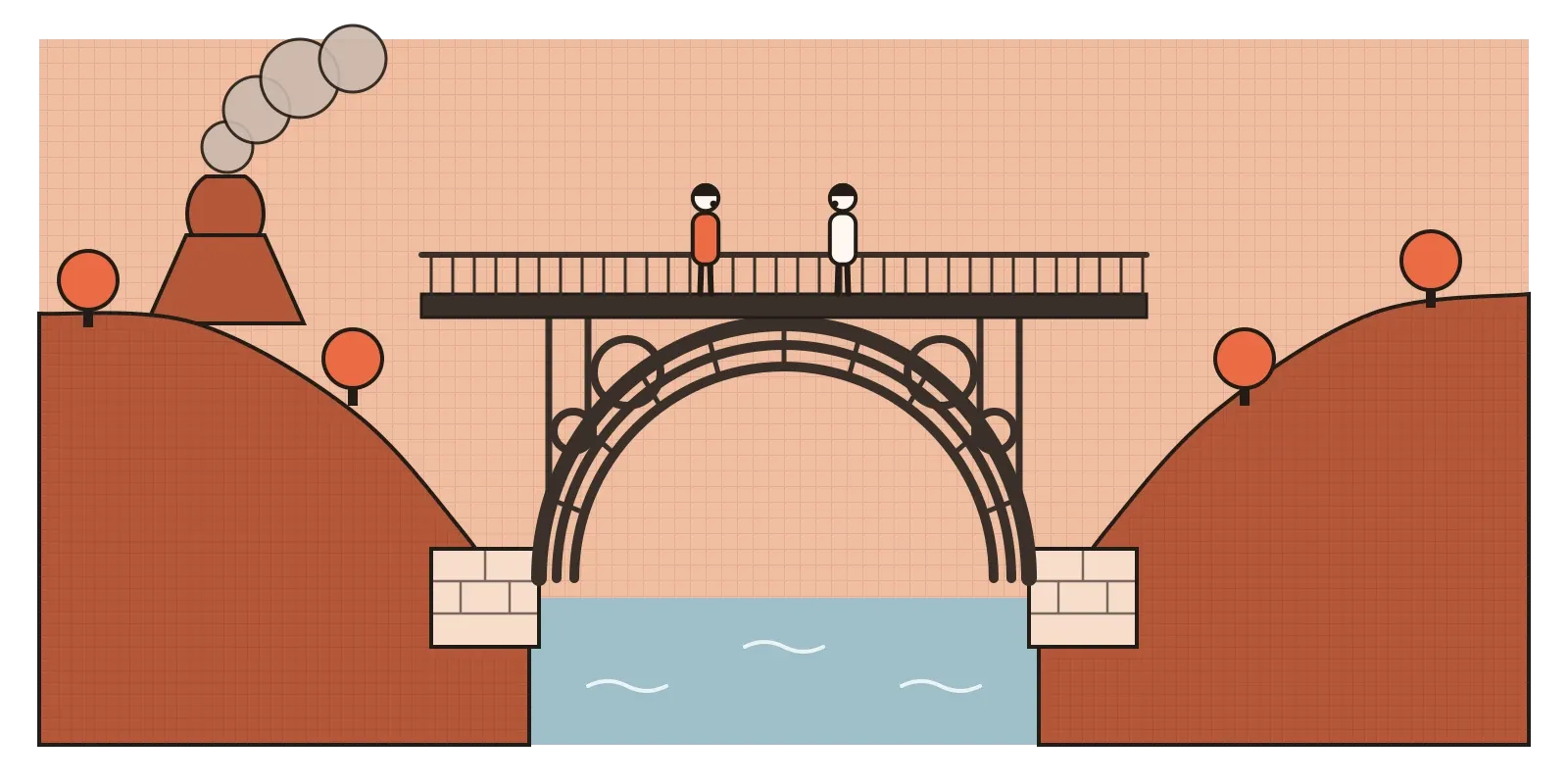
What makes it fascinating to a designer is how it's held together. With no earlier iron bridges to learn from, its builders joined the castings with techniques borrowed from carpentry: dovetails, mortise and tenon joints and wedges, as if the iron were timber. It's a pattern that recurs throughout design history: a new material arrives, and for a while people use it the way they used the old one. Early cars looked like carriages, and as I wrote in the post on form follows function, early smartphone apps dressed themselves in leather and paper. The Iron Bridge was the skeuomorphism of 1779.
Other experiments went further. Boulton's Soho Manufactory near Birmingham turned out buttons, buckles and plated tableware in huge numbers, and when James Boswell toured it in 1776, Boulton told him he sold what all the world desired: power. At the Portsmouth naval dockyard, between 1803 and 1807, the engineer Marc Brunel and the toolmaker Henry Maudslay installed around forty-five machines to make the pulley blocks sailing ships needed by the thousand, so that ten men without special training could do the work of more than a hundred skilled block makers.
And then there was Jacquard's loom itself, patented in France in 1804. Before it, a figured silk needed a second worker, often a child, perched on the loom to lift the right threads by hand for every row. Jacquard's mechanism read the pattern from punched cards instead. Change the cards, and the loom wove a different design. In 1843 the mathematician Ada Lovelace, writing about Babbage's engine, compared the two directly: the engine, she said, would weave algebraic patterns in the way the loom wove flowers and leaves. A design had become something you could store, copy and run.
The same thing, over and over
The Industrial Revolution isn't a style like the Baroque, so you recognise it less by a look than by a set of habits. The first is exact repetition. A transfer-printed plate from the 1820s carries precisely the same pattern as its neighbour, because it was printed from an engraved copper plate rather than painted by hand. The blue-and-white Willow pattern, from around 1790, even came with a "Chinese" love story invented in England to help sell it.
The second is new materials in old disguises. Cast iron could be moulded into almost any shape, so it appeared as Gothic tracery, Greek columns and acanthus leaves on railings, stoves and benches. The third is modular construction: objects designed as sets of standard parts, from machine-cut screws to iron columns and girders bolted together.
Type shows the change clearly. Cheap printing filled streets with posters and handbills that had to shout, and founders responded with letters nobody had seen before: Robert Thorne's heavy "fat faces" around 1803, Vincent Figgins's blocky slab serifs in 1815, and in 1816 what's often called the first sans serif type in English printing, from William Caslon IV's foundry. The loud display faces on today's packaging are their descendants.
Cloth that went one way, then the other
The story of industrial cotton can't be told without India, because for centuries India was the world's great cotton workshop. Chintz from the Coromandel coast, calico named after the port of Calicut and the fine muslins of Dhaka were sold across Asia, Africa and Europe. In Britain, Indian cottons became so fashionable that wool and silk manufacturers lobbied for protection. Parliament banned imports of printed calicoes in 1700 and, in 1721, banned most people from wearing or using printed cotton at all.
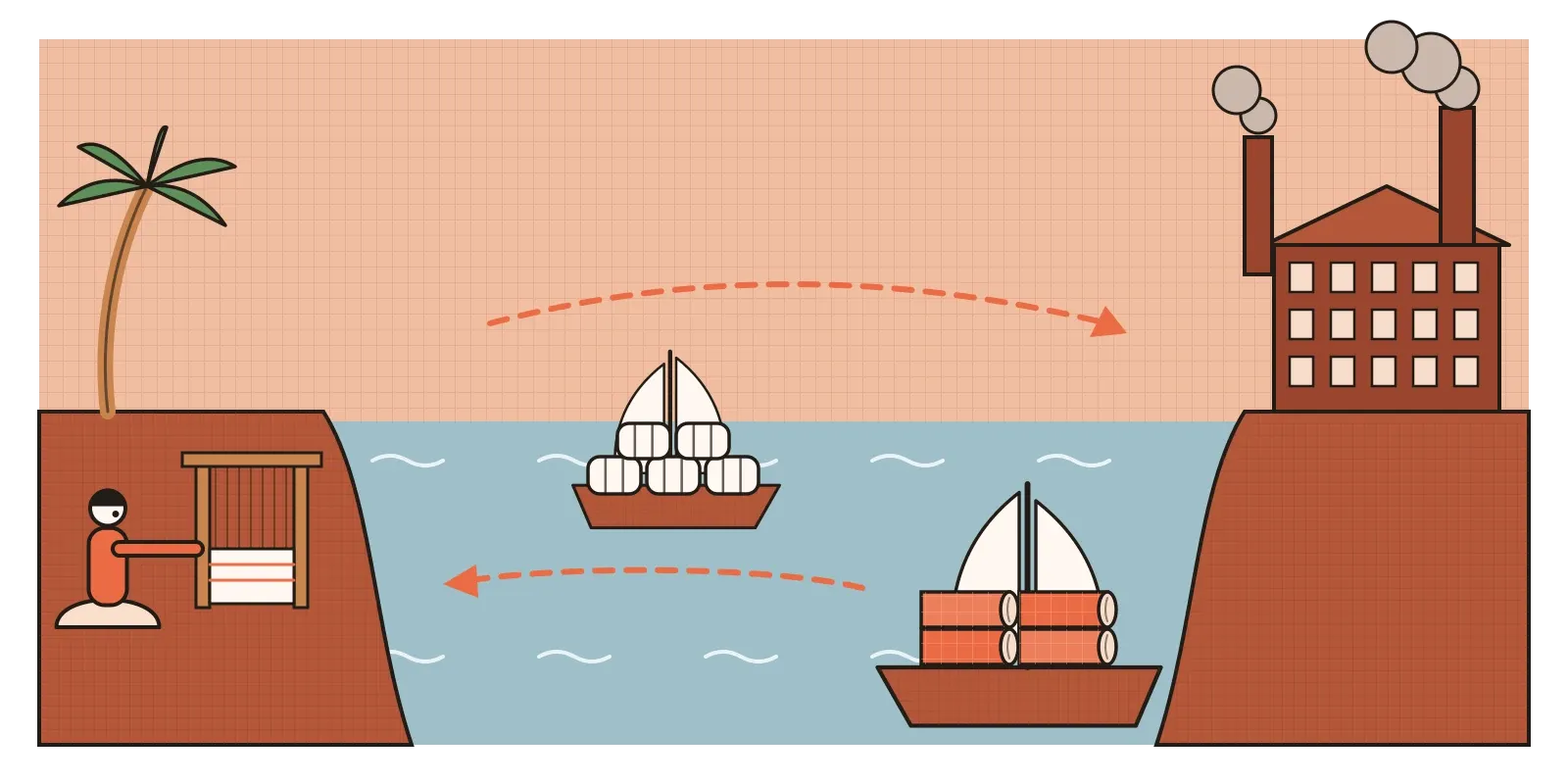
Behind those walls, British inventors learned to make cotton that could compete. Crompton's mule could spin yarn fine enough for muslin. By the early nineteenth century, the flow had reversed. Raw cotton travelled from India and the American South to the mills of Lancashire, and machine-made cloth travelled back, much of it to Indian markets, where it undercut hand-spun and hand-woven goods. As I mentioned in the post on Indian aesthetic concepts, the same empire that admired Indian craft in its museums was flooding Indian bazaars with mill cloth.
How much damage this did is still argued over. A grim line about weavers' bones bleaching on the plains of India is often attributed to the Governor-General William Bentinck, but historians doubt he wrote it. Economic historians such as Tirthankar Roy have shown that handloom weaving survived and adapted, often using cheaper mill yarn, while others, such as Prasannan Parthasarathi, stress how much spinning and the export trade were lost. Both can be true: hand spinners suffered badly, many weavers adapted, and the famous Dhaka muslins all but disappeared.
India also began its own industrial story in the same years. In 1854 the Parsi merchant Cowasji Nanabhai Davar founded the Bombay Spinning and Weaving Company, usually counted as the first successful cotton mill in Bombay, and Ahmedabad's first mill followed in 1861. Later, the spinning wheel would become a political symbol of swadeshi and of Gandhi's campaigns, a deliberate reply to the factory.
Six pieces, ten screws and a crate
In 1859, the Vienna firm of the cabinetmaker Michael Thonet launched a café chair known simply as No. 14. Thonet steamed lengths of beech until they could be bent into curves, so the chair needed just six pieces of wood, ten screws and two nuts, and no carved joints at all. Thirty-six of them, taken apart, fitted into a crate of about one cubic metre. Tens of millions were sold, and it's the ancestor of every flat-pack bookshelf you've carried home in a box.
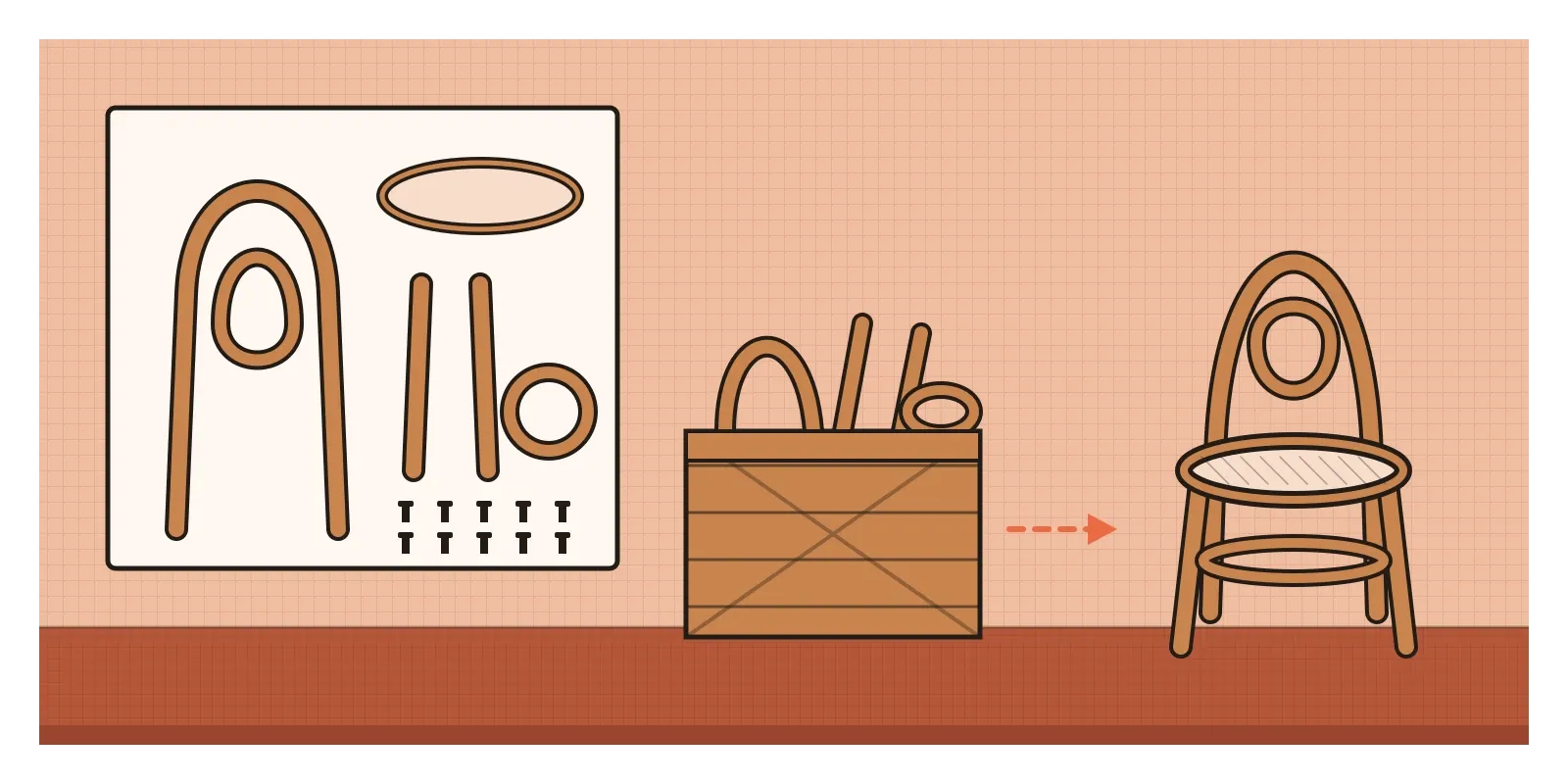
Thonet's chair carries the lesson the Industrial Revolution handed every later designer: how something will be made, packed and shipped is part of the design. Industrial designers call it design for manufacture, and it's why a plastic toy has gentle tapers so it can slide out of its mould.
Digital design inherited even more. A component library, with standard buttons, inputs and cards assembled into thousands of screens, descends from interchangeable parts, and design tokens, the named colours and spacings a product draws from, are a kind of standard screw thread. Jacquard's cards are ancestors of code. Every time a designer writes rules instead of drawing every case, whether a responsive layout, a template for thousands of ad variations or a prompt for an AI image tool, they're doing what the Lyon weavers did: putting the design into the instructions and letting a machine repeat it. The hard question moved too, from what this should look like to what every version of it should look like, including the ones nobody will ever check.
Smoke, cotton fields and cheap ornament
The costs were enormous, and fell mostly on people with no say. Children worked long hours in mills until the Factory Act of 1833 began to limit them. In 1845, Friedrich Engels described the slums of Manchester in The Condition of the Working Class in England. The Luddites, who smashed machines in the English Midlands and North between 1811 and 1816, are remembered as enemies of technology, but were mostly skilled workers protesting wage cuts and shoddy goods. The raw cotton that fed Lancashire was largely grown by enslaved people in the American South.
There was a design cost too. Machines made ornament cheap, so manufacturers piled it on, borrowing styles at random. By mid-century, critics complained that British goods were technically brilliant and visually confused, and the debate came to a head at one enormous event in a glass building in London. In the next post, on the Great Exhibition of 1851, I'll look at the show that put all of this on display, and at the people who walked out of it determined to do something different.
To see this story in India, visit the Calico Museum of Textiles in Ahmedabad, set up in 1949 in a city built on its mills, which holds extraordinary Indian textiles from courtly chintz to fine muslin. Visits are by guided tour, so book ahead. Or try this at home. Pick up any mass-produced object, a plastic bottle, a chair, a steel tumbler, and look for evidence of how it was made: the faint seam where two halves of a mould met, the screws, the identical details. Then guess how many exact copies of it exist.
Jacquard's portrait still looks like a quiet picture of an old man at his bench. But it's also a program, twenty-four thousand cards long, and it could be run again tomorrow. Most of what we design today works the same way.
Further reading: Adrian Forty, Objects of Desire: Design and Society since 1750 (1986) · James Essinger, Jacquard's Web (2004) · Giorgio Riello, Cotton: The Fabric that Made the Modern World (2013) · Sven Beckert, Empire of Cotton: A Global History (2014) · Prasannan Parthasarathi, Why Europe Grew Rich and Asia Did Not (2011)
A reply toThe slow, one-at-a-time making of the workshop and the guild.