Indus Valley Art and Design
Seals, standard bricks and planned streets from a civilisation that designed cities before monuments.
Indus Valley Art and Design
Ten signs above a city gate
In the early 1990s, archaeologists of the Archaeological Survey of India, led by R. S. Bisht, were excavating Dholavira, an ancient city on the island of Khadir in the Rann of Kutch in Gujarat. In a chamber beside the city's northern gateway, they found something no one had seen before at an Indus site: ten large signs of the Indus script laid out in a row, each around thirty-seven centimetres tall, made from pieces of white gypsum. The wooden board they had been set into had rotted away over four thousand years, but the signs kept their order. Bisht has suggested that the board once hung above the gateway, where anyone arriving would have seen its white shapes from a distance, and that it was later taken down.
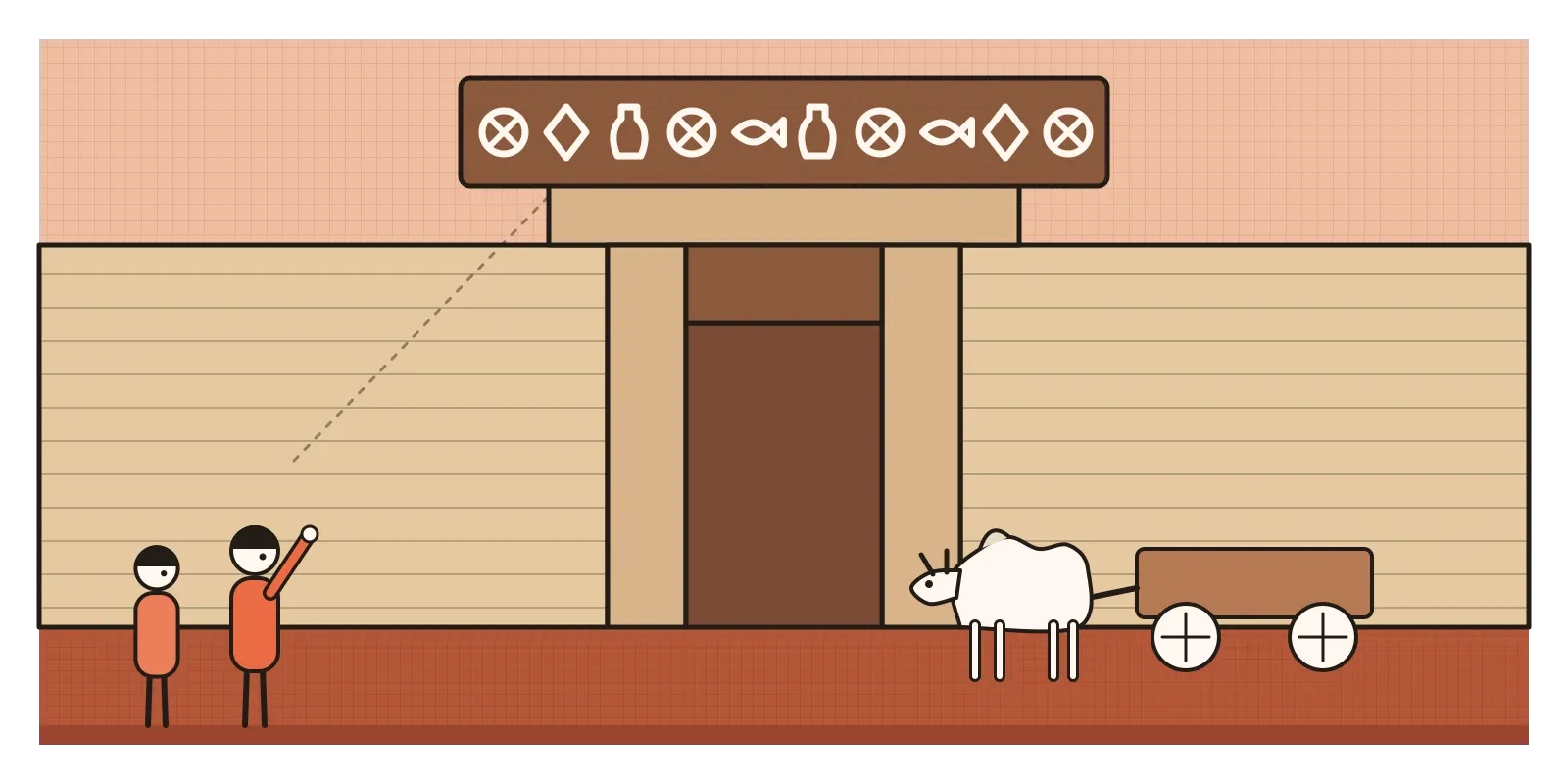
It's often called the oldest known signboard in the world, though that claim is hard to prove. What's certain is that nobody can read it. The Indus script has never been deciphered, so we don't know whether the ten signs spell the name of the city, a ruler, a god or something else entirely. We can see the letters perfectly and still not know what they say.
I wanted to write about the Indus Valley, also called the Harappan civilisation after the first site to be excavated, because its art and design are so different from what came before it in this series. It flourished at its height from around 2600 to 1900 BCE, across a huge area of what is now Pakistan and northwest India. And where Egyptian art, which I wrote about in the last post, was made to glorify kings and serve the dead, the Indus people seem to have put their best design work into everyday things: bricks, weights, seals, beads, streets and drains.
Cities without palaces
The civilisation grew up along the Indus river and its tributaries, and along a second river system to the east, the Ghaggar-Hakra, which ran through present-day Haryana, Rajasthan and Pakistan. More than a thousand settlements are known, from big cities like Mohenjo-daro in Sindh, Harappa in Punjab and Rakhigarhi in Haryana to towns like Lothal and Dholavira in Gujarat and Kalibangan in Rajasthan. The rivers flooded and fed farmland, and the coast of Gujarat opened routes by sea to the Persian Gulf.
It didn't appear from nowhere. At Mehrgarh, at the foot of the Bolan Pass in Balochistan, people were farming, making pottery and drilling beads from around 7000 BCE, and over the following millennia village cultures across the region slowly grew into towns. The mature cities were a reply to those villages: the same crafts, gathered, standardised and planned at a new scale.
Modern archaeology found the civilisation late. In the 1850s, engineers building the railway between Lahore and Multan took old baked bricks from the mounds at Harappa as ballast. Excavations began at Harappa under Daya Ram Sahni in 1921, and at Mohenjo-daro under R. D. Banerji in 1922. In September 1924, John Marshall, the director-general of the Archaeological Survey, announced the discovery in the Illustrated London News, and the history of South Asia was suddenly far older than people had thought.
A seal, a dancer and a man in a patterned robe
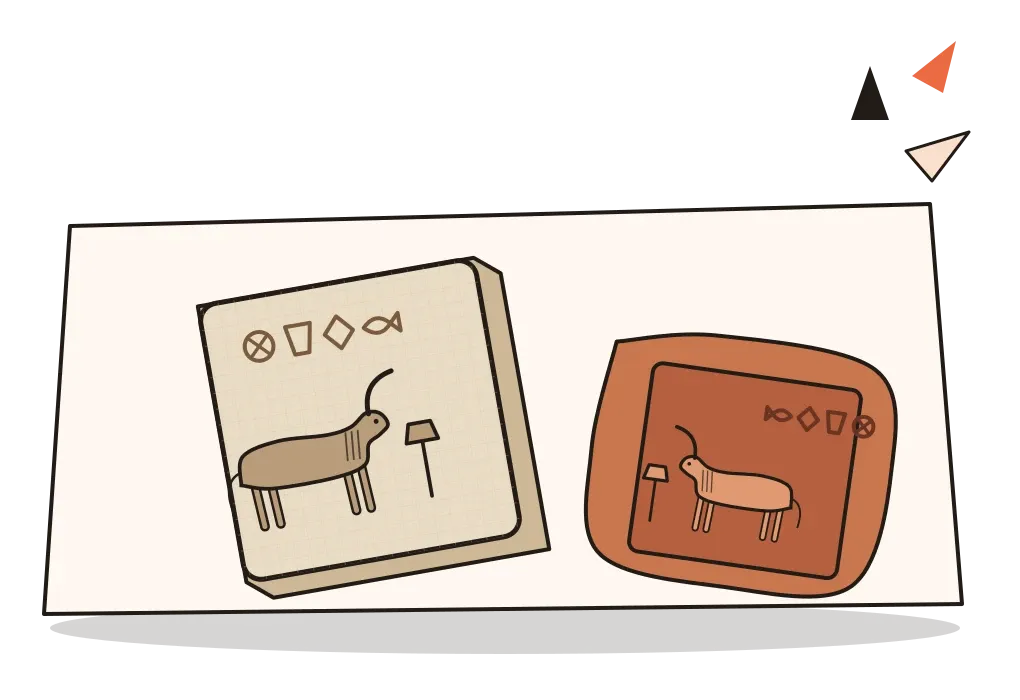
Indus art is small. There are no colossal statues, no painted tombs, no scenes of kings crushing enemies. Its masterpieces mostly fit in the palm of a hand, and the most typical is the seal. Thousands have been found. Most are square, a few centimetres across, carved in soft steatite and fired to harden it, with a pierced knob on the back. On the front, carved in reverse so that it prints the right way round, is usually an animal in profile under a short line of script. The commonest is a bull-like creature with a single horn, often called a unicorn. Others show a humped zebu, an elephant, a rhinoceros or a tiger, cut with astonishing precision on a tiny surface.
One seal from Mohenjo-daro shows a figure seated with bent knees, wearing a horned headdress and surrounded by animals. Marshall called it a proto-Shiva, an early form of the god as lord of animals, and it's often called the Pashupati seal. Many scholars now think that reading goes far beyond the evidence. It's a good example of how much we project onto what we can't read.
Two figures from Mohenjo-daro have become icons. The first is a bronze girl, only about ten centimetres tall, found in 1926 and now in the National Museum in New Delhi. Cast by the lost-wax method, she stands with one hand on her hip and her chin raised, her left arm covered almost to the shoulder in bangles, with a relaxed, confident posture that still feels alive. She's known as the Dancing Girl, though nobody knows if she was dancing. The second is a bearded man carved in steatite, about seventeen centimetres tall, wearing a robe covered in a trefoil pattern that was once filled with red paste. He's called the Priest-King, a name archaeologists gave him without any real evidence that he was either. He's now in the National Museum of Pakistan in Karachi.
Same brick, same weight, same drain
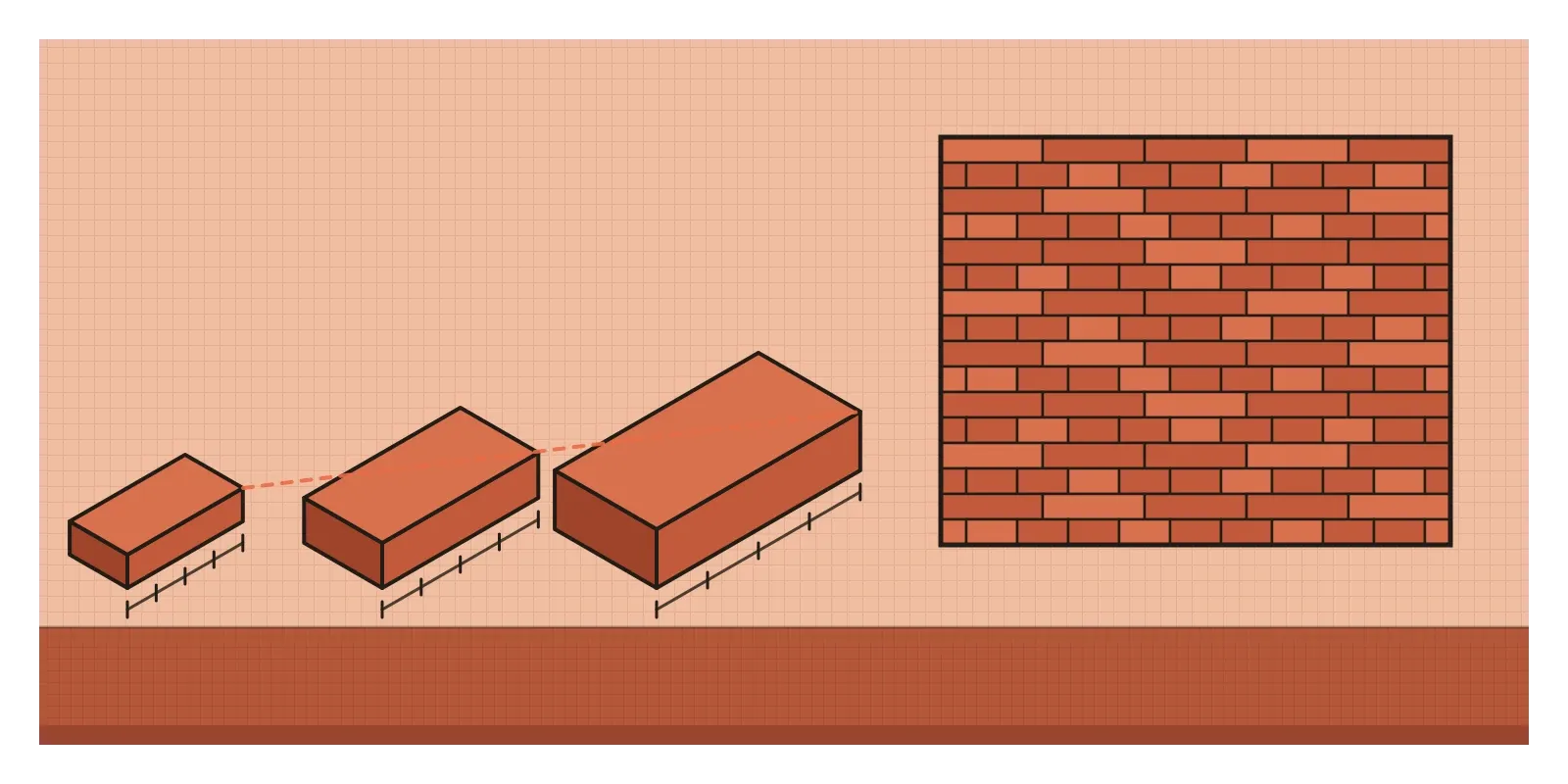
The design language of the Indus cities is consistency. Across hundreds of kilometres and several centuries, their builders used bricks made in the same proportions, roughly 1 to 2 to 4 for thickness, width and length. Small house bricks and large bricks for city walls followed the same ratio. That's not an accident. A brick twice as wide as it's thick and twice as long as it's wide can be laid in alternating directions and still line up neatly, which makes strong, regular walls without cutting. It's a modular system, and it worked whether you were building a drain or a citadel.
Weights were standardised too. Traders used small polished cubes of chert, a hard stone, in a series that doubled in the smaller sizes and then rose in steps that look decimal in the larger ones. The same weights turn up at sites far apart, which suggests a shared system of measure across the whole region.
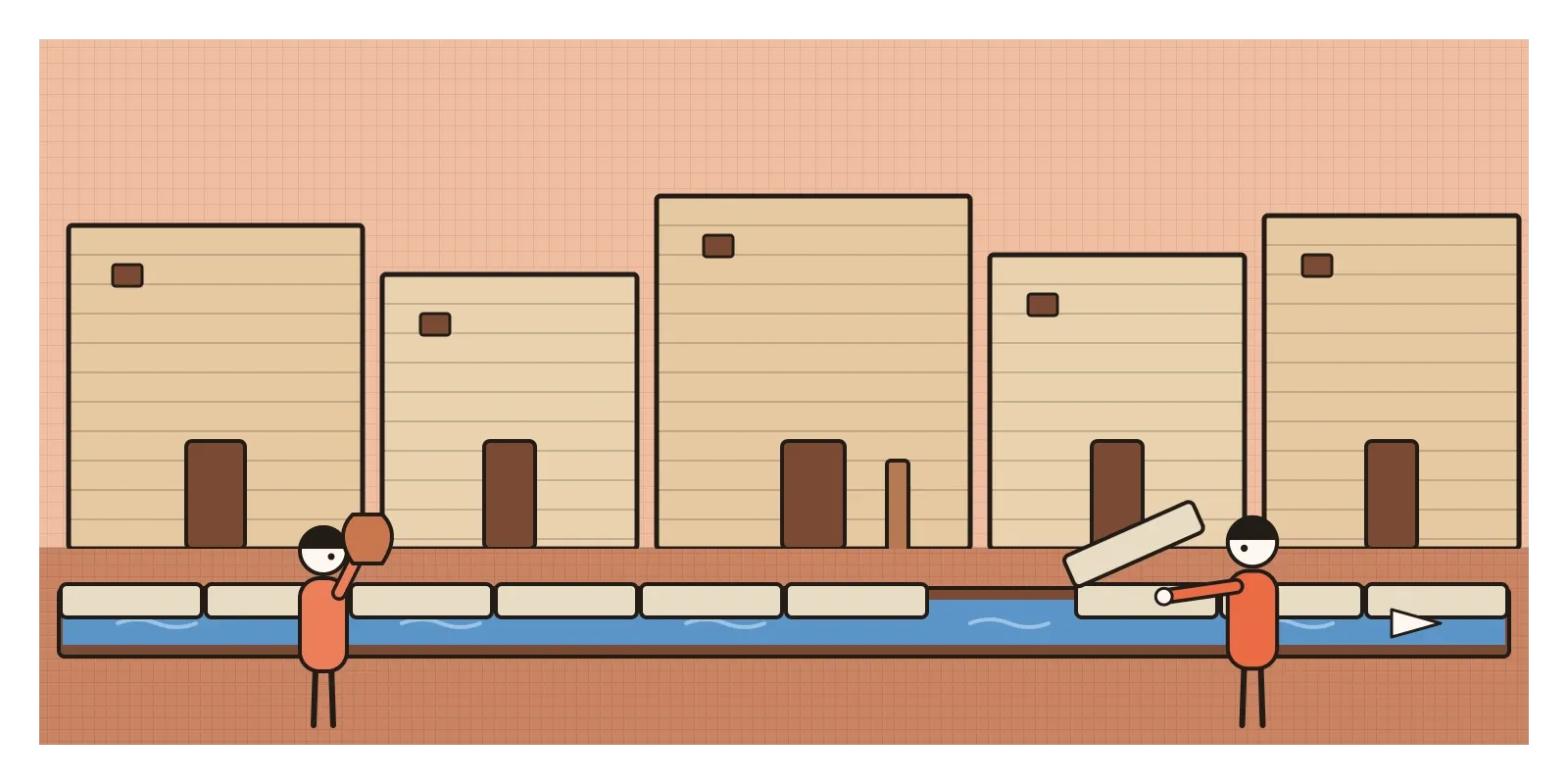
Cities were laid out with intention. At Mohenjo-daro, the main streets run roughly north to south and east to west, with smaller lanes between blocks of houses. Many houses had a bathing area and a private well, and waste water ran into brick-lined drains along the streets, covered with bricks or stone slabs and fitted with places where they could be cleaned. On the raised mound at the city's western edge is the Great Bath, a sunken pool about twelve metres long and seven wide, made watertight with fitted bricks and a layer of bitumen. Nobody knows exactly how it was used, though many guess at ritual bathing.
The visual style follows the same restraint. Pottery is usually red with black painted patterns, intersecting circles, fish scales and pipal leaves, repeated in bands. Seal carvings are crisp and economical. Long, polished carnelian beads, drilled lengthwise with special stone drills, show staggering patience. It's a culture that cared about precision, repetition and fit far more than grandeur.
Carnelian for Mesopotamia
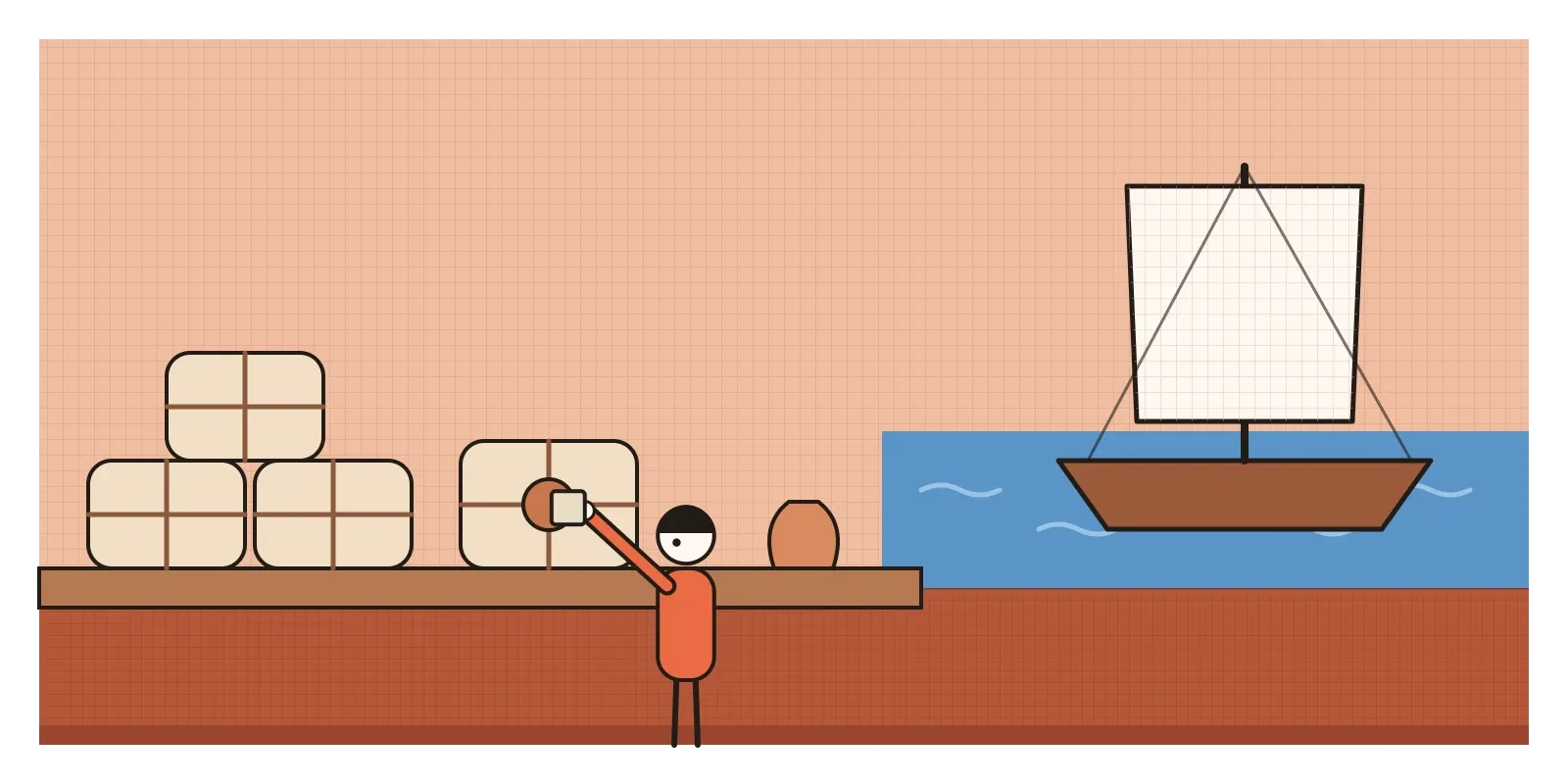
Since this is an Indian movement, the outward view is the more interesting one. The Indus cities weren't isolated. Clay tablets from Mesopotamia, in present-day Iraq, mention a distant land called Meluhha, which most historians identify with the Indus region, as a source of carnelian, ivory, timber and fine goods. Sargon of Akkad, who ruled in Mesopotamia around 2300 BCE, boasted that ships from Meluhha docked at his capital. Indus seals have been found at Mesopotamian sites like Ur, and Indus carnelian beads, including ones etched with white patterns, have turned up in the royal tombs there. At Lothal, a large brick basin has been interpreted as a dockyard, though some archaeologists argue it was a water reservoir.
What stands out when you compare the Indus with its neighbours is what's missing. Egypt and Mesopotamia filled their cities with temples, palaces, royal statues and inscriptions boasting of victories. In the Indus cities, archaeologists haven't found an obvious palace, a royal tomb or a single image of a battle. Some see this as a sign of a less hierarchical society, perhaps run by merchants or councils. Others argue the rulers simply expressed power differently, through control of standards, trade and planning rather than images of themselves. It's one of the great open questions.
Some threads run forward into later India. Terracotta toy carts look very like the bullock carts still used in villages, and the Dancing Girl's stacked bangles resemble those still worn in parts of Gujarat and Rajasthan. Scholars argue about deeper continuities in religion and language, and those arguments have often become political, so I'd treat confident claims in either direction with care.
Design systems, four thousand years early
If the Egyptians built a design system for images, the Indus people built one for a whole material culture, and it feels surprisingly modern. The brick ratio is a module, like the spacing scales used in design systems today, where every margin is a multiple of a base unit so that components fit together without fiddling. I wrote about such modules in the post on proportion systems. The weights are a shared unit of measure, the foundation of any system that many people have to trust. And the drains are a reminder that some of the most important design is invisible when it works. Nobody admires a sewer, but a city without one fails.
The seals are the part I find most suggestive. An Indus seal was pressed into clay to mark a sealed bundle of goods, a jar or a door, and the impressions, called sealings, have been found with the marks of cord and cloth on their backs. A seal combined an image, a short text and a guarantee: this belongs to someone, and it hasn't been opened. That's what a logo, a trademark and a security badge do today. Many seals also show the same few animals in the same poses, as if they followed a shared style guide while carrying different names.
Then there's the Dholavira signboard, which teaches the hardest lesson of all. Its signs are bold, high in contrast, carefully spaced and designed to be seen from a distance. By every visual measure, it's good signage. And we can't read a word of it, because the shared convention behind the signs is lost. Every icon set and every interface relies on conventions its users have learned. Clarity isn't only in the shape. It's in the agreement between the designer and the person looking.
A silent script, and the people we can't see
The main limit in understanding the Indus is that it can't speak for itself. Without a readable script, we know no names, no laws, no stories. That gap has been filled with guesses, some romantic, like the picture of a peaceful egalitarian utopia, and some damaging. In the 1940s, the archaeologist Mortimer Wheeler suggested that invading Aryans had massacred the people of Mohenjo-daro, pointing to skeletons found in the streets. Later research showed the skeletons came from different periods and showed no clear signs of a massacre. The uniformity I've been admiring may also have had a harder side. Standards that consistent usually need someone to enforce them, and we don't know who that was or who did the work.
The cities declined from around 1900 BCE, probably for several reasons together: shifting rivers, a weakening monsoon, and falling trade. People didn't vanish. They moved east and south into smaller villages, and the big cities emptied. Partition added a modern twist. When the subcontinent was divided in 1947, Harappa and Mohenjo-daro went to Pakistan, and the finds were split between the two countries, which is why the Dancing Girl is in Delhi and the Priest-King in Karachi.
To see it this week, visit the Harappan gallery at the National Museum in New Delhi, where the Dancing Girl and many seals are on show. If you're in Gujarat, Lothal is an easy trip from Ahmedabad and has a small site museum, and Dholavira, a UNESCO World Heritage Site since 2021, is worth the long drive into the Rann. For a small exercise, draw a square two and a half centimetres across and design a seal: one animal in profile and a short row of marks. Then try to make a second seal that clearly belongs to the same family but to a different owner. It's a brand system in miniature.
Ten white signs above a gate, still in their order after four thousand years, still waiting for a reader. In the next post, on ancient Greek art, I'll look at a culture that wrote a great deal about beauty, and whose sculptors spent centuries teaching stone figures how to relax.
Further reading: Jonathan Mark Kenoyer, Ancient Cities of the Indus Valley Civilization (1998) · Gregory L. Possehl, The Indus Civilization: A Contemporary Perspective (2002) · Andrew Robinson, The Indus: Lost Civilizations (2015) · Upinder Singh, A History of Ancient and Early Medieval India (2008)
A reply toThe farming villages of Mehrgarh and the early Harappan towns, gathered into planned cities.