Ancient Greek Art
How Greek sculptors and builders taught stone to relax, and why the white marble we admire was once painted.
Ancient Greek Art
A shoulder in the sand off Riace
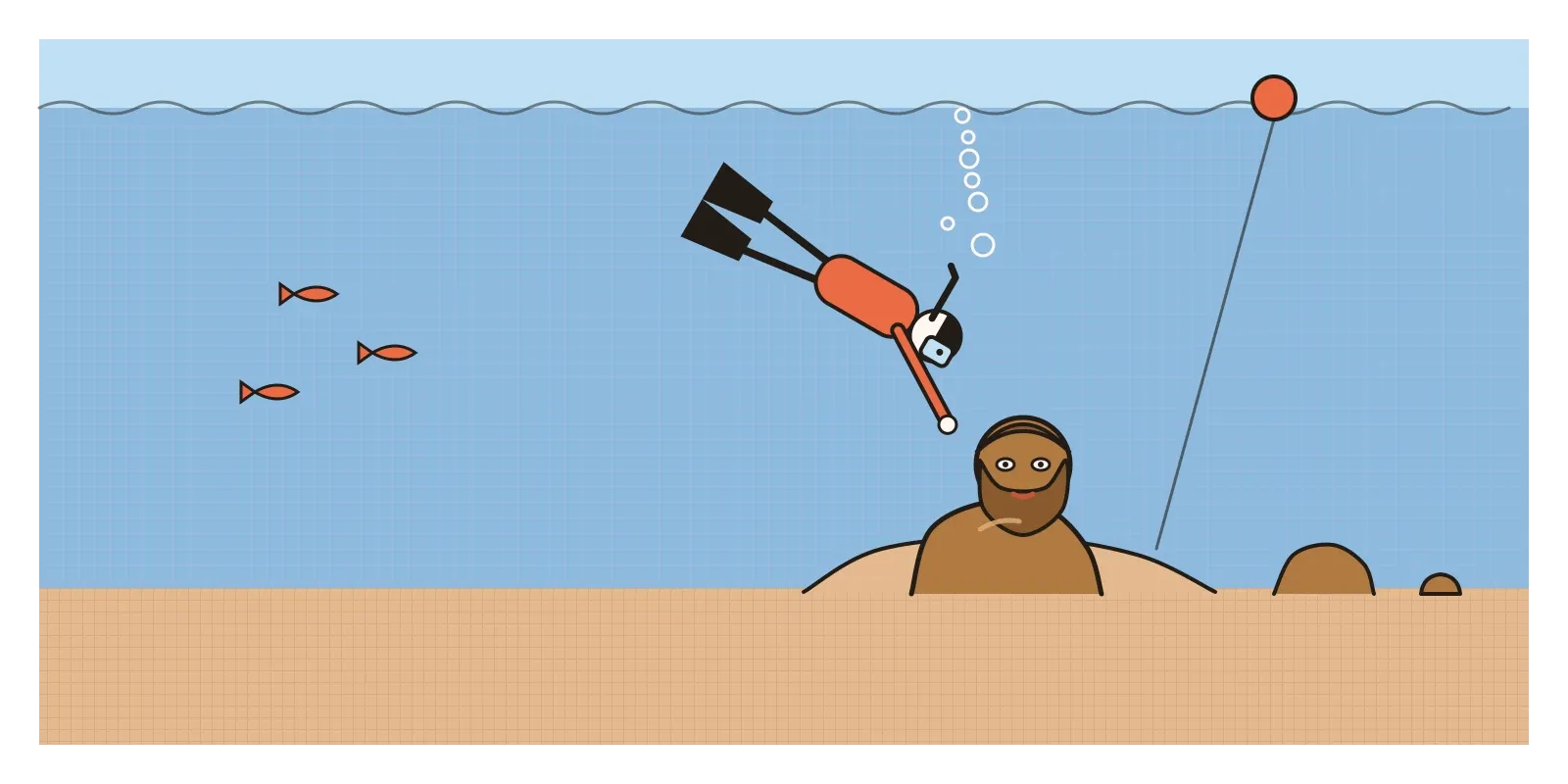
On 16 August 1972, a holidaymaker from Rome called Stefano Mariottini was diving off Riace Marina, on the coast of Calabria in southern Italy, a couple of hundred metres from the shore. On the seabed, a few metres down, he saw a dark shoulder sticking out of the sand. He touched it, realised it was bronze, and then spotted a knee and a toe belonging to a second figure nearby. He marked the place with a buoy and reported it, and a few days later two bronze warriors, each almost two metres tall, were lifted out. A group of young men from Riace later claimed to have found them first, but the courts gave Mariottini the finder's reward.
The Riace bronzes, now in the Museo Nazionale della Magna Grecia in Reggio Calabria, were made around 460 to 430 BCE, at the height of what we call the Classical period. They're bearded, naked and muscular, and each stands with his weight on one leg, the other knee relaxed, the head turned slightly. Large Greek bronzes are rare, because most were melted down for their metal, so the pair caused a sensation. Up close, they're startlingly alive. Their eyes are inlaid with white stone and coloured glass, their lips and nipples are copper, which would have been redder than the body, and one has teeth of silver. When new, the polished bronze would have had a warm, golden shine.
Ancient Greek art covers what was made in the Greek world from around 800 BCE to 31 BCE, when Rome defeated the last great Greek kingdom, Ptolemaic Egypt, at the battle of Actium. Its long project was to make images of people that felt alive, idealised and believable at once, and the warriors from Riace are close to the peak of that project.
Learning from Egypt, then letting go
Greece was never one country. It was a scatter of independent city-states, Athens, Sparta, Corinth and many more, around the Aegean and in colonies from Sicily to the Black Sea. They shared a language, gods and great sanctuaries like Olympia and Delphi, where cities and athletes put up statues to honour the gods and show off. The materials were marble, especially the fine white stone of Paros and Mount Pentelikon, bronze cast by the lost-wax method, and clay for painted pottery.
Greek art grew up in conversation with older neighbours. In the seventh century BCE, Greek traders and soldiers settled in Egypt, and around then Greek sculptors began making life-size stone figures of young men called kouroi. A kouros stands upright, arms at his sides, fists clenched, left foot forward, looking straight ahead. If you've read the post on Egyptian art, that pose will look familiar. The Greek kouros is the Egyptian striding figure, borrowed. What the Greeks did next was the reply. They took away the supporting stone at the back, made the figure fully naked, and over the next century and a half, kept adjusting the anatomy until the figure stopped being a rigid block and started to look like a body with weight.
The politics matter too. In 480 BCE, a Persian army sacked Athens and burned the temples on the Acropolis. After the Greeks won, Athens led an alliance of cities, and under Pericles it used the alliance's treasury to rebuild the Acropolis on a grand scale. The confident art of the Classical period was paid for, in part, by other cities.
A board game, a boy and a temple that bends
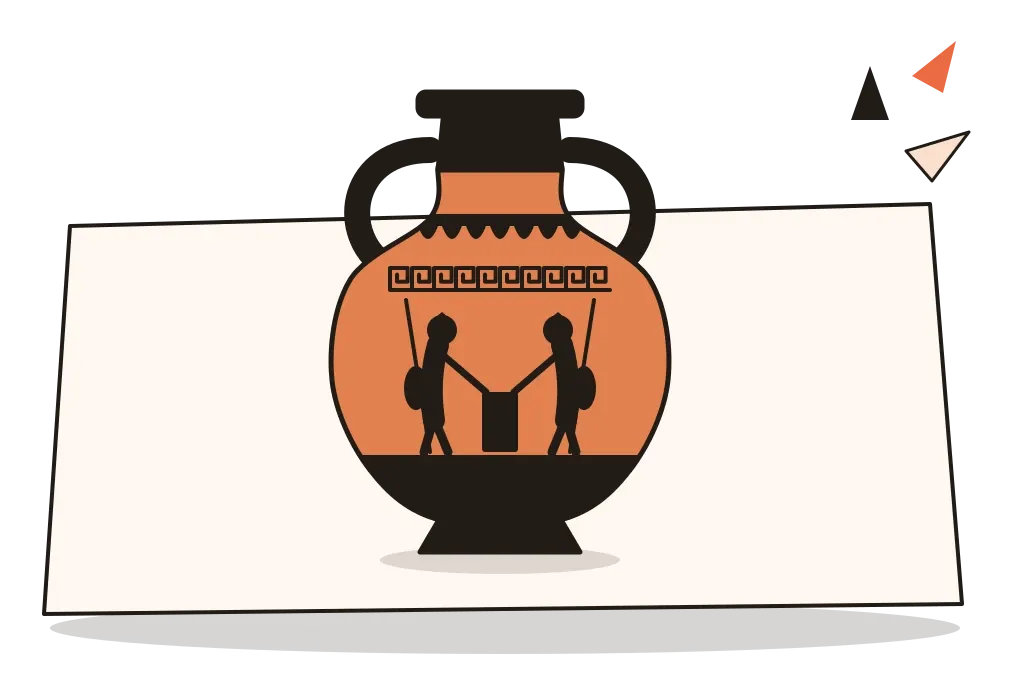
Some of the finest Greek pictures are on pots. Around 540 to 530 BCE, the Athenian potter and painter Exekias made an amphora, a two-handled storage jar, now in the Vatican Museums. On it, the heroes Achilles and Ajax lean on their spears, bent over a board game in a quiet moment of the Trojan War. It's painted in the black-figure technique, glossy black figures on orange clay with details scratched through the black, and the two curved backs echo the curve of the jar. Around 530 BCE, Athenian painters reversed the scheme, leaving the figures the colour of the clay against black, which let them draw anatomy with a brush rather than a needle.
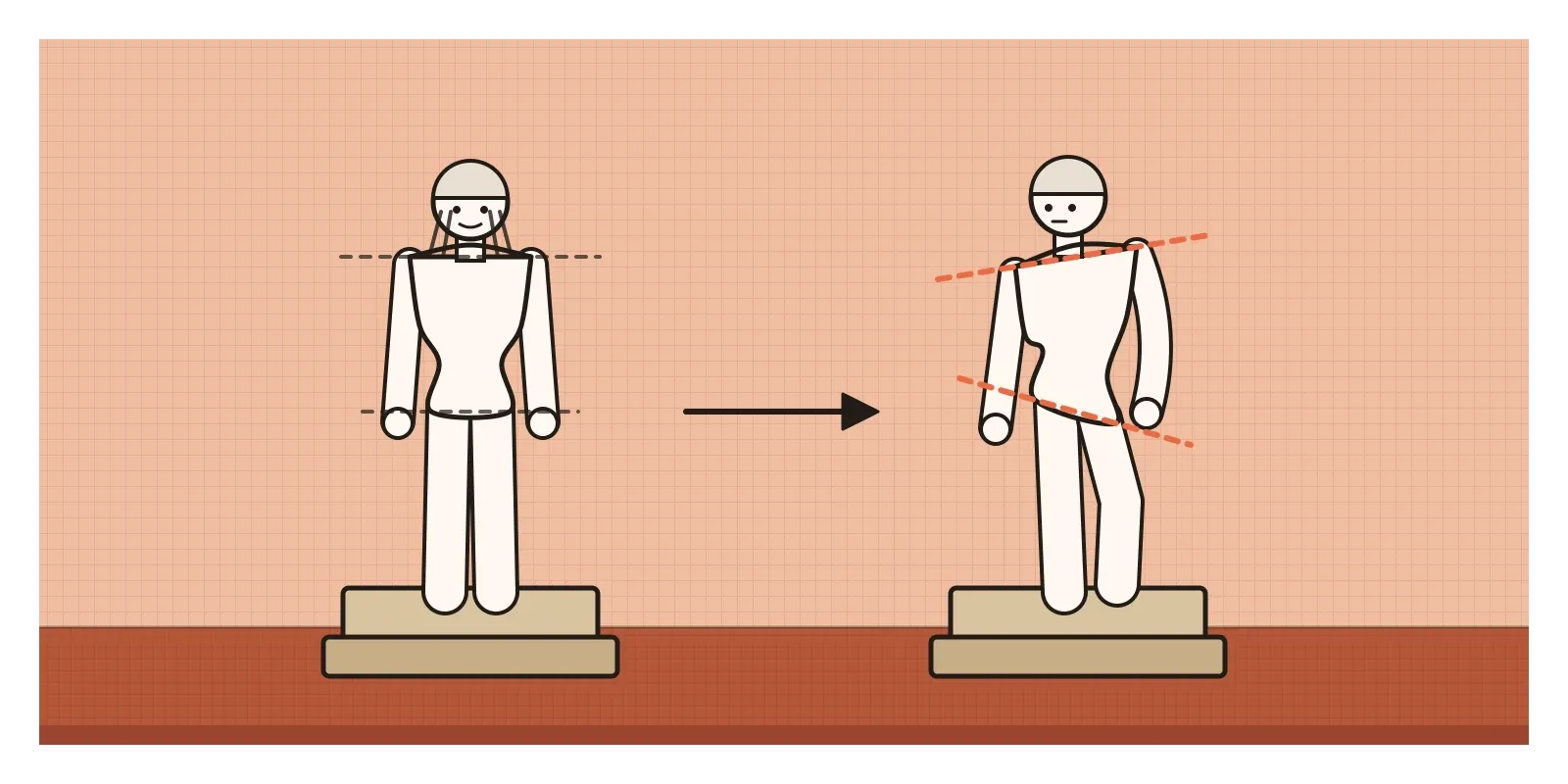
Back on the Acropolis, a marble figure of a young man, a little smaller than life, was found in the 1860s in the debris of the Persian destruction. It's known as the Kritios Boy, made around 480 BCE, and it may be the first statue to stand the way people actually stand. His weight rests on his left leg, his right knee bends forward, his hips tilt and his head turns slightly. That small shift, later called contrapposto, changes everything. In the post on proportion systems, I wrote about Polykleitos and his lost book of ideal proportions. His famous Spear-Bearer took the same idea and made it a rule.
Then there's the Parthenon, the temple of Athena on the Acropolis, begun in 447 BCE by the architects Ictinus and Callicrates, with the sculptor Phidias overseeing its sculpture. As I wrote in the post on the golden ratio, the popular claim about its proportions doesn't hold up. The truth is stranger. Almost nothing in it is straight. The platform curves gently upwards in the middle. The columns lean slightly inwards and swell a little as they rise, a refinement called entasis, and the corner columns are thicker than the rest. Scholars still argue about why, but a common explanation is that these adjustments correct for the way our eyes see, so the building looks straight and solid rather than sagging.
After Alexander the Great died in 323 BCE, his generals divided his empire, and Greek art spread from Egypt to Afghanistan. This Hellenistic phase loved drama: twisting bodies, wind-blown drapery, old age and suffering. The Winged Victory of Samothrace, made around 200 to 190 BCE and now at the top of a staircase in the Louvre, is a goddess landing on the prow of a ship, her clothes pressed against her by the sea wind.
Weight on one leg
What makes Greek art recognisable? In sculpture, it's the idealised human body, usually naked if male and draped if female, until Praxiteles made a famous nude Aphrodite around 350 BCE. Bodies are calm, balanced and anatomically convincing but never individual. They're types, the young athlete, the mature warrior, the goddess, shown at their best. Contrapposto gives them life: one hip up, one shoulder down, the body's lines gently opposing each other. Faces move from the fixed "Archaic smile" of the early kouroi to the cool stillness of Classical figures and the open emotion of Hellenistic ones.
In architecture, it's the orders, the Doric, Ionic and Corinthian systems I described in the post on proportion systems, where every part of a temple, from column base to roof edge, is related to every other by proportion. Buildings are made of posts and beams, raised on a stepped platform, with sculpture in the triangular gables and in bands along the top.
In pottery and painting, it's line: clean, flowing outlines against plain backgrounds, with ornament like the meander, the continuous squared spiral sometimes called the Greek key, running in bands. And everywhere there's an interest in measure. The Greeks discussed beauty as proportion, harmony and balance, ideas that have run through Western thinking about design ever since.
A Greek ambassador at Vidisha
Greek art reached India in person. Alexander's army crossed into Punjab in 326 BCE, and after his death the Seleucid kingdom sent an ambassador, Megasthenes, to the court of Chandragupta Maurya at Pataliputra, modern Patna. In the second and first centuries BCE, Greek kings ruled parts of present-day Afghanistan, Pakistan and northwest India. Their coins are small masterpieces, with a realistic royal portrait and Greek lettering on one side, and on the other an inscription in a local Prakrit written in the Kharoshthi script. Indian sources call the Greeks Yavanas, from Ionia, the Greek coast of Asia Minor.
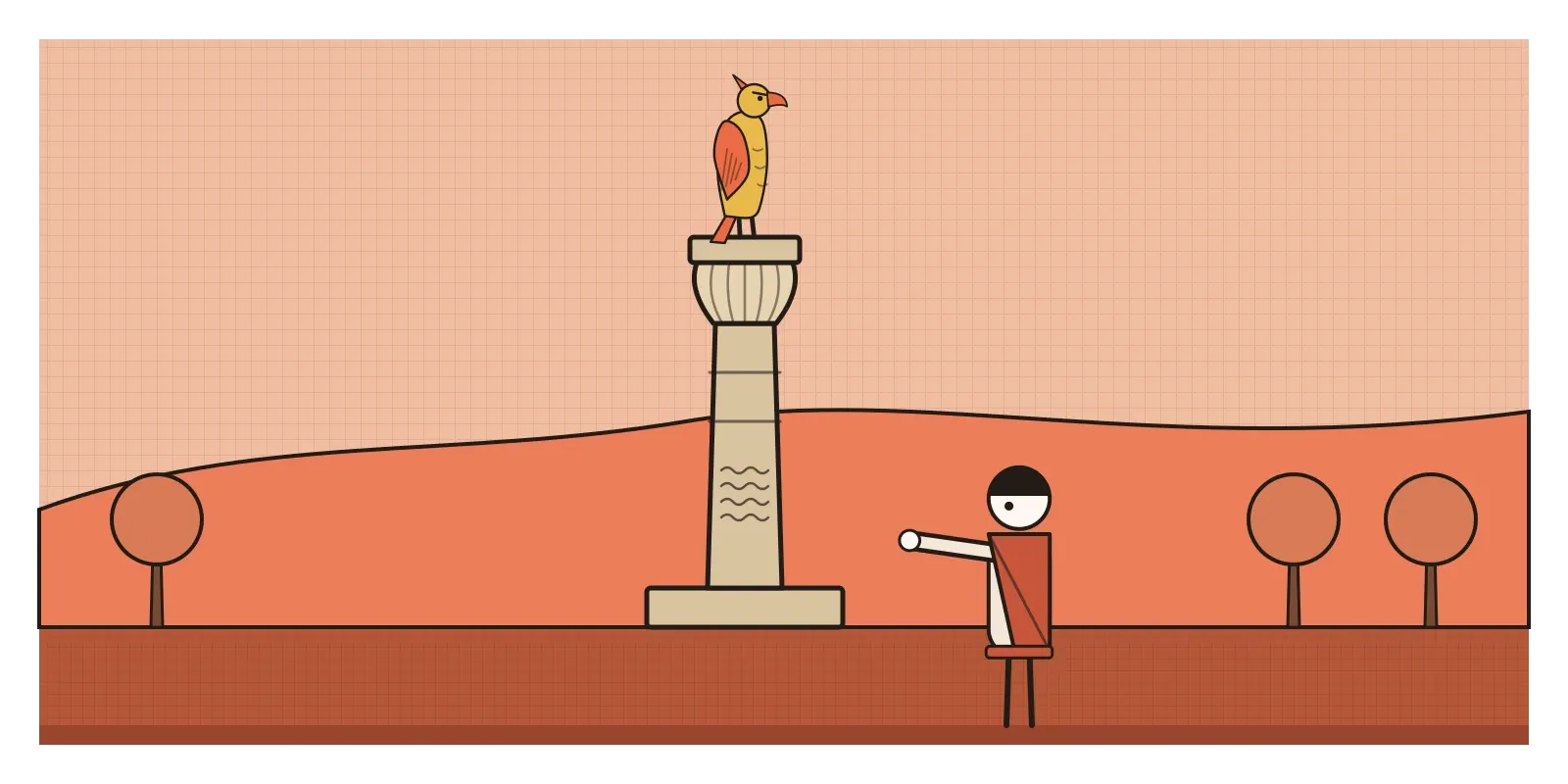
The most moving trace stands in a field at Besnagar, near Vidisha in Madhya Pradesh. It's a tall stone column, put up around 113 BCE by a man called Heliodorus, the son of Dion, from Taxila. Its inscription in Brahmi says that he came as an envoy of the Greek king Antialcidas to the court of a local king, Bhagabhadra, and that he set up this Garuda pillar in honour of Vasudeva, a form of Vishnu, describing himself as a devotee. The Garuda that once crowned it is lost. For centuries local people worshipped the pillar as Khamb Baba, and its inscription was only noticed by archaeologists in the early twentieth century. A Greek diplomat, raising an Indian-style pillar to an Indian god, in an Indian script: it's a better picture of how cultures meet than any story of conquest.
The fuller blend of Greek and Indian forms came later, in the Buddhist sculpture of Gandhara, which belongs to the post on ancient Indian art. What strikes me in the comparison is how differently the two traditions imagined an ideal body. Greek sculptors built theirs from visible anatomy, muscle and bone in balance. Indian sculptors were more interested in bodies full of breath and inner energy, smooth and swelling rather than muscled. Both were idealised. They simply idealised different things.
Optical corrections, then and now
The Parthenon's curves are the lesson I use most. Type designers do the same thing every day. Round letters like O and C are drawn slightly taller than flat ones like H, dipping just below the baseline and rising just above the cap height, because if they were exactly the same height they'd look smaller. It's called overshoot. In interfaces, a triangular play icon has to be nudged slightly to the right of the mathematical centre of its circle to look centred. Mathematically correct and visually correct are different things, and the Greeks knew it two and a half thousand years ago.
Contrapposto has a lesson too. A figure standing perfectly symmetrically looks stiff, like a mannequin. Shift the weight onto one leg and it relaxes. Illustrators and photographers use this constantly, and layouts work the same way: a little asymmetry, held in balance, usually feels more alive than perfect symmetry.
And the orders still carry meaning. Banks, courts, universities and museums put columns on their fronts to borrow an air of permanence. Mumbai's Town Hall, finished in 1833 and home to the Asiatic Society's library, greets visitors with Doric columns at the top of a broad flight of steps. Whenever a brand puts a column in its logo, it's still borrowing from the Acropolis.
Painted gods and a white myth
For centuries, people believed that Greek sculpture was meant to be pure white marble. In 1755, the German scholar Johann Joachim Winckelmann praised Greek art for its "noble simplicity and quiet grandeur", and white marble became the model for Neoclassical sculpture, museums and government buildings across the world. But the statues were painted. Traces of pigment survive on many of them, and since the 2000s the archaeologists Vinzenz Brinkmann and Ulrike Koch-Brinkmann have toured reconstructions in an exhibition called Gods in Color, showing the figures with patterned clothes, coloured skin, painted eyes and bright borders. Researchers have even found Egyptian blue, the pigment I described in the post on Egyptian art, on the Parthenon sculptures.
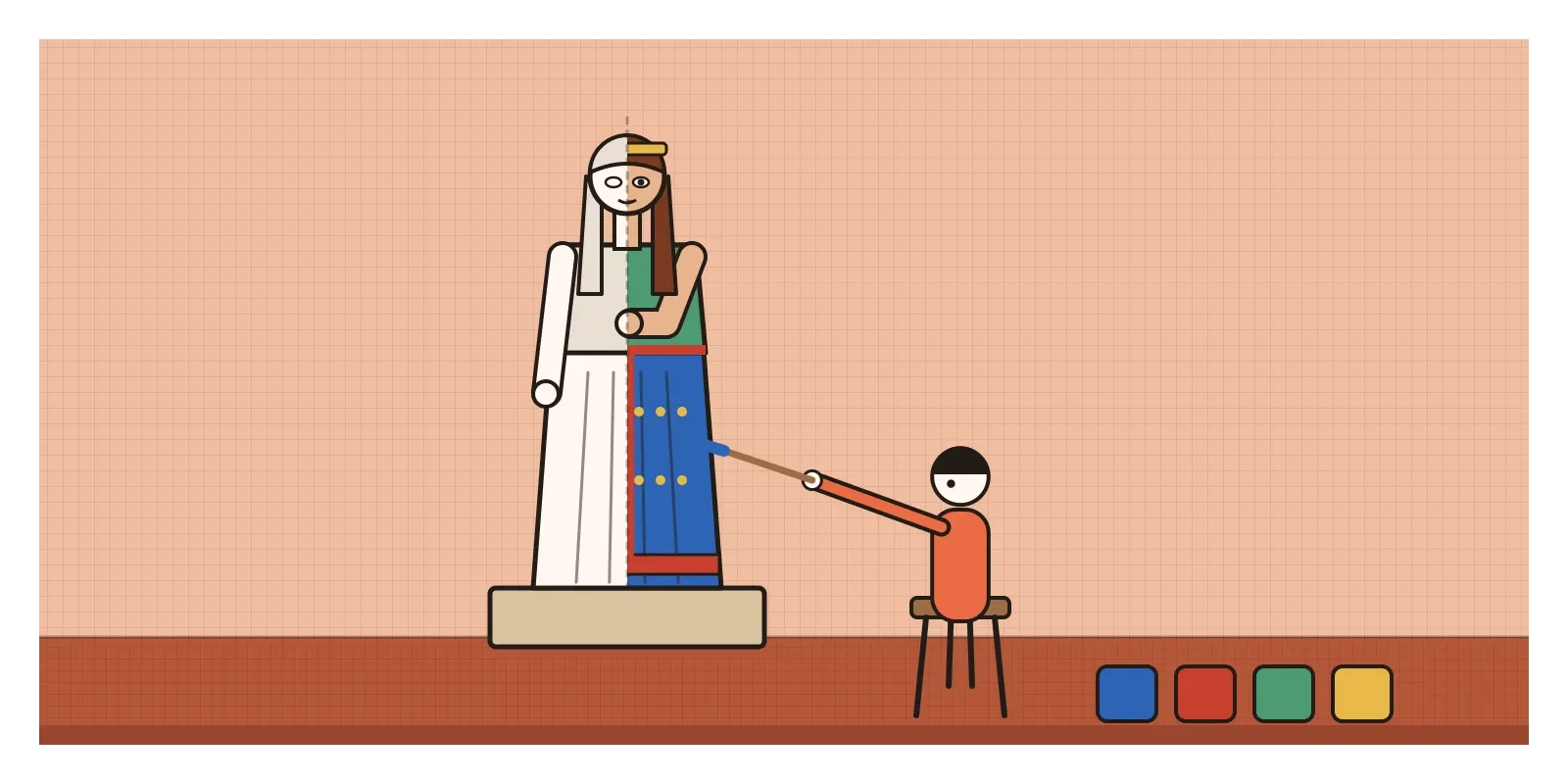
The white myth wasn't harmless. In the eighteenth and nineteenth centuries, pale marble was used to support ideas about the superiority of white Europeans, and those ideas haven't disappeared. The ideal bodies themselves were narrow: young, fit, male, Greek. Women were excluded from citizenship in Athens, and much of its wealth depended on slavery, including enslaved miners in the silver mines at Laurion. And the Parthenon raises a modern question. Between 1801 and 1812, agents of the British ambassador Lord Elgin removed many of its sculptures, which have been in the British Museum since 1816. Greece has asked for their return for decades.
Greek independence ended as Rome swallowed the Greek world in the second and first centuries BCE, but Greek art didn't end. The Romans admired it, collected it, copied it and put it to work, and much of what we know of Greek sculpture survives only in their copies.
To see it this week in India, go to Besnagar, a short drive from Vidisha in Madhya Pradesh, where the Heliodorus pillar still stands, and combine it with Sanchi, a few kilometres away. In Mumbai, stand in front of the Town Hall and count the columns. For a small exercise, stand in front of a mirror with your weight on both feet, then shift it to one leg and watch your hips, shoulders and head rearrange themselves. Sketch both poses quickly. The second will look alive, and you'll have learned contrapposto in a minute. It took Greek sculptors about a hundred and fifty years.
Mariottini saw a dark shoulder in the sand. The sculptor who made it saw something shining, coloured and alive. Most of what we think we know about Greek art sits somewhere between those two views. In the next post, on ancient Roman art, I'll look at how Rome replied to all this perfection: practical, realistic and engineered.
Further reading: Nigel Spivey, Greek Art (1997) · Mary Beard and John Henderson, Classical Art: From Greece to Rome (2001) · John Boardman, Greek Art (1964, later editions) · Sarah E. Bond, "Whitewashing Ancient Statues" (2017)
A reply toEgypt's rigid striding figures, borrowed and then taught to shift their weight.