
Impressionism
How a group of painters walked out of the studio, organised their own show and painted light before it moved.
Impressionism
An orange sun and a mocking review
On 15 April 1874, a fortnight before the official Paris Salon opened its doors, about thirty artists opened an exhibition of their own at 35 boulevard des Capucines, in rooms that had until recently been the studio of the photographer Nadar. They had formed a company to do it, with an unwieldy name that translates roughly as the Limited Company of Painters, Sculptors and Engravers. Among the 165 or so works on the walls was a small, quick painting by Claude Monet of the harbour at Le Havre at dawn. Grey-blue mist swallows the cranes and masts. A few dark boats float in the foreground, sketched in a handful of strokes. And just above the horizon hangs a small, flat disc of orange sun, with a few orange dashes beneath it for its reflection in the water.
Monet later said that when he was asked for a title for the catalogue, he told them to call it Impression, because it could hardly pass for a view of Le Havre. It went in as Impression, Sunrise. Ten days after the opening, the critic Louis Leroy published a satirical review in the comic paper Le Charivari, written as a conversation with an imaginary academic painter who slowly loses his mind as he walks round the rooms. In front of Monet's harbour, Leroy's painter splutters that wallpaper in its early stages is more finished than this. Leroy headed his review "Exhibition of the Impressionists". He meant it as an insult. The painters, after a while, decided to keep it.
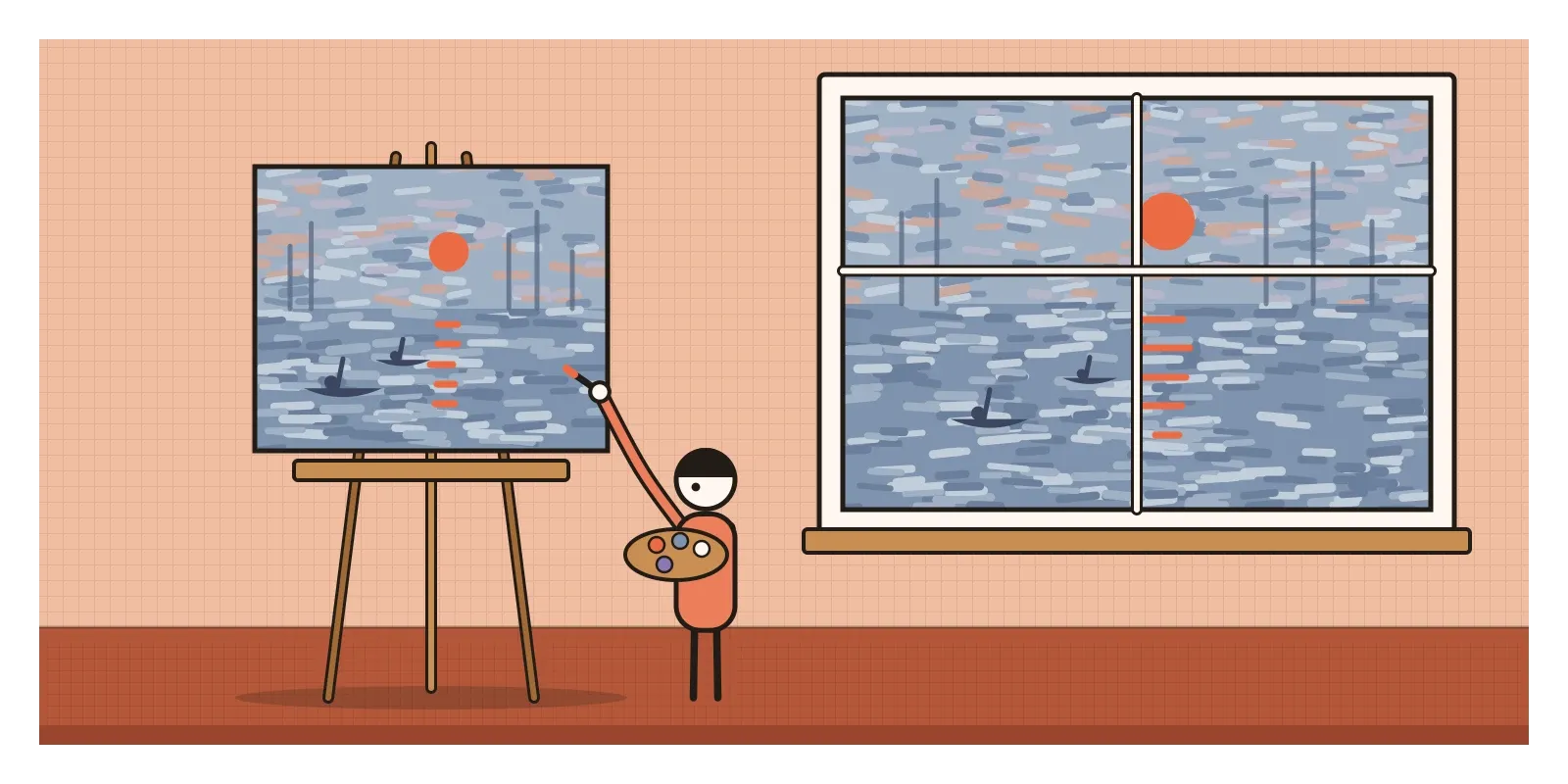
In 2014, the astrophysicist Donald Olson and his colleagues used tide tables, weather records and the position of the sun to suggest that Monet painted the scene from his hotel window on 13 November 1872, at around 7.35 in the morning. It's a reconstruction, not a certainty, but it fits the painting: Impressionism was about one place at one minute.
Impressionism is the name for the painting this loose group made in and around Paris from the late 1860s to the mid 1880s: quick, bright, broken brushwork, painted as often as possible in front of the subject, to catch the effects of light, weather and modern life. They held eight group exhibitions between 1874 and 1886. Historians argue about the edges, because several of the key people disliked the label, and one of the painters most associated with them, Édouard Manet, never exhibited with them at all.
Paint in tubes, a train to the river and friends side by side
To understand what the Impressionists were replying to, picture the Salon, the giant official exhibition I described in the post on critique. Its taste was shaped by the Academy, which ranked paintings by subject, with history, myth and religion at the top and landscape and everyday scenes far below. A good Salon painting was carefully planned through drawings and studies, painted in the studio over warm, darkish underlayers and finished so smoothly that you couldn't see a single brushstroke. The Realists, the subject of an earlier post in this section, had already insisted that ordinary life was worth painting. The Impressionists went further and insisted that the way you saw it, in a glance, under a particular light, was the subject too.
Technology helped. In 1841 an American portrait painter in London, John Goffe Rand, patented a squeezable tin tube for paint. Before that, painters stored colours in messy pig's bladders. With tubes, you could pack a box of colours and walk out of the door. Chemists were also producing new pigments, bright synthetic blues, greens and yellows that were cheaper and more vivid than the old earth colours. Jean Renoir, the son of the painter Pierre-Auguste Renoir, later reported his father saying that without tubes there would have been no Impressionism. Railways did the rest. Trains now ran from Paris to riverside towns such as Argenteuil, where Monet lived through much of the 1870s, and Parisians poured out on Sundays to boat, swim and dance. Inside the city, Baron Haussmann's rebuilding had cut wide new boulevards lined with cafés.
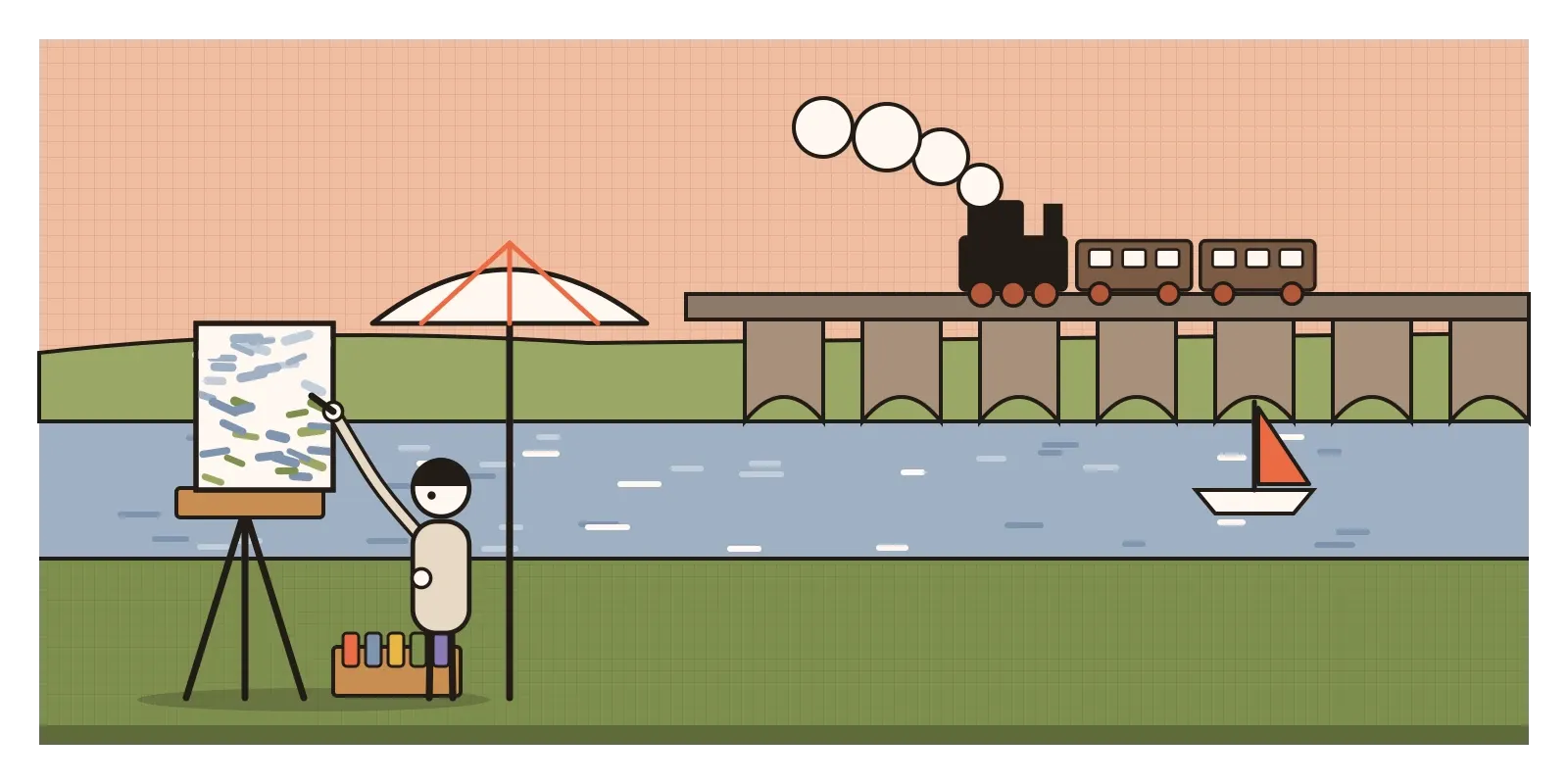
The core group were friends who painted together and argued constantly. In the summer of 1869, Monet and Renoir set up their easels side by side at La Grenouillère, a floating café and bathing spot on the Seine near Bougival, and painted the same scene of bathers, boats and glittering water. Comparing them is like watching two people work out a new language together. Renoir went on to paint Bal du moulin de la Galette (1876), a crowded Sunday dance in Montmartre where patches of sunlight fall through the trees onto jackets, faces and dresses.
Berthe Morisot showed The Cradle in the first exhibition, a quiet picture of her sister watching her sleeping baby through a gauzy white curtain, and she exhibited in every group show except one. Camille Pissarro, older than the others and a kind of father to the group, was the only artist to show in all eight. Edgar Degas painted dancers, laundresses and café singers, often with odd, cropped viewpoints, and he disliked painting outdoors and called himself a realist or an independent, not an Impressionist. Gustave Caillebotte, who was wealthy, painted and also bought his friends' work and paid their bills. In 1877 Monet rented a flat near the Gare Saint-Lazare and painted the station again and again, with locomotives breathing steam into the light under the great glass roof.
Coloured shadows and a sun that vanishes in grey
The easiest thing to notice in an Impressionist painting is the brushwork. Instead of smooth blended surfaces, you see separate strokes, dabs and commas of paint, often laid wet into wet, so the eye blends them from a distance. Painters started on white or pale canvases instead of dark ones, which makes everything brighter. They avoided black and brown for shadows and used blues and violets instead, because shadows outdoors on a sunny day really are cooler, lit by blue sky. As I wrote in the post on colour temperature, Monet's cathedral series is that idea pushed to its limit.
The compositions feel casual and cut off, as if glimpsed rather than arranged: a figure sliced by the edge of the frame, a road running out of the picture, an empty foreground of water. Part of that came from photography, and part from Japanese prints, which have their own post in this section. Subjects are modern and ordinary: picnics, railway stations, boulevards in the rain, gardens, theatre boxes.
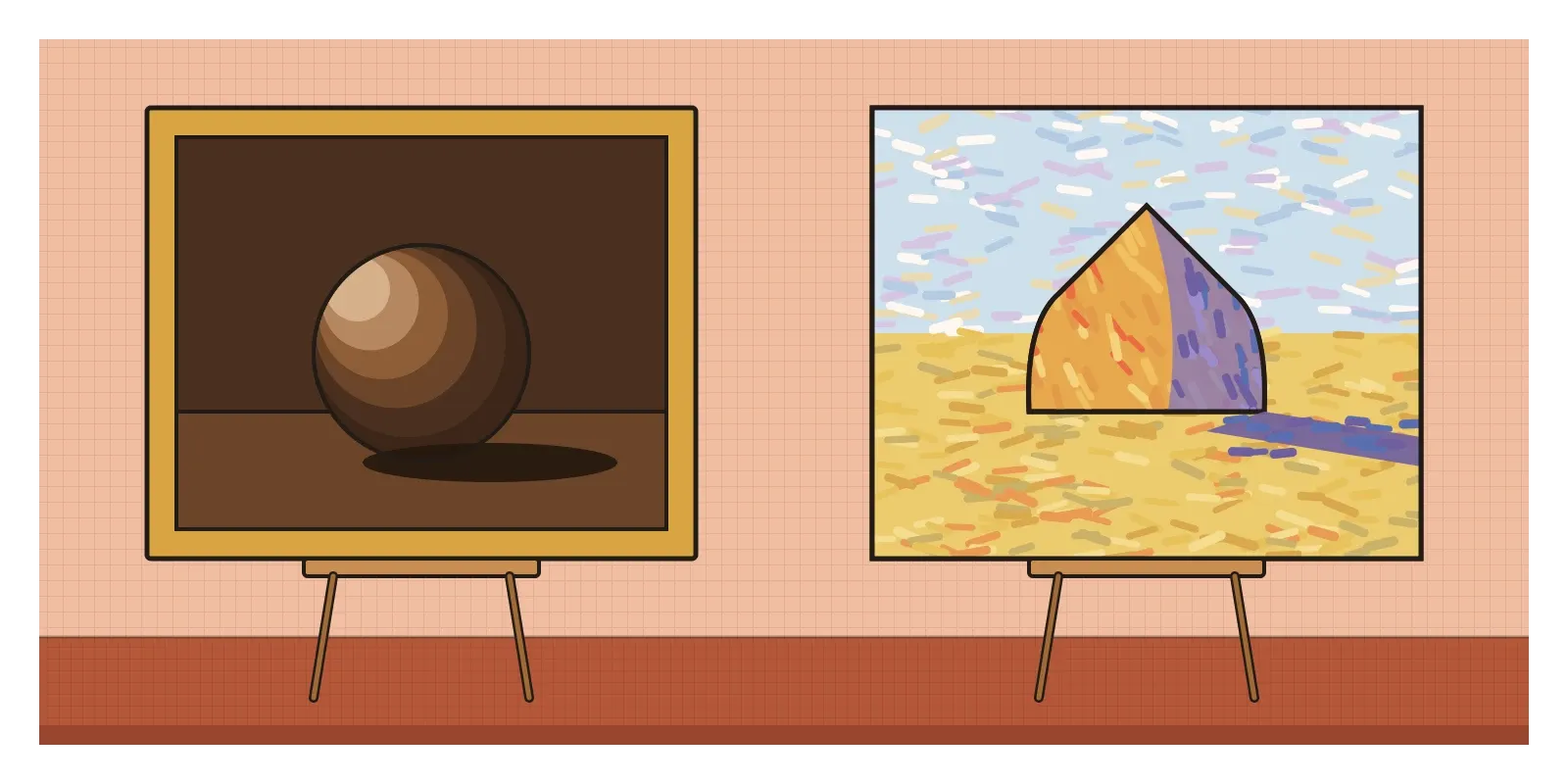
The neuroscientist Margaret Livingstone pointed out something lovely about Impression, Sunrise. The orange sun is roughly as light as the grey sky around it. Turn the painting into black and white and the sun almost disappears. Because the part of our visual system that tracks position and movement mostly sees lightness, not colour, a sun with no lightness contrast seems to shimmer and float. Monet probably found it by eye, but it shows how much of Impressionism is really about perception, about painting what the eye does rather than what the mind knows.
Twelve months, painted from memory
Impressionism had very little direct effect in India in its own time. Indian art schools of the 1870s and 1880s, under British control, were teaching exactly the kind of careful academic copying the Impressionists were rebelling against, a story for the later post on Raja Ravi Varma and Indian academic realism. But there's a looser parallel I find useful, because it highlights what was strange about the Impressionist idea.
Indian painters had been painting seasons, weather and times of day for centuries. A popular subject in Rajput and Pahari painting was the baramasa, the twelve months, from a poetic genre in which each month is described through its weather, usually through the feelings of a woman waiting for her absent lover. Painters made sets of twelve pictures to go with the verses, many based on the Kavipriya written by the poet Keshavdas in 1601. In the month of Shravan, heavy blue-black monsoon clouds roll in, lightning zigzags across them, white cranes fly in a line, peacocks dance and the lovers shelter in a pavilion. Every element is a sign that any viewer of the time would read instantly.
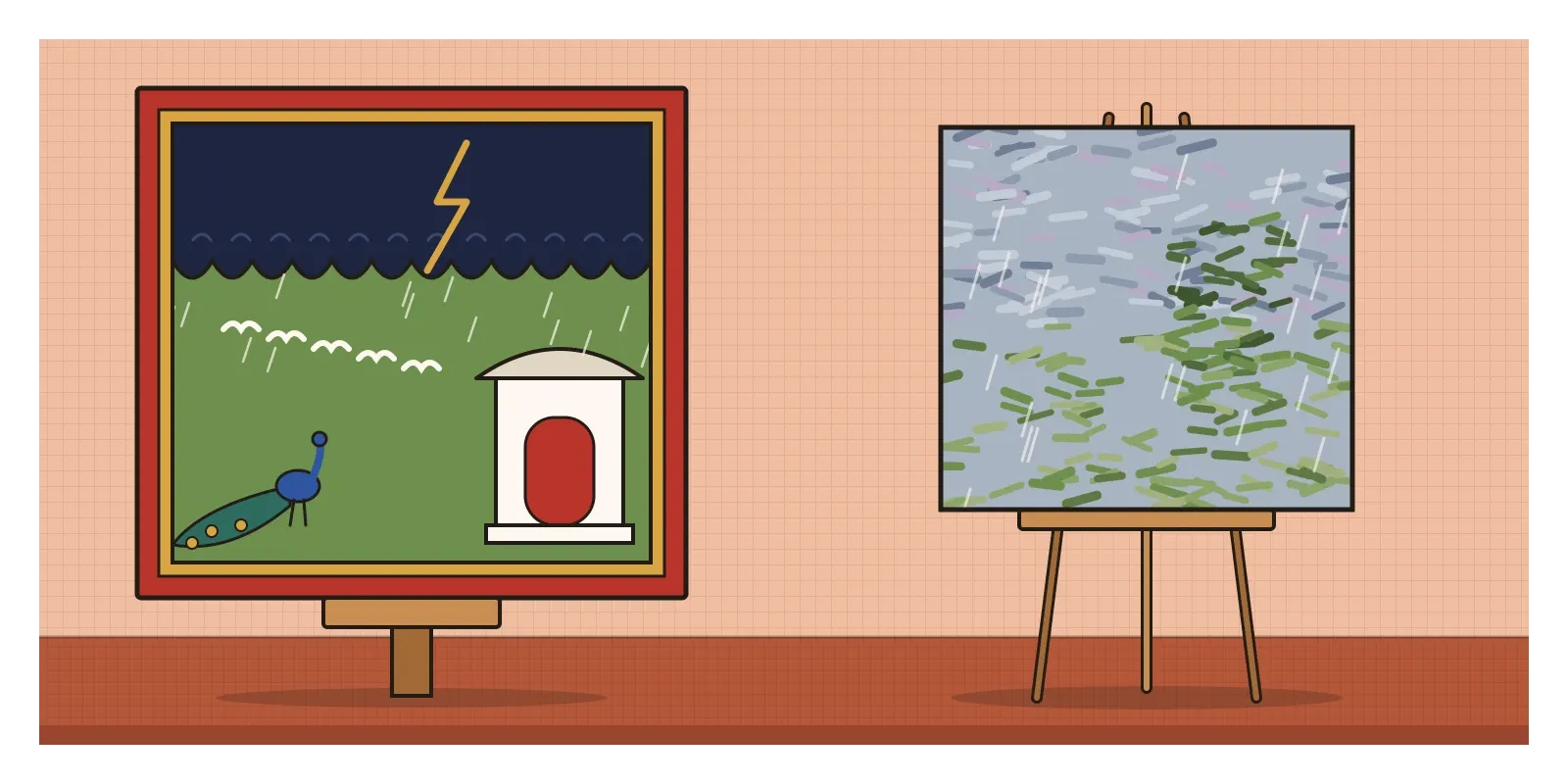
The difference is the point. A baramasa painter didn't sit in the rain and paint what the clouds looked like at 7.35 in the morning. He painted what the monsoon means, using a shared vocabulary of symbols built up over generations. The Impressionists threw that kind of vocabulary away and tried to paint the season as it looked to one person, at one moment, from one spot. One tradition paints the idea of weather, the other its appearance. Neither is more truthful, but the comparison shows how unusual, and how personal, the Impressionist bet was.
Unfinished on purpose
Designers borrow more from Impressionism than they might think. The most obvious trace is the idea that the same thing looks different at different times. In 2018 Apple's macOS Mojave introduced a dynamic desktop, a desert photograph that shifts from dawn to night as the day passes, and dark mode, now standard almost everywhere, is a simpler version of the same thought: an interface should suit the light it's seen in.
The less obvious trace is in how we show work in progress. Leroy's insult, that Monet's picture was less finished than wallpaper, is a version of something designers hear all the time. But looking unfinished can be useful. Rough sketches and low-fidelity wireframes tell people that a design is still open, so they comment on the idea instead of the button colours. Tools such as Balsamiq deliberately make wireframes look hand-drawn for exactly that reason. An impression, in the Impressionist sense, is an honest first answer, made quickly and shown before it hardens.
And then there's the self-organised show. The Impressionists didn't win over the Salon. They went around it, set up a company, rented a space and found their own public. Every designer who publishes a portfolio, a newsletter or an open-source tool instead of waiting for a gatekeeper's approval is doing something similar.
Who got left out of the light
For all its freshness, Impressionism painted a fairly narrow world. Its pictures are mostly of middle-class Parisians at leisure: boating, dancing, strolling, taking tea. The people who made that leisure possible, the waiters, rowers for hire, factory workers and servants, appear mostly at the edges, though Caillebotte's The Floor Scrapers (1875), showing labourers planing a floor, is a striking exception. In 1988 the art historian Griselda Pollock argued in a well-known essay that Morisot and Mary Cassatt, who joined the group in 1879, painted gardens, drawing rooms and theatre boxes partly because respectable women of their class couldn't freely go to the bars, backstage corridors and late-night cafés their male colleagues painted. The modern city in Impressionism is largely a man's city.
Other painters soon criticised it for a different reason. If you dissolve everything into flickering light, where does solid form go? Paul Cézanne, who showed in the first exhibition, came to want something more lasting and structured. By the mid 1880s the group was falling apart. At the eighth and last exhibition, in 1886, Monet and Renoir didn't take part, and the painting everyone talked about was Georges Seurat's A Sunday Afternoon on the Island of La Grande Jatte, which I wrote about in the post on point, built from careful dots instead of quick strokes. That same year the dealer Paul Durand-Ruel took a large Impressionist exhibition to New York, and success followed. The rebels were becoming the establishment, and the next generation was already replying.
Paint the same view twice
To see the work itself, the Musée d'Orsay in Paris has the largest collection, and Impression, Sunrise hangs in the Musée Marmottan Monet. For the baramasa side of the comparison, the miniature galleries of the National Museum in New Delhi are a good place to spend an afternoon, and many museums have put whole twelve-month sets online. John Rewald's The History of Impressionism is still the classic account of who did what, and when.
For an exercise, take a sketchbook outside and give yourself ten minutes to paint or colour a view without drawing a single outline first. Use only patches. Make the shadows blue or violet instead of grey. When the time's up, stop, even if it feels unfinished. Then come back at a different hour and do it again. You'll find that the second picture isn't a correction of the first, just a different truth.
Leroy thought he was ending a career with a joke about wallpaper. Instead he named a movement, and the small orange sun he mocked became one of the most famous patches of colour in the world. In the next post, on Post-Impressionism, the painters who came after it keep its bright colour but try to give back what it dissolved: structure, emotion and meaning.
Further reading: John Rewald, The History of Impressionism (1946) · Sue Roe, The Private Lives of the Impressionists (2006) · Griselda Pollock, "Modernity and the Spaces of Femininity", in Vision and Difference (1988) · Margaret Livingstone, Vision and Art: The Biology of Seeing (2002)
A reply toThe polished studio painting of the Salon, with its brown shadows and invisible brushstrokes.