Computational and Generative Art
How a few engineers and artists in the 1960s taught computers to draw, and why designers now write rules.
Computational and Generative Art
Drawings no hand had touched
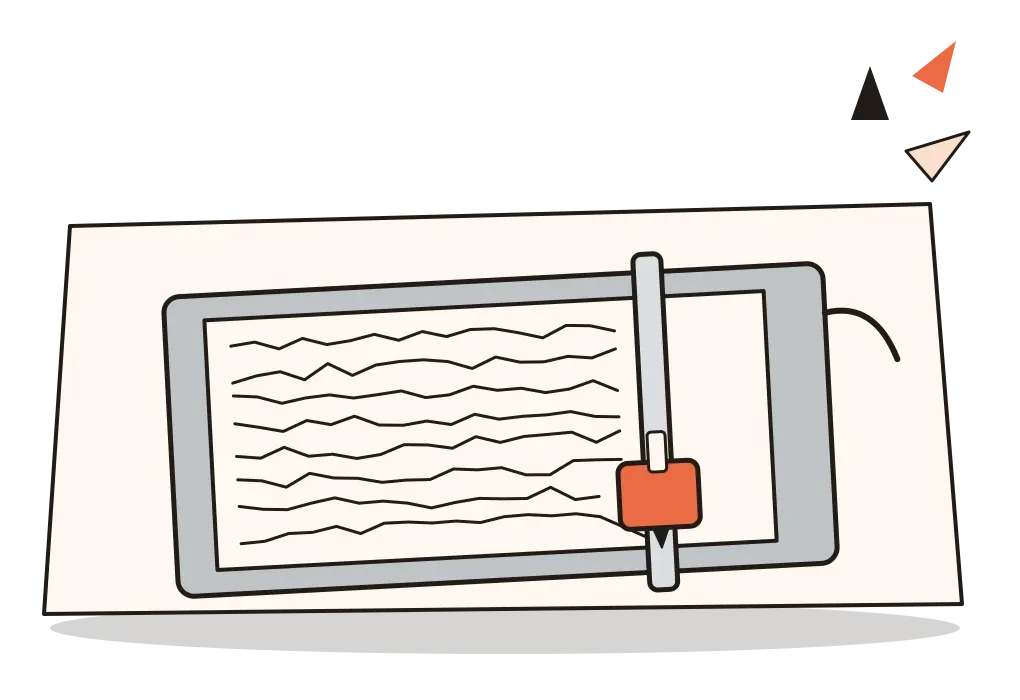
In February 1965, a small gallery run by the philosopher Max Bense at the Technische Hochschule in Stuttgart opened an exhibition of drawings by a mathematician called Georg Nees. Nees worked at the electronics company Siemens in Erlangen, and his drawings were made by a computer. He had written programs on punched paper tape, and a flatbed plotter, a machine that moves a pen across paper under electronic control, had drawn them in ink. There were grids of squares that tumbled into disorder, scatters of straight lines, and networks of jagged paths, all clean, precise and slightly eerie.
Local artists came to the opening, and some of them were not pleased. The story, as Nees and his colleague Frieder Nake later told it, is that one of them asked whether the computer could ever draw the way he drew. Nees replied that it could, if the artist could describe exactly how he drew. It's a good line, and it may have been polished in the retelling, but it named the question that still hangs over art made with computers. If a process can be described, can it be handed to a machine? And if it can, where is the artist?
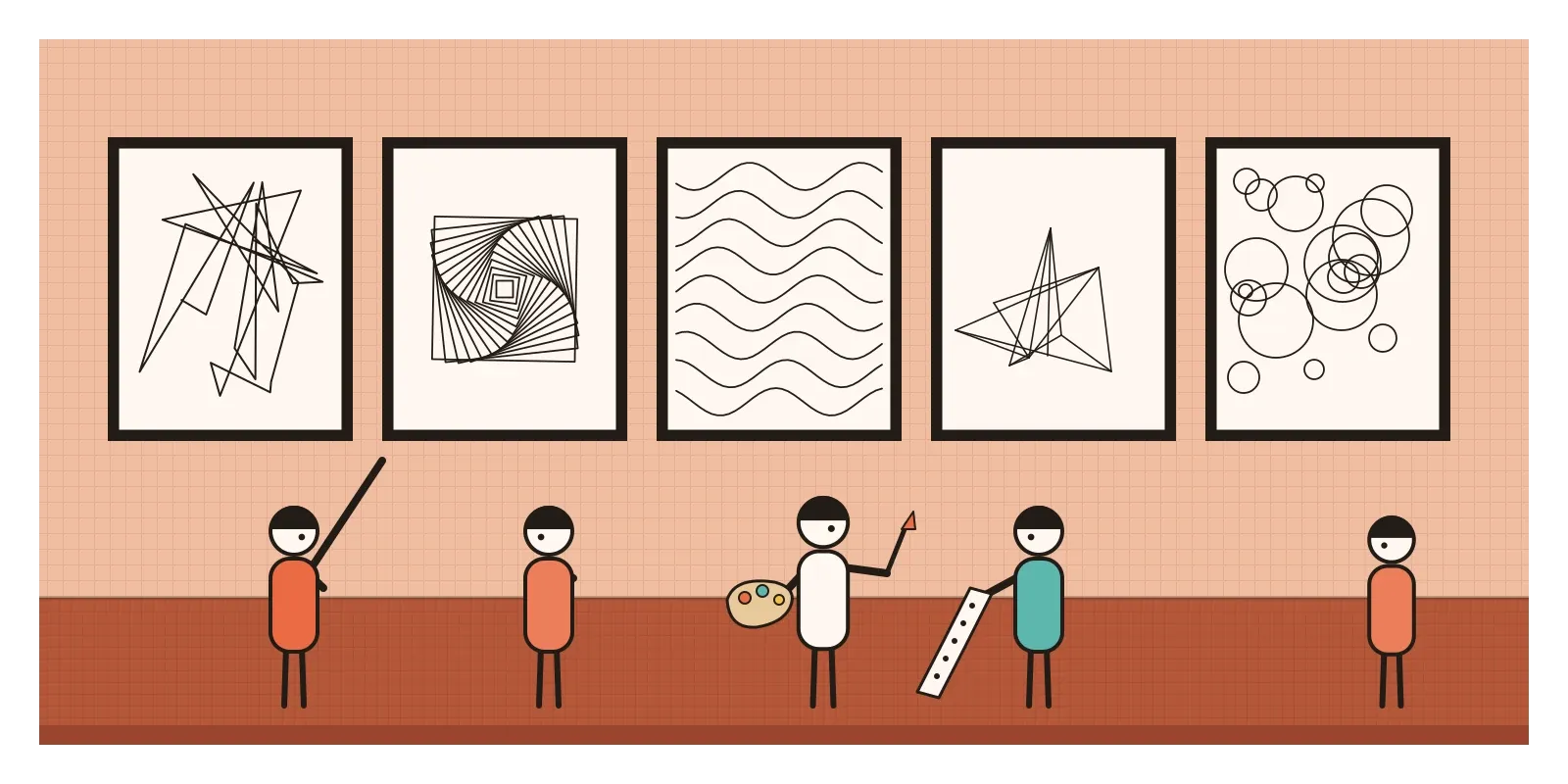
Computational art is art made with computers, and generative art, the wider term, is art made by setting up a system, usually a set of rules, often with some randomness, and letting it produce the work. The artist designs the process rather than each mark. The first wave came in the 1960s from a handful of engineers and artists with access to rare, expensive machines, and it has grown into a whole family of practices that now runs through creative coding, data visualisation, brand identities, games and the AI image tools on our laptops.
Mainframes, cybernetics and a word from Stuttgart
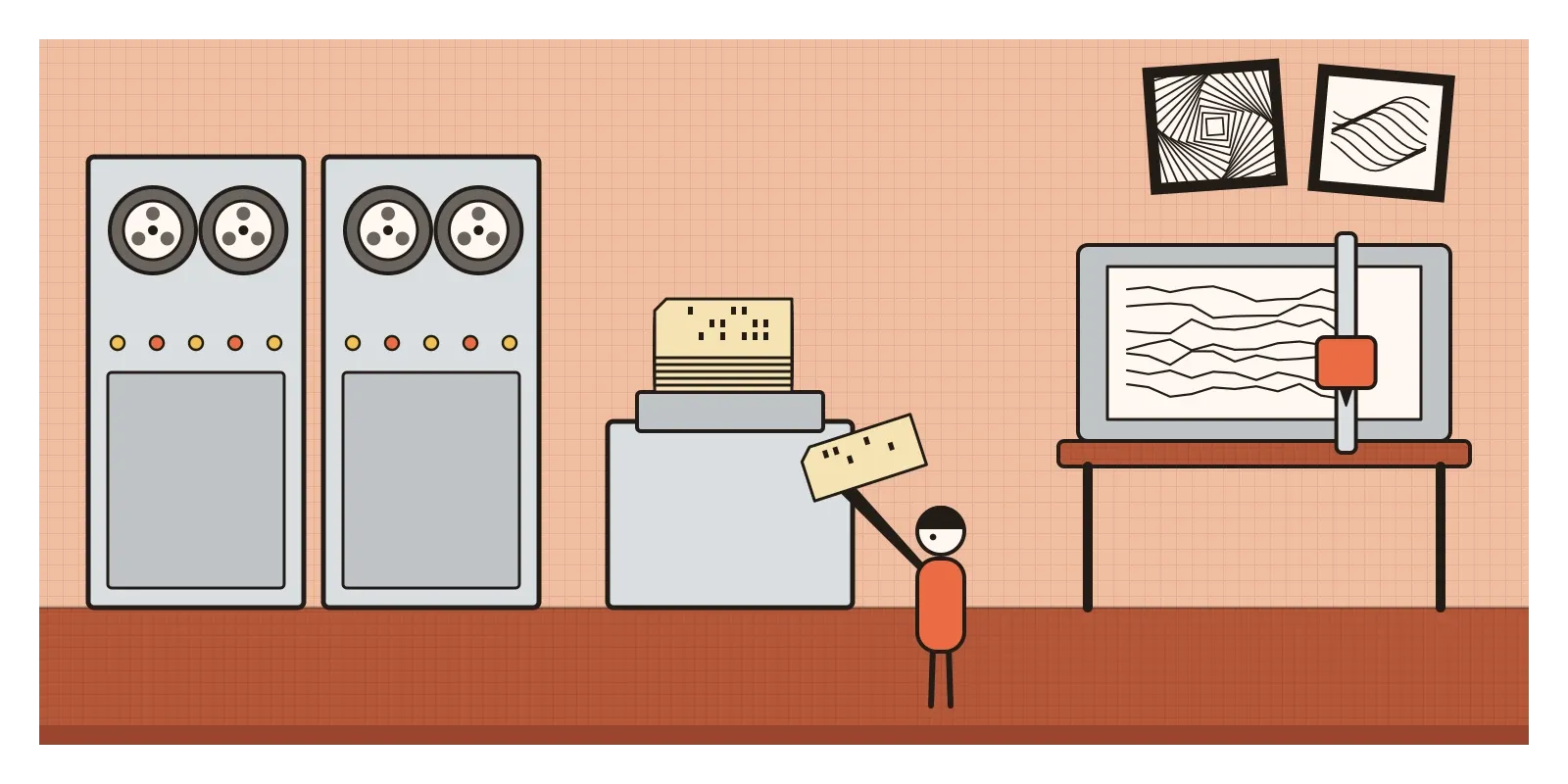
In the early 1960s, computers were room-sized machines owned by universities, governments and large companies. They had no screens to speak of. You gave them instructions on punched cards or paper tape and got back printouts or, if you were lucky, plotter drawings. The phrase computer graphics was coined around 1960 by William Fetter, a designer at the aircraft company Boeing, who used computers to draw a human figure fitting into a cockpit. Most early computer art came from such places: Siemens in Germany, Bell Telephone Laboratories in New Jersey, university computing centres in Paris and London, because that was where the machines were.
The ideas came from cybernetics, the science of control and feedback named by Norbert Wiener in 1948, and from information theory. In Stuttgart, Bense was trying to build an aesthetics based on measurement and probability, and in 1965 he wrote about what he called generative aesthetics, which is where our word comes from.
What these artists replied to was the cult of the artist's hand. By 1960 Abstract Expressionism, which has its own post in this section, had made painting into a heroic personal act, the drip and the gesture as signs of an inner self. The computer artists wanted something cooler, rules you could write down, test and share. They also had ancestors. The Dada artists had used chance, as I wrote in the post on Dada, and constructive artists such as Max Bill had already built paintings from systems. The computer simply made the rule-following tireless.
Three engineers, a painter in Paris and a show in London
Nees, Nake and the American A. Michael Noll are sometimes called the three Ns of early computer art, because all three exhibited in 1965. Nees's best-known work, usually called Schotter, German for gravel, is a column of squares that start in neat rows at the top and become more and more tilted and scattered towards the bottom, order dissolving into chaos in a single image. Nake, a young mathematician in Stuttgart, wrote programs that chose lines and shapes at random within rules, and in 1965 made a plotter drawing in homage to Paul Klee, building on Klee's own interest in lines and rhythm.
Noll worked at Bell Labs. In 1964 he programmed a pattern of short black bars scattered within a circle, meant to resemble Mondrian's 1917 painting Composition with Lines, and showed both images to about a hundred colleagues without saying which was which. Most preferred the computer version, and only around a quarter identified the Mondrian correctly. It was a small, unscientific test, but it made the point that people found the machine's randomness more lively than the painter's careful placing. In April 1965, Noll and the psychologist Béla Julesz showed computer-generated pictures at the Howard Wise Gallery in New York.
The most remarkable figure came from painting, not engineering. Vera Molnár, born in Hungary in 1924 and living in Paris, began around 1959 to make drawings by what she called an imaginary machine, inventing rules and following them by hand: place a square, shift it slightly, repeat, change one thing. She was a founding member of the group GRAV, which I mentioned in the post on Op Art. In 1968 she finally got access to a real computer at a research centre in Paris and spent decades exploring how much disorder an orderly system can take, sometimes just one per cent, enough to make a grid of squares feel alive. She was still working when she died in 2023, aged 99.
In 1968 the critic Jasia Reichardt organised Cybernetic Serendipity at the Institute of Contemporary Arts in London, a big, playful exhibition of computer drawings, music, poetry, robots and machines that responded to visitors, which later travelled to the United States. At Bell Labs, Lillian Schwartz and Ken Knowlton made some of the first computer films. In Paris, Manfred Mohr spent years generating drawings from the edges of a cube, and in 1973 the British painter Harold Cohen began writing AARON, a drawing program he kept teaching for over forty years. Cohen didn't think AARON was an artist. He thought of it as a long conversation with himself about what drawing is.
Rules, randomness and a pen that never tires
Early computer art has a family look, partly because of the tools. Plotter drawings are made of thin, even lines in one or two colours of ink, with no pressure or wobble, because the pen moves at a constant speed. Early printers built images out of characters or dots. So the vocabulary is spare: straight lines, squares, circles, grids, polygons and curves defined by equations, usually black on white.
The real signature, though, is structure. Look for a simple unit repeated many times, with a rule that changes it a little each time: rotate it by a few degrees, shift it, enlarge it, remove a line. Look for a gradient from order to disorder across the image, the visual signature of a random number being allowed a bit more freedom with each row. Look for series, many versions of one program, because the artist was more interested in the space of possibilities than in a single perfect result. And look for a sense of balance between control and surprise. As Molnár's work shows, a system with no randomness is dead, and one with too much is noise. Most of the art lives in between.
This is also why generative art is a natural fit for designers. A design system is a set of rules, and a good one produces endless, consistent variety, the same way a good program does.
Patterns tied in thread in Varanasi
India has an older tradition of turning patterns into code than most people realise, and it's alive in Varanasi. Before a Banarasi brocade sari can be woven, its design has to be translated into instructions the loom can follow. A designer, the naqshaband or naksha maker, plots the motif on squared graph paper, one square for each crossing of threads. That pattern was traditionally then tied, thread by thread, into a naksha, a harness of cotton threads mounted on a frame, which lifted the right warp threads for each pass of the shuttle. Over the twentieth century, most looms switched to jacquard mechanisms that read the same information from long chains of punched cards, and today the graph-paper stage is often done in design software, which punches the cards or drives an electronic jacquard directly.
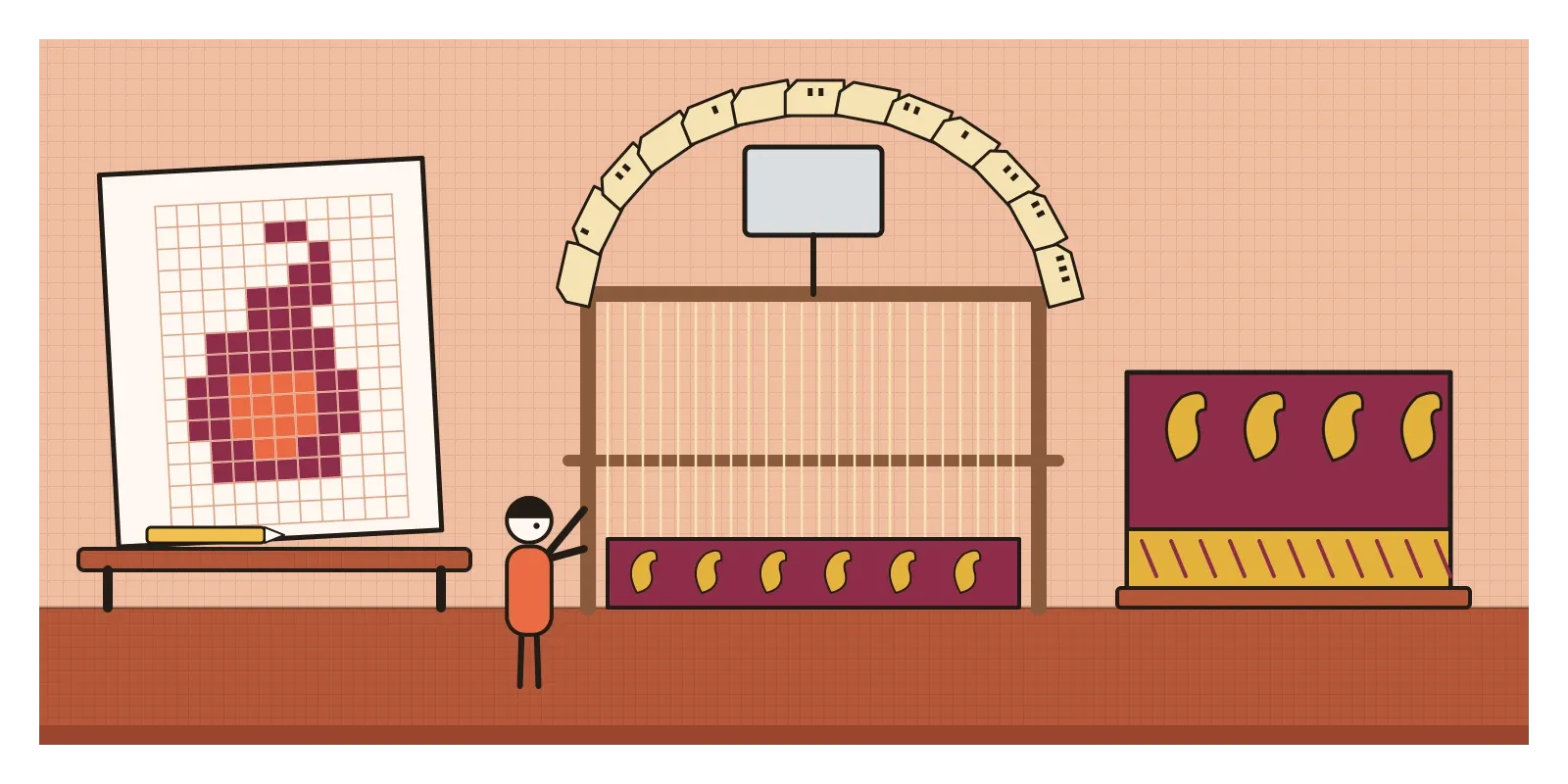
I find this a useful parallel because it's the same problem the 1960s computer artists faced, from the other side. A visual idea has to become a sequence of yes-or-no decisions, thread up or thread down, before a machine can make it. The skill of the naksha maker is a skill of translation and encoding, and it was a hereditary, specialised craft long before anyone called it programming. In the post on Op Art I mentioned how scholars at Madras Christian College studied the rule-based families of kolam patterns, and India also has one of the oldest rule systems for generating anything at all: the Sanskrit grammar of Pāṇini, perhaps from the fourth century BCE, a few thousand compact rules from which correct words and sentences can be produced. Linguists still cite it as an ancestor of generative grammar. The link to computer art is loose, but the instinct, describe the rules and let them make the forms, is the same.
From plotters to prompts
Designers use generative ideas every day now, often without noticing. In 2001, Casey Reas and Ben Fry, students in John Maeda's group at the MIT Media Lab, released Processing, a simple programming environment for artists and designers, and it and its web cousin p5.js have taught a generation to sketch in code. Data visualisation is generative by nature: you design the rules, and the data draws the chart. Brand identities have become systems rather than single logos. The MIT Media Lab's 2011 identity used an algorithm that could produce tens of thousands of variations of its mark, one for each person. Variable fonts, procedural textures in games and the endless wallpapers on our phones all come from the same idea, and so does the design system you probably use at work.
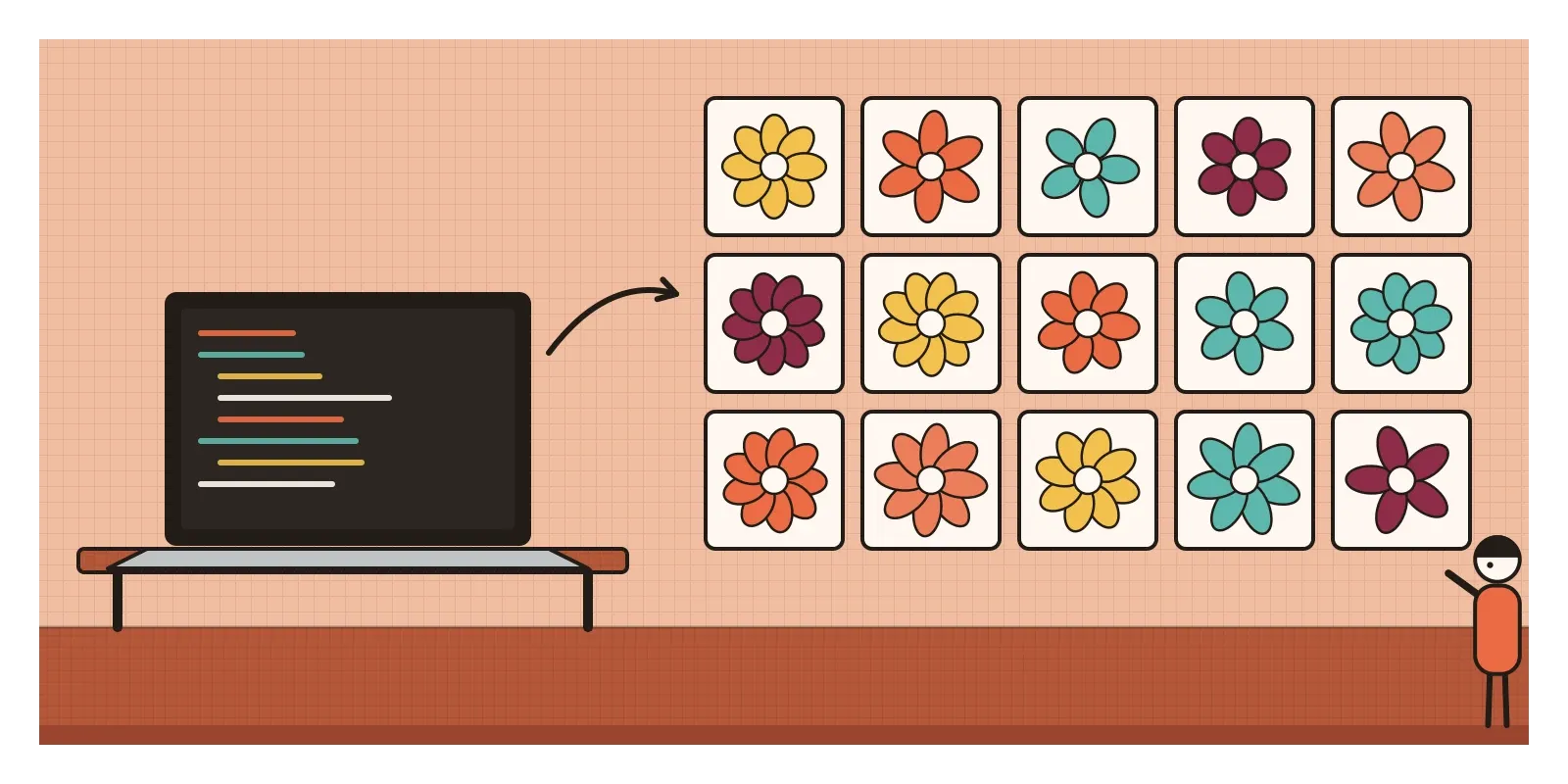
The newest generative tools are the AI image and text models, and they raise every old question at once. The early computer artists wrote their own rules and could explain every line. A diffusion model has learned its patterns from millions of images made by people, often without their consent, and several artists have gone to court over it. For anyone designing with these tools, Molnár's lesson still applies: decide what the system may vary, and what it must never touch.
The movement had other limits from the start. Access to computers was restricted to a few institutions, so early computer art was made mostly by engineers and men, with Molnár and Schwartz as notable exceptions. The art world kept it at arm's length for decades, treating it as technical curiosity, and artists who used computers were often excluded from galleries and histories. When computer art finally became fashionable, around 2021, it was through the speculative boom in NFTs, which brought money and attention but also scams and enormous energy use. Generative art can be dazzling and empty at the same time, endless variations of nothing in particular. The artist still has to decide what is worth generating.
Its successors replied in different directions. Conceptual artists, as I wrote in the post on Conceptual Art, also made art from instructions, but often left the machine out entirely and let people carry them out. Fluxus, in the next post, turned instructions into playful everyday performances.
Write a rule and let it run
To see early computer art, look for the collections of the Victoria and Albert Museum in London, which has one of the biggest, or browse its online collection from home. In India, visit the Weavers' Service Centre in Varanasi or a weaving workshop there, and ask to see a punched card set for a sari design. Grant D. Taylor's When the Machine Made Art is a thoughtful history of how the art world resisted computer art.
For an exercise, try Molnár's imaginary machine without a computer. Draw a grid of ten by ten squares on graph paper. Write down one rule, such as "in each row, tilt each square a little more than in the row above", and follow it exactly. Then do it again, letting yourself add one per cent of disorder, one square out of place. Which one feels alive?
Nees's answer to that grumbling artist in Stuttgart still holds, with a twist. A machine can draw the way you draw, if you can describe it. The hard part, then and now, is knowing what you're trying to describe.
Further reading: Grant D. Taylor, When the Machine Made Art: The Troubled History of Computer Art (2014) · Jasia Reichardt (ed.), Cybernetic Serendipity: The Computer and the Arts (1968) · Casey Reas and Ben Fry, Processing: A Programming Handbook for Visual Designers and Artists (2007) · Margit Rosen (ed.), A Little-Known Story about a Movement, a Magazine, and the Computer's Arrival in Art: New Tendencies and Bit International (2011)
A reply toThe cult of the artist's hand and the heroic personal gesture of Abstract Expressionism.