
Futurism
How a poet's car crash in Milan became a movement that worshipped speed, noise and machines, and then war.
Futurism
A poet in a factory ditch
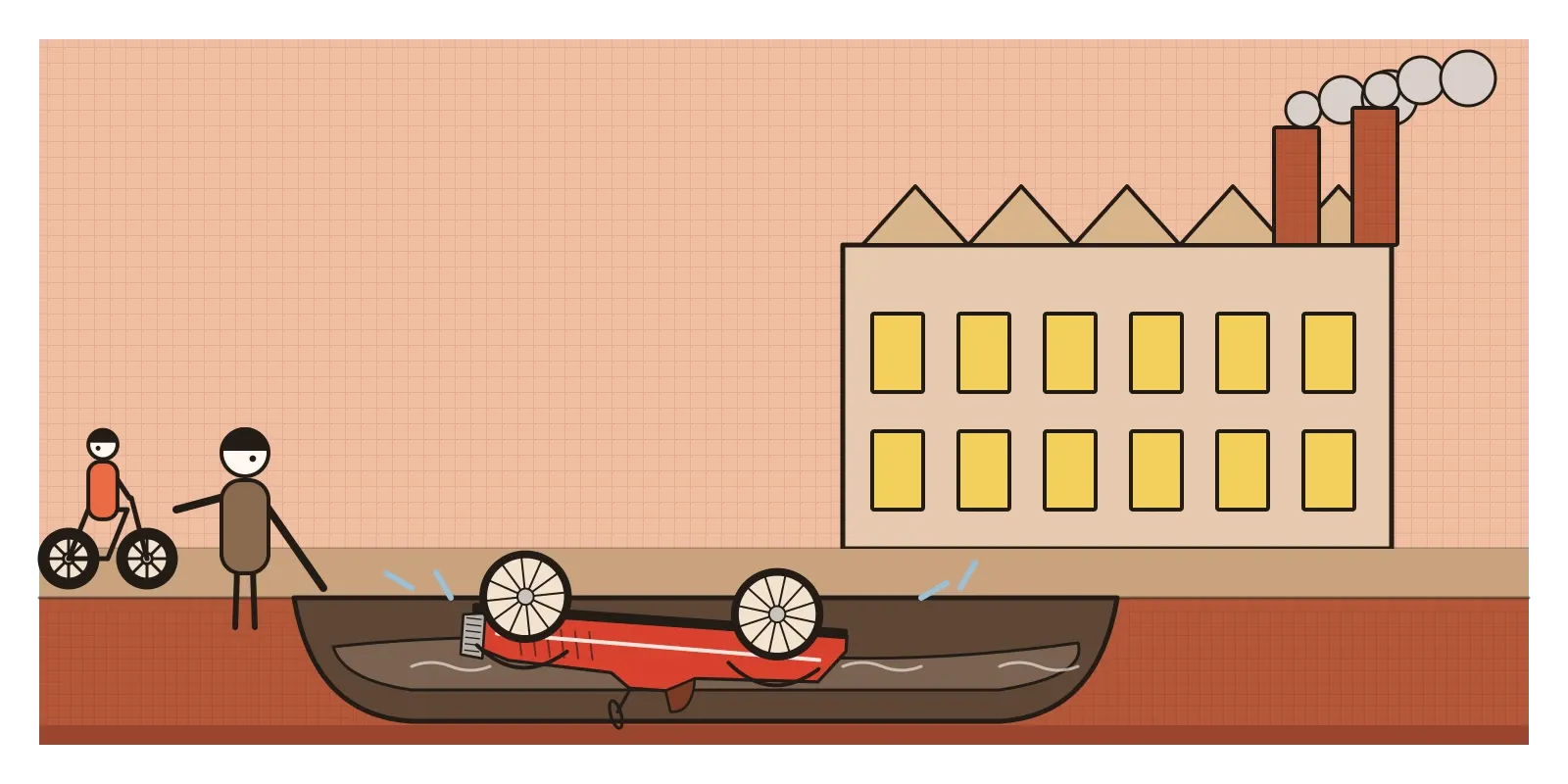
In October 1908, Filippo Tommaso Marinetti, a rich poet and magazine editor living in Milan, was driving his new four-cylinder Fiat on the edge of the city when a cyclist crossed his path. Some accounts say two cyclists. He swerved, the car went off the road and turned over into a ditch, and the local paper reported a few lines about a poet who had been shaken but not badly hurt.
Marinetti turned this small accident into a creation myth. He wrote it up as the opening of the Founding and Manifesto of Futurism. In his version, the drive became a wild night race, and the ditch became a factory drain full of sludge, which he says he gulped down like a baby at the breast before climbing out reborn. What followed was a numbered list of beliefs: courage, aggression and the beauty of speed; a roaring racing car declared more beautiful than the ancient Greek statue of the Winged Victory of Samothrace; war praised as the world's only hygiene; contempt for women; and a promise to destroy museums, libraries and academies. After appearing in several Italian papers, it was printed on the front page of the Paris daily Le Figaro on 20 February 1909, which gave an Italian poet's manifesto an audience across Europe.
Futurism is the movement that came out of that manifesto. Founded in Italy in 1909 and led by Marinetti, it celebrated speed, machines, electricity, crowds, the industrial city, youth and violence, and tried to remake painting, sculpture, poetry, music, typography, architecture, theatre, cooking and politics in that image. Most historians date its first and most inventive phase from 1909 to around 1916, and call what came after, in the 1920s and 1930s, the second Futurism. It was the first art movement to sell itself with manifestos, publicity stunts and planned scandals, and it was the first whose leader helped to found a Fascist party. Both facts belong in its story.
A country buried in its museums
Italy had only become a single state between 1861 and 1870, and it came late to industry. By 1909, though, the north was changing fast. Fiat had been founded in Turin in 1899, Milan was full of electric trams, rubber works and engineering firms, and its outskirts were a jumble of building sites and new tenements. Yet to the rest of Europe, Italy was still a museum of ruins and Renaissance churches, whose academies taught young painters to copy the past. Marinetti hated this. In 1910 he and his friends threw leaflets attacking "passéist" Venice from the clock tower in St Mark's Square, calling for its canals to be filled in.
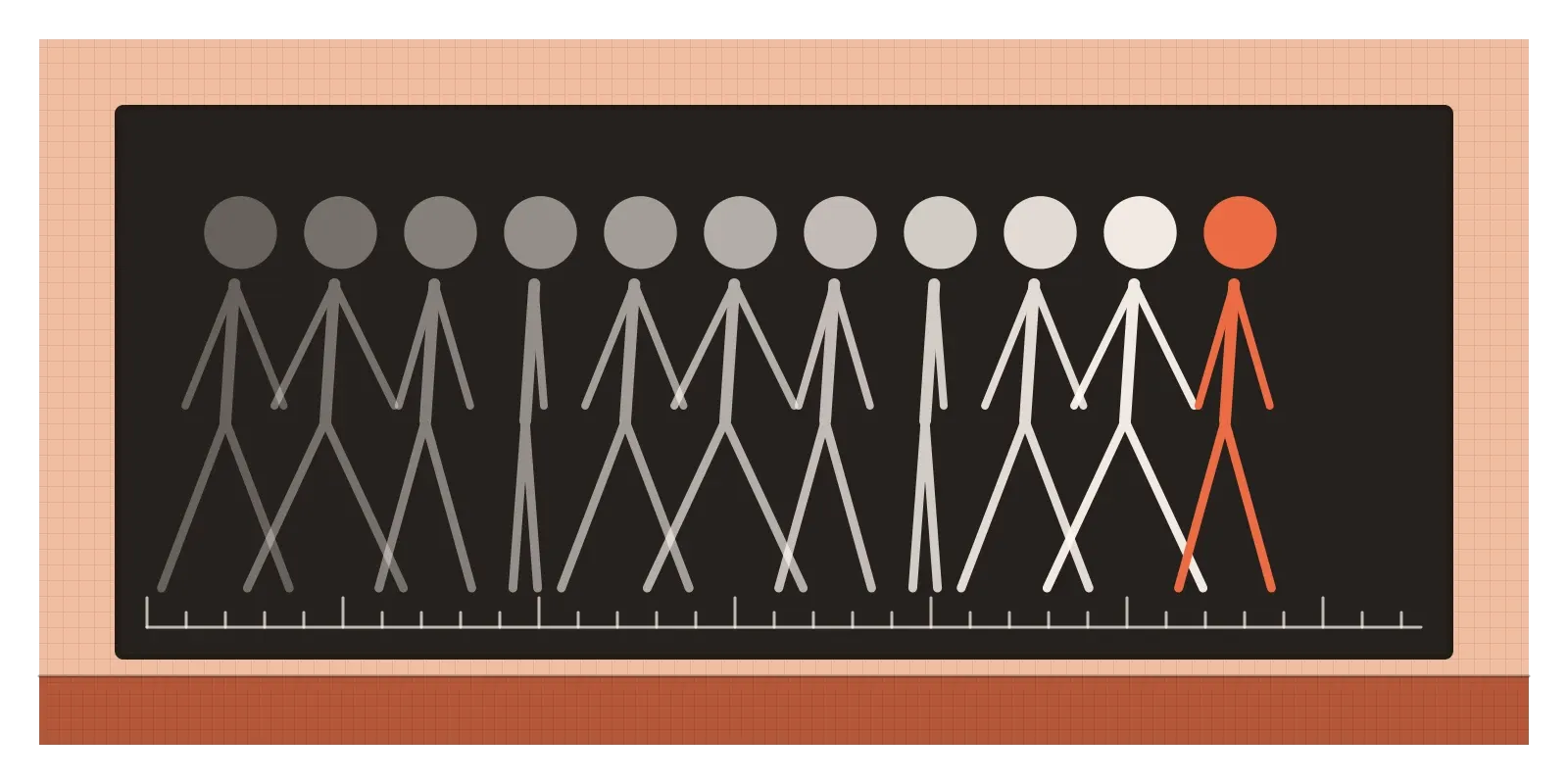
Futurism replied to that weight of history, and to the soft, dreamy Symbolism that Marinetti himself had written in his early poems. Its painters didn't start from nothing, though. Several had trained in Divisionism, the Italian cousin of the dotted colour I described in the post on Post-Impressionism, and they kept its bright, separated strokes. From photography they took the chronophotographs of the French scientist Étienne-Jules Marey, who in the 1880s had recorded a walking man or a flying bird as a series of overlapping positions on a single plate. From Paris they took Cubism, the subject of the previous post, with its broken planes. When the Futurist painters showed at the Bernheim-Jeune gallery in Paris in February 1912, their catalogue accused the Cubists of painting things that stood still. Futurism wanted the broken planes to move.
Horses with twenty legs
The painters published their own manifestos in 1910. One of their claims was that a galloping horse doesn't have four legs but twenty, because the eye keeps its earlier positions for a moment as it moves. Umberto Boccioni, the movement's most gifted painter and sculptor, put this into The City Rises (1910), a huge canvas now in New York's Museum of Modern Art. A giant red horse charges through the middle of a building site on the edge of Milan while workmen strain at its harness, and everything, horse, men, scaffolding and smoke, dissolves into streaming strokes of colour, so the picture seems to roar.
Giacomo Balla, in Rome, was gentler and funnier. His Dynamism of a Dog on a Leash (1912) shows a small dachshund trotting beside its owner's skirt hem, its legs blurred into a whirring fan, its tail a row of overlapping strokes and its lead swinging in several places at once. Boccioni turned motion into sculpture in Unique Forms of Continuity in Space (1913), a striding figure whose muscles stream backwards like flames in the wind. He only saw it in plaster. The well-known bronzes were cast after his death, and the figure now appears on the Italian 20-cent euro coin.
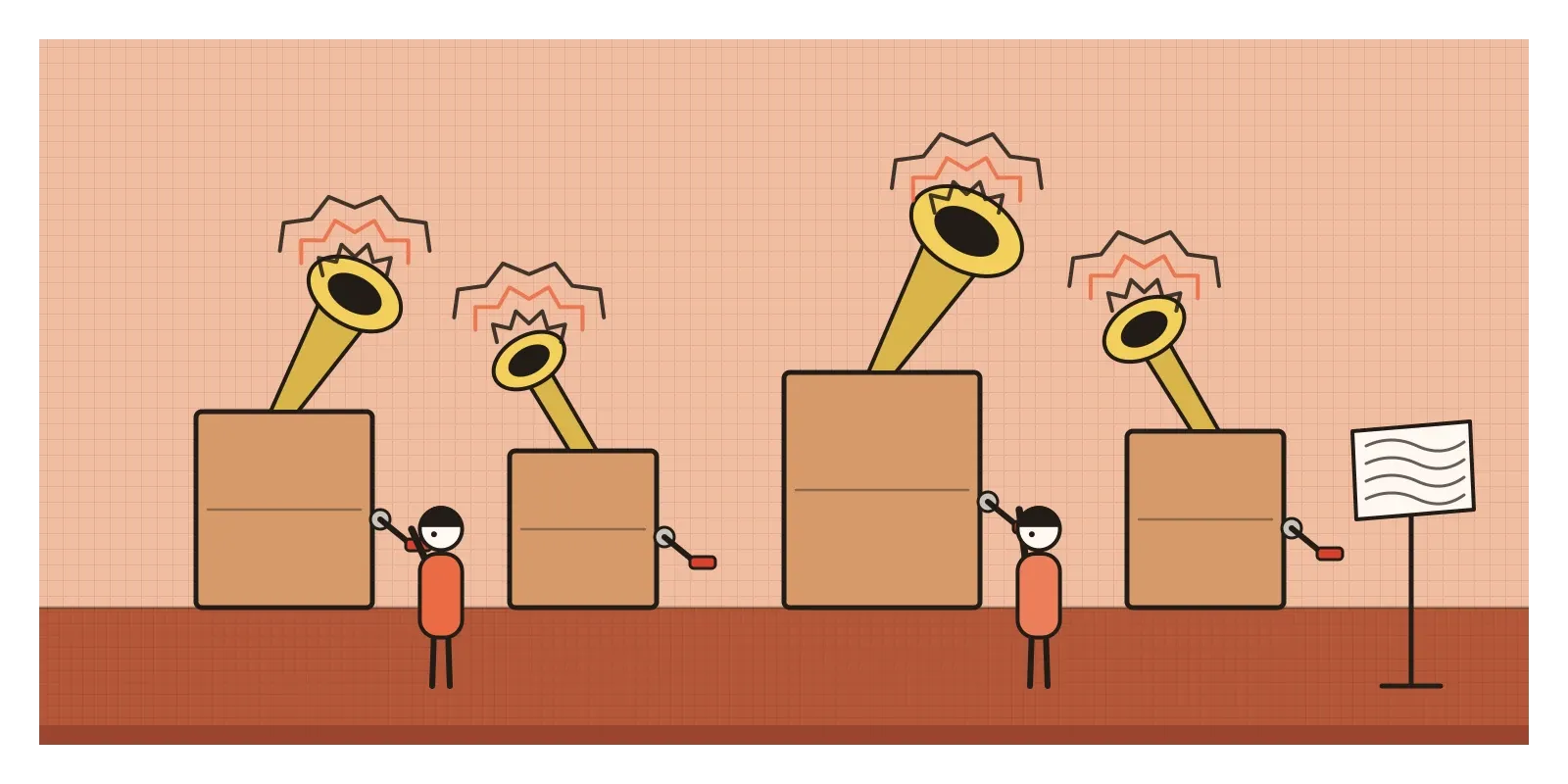
Futurism was never only painting. In 1913 the painter Luigi Russolo wrote The Art of Noises, arguing that the sounds of engines, trams and crowds were a richer music than any orchestra. With his friend Ugo Piatti he built intonarumori, noise intoners: wooden boxes with big metal horns, worked by a crank or lever, that howled, crackled, gurgled and roared. Their first full concert, in Milan in April 1914, ended with the audience shouting and throwing things, which was exactly the reaction the Futurists hoped for.
Marinetti attacked the page itself. In Zang Tumb Tuuum (1914), his sound poem about the siege of Adrianople in the Balkan War of 1912, which he had seen as a reporter, words explode across the page in different sizes and typefaces, run diagonally, turn into mathematical signs and break into noises. He called it words-in-freedom. The young architect Antonio Sant'Elia drew a Città Nuova, a New City, in 1914: stepped towers with lifts running up their outsides, power stations, and roads and railways stacked on several levels. In the 1920s Fortunato Depero designed advertising and a book that was bound with two big metal bolts. And Valentine de Saint-Point, a French writer, answered Marinetti's contempt for women in 1912 with a Manifesto of the Futurist Woman, though she shared much of his love of violence.
Lines of force
The surest sign of Futurist painting is repetition. A limb, a wheel or a head appears several times in slightly different places, like frames of a film laid on top of each other. Look next for what the painters called lines of force: diagonals, wedges, spirals and arcs that cut through the picture and push the eye in one direction. Objects bleed into their surroundings, so a tram passes through a house and a crowd pours into a street. Where Cubism used quiet browns, Futurism used hot colour, often in separated Divisionist strokes, and where Cubism looked at a guitar on a table, Futurism looked at cars, trains, trams, riots, cyclists and, later, aeroplanes.
Futurist typography mixes sizes and weights on one page, sets lines at angles and uses sound words as images. Futurist architecture is vertical, layered and full of visible lifts, ramps and bridges. Everything is aimed at one feeling, speed, and one enemy, stillness.
The same year, a book against the machine
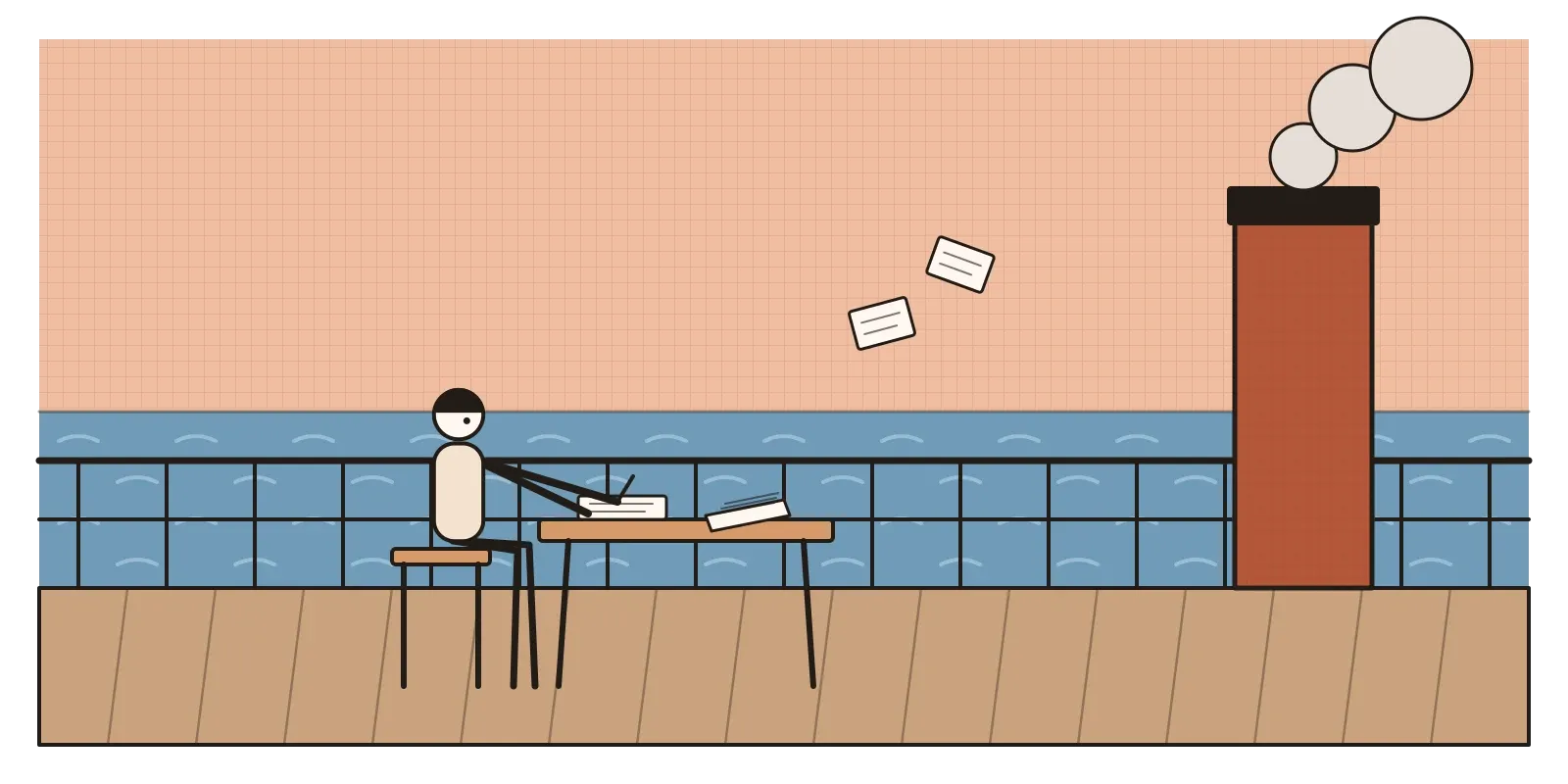
In November 1909, nine months after Marinetti's manifesto appeared in Le Figaro, Mohandas Gandhi was sailing back from London to South Africa on the steamship Kildonan Castle. In about ten days on board he wrote, in Gujarati, a short book in the form of a dialogue between a reader and an editor. When his right hand grew tired, he wrote with his left. It was Hind Swaraj, Indian Home Rule, and it was published that December in his weekly paper Indian Opinion, then banned by the government in Bombay in 1910.
Set the two texts side by side and they read like a quarrel across a continent. Marinetti praised the railway, the factory and the machine as the shape of a new world. Gandhi argued that railways had spread plague and famine, that lawyers and doctors served the system rather than the people, and that machinery was the clearest symbol of a modern civilisation he thought was a disease. Both men hated the comfortable nineteenth century they had grown up in, and both reached for the manifesto as a weapon. I don't want to stretch this into a direct link, because neither, as far as I know, was writing to the other. It's a contrast, but a revealing one.
There is a later and more direct Indian encounter with Futurism's politics. In 1926 Rabindranath Tagore visited Italy at the invitation of an Italian scholar, met Mussolini and was welcomed loudly by the Fascist press, which presented the visit as a blessing. Afterwards, staying with the French writer Romain Rolland in Switzerland, he heard from Italian exiles about the violence and censorship of the regime, and in August 1926 a letter from him was published in the Manchester Guardian distancing himself from Fascism. A poet who had been treated as a prize had refused the role.
Speed lines, kinetic type and the cult of the new
Futurism's visual tricks are now so common that they feel natural. The speed lines behind a running character in a comic, the motion blur on a sports photograph, the swoosh in a logo and the italic, forward-leaning type used for anything that wants to feel fast all descend from its lines of force and repeated limbs. Motion designers working on kinetic typography, words that fly, grow and collide on screen, are doing what Marinetti tried to do with a printing press.
Russolo's noise machines are an ancestor of sound design and of music built from recorded sounds. In the 1980s a British band even named itself Art of Noise after his essay. Sant'Elia's stacked city, with transport on several levels and lifts on the outside of towers, fed into films such as Metropolis and Blade Runner, and anyone who has stood under a Mumbai flyover with a metro line above it and a skywalk beside it has stood inside a version of his drawings that nobody planned.
Futurism also left a habit of language. Tech companies that promise to disrupt, break things and leave the past behind are speaking its dialect,. That's worth noticing, because of where such language led.
War, the world's only hygiene
Futurism's critics don't need to dig for hidden politics, because its politics were written on page one. The manifesto glorified war and despised women, and the Futurists acted on both. They campaigned noisily for Italy to enter the First World War, and Marinetti, Boccioni, Russolo and Sant'Elia joined a volunteer cyclist battalion in 1915. In 1916 Boccioni died after falling from a horse during army training, and Sant'Elia was killed at the front. The movement got the war it had asked for, and it cost it two of its best artists.
Then came Fascism. Marinetti founded a Futurist Political Party in 1918, and in March 1919 he was at the meeting in Milan's Piazza San Sepolcro where Benito Mussolini founded his first Fascist movement. In April 1919 Marinetti helped lead a gang of Futurists and former shock troops that attacked and burned the offices of the socialist newspaper Avanti!, one of the first acts of Fascist street violence. He broke with the movement in 1920, unhappy with its peace with the monarchy and the Church, but soon came back, and in 1929 he accepted a seat in the Royal Academy of Italy, the kind of institution he had once promised to destroy. Futurist aeropainting of the 1930s celebrated the regime's air power, and Marinetti cheered the invasion of Ethiopia. The German critic Walter Benjamin ended a famous 1935 essay by quoting Marinetti on the beauty of that war, and concluded that Fascism turns politics into an aesthetic spectacle. Marinetti died in December 1944, still loyal to Mussolini's last puppet republic.
Not every Futurist followed him, and Russian Futurists such as Vladimir Mayakovsky sided with the Bolsheviks instead. But it would be dishonest to treat Fascism as something that merely happened to Futurism. Its love of violence, its scorn for women and the weak, and its belief that the old should be swept away were ideas Fascism used. Others replied to it sooner: Dadaists mocked its machine worship, London painters borrowed its energy and called it something else, and Russian artists took its broken forms towards pure abstraction.
There's no Futurist collection in India that I know of, so this week look at Boccioni's The City Rises on MoMA's website, or Depero's house-museum in Rovereto if you're ever in northern Italy. Read the Founding Manifesto and Hind Swaraj back to back; both are short and easy to find, and the contrast is startling. Then try a small exercise: draw someone walking past you as five overlapping outlines, or photograph traffic at night with a slow shutter. It's a thrilling effect, and it's worth remembering that it began with a man in a ditch deciding that speed mattered more than people. In the next post, on the Deutscher Werkbund, I'll step back to 1907 and to a quieter group who wanted German factories to make better things.
Further reading: F. T. Marinetti, Critical Writings, ed. Günter Berghaus (2006) · Caroline Tisdall and Angelo Bozzolla, Futurism (1977) · Christine Poggi, Inventing Futurism: The Art and Politics of Artificial Optimism (2009) · Luigi Russolo, The Art of Noises (1913) · M. K. Gandhi, Hind Swaraj (1909)
A reply toItaly's worship of its own past, and the still, silent objects of Cubism.