
The Deutscher Werkbund
How German designers and factory owners joined forces to make everyday goods better, and argued about what better meant.
The Deutscher Werkbund
Ten theses on the Rhine
In the summer of 1914, the city of Cologne was hosting a large design exhibition on the east bank of the Rhine. It had opened in May, and among its pavilions were a model factory by two young architects, Walter Gropius and Adolf Meyer, with glass-wrapped staircases at its corners, a theatre by the Belgian designer Henry van de Velde, and a small, glittering pavilion of coloured glass by Bruno Taut. The exhibition belonged to the Deutscher Werkbund, the German association of craft and industry, and that summer its members met in the city for their annual congress.
The meeting turned into a quarrel that design schools still teach. The architect Hermann Muthesius, one of the association's founders, put forward ten theses arguing that German design should work towards Typisierung, the development of standard types: well-made, agreed forms that factories could produce in quantity and that would give German goods a clear, recognisable character. Van de Velde answered with ten counter-theses. The artist, he said, was by nature a free individual who would never submit to a rule or a standard type. Gropius, Taut and others sided with van de Velde, the hall was in uproar, and Muthesius stepped back from his proposals. A few weeks later the war began, the exhibition closed early, and van de Velde, now an enemy alien, eventually had to leave Germany.
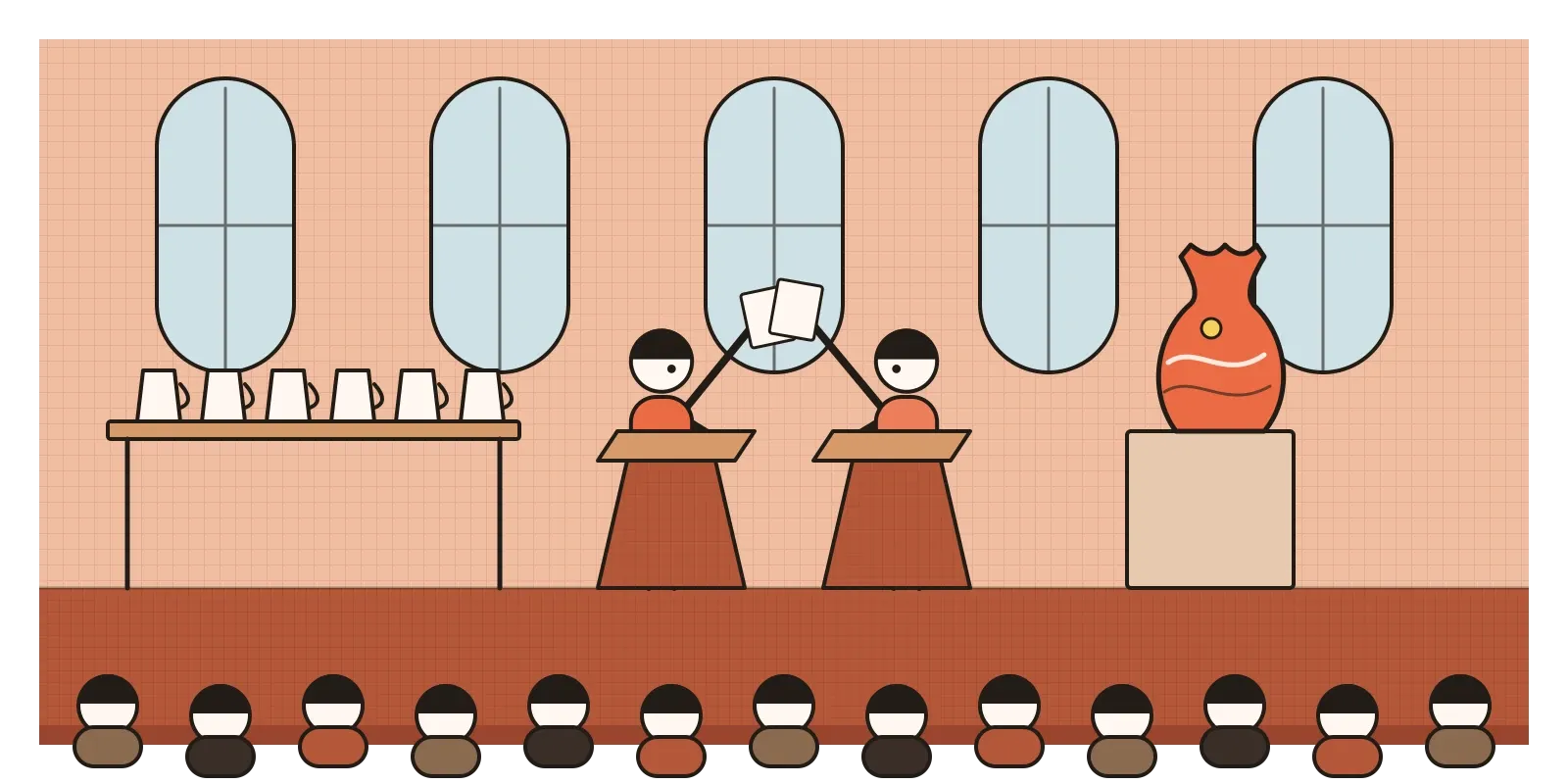
The Deutscher Werkbund wasn't a style. It was an organisation, founded in Munich in October 1907, that brought together artists, architects, manufacturers, shopkeepers and writers to raise the quality of German goods, from teapots to power stations. It argued about almost everything, including the question at the heart of that Cologne debate, which every design team still faces. Should good design come from shared standards or from individual genius? Its answer changed over the years, but the alliance it built between designers and industry is where much of modern product design begins.
Made in Germany, and meant as an insult
In 1887 Britain passed a law requiring imported goods to be marked with their country of origin. The idea was partly to warn British shoppers off cheap foreign copies, and German goods in particular had a reputation for being cheap and badly made. Within twenty years the label had turned into a boast. Germany, unified only in 1871, had become an industrial giant, leading the world in chemicals and electrical engineering. But many of its consumer goods still looked like imitations: machine-made furniture smothered in stamped historical ornament, mass-produced vases pretending to be handmade.
Muthesius had seen an alternative up close. From 1896 to 1903 he worked at the German embassy in London, officially to study British architecture and design, and he came home an admirer of English houses and of the Arts and Crafts movement, whose post sits earlier in this series. In a 1907 lecture in Berlin he attacked German applied art for its fake ornament and its copying of past styles, and the furious response from trade associations helped push like-minded people into organising. In October 1907, twelve artists and twelve firms met in Munich and founded the Werkbund. The artists included Peter Behrens, Richard Riemerschmid and Josef Hoffmann of the Wiener Werkstätte. The politician Friedrich Naumann and the furniture maker Karl Schmidt were among its driving forces.
The Werkbund replied to two things at once. It rejected the historical copying of the nineteenth century. And it rejected the Arts and Crafts belief that machines destroyed good work, a belief that kept William Morris's furniture handmade and expensive. The Werkbund kept Morris's moral seriousness about honest, well-made things, and turned it towards the factory.
An artist hired by an electricity company
The clearest example of what that meant came from AEG, the giant Berlin electrical firm. In 1907 it hired Peter Behrens, a painter turned architect, as its artistic adviser, and over the next few years he designed almost everything the company showed to the world: its trademark, its catalogues and price lists, its showrooms, electric fans, clocks, arc lamps for street lighting, electric kettles, workers' housing and factories. It is often described as the first corporate identity, long before anyone used the phrase.
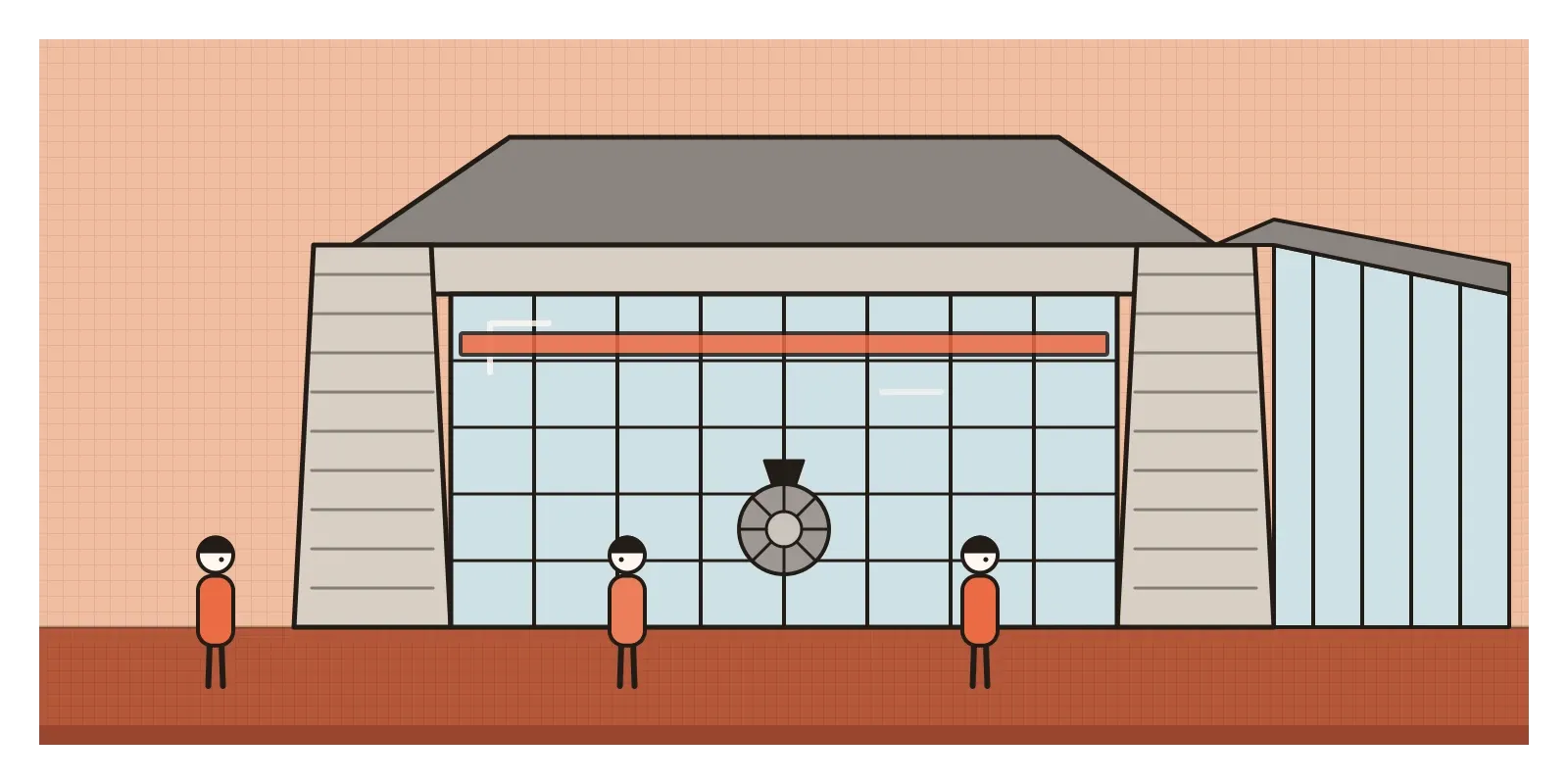
His most famous building is the Turbine Hall in Berlin-Moabit, completed in 1909 with the engineer Karl Bernhard: a vast shed for assembling turbines, its long sides made of steel frames filled with glass, under a great angled roof. Behrens gave it heavy, ribbed concrete corners that look like the corner stones of a temple, even though they hold up almost nothing, so the building has the dignity of a classical monument and the honesty of a factory. In his office around 1908 to 1911 worked three young men who would shape the century: Walter Gropius, Ludwig Mies van der Rohe and, for a few months, Charles-Édouard Jeanneret, later Le Corbusier.
Others worked in the same spirit. In Dresden, Richard Riemerschmid designed what he called machine furniture for Karl Schmidt's workshops from 1906: plain pieces in pine, designed so that machines could cut the parts and workers assemble them, sold from a catalogue at fixed prices. Schmidt later built a garden city at Hellerau, outside Dresden, with workshops, housing and a theatre side by side. In 1911, Gropius and Meyer began the Fagus factory in Alfeld for a maker of shoe lasts, with glass walls that wrap around the corners without a supporting column, a building I mentioned in the post on the Bauhaus. And Taut's Glass Pavilion at Cologne in 1914, built to advertise the glass industry, was a little temple with a faceted coloured-glass dome and a cascade of water inside, with rhymes about glass by the writer Paul Scheerbart running around its frieze.
Plain, but not poor
Werkbund objects don't share one look, but they share a manner. The German word most often used for it is Sachlichkeit, which means something like matter-of-factness. Forms are built from simple geometry: the octagon, the cylinder, the sphere. Ornament isn't banned, but it's quiet, a hammered surface, a band of beading, a ribbed handle, and it usually comes from the way the thing was made rather than being stuck on. Materials are left to speak: brass looks like brass, pine like pine.
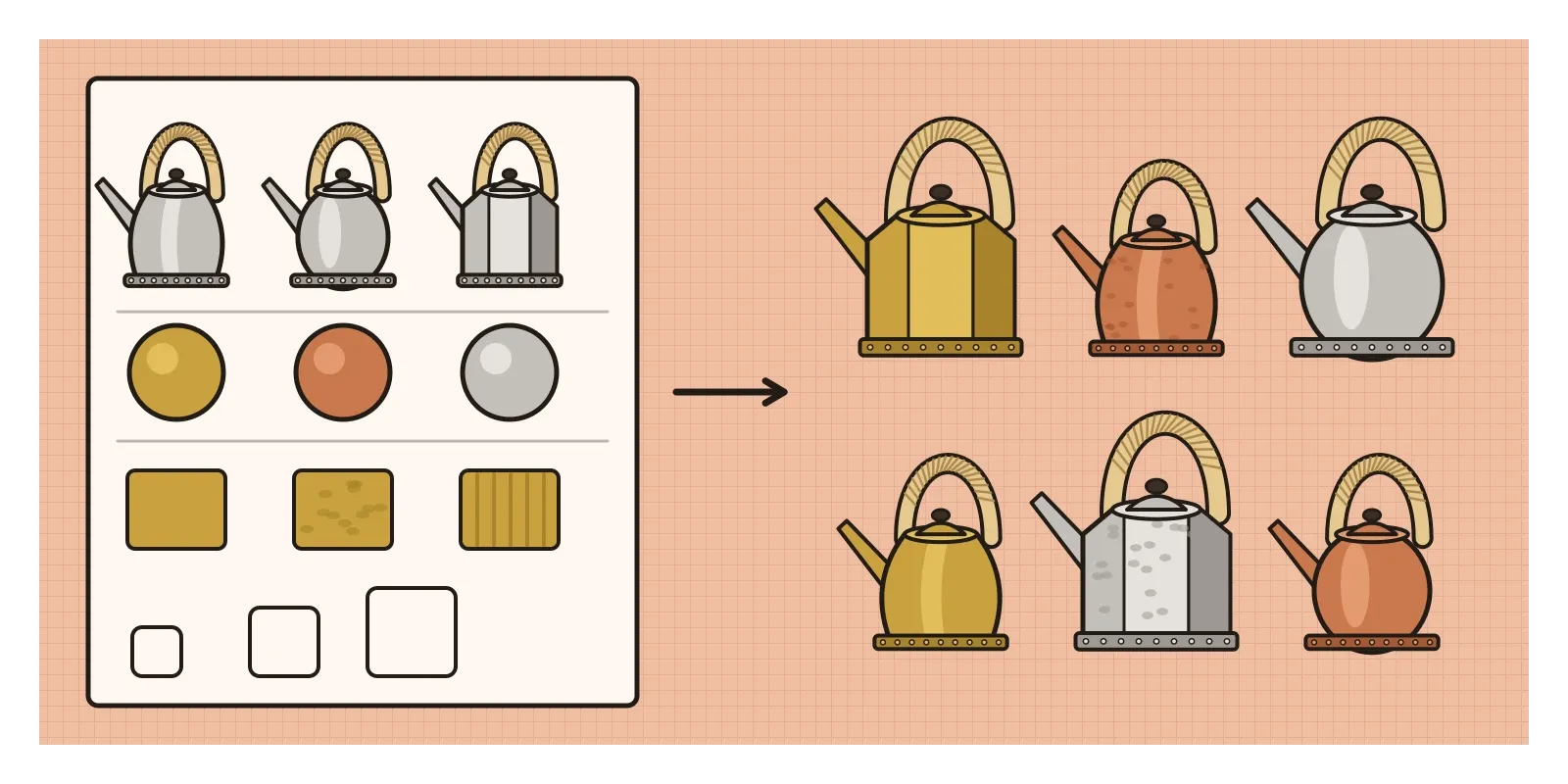
Behrens's electric kettles of 1909 show the method best. Instead of designing one perfect kettle, he designed a small set of parts: a few body shapes (round, oval and octagonal), several metals and surface finishes, different sizes, interchangeable lids, handles and bases. Combined, they produced dozens of possible models, of which some thirty are said to have reached the shops, all recognisably from the same family and all made with the same tools. The type that Muthesius would argue for in 1914 wasn't one object repeated forever. It was a system.
The same thinking reached print. Behrens set AEG's catalogues in consistent typefaces and layouts, so that a price list, a poster and a showroom sign all looked as if they came from one company. Werkbund buildings, meanwhile, tend to look like a negotiation between engineering and monument, which is why so many of them have the odd mix of glass curtain and heavy stone corners that you see in the Turbine Hall.
Swadeshi and the pride of things
In August 1907, two months before the Werkbund was founded, the Tata Iron and Steel Company was registered in Bombay. Its share issue, offered to Indian investors at the height of the Swadeshi movement, is said to have been taken up within weeks, and its works at Sakchi, later Jamshedpur, produced their first steel in 1912. Six years earlier, in Calcutta, the chemist Prafulla Chandra Ray had turned a small laboratory business into Bengal Chemical and Pharmaceutical Works, making medicines and toiletries to show that Indians could manufacture modern goods themselves. Swadeshi, which means "of one's own country", began as a boycott of British goods after the 1905 partition of Bengal, and it made buying Indian-made soap, cloth or matches a political act.
This is a loose parallel, and I want to be clear about its limits. Both movements treated the quality of national goods as a national question, and both drew artists and industrialists into one conversation. But the Werkbund served an independent industrial power looking for export markets, while Swadeshi was a colonised country's fight for economic self-respect. And India's design thinkers of the time often pulled the other way. In Essays in National Idealism (1909), Ananda Coomaraswamy warned that a factory imitation of a foreign product, made in India, wasn't real Swadeshi at all, and urged a return to Indian craft. Gandhi's later khadi took that argument further. A full Indian alliance of design and industry, on the Werkbund model, only came after independence, a story for later posts in this series.

The grandparent of the design system
If you work with a design system, you're working inside the Werkbund's argument. Behrens's kettles were a component library in brass: a few shapes and finishes, combined by rule, producing many products that obviously belonged together. Today's component variants, with their sizes, states and themes, follow the same logic, and the tension Muthesius and van de Velde fought over is still there in every team that has to balance consistency against a designer's wish to make something new. When I worked on an agentic AI system at Rocketium, much of the hard thinking was about which parts of a layout should be fixed rules and which left open, which is Cologne in 1914 in a smaller room.
Behrens's work for AEG is the ancestor of corporate identity, the idea that a company should look like one company across every product, building and printed sheet, a line that runs through to the brand guidelines most firms now keep. The Werkbund's belief in standards fed into Germany's national standards body, founded in 1917, and its habit of exhibitions as arguments continued in the 1927 Weissenhof housing estate in Stuttgart, where it invited leading modern architects to build model homes. Its model spread abroad too: Austria had its own Werkbund from 1912, Switzerland from 1913, and in 1915 Britain founded the Design and Industries Association in open imitation of its wartime enemy.
Good form, for whom?
The Werkbund's critics point first to its nationalism. Naumann and others saw well-designed German goods as a way to win world markets, and "German form" could slide easily into German power. In 1914 many members welcomed the war. There's also a strong strain of telling people what to like. The Werkbund's experts, mostly educated middle-class men, were sure they knew what good form was, and much of its campaigning was aimed at reforming the taste of workers and shopkeepers who hadn't asked to be reformed. Women were present, and the 1914 Cologne exhibition even had a House of Women, but the architect and designer Lilly Reich only became the first woman on its board in 1920.
Its story then darkened. When the Nazis came to power in 1933, the Werkbund was brought into line, its Jewish members were pushed out, and some of its language about quality, standards and the beauty of work was put to the regime's use. It was absorbed into the Nazi cultural apparatus and later dissolved, and only re-formed after the war. The reply to it had come much earlier, though. In 1919, Gropius, who had cheered van de Velde in Cologne, founded a school in Weimar that tried to hold both sides of that debate at once, art and industry, the individual and the type. That school has its own post. Before it, in Russia, artists were stripping art down even further.
To see the Werkbund for yourself, look up the Fagus factory, a UNESCO World Heritage Site, or the Werkbundarchiv, a museum of everyday things in Berlin. Closer to home, walk through a steel utensil shop in any Indian market and look at a stack of tiffin carriers or dabbas: the same few shapes in many sizes, finishes and lid designs, made with the same tools and obviously one family. That is Behrens's kettle system, still on sale. Then try the exercise the Cologne congress argued about. Pick one object you design, a button, a card or an icon, and decide which parts should be fixed for everyone and which you'd leave free. You'll find yourself taking a side, Muthesius or van de Velde, just as the hall did in 1914. In the next post, on Suprematism, I'll leave the factories for a Russian stage and a single black square.
Further reading: Frederic J. Schwartz, The Werkbund: Design Theory and Mass Culture before the First World War (1996) · Joan Campbell, The German Werkbund: The Politics of Reform in the Applied Arts (1978) · Tilmann Buddensieg, Industriekultur: Peter Behrens and the AEG, 1907-1914 (1984) · Hermann Muthesius, The English House (1904-05) · Ananda K. Coomaraswamy, Essays in National Idealism (1909)
A reply toFake historical ornament on German factory goods, and the Arts and Crafts movement's distrust of the machine.