
Fluxus
How a loose network of 1960s artists turned everyday actions, small boxes and simple instructions into art.
Fluxus
The night they took the piano apart
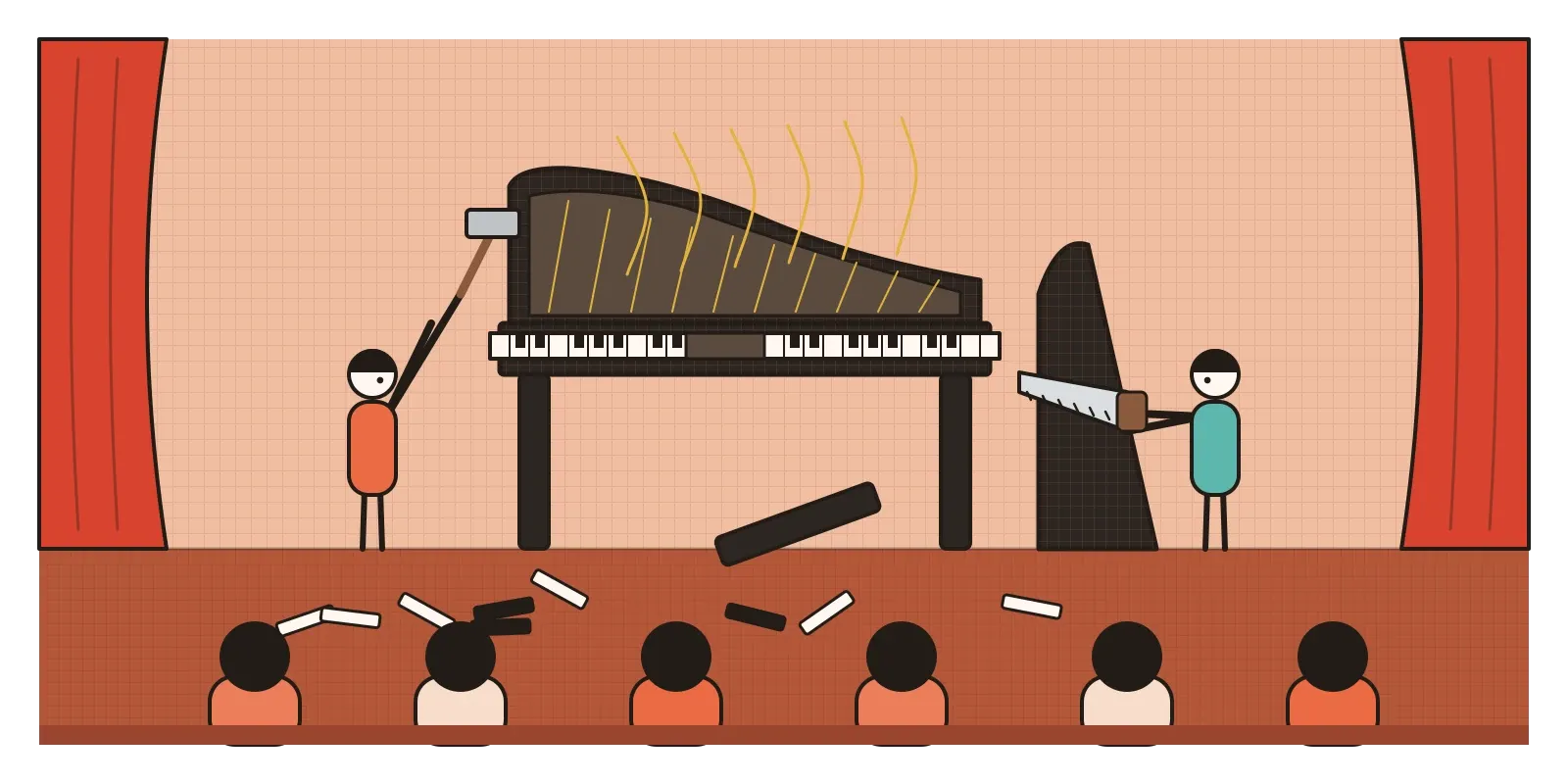
In September 1962, the lecture hall of the city museum in Wiesbaden, a spa town in West Germany, hosted a series of weekend concerts with a grand title: the Fluxus International Festival of Newest Music. The audience got something unexpected. On one evening, a group of performers, including the Lithuanian-born American organiser George Maciunas and the composer Dick Higgins, played a piece by the American composer Philip Corner called Piano Activities. Corner's score asked for things to be done to a piano: plucking the strings, rubbing them, dropping objects on them, striking the body. The performers took it further. By the end, they had pulled the old grand piano apart with hammers, saws and bare hands, and the pieces lay across the stage.
The local press was scandalised. People who had come for new music had watched a piano being dismantled, and they couldn't agree whether it was a concert, a prank or vandalism. That confusion was exactly the point. At the same festival, the Korean artist Nam June Paik dipped his head in ink and dragged it along a strip of paper on the floor, his reading of a friend's score that simply asked for a straight line to be drawn and followed, and others performed pieces made of a single small action.
Fluxus was the name Maciunas gave to the loose international network of artists, composers and poets who took part in events like this from the early 1960s. It wasn't a style in the usual sense, and its members argued about whether it was a movement at all. What they shared was an attitude. Art could be an everyday action, a joke, a game, a set of written instructions or a small box of odd objects, and anyone could do it. The aim was to blur the line between art and life until it almost disappeared.
A dictionary word and a class in New York
Maciunas had trained in architecture and graphic design in the United States, and in 1961 he ran a short-lived gallery in New York. He planned a magazine, looked up a name in the dictionary and chose fluxus, Latin for flowing, because its definitions, a flow, a continuous change, even a purging of the bowels, suited what he wanted. When he moved to West Germany to work as a designer for the US Air Force, he used the name for the festivals that launched the group in Europe in 1962 and 1963, from Wiesbaden to Copenhagen, Paris and Düsseldorf.
Many of the ideas came from one classroom. From 1957 to 1959, the composer John Cage taught a course in experimental composition at the New School for Social Research in New York. Cage had been using chance and silence in music for years, and he encouraged his students to treat any sound, and by extension any action, as material. Among those who attended were George Brecht, Dick Higgins and Jackson Mac Low, and the ideas spread from there to a wider circle including Yoko Ono, La Monte Young and Alison Knowles.
What Fluxus replied to was the art world of the late 1950s, in which Abstract Expressionist painting, discussed in its own post in this section, had made the artist into a lone hero and the painting into a costly object. Fluxus wanted art to be cheap, quick, collective and funny. It also looked back. The Dada artists, as I wrote in the post on Dada, had staged absurd evenings in Zurich during the First World War, and Fluxus artists knew it. But where Dada had raged, Fluxus mostly played.
Scores for dripping water and making salad
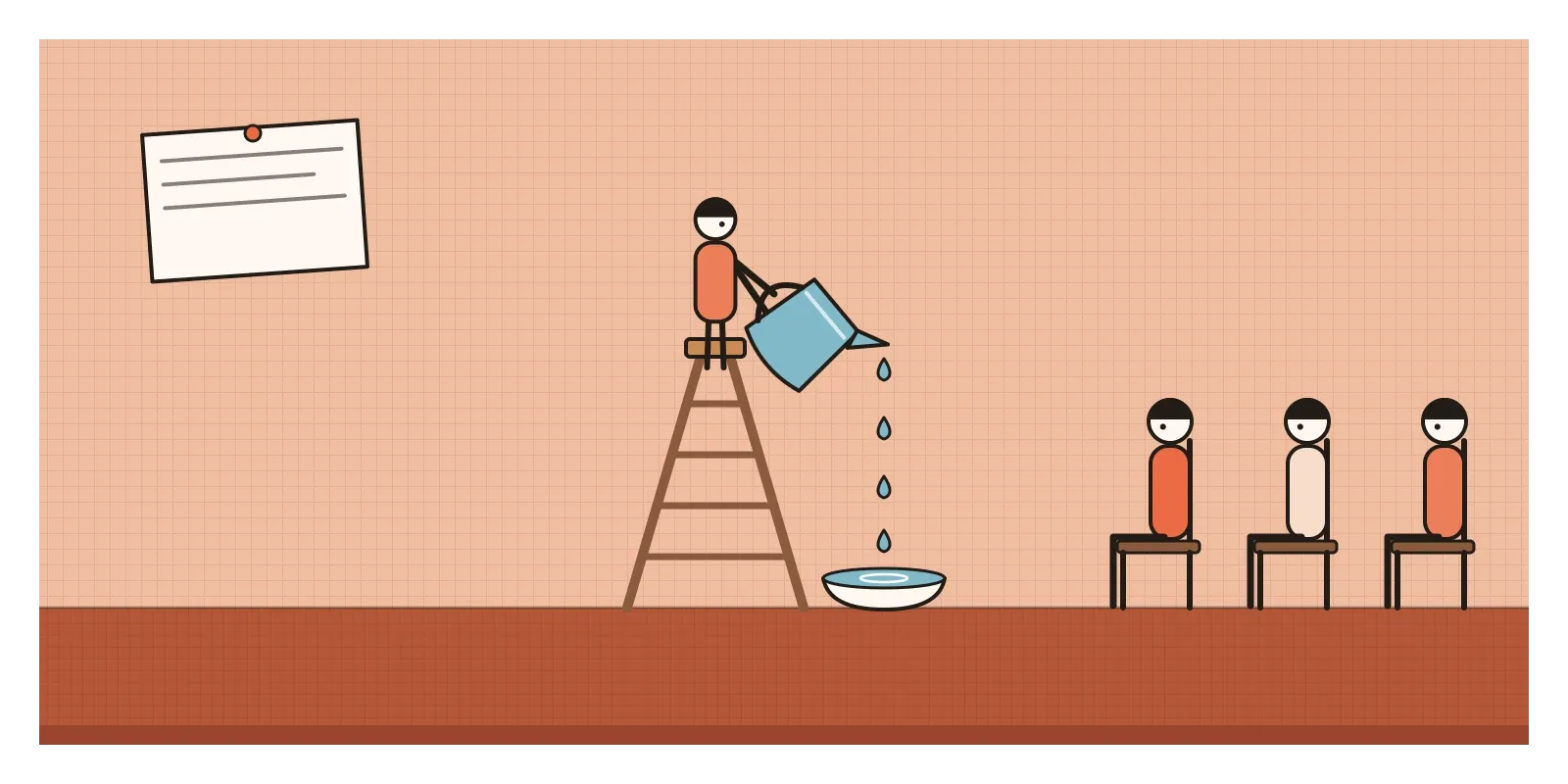
George Brecht invented the form most closely linked with Fluxus, the event score. These were short instructions, often printed on small cards, that described an action anyone could perform. One of his best known, Drip Music, simply arranges for water to drip from a source into an empty container. Another consists of a single word that you might see above a door on your way out. Brecht collected his scores in a box called Water Yam (1963), and the cards could be performed in a concert hall, at home or just noticed in daily life. A score didn't make a sound or an object. It made you pay attention.
Yoko Ono had been writing instruction pieces in New York and Tokyo since around 1960, and in 1964 she published them in a small book, Grapefruit, full of gentle, impossible or poetic tasks, such as imagining clouds dripping or listening to the sound of the earth turning. That year in Kyoto she first performed Cut Piece, sitting still on a stage while members of the audience came up one by one and cut away pieces of her clothing with scissors. It's still one of the most discussed performances of the century, about trust, vulnerability and the violence that can hide in polite participation.
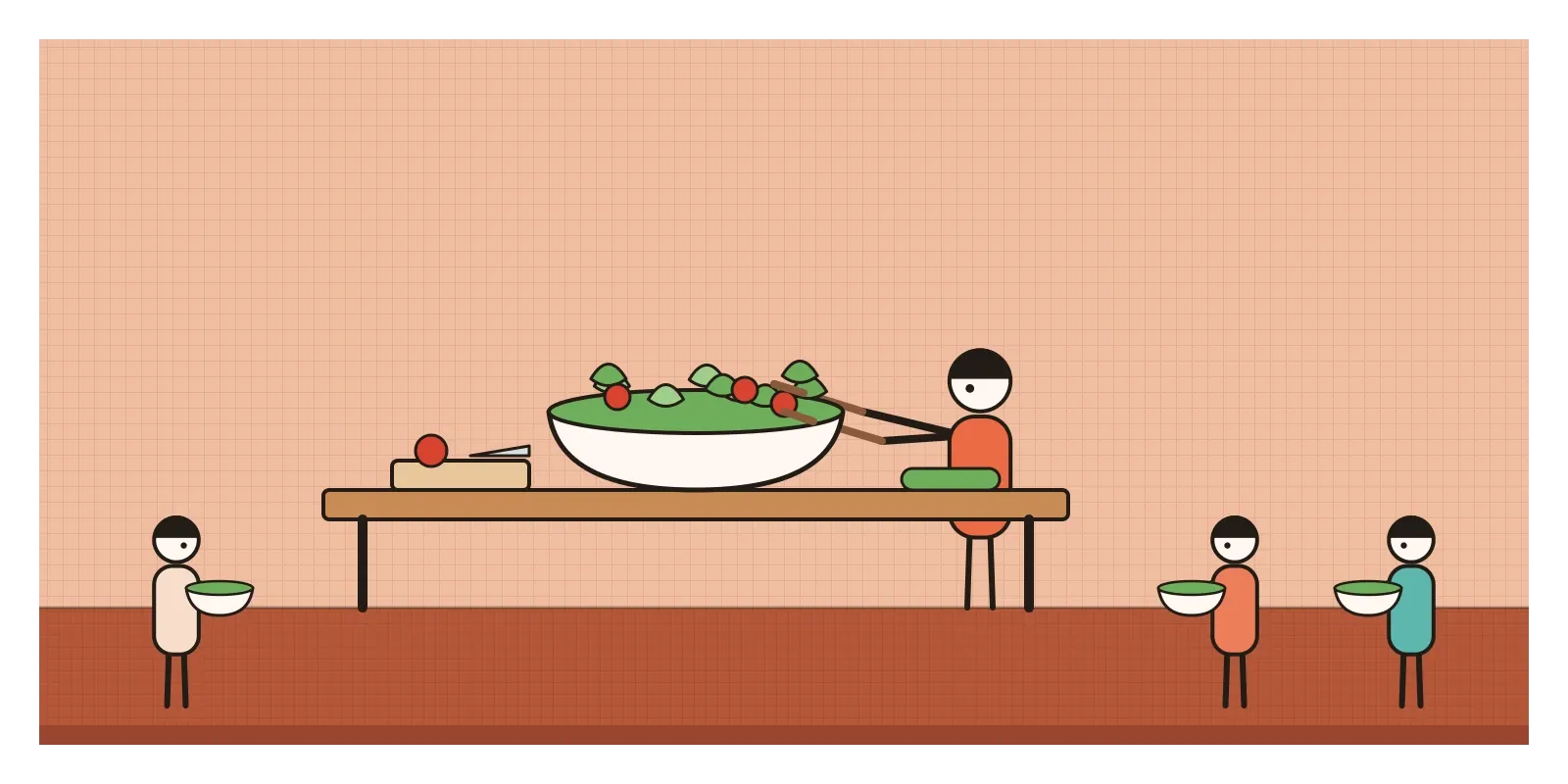
Alison Knowles's Make a Salad, first performed in London in 1962, is just that: she makes a large salad on stage and serves it to the audience. Paik went on to put televisions into art, manipulating their pictures in a 1963 show in Wuppertal, and became the pioneer of video art. In Japan, Mieko Shiomi posted instructions to people around the world and gathered their responses into Spatial Poems. Benjamin Patterson, a classically trained double bass player and one of the few Black artists in the early group, made performances out of paper being crumpled and torn. In Nice, Ben Vautier turned his small shop, covered in objects and handwritten signs, into a long-running artwork.
Boxes, cards and a cheap, cheerful look
Fluxus is an attitude more than a look, but it has recognisable traces, many of them designed by Maciunas himself. The typical Fluxus object is small and cheap: a plastic box, a little wooden crate or a briefcase, divided into compartments holding cards, scraps of film, stones, balls, rubber stamps, puzzles and jokes. These Fluxkits and the Flux Year Box were meant to be mass-produced and sold for very little, an art collection you could hold in your hands. Maciunas designed their labels in dense, playful typographic layouts, mixing typefaces and borders like old commercial printing, and laid out newspapers, posters and charts in the same spirit.
The performances share a vocabulary too: short duration, simple everyday actions, ordinary materials, the audience drawn in or made to do the work, humour, repetition and silence. The scores are the purest form, a few plain words that can be carried out by anyone, anywhere, slightly differently each time. A good test is to ask whether the piece could be done again tomorrow by someone else from the instructions alone. If it could, it's in the Fluxus spirit.
A lesson in quiet from Ahmedabad
There was no Fluxus group in India, but one of the quietest influences on it came from Ahmedabad. In 1946, Gita Sarabhai, a young musician from the Sarabhai family of Ahmedabad, travelled to New York to study Western music and met John Cage. They agreed on an exchange: he would teach her contemporary Western music, and she would teach him about Indian music and thought. Cage later said that she told him something her teacher in India had said, that the purpose of music was to quiet and sober the mind and so make it open to divine influences. He kept repeating it for the rest of his life.
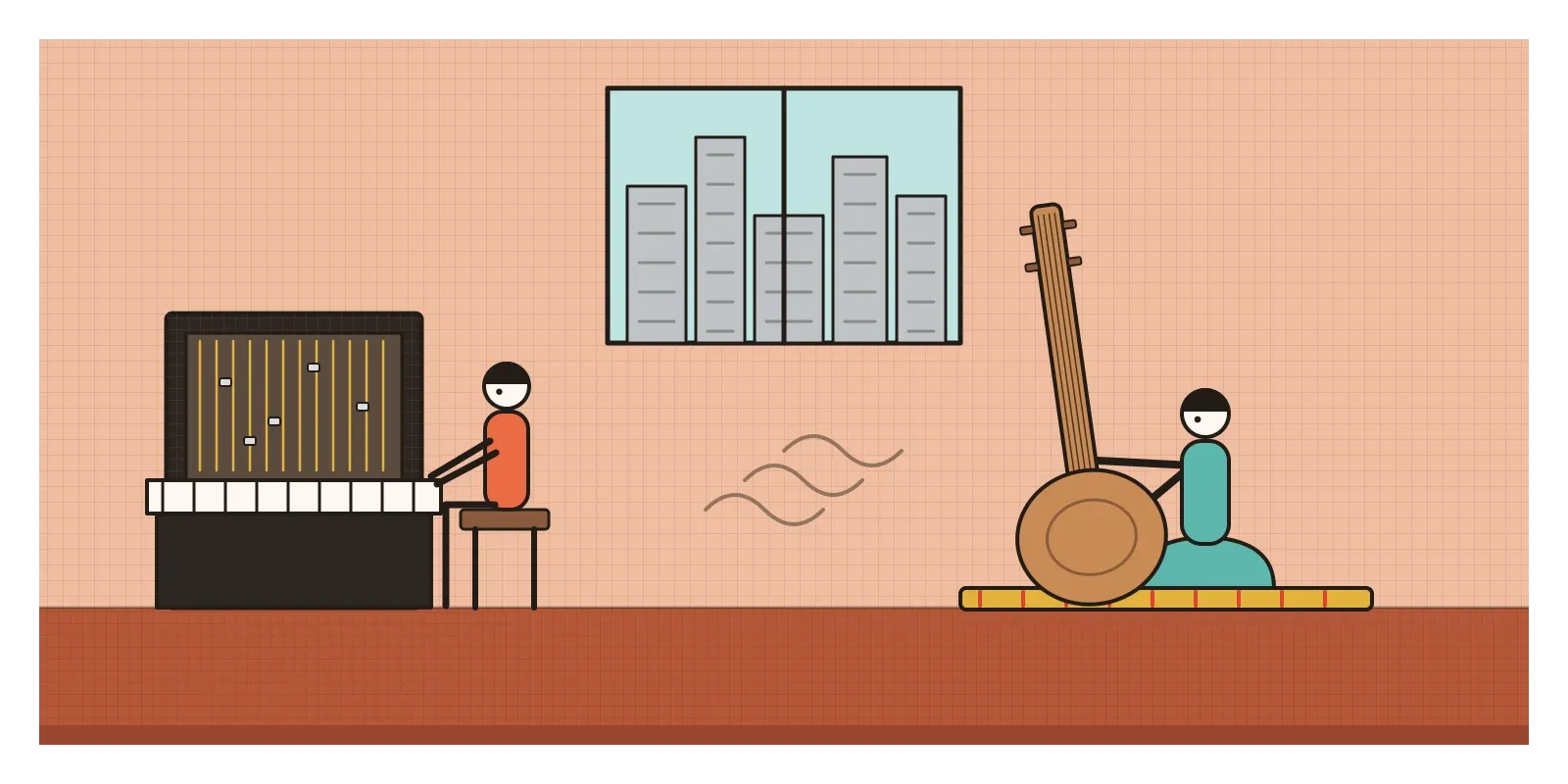
Around the same time, Cage was reading about Indian aesthetics and wrote his Sonatas and Interludes for prepared piano, which he described as expressing the permanent emotions of the Indian tradition, the rasas that I wrote about in the post on rasa theory. The path from Gita Sarabhai to the Wiesbaden stage isn't direct, and much else went into Cage's thinking, especially Zen Buddhism, but the idea that art might be about attention and calm rather than self-expression passed through his New School class to the Fluxus artists. A later link is the composer La Monte Young, who co-edited an early book of scores that Maciunas designed, and who from 1970 studied Hindustani singing with Pandit Pran Nath for more than twenty years.
I find a loose parallel closer to home in everyday ritual, actions repeated with care, done and then undone, like a kolam drawn at dawn and walked over by noon. And today, Indian performance artists such as Nikhil Chopra, whose long, slow performances can last days, work in a world Fluxus helped make possible, even if their concerns are their own.
Instructions, prompts and playful products
Fluxus taught designers that the most important thing you make might be a set of instructions. An event score is like a user flow written as poetry, a few words that produce an experience when someone carries them out. Design workshops borrow the format constantly, with cards that tell a team to do something simple and odd to break their habits. And in the last few years, with AI tools that make images and text from a few words, everyone has become a writer of scores. A good prompt, like a good Fluxus score, is short, specific about the action and open about the result.
Its influence runs elsewhere too. Higgins coined the word intermedia in 1966 for work that falls between art forms, a useful ancestor of today's interaction and experience design. Paik's televisions led to video art and the screen-filled installations in every museum, and in the 1970s he even wrote about an electronic super highway. Knowles's salad is an ancestor of participatory design and of every pop-up event where the audience makes the work. The Fluxkit's spirit lives in zines, artist's multiples and subscription boxes full of small surprises.
Fluxus had real contradictions. It claimed to be anti-art and anti-commercial, but its boxes and scores are now carefully conserved in museums such as MoMA in New York, displayed behind glass and worth a great deal. Maciunas wanted it collective but often ran it like a strict editor, expelling members who strayed. Many of its jokes only make sense to people already inside the art world, so its promise that anyone can do it rarely reached far beyond that world. And though women such as Ono, Knowles, Shiomi, Takako Saito and Shigeko Kubota were central, histories long told it as a story of men, with Ono in particular dismissed for decades. Maciunas also spent his last years trying to build cooperative artists' housing in the lofts of SoHo in New York, a project that helped turn the area into one of the most expensive neighbourhoods in the city.
Fluxus faded after Maciunas died in 1978, though its artists kept working. Performance art, video art, mail art and Conceptual Art all grew in the space it opened. In the next post, on Land Art, artists replied by leaving the gallery and its small boxes behind altogether, for deserts, lakes and fields.
Perform a score this week
You don't need a museum to see Fluxus. Pick any small, repeated action in your day, pouring water, sweeping a step, closing a door, and do it once with full attention, as if it were a performance. That's essentially an event score. If you want to see the objects, MoMA's online collection has a large Fluxus archive, and Hannah Higgins's Fluxus Experience is a clear, warm account of what it was like to take part.
Then try writing a score for your own work. Describe, in no more than twenty words, an action a user of your product might perform, without describing the screen at all. If it reads like a strange little poem, you're probably close to what they actually do.
The piano in Wiesbaden didn't survive the evening, but the question it raised did. If an action is done with attention, in front of people who are paying attention, it can be art. Fluxus spent its whole life testing how small that action could get.
Further reading: Hannah Higgins, Fluxus Experience (2002) · Yoko Ono, Grapefruit (1964) · Kristine Stiles, "Between Water and Stone: Fluxus Performance, a Metaphysics of Acts" in In the Spirit of Fluxus (1993) · Kay Larson, Where the Heart Beats: John Cage, Zen Buddhism, and the Inner Life of Artists (2012)
A reply toThe lone hero of Abstract Expressionism and the art world's love of costly objects.