De Stijl
How a small Dutch group tried to rebuild art, furniture and rooms from straight lines and primary colours.
De Stijl
A dance hall nobody wanted
Early in 1928, the people of Strasbourg were invited into the Aubette, a long eighteenth-century building on the city's main square, Place Kléber, that two brothers, Paul and André Horn, had turned into an entertainment complex. Inside there were cafés, a tea room, bars, a billiard room and, upstairs, halls for dancing, parties and films. The commission had gone to the artist couple Sophie Taeuber-Arp and Jean Arp, and they had brought in their friend Theo van Doesburg, a Dutch painter, writer and tireless campaigner for a movement called De Stijl.
Van Doesburg's upstairs dance hall was unlike any room the guests had seen. Its walls and ceiling were covered with large rectangles of colour, red, blue, yellow, green, white, grey and black, set in shallow relief and tilted at forty-five degrees, so that the whole room seemed to be sliding diagonally around the dancers. It was meant to be a painting you could walk into. The customers didn't like it. They found it cold and dizzying, and over the next decade the owners redecorated and covered much of it up. Restoration began in the 1980s, and in 2006 the reconstructed rooms reopened to visitors, nearly eighty years after the public had turned its back on them.
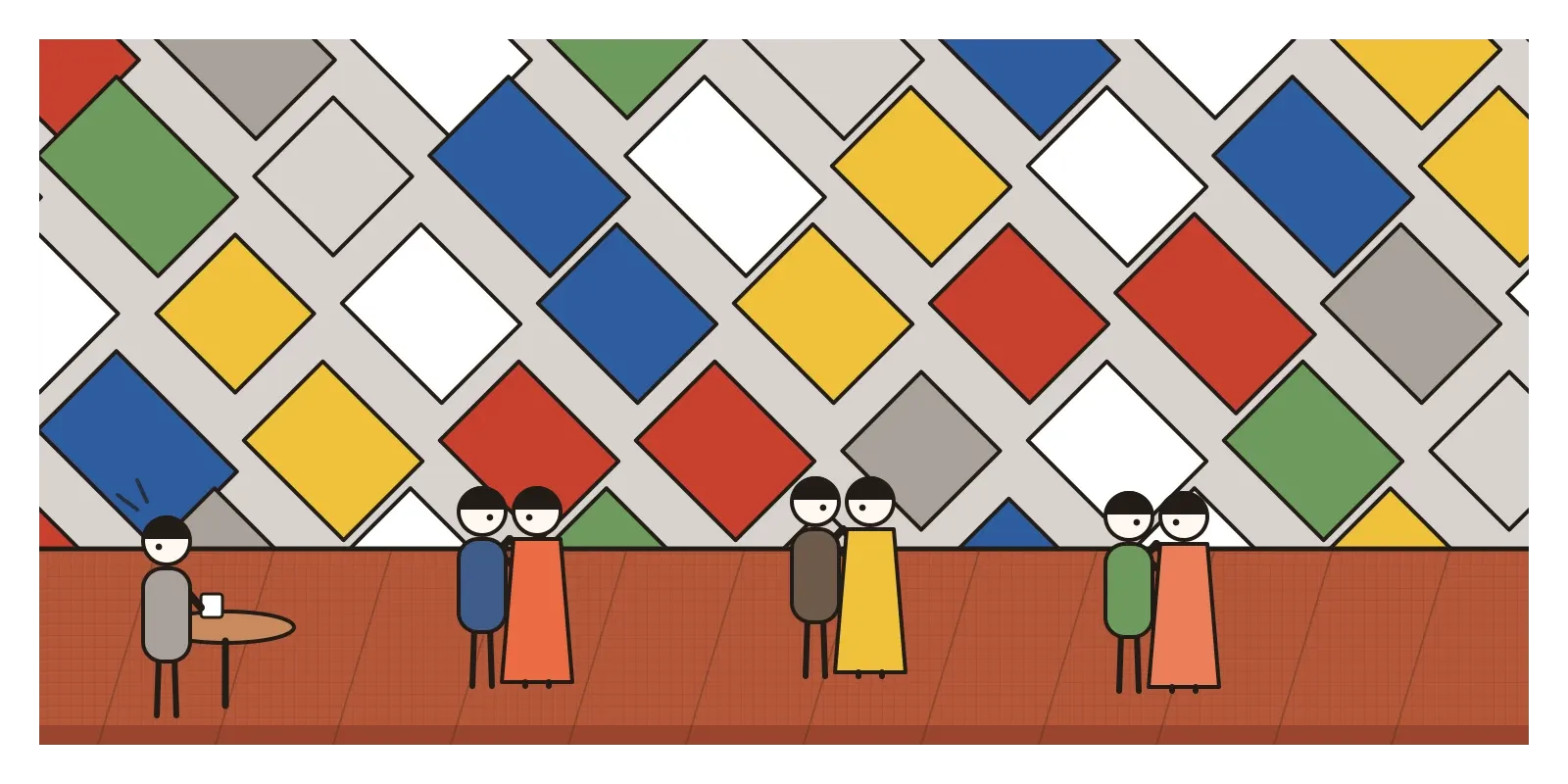
De Stijl, Dutch for "the style", was a group of painters, architects and designers founded in the Netherlands in 1917. Its members believed that art could reveal a universal harmony underneath the messy surface of the world, and that it could be built from the simplest possible elements, straight horizontal and vertical lines, rectangles, the three primary colours and the non-colours black, white and grey. They wanted that order to spread from canvases into furniture, rooms, buildings and eventually whole cities.
Order in a neutral country
The Netherlands stayed neutral in the First World War. While the armies of its neighbours dug into the trenches, Dutch artists were cut off from Paris and thrown back on one another. The painter Piet Mondrian, who had been working in Paris among the Cubists, was visiting home when the war broke out in 1914 and couldn't go back. As I wrote in the post on abstraction, he had already been stripping trees down to a web of lines. In the village of Laren he met the philosopher M. H. J. Schoenmaekers, whose mystical books described the world as a balance of opposites, the horizontal and the vertical, and named yellow, blue and red as the essential colours. Mondrian had joined the Theosophical Society in 1909, as I mentioned in the post on Symbolism, and these ideas fitted.
In October 1917 van Doesburg launched a small magazine called De Stijl from Leiden, with a cover designed by the Hungarian-born painter Vilmos Huszár. It gathered painters including Mondrian, Bart van der Leck and Huszár, the architects J. J. P. Oud, Jan Wils and Robert van 't Hoff, and the Belgian sculptor Georges Vantongerloo. The cabinet-maker Gerrit Rietveld joined soon after. What were they replying to? To Cubism, which had broken objects up but still kept them, and more broadly to the individual, emotional styles of the years before, whose wild brushwork they saw as part of the same self-centred culture that had produced the war. Their answer was impersonal order, something any careful person could make, and they hoped any society could share.
A painter's studio and a widow's house
Van der Leck was one of the first to paint flat patches of pure primary colour on white, reducing scenes of workers and soldiers to triangles and bars until the people almost disappear. Mondrian went further. By the early 1920s, back in Paris, he had arrived at the paintings everyone now recognises: a white canvas crossed by thick black horizontal and vertical lines, with a few rectangles filled in red, yellow or blue. He called this Neo-Plasticism, his name for a new, purely abstract kind of image. As the post on balance explains, these pictures are almost never symmetrical, yet they feel perfectly settled.
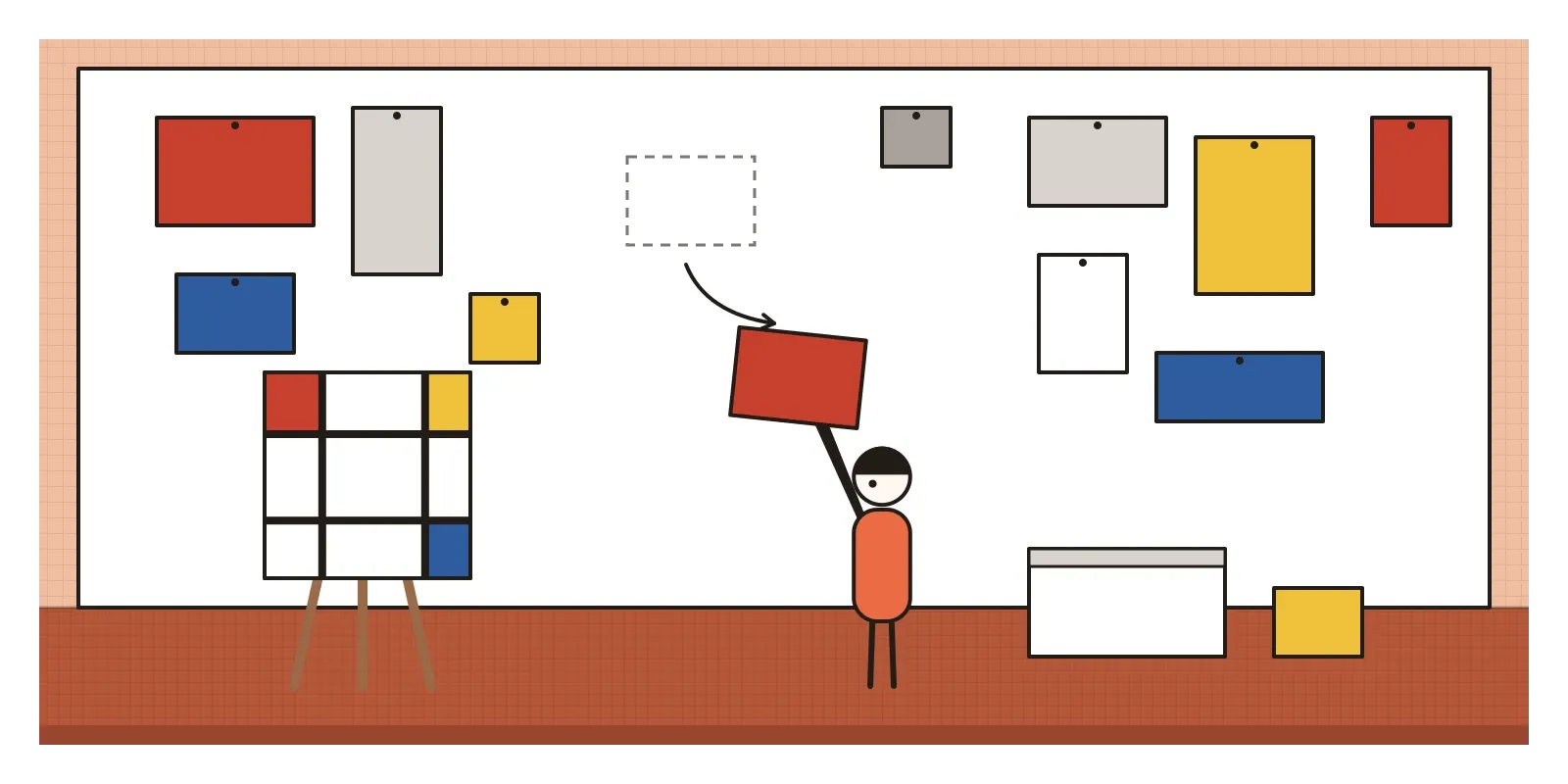
His studio at 26 rue du Départ in Paris was a work of art in itself. He painted the walls white and pinned up rectangles of card painted red, blue, yellow, grey and white, moving them around to rebalance the room as his paintings changed. Visitors described stepping inside one of his canvases.
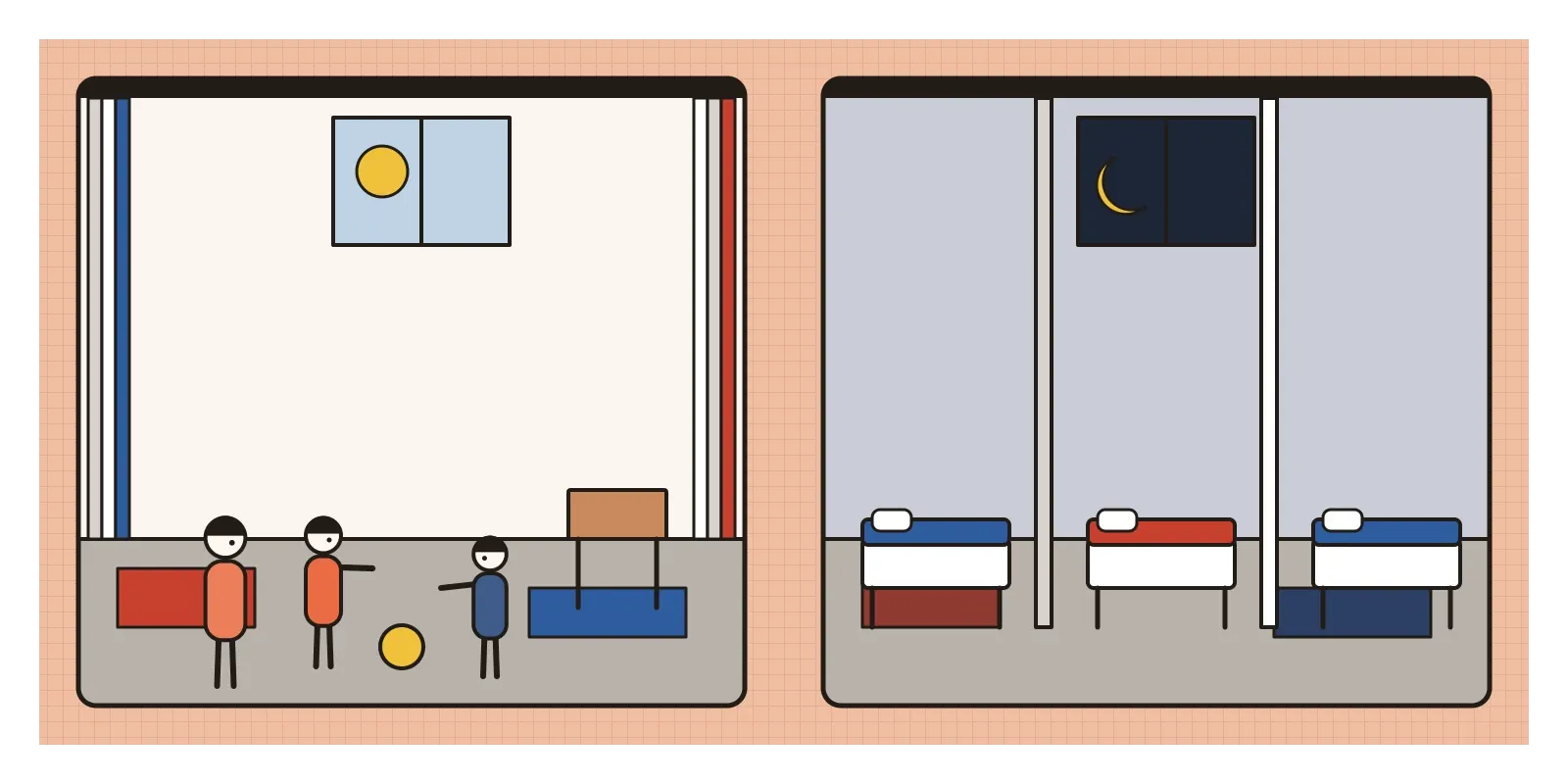
Rietveld turned the ideas into wood. His famous armchair, first made around 1918 and painted a few years later with a red back, a blue seat and a black frame whose cut ends are yellow, is built from standard strips and boards that overlap but never merge, so you can see exactly how each part meets the next. It's a diagram of a chair as much as a seat. In 1924 he designed a small house in Utrecht with Truus Schröder, a widow who wanted a home where she and her three children could live in a new, open way. Its walls are a set of planes and lines in white, grey and primary colours, and on the upper floor sliding partitions let the family open the whole level into one room by day and close it into separate bedrooms at night. A corner window opens so that the corner itself disappears. Schröder lived there for sixty years, and Rietveld spent his last years there too. It's now a World Heritage Site.
Oud took the style onto the street with the Café De Unie in Rotterdam (1925), a narrow façade of coloured planes and lettering squeezed between older buildings. It was destroyed in the bombing of May 1940 and later rebuilt on a nearby site.
Only straight lines allowed
De Stijl is one of the easiest movements to recognise, because its rules were so strict. Lines run only horizontally and vertically. Colour is limited to red, yellow and blue, plus black, white and grey. Shapes are rectangles, never curves. Everything is flat and evenly painted, with no texture, shading or visible brushwork, at least in theory, because Mondrian's canvases, seen up close, show his brush and his many adjustments.
Look at how the parts relate. In a Mondrian, black lines often stop short of the edge or run off it, so the grid feels as if it continues beyond the frame. The large white areas aren't background; they are as carefully weighed as the coloured ones. In Rietveld's furniture and buildings, look for planes that slide past one another, overlapping without touching, and joints that are left visible. Everything is asymmetrical but balanced, held in a kind of tension rather than a mirror image.
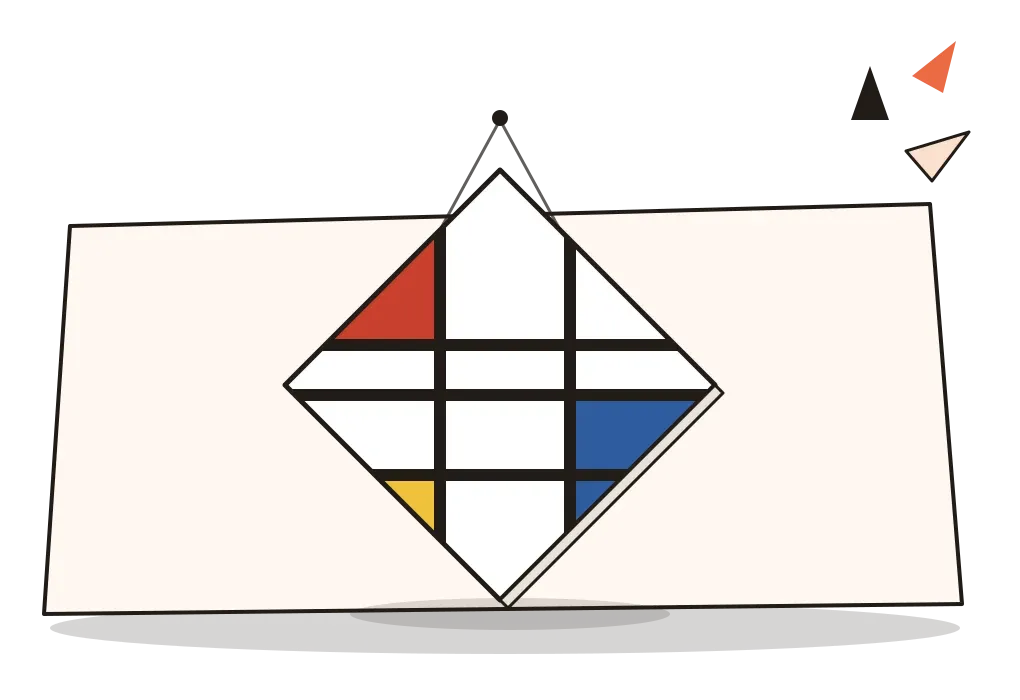
The group's one great argument was about a single angle. Around 1924 van Doesburg began tilting his rectangles at forty-five degrees, calling the new approach Elementarism and saying the diagonal added energy and time. Mondrian thought this betrayed the whole idea, and partly over it he left the group. Yet Mondrian had his own diagonals. From 1918 he painted some canvases turned on their points, as diamonds he called lozenges, while keeping every line inside them strictly horizontal and vertical. The diagonal was allowed in the frame, never in the line.
The grid on a loom
De Stijl's spiritual roots ran partly through Theosophy, whose world headquarters, as I wrote in the post on Symbolism, has been at Adyar in Chennai since 1882. Mondrian never came to India, and nothing suggests De Stijl drew directly on Indian art. So the parallel I want to suggest is a loose one, and it comes from the same city.
Long before Mondrian, weavers in the region around Madras were making cotton cloth in checks of red, blue, yellow and indigo, bands of colour crossing at right angles on a light ground. Traders shipped it across the world. The cloth called madras became a fixture of West African dress, especially in the Niger Delta, and decades later a fashion on American college campuses. Checked lungis and gamchhas are still woven on handlooms all over India.
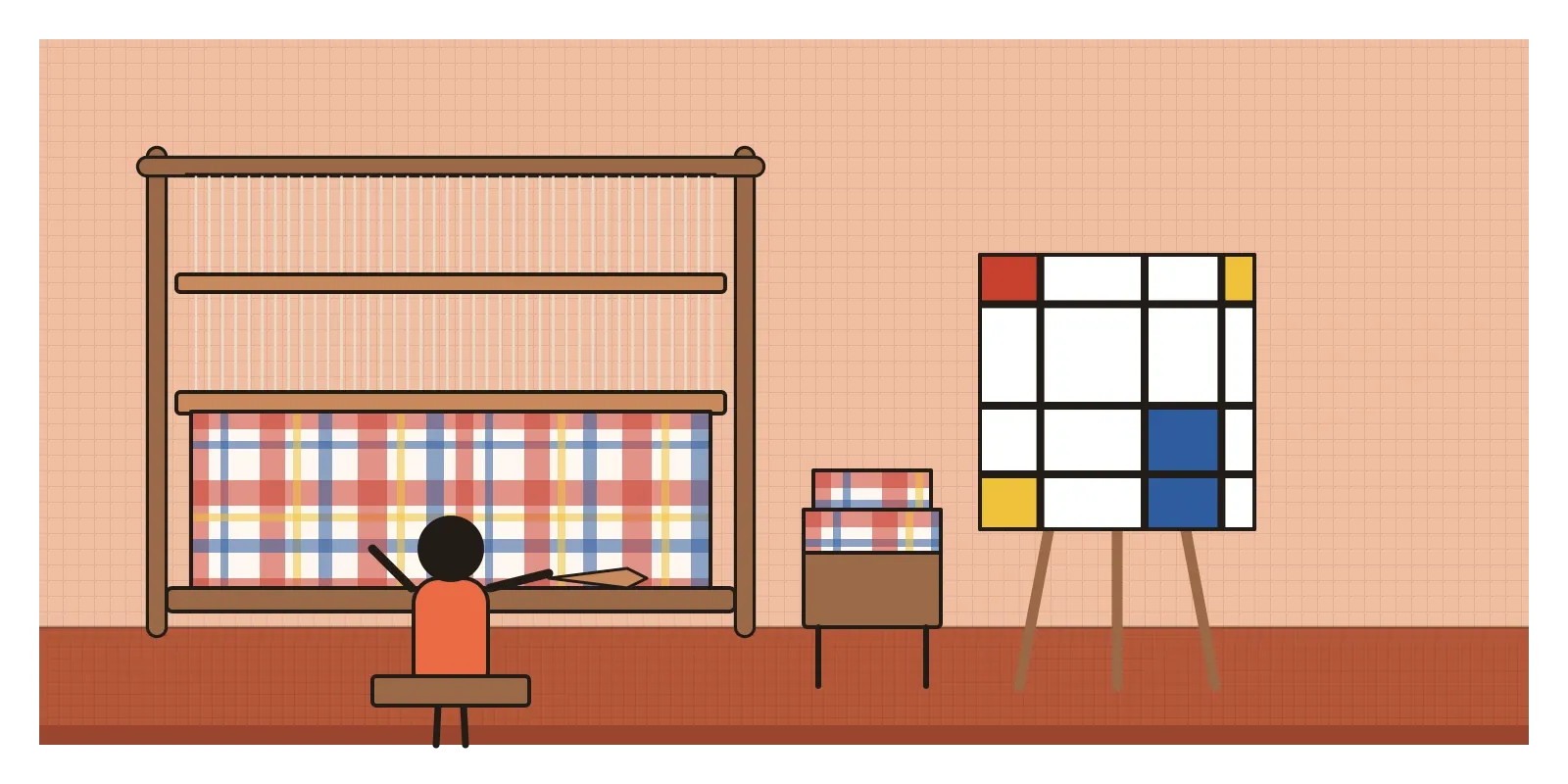
The difference is instructive. Mondrian reached the grid of horizontals and verticals through years of philosophy, as a symbol of cosmic balance. A weaver reaches it through the loom itself, where the warp threads run one way and the weft the other, so every pattern is built from right angles. And a good madras check, like a Mondrian, is often asymmetrical, with bands of different widths that are balanced by eye rather than measured. One grid came from the spirit, the other from the structure of making, and yet they arrive at something very similar. That may be the most down-to-earth argument for De Stijl's claim that these forms are universal.
Grids, tiles and open plans
Every designer who places content on a grid of columns and rows is working in a world De Stijl helped make thinkable. Modern layouts that divide a screen into rectangles of different sizes, from dashboard tiles to the boxy "bento" grids now fashionable on product websites, use the same logic of asymmetrical balance, whether or not their designers have Mondrian in mind. The idea that a page is a field to be divided, not a frame to be filled, owes something to these painters.
Mondrian's paintings became one of the most copied images of the twentieth century. In 1965 Yves Saint Laurent made a collection of shift dresses in his black lines and coloured blocks, and since then the pattern has appeared on everything from cosmetics packaging to trainers. Rietveld's chair is a fixture of design schools, where students rebuild it to understand how a structure can be expressed. And the Schröder house's sliding walls are an ancestor of every open-plan flat where a partition or folding screen turns one room into two, a practical answer to small city homes from Mumbai to Tokyo.
Universal for whom?
De Stijl claimed to have found a universal language, but it was the language of a few Dutch men with a particular mystical philosophy, and it took little interest in how anyone else lived or what they found beautiful. The Aubette's customers simply wanted somewhere comfortable to drink and dance, and they voted with their feet. Rietveld's armchair is famously hard to sit in for long, and his early work served well-off clients willing to experiment. The group was also tiny and quarrelsome. It was really van Doesburg and his magazine, and members came and went as he fell out with them.
Women did crucial work and got little credit. Truus Schröder shaped her house as much as its architect did, yet for decades it was simply Rietveld's. Sophie Taeuber-Arp's rooms at the Aubette were long overshadowed by van Doesburg's hall. Nelly van Doesburg, a pianist, performed at his events and looked after his work and legacy after his death.
The movement ended with van Doesburg, who died in Switzerland in March 1931. A final memorial issue of the magazine appeared the following year. But its ideas had already moved on. Van Doesburg had spent 1921 and 1922 in Weimar, running a private De Stijl course for students of the Bauhaus and criticising the school's mystical crafts teaching, and his visit helped push it towards the machine. Odder still, he had a secret second life as a Dada poet under the name I. K. Bonset, and in 1923 toured Dutch towns with Kurt Schwitters giving Dada evenings, the opposite of everything his magazine preached.
To see De Stijl for yourself, visit the Rietveld Schröder House in Utrecht, run by the Centraal Museum, or the Kunstmuseum in The Hague, which has the world's largest collection of Mondrians. In India, take a closer look at a handloom check: count the bands, notice which are wide and which narrow, and see how the weaver balanced them. For an exercise, draw a square, divide it with five black lines, only horizontal and vertical, and fill three of the spaces with red, yellow and blue. Move a line until the whole feels still. Then turn the sheet into a diamond and see what changes. And think of the dancers at the Aubette in 1928, under ceilings of tilted colour they never asked for, inside a painting that was too far ahead of them. In the next post, on the Bauhaus, I'll follow these ideas to the school where they met the factory.
Further reading: Hans L. C. Jaffé, De Stijl 1917-1931: The Dutch Contribution to Modern Art (1956) · Carel Blotkamp (ed.), De Stijl: The Formative Years, 1917-1922 (1986) · Paul Overy, De Stijl (1991) · Marijke Küper and Ida van Zijl, Gerrit Th. Rietveld: The Complete Works (1992) · Yve-Alain Bois, Painting as Model (1990)
A reply toCubism's broken objects, and the emotional, individual styles of a Europe at war.