
Dada
How artists in wartime Zurich, Berlin and Paris answered the slaughter with nonsense, chance and scissors.
Dada
A bishop made of cardboard
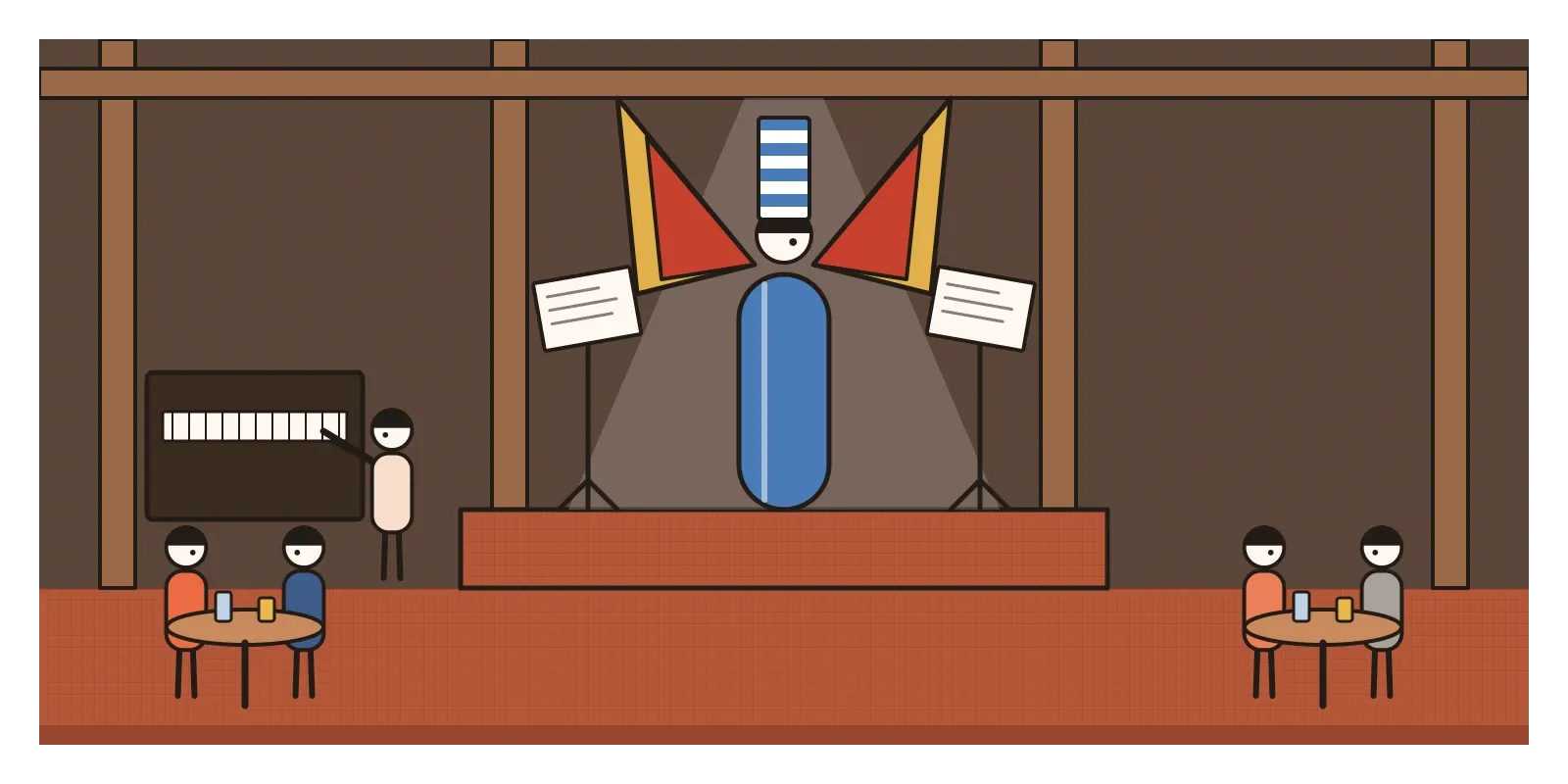
On the evening of 23 June 1916, in a small, smoky back room in Zurich called the Cabaret Voltaire, the lights went down and a man was carried onto the stage. He couldn't walk there himself. His legs were encased in a tall tube of shiny blue cardboard that reached his hips, so that he looked, in his own words, like an obelisk. Around his shoulders stood a huge cardboard collar, scarlet inside and gold outside, which he could flap like wings by moving his elbows, and on his head sat a tall cylindrical hat striped in blue and white. Music stands had been set up on three sides of him, each holding a sheet of paper.
The man was Hugo Ball, a German writer and theatre director who had fled the war to neutral Switzerland. He began to recite poems made of sounds that weren't words in any language, strings of syllables like the noises of a caravan of elephants or a chant in some forgotten tongue. The audience laughed and heckled. Ball later wrote in his diary that, as the reading went on, his voice took on the rise and fall of a priest's lament, and that he felt a kind of terror. When the lights went out, he was carried off the stage dripping with sweat, like a magical bishop.
That night was Dada at its purest. Dada was a loose international movement of writers and artists, born in Zurich in 1916 and spreading to Berlin, Hanover, Cologne, Paris and New York, that attacked art itself. Its members used nonsense, chance, collage, performance and insults to mock the values of a civilisation that had produced the First World War.
Nonsense as the only sane reply
Ball and his partner, the performer and poet Emmy Hennings, opened the Cabaret Voltaire in February 1916 in the back room of a tavern on the Spiegelgasse, a narrow street in Zurich's old town. Zurich was full of refugees, deserters, spies and exiles from the war; Lenin lived a few doors along the same lane. Within days the cabaret had gathered a crowd of young artists: the Romanian poet Tristan Tzara and the Romanian painter Marcel Janco, the German writer Richard Huelsenbeck and the Alsatian artist Hans Arp, who also went by Jean.
What were they replying to? Not one style but the whole idea of polished, serious, rational art. Across the border, the most educated nations in Europe were using engineering, chemistry and patriotic speeches to kill millions of young men in the trenches. If reason and good taste had led to that, the Dadaists argued, then reason and good taste deserved no respect. They also borrowed freely from movements before them: the noise music and provocative evenings of Futurism, and the collages of Cubism, which, as I wrote in the post on Cubism, had already let newspaper and wallpaper into the picture.
The name is a mystery of their own making. "Dada" is French baby talk for a hobby-horse, and in some languages it means "yes, yes". Several members later claimed to have found it, often by sticking a knife into a dictionary at random. Nobody can be sure, which suits a movement that loved chance.
Masks, puppets and a bag of words
Janco made masks for the cabaret from painted cardboard, paper, string and glue, with gaping mouths and flattened, angular features, and the performers found themselves dancing differently when they put them on. Arp made collages of torn paper. The best known, now at the Museum of Modern Art in New York, is usually called Collage with Squares Arranged According to the Laws of Chance. The story goes that, unhappy with a drawing, he tore it up, let the pieces fall to the floor and liked the arrangement they made. The squares in the finished work look rather too tidy for pure accident, and scholars think he adjusted them, but the idea of letting chance share the work was real and new.
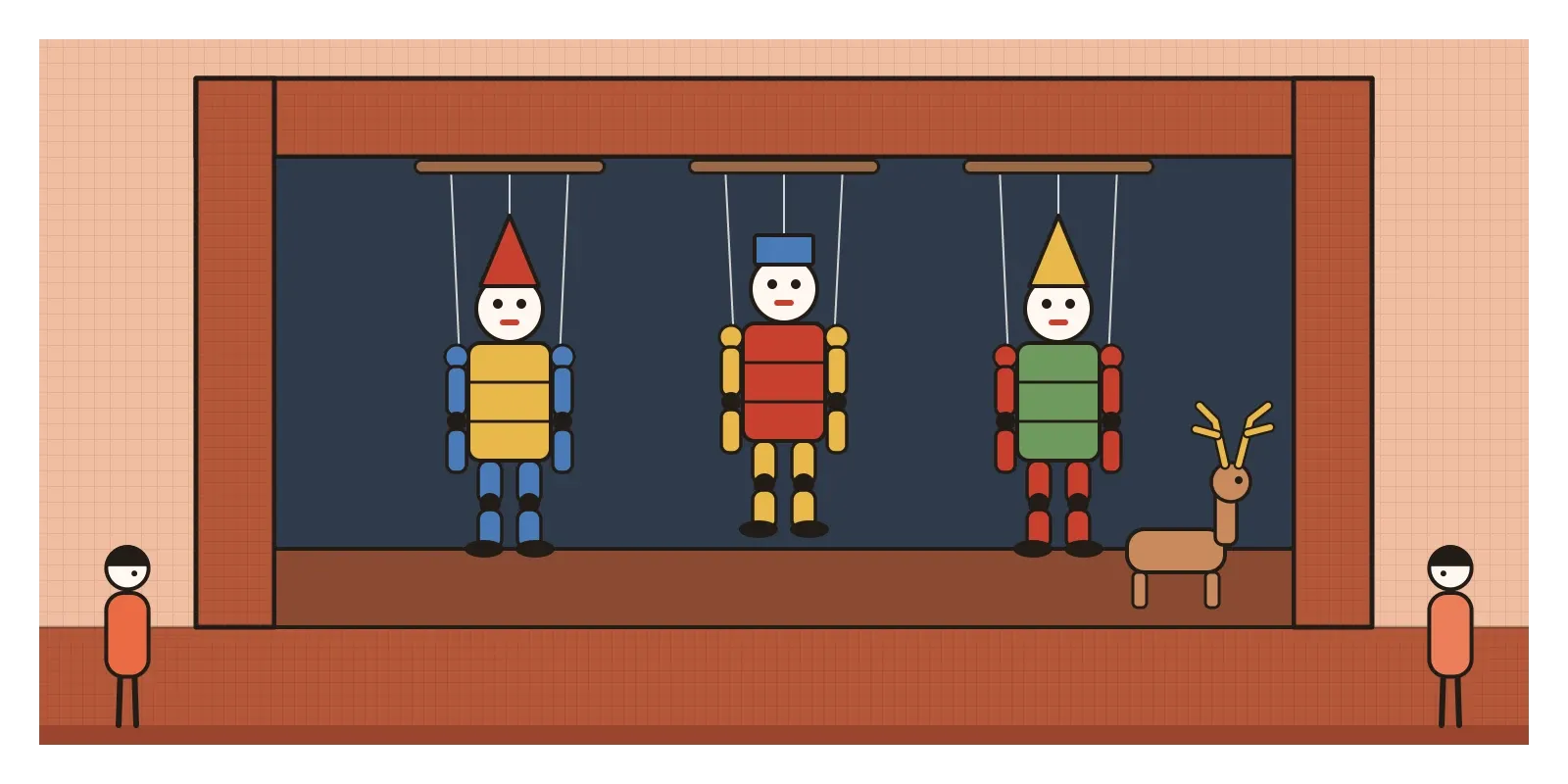
Sophie Taeuber, who later married Arp, danced at the Dada evenings and taught textile design at Zurich's school of applied arts. In 1918 she made a set of marionettes for a production of King Stag, an eighteenth-century fairy-tale play by Carlo Gozzi. They were turned on a lathe from wood and painted in bright, flat colours, with cylinder bodies, cone hats and jointed limbs, half fairy-tale characters and half machines. She also turned wooden "Dada heads" that look like hat stands with faces painted on.
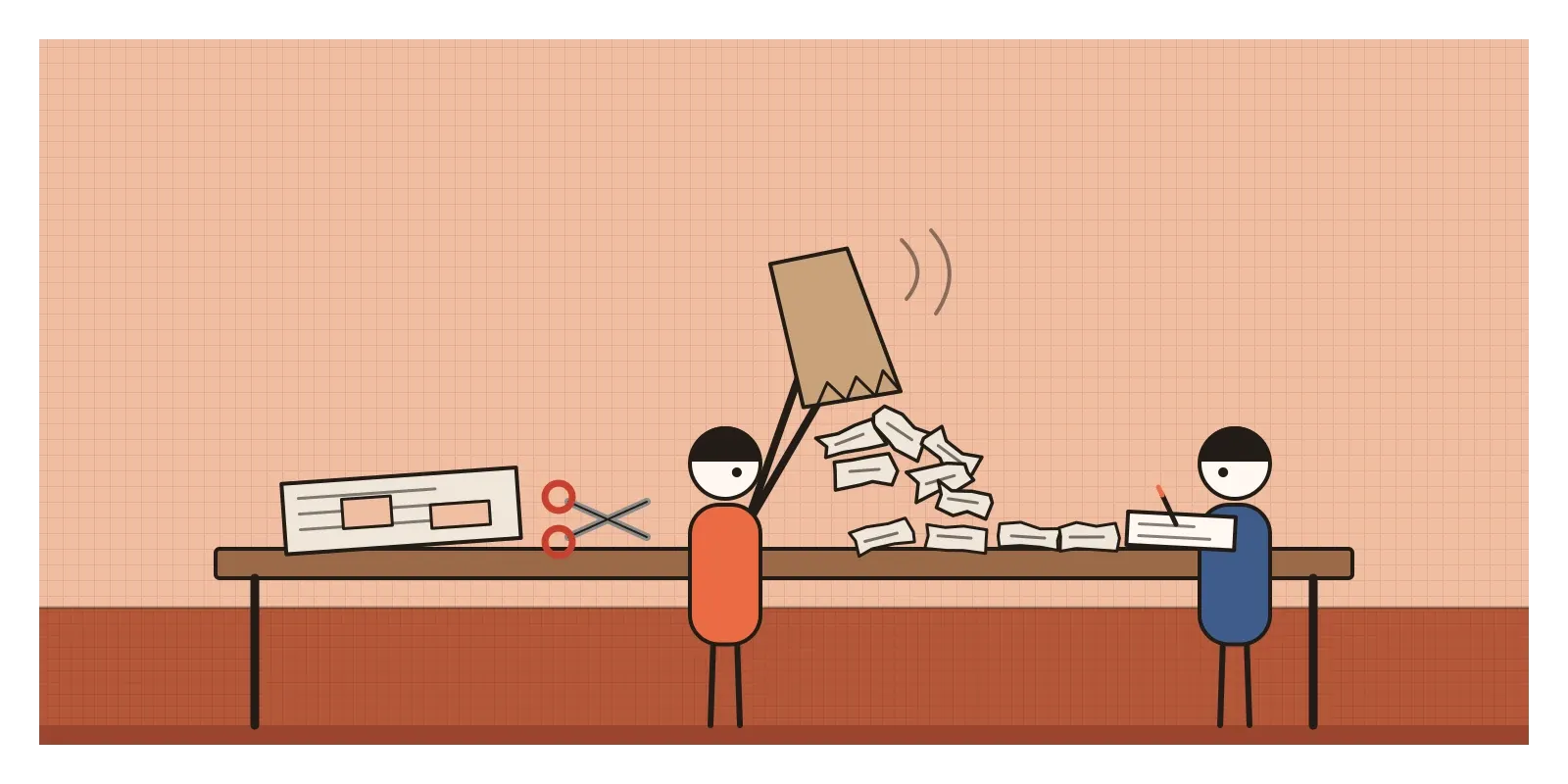
In 1920 Tzara published a recipe for making a Dada poem. In paraphrase: take a newspaper and a pair of scissors, cut out an article, then cut out each of its words and put them in a bag. Shake gently. Take the words out one at a time and copy them down in the order they come. The poem, he promised, will resemble you.
In Berlin, where the war ended in hunger and street fighting, Dada turned political and angry. Hannah Höch cut photographs out of illustrated magazines and glued them into dense, crowded photomontages. Her largest, made in 1919 and 1920, has a title as long as a sentence that begins Cut with the Kitchen Knife, and it's a whirl of politicians, generals, dancers, wheels, gears and crowds, with a small map in one corner showing the countries where women could vote. It hung in the First International Dada Fair in Berlin in the summer of 1920, a crowded show of collages and slogans with a dummy of an army officer wearing a pig's mask hanging from the ceiling. The officer led to a trial and fines for insulting the army. In Hanover, Kurt Schwitters built collages from tram tickets and sweet wrappers and called his art Merz, a scrap of the word for commerce cut from a bank advertisement. In Paris, Marcel Duchamp took a cheap postcard of the Mona Lisa, drew a moustache and a small beard on her face and added five capital letters that, read aloud in French, make a crude joke about her. Duchamp's urinal, which I wrote about in the post on design, art and craft, belongs to the same mischievous spirit.
Torn paper and shouting type
Dada doesn't have one look, but it does have habits you can learn to spot. The first is collage and its photographic cousin, photomontage: images built from fragments of other images, cut out and glued with the seams left showing. Scale jumps wildly, so a head can be the size of a factory, and pictures often seem to explode outwards from the centre.
The second is chance. Torn edges instead of cut ones, words drawn from a bag, objects found rather than made. The third is the readymade, an ordinary manufactured thing, a bottle rack, a postcard, a hairdresser's dummy, given a title and put in an exhibition, or assembled into strange new creatures. Raoul Hausmann's Mechanical Head is a wooden dummy's head with a tape measure, a wallet, a ruler and other bits of junk fixed to it, a portrait of a man with no thoughts of his own.
The fourth is typography. Dada journals and posters mixed typefaces of every size and weight on the same page, set lines upside down and sideways, scattered letters and printed over pictures. To a reader used to calm, centred pages it looked like shouting. The fifth is performance: masks, costumes, sound poems, several people reading different poems at once, and evenings designed to make the audience angry.
A duck crossed with a porcupine
India had no Dada movement, and I don't want to invent one. But in Calcutta, in the same years, a writer was making nonsense of a very different kind. Sukumar Ray, born in 1887, came from a family of printers and writers. His father, Upendrakishore Ray, founded the children's magazine Sandesh and ran a fine printing business, and Sukumar studied photography and printing technology in England before taking both over. His son was the film-maker Satyajit Ray, whose notebooks I wrote about in the post on sketching as thinking. In the 1900s Sukumar also started a literary circle of friends called the Monday Club, whose meetings were as much about food and jokes as literature.
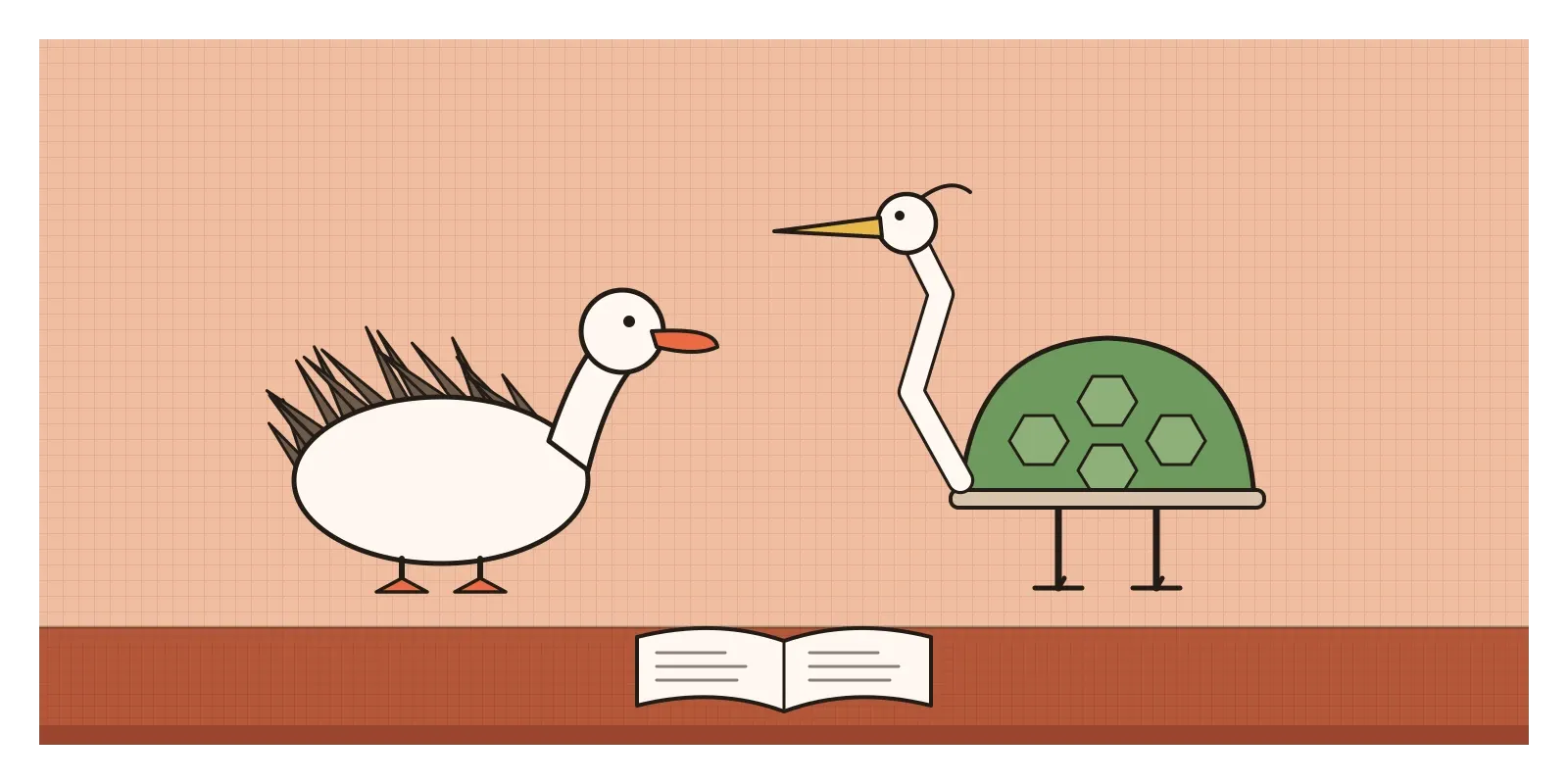
His great book of nonsense verse, Abol Tabol, was published in 1923, days after he died of a fever at thirty-five. In one of its best-known poems, animals have been joined together like words: a duck fused with a porcupine, a heron fused with a tortoise, each glumly unsure what it is. Ray drew the pictures himself, in clean, deadpan pen lines, and his creatures are as odd as anything from a Dada collage.
The parallel is loose. Ray's nonsense grew from Bengali children's rhymes and the English tradition of Edward Lear and Lewis Carroll, not from the trenches, and its spirit is affectionate rather than furious. Yet both treat language and images as things you can cut apart and recombine, and both use absurdity to tease the self-important, Ray's pompous officials and pundits standing in for the generals the Dadaists mocked.
Cut-ups, zines and remix culture
Dada taught design that any image can be raw material for another. Every collage, every poster made from cut-out photographs, every meme that places a politician's face on a cartoon body is a descendant of Berlin photomontage. Punk took the look directly: the ransom-note lettering of 1970s record sleeves and photocopied fanzines, letters cut from different newspapers and glued in a wobbly line, is Dada typography reborn on a photocopier.
Its use of chance runs through later art too. The composer John Cage used coin tosses to make music, and the Fluxus artists of the 1960s staged events as absurd as anything at the Cabaret Voltaire. Designers still borrow the trick in workshops, when a random word or image is used to break a team out of its first, obvious ideas. And it's hard to look at Tzara's bag of newspaper words without thinking of today's text generators, which also recombine fragments of existing writing. The difference is that Tzara wanted nonsense, and he wanted you to notice it.
Perhaps Dada's most useful lesson for designers is attitude. It asked who decides what counts as art, as good taste, as a proper way to use an object, and it showed that breaking a convention on purpose can make people see it for the first time.
Anti-art in a gilt frame
Dada's trouble was that it couldn't stay against everything for long. Mockery needs something to mock, and once the war ended the movement's energy turned inwards. In Paris, quarrels between Tzara and the poet André Breton split the group, and an evening in July 1923 ended in a fist fight on stage. Breton went on to found Surrealism, which has its own post later in this section, and which tried to turn Dada's chaos into a method for exploring the mind.
Its equality was patchy. Höch later recalled that her Berlin colleagues were slow to take a woman seriously, and George Grosz and John Heartfield reportedly opposed showing her work at the Dada Fair until Hausmann insisted. Emmy Hennings, who co-founded the cabaret and was one of its main performers, is remembered far less than Ball. In New York the poet and artist Elsa von Freytag-Loringhoven, who walked the streets in costumes of tin cans and postage stamps, was treated as a curiosity, and a few historians have argued, against strong disagreement, that she had a hand in Duchamp's urinal.
And then there's the final irony. A movement that set out to destroy art is now art. Its torn papers and postcards hang in gilt-framed calm in the world's great museums and sell for millions. Dada predicted this too, perhaps. Its members always said that Dada was against Dada as well.
To see it for yourself, visit the Cabaret Voltaire, which still runs as an arts venue at Spiegelgasse 1 in Zurich, or look up Taeuber-Arp's puppets, now in the Museum für Gestaltung in Zurich. In India, read Abol Tabol in Bengali if you can, or in Sukanta Chaudhuri's English translations, and look closely at Ray's drawings. For an exercise, follow Tzara's recipe with a page of today's news, or build a photomontage from old magazines in fifteen minutes, without planning. Then picture Ball, sweating inside his cardboard tube while the room laughed, chanting syllables that meant nothing at a world that had stopped making sense. In the next post, on De Stijl, I'll turn to artists in neutral Holland who answered the same war with the opposite: perfect order.
Further reading: Hugo Ball, Flight Out of Time: A Dada Diary (1927, English translation 1974) · Hans Richter, Dada: Art and Anti-Art (1965) · Leah Dickerman (ed.), Dada (2005) · Maud Lavin, Cut with the Kitchen Knife: The Weimar Photomontages of Hannah Höch (1993) · Sukumar Ray, The Select Nonsense of Sukumar Ray (translated by Sukanta Chaudhuri, 1987)
A reply toThe reason, patriotism and polished good taste of a Europe that had marched into the First World War.