Cubism
How two painters in Paris broke objects into planes, glued wallpaper to drawings and changed what a picture could be.
Cubism
A roll of fake oak in a shop window
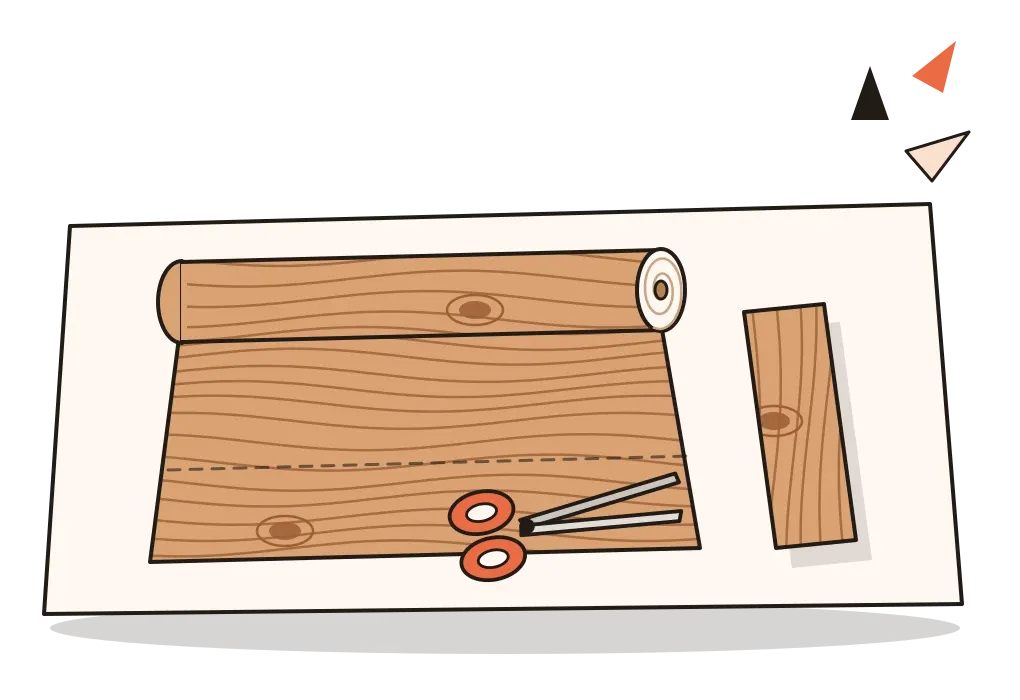
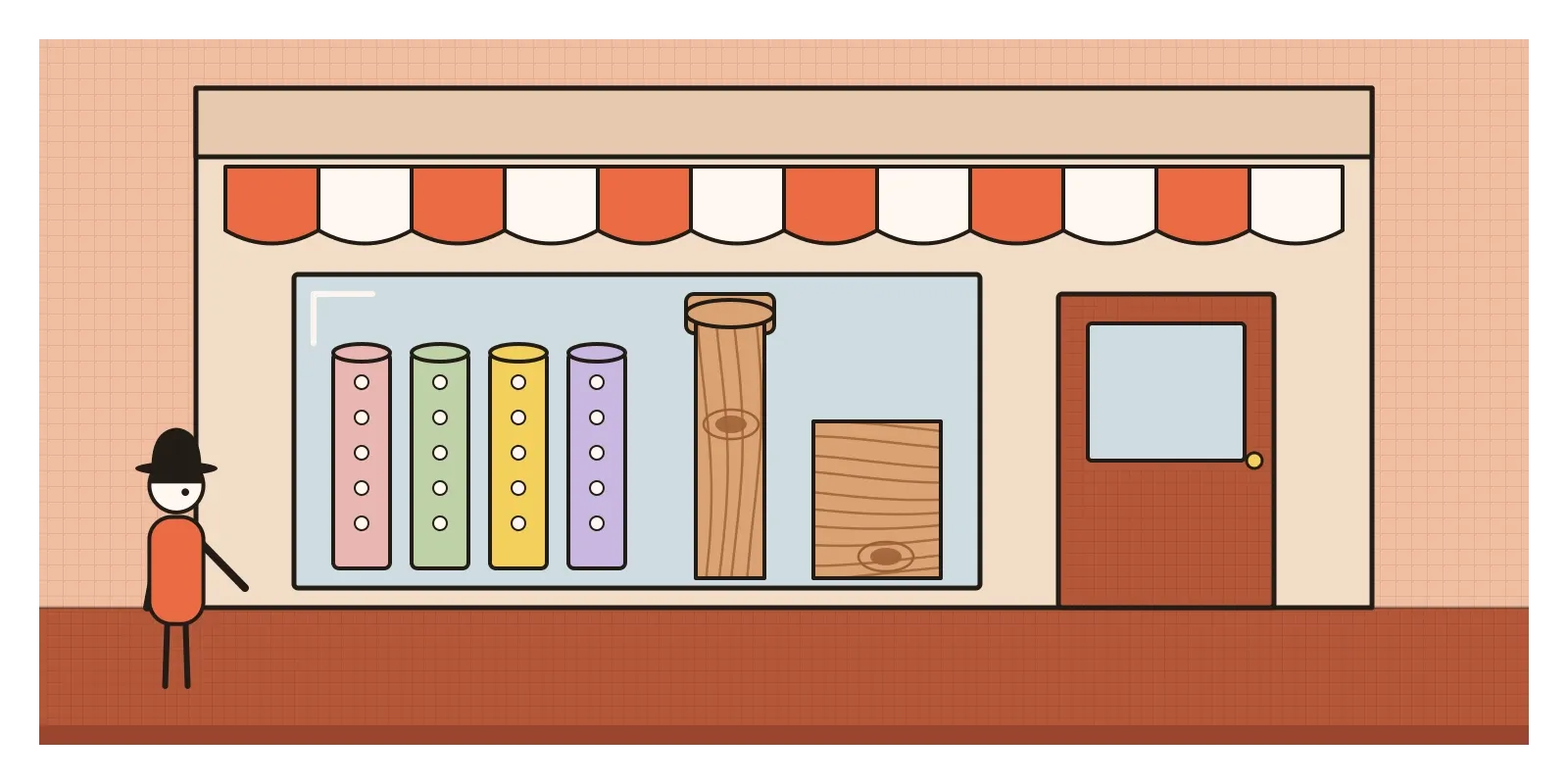
In the summer of 1912, Georges Braque and Pablo Picasso were both working in Sorgues, a small town near Avignon in the south of France. Early that September, Picasso went back to Paris for a few days. While he was away, Braque was walking through Avignon when he noticed something in a shop window: a roll of wallpaper printed to look like oak panelling, complete with knots and wavy grain. He had seen it before and, according to the story he told later, waited until Picasso had left before buying it, because he wanted to try something first.
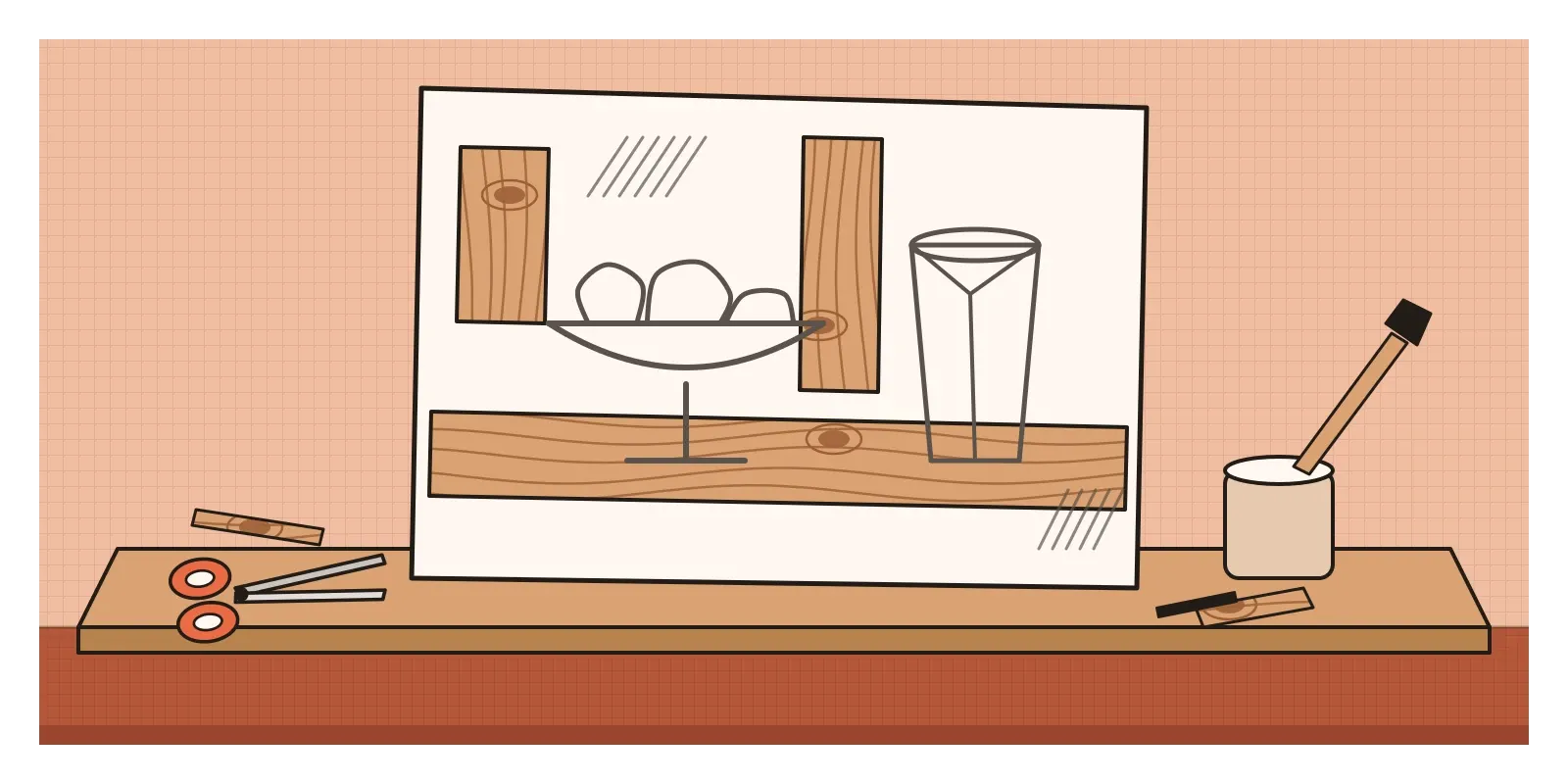
Back in his studio, Braque made a charcoal drawing of a fruit dish and a glass, then cut strips from the fake-oak paper and pasted them onto the sheet. The strips sit flat on the drawing, standing for a wooden table or wall panelling, while the charcoal lines run over and around them. It is now called Fruit Dish and Glass, and it's usually counted as the first papier collé, French for pasted paper. The choice wasn't random. Braque's father ran a house-painting and decorating business, and Braque had trained as a decorator, learning to paint fake wood and marble with steel combs. He knew better than anyone that a surface could pretend to be something it wasn't.
That small act of glueing printed paper onto art was one step in a revolution that Braque and Picasso had been running together for four years. Cubism is the name for the way of painting they invented in Paris from around 1907, in which objects are broken into flat, angular planes and shown from several points of view at once, and pictures are later rebuilt from flat shapes, letters and pieces of the real world. Historians usually split it into an early "analytic" phase, roughly 1909 to 1912, and a later "synthetic" one from 1912, labels that came afterwards and that the painters never used. Cubism changed painting more than any movement since the Renaissance, and its effects ran on into sculpture, architecture, posters and design.
One eye, one moment, one window
Since the Renaissance, most European painting had been built on linear perspective, the system I described in the post on perspective drawing. A painting was a window: a view of the world from one fixed eye at one moment, with lines running to a vanishing point. The Impressionists had loosened the brushwork and brightened the colour, but they kept the window. The Fauves, in the post before last, had freed colour from nature. Nobody had yet attacked the window itself.
The attack came from two directions. The first was Paul Cézanne, who died in 1906 and whose work was shown in a large memorial exhibition in Paris the following year. In the post on Post-Impressionism I wrote about how his apples seem to slide off tilted tables, and in the post on form about his advice to treat nature through the cylinder, the sphere and the cone. Cézanne had quietly combined slightly different viewpoints in one painting, and the young painters noticed. The second was sculpture from Africa and the Pacific, which many Paris artists were seeing for the first time in the ethnographic museum at the Trocadéro and in junk shops, and which represented faces and bodies through bold, simplified planes instead of imitation.
Two climbers roped together
The first shock was Picasso's. In 1907, in his ramshackle studio building in Montmartre known as the Bateau-Lavoir, he painted a huge canvas of five nude women in a brothel, now known as Les Demoiselles d'Avignon. Their bodies are hacked into sharp angular shapes, the space around them is shattered like broken glass, and two of the faces look like masks. A small still life of fruit sits at the bottom edge. His friends were horrified, and Braque is said to have compared it to being made to drink paraffin. Picasso kept it rolled up in his studio, and it wasn't publicly exhibited until 1916.
Braque's reply came the next summer. At L'Estaque near Marseille, the coast where Cézanne had painted, he made landscapes in which houses become ochre blocks stacked up a hillside, with trees reduced to a few green curves and almost no sky. When the jury of the Salon d'Automne rejected them in 1908, the dealer Daniel-Henry Kahnweiler, a young German who had opened a small gallery in Paris the year before, showed them himself that November. The critic Louis Vauxcelles, who had already named the Fauves, wrote that Braque reduced everything to cubes, and the name stuck.
For the next six years, Braque and Picasso worked so closely, visiting each other's studios almost daily, that Braque later compared them to two mountaineers roped together. Their paintings of 1910 and 1911 can be genuinely hard to tell apart. In works like Braque's Violin and Palette (1909) and Picasso's portrait of Kahnweiler (1910), the subject dissolves into a shimmering scaffold of small, overlapping planes in browns, greys and ochres, so that a violin's scroll, a sitter's clasped hands or the curl of a moustache surface only here and there. Braque even painted a realistic nail with a shadow at the top of Violin and Palette, as if to prove he could still do illusion. Then they started adding stencilled letters, and in May 1912 Picasso glued a piece of printed oilcloth imitating chair caning onto an oval canvas and framed it with real rope. Braque's wallpaper followed that September.
Cubism quickly became much bigger than its inventors. At the Salon des Indépendants of 1911, a group including Albert Gleizes, Jean Metzinger, Fernand Léger and Robert Delaunay hung their work together in Room 41 and caused a public scandal. Gleizes and Metzinger wrote the first book on the movement in 1912. The Spanish painter Juan Gris made Cubism clearer and more colourful, building his still lifes on careful geometric grids. In 1913, Marcel Duchamp's Nude Descending a Staircase, a figure fractured into a cascade of brown planes, became the scandal of the Armory Show in New York. And in Prague, architects turned the style into buildings. Josef Gočár's House of the Black Madonna, completed in 1912 as a department store, has a facade folded into crystal-like facets, and Prague still has a Cubist lamp post near Jungmann Square.
Reading a fractured guitar
The first thing to look for is facets. Analytic Cubist paintings are built from small, flat, angular planes, each shaded slightly darker on one edge and lighter on another, so the surface seems to tilt in and out like a cut crystal. The planes often slide into each other without a clear edge, a device painters call passage, which lets the object and the space around it merge. The colours are restricted to browns, greys, ochres and greens, so colour doesn't distract from structure.
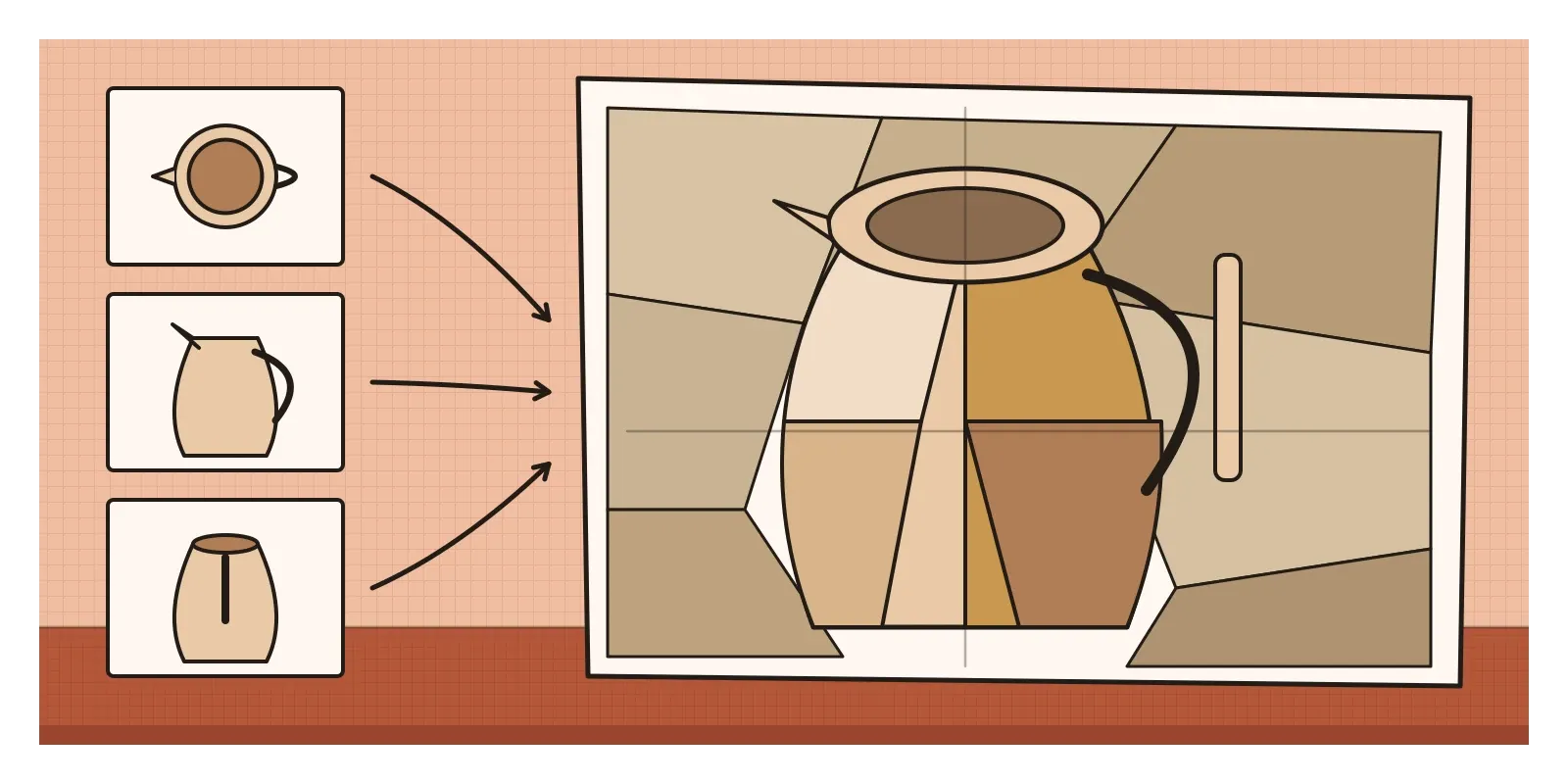
The second thing is multiple viewpoints. A jug might show its round mouth from above, its profile from the side and its handle from the front, all at once. A face can be seen in profile and full-on simultaneously. The picture isn't a window anymore. It's a summary of what you know about an object after walking around it. Underneath, there's usually a loose grid of verticals and horizontals holding everything together, which is why so many Cubist paintings feel stable even while they look broken.
Synthetic Cubism adds a third layer. Here the picture is assembled rather than analysed, from large flat shapes, brighter colours, stencilled or printed letters, pasted newspaper, wallpaper, sheet music and cigarette papers. Real materials stand for themselves and for something else at the same time. A strip of newspaper can be a newspaper on a café table and also simply a grey shape in the composition. That double reading, flat shape and object at once, is something graphic designers have relied on ever since.
An Indian Cubist
Cubism's most striking Indian echo came from inside the Tagore family house at Jorasanko in Calcutta. Gaganendranath Tagore, elder brother of Abanindranath, whose Bengal School is the subject of an earlier post in this series, was already known for sharp, funny caricatures of Calcutta society. Around 1920 he began painting something quite different: interiors, staircases, doorways and dream cities made of overlapping, prismatic planes of light and colour, often in deep blues and violets broken by shafts of white and gold, with tiny figures moving through them.
In 1922, the Austrian art historian Stella Kramrisch, who had just come to teach at Santiniketan, published an essay about him in the Calcutta journal Rupam under the title "An Indian Cubist". That year his work also hung in Calcutta beside paintings sent from the German Bauhaus, a story for the post on the Bauhaus.
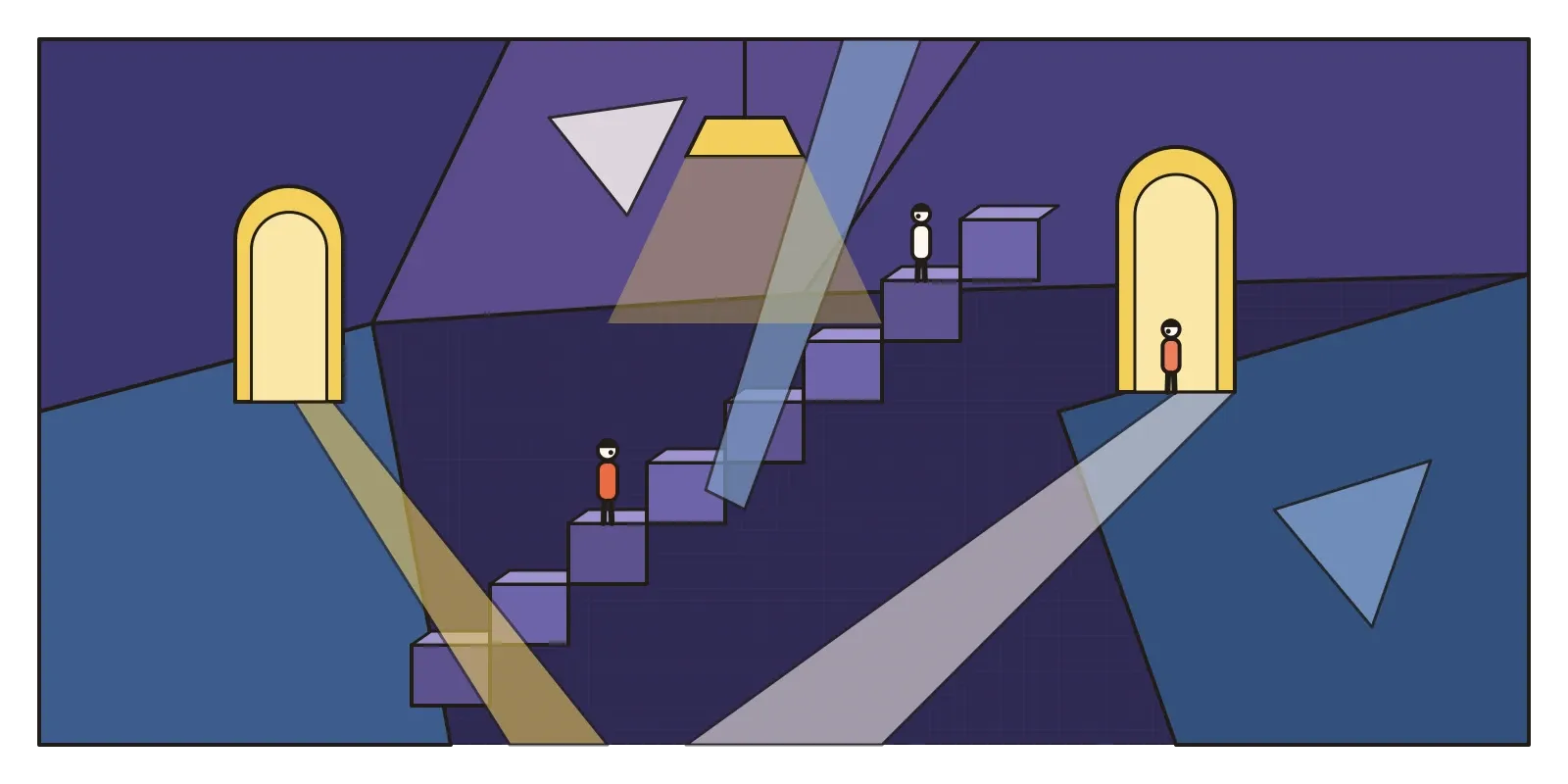
It would be wrong to call Gaganendranath a follower of Braque and Picasso. As far as we know, he saw Cubist work mainly in reproduction, and he wasn't interested in taking a guitar apart to study its structure. He borrowed the fractured plane and used it for mystery and light, much closer in feeling to the lit stage sets of the theatre performed at his family home than to a Paris still life. The historian Partha Mitter has argued that this selective borrowing was itself a modern move, an artist taking from Europe only what served his own imagination. A stroke around 1930 left him paralysed and ended his painting, which makes his Cubist years a brief, brilliant episode.
From camouflage to collage
Cubism's oddest design legacy is military. In 1915 the French army set up a camouflage unit led by the painter Lucien-Victor Guirand de Scévola, who said later that he had used the methods of Cubism to break up the outlines of guns and vehicles. Gertrude Stein recalled walking with Picasso in Paris early in the war, when a camouflaged truck went by and he exclaimed that it was they, the Cubists, who had made that.
The more everyday legacy is collage. Braque's wallpaper and Picasso's oilcloth made it normal to build an image from found, printed and photographed fragments, and that habit passed to the Dadaists, to photomontage, to album covers and magazine layouts, and finally into the layers panel of every image editor. The mood boards I wrote about in an earlier post are Cubist collages with a practical purpose. Cubism also made it acceptable for a picture to be openly flat and built of shapes, which freed poster designers and illustrators.
There's a lesson about representation too. Product designers routinely show an object as a set of views, front, side, top and exploded, because no single view tells the whole truth. Cubism tried to cram that understanding into one image. It's a useful reminder when designing icons and illustrations: the clearest picture of a thing isn't always the most realistic one.
Whose masks?
Cubism's critics start with the masks in Les Demoiselles d'Avignon. Picasso and his friends treated African and Pacific sculpture as raw material, admiring it as "primitive" while knowing almost nothing about who made it, what it meant or how it had reached Paris. Many of those objects came through France's colonial empire, sometimes taken by force, and the debate over returning them is still going on. In 1984, the Museum of Modern Art in New York staged an exhibition on "primitivism" in modern art that was fiercely criticised for showing African objects only as sources for European genius. The painting itself has a second problem: it presents women's bodies as a field for a male painter's experiment, and the women of Cubism, such as the Spanish painter María Blanchard, are still far less known than the men.
The movement was also a private affair. Kahnweiler kept Braque and Picasso out of the public Salons, so their key works were seen mainly by collectors and friends. Then the war broke it apart. Braque was badly wounded in the head in 1915, Kahnweiler, as a German, had his stock seized by the French state and later auctioned, and the roped partnership never resumed. In 1918 the painter Amédée Ozenfant and the architect Charles-Édouard Jeanneret, later known as Le Corbusier, published After Cubism, arguing that it had become decorative and calling for a cleaner, more ordered art they called Purism.
To see it this week, look for Gaganendranath's paintings in the Rabindra Bharati Museum at the Tagore house in Jorasanko, Kolkata, or the National Gallery of Modern Art in Delhi, where his prismatic interiors make an interesting contrast with his brother's softer wash paintings. Then try two small exercises. Draw a cup three times, from above, from the side and from the front, and then combine all three into one drawing. And make your own papier collé: a quick charcoal still life with one strip of printed paper, wrapping paper, a newspaper or a fake-wood offcut, glued where a table should be. You'll find, as Braque did in 1912, that a cheap printed surface pretending to be oak can make a drawing feel more real, not less. In the next post, on Futurism, the fractured planes start to move.
Further reading: John Golding, Cubism: A History and an Analysis, 1907-1914 (1959) · William Rubin, Picasso and Braque: Pioneering Cubism (1989) · John Richardson, A Life of Picasso, Volume II: 1907-1917 (1996) · Christopher Green, Cubism and Its Enemies (1987) · Partha Mitter, The Triumph of Modernism: India's Artists and the Avant-Garde, 1922-1947 (2007)
A reply toThe single fixed viewpoint of Renaissance perspective, still intact under Impressionism's shimmering surfaces.