
Conceptual Art
How artists in the 1960s and 1970s made the idea the artwork, and the object an optional extra.
Conceptual Art
Paintings into cookies
On 24 July 1970, the Californian artist John Baldessari loaded up the paintings he still owned, landscapes and abstractions he had made between May 1953 and March 1966, and took them to a mortuary in San Diego to be cremated. It wasn't easy to arrange. By his own account several mortuaries turned him down, and the one that agreed insisted on doing it at night. The ashes went into an urn, which was set beside a bronze plaque giving his name and the two dates like the birth and death of a person. Some of the ashes were baked into cookies. Photographs of the whole process, the urn, the plaque and a recipe became a single work, The Cremation Project.
Baldessari was not having a breakdown. He was nearly forty, his studio was full of paintings nobody wanted to buy, and he had decided that what he cared about was no longer how a picture looked but what it meant to make one. Burning the old work was a way of announcing that. A year later he was invited to show at an art school in Nova Scotia but couldn't go, so he sent an instruction instead: students wrote one sentence over and over across the gallery walls, like a punishment at school, promising that he would not make any more boring art. He didn't have to be there. The idea was enough.
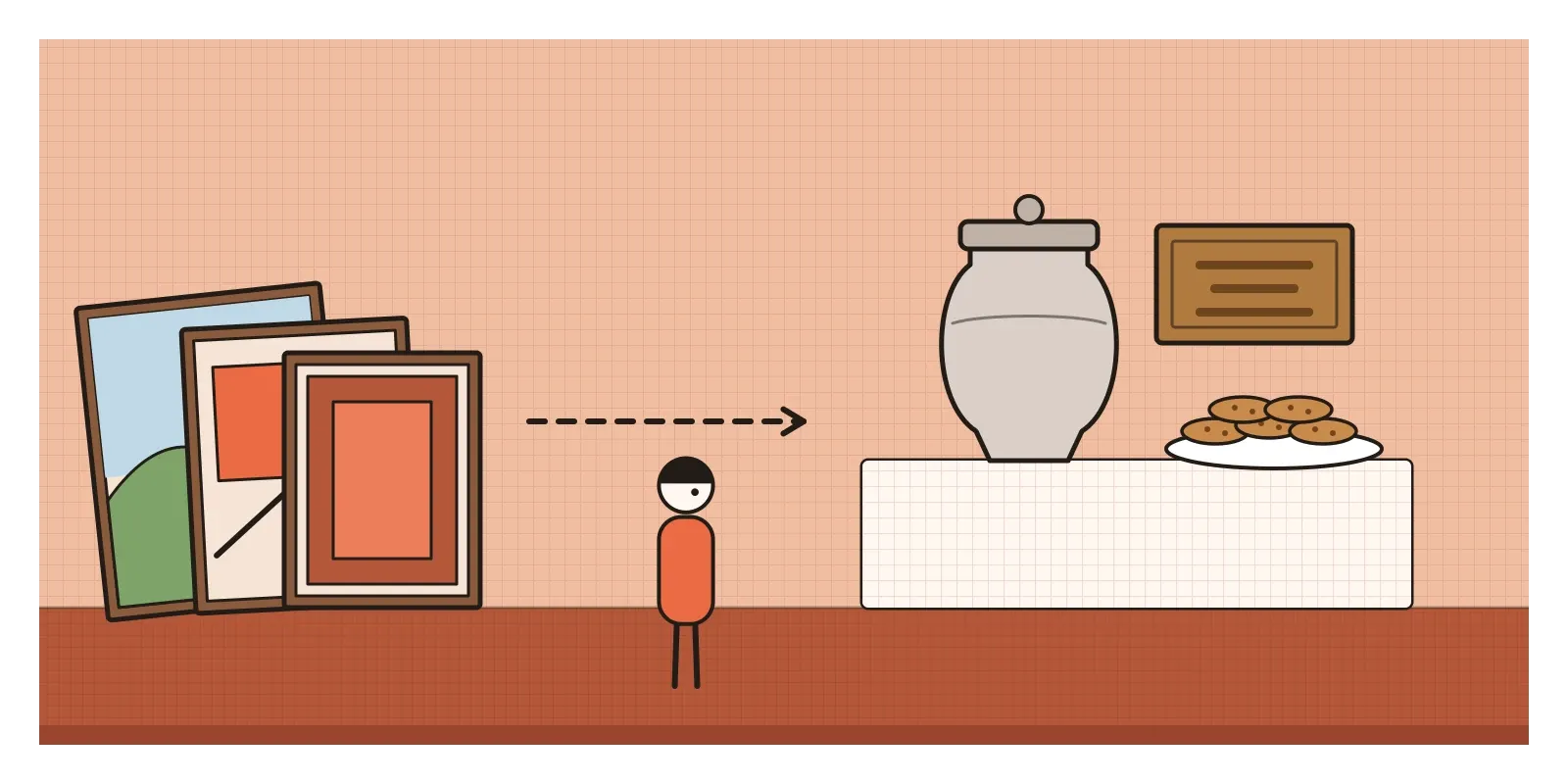
That is conceptual art in one gesture. It's the name for art, from the mid-1960s onwards, in which the idea is the main work and the physical form, if there is one, is secondary. The work might be a set of instructions, a typed statement, a photograph, a map, a receipt, a book, an action or a question. Some conceptual works can be carried out by anyone. Some don't need to be carried out at all.
After the bricks, the idea
Conceptual art grew up in the same New York studios as Minimalism, which I wrote about two posts ago, and it pushed Minimalism's logic to the end. If a work could be a plain box made in a factory to the artist's plan, why did the box matter at all? Why not just the plan? It was also a reply to the art market of the 1960s, booming on the back of Abstract Expressionism and Pop, where paintings had become expensive things to own, trade and hang over sofas. Making art out of ideas, words and actions was partly a way of making something that was hard to buy.
The idea had a long fuse. In 1917 Marcel Duchamp had sent a factory-made urinal to an exhibition and called it art, the story I told in the posts on Dada and on design, art and craft. In 1953 the young Robert Rauschenberg asked Willem de Kooning, the most admired painter in New York, for a drawing so that he could erase it. De Kooning, reluctantly, gave him one he'd be sorry to lose, drawn in crayon, charcoal and pencil so it would be hard to rub out. Rauschenberg spent weeks erasing it, framed the faint remains and had Jasper Johns letter a label: Erased de Kooning Drawing. In Paris around 1959, Yves Klein began selling what he called zones of immaterial pictorial sensibility, empty space, in exchange for gold. If the buyer burned the receipt, Klein threw half the gold into the Seine, so that nothing material was left of the sale.

The 1960s supplied the tools and the mood. Photocopiers, cheap offset printing, typewriters and the post made it easy to produce and send words and images without a studio or a gallery. Protest against the war in Vietnam made many young artists distrust museums, collectors and the companies whose money flowed through both. In 1968 the critic Lucy Lippard and the artist John Chandler gave the change a name in an essay called "The Dematerialization of Art". Art, they argued, was becoming less and less of a thing.
Instructions, chairs and a book that was the show
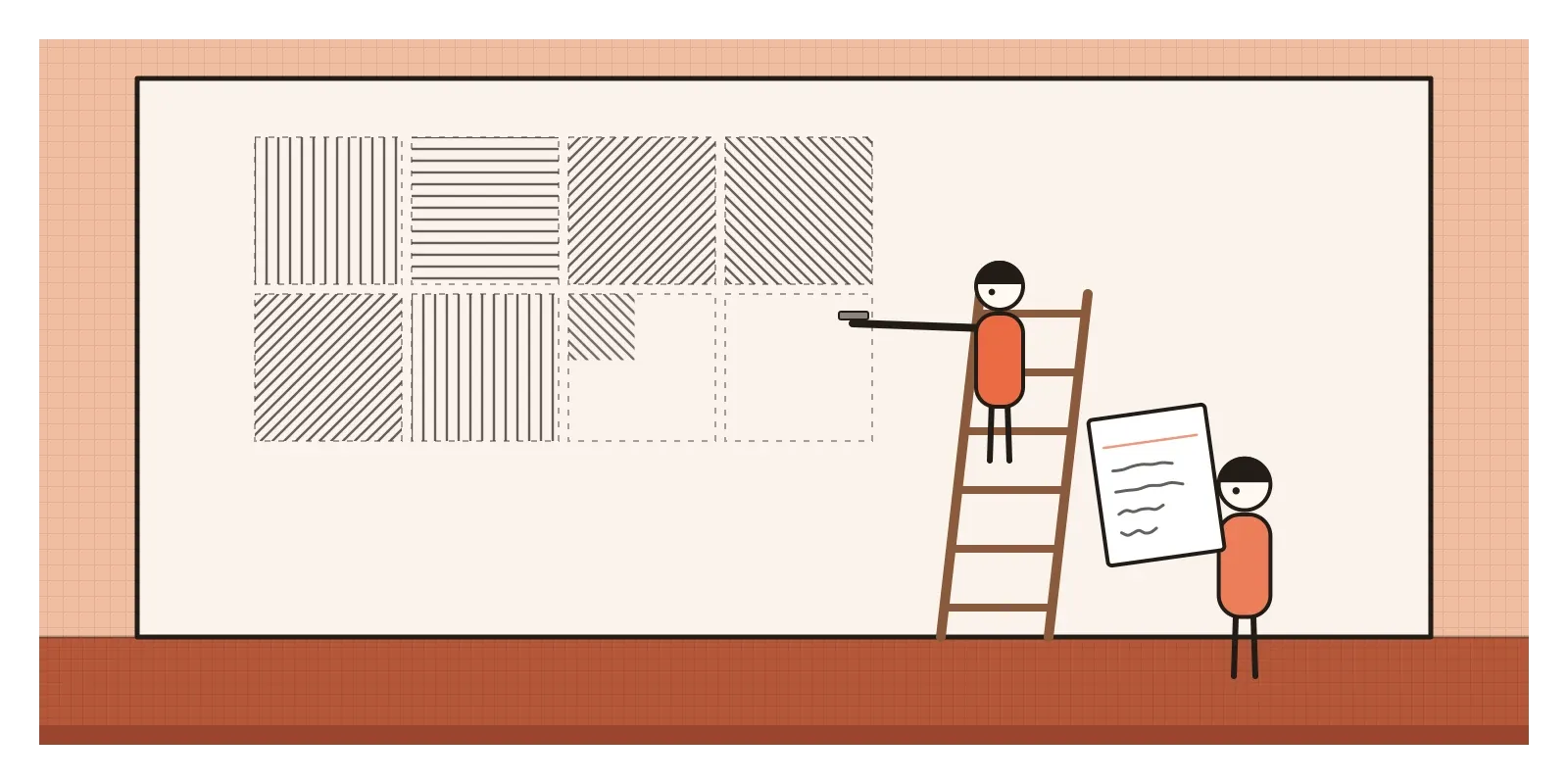
Sol LeWitt did more than anyone to name the movement and give it a motto. In "Paragraphs on Conceptual Art", published in Artforum in 1967, he argued that in conceptual art the planning and decisions all come first, and carrying them out is almost a formality. The idea, he wrote, becomes a machine that makes the art. He meant it literally. From 1968 he made wall drawings that existed as written instructions and diagrams, such as lines in four directions or arcs from the corners and sides, carried out directly on a gallery wall by assistants and later by anyone with the certificate and the skill. When the show ended, the wall was painted over. The drawing could be made again, somewhere else, by someone else.
Joseph Kosuth, in his early twenties, made One and Three Chairs in 1965: a plain wooden folding chair, a life-size photograph of the same chair, and an enlarged dictionary definition of the word, side by side on the wall. Which one is the chair? In his essay "Art after Philosophy" (1969), he argued that art after Duchamp was really a way of asking what art is. Lawrence Weiner wrote short statements describing materials and actions and, in 1968, declared that the artist may make a piece, someone else may make it, or it need not be made at all. His works are usually shown as plain lettering painted on a wall.
The dealer Seth Siegelaub worked out how to show this kind of art. His exhibition of January 1969, titled simply with its dates, took place in a rented office in New York with very little in the room. The real exhibition was the catalogue, which listed and illustrated the works. In 1971 he and the lawyer Robert Projansky drafted a standard sale agreement giving artists a share of the profit whenever their work was resold, a piece of design aimed at the market itself.
The movement was wider than New York. On Kawara, a Japanese artist living in New York, painted the date in white letters on a dark canvas, finishing each one on the day it named, for decades. Adrian Piper, then a philosophy student, rode the New York subway in clothes soaked in vinegar, eggs and cod liver oil, to make strangers' reactions the work. Hans Haacke asked visitors to the Museum of Modern Art in 1970 to vote, by dropping ballots into clear boxes, on a question about one of its own trustees, Nelson Rockefeller. In Brazil, Cildo Meireles printed political messages on returnable Coca-Cola bottles and put them back into circulation, readable only when the bottles were refilled.
The look of a filing cabinet
Conceptual art often looks deliberately dull, and that's a choice worth reading with a designer's eye. The historian Benjamin Buchloh later called it an aesthetic of administration. Typewritten sheets, index cards, ring binders, maps, charts, receipts, contracts, certificates and black-and-white photographs taken as plainly as possible. Type is usually a neutral sans serif or a typewriter face, set flush left, with no decoration. Photographs are evidence, not pictures, often in grids or sequences. Text sits on the wall at the size of a sign.
The point of the plainness was to keep your attention on the idea and away from craft, beauty or the artist's touch. Kosuth used dictionary definitions because they are about as unexpressive as words get. LeWitt's instructions are written like a recipe. Even when a work is beautiful, and many of LeWitt's wall drawings are, the beauty is a side effect of a rule. It's the opposite of the psychedelic poster I wrote about in the last post, which wanted to hold your eye for as long as possible. Conceptual art wanted you to think, and often to go away and keep thinking.
Drawn on a wall, wiped away
Conceptual art came to India late, and when it came it arrived with urgency rather than irony. Through the 1970s and 1980s, much of the most talked-about Indian art was figurative and narrative, painting that told stories about people and cities. The turn came in the early 1990s, when the violence around the demolition of the Babri Masjid in December 1992 and the Bombay riots that followed made many artists feel that a painting on a wall was not enough.
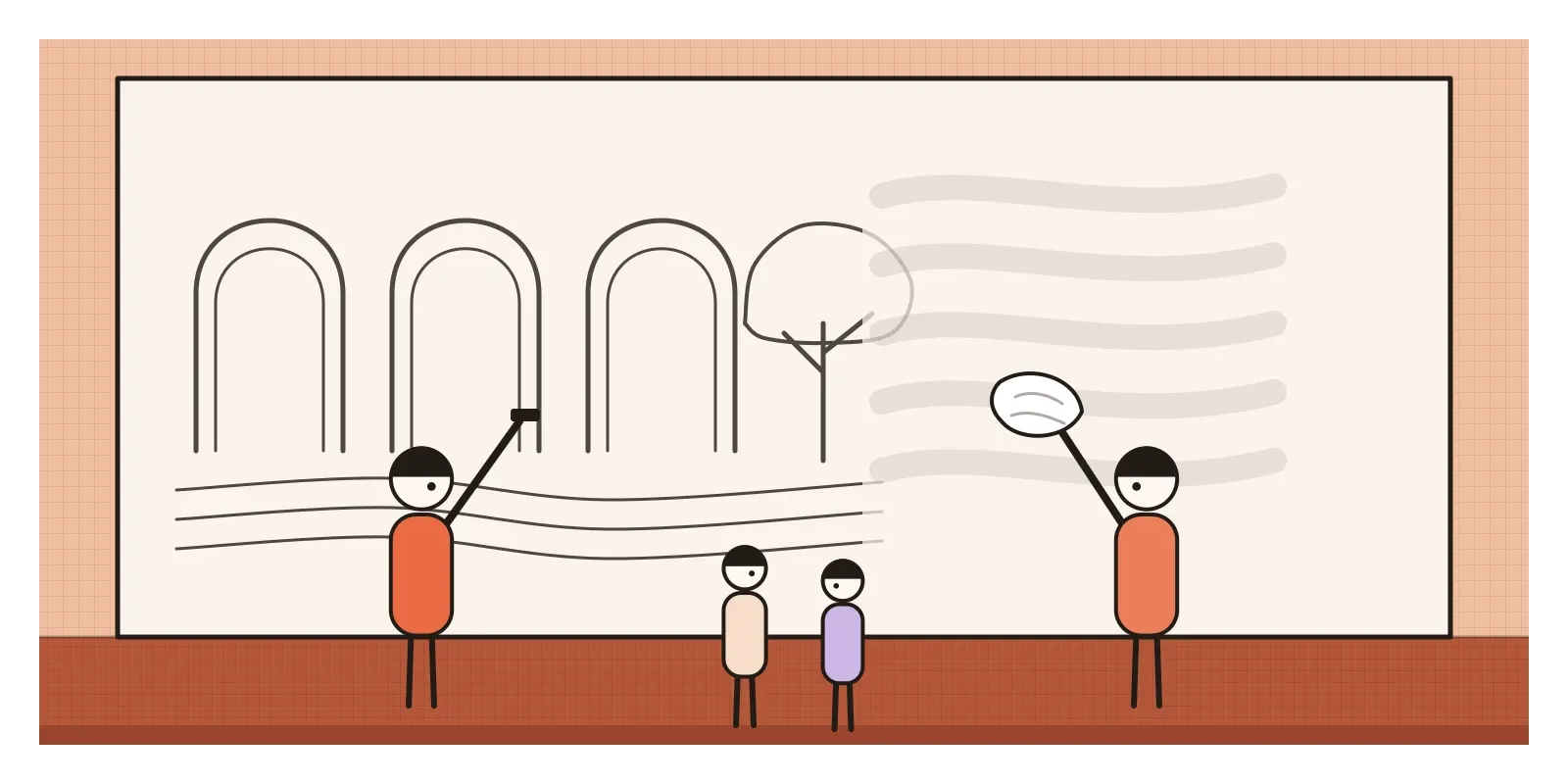
In 1992, Nalini Malani turned Gallery Chemould in Bombay into an open studio for her exhibition City of Desires. For about two weeks she drew directly on the gallery walls, in charcoal and pigment, erasing and redrawing as visitors watched, and at the end the drawings were destroyed. The work referred to old wall paintings in the temples of Nathdwara in Rajasthan that had been neglected and painted over, and to a rising Hindu nationalism that was rewriting the past. LeWitt's walls were wiped because the idea could always be redrawn. Malani's were wiped to make a point about what is lost when they are. She has made wall drawings and erasures ever since.
In 1993 Vivan Sundaram responded to the riots with Memorial, an installation built around a news photograph of a man killed in the violence, and Rummana Hussain turned to installation and performance to work through questions of faith and the body. None of these artists called themselves Conceptual artists in the New York sense, and their work is full of feeling. But they shared its central move: the idea and the context came first, and the object was whatever best carried them.
The brief is the work
Designers live with conceptual art's main idea every day, mostly without the drama. A brief, a spec or a design system is a set of instructions that other people carry out, and good ones, like LeWitt's, leave room for the person executing them while still producing something recognisably yours. I wrote in the posts on Fluxus and on computational art about scores and prompts. The difference with conceptual art is its emphasis on the document itself: the plain, written idea that can travel without its author.
Its look has also become a style. Typewriter fonts, monospaced type, document-like layouts, index cards and receipts all appear in branding that wants to seem honest and unpolished, and the white wall with one plain sentence on it is a familiar shop and museum gesture. Haacke's maps and charts of who owned what now look like an early form of data journalism. And Siegelaub's contract has a long afterlife. Many countries now give artists a share of resale prices, and India's copyright law has included such a right since 1994, though it is rarely used.
The movement had real limits. Its writing could be dense to the point of parody, and some of its most famous works need a paragraph of explanation to work at all. It meant to escape the market and was absorbed by it within a decade: LeWitt's certificates, Weiner's statements and Kawara's dates now sell for large sums. Its standard histories are centred on New York and London, though artists in Latin America, Japan and Eastern Europe were doing similar things, sometimes earlier and at greater risk. Women were sidelined, which is why Lippard organised a touring show of only women's conceptual art, c. 7,500, in 1973. By the late 1970s, painting was coming back, and in the next post, on Radical Design, young Italian architects took the same sceptical spirit into furniture and whole cities, drawing buildings that were never meant to be built.
Write the instructions, not the thing
Some of the best places to see conceptual art are built around instructions. MASS MoCA in Massachusetts has a long-term exhibition of more than a hundred of LeWitt's wall drawings, redrawn by teams of artists. In India, the Kochi-Muziris Biennale, held in Fort Kochi since 2012, is the best place to see installation and idea-led work by Indian and international artists side by side. For reading, Lucy Lippard's Six Years is a scrapbook-like record of the period, and Tony Godfrey's Conceptual Art is a clear introduction.
For an exercise, write instructions for a drawing in no more than five sentences, without sketching anything, and give them to two friends. Compare what comes back. Then rewrite the instructions to get closer to what you meant, and notice which words did the work. It's a small, humbling lesson in writing briefs.
Baldessari's urn still sits beside its plaque, a few ashes standing in for thirteen years of painting. The paintings are gone. What survives is the idea that he could let them go.
Further reading: Lucy R. Lippard, Six Years: The Dematerialization of the Art Object from 1966 to 1972 (1973) · Sol LeWitt, "Paragraphs on Conceptual Art" (1967) · Tony Godfrey, Conceptual Art (1998) · Alexander Alberro and Blake Stimson (eds), Conceptual Art: A Critical Anthology (1999)
A reply toThe belief that a work of art must be a crafted object to look at, own and sell.