Byzantine Art
How an eastern Christian empire turned Roman realism into gold, light and faces that look straight back.
Byzantine Art
The day the dome came down
On 7 May 558, while workmen in Constantinople were repairing cracks in the dome of the Great Church, Hagia Sophia, the eastern part of it fell in. Earthquakes the year before had weakened it, and the crash brought down the altar and its canopy beneath. It was a terrible blow to the emperor Justinian, who had built the church barely twenty years earlier, after rioters burned its predecessor in 532. That first building had gone up in under six years, designed by two men better known as mathematicians than builders, Anthemius of Tralles and Isidore of Miletus. Now Isidore's nephew, known as Isidore the Younger, was given the job of putting the dome back, and he rebuilt it steeper and about six or seven metres higher. The new dome was finished in 562, and despite later partial collapses and repairs, it's essentially the one that stands in Istanbul today.
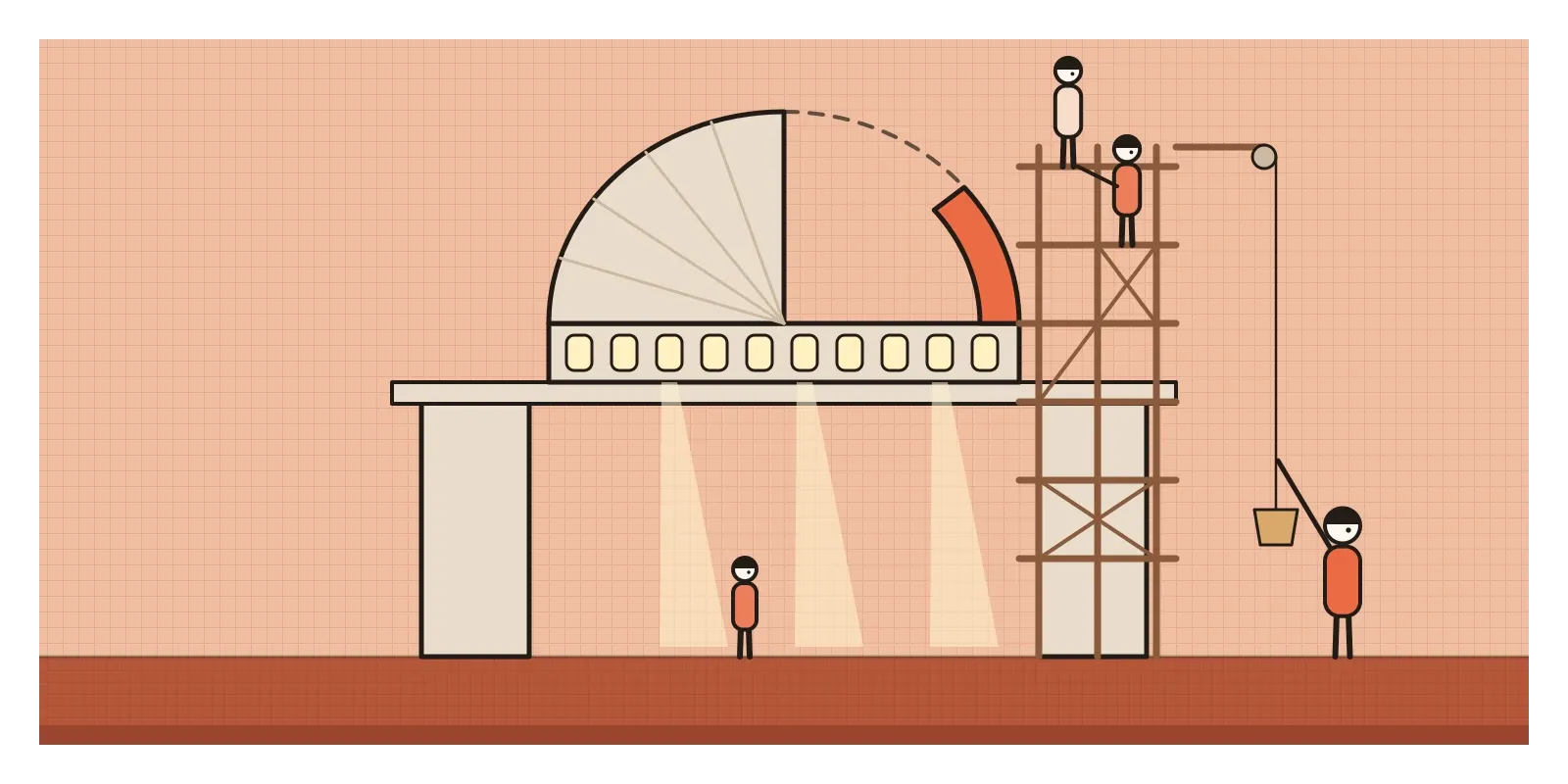
The court historian Procopius had described the original dome as so light that it seemed not to rest on the building at all, but to hang from heaven on a golden chain. That was the point. A ring of forty windows runs around the base of the dome, so the shell above appears to float on light. Inside, the walls were covered with coloured marble and the vaults with gold mosaic, and in the flicker of lamps the whole interior seemed to dissolve. Hagia Sophia was a building designed to make the material world look as if it were melting into the spiritual one.
That's Byzantine art in a sentence. It's the art of the Eastern Roman Empire, ruled from Constantinople, from the city's founding by Constantine in 330 to its capture by the Ottomans in 1453, and of the Orthodox Christian world that carried it on: churches, mosaics, icons, illuminated books, ivories and silks. Historians argue over where Late Roman art ends and Byzantine begins, and the people we call Byzantines never used the word. They called themselves Romans.
Romans who looked through the world
In the post on ancient Roman art I ended with the Arch of Constantine and its stiff, frontal figures. That shift was the beginning of this one. When Constantine made Christianity a favoured religion and moved his capital to the old Greek town of Byzantium, renaming it Constantinople, the empire's art took on a new job. Roman art had been brilliant at showing the visible world, a wrinkled senator, a battle, a garden painted on a wall. Christian art needed to show things nobody could see: God, saints, heaven and the authority of an emperor who ruled, in theory, on God's behalf.
So Byzantine artists replied to Roman illusionism by turning away from it, gradually and never completely. They kept the Roman skills, mosaic, fresco, carving and portraiture, but flattened space, stilled movement and swapped painted skies for backgrounds of gold. The emperor and the church were the great patrons, and art served both. The city itself sat on the trade routes between Europe and Asia, rich enough to afford acres of gold and marble. Procopius even tells how monks smuggled silkworm eggs from the east for Justinian in the 550s, giving Byzantium its own silk industry, a story that may be partly legend but shows how much the empire valued precious materials. A mosaic in a Byzantine church wasn't meant to be a window onto a scene. It was meant to be a presence in the room.
An empress in Ravenna, a face at Sinai
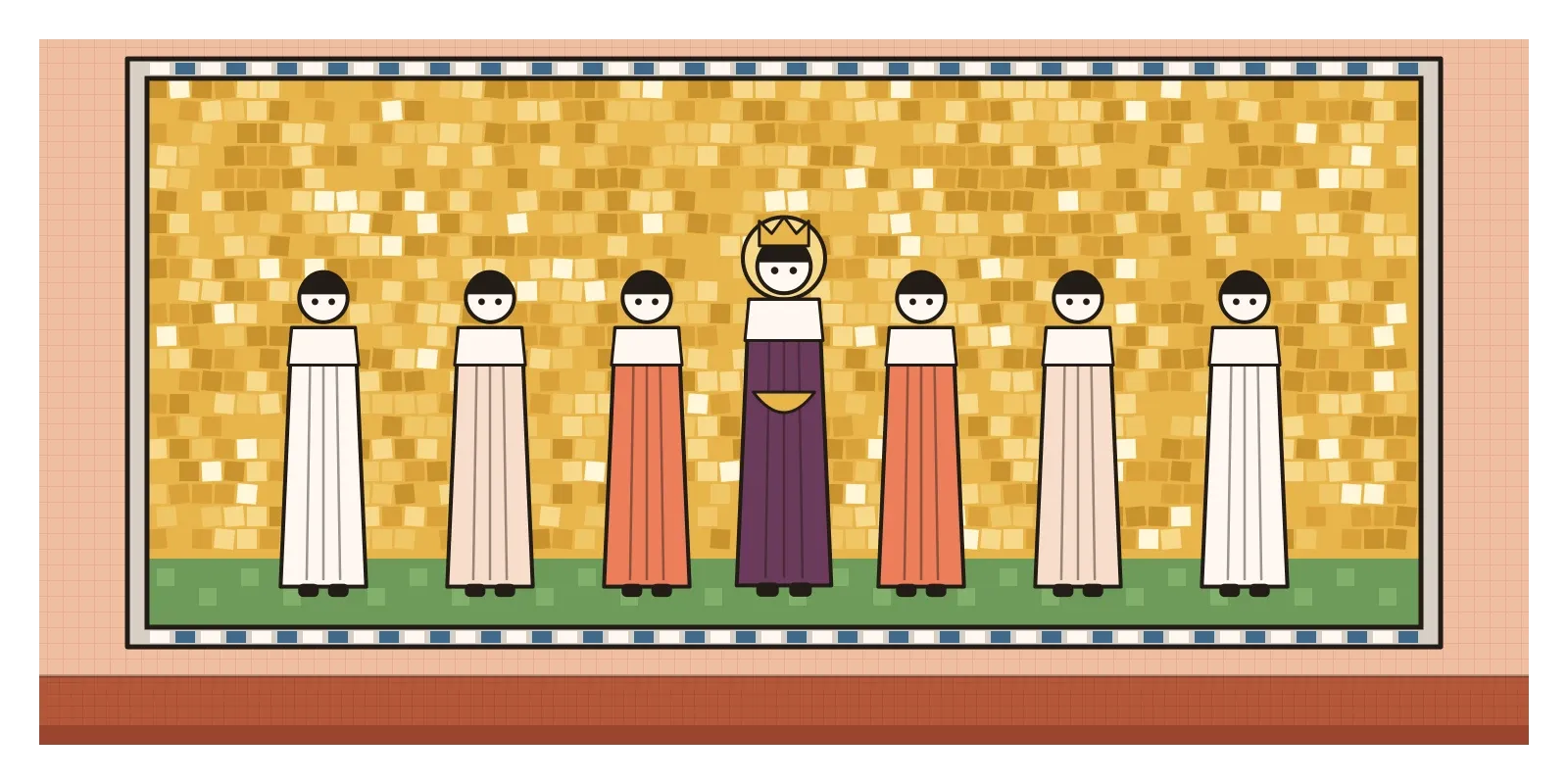
The most famous Byzantine mosaics aren't in Constantinople at all. In Ravenna, in north-east Italy, which Justinian's armies had recaptured in 540, the church of San Vitale was consecrated around 547. On the walls of its apse, two panels face each other. On one side, Justinian, crowned and haloed, carries a golden bowl for the Eucharist, flanked by clergy, officials and soldiers. On the other side, his wife Theodora, a former actress who became one of the most powerful people in the empire, stands among her ladies holding a jewelled chalice. Neither ruler seems ever to have visited Ravenna. The mosaics put them there anyway, standing on a green ground against a gold sky, their feet barely touching the floor.
At the Monastery of Saint Catherine, at the foot of Mount Sinai in Egypt, hangs one of the oldest surviving icons, a sixth-century panel of Christ painted in encaustic, pigment mixed with hot wax, the same technique as the Roman-era mummy portraits from Egypt. The two halves of the face are subtly different, one calmer, one sterner, and many viewers read this as the two natures, divine and human, in one person. It survived partly because Sinai lay outside the empire's control during the period of iconoclasm, when images were destroyed elsewhere.
Much later, around 1261, after the Byzantines won back their capital from Western crusaders, a vast mosaic was made in an upper gallery of Hagia Sophia showing Christ between Mary and John the Baptist, a group known as the Deësis. The faces are soft and sorrowful, shaded with tiny tesserae, far gentler than the stern figures of earlier centuries. And in the early fourteenth century, at the Chora Church in Constantinople, a statesman called Theodore Metochites paid for a fresco of the Resurrection in which Christ, in dazzling white, pulls Adam and Eve out of their tombs by the wrists, an image full of movement.
Gold that turns walls into light
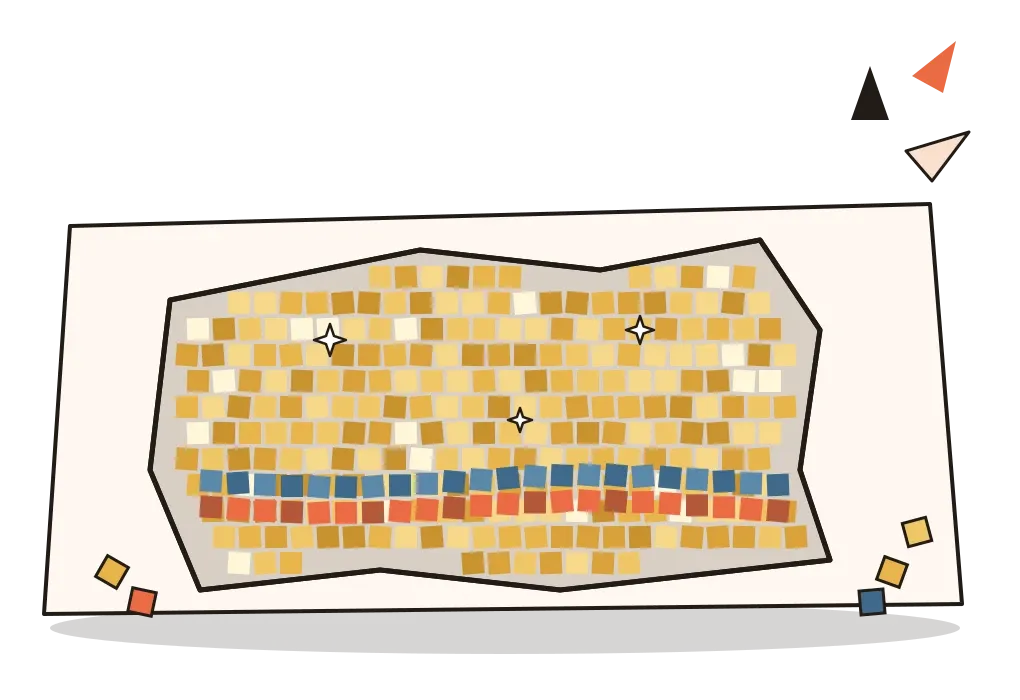
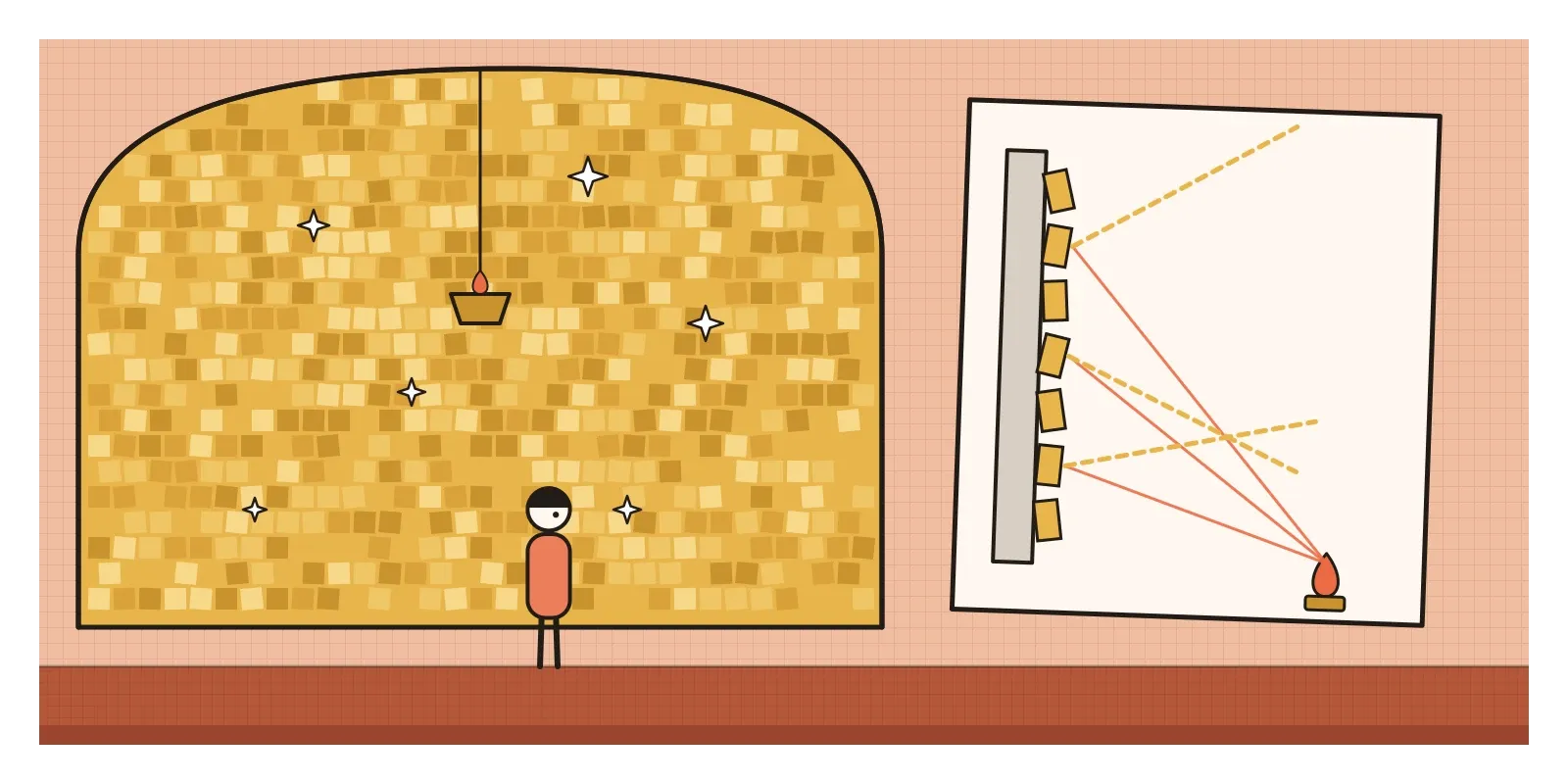
The most recognisable thing is the gold. Byzantine gold tesserae are made of glass with a thin layer of gold leaf fused between two layers. Mosaicists set them at slightly different angles, especially on curved vaults, so they don't reflect light all together like a mirror but glitter unevenly as you move or as a lamp flickers. In daylight a gold apse glows; by candlelight it shimmers. Gold here isn't a colour for a sky. It stands for no particular place at all, a timeless space where holy figures appear.
Figures are frontal, tall and still, with large eyes that look straight out at you. Their bodies are long and slender, their robes fall in flat, linear folds, and shadows are minimal. Rank is shown by size, position and costume rather than by perspective. Halos mark holiness and, sometimes, imperial power. Space is shallow, and sometimes it seems to open towards the viewer rather than away, an effect later writers called inverse or reverse perspective, although how deliberate it was is debated. Icons follow agreed types. A painter of the Virgin and Child would choose from a set of established poses and repeat them faithfully, because a correct icon was a true likeness, not a personal invention.
Architecture supports all this. The Byzantines perfected the pendentive, a curved triangle of masonry that lets a round dome sit on four arches over a square space. Churches became centred on a dome, with the image of Christ often placed at the top, looking down.
Gold coins in the land of pepper
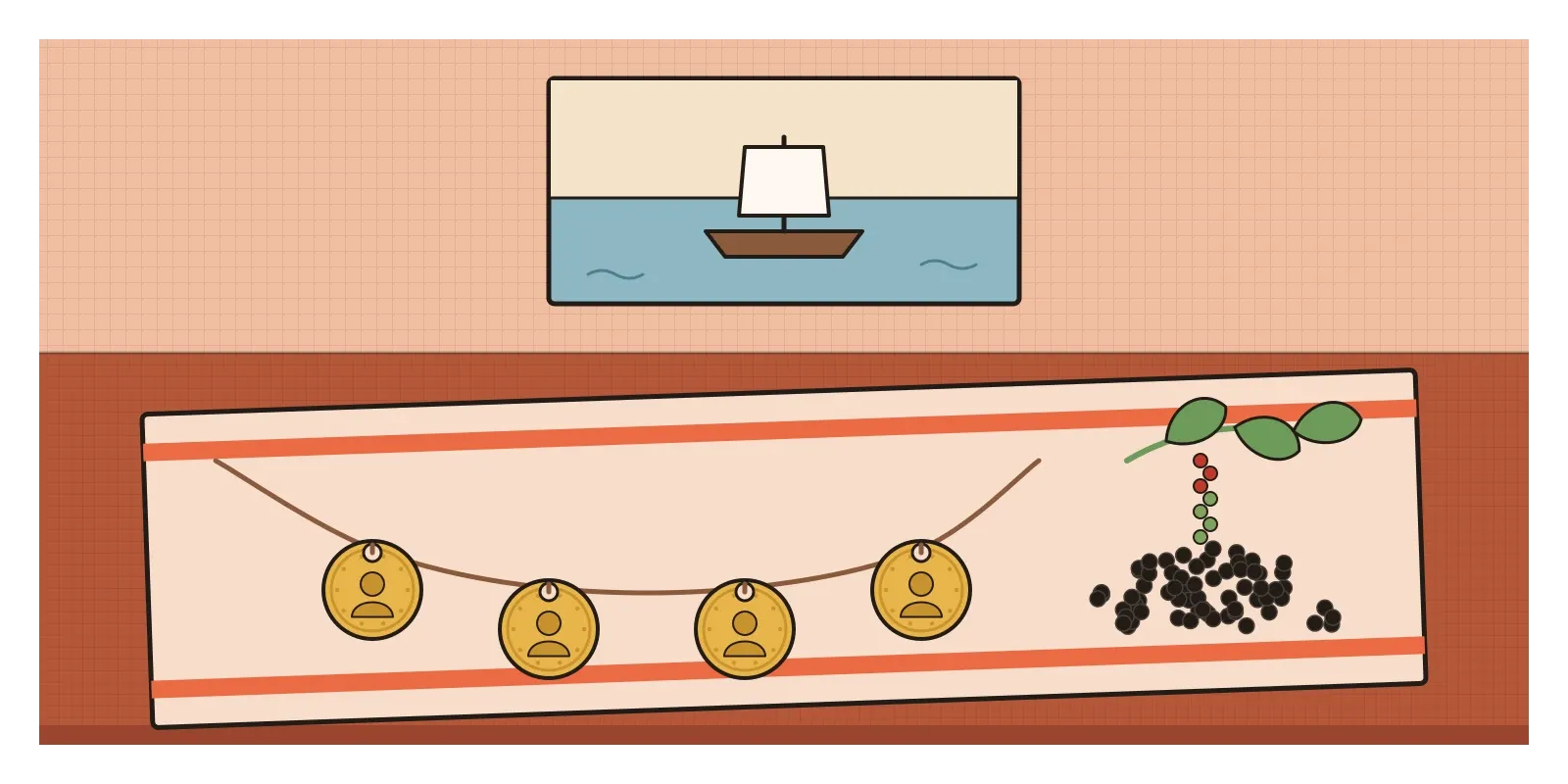
Byzantium and India were connected first by trade. Byzantine gold coins, the solidus, have been found at sites across south India, along with local imitations, and many have holes punched through them, which suggests they were worn as jewellery or ornaments rather than spent. In the sixth century, a merchant from Alexandria who later became a monk, known as Cosmas Indicopleustes, wrote a strange book called the Christian Topography. It describes the trade of Sri Lanka and of Male, where pepper grows, almost certainly the Malabar coast, and mentions Christian communities there.
Those Kerala Christians, the Saint Thomas Christians, looked mainly to the Church of the East, based in Persia and using Syriac, rather than to Constantinople, so the artistic link is looser than it sounds. The early stone crosses in some Kerala churches, carved with Persian inscriptions, come from that eastern world rather than from Byzantium. The visual parallels are more interesting. Thanjavur painting, which developed in Tamil Nadu centuries later, also sets frontal holy figures against shining gold leaf, raised on gesso and studded with glass stones, though there's no historical connection. And the Hindu idea of darshan, seeing and being seen by the deity, is close to what Orthodox believers expect of an icon. In both, the eyes matter most.
Icons on your home screen
The most obvious borrowing is a word. Eikon is Greek for image, and when computer researchers in the 1970s needed a name for the small pictures that stood for files and programs, they took it. The analogy is better than it looks. A Byzantine icon was a standard, recognisable type that pointed to something beyond itself, which is exactly what a good interface icon does. Consistent icon sets, where every symbol shares a grid, line weight and style, work on the same principle as icon painters' pattern books: people trust what they recognise.
Orthodox churches also gave us one of the earliest image-covered screens. The iconostasis, a wall of icons that separates the congregation from the sanctuary, arranges its images in strict rows by importance, with a fixed place for every figure. It's an interface in the literal sense, a surface between two spaces, and its order is as rigid as any navigation bar.
Gold still signals sacred or precious things, in wedding cards, festive packaging and the foil on premium products. The Cyrillic alphabet, used by more than 250 million people today, developed in the ninth and tenth centuries from Byzantine Greek letterforms, so any designer working in Russian, Bulgarian or Serbian is working with a Byzantine inheritance. And the dome on pendentives became one of the most influential structural ideas in history. Ottoman architects studied Hagia Sophia closely, which I'll come back to in the post on Islamic art and design.
Smashed images and a gold that stayed
The fiercest critics were Byzantines themselves. From around 730 to 787, and again from 815 to 843, emperors known as iconoclasts, image-breakers, banned religious images, arguing they led people to worship wood and paint. Icons were destroyed and mosaics replaced with plain crosses. It was an empress, Theodora, who restored the icons in 843, still celebrated in the Orthodox Church. Western critics came later. In the sixteenth century, the Italian painter and biographer Giorgio Vasari dismissed the "Greek manner" as stiff and crude, and for centuries "Byzantine" became a word for anything rigid or bureaucratic. The art was also bound tightly to power: its gold flattered emperors as much as saints, and its conventions left little room for individual makers, almost all of whom are anonymous. In 1204 Western crusaders sacked Constantinople and carried off its treasures, including the four bronze horses now in Venice.
Byzantium ended in 1453, but its art didn't. It continued in Greece, the Balkans and Russia, where Andrei Rublev painted his Trinity in the early fifteenth century. In Italy, Giotto's generation took the Greek manner and gave its figures weight and space, and in the Islamic world, which seems to have employed Byzantine mosaicists early on, artists replied with a very different idea of sacred art.
To see it this week, look up an online tour of Hagia Sophia or the Ravenna mosaics. In Kerala, the old Persian crosses at the Valiya Palli in Kottayam show the eastern Christian world that Cosmas glimpsed. Or look at a gold-leaf Thanjavur painting, in a museum or a friend's home, and notice how the gold changes as you move. For a small exercise, cut a sheet of gold card into small squares and glue them onto a board at slightly different angles, then shine a torch across them in a dark room. You'll understand in a minute why Procopius thought a dome could hang from heaven. In the next post, on Islamic art and design, I'll follow what happened when a new faith inherited those craftsmen and chose words and geometry over faces.
Further reading: Robin Cormack, Byzantine Art (2000) · Robin Cormack, Writing in Gold: Byzantine Society and Its Icons (1985) · Rowland J. Mainstone, Hagia Sophia: Architecture, Structure and Liturgy of Justinian's Great Church (1988) · Liz James, Light and Colour in Byzantine Art (1996) · Judith Herrin, Byzantium: The Surprising Life of a Medieval Empire (2007)
A reply toRoman illusionism, turned away from the visible world and towards the invisible one.