
The Bengal School
How painters in Calcutta turned away from oil and shadow and tried to invent a modern art that looked Indian.
The Bengal School
Four gifts in a saffron robe
Around 1905, in his family's rambling house at Jorasanko in north Calcutta, Abanindranath Tagore painted a small picture of a young woman. She stands barefoot against a pale, empty sky, dressed in saffron like an ascetic, a soft halo behind her head. She has four arms, and in her hands she holds a book, a sheaf of rice, a folded white cloth and a string of prayer beads. There's no throne, no jewellery, no dramatic lighting. The colours are faint and misty, as if seen through morning haze, and the whole figure feels quiet, gentle and a little sad.
The painting became known as Bharat Mata, Mother India. It was made in the middle of an uproar. In 1905 the viceroy, Lord Curzon, partitioned the province of Bengal, and the split took effect on 16 October. Bengalis saw it, rightly, as a way of dividing and weakening them, and responded with the Swadeshi movement, boycotting British goods, burning foreign cloth and buying Indian-made instead. Sister Nivedita, the Irish-born disciple of Swami Vivekananda, read the four objects in the painting as the gifts the motherland offered her children: learning, spiritual life, food and clothing. She reportedly said she would like to see it reproduced by the thousand and carried across the country.
Abanindranath, then in his mid-thirties, was the leading figure of what came to be called the Bengal School, a movement of painters, teachers and critics based in Calcutta from roughly 1900 to the 1930s, who set out to create a modern Indian art. They rejected the oil paint, shadows and European realism taught in colonial art schools and looked instead to Mughal and Rajput painting, the murals of Ajanta and the art of Japan. The name is a little misleading, because the movement soon spread well beyond Bengal, and historians still argue about where it ends and later Indian modernism begins.
A principal sells his paintings
To see what the Bengal School was replying to, picture an Indian art student around 1890. At the government art schools in Calcutta, Bombay and Madras, set up in the 1850s, students drew from plaster casts of Greek and Roman statues, learned European perspective and anatomy, and aspired to paint in oils. The most famous Indian painter of the day, Raja Ravi Varma, had built his fame on exactly that style, as I described in the posts on light, shade and rendering and on Ravi Varma himself. Older Indian painting was treated by most teachers as a quaint craft, not as art.
Then an Englishman changed his mind. E. B. Havell, who became principal of the Government School of Art in Calcutta in 1896, had come to believe that Indian art schools were training students to make second-rate copies of European pictures while ignoring a great tradition of their own. He reorganised the teaching around Indian design and painting, and around 1904 he sold off much of the school gallery's collection of European paintings and bought Mughal and Rajput miniatures in their place. Many students were furious. They had come to learn what they saw as modern art, and their principal seemed to be taking it away.
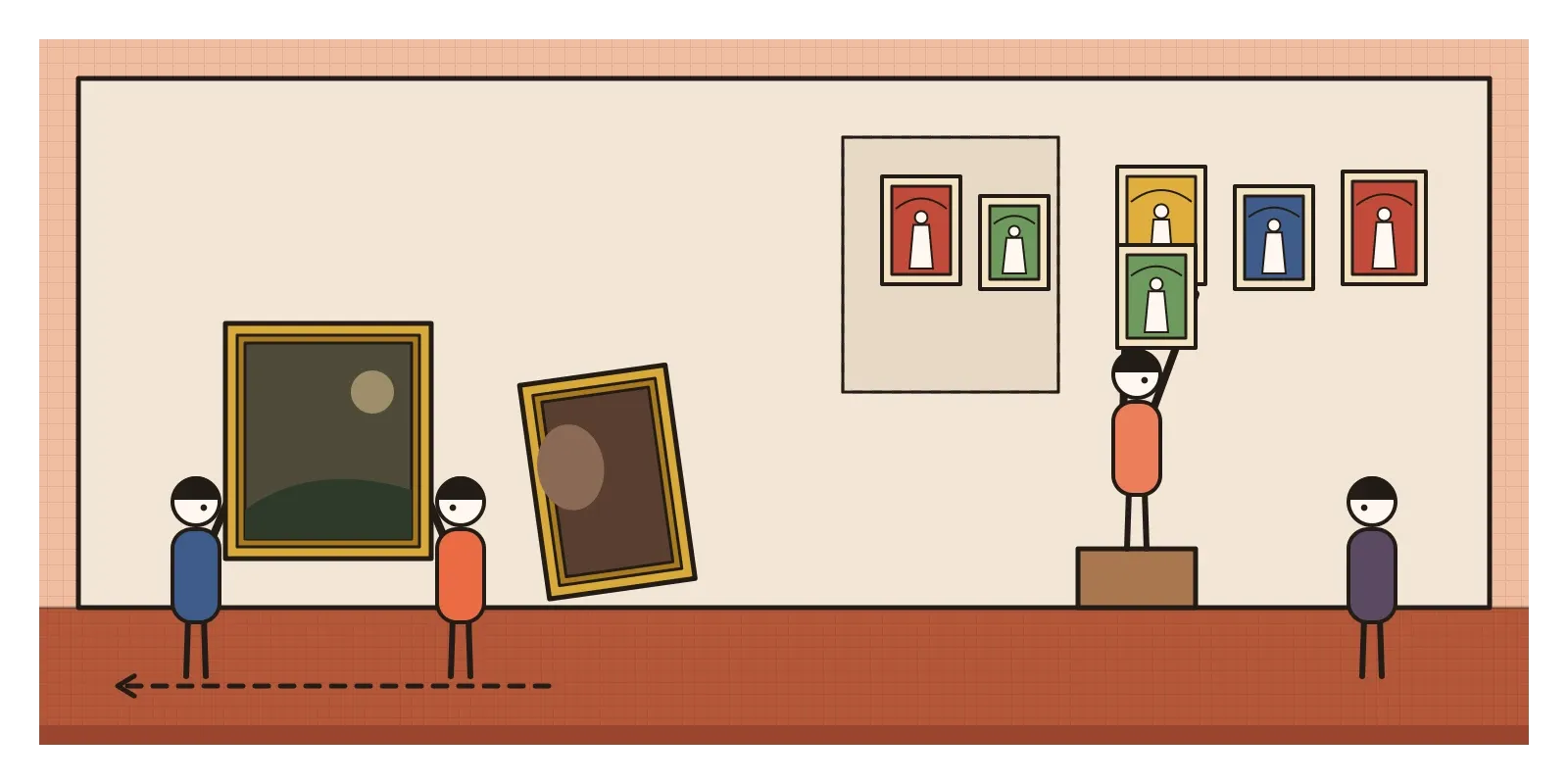
Havell found an ally in Abanindranath, a nephew of the poet Rabindranath Tagore, who had studied European oil painting and pastel with private teachers and then, in his twenties, fallen for Mughal miniatures. In 1905 Havell made him vice-principal of the school. Meanwhile, as I wrote in the post on Japonisme, the Japanese art historian Okakura Kakuzō had stayed with the Tagores in 1902, and the painters Yokoyama Taikan and Hishida Shunsō had followed. In 1907 the circle founded the Indian Society of Oriental Art in Calcutta to exhibit and promote the new painting. The Swadeshi movement gave all of this political urgency. Indian cloth, Indian goods and now Indian art.
Masters, students and a cave lit by lamps
Abanindranath's first famous picture in the new style was The Passing of Shah Jahan, painted around 1900. It shows the old Mughal emperor, imprisoned by his son, lying on a terrace of the Agra Fort and gazing across the river at the Taj Mahal, the tomb of his wife, with his daughter grieving at his feet. It's small, delicate and full of feeling, closer to a Mughal album page than to a European history painting, and it won wide attention when it was shown at the great exhibition held for the Delhi Durbar of 1903. Abanindranath was also a much-loved writer for children, and in old age he made whimsical little sculptures from driftwood and roots that he called kutum katam.
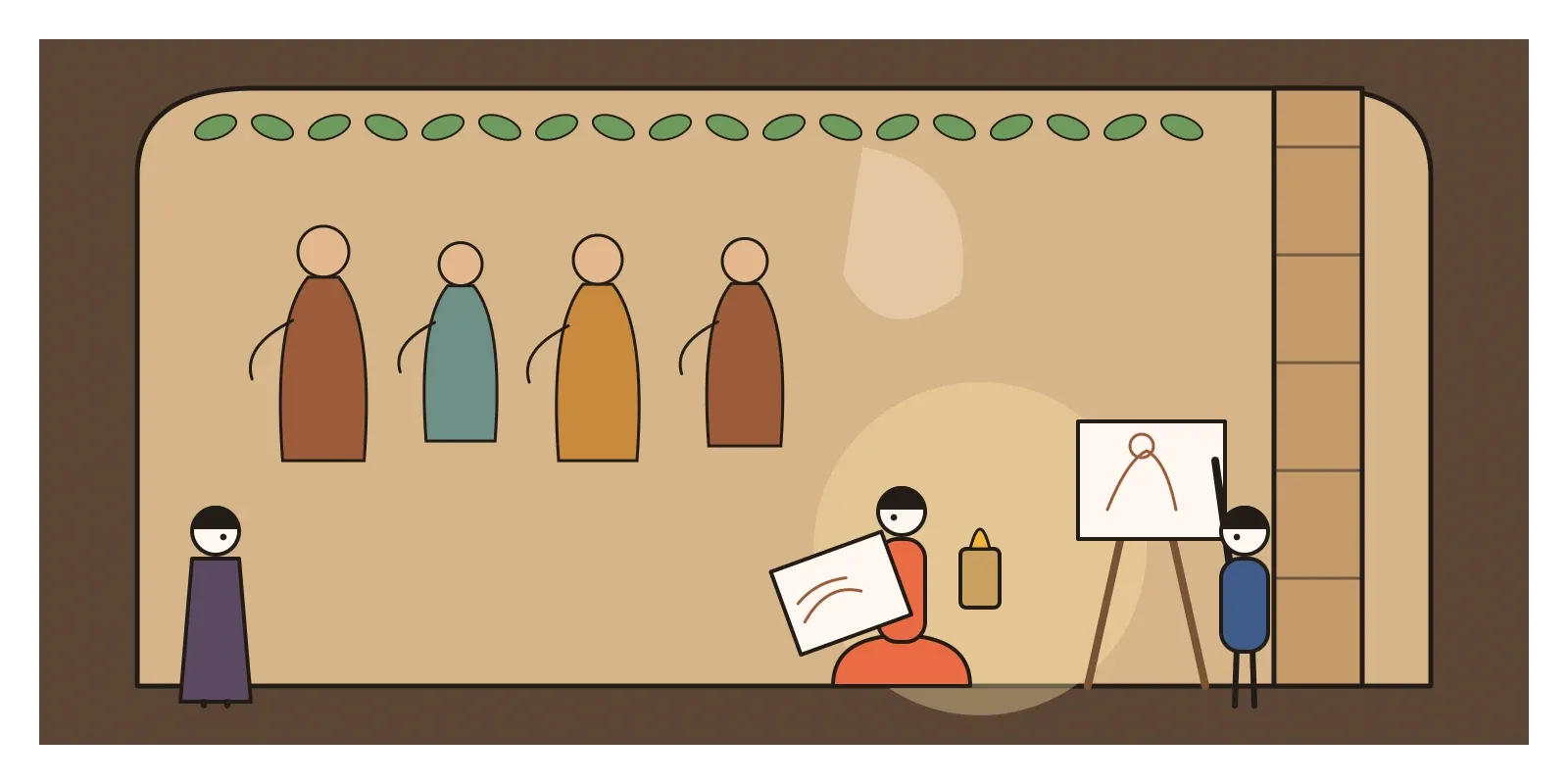
His most influential student was Nandalal Bose, who joined him around 1905. In 1909, Nandalal and another student, Asit Kumar Haldar, went to Ajanta with Lady Christiana Herringham, an English painter who had set out to make full-size copies of the cave murals before they faded further. For weeks they worked inside the caves, in poor light, copying the paintings onto paper. The copies were published in London in 1915, and the experience shaped Nandalal for the rest of his life: the flowing outline, the warm earth colours, the sense of figures moving in a continuous story.
The movement was never a single style. Abanindranath's elder brother, Gaganendranath Tagore, made savage caricatures of Calcutta's Westernised elite and, in the 1920s, paintings of light breaking into prism-like planes that critics compared with Cubism. Their sister, Sunayani Devi, began painting in her thirties, untrained, with flat colours and big-eyed figures close to folk art, and was championed in the 1920s by the critic Stella Kramrisch, whom I mentioned in the post on the Vienna Secession. In Lahore, Abdur Rahman Chughtai blended the Bengal wash with the fine line of Persian painting. And in 1921 Rabindranath Tagore opened a university at Santiniketan, where Nandalal led the art school, Kala Bhavana, from the early 1920s, and trained a generation of artists who would carry the movement in new directions.
Painting through water
The easiest way to recognise a Bengal School painting is its atmosphere. Colours are soft, low in contrast and slightly blurred, as if seen through mist or dusk. Skies are pale and empty. Figures are slender, with long necks, downcast eyes and gentle gestures, often shown in profile or three-quarter view. There is almost no cast shadow. Space is suggested by layers of haze rather than by perspective lines, and the outline, when it appears, is fine and flowing.
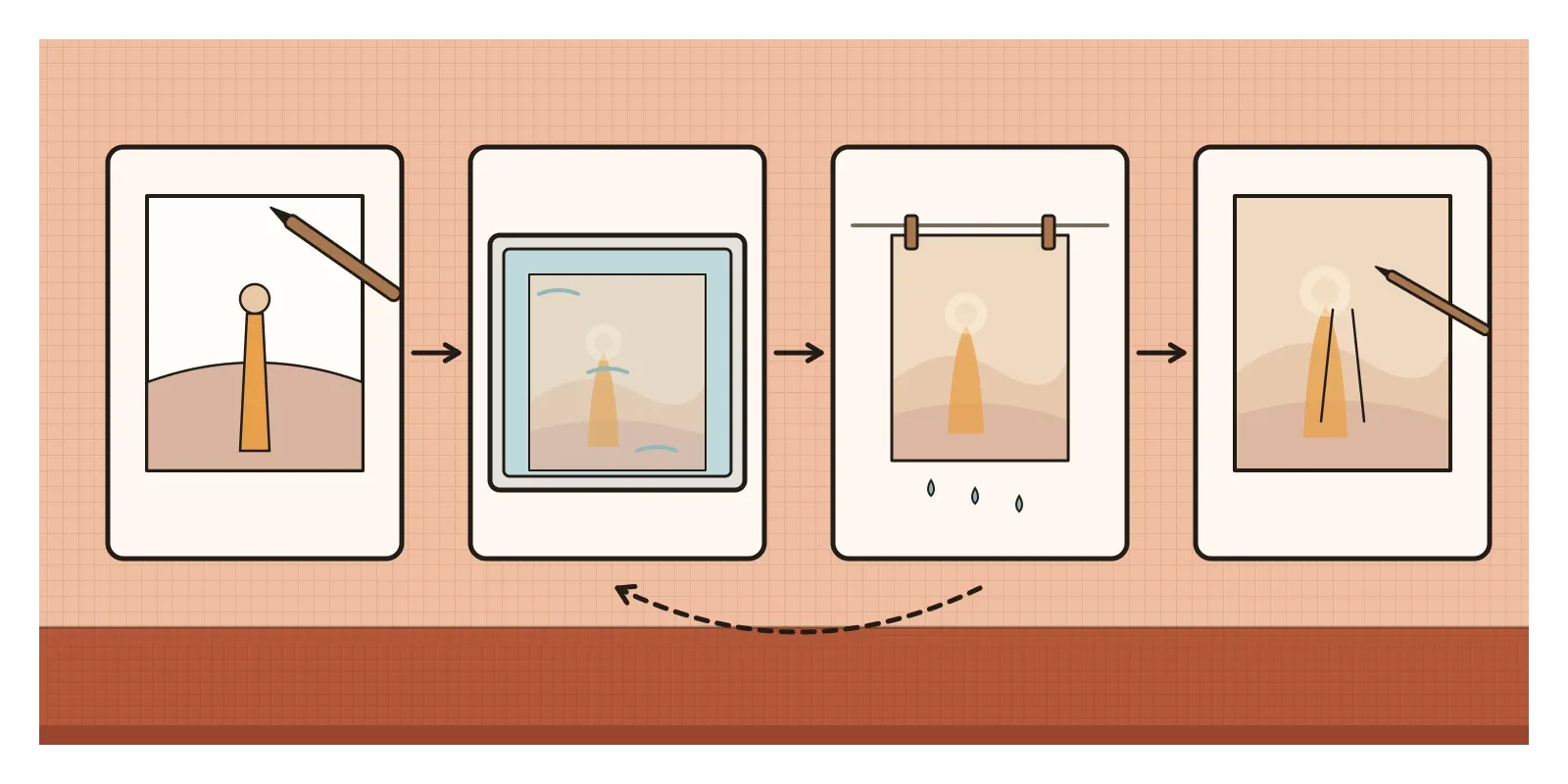
Much of that comes from the wash technique. The painter lays down thin watercolour, then submerges the whole sheet in water, lets the colour soak and spread, and dries it. Then another thin layer, another soak and another drying, over and over. Each wash softens edges and fuses the colours into a single glowing tone. Detail is brought back at the end with a fine brush. Abanindranath developed the method in the years after the Japanese painters' visit, adapting their way of building hazy atmosphere without strong outlines, and it became the movement's trademark.
The subjects reinforce the mood. Episodes from the epics and from Kalidasa's poetry, Buddhist stories, Mughal history, Radha and Krishna, village women at the river, all drawn from an Indian past and treated with tenderness rather than drama. Formats echo older Indian painting too, small and intimate, sometimes with decorative borders like a miniature. Compare this with a Ravi Varma oleograph and the difference is total. Where Ravi Varma made gods look like photographed people in solid light, the Bengal School made people look like memories.
Borrowing from Tokyo to sound like Ajanta
Because this is an Indian movement, it's worth looking outward at how much of it was borrowed. The irony at its heart is that an art meant to be authentically Indian took essential ingredients from abroad. Its champion and patron in the early years was an English principal, Havell. Its most influential theorist, Ananda Coomaraswamy, whom I wrote about in the post on the Arts and Crafts movement, was half Sri Lankan and half English and drew heavily on William Morris. Its signature technique came from Japan, through Okakura's circle and the pan-Asian ideal of an Asia united against Western materialism. Even the idea of rejecting academic realism in favour of an older, purer tradition echoed the Pre-Raphaelites, the subject of an earlier post in this series.
It's also worth noticing the timing. The partition of Bengal took effect on 16 October 1905. Two days later, in Paris, the Salon d'Automne opened with a room of paintings so violently coloured that a critic compared the painters to wild beasts. In the same year in Vienna, Klimt's circle was walking out of the Secession. Artists in many places were turning against the academy at once, but in opposite directions. In Paris, the answer was to make colour louder and break the rules of representation. In Calcutta, it was to make colour quieter and go back to a tradition the academy had despised. Both were modern, and both were replies.
From a Congress pandal to the Constitution
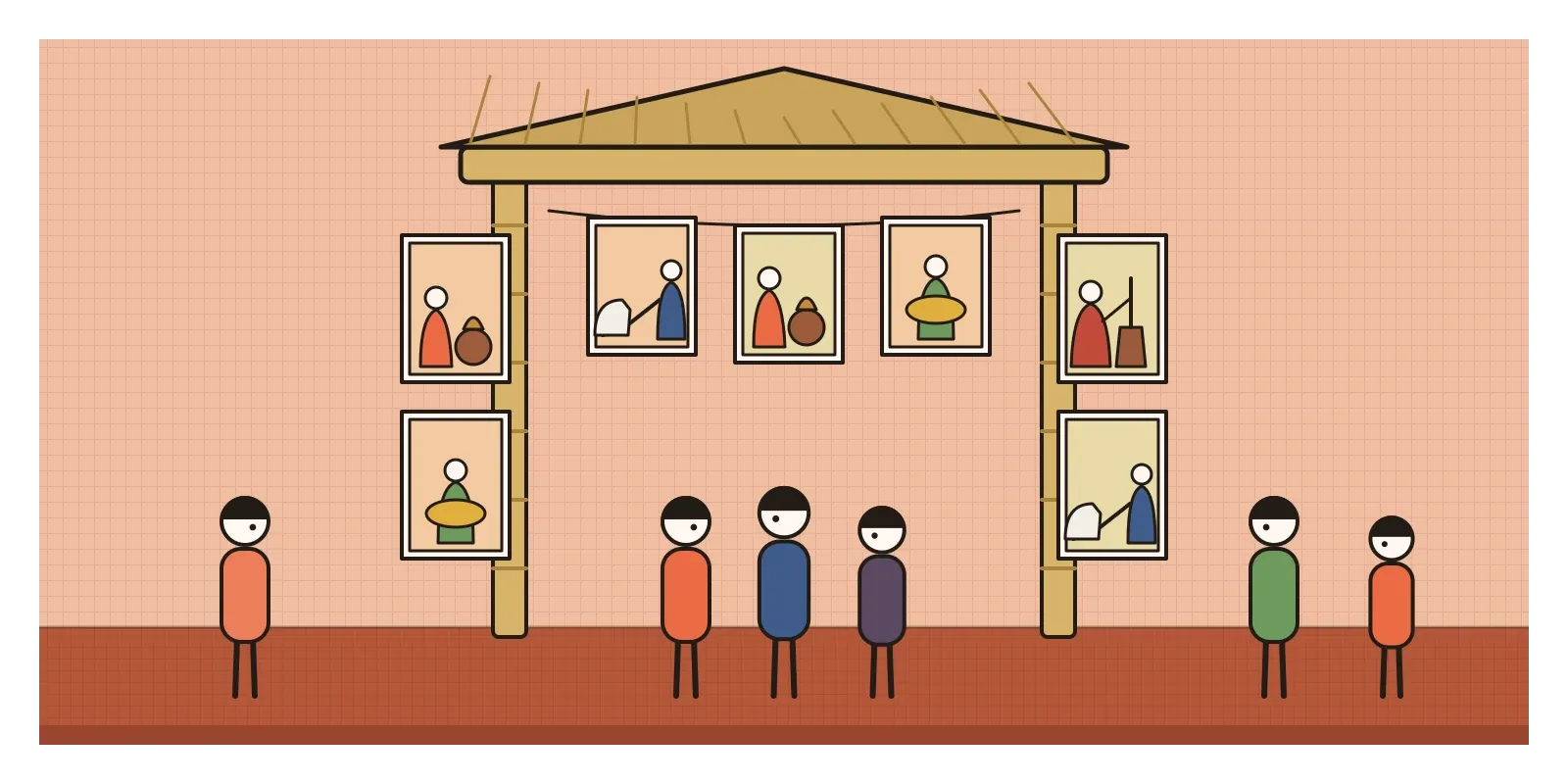
The Bengal School's most direct legacy for designers comes through Nandalal Bose, who carried it out of the gallery and into public life. In 1938, Mahatma Gandhi invited him to decorate the annual session of the Indian National Congress at Haripura in Gujarat. Nandalal and his students painted hundreds of posters of everyday rural life, a potter at the wheel, a woman churning butter, a drummer, a farmer with his plough, in bold outlines and flat colour, and hung them around the gateways and pavilions of a temporary town built from bamboo and local materials. It was political design, an image of the nation made from its villagers rather than its rulers.
A decade later, Nandalal and his students at Kala Bhavana illustrated the handwritten original of the Constitution of India, completed in 1950. The calligraphy was by Prem Behari Narain Raizada, and each part of the text opens with a small painting from India's long history, from an Indus seal to the freedom struggle, framed by decorative borders. The drawing of the Lion Capital adapted for the national emblem is usually credited to Dinanath Bhargava, a young student at Santiniketan. A founding legal document designed like an illuminated manuscript is a very Bengal School idea.
Satyajit Ray studied at Kala Bhavana in the early 1940s under Nandalal and Benode Behari Mukherjee, before turning to advertising, book covers and film, and I wrote about his notebooks in the post on sketching as thinking. Through teachers like these, the movement's real gift to Indian design wasn't the misty wash. It was the conviction that Indian makers could draw on their own visual traditions, folk, classical and courtly, and make something modern from them, a question every Indian brand, app and typeface still faces.
An Indian art, but whose India?
The movement's critics started early. Many found its paintings sentimental, all drooping necks and twilight, more nostalgic than modern. The wash technique, endlessly repeated by lesser followers, hardened into a formula. Amrita Sher-Gil, whom I wrote about in the post on Post-Impressionism, dismissed much Bengal School painting in the 1930s as sweet and weak. Even Rabindranath Tagore, when he began to paint in his late sixties, made strange, dark, inky images that owed nothing to his nephew's style.
The politics are harder. The Bengal School's India was largely Hindu, upper-caste and drawn from an idealised ancient past, and the image of the nation as a Hindu mother goddess left many Indians, Muslims above all, outside the picture. Bharat Mata herself has since been claimed by very different political movements. The movement was also dominated by one wealthy, landowning family and its circle in Calcutta, and women, Sunayani Devi aside, were rarely at its centre.
By the 1930s and 1940s, younger artists were replying. At Santiniketan itself, Benode Behari Mukherjee and the sculptor Ramkinkar Baij moved towards a looser, more open modernism, which the historian R. Siva Kumar later called contextual modernism. Jamini Roy, as I wrote in the post on Kalighat painting, found Indianness in the bazaar and the village rather than the court. And after Independence, young painters in Bombay would reject the Bengal School outright in favour of international modernism, the subject of a later post.
To see the Bengal School for yourself, the Indian Museum and the Rabindra Bharati Society in Kolkata, the National Gallery of Modern Art in New Delhi and Kala Bhavana at Santiniketan all hold major works. Look up the illustrated pages of the Constitution, which are online. For an exercise, try the wash technique with cheap watercolour: paint a simple figure or landscape, slide the sheet into a tray of water for a minute, dry it flat, and repeat three times. Notice how the hard edges dissolve and the colours begin to glow. Then picture that small saffron figure in Jorasanko in 1905, holding out her four gifts at the moment a divided province was looking for an image of itself. In the next post, on Fauvism, I'll go to Paris in that same October, and to the wild beasts.
Further reading: Tapati Guha-Thakurta, The Making of a New "Indian" Art: Artists, Aesthetics and Nationalism in Bengal, c. 1850-1920 (1992) · Partha Mitter, Art and Nationalism in Colonial India, 1850-1922 (1994) · R. Siva Kumar, Santiniketan: The Making of a Contextual Modernism (1997) · E. B. Havell, Indian Sculpture and Painting (1908)
A reply toThe oil paint, shadows and plaster casts of colonial art schools, and the realism of Ravi Varma.