The Baroda School and the Madras Art Movement
How artists in Baroda and Madras built modern Indian art from craft, folk traditions and their own regions.
The Baroda School and the Madras Art Movement
A village paid for in batik
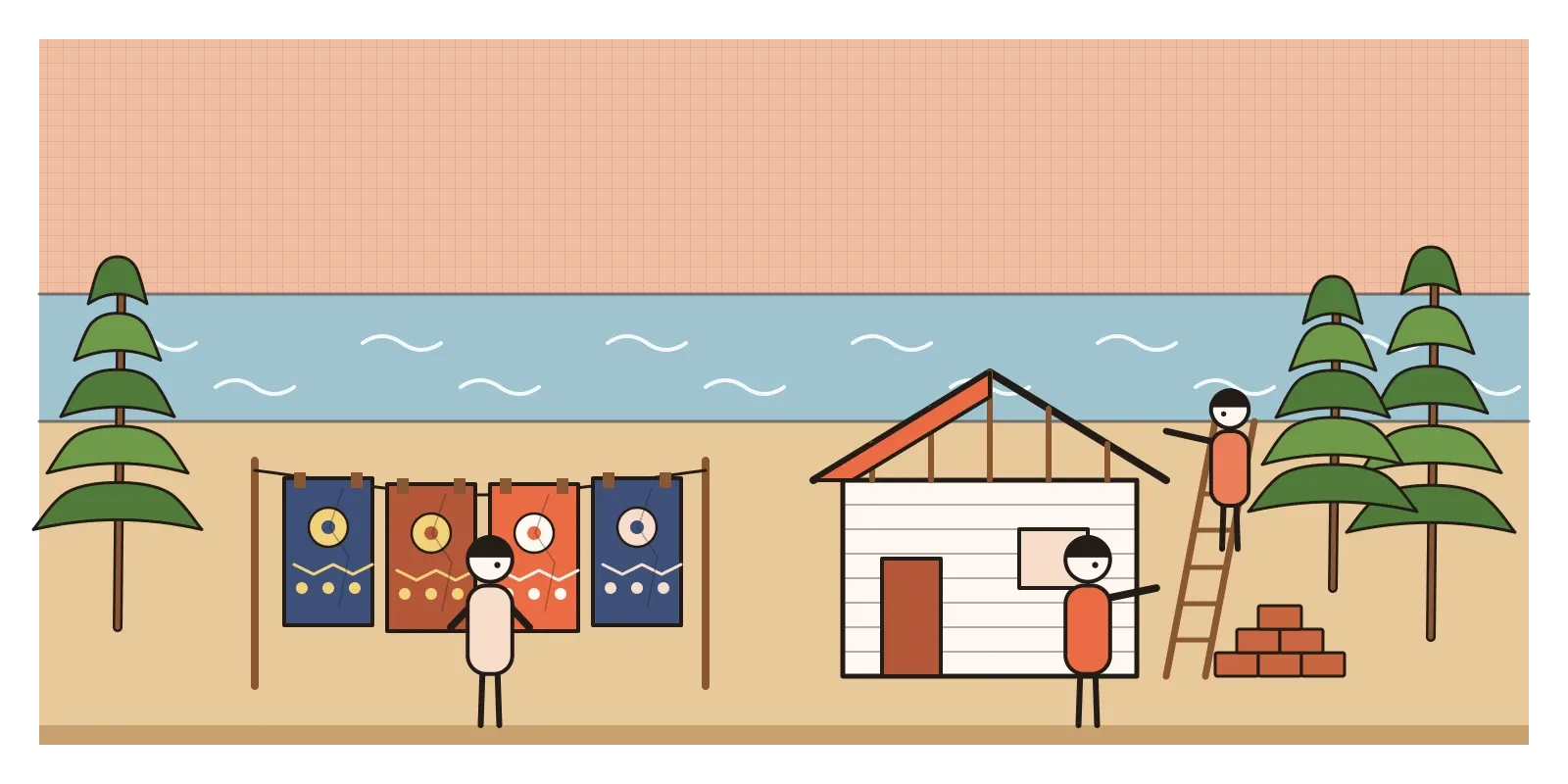
In 1966, a group of about thirty painters and sculptors from Madras bought a strip of sandy land by the sea at Injambakkam, then a fishing hamlet a few miles south of the city, and began building themselves a village. Most of them were students or former students of the Government College of Arts and Crafts in Madras, and their leader was its principal, the painter K. C. S. Paniker. There were almost no commercial galleries in the city, and Paniker had watched talented graduates drift into jobs that left no time for art. His answer was practical. The artists would make and sell crafts, batik cloth, beaten copper and brass, leather and terracotta, through a cooperative, and use the money to buy time for their own work.
The land was paid for largely with the proceeds of their batik sales. Accounts of its size differ, but it was a few acres among casuarina and cashew trees, and the artists built houses and studios on it bit by bit. They called it Cholamandal, after the old name for this stretch of coast. It still exists, with a museum and galleries, and some of the founders' children and grandchildren still live and work there.
Cholamandal was the most visible achievement of what's now called the Madras Art Movement. More than a thousand kilometres to the north, in Gujarat, a new art school at Baroda was working its way towards a similar idea from another direction. Both labels were applied later and loosely. But together they made the most important reply to the big-city, Paris-facing modernism of the Progressive Artists' Group in Bombay. Modern Indian art, they suggested, didn't have to be imported. It could be grown from local crafts, folk traditions and the life of a particular region.
Two schools and an argument with Bombay
The Madras School of Art was one of the oldest art schools in India, founded in 1850. For much of the twentieth century it was run by the Bengali sculptor D. P. Roy Chowdhury, a powerful academic realist, and when Paniker succeeded him as principal in 1957 he set about changing what it taught. Students were pushed to look at the temple bronzes, metalwork, wall paintings and textiles of south India, and at the line drawing that runs through them, as seriously as at Picasso or Klee.
The Faculty of Fine Arts at the Maharaja Sayajirao University of Baroda was brand new, founded in 1950 in a city whose former rulers had long been patrons of art and education. Its first dean was the painter Markand Bhatt. The painter N. S. Bendre and the sculptor Sankho Chaudhuri taught there from the start, and the German art historian Hermann Goetz, then running the Baroda Museum, helped shape it. In 1951 they were joined by a young painter from Kerala, K. G. Subramanyan, who would become the school's guiding intelligence for decades.
Subramanyan had studied at Santiniketan, Rabindranath Tagore's university in Bengal, under Nandalal Bose, Benode Behari Mukherjee and the sculptor Ramkinkar Baij. In the post on the Bengal School I wrote about how Santiniketan treated art as part of daily life, closer to craft and festival than to the salon. Subramanyan carried that idea west. He called it the living tradition. Indian crafts weren't relics to be copied or rescued, he argued, but working languages, still changing, which a modern artist could learn from and speak in.
Both schools were replying to the same two things. One was the British art-school training that still produced academic portraits and landscapes. The other was the Progressives' answer, which I wrote about in the post on the Progressive Artists' Group: modern European painting, learned from books and finished in Paris or London. Baroda and Madras thought there was a third way, closer to home.
Toy fairs, terracotta and a house numbered 1890
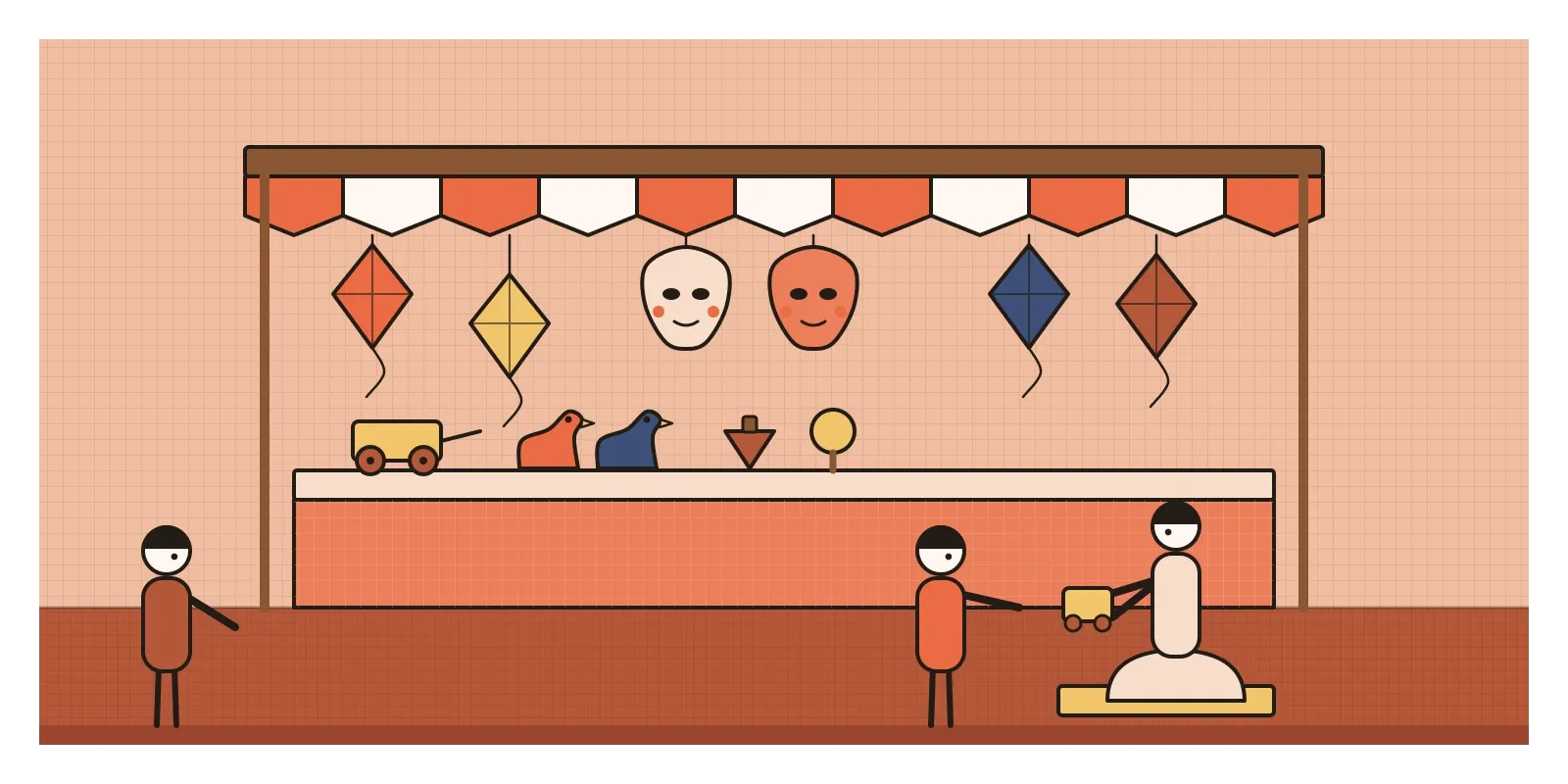
Subramanyan practised what he taught. Between 1959 and 1961 he worked in Bombay as a deputy director of design for the All India Handloom Board, which was helping handloom weavers find new markets. At Baroda he helped develop the Fine Arts Fair, a yearly event at which students made and sold toys, masks, kites, prints and painted objects, often learning techniques from craftspeople invited into the school. In 1962 and 1963, with students from Baroda including Jyoti Bhatt, he made an enormous terracotta mural for the Rabindralaya, a performing arts centre in Lucknow, built from thousands of moulded and fired clay tiles telling a story from one of Tagore's plays. It was the kind of public, collaborative, hand-made work that the Bombay painters rarely attempted.
Baroda soon produced its own groups. Bendre led the Baroda Group, which exhibited from 1956 into the early 1960s. More dramatic was Group 1890, twelve artists who met at a house in Bhavnagar, in Saurashtra, in August 1962 and took its door number as their name. Led by the painter J. Swaminathan, they included Jeram Patel, whose burnt wood I described in the post on Arte Povera, the sculptor Himmat Shah, Jyoti Bhatt, Gulammohammed Sheikh and, from Madras, Reddeppa Naidu. Their manifesto rejected, roughly speaking, both borrowed Western styles and sentimental Indian revivalism. They held one exhibition, at Rabindra Bhavan in New Delhi in 1963, which Prime Minister Nehru opened and for which the Mexican poet Octavio Paz, then his country's ambassador to India, wrote the catalogue essay. Then the group fell apart.
The longest-lasting Baroda style was narrative. Gulammohammed Sheikh, born in 1937 in Surendranagar in Gujarat, studied and later taught at Baroda, and in paintings like City for Sale (1981 to 1984), now in the Victoria and Albert Museum in London, he showed Baroda as a crowded whirl of houses, streets, a cinema and people, seen from several viewpoints at once, as in an Indian miniature or an early Italian altarpiece, at a time of communal violence in the city. Bhupen Khakhar, whose bazaar-print collages I described in the post on Pop Art, painted tailors, watch repairers and, later, his own life as a gay man with disarming frankness. Nilima Sheikh used the fine brushwork of miniature painting for When Champa Grew Up (1984), a series about a young woman killed over dowry. Jyoti Bhatt photographed the rangoli, wall paintings and decorated houses of rural Gujarat, building an archive of folk art that was disappearing. Nasreen Mohamedi, whom I wrote about in the post on Minimalism, taught there too.
Line, sign and story
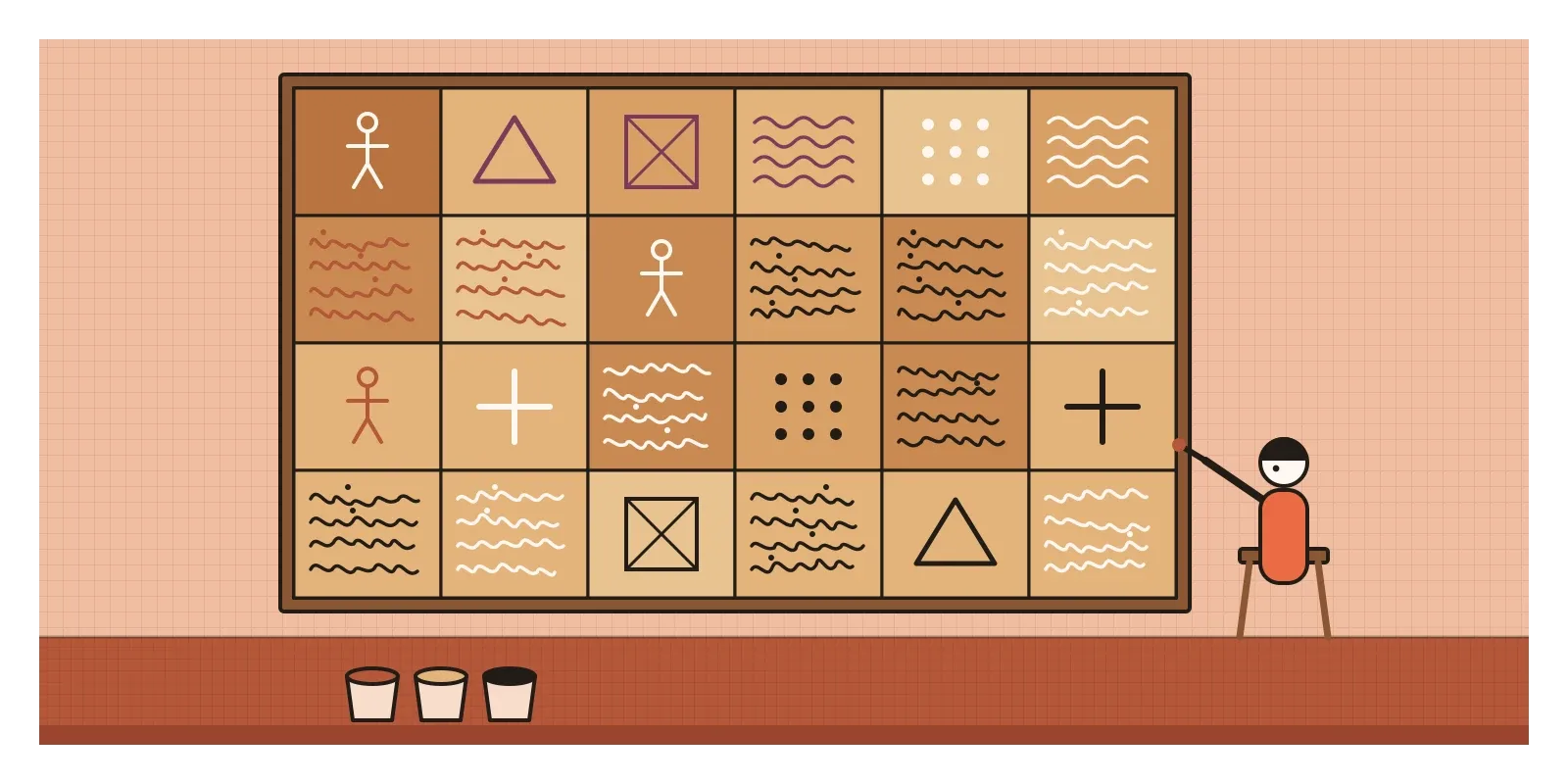
Madras art is usually about line and sign. Paniker's best-known series, Words and Symbols, begun in 1963, fills earth-coloured grounds with rows of small signs: fragments of Malayalam script, numbers, astrological charts, arrows, crosses and tiny figures, laid out in compartments like a page from a horoscope or an accounts book. The writing is mostly unreadable, and it's meant to be looked at rather than read. Other Madras artists drew with a fine, continuous line that owes a lot to temple sculpture and bronze casting, or, like P. V. Janakiram, hammered sheets of copper and brass into shallow reliefs. Colour tends to be warm and earthy, and surfaces are often flat and decorated edge to edge.
Baroda art is more often about story. Figures are small and many, spaces are flattened and tilted so you can see inside houses and along streets at the same time, and a single picture may contain several moments, like a scroll painting or a temple frieze. Techniques are borrowed freely from crafts and miniatures: tempera, wash, printmaking, terracotta, collage, even toy-making. What links the two is a refusal to treat Indian craft and folk art as "low" and European painting as "high".
Paz, Saqqakhaneh and an artists' colony
Because these are Indian movements, the useful question is how they connected outward, and they did so more than their regional labels suggest. Octavio Paz's essay for Group 1890 is a good example. Mexico had its own modern art built from local traditions, which I wrote about in the post on Mexican muralism, and Paz saw in the young Indians a similar search.
Paniker's script paintings had cousins elsewhere. In Iran in the early 1960s, artists such as Parviz Tanavoli and Charles Hossein Zenderoudi were turning the objects and lettering of popular religious shrines into modern art, a tendency the critic Karim Emami named Saqqakhaneh. Across the Arab world, painters were building abstraction out of calligraphy. Paniker was part of a wider mid-century discovery, from Paul Klee to Cy Twombly, that script could be pure image.
Cholamandal had cousins too. Artists' colonies like Worpswede in Germany, founded in 1889, had also taken artists out of the city to live together. The difference was economic. Cholamandal's artists weren't escaping a market. They were trying to build one, through craft, in a city that barely had one. And at Baroda, the turn to narrative found friends abroad. Khakhar was a close friend of the British painter Howard Hodgkin, and in the 1980s Indian and British figurative painters were looking at each other's work. The exhibition Place for People (1981), which gathered six narrative painters including Khakhar and Sheikh, belongs to that wider return to the figure, which I'll come to in the post on Neo-Expressionism.
Learning from the toy-maker
For designers, Subramanyan's idea of the living tradition is probably the most useful thing these schools left. It's the opposite of using craft as decoration. Instead of pasting a block print onto a website, you learn how the block printer works, what the technique is good at, and what it could become. Much of Indian design education, which has its own post in this series, grew out of the same conviction. The Fine Arts Fair, where students sold toys and learned from craftspeople, is a direct ancestor of every design-school maker fair and every studio that collaborates with artisans rather than borrowing their patterns.
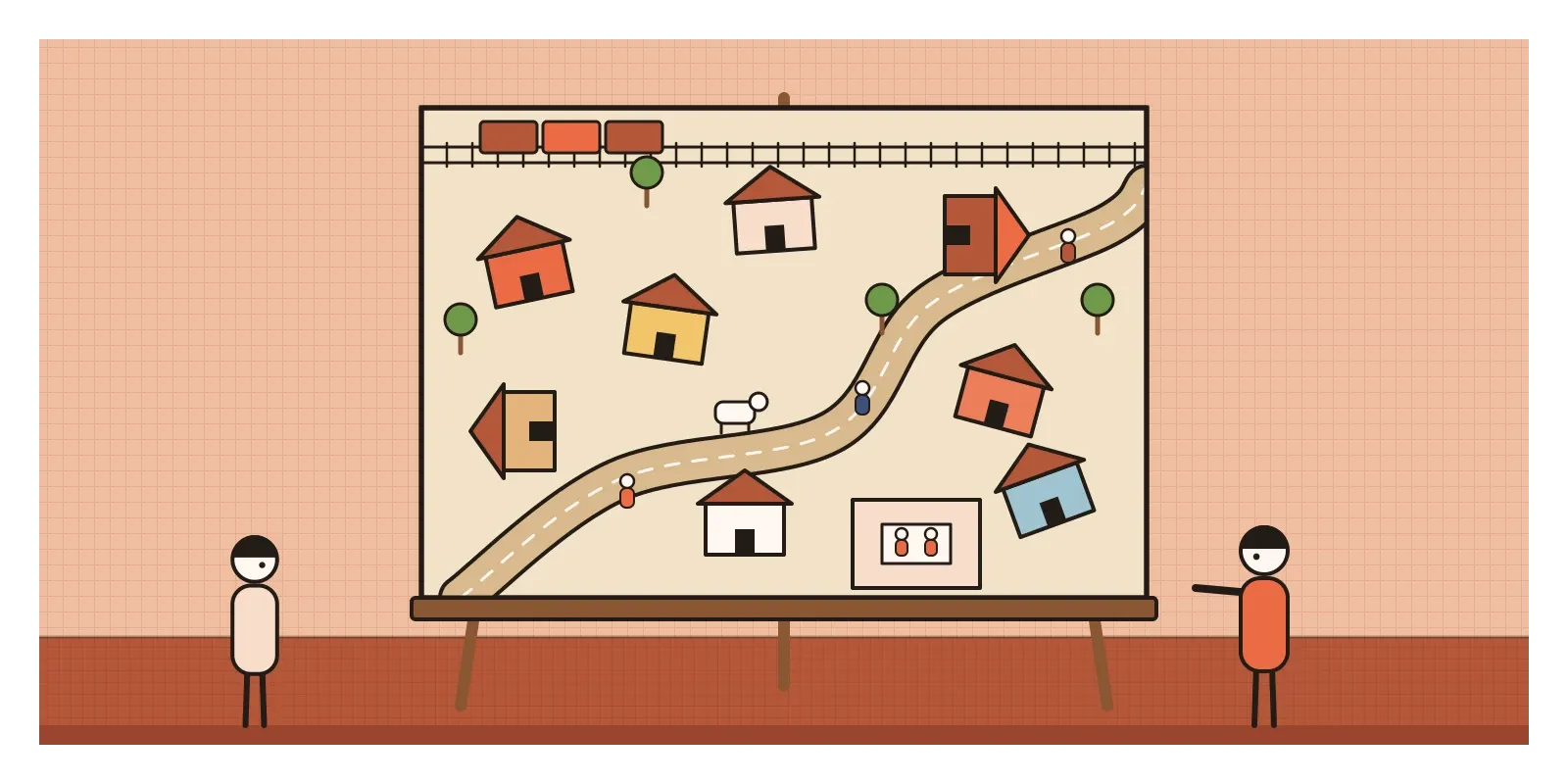
Baroda's storytelling lives on in Indian illustration and comics. Orijit Sen's River of Stories (1994), often called India's first graphic novel, and the many illustrators who now draw crowded, many-viewpoint scenes of Indian streets, owe something to painters like Sheikh and Khakhar who showed that a busy, local, narrative picture could be serious art. Paniker's Words and Symbols has its echo whenever a designer treats Indian scripts as visual material, letting the shapes of Tamil, Malayalam or Devanagari carry feeling even for people who can't read them. And Cholamandal's model, commercial craft paying for experimental work, is how many small design studios still survive: client work by day, their own projects at night.
Whose tradition was it?
The obvious criticism is about whose crafts these were. The artists were mostly educated, urban and middle class, and the potters, weavers, toy-makers and wall painters they learned from were rarely named, paid or exhibited on equal terms. A living tradition can easily become a resource that someone else profits from, and some later critics argued that "folk" was being romanticised by people who didn't have to live by it. The Madras artists' craft sales, meanwhile, were sometimes dismissed as decorative compromise, and the regional label could make serious work look provincial.
Both scenes were also dominated by men in their early years, though Baroda soon became one of the few places in India where women artists such as Nilima Sheikh, Nasreen Mohamedi, Mrinalini Mukherjee and Rekha Rodwittiya could flourish. And the freedom Baroda stood for proved fragile. In May 2007, Hindu nationalist activists disrupted a student's examination display at the Faculty, the student, Chandramohan Srilamantula, was arrested, and the acting dean, Shivaji Panikkar, was suspended for defending him. Artists across India protested.
The Madras movement faded after Paniker's death in 1977, though Cholamandal carried on. Baroda kept changing, and its graduates went on to lead Indian art into installation, video and the international biennales of the 1990s.
To see this work for yourself, visit Cholamandal Artists' Village on the East Coast Road south of Chennai, where the museum shows the founders' work, or the Faculty of Fine Arts in Vadodara during its annual exhibitions. If you're in Lucknow, look for Subramanyan's terracotta mural at the Rabindralaya. For an exercise, find a craftsperson near you, a potter, a tailor or a sign painter, and ask to learn one small technique from them. Then make something of your own with it. You'll understand Subramanyan's living tradition faster than any book can explain it.
Paniker's artists paid for a village with batik and built it by hand, so they could keep making art no one would yet buy. That's what a regional modernism looked like: practical, rooted and stubborn. In the next post, on Neo-Tantra, I'll follow another line out of these years, including Paniker's own signs, into Indian abstraction drawn from Tantric diagrams.
Further reading: K. G. Subramanyan, The Living Tradition: Perspectives on Modern Indian Art (1987) · Gulammohammed Sheikh (ed.), Contemporary Art in Baroda (1997) · Josef James (ed.), Cholamandal: An Artists' Village (2004) · Partha Mitter, Indian Art (2001)
A reply toThe Paris-facing modernism of the Progressive Artists' Group, and the academic realism of the colonial art schools.